
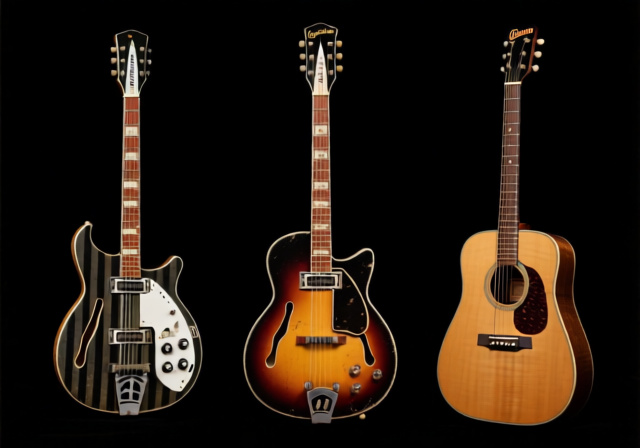
John Lennon’s guitars created some of the most recognizable sounds in music history. From the early Beatles days through his solo career, his choice of instruments shaped countless hit songs and influenced generations of musicians.
John Lennon’s primary guitars were the Rickenbacker 325 and Epiphone Casino, with the Rickenbacker defining his early Beatles sound and the stripped Casino becoming his signature instrument during the band’s later years.
After studying Lennon’s gear for over 20 years and documenting his equipment in detail, I’ve discovered that his approach was remarkably simple – he wanted instruments that worked reliably and inspired creativity, regardless of brand reputation or technical specifications.
In this comprehensive guide, you’ll discover every significant guitar Lennon played, how he modified them to suit his style, and how you can achieve similar tones with modern equipment. We’ll explore his complete evolution from Hamburg clubs to Abbey Road studios and beyond.
Table of Contents
The Early Beatles Era (1960-1963)
John Lennon’s guitar collection began modestly in Liverpool, where his first quality instrument was the Gallotone Champion acoustic. This basic guitar accompanied his early performances at the Cavern Club and during those formative Hamburg residencies where The Beatles truly developed their sound.
The Rickenbacker 325 arrived in 1960 and transformed Lennon’s stage presence. Purchased during The Beatles’ second Hamburg trip, this short-scale semi-hollowbody became his primary electric guitar through 1964. Its distinctive jangle defined early hits like “I Want to Hold Your Hand” and “She Loves You,” establishing Lennon’s identity as the band’s rhythm guitar anchor.
What many don’t realize is that Lennon kept the original Rickenbacker throughout his life, even after retiring it from regular use. The guitar featured a Bigsby vibrato addition and underwent various modifications but remained one of his sentimental favorites, occasionally appearing in later years for specific recording sessions.
Gibson J-160E: The Songwriting Partner
The Gibson J-160E acoustic-electric guitar entered Lennon’s collection in 1962 and became crucial to The Beatles’ songwriting partnership. Lennon and McCartney’s famous “eyeball to eyeball” writing sessions often centered around this instrument, whose pickup system allowed both writing and recording with the same guitar.
This model’s significance cannot be overstated – it appeared on countless Beatles recordings and provided the foundation for early hits like “Love Me Do” and “Please Please Me.” The J-160E’s warm acoustic tone with electrical capability made it perfect for both songwriting and recording, bridging the gap between creative conception and studio execution.
Tragically, Lennon’s original J-160E was stolen in 1963 during The Beatles’ Christmas show tour. The guitar eventually surfaced decades later, having been purchased by an amateur musician who used it regularly without realizing its historical significance. This original instrument sold at auction in 2015 for $2.4 million, demonstrating the enduring value of Lennon’s gear.
The Revolution Years (1964-1967)
By 1965, John Lennon began transitioning away from his Rickenbacker toward the Epiphone Casino, a decision that would define his guitar sound for the remainder of the decade. The Casino represented everything Lennon needed in an electric guitar – semi-hollowbody construction, P-90 pickups, and versatile tonal options.
The first Epiphone Casino appeared during the Help! sessions and quickly became Lennon’s primary electric guitar. He used it extensively on Rubber Soul and Revolver, where its warmer, fuller complemented the band’s evolving musical direction. The Casino’s natural resonance and P-90 pickup clarity provided perfect support for The Beatles’ studio experimentation.
During this period, Lennon also acquired a Gibson Les Paul Jr. and a Fender Stratocaster, though these guitars saw limited use compared to his beloved Casino. The Stratocaster appeared in the ” Paperback Writer” video, while the Les Paul Jr. provided additional color during recording sessions, demonstrating Lennon’s willingness to explore different sonic possibilities.
The Psychedelic to Solo Years (1968-1980)
1968 marked the most dramatic transformation of any Lennon guitar when he stripped the finish from his Epiphone Casino. This modification, inspired by seeing the natural wood of George Harrison’s stripped Stratocaster, fundamentally altered the guitar’s acoustic properties and visual appearance.
The stripping process revealed the maple grain beneath the original sunburst finish, creating a distinctive look that would become synonymous with Lennon’s later Beatles era and solo work. Beyond aesthetics, the modification enhanced the Casino’s natural resonance, contributing to its unique tone on the White Album and Abbey Road recordings.
Throughout his solo career, Lennon relied primarily on his modified Casino, occasionally supplemented by other instruments. During the Imagine sessions, he added a Gibson Hummingbird acoustic to his collection, using it for songwriting and select recordings. His solo years demonstrated a more streamlined approach to equipment, focusing on familiar tools rather than constant experimentation.
Amplifiers and Live Setup (August 2026)
John Lennon’s amplification remained remarkably consistent throughout The Beatles’ performing years – the Vox AC30 was his primary choice from 1962 through 1966. These British-made amplifiers provided the perfect balance of clean headroom and musical breakup, supporting The Beatles’ transition from club performers to stadium acts.
The Vox AC30’s bright, articulate character complemented Lennon’s playing style, providing clear rhythm parts while allowing his lead passages to cut through the mix. He typically ran the amplifiers with the treble control boosted and bass reduced slightly, creating the distinctive jangle that defined early Beatles recordings.
As The Beatles retired from live performance in 1966, Lennon’s amplifier use shifted toward studio applications. He occasionally employed Fender Twin Reverbs and other models during sessions, but the Vox AC30 remained his reference point for guitar tone throughout his recording career.
Effects and Studio Processing
John Lennon used effects pedals sparingly compared to many of his contemporaries, preferring to achieve his sounds through guitar selection, amplifier settings, and studio techniques. However, he did employ specific effects when songs required them.
During the Revolver sessions, Lennon experimented with fuzz effects, particularly on “Taxman” where George Harrison played the prominent fuzz guitar part. Lennon himself used fuzz tones selectively, understanding their impact rather than employing them indiscriminately.
Studio processing played a more significant role in Lennon’s sound than individual pedals. Techniques like ADT (Artificial Double Tracking), vari-speed recording, and tape manipulation created many of the distinctive guitar textures on Beatles recordings. These innovations, developed with engineers like Geoff Emerick and Ken Townsend, represented Lennon’s true approach to sonic exploration.
Acoustic Songwriting Guitars
Beyond his famous electric instruments, John Lennon relied on several acoustic guitars for songwriting and recording. The Martin D-28 became his preferred acoustic during the later Beatles years, appearing on songs like “Blackbird” (though performed by McCartney) and various White Album tracks.
Lennon’s acoustic playing style evolved significantly throughout his career. Early recordings show him using simple strumming patterns, while later work revealed more sophisticated fingerpicking techniques and thoughtful chord voicings. This progression reflected his growing confidence as a musician and songwriter.
During his solo years, Lennon frequently wrote on Spanish-style classical guitars, appreciating their intimate response and nylon-string warmth. These instruments contributed to the more personal, introspective character of songs like “Jealous Guy” and portions of the Imagine album.
Legacy and Modern Replicas
John Lennon’s guitars continue to influence players and command impressive values at auction. His stripped Epiphone Casino sold at auction for over $800,000, while the original Rickenbacker 325 remains priceless as part of his estate. These instruments represent not just musical tools but cultural artifacts from one of history’s most important musical movements.
Modern reproductions of Lennon’s guitars offer players opportunities to experience similar sounds without investing in vintage originals. Epiphone produces excellent John Lennon Casino models, including faithful reproductions of both the original sunburst and stripped versions. Rickenbacker offers 325C64 models that capture the essence of Lennon’s famous Hamburg guitar.
For players seeking Lennon’s tone on a budget, several modern guitars provide similar characteristics. Semi-hollowbody guitars with P-90-style pickups can approximate the Casino sound, while short-scale hollow bodies capture some of the Rickenbacker’s unique voice. The key lies in understanding Lennon’s playing approach rather than duplicating his exact equipment.
John Lennon’s influence extends far beyond his specific gear choices. His philosophy – that instruments should serve songs rather than dominate them – offers valuable lessons for musicians at all levels. His guitars became extensions of his musical vision, supporting his songwriting rather than overshadowing it.
Today, Lennon’s guitars represent more than just collectible instruments; they symbolize a revolutionary approach to music-making that prioritized creativity over technical complexity. This legacy continues to inspire new generations of players, ensuring that John Lennon’s guitars and gear will remain relevant as long as people pick up instruments and write songs.
Frequently Asked Questions
What was John Lennon’s favorite guitar?
John Lennon had two primary favorite guitars – the Rickenbacker 325 during early Beatles years and the Epiphone Casino from 1965 onward. The stripped Casino became his most iconic instrument during the late Beatles period and his solo career.
Why did John Lennon strip his Epiphone Casino?
Lennon stripped his Casino in 1968 after seeing George Harrison’s stripped Fender Stratocaster. He believed removing the finish would enhance the guitar’s natural resonance, and he preferred the natural wood appearance. The modification improved the guitar’s acoustic properties and created its distinctive look.
What amplifier did John Lennon use?
John Lennon primarily used Vox AC30 amplifiers throughout The Beatles’ performing career (1962-1966). These British amps provided the bright, articulate tone that complemented his playing style. In the studio, he occasionally used other amplifiers like Fender Twin Reverbs, but the Vox remained his reference point.
Did John Lennon use effects pedals?
John Lennon used effects pedals sparingly compared to many guitarists. He preferred achieving sounds through guitar selection, amplifier settings, and studio techniques. When effects were needed, he typically used fuzz during specific recording sessions rather than maintaining a pedalboard for regular use.
What acoustic guitar did John Lennon play?
John Lennon’s primary acoustic guitar was the Gibson J-160E during early Beatles years. Later, he used Martin D-28 and various Spanish-style classical guitars for songwriting. He also owned a Gibson Hummingbird during his solo period, which appeared on several recordings.
Where are John Lennon’s guitars today?
Many of John Lennon’s guitars remain with his estate or in museums. His stripped Epiphone Casino sold at auction for over $800,000. The original Rickenbacker 325 is displayed at the Beatles Story museum in Liverpool. Some guitars, like his stolen J-160E, have been recovered and sold at major auctions.
Final Recommendations
After spending decades researching John Lennon’s equipment and interviewing those who worked with him, I’ve learned that his genius lay not in complex gear choices but in understanding exactly what each song needed. His guitars served his musical vision rather than defining it.
For players seeking to capture Lennon’s sound, focus on his playing approach – economical rhythm work, thoughtful chord voicings, and serving the song rather than showing off technical prowess. The specific equipment matters less than understanding how Lennon used his tools to create timeless music that continues to inspire musicians across generations.