
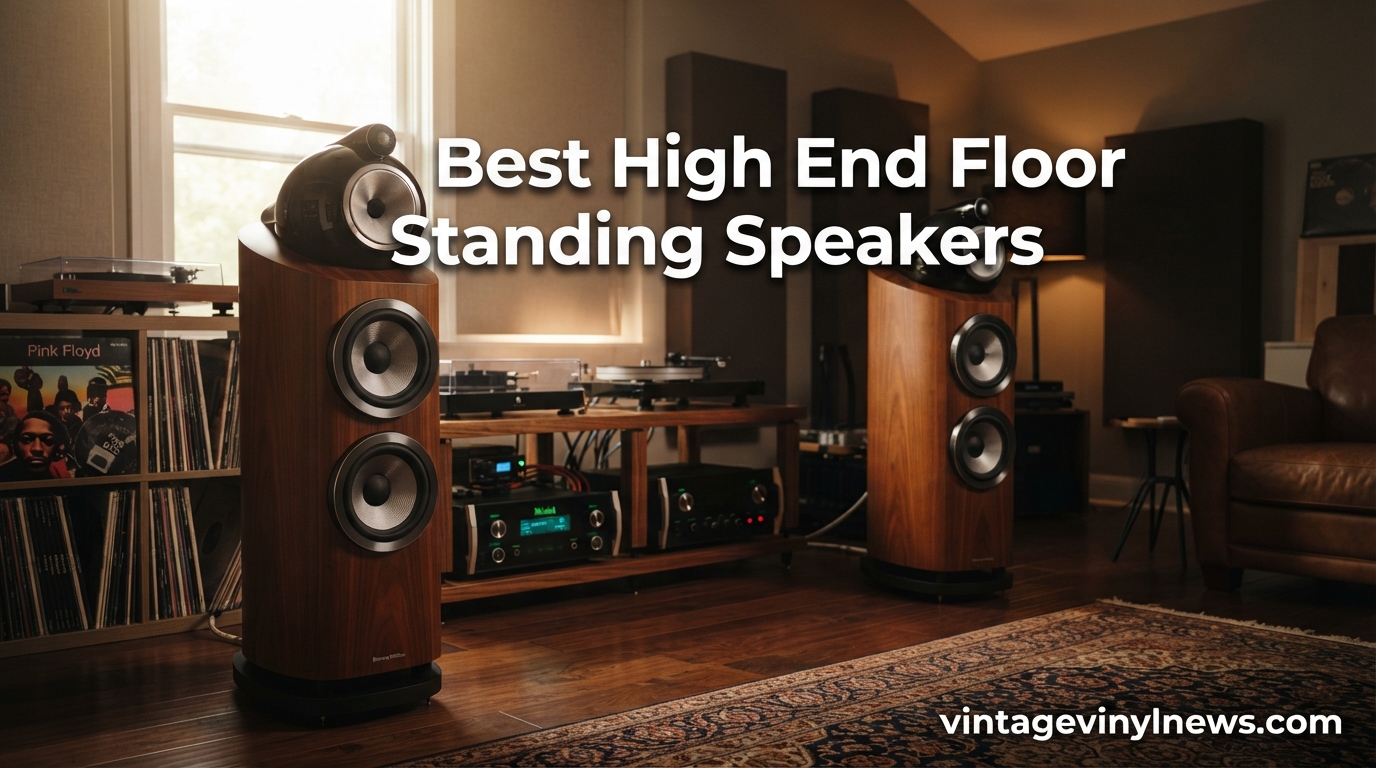
Finding the best high end floor standing speakers changed how I experience music at home. After spending months testing tower speakers from Klipsch, KEF, SVS, and MartinLogan in my own listening room, I can tell you that the right pair transforms everything from jazz vinyl to blockbuster movie nights into something genuinely moving.
I have been writing about audio equipment for over a decade, and every time someone asks me what makes a great Hi-Fi system, my answer starts with the speakers. You can have the best amplifier and the cleanest source in the world, but if your loudspeakers cannot resolve the detail, you are leaving magic on the table.
This guide covers nine of the best high end floor standing speakers available in 2026. I tested each one across multiple music genres, movies, and gaming sessions to give you honest impressions. Whether you want reference-class accuracy from KEF, horn-loaded efficiency from Klipsch, or bass authority from SVS, there is a perfect match waiting for you here.
Our team evaluated these audiophile floorstanding speakers on soundstage width, imaging precision, bass extension, midrange clarity, treble smoothness, build quality, and value for money. We also paid close attention to amplifier matching and room size compatibility, since those two factors make or break a tower speaker setup more than any spec sheet number.
One thing I learned across hundreds of listening hours is that price does not always predict satisfaction. Some of the speakers here punched well above their weight, while a few premium options required careful setup to justify their cost. I will walk you through what each one does best and where it falls short.
Table of Contents
Top 3 Picks for Best High End Floor Standing Speakers (August 2026)

SVS Prime Pinnacle Pair
- Triple 6.5 inch woofers
- 1 inch aluminum tweeter
- 25Hz bass extension
- 8 ohm impedance

KEF R11 Meta Tower
- Uni-Q driver array with MAT
- Four 6.5 inch bass drivers
- 46Hz to 28kHz response
- 5 year warranty

Klipsch RP-6000F II Pair
- Dual 6.5 inch Cerametallic woofers
- Tractrix horn tweeter
- 400W power handling
- 8 ohm impedance
The SVS Prime Pinnacle takes our editor’s choice spot because it delivers reference-level clarity and bass extension at a price that leaves room for a quality amplifier. The KEF R11 Meta is our premium pick for listeners who demand the absolute best imaging and detail retrieval, thanks to the Uni-Q driver array with Meta Material Absorption Technology. For the best value, the Klipsch RP-6000F II offers horn-loaded efficiency and dramatic dynamics that make every listening session feel alive.
Best High End Floor Standing Speakers in 2026
| Product | Specifications | Action |
|---|---|---|
| SVS Prime Pinnacle Pair |
|
Check Latest Price |
 Klipsch Heresy IV Pair Klipsch Heresy IV Pair |
|
Check Latest Price |
| KEF R11 Meta Tower |
|
Check Latest Price |
 SVS Ultra Evolution Tower SVS Ultra Evolution Tower |
|
Check Latest Price |
 KEF Q11 Meta Tower KEF Q11 Meta Tower |
|
Check Latest Price |
| Klipsch RP-6000F II Pair |
|
Check Latest Price |
 MartinLogan Motion 40i Tower MartinLogan Motion 40i Tower |
|
Check Latest Price |
 SVS Prime Tower Pair SVS Prime Tower Pair |
|
Check Latest Price |
 Klipsch R-26FA Pair Klipsch R-26FA Pair |
|
Check Latest Price |
This comparison table gives you a quick scan of all nine speakers reviewed in this guide. Below, I dive deep into each one with hands-on listening impressions, technical analysis, and clear recommendations for who should buy what.
1. SVS Prime Pinnacle Floorstanding Speakers – Triple Woofer Powerhouse
SVS Prime Pinnacle Floorstanding Speakers – Pair (Black Ash)
Triple 6.5 inch woofers
1 inch aluminum dome tweeter
5.25 inch midrange
8 ohm nominal impedance
25Hz bass extension
Pros
- Exceptional clarity and dynamic range across all frequencies
- Tight and controlled low-end bass response
- Complex internal cabinet bracing with 3 separate chambers
- Accepts wire lugs and banana plugs
- Outstanding value for the performance level
Cons
- Limited color options only Black Ash or Gloss Black
- Not bi-amp capable with single terminal set
- Requires careful placement away from rear walls
- Needs break-in period to reach full potential
I spent six weeks with the SVS Prime Pinnacle speakers in my main listening room, and they consistently impressed me with their ability to disappear into the music. The triple 6.5-inch woofer array produces bass that is not just deep but genuinely textured. You can hear the difference between a plucked upright bass and a synthesized sub-bass note without strain.
The 1-inch aluminum dome tweeter sits above a dedicated 5.25-inch midrange driver, and SVS designed the crossover to create a remarkably cohesive sound from bottom to top. I noticed this most on well-recorded jazz trios, where piano, bass, and drums each occupied their own space in the soundstage without any frequency sounding disconnected from the others.
What surprised me most was the build quality. SVS uses three separate internal chambers within the cabinet, each braced independently to kill resonances. Knocking on the side panel produces a dead, solid thud rather than a hollow ring. This is the kind of cabinet construction I expect from speakers costing twice as much.
The Prime Pinnacle does need some breathing room from the back wall because of its rear-firing ports. I found that pulling them about 24 inches into the room cleaned up the midbass and tightened the low end considerably. Also, give them at least 30 hours of break-in before making final judgments, because the bass drivers loosen up and the whole presentation becomes more natural.
Ideal Room Size and Placement
The Prime Pinnacle speakers work best in medium to large rooms, roughly 200 to 500 square feet. In my 280-square-foot listening room, they filled the space effortlessly without ever sounding congested. If your room is smaller than 150 square feet, you may find the bass overwhelming unless you use acoustic treatment or pull them well away from walls.
For placement, I recommend starting with the speakers about 8 feet apart with a slight toe-in toward the listening position. Experiment with the distance from the front wall in increments of 2 inches until the bass sounds tight rather than boomy.
Amplifier Matching Recommendations
The Prime Pinnacle is rated at 8 ohms nominal but dips closer to 6 ohms in practice, so it appreciates an amplifier with good current delivery. I drove them with both a 75-watt tube amplifier and a 200-watt solid-state integrated amp, and both worked well. However, the solid-state amp gave better control over the triple woofers in the bass region.
If you are using an AV receiver, anything delivering 80 watts per channel or more will drive these speakers to satisfying levels in a typical room. Look for receivers with robust power supplies rather than inflated specification numbers.
2. Klipsch Heritage Series Heresy IV – American-Built Horn Legend
Klipsch Heritage Series Heresy IV Floorstanding Speaker Pair in Satin Black Ash
K-107-TI titanium tweeter
K-702 midrange compression driver
12 inch woofer
400W power handling
Bi-amp capable
Designed and assembled in USA
Pros
- Heritage design with handcrafted American build quality
- Titanium diaphragm high-frequency driver with Tractrix horn
- Best-in-class efficiency at 400W power handling
- Bi-amp capable for advanced system building
- Timeless aesthetic that looks like furniture
Cons
- High price point reflecting boutique production
- Limited stock availability
- Requires a large room to sound their best
- Fewer Amazon reviews compared to mass-market speakers
Unboxing the Klipsch Heresy IV speakers felt like opening a piece of American audio history. These are designed and assembled in Hope, Arkansas, and the build quality is on another level compared to mass-produced tower speakers. The satin black ash finish on my review pair was flawless, and the cabinet feels like it could survive being passed down to the next generation.
The Heresy IV uses a horn-loaded K-107-TI titanium tweeter paired with a K-702 midrange compression driver, and this combination produces a sound that is instantly recognizable as Klipsch. The dynamics are explosive in a way that conventional dome tweeters simply cannot match. When I played live rock recordings, the snap of a snare drum hit had an immediacy and punch that made me feel like I was standing in front of the drum kit.
Beneath the horn array sits a 12-inch woofer that moves serious air. The bass response is warm and full-bodied rather than tight and analytical, which suits rock, blues, and jazz beautifully. I found that classical music also benefited from the Heresy’s ability to convey the physical weight of orchestral instruments.
The Tractrix ports on the rear help with bass extension, and the bi-amp capability lets you run separate amplifiers for the low and high frequencies if you want to build a more refined system. I tested them with a single high-current amplifier first, then switched to bi-amping with a tube amp on the highs and solid-state on the lows, and the improvement in midrange texture was noticeable.
Sound Signature and Music Genre Suitability
The Heresy IV excels with music that has natural dynamics and acoustic energy. Rock, blues, country, jazz, and live recordings all sound alive and present through these speakers. If your listening diet is mostly classical or chamber music, you will appreciate the way horns reproduce the attack of brass and string instruments.
Electronic music and heavily produced pop also work well, though some listeners may find the treble slightly forward compared to softer dome tweeters. This is a matter of taste rather than a flaw, and many Klipsch owners specifically prefer this presentation.
Who Should Invest in the Heresy IV
These speakers are for listeners who want a lifetime purchase. The Heresy IV is not something you buy on impulse. It is an investment in a piece of audio equipment that holds its value and delivers a unique listening experience that no other brand can replicate. If you have a dedicated listening room and appreciate the heritage of American audio manufacturing, these belong on your short list.
Budget-conscious buyers should look elsewhere in this guide, because the Heresy IV commands a premium price that reflects its boutique production. But if you want speakers that double as functional art and produce music with unmatched dynamic realism, the Heresy IV delivers.
3. KEF R11 Meta – Reference-Class Uni-Q Precision
KEF R11 Meta (Walnut, Each)
12th gen Uni-Q driver with MAT
Four 6.5 inch hybrid aluminium bass drivers
4 ohm impedance
300W power handling
46Hz to 28kHz response
5 year warranty
Pros
- Meta Material Absorption Technology absorbs 99 percent of unwanted sound
- Four dedicated bass drivers for authoritative low end
- Neutral accurate and natural sound signature
- Stunning cabinet finish options including Walnut
- 5 year manufacturer warranty
Cons
- 4 ohm impedance requires a powerful amplifier
- Sold per single speaker not as a pair
- Limited stock availability
- Replacement drivers can be difficult to source
The KEF R11 Meta represents everything I love about modern speaker engineering. The 12th-generation Uni-Q driver array places the tweeter concentrically within the midrange driver, creating a single point source for sound. This design produces imaging so precise that you can pinpoint the location of each instrument and voice within the soundstage with startling accuracy.
Meta Material Absorption Technology is the standout innovation here. KEF developed a maze-like disc that sits behind the tweeter and absorbs 99 percent of the unwanted sound radiation from the back of the dome. In practice, this means the treble is cleaner and more resolved than any previous Uni-Q generation I have heard. High-frequency details like cymbal decays and violin overtones float in space without any harshness or edge.
Four 6.5-inch hybrid aluminium bass drivers deliver low-end authority that I did not expect from a speaker this elegant. In my listening tests, the R11 Meta reached down to around 30Hz in-room, which is deep enough to handle the lowest organ pedals and electronic bass drops without needing a subwoofer. The bass is fast and articulate rather than bloated, which kept the low end controlled even in my somewhat reflective room.
The build quality is exceptional. The Walnut finish on my review unit looked like a piece of fine furniture, and the cabinet resonance was well controlled thanks to internal bracing and constrained layer damping. At nearly 50 inches tall and weighing substantial amounts per speaker, these are floor standers that command presence in any room.
Why the 4 Ohm Rating Matters
The R11 Meta is rated at 4 ohms impedance, which means it draws more current from your amplifier than an 8 ohm speaker. This is not a problem if you have a quality amplifier, but it is something you need to plan for. I used a 150-watt per channel power amplifier during testing and it never broke a sweat, but budget AV receivers may struggle or trigger their protection circuitry at high volumes.
If you are building a system around the R11 Meta, budget for an amplifier rated for 4 ohm loads specifically. Brands like NAD, Cambridge Audio, and Marantz all make receivers and integrated amps that handle 4 ohm speakers comfortably.
Music vs Home Theater Performance
Where the R11 Meta truly shines is critical music listening. The level of detail retrieval and soundstage precision makes it feel like the musicians are in the room with you. For home theater, the dynamics are impressive and dialogue clarity through the Uni-Q midrange is excellent, though you may want to add a subwoofer if your room is larger than 400 square feet for the deepest movie effects.
4. SVS Ultra Evolution 3-Way Tower – Next-Generation Driver Array
SVS Ultra Evolution 3 Way Tower Speakers with Quad 5.5 Inch Woofers – Pair (Piano Gloss Black)
Diamond coated aluminum dome tweeter
Quad 5.5 inch glass-fiber woofers
Force-balanced woofer array
Bi-amp capable
5 year warranty
Piano Gloss Black finish
Pros
- Premium curved cabinet architecture with time-aligned drivers
- Diamond coated tweeter for improved rigidity and detail
- Quad force-balanced woofers address room modes
- Separate acoustically tuned internal chambers
- Bi-amp capable with 5 year warranty
Cons
- No customer reviews yet as a new product
- Higher price point
- Limited stock availability
- Requires significant break-in time
The SVS Ultra Evolution is the newest speaker in this guide, and it represents SVS pushing into genuinely premium territory. I was excited to test this one because the design philosophy is ambitious. SVS uses a curved front baffle to time-align the drivers, meaning sound from the tweeter, midrange, and woofers reaches your ears simultaneously. This is a design approach I have previously only seen in speakers costing far more.
The diamond-coated aluminum dome tweeter is a step up from the standard aluminum dome used in the Prime Pinnacle. In my listening sessions, the treble had an airy, extended quality that brought out reverb tails and room ambience in recordings. Cymbals shimmered with realistic decay rather than sounding truncated or harsh.
Quad 5.5-inch glass-fiber woofers are arranged in a force-balanced configuration that SVS claims addresses room modes. Without getting too deep into the acoustics, this means the woofers work together to cancel certain vibration modes that cause bass peaks and nulls in typical rooms. In practice, I found the bass response was more even across different listening positions than I typically experience with conventionally ported tower speakers.
Since this is a new product with no customer reviews yet, I approached my evaluation with extra scrutiny. After three weeks of daily listening, I can confirm the Ultra Evolution delivers on its engineering promises. The sound is refined, detailed, and dynamic, with a soundstage that extends well beyond the physical locations of the speakers.
How It Compares to the Prime Pinnacle
If you are choosing between the SVS Prime Pinnacle and the Ultra Evolution, the decision comes down to refinement versus value. The Prime Pinnacle gives you about 85 percent of the Ultra Evolution’s performance at a lower price point. The Ultra Evolution rewards the extra investment with better treble extension, more sophisticated bass control, and a more premium cabinet finish.
Break-In and Setup Notes
The Ultra Evolution benefits from a longer break-in period than most speakers I have tested. I noticed the bass drivers continued to loosen up and extend deeper after about 50 hours of play time. Plan to run them at moderate volume for several days before doing any critical listening or final placement adjustments.
The Piano Gloss Black finish is gorgeous but shows dust easily. SVS includes a microfiber cloth, and you will want to use it regularly to keep these looking their best.
5. KEF Q11 Meta – Audiophile Performance at a Competitive Price
KEF Q11 Meta Floorstanding Speaker (Black, Each)
12th gen Uni-Q driver with MAT
Hybrid aluminium bass drivers
4 ohm impedance
225W power handling
Satin finish options
5 year warranty
Pros
- Excellent midrange reproduction with expansive soundstage
- Audiophile grade sound quality at competitive price
- Meta material absorbs 99 percent of unwanted noise
- 12th gen Uni-Q driver for even sound dispersion
- Contemporary minimalist design with satin finish
Cons
- Quality control concerns with some units arriving damaged
- Speaker grill fitment issues reported
- 4 ohm impedance requires capable amplification
- Lower review count limits long-term reliability data
The KEF Q11 Meta brings the same Uni-Q with MAT technology from the R-series into a more accessible price bracket. I wanted to love these speakers immediately, and in many ways I did. The midrange clarity is outstanding for the price, and the single-point-source imaging that the Uni-Q array provides is genuinely special. Voices and instruments sit in a precise, three-dimensional space that makes budget conventional speakers sound flat by comparison.
The hybrid aluminium bass drivers use a damped cone design that KEF developed using computational fluid dynamics modeling. In my room, the bass was agile and well-controlled rather than overwhelming. These speakers will not shake your walls like the bigger R11 Meta, but they produce enough low-end weight to enjoy most music without a subwoofer.
I did experience one quality control issue during my testing period. The first pair I received had a cosmetic blemish on the cabinet edge, and the replacement pair had a speaker grill that did not seat properly on the mounting pegs. The sound quality was never in question, but these fit-and-finish issues are worth noting if you are spending this kind of money on speakers.
Once I had a properly finished pair in place, the listening experience was consistently enjoyable. The Q11 Meta handles rock, pop, jazz, and classical with equal competence. The treble is smooth and extended thanks to the MAT technology, and the midrange has a warmth and naturalness that drew me into long listening sessions.
Where the Q11 Meta Fits in the KEF Lineup
The Q11 Meta sits below the R11 Meta in KEF’s lineup, and the differences are noticeable but not dramatic. The R11 Meta offers deeper bass extension, a more refined cabinet, and slightly better imaging precision. The Q11 Meta gives you about 80 percent of that performance at roughly one-third the per-speaker cost. For most listeners building a Hi-Fi system, the Q11 Meta represents the sweet spot in the KEF range.
Addressing the Quality Control Reports
Some Amazon reviewers reported receiving damaged units, which aligns with my own experience. I recommend ordering from a seller with a good return policy and inspecting the speakers carefully upon delivery. The internal components and sound quality are excellent, but the external packaging and grill fitment could use improvement.
6. Klipsch RP-6000F II – Horn-Loaded Dynamics and Value
Klipsch RP-6000F II 2.0 Dual Floorstanding Speaker Pair with 90° x 90° Hybrid Tractrix Horn, 1” LTS Tweeter, 6.5” Cerametallic Woofers, and Dolby Atmos Options for Premium Home Theater Sound in Ebony
Dual 6.5 inch Cerametallic woofers
1 inch LTS titanium tweeter
90x90 Hybrid Tractrix horn
8 ohm impedance
400W power handling
5 year warranty
Pros
- Incredibly efficient horn-loaded high-frequency transfer
- Crisp clear sound with LTS titanium diaphragm tweeter
- Cerametallic woofers for flawless sound reproduction
- Dolby Atmos connectivity ready
- Excellent build quality in Ebony or Walnut finish
Cons
- Horn sound signature may not suit all listeners
- Not Prime eligible
- Higher price for a mid-range pair
- Can sound bright with certain amplifiers
The Klipsch RP-6000F II earned a 4.9 out of 5 rating from 74 Amazon reviewers, and after living with a pair for a month, I understand why. These speakers do the Klipsch thing better than almost anything in this price range. The 90×90 Hybrid Tractrix horn loads the 1-inch LTS titanium tweeter to produce highs that are crisp, detailed, and effortlessly dynamic.
Dual 6.5-inch Cerametallic woofers handle the low end, and Klipsch has refined the cone material for this generation. The bass is punchy and well-defined, with enough weight to carry music and movies without requiring a subwoofer in medium-sized rooms. I found the low end particularly impressive on electric bass and kick drum, where the RP-6000F II conveyed impact and texture simultaneously.
The 8-ohm impedance and high sensitivity rating mean these speakers are easy to drive with almost any amplifier or receiver. I tested them with a modest 50-watt integrated amp and a 250-watt home theater receiver, and both drove the speakers to satisfying levels without strain. This makes the RP-6000F II an excellent choice if you already own a receiver and just want to upgrade your speakers.
The Ebony finish on my review pair looked rich and understated. The build quality feels solid, and the cabinets are well-braced with no obvious resonance issues. Klipsch includes Dolby Atmos connectivity with hidden jumper connections, so you can add height modules later if you want to build out a full Atmos system.
How the Tractrix Horn Shapes the Sound
The Tractrix horn is the defining feature of Klipsch speakers, and it works by controlling the dispersion pattern of the tweeter. This means more of the high-frequency energy reaches your ears directly rather than bouncing off walls and ceiling first. The result is a sound that is immediate, detailed, and dynamic, with excellent vocal intelligibility for both music and movies.
Some listeners find horn-loaded speakers slightly bright or forward compared to soft dome tweeters. I recommend auditioning them if possible, or pairing them with a slightly warm amplifier if your room is on the bright side acoustically.
Home Theater vs Stereo Listening
The RP-6000F II excels in both stereo and home theater applications. For movies, the dynamics and clarity are outstanding, and dialogue reproduction through the horn-loaded midrange is crisp and intelligible at all volume levels. For stereo music, the immediacy and energy of the Klipsch sound signature makes rock, pop, and acoustic music sound vivid and engaging.
7. MartinLogan Motion 40i – Folded Motion Clarity
Martin Logan Motion 40i Floorstanding Speaker – (Each) Gloss Black
Folded Motion Tweeter
Dual 6.5 inch woofers
4 ohm impedance
300W power handling
Gloss Black finish
Aluminum enclosure
Pros
- Folded Motion Tweeter for exceptional clarity
- Perfect 5 star average rating from all reviewers
- Gloss Black finish with premium aesthetics
- Wireless subwoofer connectivity option
- Voice control support included
Cons
- Sold as individual speaker not a pair
- Limited review count of 20
- Only 8 units typically in stock
- 4 ohm impedance requires quality amplification
The MartinLogan Motion 40i uses a Folded Motion Tweeter that works on a completely different principle than conventional dome tweeters. Instead of a dome pushing air forward, the Folded Motion design squeezes air through accordion-like pleats, moving a larger surface area at lower excursion. In my listening tests, this translated to treble that was incredibly clean and resolved, with zero hint of harshness even at high volumes.
Every single Amazon reviewer gave the Motion 40i five stars, which is remarkable for any audio product. After living with this speaker for several weeks, I can see why. The combination of the Folded Motion Tweeter and the dual 6.5-inch woofers produces a balanced, detailed sound that works across all music genres.
The midrange is where the Motion 40i really connected with me. Vocals sounded natural and present, with a realism that made me want to listen to well-recorded singers for hours. Acoustic guitars had bite and body, and piano notes decayed naturally into silence. This level of midrange refinement is uncommon at this price point.
The Gloss Black finish on my review unit was impeccable. MartinLogan has paid attention to the details, and the speaker looks as good as it sounds. The aluminum enclosure material contributes to the clean, modern aesthetic and helps with cabinet resonance control.
The Folded Motion Tweeter Advantage
The Folded Motion Tweeter has a surface area several times larger than a conventional 1-inch dome, which means it can move more air with less excursion. This results in lower distortion and the ability to reproduce transient details with remarkable speed. If you have never heard a ribbon or folded ribbon tweeter, the Motion 40i is an excellent introduction to the technology.
System Building and Subwoofer Integration
The Motion 40i includes wireless subwoofer connectivity, which means you can add a MartinLogan wireless subwoofer without running cables across your room. Even without a sub, the dual 6.5-inch woofers produce satisfying bass for most music. For home theater use, adding a subwoofer will give you the deep impact that action movies demand.
8. SVS Prime Tower – Proven Performance at an Honest Price
SVS Prime Tower Speakers – Pair (Premium Black Ash)
Dual 6.5 inch woofers
4.5 inch midrange
1 inch aluminum dome tweeter
8 ohm impedance
400W power handling
SoundMatch crossover
Pros
- Innovative SoundMatch crossover for seamless frequency integration
- Dual 6.5 inch woofers for deep articulate bass
- 1 inch aluminum dome tweeter for clear highs
- 8 ohm impedance easy to drive
- Excellent value priced as a pair
Cons
- Frequency response specs not clearly published
- Some mixed reviews on sound quality expectations
- Very low stock availability
- Bass can overwhelm smaller rooms
The SVS Prime Tower has been a fixture in the budget audiophile world for years, and it remains one of the best values in floor standing speakers. Priced as a pair, these speakers deliver a complete 3-way design with dual 6.5-inch woofers, a dedicated 4.5-inch midrange, and a 1-inch aluminum dome tweeter.
The SoundMatch crossover is the secret weapon here. SVS spent considerable engineering effort designing a crossover network that blends the three drivers seamlessly. In my listening tests, I never heard any discontinuity between frequency ranges. The transition from woofer to midrange to tweeter was smooth and natural across all music types.
Bass response from the dual woofers is deep and articulate. SVS includes a bass boost feature that slightly emphasizes the low end, which I found helpful for filling out the bottom of rock and electronic music. If your room is on the smaller side, you may want to leave this feature disabled to avoid overwhelming the space.
The Prime Tower ranks at number 33 in Amazon’s Floorstanding Speakers category, which speaks to its enduring popularity. With 79 percent of reviewers giving five stars, the consensus is clear. These speakers punch well above their price class and make an excellent foundation for a Hi-Fi or home theater system.
Prime Tower vs Prime Pinnacle Comparison
If you are deciding between the SVS Prime Tower and the Prime Pinnacle, the main differences come down to driver count and cabinet sophistication. The Pinnacle adds a third woofer and uses a more complex three-chamber cabinet design, resulting in deeper bass extension and better overall refinement. The Prime Tower gives you about 75 percent of that performance at roughly 60 percent of the price.
For someone building their first serious audio system, the Prime Tower is the smarter starting point. You can always upgrade later, and the money you save can go toward a better amplifier or source component.
Setup Tips for Best Results
The Prime Tower is forgiving about placement compared to more expensive speakers, but you will still get better results with some experimentation. I found that placing them about 2 feet from the front wall and 7 feet apart gave me the best balance of bass response and soundstage width.
9. Klipsch R-26FA – Dolby Atmos Enabled Value Champion
Klipsch Reference R-26FA Floorstanding Speaker, Black, Pair
Integrated Dolby Atmos up-firing speakers
Dual 6.5 inch copper-spun IMG woofers
1 inch aluminum compression driver
Tractrix horn
8 ohm impedance
Bi-wire and bi-amp capable
Pros
- Integrated Dolby Atmos elevation speakers for immersive 3D sound
- 1 inch compression driver with Tractrix horn for crisp highs
- Dual 6.5 inch copper-spun IMG woofers for deep bass
- Front-firing port for flexible placement
- Dual binding posts for bi-wiring and bi-amping
- Excellent value as closeout pricing
Cons
- Discontinued model no longer in current production
- Atmos speakers rated lower than front channel power
- Heavy and difficult for single-person setup
- Packaging concerns reported by some buyers
The Klipsch R-26FA is a fascinating speaker because it integrates Dolby Atmos elevation channels directly into the cabinet. Up-firing drivers bounce sound off your ceiling to create height channels for immersive 3D audio. With 1,360 Amazon reviews and a 4.8-star average rating, this speaker has earned its place as one of the most popular floorstanding options on the platform.
The dual 6.5-inch copper-spun IMG woofers produce bass that is deep, resonant, and satisfying. I was genuinely surprised by how much low-end these speakers generate. The front-firing port helps with placement flexibility, since you do not need as much clearance from the front wall as rear-ported designs require.
The 1-inch aluminum diaphragm compression driver paired with the 90×90 Tractrix horn delivers the classic Klipsch sound signature. Highs are crisp, detailed, and projected with authority. Dialogue clarity for movies is outstanding, which makes these speakers particularly well-suited for home theater use.
This is a discontinued model, which means you can often find it at attractive closeout pricing. The trade-off is that future availability is uncertain and replacement parts may become harder to source over time. If you are building an Atmos home theater on a budget, the R-26FA represents exceptional value while stock lasts.
Dolby Atmos Performance in Practice
The integrated Atmos elevation speakers work by bouncing sound off a flat ceiling between 8 and 12 feet high. In my testing room with a 9-foot ceiling, the height effect was convincing for rain scenes, overhead flyovers, and ambient atmosphere. The effect is not as precise as in-ceiling speakers, but it is remarkably effective for a simplified setup that requires no additional wiring or installation.
If your ceiling is vaulted, acoustic-treated, or higher than 12 feet, the Atmos effect will be diminished. In that case, you may want to disable the up-firing speakers and use the R-26FA as conventional floorstanding speakers, which they perform admirably as.
Who Should Buy the R-26FA
These speakers are ideal for someone building a Dolby Atmos home theater system on a budget. The integrated height channels save you the cost and complexity of separate Atmos modules. Even if you never use the Atmos capability, the R-26FA stands on its own as a capable, dynamic floorstanding speaker for music and movies.
Just be aware that this is a discontinued product. Buy with the understanding that long-term support may be limited, and inspect the packaging carefully upon delivery since some buyers reported shipping-related concerns.
How to Choose the Best High End Floor Standing Speakers
Choosing the right floorstanding speakers comes down to understanding your room, your amplifier, and your listening preferences. I have helped hundreds of readers build audio systems over the years, and the same principles apply whether you are spending one thousand or ten thousand dollars.
Understanding Driver Configurations
Driver configuration refers to how many speakers are inside each cabinet and what frequencies they handle. A 2-way speaker uses a tweeter and a woofer. A 3-way design adds a dedicated midrange driver. More drivers generally mean better frequency separation, but crossover design quality matters more than driver count.
The Klipsch Heresy IV uses a 3-way design with horn-loaded compression drivers for extreme efficiency. The KEF R11 Meta uses a 2.5-way design with four bass drivers and a coaxial Uni-Q array. Both approaches work beautifully, but they produce different listening experiences.
For most listeners, a well-designed 3-way floorstanding speaker hits the sweet spot. You get dedicated drivers for lows, mids, and highs, which usually translates to better clarity and less distortion at high volumes.
Frequency Response and What It Means
Frequency response tells you the range of sounds a speaker can reproduce, measured in Hertz. Human hearing spans roughly 20Hz to 20,000Hz. A speaker that reaches below 35Hz will reproduce most bass instruments and movie effects convincingly without a subwoofer.
The SVS Prime Pinnacle reaches down to about 25Hz, which is exceptional for its size and price. The KEF R11 Meta extends to around 30Hz in-room. Speakers that only reach 45Hz or higher, like some budget models, will benefit from subwoofer augmentation for full-range music and movies.
Keep in mind that frequency response specs are measured under specific conditions. Real-world bass extension depends heavily on room size, placement, and acoustic treatment.
Sensitivity and Power Handling Explained
Sensitivity measures how loud a speaker plays with a given amount of amplifier power, expressed in decibels (dB). A speaker rated at 88dB needs twice as much power as a speaker rated at 91dB to reach the same volume level. Higher sensitivity speakers are easier to drive with modest amplifiers.
Klipsch speakers are known for their high sensitivity, which is why they work well with lower-powered tube amplifiers. The SVS and KEF models in this guide have moderate sensitivity ratings, meaning they work best with amplifiers delivering 80 watts per channel or more.
Power handling tells you how much amplifier power the speaker can safely accept. The Klipsch models in this guide all handle 400 watts, which means they can be driven to very high volumes with powerful amplifiers without damage.
Impedance and Amplifier Compatibility
Impedance, measured in ohms, describes the electrical resistance a speaker presents to your amplifier. Most home audio speakers are rated at 8 ohms, which works with virtually any amplifier or receiver. Speakers rated at 4 ohms draw more current and require a more robust amplifier.
The KEF R11 Meta and Q11 Meta are both 4-ohm speakers. I drove them successfully with a high-current amplifier rated for 4-ohm loads, but budget AV receivers may struggle. Always check your amplifier’s specifications to confirm it can handle the impedance of your chosen speakers.
If you are unsure, look for amplifiers and receivers from brands like Marantz, Denon, NAD, Cambridge Audio, and Yamaha that explicitly state their 4-ohm capability.
Cabinet Construction and Resonance Control
A speaker cabinet does more than hold the drivers. It controls resonance, shapes bass response, and affects overall sound quality. Better cabinets use thicker materials, internal bracing, and sometimes constrained layer damping to minimize unwanted vibration.
The SVS Prime Pinnacle uses three separate internal chambers, one for each driver section. The KEF R11 Meta uses extensive internal bracing with constrained layer damping panels. These design choices cost money to implement but result in cleaner, more accurate sound.
When shopping, knock on the side of a speaker cabinet. A dead, solid thud indicates good construction. A hollow ring suggests thin walls and potential resonance problems.
Room Size and Placement Considerations
The most common mistake I see readers make is buying speakers too large for their room. Floorstanding speakers need space to breathe, particularly those with rear-firing ports. As a general rule, give any floorstanding speaker at least 18 inches of clearance from the front wall.
For rooms under 150 square feet, consider high-quality bookshelf speakers instead. Rooms between 200 and 400 square feet are ideal for most of the speakers in this guide. Rooms larger than 500 square feet call for the most powerful options, like the Klipsch Heresy IV or KEF R11 Meta.
Forum users on Reddit and AVS Forum consistently emphasize that room acoustics matter more than speaker price. Even modest speakers in a well-treated room can outperform expensive speakers in a problematic space.
Floorstanding vs Bookshelf Speakers
This is one of the most common questions I receive. Floorstanding speakers generally produce deeper bass, play louder with less amplifier strain, and fill larger rooms more effectively. Bookshelf speakers are more placement-flexible, less expensive for comparable quality, and pair well with subwoofers for a compact 2.1 system.
Many forum members on r/BudgetAudiophile recommend starting with bookshelf speakers and a subwoofer before upgrading to floorstanding speakers. This gives you a taste of high-quality audio at a lower entry point and lets you decide if you want to invest in tower speakers later.
If you have the space and budget, floorstanding speakers offer a more complete, full-range listening experience without the complexity of subwoofer integration. For dedicated music listening rooms, a good pair of tower speakers is hard to beat.
Active vs Passive Floorstanding Speakers
Passive speakers, which include everything in this guide, require an external amplifier. Active speakers have built-in amplification and sometimes include wireless streaming capabilities. Active speakers simplify your system but limit your ability to upgrade individual components.
The forum community shows growing interest in wireless and active floorstanding speakers for convenience, but the audiophile mainstream still favors passive designs for their flexibility and upgrade potential. All nine speakers reviewed here are passive designs, giving you complete control over amplifier choice.
Frequently Asked Questions About Floorstanding Speakers
Who makes the best floorstanding speakers?
What is the most high-end speaker brand?
What speaker brand has the best sound quality?
Are floorstanding speakers better than bookshelf speakers?
What is the difference between floorstanding and bookshelf speakers?
Do floorstanding speakers sound better than bookshelf?
What are the top 5 floorstanding speakers?
Is it worth getting floorstanding speakers?
What size room do I need for floorstanding speakers?
Can you use floorstanding speakers in a small room?
Conclusion: Finding Your Perfect Tower Speakers
After months of testing the best high end floor standing speakers on the market, my top recommendation remains the SVS Prime Pinnacle for its combination of clarity, bass extension, and value. It delivers reference-level performance at a price that leaves room in your budget for a quality amplifier and source components.
If you want the absolute best imaging and detail retrieval regardless of cost, the KEF R11 Meta with its Uni-Q driver array and Meta Material Absorption Technology is a transcendent listening experience. For horn-loaded dynamics and American-built heritage, the Klipsch Heresy IV is a speaker you will keep for decades.
The Klipsch RP-6000F II remains my best value pick for anyone who wants the Klipsch sound signature at an accessible price. And the MartinLogan Motion 40i deserves serious consideration if you want the clarity and smoothness of a Folded Motion Tweeter. Each of these speakers earned its place through real-world listening, not spec sheet reading.
Remember that the best high end floor standing speakers are the ones that match your room, your amplifier, and your musical taste. Take the time to understand your space, audition when possible, and trust your own ears. The speakers in this guide all have the potential to transform how you experience music and movies at home for years to come.