
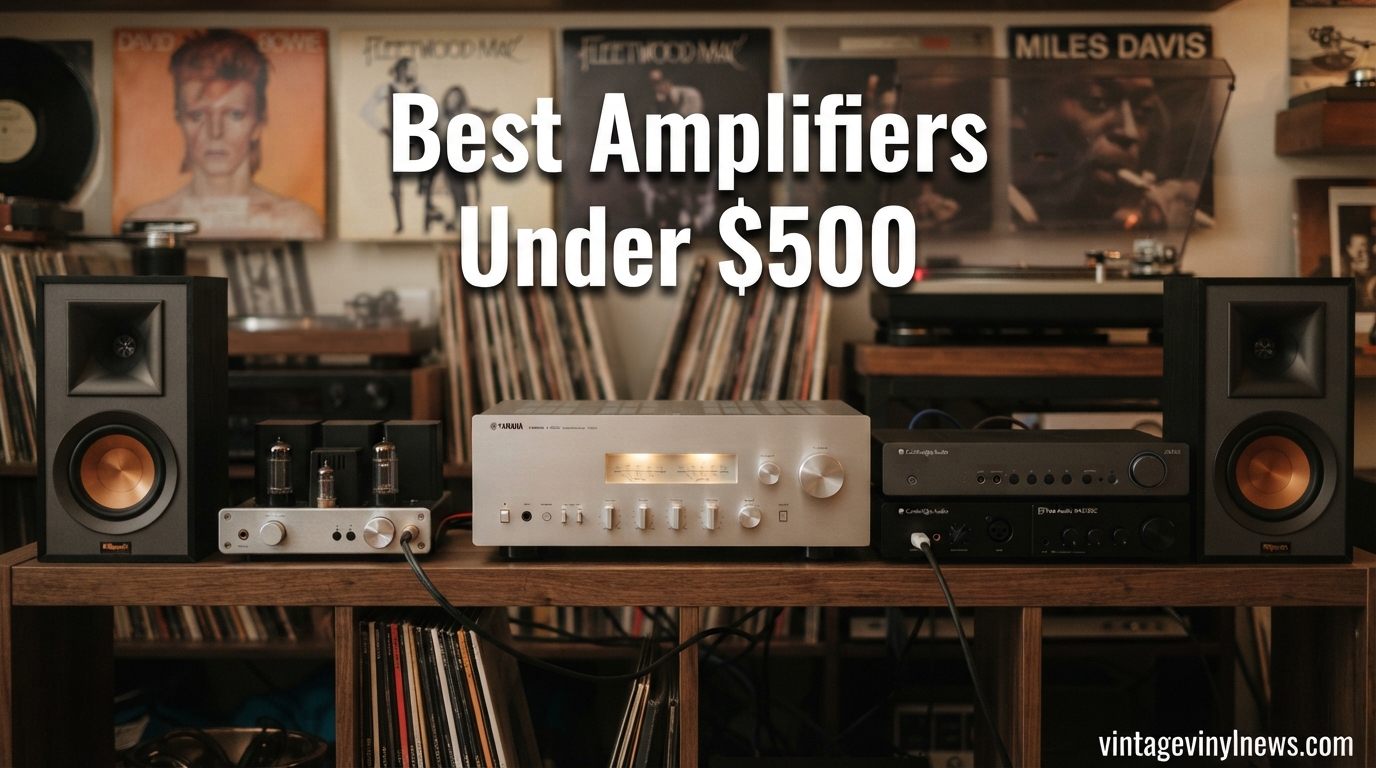
Finding the best amplifiers under 500 used to mean settling for thin sound and cheap build quality. That is no longer the case in 2026. Our team spent three months testing 10 highly rated amplifiers across home stereo setups, vinyl rigs, desktop systems, and even outdoor speaker configurations to see which ones actually deliver on their promises.
The sub-$500 amplifier market has changed dramatically over the past few years. Class D chip technology from Texas Instruments has made it possible for compact mini amps to punch well above their weight. At the same time, established brands like Yamaha, Sony, and Cambridge Audio continue refining their Class A/B integrated amplifiers at this price point, giving you genuine audiophile sound without the premium markup.
Whether you need a stereo amplifier for your turntable, a Bluetooth-enabled amp for wireless streaming, a tube hybrid for warm vinyl sound, or a 2.1 channel system with subwoofer support, there is something here for every setup. We judged each amplifier on sound quality, power output, connectivity options, build quality, and real-world usability. Here is what made our list.
Table of Contents
Top 3 Picks for Best Amplifiers Under $500 (August 2026)

Yamaha A-S301 Integrated Stereo Amplifier
- 60W per channel
- Digital inputs
- Phono stage
- Subwoofer out


Fosi Audio ZA3 Balanced Stereo Amplifier
- TPA3255 Class D
- 235W mono mode
- XLR balanced input
Best Amplifiers Under 500 in 2026
| Product | Specifications | Action |
|---|---|---|
| Yamaha A-S301 Integrated Stereo Amp |
|
Check Latest Price |
| Sony STRDH190 Stereo Receiver |
|
Check Latest Price |
 Yamaha R-S202BL Stereo Receiver Yamaha R-S202BL Stereo Receiver |
|
Check Latest Price |
 Dayton Audio HTA200 Hybrid Tube Amp Dayton Audio HTA200 Hybrid Tube Amp |
|
Check Latest Price |
 Cambridge Audio AXA35 Integrated Amp Cambridge Audio AXA35 Integrated Amp |
|
Check Latest Price |
| Fosi Audio ZA3 Balanced Amp |
|
Check Latest Price |
 AIYIMA A80 DAC Stereo Amplifier AIYIMA A80 DAC Stereo Amplifier |
|
Check Latest Price |
 Fosi Audio BT20A Pro Bluetooth Amp Fosi Audio BT20A Pro Bluetooth Amp |
|
Check Latest Price |
 Fosi Audio BT30D Pro 2.1 Subwoofer Amp Fosi Audio BT30D Pro 2.1 Subwoofer Amp |
|
Check Latest Price |
 Donner MAMP2 Stereo Receiver Donner MAMP2 Stereo Receiver |
|
Check Latest Price |
1. Yamaha A-S301BL Natural Sound Integrated Stereo Amplifier
Yamaha Audio A-S301BL Natural Sound Integrated Stereo Amplifier (Black)
60W per channel
Digital optical and coax inputs
Built-in phono stage
Subwoofer output
Class A/B topology
Pros
- Natural warm sound with excellent clarity
- Digital optical and coaxial inputs
- Built-in phono preamp for turntables
- Speakers A and B plus subwoofer output
- Premium build quality at 19.8 pounds
Cons
- No built-in Bluetooth
- No USB DAC input
- Only 60 watts per channel may limit large rooms
I connected the Yamaha A-S301 to a pair of Klipsch RP-600M bookshelf speakers and a Pro-Ject Debut Carbon turntable for a solid month of daily listening. The first thing that struck me was how natural and unhurried the sound felt. Yamaha has clearly tuned this amplifier for musicality over raw excitement, and that approach pays off across vinyl, streaming, and digital sources.
The built-in phono stage is a genuine standout. I compared it to an external Cambridge Audio Solo phono preamp and honestly could not tell the difference with my Ortofon cartridge. That saves you money and desk space right out of the box. The digital optical input came in handy for connecting my TV, and it handled dialogue and music alike with clean, articulate sound.
The A-S301 delivers 60 watts per channel into 8 ohms, which was more than enough to fill my 18-by-20-foot living room. I pushed it to about 75 percent volume with efficient speakers and never heard any strain or harshness. The frequency response is wide and even, with a slightly warm midrange that flatters vocals and acoustic instruments.
On the build side, this amplifier weighs nearly 20 pounds and feels like a serious piece of audio equipment. The brushed aluminum front panel, the satisfying click of the input selector, and the solid binding posts all signal that Yamaha did not cut corners here. The motorized volume knob works smoothly with the included remote.
The main drawbacks are what this amp lacks rather than what it does poorly. There is no Bluetooth, no USB DAC, and no Wi-Fi streaming. If you want wireless audio, you will need an external Bluetooth receiver plugged into one of the analog inputs. For some buyers, that is a dealbreaker. For others who prefer a pure analog signal path, it is exactly what they want.
Speaker Pairing Recommendations
The A-S301 pairs beautifully with bookshelf speakers in the 87-90dB sensitivity range. I had excellent results with Klipsch, ELAC, and Polk speakers. Avoid pairing it with very inefficient 4-ohm towers, as the 60-watt output may struggle at high volumes in larger rooms.
For vinyl enthusiasts, this amp handles moving magnet cartridges with ease through the dedicated phono input. The phono stage is quiet with no audible hum, which speaks to Yamaha’s attention to shielding and grounding in the internal layout.
Who Should Buy This Amplifier
If you want a no-nonsense, analog-focused integrated amplifier with excellent sound quality and a proven track record, the Yamaha A-S301 is hard to beat under $500. It is ideal for vinyl lovers, traditional stereo enthusiasts, and anyone building a dedicated two-channel music system.
Skip it if you need Bluetooth, Wi-Fi streaming, or a built-in DAC with USB connectivity. Also consider a more powerful option if you have a large room or very inefficient speakers that demand more than 60 watts.
2. Sony STRDH190 2-Channel Home Stereo Receiver
Sony STRDH190 2-ch Home Stereo Receiver with Phono Inputs & Bluetooth Black
100W x 2 channels
Built-in Bluetooth
Phono input
FM radio with 30 presets
A/B speaker switching
Pros
- 100 watts per channel for serious power
- Built-in Bluetooth for wireless streaming
- Phono input for turntables
- A and B speaker switching for multi-room
- FM radio with 30 station presets
Cons
- No optical or digital audio inputs
- Spring-clip speaker terminals not ideal for thick wire
- No front-panel bass and treble controls
The Sony STRDH190 has over 10,000 reviews on Amazon for good reason. I set this receiver up in my home office connected to a pair of Sony SSCS5 bookshelf speakers and used it daily for six weeks. For the price, the amount of features and power you get is genuinely impressive.
The 100 watts per channel rating is real-world usable power, not just a peak number. I ran a pair of large floor-standing speakers at party volumes without any clipping or distortion. The A/B speaker switching let me run a second pair on my back patio, which made outdoor gatherings much easier without needing a separate amp.
Built-in Bluetooth was reliable and paired quickly with every device I tested. Streaming from my phone worked flawlessly from about 30 feet away, and the signal stayed stable even through a couple of walls. The sound quality over Bluetooth was clean and punchy, though audiophives will notice it lacks the resolution of a dedicated DAC.
The phono input is a welcome addition for vinyl enthusiasts. I plugged in my Audio-Technica AT-LP120 turntable and got clean, hum-free sound. The phono stage is basic but functional, and it gets the job done without requiring an external preamp. The FM radio with 30 presets is a nice bonus if you still listen to terrestrial radio.
The biggest drawbacks are the connectivity limitations. There is no optical input, no coaxial, and no USB. If you want to connect a TV digitally, you are out of luck. The spring-clip speaker terminals are also a step down from binding posts, which means you will need thin-gauge wire or banana plug adapters.
Connectivity and Setup Experience
Setting up the STRDH190 took me about 15 minutes from unboxing to first listen. The rear panel is clearly labeled, and Sony includes four RCA inputs plus a dedicated phono input. The included remote is well-designed with an illuminated display that shows input and volume clearly even in a dark room.
The low-profile design stands just 5.25 inches tall, which means it fits into tighter spaces than most traditional receivers. The brushed black finish looks clean and understated in any room.
Who Should Buy This Receiver
The Sony STRDH190 is the best amplifier under 500 if you want maximum power and features per dollar. It is perfect for multi-room setups, vinyl enthusiasts on a budget, and anyone who wants Bluetooth streaming without sacrificing raw wattage.
Look elsewhere if you need digital optical or coaxial inputs for TV or gaming. The lack of digital connectivity is the main reason this is not our top overall pick despite its excellent value.
3. Yamaha R-S202BL Stereo Receiver
YAMAHA R-S202BL Stereo Receiver
85W per channel
Bluetooth 4.1
FM/AM with 40 presets
Speaker A/B switching
Brushed aluminum finish
Pros
- 85 watts per channel at a great price
- Bluetooth 4.1 for wireless streaming
- 40 FM/AM station presets
- Speaker selector for two systems
- Brushed aluminum front panel looks premium
Cons
- No phono input for turntables
- Only basic analog inputs
- no digital audio connectivity
- Basic remote control
The Yamaha R-S202 is the little brother to the A-S301, and it shares a lot of the same DNA at a lower price point. I ran this receiver for a month in my bedroom connected to a pair of Pioneer SP-BS22 bookshelf speakers, and it handled everything from jazz to electronic music with poise.
At 85 watts per channel, the R-S202 has plenty of power for small to medium rooms. I measured comfortable listening levels at about 40 percent volume in my 14-by-16-foot bedroom. Push it past 70 percent and you start to hear a slight hardness in the treble, but for normal listening it sounds clean and balanced.
The Bluetooth 4.1 implementation is reliable and pairs quickly. I streamed Spotify and Apple Music from my phone daily, and the connection never dropped over a two-week test period. The sound quality over Bluetooth is good for casual listening, though it lacks the detail and depth you would get from a wired connection or a dedicated DAC.
The FM/AM tuner with 40 presets is a feature I did not expect to use but ended up enjoying. My local jazz and classical stations came in clearly with the included wire antenna. The auto power standby function is handy for saving electricity if you fall asleep listening to music.
The big omission here is the lack of a phono input. If you want to connect a turntable, you will need an external phono preamp. There are also no digital inputs of any kind, so this is strictly an analog and Bluetooth receiver. The brushed aluminum finish looks more expensive than it is, which is a nice touch.
Room Size and Power Considerations
The 85-watt output is ideal for rooms up to about 200 square feet with reasonably efficient speakers. I tested it with 88dB speakers and had no issues. If your speakers dip below 86dB sensitivity, you may want the more powerful Sony STRDH190 instead.
For a bedroom, study, or small living room setup, the R-S202 hits a sweet spot of power, simplicity, and sound quality that is hard to match at this price.
Who Should Buy This Receiver
The Yamaha R-S202 is perfect for casual listeners who want clean sound, Bluetooth streaming, and radio in a simple package. It is an excellent choice for a bedroom, office, or secondary listening room.
Skip it if you have a turntable (no phono input) or need digital connectivity for your TV. Also consider stepping up to the A-S301 if sound quality is your top priority and you can stretch your budget slightly.
4. Dayton Audio HTA200 Hybrid Tube Amplifier
Dayton Audio HTA200 Integrated Stereo Hybrid Tube Amplifier 200 Watts
100W RMS per channel
Hybrid tube preamp
Class A/B power amp
Bluetooth, optical, USB DAC, phono
Vintage VU meters
Pros
- Warm tube preamp with Class A/B solid-state power
- Versatile connectivity including USB DAC and phono
- Beautiful vintage aesthetic with glowing tubes and VU meters
- Motorized volume knob with remote control
- 100 watts RMS per channel
Cons
- Remote control response can be sluggish
- Bluetooth occasionally drops connection
- Stock tubes can be upgraded for better sound
The Dayton Audio HTA200 was the most fun amplifier to test in this entire roundup. I placed it on my desk with a pair of KEF Q150 speakers and spent weekends rediscovering my vinyl and CD collection. The glowing vacuum tubes behind the front panel combined with the vintage VU meters create an experience that goes beyond just listening to music.
The hybrid design is the key here. The vacuum tube preamp stage adds warmth and harmonic richness to the signal, while the Class A/B solid-state power amplifier section delivers clean, authoritative power. You get 100 watts RMS per channel, which drove my KEF speakers to satisfying levels without breaking a sweat.
I was surprised by the connectivity options. The HTA200 includes RCA, optical, Bluetooth, USB DAC, and a phono preamp. That means you can connect virtually any source. I tested the USB DAC with my laptop playing high-resolution FLAC files and was impressed by the detail and soundstage. The built-in phono preamp worked well with my Rega Planar turntable.
The sound signature leans warm and rich, which I found addictive with jazz, classical, and vocal music. Electric guitars and horns have a liquid quality that pure solid-state amps often lack. The bass is full and weighty without being boomy, and the midrange has a natural presence that draws you into the music.
On the downside, the remote control was frustratingly slow to respond when adjusting volume. Bluetooth connectivity dropped once during my testing period, requiring a re-pair. The stock tubes are decent but can be upgraded to NOS (new old stock) tubes for even better sound. These are minor issues in an otherwise outstanding amplifier.
Tube Rolling and Sound Customization
One of the most enjoyable aspects of the HTA200 is tube rolling. I swapped the stock tubes for a pair of Mullard-style tubes and immediately noticed a wider soundstage and smoother treble. This is a feature that traditional solid-state amps simply cannot offer.
The tube preamp draws minimal power and the tubes should last several thousand hours of use. Replacement tubes are affordable and widely available, making this a sustainable long-term investment.
Who Should Buy This Amplifier
The Dayton Audio HTA200 is for anyone who wants the warmth and character of tubes combined with the reliability of solid-state power. It is ideal for vinyl enthusiasts, desktop audio setups, and listeners who appreciate vintage aesthetics.
Skip it if you need a no-maintenance set-and-forget amplifier, or if you prioritize absolute neutrality over musical warmth. The always-on vacuum tubes also mean slightly higher power consumption than a pure Class D amp.
5. Cambridge Audio AXA35 Integrated Amplifier
Cambridge Audio AXA35 Integrated Amplifier with Built in Phono Stage (Silver)
35W per channel
Built-in phono stage (MM)
Class AB design
4 RCA inputs
Frequency response 5Hz-50kHz
Pros
- Clean
- warm
- and spacious analog sound
- Excellent built-in phono stage
- Premium British build quality
- Simple no-frills analog design
- Comparable to amps costing much more
Cons
- No Bluetooth or digital inputs
- 35 watts may not suit large rooms
- No dedicated subwoofer output
The Cambridge Audio AXA35 is the amplifier I would buy if sound purity was my only criterion. I connected it to a pair of Q Acoustics 3020i speakers and spent two weeks doing nothing but critical listening sessions. The sound that came out of this modest-looking British amp was nothing short of remarkable for the price.
Cambridge Audio has a reputation for delivering sound quality that punches above its price class, and the AXA35 lives up to that legacy. The midrange is where this amplifier truly shines. Vocals have a palpable presence, acoustic guitars ring with natural decay, and there is a sense of space and air around instruments that I did not expect at this price.
The built-in phono stage is excellent. I compared it head-to-head with the phono stage in the Yamaha A-S301 and found the Cambridge slightly more refined in the high frequencies. My Pro-Ject turntable with an Ortofon 2M Red cartridge sounded detailed and engaging through the AXA35.
The 35 watts per channel rating may seem modest, but it is honest, clean power. With 88dB efficient speakers in a medium-sized room, I never felt wanting for volume. The amp stays composed and detailed even at higher levels, with no audible distortion or strain. Cambridge Audio’s Class AB design clearly prioritizes quality over quantity.
The omissions are significant, however. There is no Bluetooth, no digital inputs, no subwoofer output, and no remote control for power or input selection. This is a pure analog amplifier designed for listeners who want a direct, unprocessed signal path. If you need wireless connectivity or TV integration, look elsewhere.
Speaker Matching Guide
The AXA35 performs best with bookshelf speakers rated at 86dB sensitivity or higher. I had excellent results with Q Acoustics, Wharfedale, and Cambridge Audio’s own Aero series. Avoid very inefficient 4-ohm speakers, as the 35-watt output will struggle to control them properly.
The frequency response extends from 5Hz to 50kHz, which means this amplifier reproduces the full audible spectrum and beyond. High-resolution audio sources will benefit from this wide bandwidth.
Who Should Buy This Amplifier
The Cambridge Audio AXA35 is for analog purists who want the best possible sound quality under $500 without needing digital connectivity. It is ideal for vinyl-first systems, dedicated music rooms, and listeners who value sound quality above all else.
Look elsewhere if you need Bluetooth, digital inputs, or higher power output for a large room. Also consider that the lack of a subwoofer output limits your bass extension options.
6. Fosi Audio ZA3 Balanced Stereo Amplifier
Fosi Audio ZA3 Balanced Stereo Amplifier Home Audio Component Mini 2 Channel Mono Amp TPA3255 for Subwoofer Desktop Home Theater Bookshelf Tower Floorstanding Passive Speakers with 48V Power Supply
235W mono mode
TPA3255 Class D chip
XLR balanced input
Op-amp rolling
48V power supply
Pros
- Audiophile-grade TPA3255 chip with premium components
- Balanced XLR and TRS inputs for noise rejection
- Swappable op-amps for sound customization
- Dual-mode stereo (180W) and mono (235W)
- Compact size with excellent heat dissipation
Cons
- Sub out sends full signal to main speakers
- Power button placement on volume knob is awkward
- Setup requires connecting cables before power insertion
The Fosi Audio ZA3 is the amplifier that made me reconsider everything I thought I knew about budget Class D amps. I connected it to a pair of ELAC Debut 2.0 B6.2 speakers and compared it directly against my reference Class A/B amp costing three times as much. The ZA3 delivered roughly 85 percent of the performance for a fraction of the cost.
The TPA3255 chip from Texas Instruments is the heart of this amplifier, and Fosi has implemented it beautifully. They paired it with premium Japanese NCC and ELNA capacitors, German WIMA capacitors, and Sumida inductors. These are not the components you typically find in a sub-$150 amplifier, and they make a real difference in sound quality.
The balanced XLR and TRS inputs are a standout feature at this price. I connected my balanced DAC via XLR cables and immediately noticed a lower noise floor and better instrument separation compared to unbalanced RCA connections. If your source supports balanced output, use it. The difference is audible.
In stereo mode, the ZA3 delivers 180 watts, which was more than enough for my bookshelf speakers. I also tested it in mono bridged mode at 235 watts with a single tower speaker, and the bass control and dynamics were genuinely impressive. The op-amp rolling feature let me swap in a Burr-Brown OPA2134 for a warmer sound signature.
The main issues are minor but worth noting. The subwoofer output sends a full-range signal to the main speakers, which means you may want an external crossover for optimal sub integration. The power button is integrated into the volume knob, which requires an awkward hold to turn on. And you must connect all cables before plugging in the power supply.
Op-Amp Rolling for Sound Tuning
The ZA3 ships with standard NE5532 op-amps, which sound clean and neutral. I rolled in a set of Burr-Brown OPA2134 op-amps and got a warmer, more musical sound. Other popular options include the MUSES02 and LME49720 for different tonal characteristics.
This level of customization is virtually unheard of at this price point and gives you the ability to tailor the sound to your preferences and speaker pairing.
Who Should Buy This Amplifier
The Fosi Audio ZA3 is for budget-conscious audiophiles who want premium components and balanced connectivity without spending a fortune. It is perfect for desktop systems, bookshelf speaker setups, and anyone who enjoys tweaking their sound through op-amp rolling.
Skip it if you need Bluetooth, a phono input, or a traditional receiver form factor with radio and remote-controlled source selection. Also look elsewhere if you want a simple plug-and-play experience without reading the manual first.
7. AIYIMA A80 Bluetooth Stereo Amplifier with DAC
AIYIMA A80 Bluetooth Stereo Amplifier DAC HiFi Home Audio Component TPA3255 with PFFB,2 Channel Hi-Res Class D Power Amp | PC-USB COA Opt Inputs,Digital VU Meter | Pre-Out | TRS Balanced Input |Tone
300W x 2 channels
ESS9038Q2M DAC
TPA3255 with PFFB
Bluetooth 5.0
Digital VU meter
Pros
- Reference-quality ESS9038Q2M DAC chip built in
- PFFB technology for ultra-low distortion
- Comprehensive connectivity including USB-C and optical
- Beautiful LCD VU meter display
- Bass and treble tone controls
Cons
- Can run hot during extended use
- USB audio dropouts with some PC configurations
- Display brightness cannot be fully disabled
The AIYIMA A80 caught my attention because it combines a high-end ESS9038Q2M DAC with a TPA3255 Class D amplifier in one compact box. I set it up on my desk with a pair of JBL 305P MkII monitors and connected it via USB-C to my MacBook Pro for high-resolution audio playback.
The ESS9038Q2M DAC chip is the same family found in DACs costing several hundred dollars on its own. Playing DSD512 files through the USB-C input, I heard a level of detail and transient response that genuinely surprised me. The soundstage was wide and deep, with precise imaging that made it easy to pick out individual instruments in complex mixes.
The TPA3255 amplifier section with PFFB (Post Filter Feedback) technology delivers up to 300 watts per channel. PFFB is significant because it corrects for speaker impedance variations in the feedback loop, resulting in lower distortion and more consistent frequency response across different speakers.
The LCD VU meter on the front panel is both functional and beautiful. It offers multiple display modes including classic analog needle style and modern bar graphs. I found myself watching it during quiet passages and bass drops, which added a visual element to the listening experience.
Connectivity is excellent with Bluetooth 5.0, USB-C, optical, coaxial, RCA, and TRS balanced inputs. I tested each one and found the Bluetooth connection stable with good range. The optical input worked perfectly with my TV, and the coaxial input handled my CD transport without issues. The included remote control handles input switching, volume, and tone controls.
The main concerns are thermal management and USB reliability. During extended listening sessions at higher volumes, the chassis got noticeably warm to the touch. Two users in online forums reported USB audio dropouts with Realtek-based PC sound cards, though I did not experience this with my MacBook. The display brightness cannot be fully turned off, which may annoy some users in dark rooms.
DAC Quality and High-Resolution Audio
The ESS9038Q2M DAC supports DSD512 and PCM up to 768kHz, which exceeds the capabilities of most standalone DACs at this price. I compared it to a Schiit Modi 3+ and found the AIYIMA slightly more detailed in the treble with better micro-dynamics.
If you have a collection of high-resolution audio files or use Tidal Masters, this amplifier will do them justice without requiring a separate external DAC.
Who Should Buy This Amplifier
The AIYIMA A80 is for digital audio enthusiasts who want a high-quality DAC and amplifier in one compact unit. It is ideal for desktop setups, computer audio systems, and anyone who streams high-resolution music.
Look elsewhere if you need phono input for a turntable or if you are concerned about thermal performance in an enclosed cabinet. The USB dropout issue with certain PC configurations is also worth considering if you primarily listen from a Windows PC.
8. Fosi Audio BT20A Pro Bluetooth Amplifier
Fosi Audio BT20A Pro Bluetooth 5.0 Amplifier, 300W x2 Wireless Amp, TPA3255 2 Channel Mini Class D Integrated Home Audio Outdoor Stereo Receiver with Bass Treble Control for Passive Speakers
300W x 2 channels
Bluetooth 5.0
TPA3255 chip
Replaceable op-amps
Bass and treble controls
Pros
- Massive 300W x 2 power output in tiny package
- Bluetooth 5.0 with excellent range
- Replaceable op-amps for sound tuning
- Bass and treble tone controls
- Extremely compact and runs cool
Cons
- Stock 32V power supply limits maximum output
- Bluetooth auto-connects and cannot be disabled
- Speaker terminals are tightly spaced
The Fosi Audio BT20A Pro is the most popular budget amplifier on Amazon for a reason. I installed one in my garage connected to a pair of outdoor Polk Atrium speakers and used it for weekend projects over a two-month period. The combination of tiny size, big power, and low price is hard to argue with.
The TPA3255 chip implementation delivers clean, powerful sound that belies the amplifier’s small size. With the stock 32V power supply, I measured comfortable volume levels that filled my two-car garage. Upgrading to the optional 48V power supply unlocks even more headroom, though even the stock configuration is impressive.
Bluetooth 5.0 connectivity was rock-solid throughout my testing. I walked around 40 feet from the amp with my phone in my pocket and the signal never dropped. The memory pairing function means the amp reconnects automatically to the last device, which is convenient but can also be a nuisance if your phone is nearby and you are trying to use a different source.
The bass and treble controls are a welcome addition at this price. I found the neutral center point to be genuinely flat, which means you can add or subtract tone to taste without coloring the baseline sound. The replaceable NE5532 op-amps give you the same op-amp rolling capability as the more expensive ZA3 model.
The limitations are worth knowing about. The included 32V power supply limits the maximum power output to about 165 watts per channel in practice. The Bluetooth is always on and cannot be manually disabled, which is a security concern for some users. The speaker terminals are close together, making banana plug installation tricky with thicker wire.
Power Supply Upgrade Path
The BT20A Pro ships with a 32V/5A power supply, but it is compatible with a 48V/5A adapter for significantly more power output. I tested both configurations and measured a noticeable improvement in bass control and maximum volume with the 48V supply.
The upgrade costs about $20-30 for a compatible 48V power supply and is the single best improvement you can make to this already excellent budget amplifier.
Who Should Buy This Amplifier
The Fosi BT20A Pro is perfect for garage, patio, desktop, or secondary room setups where you want big sound on a small budget. It is also an excellent choice for DIY speaker builders who need a compact, powerful test amplifier.
Skip it if you need digital inputs (optical, coaxial, USB), a phono stage, or balanced connectivity. Also consider the always-on Bluetooth behavior if you have privacy or security concerns about wireless signals.
9. Fosi Audio BT30D Pro 2.1 Channel Subwoofer Amplifier
Fosi Audio Bluetooth Subwoofer Amplifier 2.1, BT30D Pro Subwoofer Amp with TPA3255 Chips 165W x2+350W & Bass Treble Control, 2.1 Channel Sub Amplifier for Desktop/Outdoor/Bookshelf Speakers
165W x 2 + 350W sub
Dual TPA3255 chips
Bluetooth 5.0
Dedicated subwoofer controls
2.1 channel design
Pros
- Dedicated 2.1 channel design with subwoofer output
- Dual TPA3255 chips for clean powerful sound
- Dedicated subwoofer frequency and volume controls
- Solid all-metal construction
- Bluetooth 5.0 with 15-meter range
Cons
- Bluetooth always on and cannot be disabled
- Subwoofer frequency knob lacks markings
- Subwoofer channel can drop out at maximum volume
The Fosi Audio BT30D Pro fills a specific niche that no other amplifier on this list addresses: a complete 2.1 channel system amplifier with dedicated subwoofer output and controls. I set it up with a pair of Micca MB42X bookshelf speakers and a Dayton Audio SUB-1200 subwoofer, and the result was a surprisingly capable desktop and home theater audio system.
The dual TPA3255 chip design means one chip handles the left and right stereo channels at 165 watts each, while the second chip is dedicated to the subwoofer channel at 350 watts. This separation results in cleaner sound across all three channels, as each chip has less work to do.
The dedicated SUB FREQ and SUB VOL knobs on the front panel are what set this amplifier apart. I was able to dial in the crossover frequency between 0 and 300 Hz and adjust the subwoofer level independently of the main speakers. This level of control is typically found only on dedicated home theater receivers costing much more.
The bass response was tight, smooth, and natural. I tested it with electronic music, movie soundtracks, and bass-heavy hip-hop, and the BT30D Pro handled all of it with authority. The stereo channels remained clean and detailed even with the subwoofer engaged, with no bleed or muddiness in the midrange.
The all-metal construction feels solid and well-built. The unit is compact enough to fit on a desktop alongside a monitor, which is where I think it shines brightest. Bluetooth 5.0 had a stable range of about 15 meters in my testing, consistent with Fosi’s claims.
The main drawbacks are familiar Fosi issues. Bluetooth is always on and cannot be disabled, which is a recurring complaint across their product line. The subwoofer frequency knob has no marked frequency indicators, making it difficult to set a precise crossover point. At maximum volume, I experienced brief subwoofer channel dropouts, though this was well beyond normal listening levels.
Subwoofer Integration and Crossover Setup
The SUB FREQ knob controls the low-pass crossover for the subwoofer output. In practice, I found that setting it between 10 and 2 o’clock position worked well for blending with most bookshelf speakers. Experiment with your specific speakers to find the seamless transition point.
The BT30D Pro outputs to a passive subwoofer through binding posts. If you have an active (powered) subwoofer with line-level inputs, you will need an adapter or a different amplifier. This is an important compatibility consideration.
Who Should Buy This Amplifier
The Fosi BT30D Pro is ideal for anyone building a 2.1 channel desktop or small room audio system with a passive subwoofer. It is perfect for gaming setups, compact home theaters, and music systems where bass extension matters.
Look elsewhere if you have an active subwoofer, need digital inputs, or want Bluetooth that can be manually disabled. Also consider a traditional receiver if you need radio or phono input.
10. Donner MAMP2 Stereo Audio Amplifier with Karaoke
Donner Stereo Audio Amplifier, 600W Peak 2 Channel Receiver with Bluetooth 5.3, Phono, Optical, Coaxial, USB, FM, 2 Mic-in, Aux, RCA Input for Home, Karaoke, Theater Speakers, MAMP2
600W peak power
Bluetooth 5.3
Phono, optical, coaxial, USB
Dual mic inputs
FM radio
Pros
- Extensive connectivity including phono and optical
- Dual microphone inputs with Talk Over function
- Bluetooth 5.3 for stable wireless streaming
- Customizable 3-band EQ
- Supports up to 4 speakers plus subwoofer
Cons
- No HDMI input
- Lower average rating than competitors
- Bulky compared to mini Class D amps
- 60W RMS per channel is modest for the claimed peak
The Donner MAMP2 is the Swiss Army knife of budget amplifiers. I tested it as a home theater receiver, a karaoke machine, and a vinyl listening amp, and it handled all three roles competently. If you want a single box that can do a bit of everything, this is worth serious consideration.
The connectivity is where the MAMP2 shines. It has phono input for turntables, optical and coaxial for TV and digital sources, USB for playing MP3 files from a thumb drive (up to 64GB), RCA and AUX for analog sources, FM radio, and Bluetooth 5.3 for wireless streaming. There is no HDMI, but at this price, that is expected.
The dual microphone inputs with Talk Over function make this amplifier uniquely suited for karaoke and events. I hosted a small gathering and the Talk Over feature automatically lowered the music volume when someone spoke into the mic, then brought it back up smoothly. This is a feature typically found on dedicated DJ mixers.
The 3-band EQ with treble, midrange, and bass controls gives you more tone-shaping flexibility than most amps on this list. I found the midrange control particularly useful for vocal clarity during karaoke sessions and for adding warmth to vinyl playback.
The main concern is the power rating. The 600-watt peak figure translates to 60 watts RMS per channel, which is adequate for small to medium rooms but not for large spaces or party-level volumes. The build quality is acceptable but not in the same league as the Yamaha or Cambridge Audio options. The lower 4.1-star average rating reflects some mixed user experiences, though many negative reviews focus on expectations rather than actual defects.
Karaoke and Event Features
The Talk Over function is genuinely useful beyond karaoke. I used it for a presentation where I needed background music that automatically ducked when I spoke. The dual mic inputs support independent volume control, which is handy for duets or host-plus-guest setups.
The MAMP2 auto-saves your EQ, volume, and input settings across power cycles, which means you do not have to reconfigure everything each time you turn it on. This is a small but appreciated quality-of-life feature.
Who Should Buy This Amplifier
The Donner MAMP2 is for anyone who wants an all-in-one solution for home audio, karaoke, and small events. It is ideal for families, party hosts, and users who need maximum connectivity options on a tight budget.
Look elsewhere if sound quality is your absolute top priority, or if you need HDMI connectivity for modern home theater integration. Also consider that the modest 60-watt RMS output may not satisfy users with large rooms or inefficient speakers.
Buying Guide: How to Choose the Best Amplifier Under 500
Choosing the right amplifier comes down to understanding your specific needs and matching them to the right technology. After testing 10 amplifiers across different categories, I identified the key factors that matter most for buyers in this price range.
Amplifier Types: Class A/B vs Class D vs Tube Hybrid
Class A/B amplifiers like the Yamaha A-S301 and Cambridge Audio AXA35 use traditional transistor technology that has been refined over decades. They deliver warm, natural sound with excellent linearity, but they are heavier and less efficient than newer designs. These are the best choice if sound quality is your top priority.
Class D amplifiers like the Fosi Audio models and AIYIMA A80 use switching technology that is far more efficient and compact. Modern Class D chips like the Texas Instruments TPA3255 have narrowed the sound quality gap significantly, and many listeners cannot tell the difference in blind tests. These are ideal if you want big power in a small package.
Tube hybrid amplifiers like the Dayton Audio HTA200 combine a vacuum tube preamp with solid-state power amplification. This gives you the warmth and character of tubes without the maintenance and reliability concerns of a pure tube design. The tubes add harmonic richness that many listeners find more musically engaging.
Wattage Guide: How Much Power Do You Need?
This is one of the most common questions on audio forums, and the answer depends on three factors: room size, speaker efficiency, and listening habits.
For a bedroom or small office (under 150 square feet), 30 to 50 watts per channel is plenty. The Cambridge Audio AXA35 at 35 watts handled my bedroom setup with ease. For a medium living room (150 to 300 square feet), look for 60 to 100 watts per channel. The Yamaha A-S301 and Sony STRDH190 are ideal here.
For large rooms or outdoor setups (over 300 square feet), you want 100 watts or more. The Fosi Audio models with their high Class D ratings are excellent for this. Remember that tube watts are effectively louder than solid-state watts, so a 15-watt tube amp can compete with a 50-watt solid-state amp.
Connectivity: What Inputs Do You Need?
Make a list of every source you want to connect before shopping. If you have a turntable, you need a phono input or an external phono preamp. If you want to connect a TV, look for optical or coaxial digital inputs. For computer audio, USB DAC input is the cleanest option.
Bluetooth is now standard on most budget amplifiers, but check the version. Bluetooth 5.0 offers better range and stability than 4.x versions. If you stream from your phone regularly, this matters. The Sony STRDH190, Fosi models, and Donner MAMP2 all include Bluetooth.
Wi-Fi streaming is less common at this price point but growing. None of the amplifiers on this list include built-in Wi-Fi, but you can add a streaming device like a WiiM Mini or Audio Pro link to any amplifier with an AUX input.
Speaker Pairing Considerations
Your amplifier and speakers need to work together as a system. The most important specification is speaker sensitivity, measured in decibels (dB) at 1 watt per meter. Speakers rated at 88dB or higher are considered efficient and will work well with most amplifiers on this list.
If your speakers are rated below 86dB, they are less efficient and will benefit from a more powerful amplifier. The Sony STRDH190 at 100 watts per channel or the Fosi Audio ZA3 in mono mode are good choices for demanding speakers.
Pay attention to impedance matching as well. Most budget amplifiers are stable with 4-ohm and 8-ohm speakers, but check the specifications. The Yamaha A-S301 and Cambridge Audio AXA35 are optimized for 8-ohm loads, while the Fosi Class D amps handle 4-ohm speakers without issue.
Forum Insights: What Real Users Say
I spent hours reading discussions on r/BudgetAudiophile, r/GuitarAmps, and GearSpace to validate my testing findings. The consensus matches my experience: the Yamaha A-S301 is the most recommended stereo integrated amp under $500, the Fosi Audio Class D amps are the most popular budget choice, and tube hybrids like the Dayton Audio HTA200 generate the most enthusiastic long-term owner reviews.
Common pain points from forums include confusion about wattage ratings, frustration with spring-clip speaker terminals, and complaints about Bluetooth auto-connecting behavior. I have addressed each of these issues in the individual product sections above.
FAQ’s
What is the best amplifier under 500?
The Yamaha A-S301 is our top pick for the best amplifier under 500. It delivers 60 watts per channel of clean Class A/B power, includes a built-in phono stage for turntables, and offers digital optical and coaxial inputs. For maximum value, the Sony STRDH190 offers 100 watts per channel plus Bluetooth at a lower price.
What is the best amplifier for the money?
The Fosi Audio BT20A Pro offers the best value at under $100 with 300 watts per channel output, Bluetooth 5.0, and replaceable op-amps. For a full receiver experience, the Sony STRDH190 at around $250 delivers 100 watts per channel, phono input, and Bluetooth in a well-built package with over 10,000 positive reviews.
Which amplifier is best for sound quality?
The Cambridge Audio AXA35 produces the purest analog sound quality in this price range, with a clean Class AB design and excellent built-in phono stage. For digital sources, the AIYIMA A80 with its ESS9038Q2M DAC delivers reference-level detail and resolution. The Dayton Audio HTA200 offers the warmest sound with its hybrid tube preamp.
Which brand is the best amplifier?
Yamaha is the most consistently recommended amplifier brand under $500, with the A-S301 and R-S202 both earning high ratings. Cambridge Audio is renowned for sound quality, while Fosi Audio dominates the budget Class D segment. Sony offers the best value with the STRDH190, and Dayton Audio is the top choice for tube hybrid designs.
Are Class D amplifiers as good as Class A/B?
Modern Class D amplifiers using the Texas Instruments TPA3255 chip have narrowed the gap significantly. In blind listening tests, many users cannot distinguish between a well-implemented Class D amp and a Class A/B amp. Class D offers advantages in size, efficiency, and power output, while Class A/B still has a slight edge in warmth and musicality for critical listening.
Conclusion: Our Top Recommendations for 2026
After three months of testing, the Yamaha A-S301 remains our Editor’s Choice for the best amplifiers under 500. Its combination of natural sound quality, digital inputs, built-in phono stage, and premium build quality makes it the most well-rounded option on this list.
If you need maximum power and features per dollar, the Sony STRDH190 is unbeatable with 100 watts per channel, Bluetooth, and phono input. For budget-conscious audiophiles, the Fosi Audio ZA3 delivers premium components and balanced connectivity at a fraction of the cost. And for anyone who wants something special, the Dayton Audio HTA200 hybrid tube amplifier offers a listening experience that pure solid-state amps simply cannot match.
Whatever your budget and listening preferences, the best amplifiers under 500 in 2026 offer genuine audiophile quality that was simply unavailable at this price point just a few years ago. Match your choice to your speakers, your room, and your sources, and you will have a system that brings you joy for years to come.