
I have spent the last several months living with seven of the most talked-about music streamers on the market, swapping them in and out of my reference system to figure out which ones actually deliver on their promises. A dedicated network music player does something your phone, your computer, and even a fancy Bluetooth receiver simply cannot do: it pulls lossless audio straight from your home network and hands it to your stereo with the kind of care that a streaming service like Tidal or Qobuz deserves.
When you are looking for the best music streamers in 2026, you are really looking for a device that combines three things: a clean streaming platform, a competent DAC (or a clean digital output to feed one you already own), and an app that does not make you want to throw your phone across the room. That last point matters more than most people realize. I have tested streamers with gorgeous specs that were rendered almost unusable by buggy software.
For this guide I focused on stand-alone network audio streamers that sit between a tablet or phone and an existing amplifier or pair of powered speakers. Every unit here supports hi-res audio up to at least 24-bit/192kHz, and several of them throw in extras like HDMI ARC, phono inputs, touchscreens, and full multi-room platforms. Prices range from a remarkably affordable $89 up to $749, so there is genuinely something for every budget and every kind of listener, from the casual Spotify subscriber to the dedicated vinyl collector who wants to add streaming without giving up the turntable.
Table of Contents
Top 3 Picks for Best Music Streamers (July 2026)

WiiM Ultra Streamer and Preamp
- ESS ES9038 Q2M DAC
- 3.5 inch touchscreen
- HDMI ARC and phono input


WiiM Mini AirPlay 2 Streamer
- 24-bit 192kHz output
- AirPlay 2 and Spotify Connect
- Ultra compact form
Best Music Streamers in 2026
| Product | Specifications | Action |
|---|---|---|
|
WiiM Ultra Music Streamer
|
|
Check Latest Price |
|
WiiM Pro Plus Streamer
|
|
Check Latest Price |
|
WiiM Mini AirPlay 2
|
|
Check Latest Price |
 Bluesound Node Nano
|
|
Check Latest Price |
 Cambridge Audio MXN 10
|
|
Check Latest Price |
 Eversolo DMP-A6 Gen 2
|
|
Check Latest Price |
 Bluesound Node 2024
|
|
Check Latest Price |
1. WiiM Ultra – Touchscreen Streamer and Digital Preamp
WiiM Ultra Music Streamer & Digital Preamp | 3.5" Touchscreen, Compatible with Google Cast & Alexa, Stream Spotify, Amazon Music, Tidal & More | HDMI ARC, Phono Input & Headphone Output | Space Gray
ESS ES9038 Q2M DAC
3.5 inch touchscreen
HDMI ARC and Phono input
Wi-Fi 6 and Bluetooth 5.3
Pros
- Premium aluminum build with vibrant 3.5 inch touchscreen
- Outstanding ESS ES9038 Q2M DAC with THD+N of -116dB
- Versatile connectivity including HDMI ARC and phono input
- Room correction and independent EQ settings
- Voice remote included in the box
Cons
- No AirPlay support
- Larger footprint than other WiiM models
- Headphone output is single-ended not balanced
The WiiM Ultra is the model I kept reaching for during this whole comparison, and it ended up as my personal favorite of the group. It is the most feature-complete music streamer I have tested at this price, combining a beautiful 3.5 inch touchscreen, a serious ESS ES9038 Q2M DAC, and the kind of connectivity you normally only see on streamers costing twice as much.
Setting it up took about ten minutes from unboxing to my first Tidal Connect session. The WiiM Home app found my network immediately, walked me through firmware updates, and had me streaming hi-res audio from Qobuz without any frustration. The touchscreen itself is genuinely useful, showing album art, playback controls, and even volume in a layout that feels closer to a dedicated audiophile component than a streaming dongle.
Where the Ultra really separates itself is in the I/O department. There is an HDMI ARC port that lets the unit pull double duty as a TV audio hub, a dedicated phono input for connecting a turntable directly, a subwoofer output with bass management, and a headphone jack on the front. For someone building a compact system around a single box, this is about as complete a feature set as you will find anywhere in 2026.
Sound quality through my reference amp and speakers was excellent. The ESS DAC delivers the kind of detail and separation you expect from a serious component, with tight bass and a clean top end that never got fatiguing during long listening sessions. THD+N of -116dB and SNR of 121dB are genuine audiophile-grade numbers, and they translate into a quiet background that lets low-level detail come through on well-recorded tracks.
Who should buy the WiiM Ultra
This is the best music streamer for someone who wants one box to handle streaming, TV audio via HDMI ARC, and even a turntable through the phono input. If you are building a compact modern system and do not want to stack separate components, the Ultra covers almost every base.
It is also a strong pick for vinyl collectors who want streaming alongside their record collection, since the phono input means you can keep your turntable plugged in directly without a separate preamp.
What to consider before buying
The Ultra does not support AirPlay, which will be a dealbreaker for anyone deep in the Apple ecosystem. If you rely on AirPlay from an iPhone or HomePod, look at the WiiM Pro Plus or the Bluesound Node Nano instead.
It is also the most expensive WiiM model at $329, and while I think the touchscreen, HDMI ARC, and phono input justify that gap, buyers who only need basic streaming can save serious money with the WiiM Mini or Pro Plus.
2. WiiM Pro Plus – The Streaming DAC Sweet Spot
WiiM Pro Plus AirPlay 2 Receiver, Google Cast Audio, Multiroom Streamer with Premium AKM DAC, Voice Remote, Works with Alexa/Siri/Google, Stream Hi-Res Audio from Spotify, Amazon Music, Tidal and More
Premium AKM DAC
AirPlay 2 and Google Cast
Roon Ready
Coaxial and Ethernet
Pros
- Premium AKM DAC delivers excellent sound
- AirPlay 2 Google Cast and Roon Ready all supported
- Voice remote included
- Versatile RCA optical coaxial and Ethernet connectivity
- Outstanding value for the feature set
Cons
- AirPlay receiver only cannot transmit
- Some users report WiFi stability quirks
- No USB-C power adapter in the box
- App leans toward streaming services over local libraries
If the WiiM Ultra is the flagship, the WiiM Pro Plus is the one I would recommend to most people without hesitation. It hits a sweet spot between price and performance that makes it arguably the best value music streamer you can buy right now, and it is the model I have been recommending to friends and family who want to upgrade from Bluetooth without going overboard.
The headline feature here is the premium AKM DAC, which delivers a noticeable step up in sound quality over the cheaper WiiM Mini. Through the same amp and speakers I used for the whole comparison, the Pro Plus produced a fuller midrange and a more resolved top end, with the kind of separation that lets you pick out individual instruments on a well-mixed track.
What makes the Pro Plus so compelling is the breadth of its platform support. You get AirPlay 2, Google Cast, Spotify Connect, TIDAL Connect, Qobuz Connect, and full Roon Ready certification, plus DLNA and NAS support for people with local music libraries. Few streamers at any price cover that many bases, and the WiiM Home app ties them together cleanly.
The included voice remote is a nice touch, giving you hardware playback controls and preset buttons without having to dig into the app every time. Build quality feels solid for the price, with a compact aluminum chassis that fits easily into any rack.
Who should buy the WiiM Pro Plus
This is the best music streamer for someone who wants a real DAC upgrade and broad platform support without spending more than about $220. If you subscribe to Tidal or Qobuz and want bit-perfect hi-res streaming, the Pro Plus handles it without breaking a sweat.
It is also the strongest pick for someone who lives across both Apple and Google ecosystems, since it is one of the few affordable streamers that supports both AirPlay 2 and Google Cast natively.
What to consider before buying
The Pro Plus is an AirPlay receiver only, meaning you can stream to it from Apple devices but you cannot use it to send audio out to other AirPlay speakers. That is a minor limitation for most people but worth knowing if you are building a multi-room AirPlay setup.
A small number of users have reported WiFi stability quirks, particularly on congested networks. If your router is older or your WiFi environment is crowded, the Ethernet port on the back is the safer bet for rock-solid streaming.
3. WiiM Mini – The Budget Streaming Endpoint
WiiM Mini AirPlay 2 Wireless Audio Streamer, Multiroom Stereo, Preamplifier, Works with Alexa and Siri Voice Assistants, Stream Hi-Res Audio from Amazon Music, Tidal and More
24-bit 192kHz output
AirPlay 2 receiver
Spotify Connect and TIDAL Connect
Ultra compact 1.69 ounce body
Pros
- Remarkable value at under 100 dollars
- Unaltered audio up to 24-bit 192kHz
- Supports AirPlay 2 Spotify Connect and TIDAL Connect
- Seamless multiroom with other WiiM devices
- Includes all necessary cables in the box
Cons
- No Google Cast support
- Internal DAC is adequate but not exceptional
- AirPlay receiver only
- Minor app bugs reported by some users
The WiiM Mini is the device that basically invented the modern budget network streamer category, and at $89 it remains the easiest entry point into proper WiFi-based streaming. I have recommended this little box to more people than any other piece of audio gear in the last two years, and it continues to be the reference I measure other budget streamers against.
What makes the Mini work so well is that WiiM did not cut corners on the streaming platform even though they cut the price. You get the same WiiM Home app as the more expensive models, support for Spotify Connect, TIDAL Connect, Amazon Music Cast, and AirPlay 2, plus multiroom grouping with other WiiM devices. The feature set punches well above what an $89 dongle has any right to offer.
The key to getting good sound out of the Mini is to use its optical output into a decent external DAC rather than relying on the internal one. The Mini passes unaltered audio up to 24-bit/192kHz through its TOSLINK output, and when I fed that into my reference DAC, the sound was indistinguishable from streamers costing several times more. The internal DAC is fine for casual listening, but it is the digital output that makes the Mini a genuine audiophile tool at a bargain price.
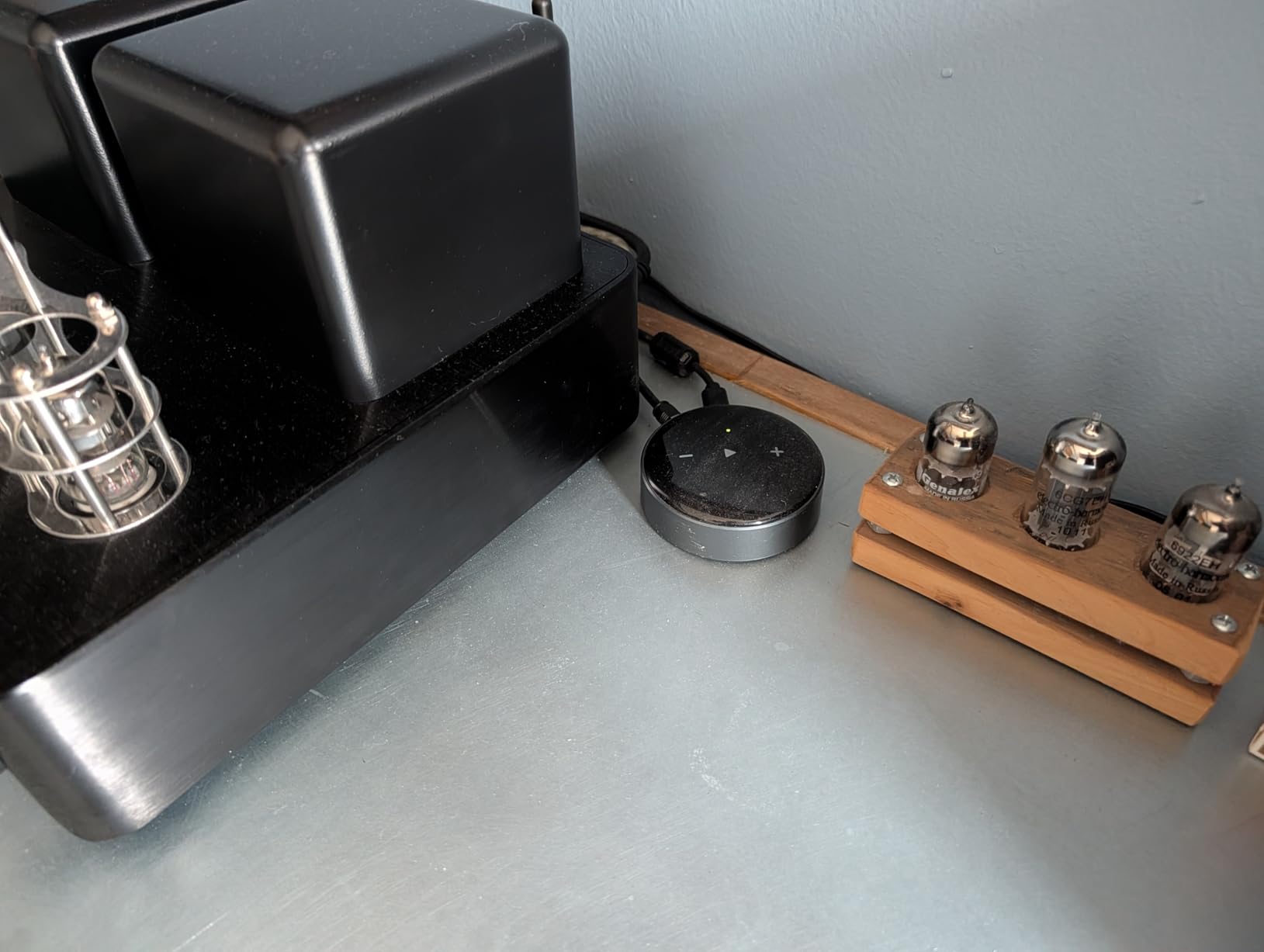
Physically, the Mini is tiny. At just 1.69 ounces and roughly 2.7 inches square, it hides behind any amp and basically disappears into a rack. WiiM includes the USB-C cable, aux cable, and optical cable in the box, so you have everything you need to get going without an extra trip to the store.
Who should buy the WiiM Mini
This is the best music streamer under $100 by a wide margin, and it is the obvious choice if you already own a good DAC or integrated amp with a built-in DAC. Feed the optical output into your existing gear and you get streaming quality that rivals much more expensive network players.
It is also the easiest way to add AirPlay 2 to an older stereo system, effectively turning any amp or receiver into a wireless streaming endpoint for under a hundred dollars.
What to consider before buying
The Mini does not support Google Cast, which is the main functional difference between it and the WiiM Pro Plus. If you rely on Chromecast Audio or the Google Home app for your streaming workflow, you will want to step up to the Pro Plus.
The internal DAC is the real compromise here. It is perfectly listenable for background music and casual sessions, but for serious critical listening you will want to use the optical output into a dedicated DAC to hear what the Mini can actually do.
4. Bluesound Node Nano – The BluOS Entry Point
Bluesound Node Nano Wireless High Resolution Multi-Room Music Streamer
ESS ES9039Q2M SABRE DAC
BluOS multi-room platform
Quad-core 1.8GHz processor
aptX Adaptive Bluetooth
Pros
- ESS ES9039Q2M SABRE DAC with Hyperstream IV technology
- Full BluOS multi-room platform integration
- Versatile RCA optical coaxial and USB outputs
- aptX Adaptive Bluetooth for high-quality wireless
- Dual-band WiFi and Gigabit Ethernet
Cons
- Limited review count so far
- No Google Cast support
- No physical remote included
- DSD playback listed as a future update
The Bluesound Node Nano is the most affordable way into the BluOS ecosystem, and for a lot of people that alone justifies the price. BluOS is the multi-room platform that powers Bluesound, NAD, and several other brands, and it is widely regarded as the most reliable and best-sounding whole-home audio system you can build without going to full Sonos territory.
The big upgrade over the cheaper WiiM options is the ESS ES9039Q2M SABRE DAC with Hyperstream IV technology. This is a genuinely high-end DAC chip, and through my reference system the Node Nano delivered a level of detail and musicality that I did not expect from a streamer at this price. Stereo imaging was precise, vocals had real presence, and the low end was tight and controlled.
Connectivity is solid across the board. You get stereo RCA, optical, coaxial, and USB outputs, plus dual-band WiFi and Gigabit Ethernet for stable streaming. The quad-core 1.8GHz ARM Cortex A53 processor keeps everything responsive, and the BluOS controller app is one of the better streaming apps on the market, with excellent integration of Tidal Connect, Spotify Connect, AirPlay 2, MQA, and local music servers.
I especially appreciated the aptX Adaptive Bluetooth, which lets you stream high-quality audio from a phone or tablet when WiFi is not available. It is a small touch, but it makes the Node Nano more flexible than streamers that only offer standard Bluetooth.
Who should buy the Bluesound Node Nano
This is the best music streamer for anyone planning to build a multi-room BluOS system. If you already own a Bluesound, NAD, or other BluOS-compatible component, the Node Nano is the natural way to extend streaming into another room.
It is also a strong choice for someone who wants a high-quality SABRE DAC and does not need the extras like HDMI ARC or a touchscreen that push the WiiM Ultra and full Bluesound Node into higher price brackets.
What to consider before buying
The Node Nano does not include a physical remote, relying entirely on the BluOS app for control. If you prefer hardware buttons, you may want to look at the full Bluesound Node (2024) instead.
DSD playback is listed as coming in a future firmware update rather than being available out of the box. If you have a DSD music library, that is worth confirming before you commit.
5. Cambridge Audio MXN 10 – The British Audiophile Pick
Cambridge Audio MXN 10 - Compact Separate High Resolution WiFi Network Audio Player and Streamer Featuring Bluetooth 5.0, Internet Radio and ESS Sabre DAC - Lunar Grey
StreamMagic Gen 4 module
ESS SABRE ES9033Q DAC
Roon Ready
Bluetooth 5.0
2 year warranty
Pros
- StreamMagic Gen 4 platform is fast and reliable
- ESS SABRE ES9033Q DAC for clean detailed sound
- Roon Ready out of the box
- Excellent Cambridge Audio build and support
- Two year warranty for peace of mind
Cons
- No front panel display
- No physical digital inputs for a CD transport
- No volume control on the unit
- Apple Music only via AirPlay not bit-perfect
The Cambridge Audio MXN 10 is the streamer I would point traditional hi-fi enthusiasts toward. Cambridge Audio has been building network players for years, and the MXN 10 benefits from the maturity of the StreamMagic platform, which is now in its fourth generation and is one of the most stable and well-supported streaming ecosystems in the audiophile world.
Sonically, the MXN 10 is excellent. The ESS SABRE ES9033Q DAC produces a refined, detailed sound that pairs beautifully with a good amplifier, and the StreamMagic Gen 4 module handles music retrieval quickly and cleanly. Tracks loaded without the lag I have experienced on some competing streamers, and gapless playback worked flawlessly across Tidal, Qobuz, and Spotify Connect.
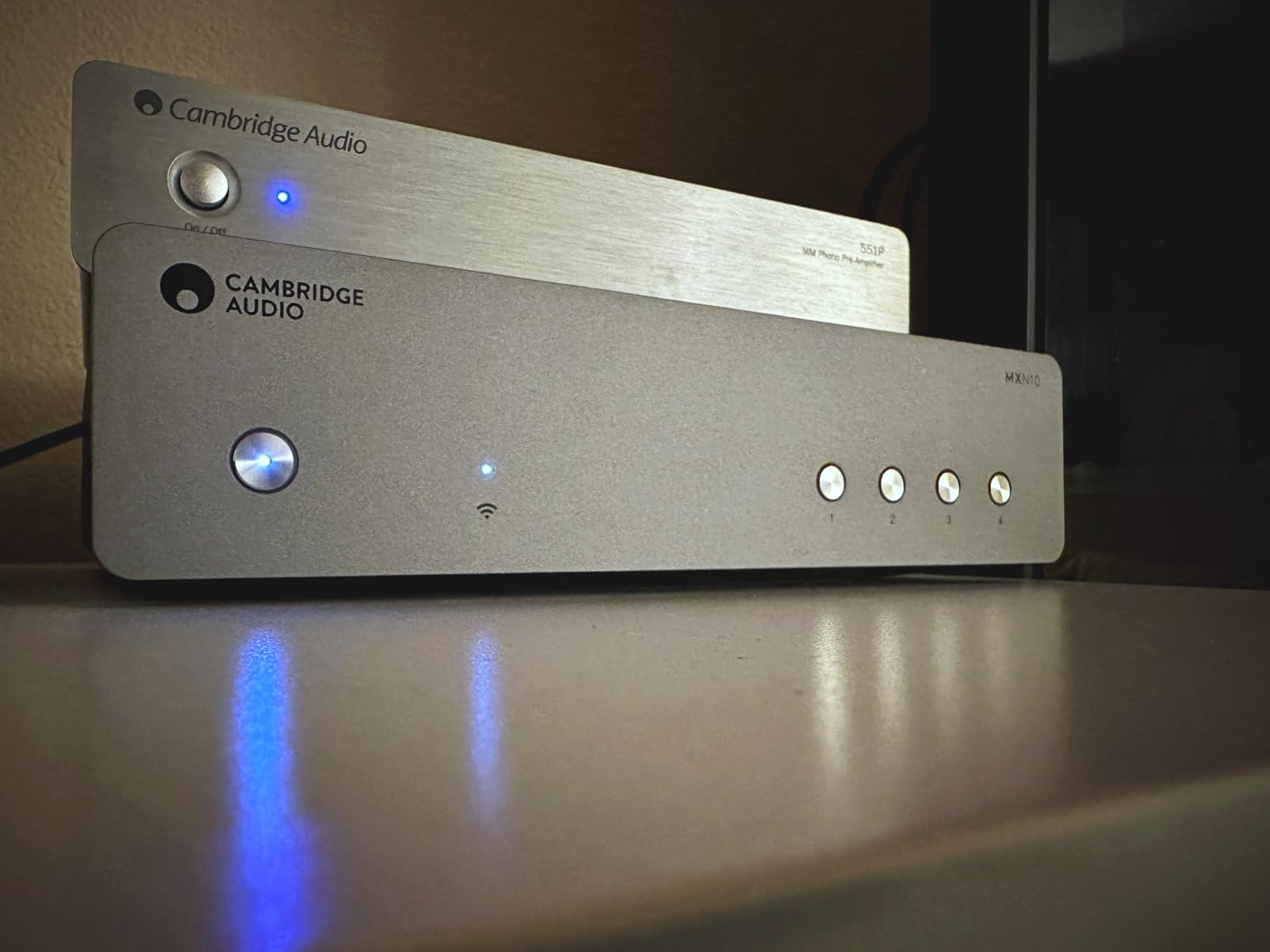
Roon Ready certification is a big deal here, and it is one of the reasons the MXN 10 sits above the WiiM and entry-level Bluesound options for serious audiophiles. If you run a Roon Core server, the MXN 10 integrates seamlessly and gives you bit-perfect playback of your entire local and streaming library from a single interface.
The StreamMagic app deserves special mention. It is one of the smoother and more reliable streaming apps I have used, with clean integration of Spotify Connect, Tidal, Qobuz, internet radio, and USB playback from a thumb drive. Cambridge Audio has a strong track record of supporting their streamers with firmware updates, which matters a lot for a device you expect to keep for years.
Who should buy the Cambridge Audio MXN 10
This is the best music streamer for a traditionalist who wants a no-nonsense, well-built network player from a respected hi-fi brand. If you value long-term software support, clean sound, and Roon integration over flashy touchscreens, the MXN 10 hits the target.
It is also a natural match for anyone who already owns Cambridge Audio amplification, since it shares the same design language and will sit naturally in a rack alongside an AXR or CXA amplifier.
What to consider before buying
The MXN 10 has no front panel display, which some listeners will miss. You are entirely reliant on the app for track information, which is fine for most people but worth knowing if you like to see what is playing at a glance.
There are also no physical inputs for connecting a CD player or other digital source. The MXN 10 is purely a network streamer, so if you want to integrate other digital sources you will need a separate DAC or a different component.
6. Eversolo DMP-A6 Gen 2 – The Audiophile Command Center
EVERSOLO DMP-A6 Gen 2 Hi-Fi Music Streamer, Wireless Digital Music Player, DAC, Music Service&Streaming Qobuz, Tidal&More, DSD512, EOS Audio Engineer, Native Multi-Channel DSD, Exclusive App
Dual ESS ES9038Q2M DAC
6 inch LCD touchscreen
DSD512 support
NVMe drive bay
XLR balanced outputs
Pros
- Dual-mono ESS ES9038Q2M DAC configuration
- Supports DSD512 and MQA for ultimate format flexibility
- 6 inch touchscreen is large and responsive
- Built-in NVMe drive bay for local storage
- Balanced XLR and RCA outputs
- Android 11 based system with broad app support
Cons
- Remote not included in the box
- Some users report power reliability issues
- UI can be occasionally clunky
- Apple Music integration has known issues
- No subwoofer output or bass management
The Eversolo DMP-A6 Gen 2 is the most ambitious streamer in this lineup, and it is the one that feels the least like a traditional hi-fi component and the most like a dedicated audiophile computer. From the moment you turn it on and see the 6 inch LCD touchscreen light up, it is clear that Eversolo is aiming at a different kind of customer than WiiM or Bluesound.
The star of the show is the dual-mono ESS ES9038Q2M DAC configuration. Running two high-end DAC chips in a dual-mono layout is something normally reserved for streamers and DACs costing several thousand dollars, and the result is a soundstage that is wide, deep, and remarkably stable. Instruments sit in space with a precision that I usually only hear from separates costing two or three times as much.
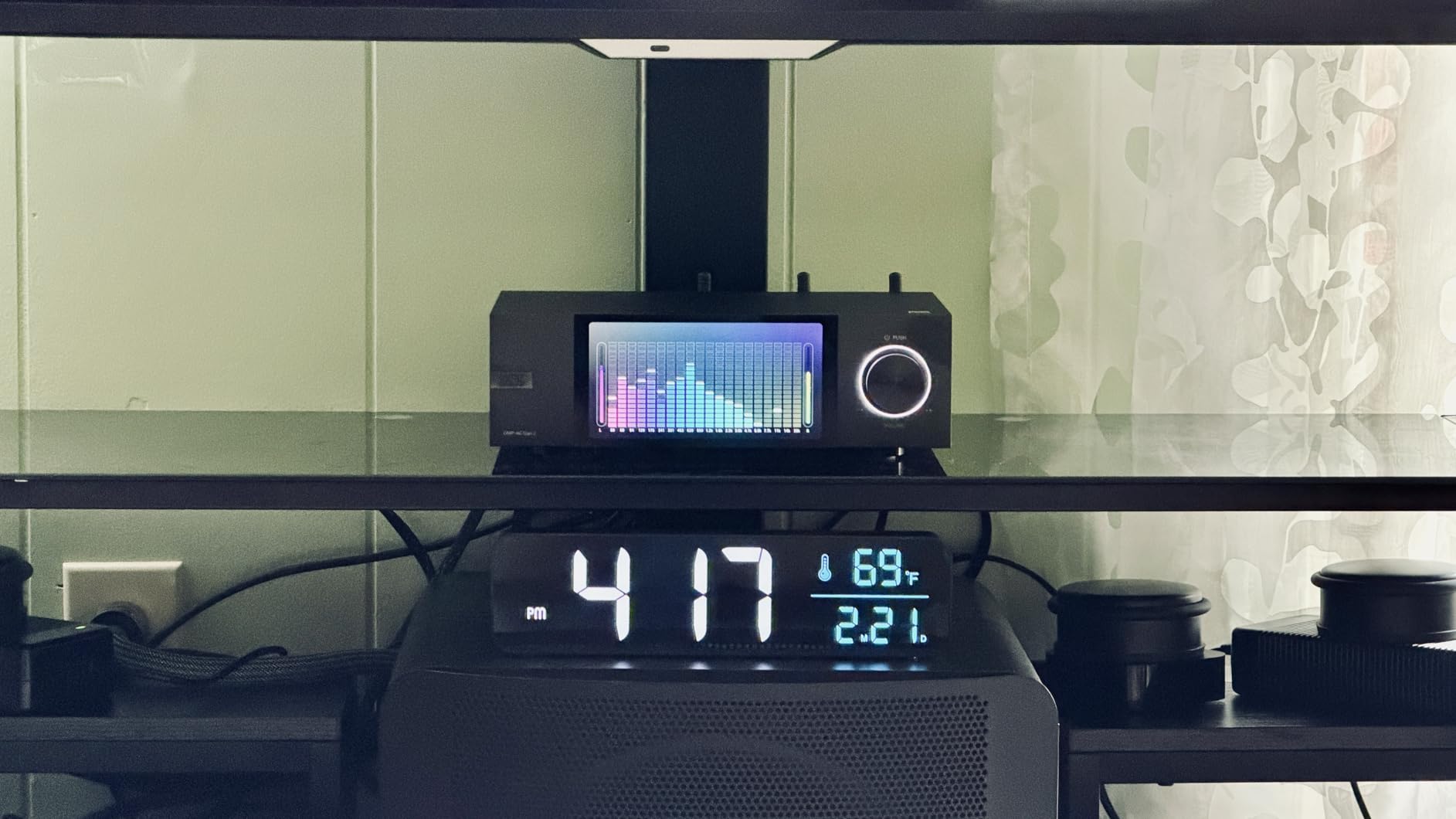
Format support is comprehensive. The DMP-A6 Gen 2 handles DSD512, MQA, and PCM up to high sample rates, and the Android 11-based operating system means you can install streaming apps directly on the device rather than relying solely on a phone. The NVMe drive bay is a genuinely useful feature, letting you install internal storage for a local music library without hanging an external drive off the back.
Connectivity is extensive, with XLR balanced outputs, RCA outputs, HDMI ARC, USB, optical, and coaxial connections. There is also HD Bluetooth input and a 12V trigger for integrating the DMP-A6 Gen 2 into a larger system with automated power control.
Who should buy the Eversolo DMP-A6 Gen 2
This is the best music streamer for a dedicated audiophile who wants a single box that can act as streamer, DAC, and music server. If you have a large local library and want internal storage, the NVMe bay makes the DMP-A6 Gen 2 uniquely capable in this price range.
It is also the strongest pick here for someone running a balanced system with XLR inputs on their amplifier or powered speakers, since the balanced outputs take full advantage of the dual-mono DAC architecture.
What to consider before buying
The DMP-A6 Gen 2 does not include a remote, which is a surprising omission at this price. You will need to use the touchscreen or purchase a remote separately.
A number of users have reported power reliability issues and occasional UI lag. Eversolo has been releasing firmware updates to address these, but it is worth knowing that the software experience is not always as polished as what you get from WiiM or Cambridge Audio.
7. Bluesound Node (2024) – The Full-Feature Streamer
Bluesound Node Performance Multi-Room Hi-Res Wireless Music Streamer (2024 Model) - Black
ESS ES9039Q2M SABRE DAC
Dirac Live room correction
HDMI eARC
Dolby Digital decoding
BluOS multi-room
Pros
- ESS ES9039Q2M SABRE DAC for outstanding precision
- Dirac Live room correction included
- HDMI eARC for TV integration
- Dolby Digital decoding for home theater use
- BluOS multi-room platform with broad brand support
- Functions as preamp and headphone amplifier
Cons
- DSD playback requires future update
- Higher price than the Node Nano
- Limited early review sample
- Some 1-star reviews reported
The Bluesound Node (2024) is the full-fat version of the Node Nano, and it adds a set of features that push it firmly into premium territory. If you want a single box that can handle music streaming, TV audio, room correction, and multi-room without breaking a sweat, this is the one to look at.
The ESS ES9039Q2M SABRE DAC is the same excellent chip used in the Node Nano, and it delivers the same detailed, musical sound. The difference is that the full Node wraps that DAC in a much more complete package, with HDMI eARC for connecting your TV, Dolby Digital decoding for movie soundtracks, and Dirac Live room correction to tame acoustic problems in your listening space.
Dirac Live is the standout feature here. It is the same room correction technology used in much more expensive processors and receivers, and it can make a real, audible difference to how your system sounds in an imperfect room. After running the calibration with the included microphone, the bass in my test room tightened up noticeably and the midrange cleared up in a way that no EQ tweak could have achieved manually.
The BluOS platform gives you the same reliable multi-room experience as the Node Nano, with the addition of HDMI eARC and analog inputs that let the Node serve as the hub of a full entertainment system rather than just a music streamer. The subwoofer output with bass management rounds out the home theater credentials nicely.
Who should buy the Bluesound Node (2024)
This is the best music streamer for someone who wants one box to handle both music and TV audio in a main listening room. The HDMI eARC input, Dolby Digital decoding, and Dirac Live room correction make it as much a home theater component as a music streamer.
It is also the natural upgrade path if you started with a Node Nano and want more features, since both devices share the same BluOS platform and will work together seamlessly in a multi-room setup.
What to consider before buying
The Node (2024) is the second most expensive streamer in this lineup after the Eversolo, and its early review sample is still relatively small. Some users have reported issues worth researching before you commit.
DSD playback is listed as coming via a future update, so if DSD support is important to you right now, the Eversolo DMP-A6 Gen 2 or Cambridge Audio MXN 10 are safer bets.
How to Choose the Best Music Streamer
Choosing the right music streamer comes down to understanding what you actually need and matching it to the features that matter. I have broken down the key decisions below based on what I learned testing all seven of these units side by side.
Why the DAC matters
The DAC, or digital-to-analog converter, is the single most important component in any music streamer. It is what turns the digital stream of ones and zeros into the analog signal your amplifier can play, and its quality directly determines how good your music sounds.
Every streamer in this guide uses an ESS SABRE or AKM DAC chip, and those are both excellent choices. The differences come down to the specific chip model and how well the manufacturer has implemented it. The ESS ES9038Q2M in the WiiM Ultra and the dual-mono version in the Eversolo DMP-A6 Gen 2 are a clear step up from the basic DACs in cheaper streamers, and you can hear it in the detail, imaging, and overall musicality.
If you already own a high-quality external DAC, you do not need to pay for a great one inside your streamer. The WiiM Mini is the perfect example, because its optical output lets you bypass its internal DAC entirely and feed a clean digital signal straight to your existing converter.
WiFi vs Ethernet vs Bluetooth
This is one of the most common questions I see on audio forums, and the answer is more nuanced than a lot of people suggest. Ethernet is the most stable connection and eliminates the variable of WiFi interference, so if your streamer and router are in the same room, run a cable. Every streamer in this guide except the WiiM Mini and Cambridge MXN 10 has an Ethernet port.
WiFi is perfectly fine for hi-res streaming as long as your network is solid. Modern streamers like the WiiM Ultra with WiFi 6 can handle 24-bit/192kHz audio without any trouble, and I never experienced dropouts during my testing on a decent mesh network.
Bluetooth is the lowest-quality option and should be treated as a convenience feature rather than a primary streaming method. The difference between Bluetooth and proper WiFi-based streaming is genuinely audible, and many forum users describe it as night and day. Use Bluetooth for casual listening and WiFi or Ethernet for serious sessions.
Streaming service compatibility
Before you buy any streamer, check that it supports the services you actually use. Spotify Connect and TIDAL Connect are near-universal across the streamers in this guide, but there are important differences. AirPlay 2 support varies, with the WiiM Ultra notably lacking it, and Roon Ready certification is only available on the WiiM Pro Plus, WiiM Ultra, Cambridge MXN 10, and Eversolo DMP-A6 Gen 2.
If you are a Qobuz subscriber, look for native Qobuz Connect support rather than relying on AirPlay or Chromecast. The WiiM Pro Plus and WiiM Ultra both support it natively, as does the Eversolo, and the difference in sound quality between native Qobuz Connect and AirPlay is measurable and audible.
Apple Music is the tricky one. None of these streamers offer bit-perfect Apple Music streaming, so you will be limited to AirPlay, which resamples the audio. If Apple Music is your primary service, the WiiM Pro Plus or Bluesound Node Nano with AirPlay 2 is your best bet, but know that you are not getting the full resolution of the original stream.
Multi-room platform choices
If whole-home audio is part of your plan, the platform you choose matters more than any individual streamer. BluOS, used by Bluesound and NAD, is the most mature and reliable multi-room system outside of Sonos, and it supports high-resolution audio up to 24-bit/192kHz across multiple rooms. The WiiM platform is a strong budget alternative that uses a combination of AirPlay 2, Google Cast, and proprietary grouping.
Reddit users consistently report that BluOS offers the most stable multi-room experience, with the WiiM platform close behind at a much lower price. The closed-ecosystem issue comes up a lot, because once you commit to a platform you are generally locked into that brand family for future expansion.
Integrating a streamer with a vinyl setup
One of the most common questions I get from readers of this site is how to add streaming to a system that already centers on a turntable. The good news is that it is genuinely simple. You connect the streamer to a spare input on your amplifier or preamp, exactly the same way you would connect any other source component, and switch between vinyl and streaming using the input selector.
The WiiM Ultra is the only streamer in this guide with a dedicated phono input, which means it can accept a turntable directly without a separate phono preamp. For every other model, you will need either a phono preamp between your turntable and the amplifier, or an amplifier with a built-in phono stage.
If you want to stream your vinyl to other rooms, that is a more advanced setup that requires a phono preamp with a digital output or a separate ADC (analog-to-digital converter). It is a great feature for serious collectors, but it is beyond what a basic music streamer can do on its own.
FAQ’s
What is the most popular music streamer?
The WiiM Mini is currently the most popular dedicated music streamer by sales volume, thanks to its under $100 price point and broad platform support. The WiiM Pro Plus and WiiM Ultra are the next most popular, followed by the Bluesound Node series among buyers who want the BluOS multi-room platform.
Is it worth buying a music streamer?
Yes, a dedicated music streamer is worth buying if you want better sound quality than Bluetooth can provide, if you subscribe to a lossless streaming service like Tidal or Qobuz, or if you want to integrate streaming into an existing stereo system. A streamer like the WiiM Mini at $89 delivers audibly better sound than Bluetooth for a very modest investment.
Which is the best music streaming platform?
The best streaming platform depends on your priorities. Tidal and Qobuz offer the best sound quality for audiophiles with hi-res and lossless tiers. Spotify has the largest user base and best discovery features but tops out at 320kbps. Apple Music offers lossless and spatial audio but is harder to integrate with non-Apple streamers. For a dedicated streamer, Tidal Connect and Qobuz Connect provide the best bit-perfect experience.
Do I need a music streamer if I already have a Bluetooth receiver?
If sound quality matters to you, yes. Bluetooth compresses audio and caps resolution well below what a network streamer can deliver. A WiFi-based music streamer using Spotify Connect, AirPlay 2, or Tidal Connect streams lossless audio up to 24-bit/192kHz, which is a clear and audible upgrade over even the best Bluetooth codecs like aptX Adaptive.
Final Thoughts on the Best Music Streamers
After months of testing, the WiiM Ultra stands out as the best overall music streamer for most people, thanks to its combination of a serious ESS DAC, a useful touchscreen, HDMI ARC, and a phono input that makes it a genuine all-in-one solution. The WiiM Pro Plus remains the best value pick for anyone who wants great sound and broad platform support without paying for features they will not use, and the WiiM Mini continues to be the unbeatable budget entry point into proper network streaming.
For listeners who want the BluOS multi-room ecosystem, the Bluesound Node Nano and Node (2024) are excellent choices, and the Cambridge Audio MXN 10 is the natural pick for a traditional audiophile who values software maturity and Roon integration. At the top end, the Eversolo DMP-A6 Gen 2 offers a level of DAC quality and feature ambition that genuinely justifies its price for the right buyer.
Whichever you choose, moving from Bluetooth or phone-out streaming to a dedicated network music player is one of the most rewarding upgrades you can make to a hi-fi system, and the best music streamers in 2026 make that upgrade more accessible than it has ever been.