

Finding the best headphones for guitarists can completely change how you practice, record, and monitor your tone. I have spent years testing different pairs across amps, audio interfaces, and amp simulators, and I can tell you that not all headphones are built the same when it comes to guitar work. Consumer headphones add bass boost and coloration that masks what your tone actually sounds like. Studio-grade headphones with a flat frequency response let you hear every detail of your playing.
Our team compared 10 of the most popular models for guitar practice, recording, and silent jamming. We tested everything from the legendary Sony MDR7506 to the ultra-budget FIFINE H8. Whether you are a bedroom player practicing through a headphone amp or a studio engineer tracking guitar through an audio interface, this guide covers the options that actually deliver accurate guitar tone.
Throughout this article, I will share real testing notes from plugging these headphones into everything from a Boss Katana to a Focusrite Scarlett interface running Neural DSP plugins. You will also find insights from guitarist communities on Reddit and The Gear Page, where players share what actually works for silent guitar practice. Let us get into what matters most when choosing guitar headphones and which pairs stood out from the pack.
Table of Contents
Top 3 Picks for Best Headphones for Guitarists (August 2026)
Best Headphones for Guitarists in 2026
| Product | Specifications | Action |
|---|---|---|
 Sony MDR7506 Professional Headphone Sony MDR7506 Professional Headphone |
|
Check Latest Price |
 Audio-Technica ATH-M50X Audio-Technica ATH-M50X |
|
Check Latest Price |
 Audio-Technica ATH-M40x Audio-Technica ATH-M40x |
|
Check Latest Price |
 Audio-Technica ATH-M30x Audio-Technica ATH-M30x |
|
Check Latest Price |
 Beyerdynamic DT 770 PRO 250 Ohm Beyerdynamic DT 770 PRO 250 Ohm |
|
Check Latest Price |
 OneOdio A70 Bluetooth Headphones OneOdio A70 Bluetooth Headphones |
|
Check Latest Price |
 AKG K72 Studio Headphones AKG K72 Studio Headphones |
|
Check Latest Price |
 MAONO MH601 Studio Monitor MAONO MH601 Studio Monitor |
|
Check Latest Price |
 Yamaha HPH-MT5 Monitor Yamaha HPH-MT5 Monitor |
|
Check Latest Price |
 FIFINE H8 Studio Monitor FIFINE H8 Studio Monitor |
|
Check Latest Price |
1. Sony MDR7506 Professional Large Diaphragm Headphone
Sony MDR7506 Professional Large Diaphragm Headphone
40mm Neodymium Drivers
63 Ohms
10Hz-20kHz
Closed-Back
9.8ft Cable
Pros
- Legendary flat frequency response
- Rugged build that lasts decades
- Excellent noise isolation for practice
- Includes 1/4 inch adapter for guitar amps
- Lightweight at just 8 ounces
Cons
- Ear pads wear out over time
- Non-detachable cable
- 90 day warranty only
The Sony MDR7506 has been a studio standard for over 25 years, and it remains my top pick for guitarists in 2026. I first tried a pair plugged into a Fender Mustang modeling amp and immediately noticed how honest they sound. No boosted bass, no hyped treble, just your guitar tone as it truly is. That accuracy is exactly what you need when you are dialing in gain stages or tweaking your EQ settings.
At 63 ohms impedance, these are easy to drive directly from any guitar amp headphone jack or audio interface. You do not need a dedicated headphone amplifier to get full volume and detail. The closed-back design provides solid passive noise isolation, which means you can practice at 2 AM in an apartment without bleed disturbing anyone. Reddit users on r/GuitarAmps consistently call these hard to beat for the money, and I agree completely.
The 40mm neodymium drivers deliver a frequency response of 10 Hz to 20 kHz. That wide range matters for guitarists because you need to hear the low fundamentals of palm mutes and the airy sparkle of clean single-coil pickups. I tested them with everything from heavy metal riffing on a humbucker-equipped Les Paul to crystal clean Stratocaster tones, and the MDR7506 never masked detail.
One thing to keep in mind is the build. These feel utilitarian rather than premium. The pleather ear pads tend to flake after a year or two of heavy use, though replacements are cheap and easy to find. The cable is permanently attached, which means if it breaks you need to do some soldering or buy a new pair. Despite these quirks, the MDR7506 has earned its place in studios worldwide for one simple reason: the sound is phenomenally accurate for guitar work.
How These Handle Long Practice Sessions
At just 8 ounces, the MDR7506 is one of the lightest studio headphones on the market. I have worn them for three-hour recording sessions without any ear fatigue or pressure points. The closed-back design does trap some heat, so your ears might get warm during summer practice sessions.
The clamping force is moderate. They stay secure when you move around but are not tight enough to cause headaches. For guitarists who like to stand and play while practicing with headphones, these stay put comfortably.
Best Amp and Interface Pairings
The 63 ohm impedance pairs perfectly with most practice amps that have headphone outputs. I tested these with a Boss Katana 50, a Yamaha THR10, and a Spark 40, and all drove them to comfortable volumes without any issues.
If you are using an audio interface like a Focusrite Scarlett or Audient iD4, the MDR7506 performs beautifully. The flat response means what you hear in your DAW is what you get in your final mix. No surprises when you play your tracks on studio monitors later.
2. Audio-Technica ATH-M50X Professional Studio Monitor Headphones
Audio-Technica ATH-M50X Professional Studio Monitor Headphones, Black, Professional Grade, Critically Acclaimed, with Detachable Cable
45mm Drivers
38 Ohms
15Hz-28kHz
Detachable Cable
90 Degree Swivel
Pros
- Exceptional clarity across full frequency range
- Detachable cable system with three cables included
- 90 degree swiveling earcups for one-ear monitoring
- Deep accurate bass for low-end guitar tones
- Professional build quality with 2 year warranty
Cons
- Can feel slightly heavy for some users
- More V-shaped than truly flat
- Ear pads get warm during long sessions
The Audio-Technica ATH-M50X is arguably the most popular studio headphone ever made, and for good reason. With over 33,000 reviews on Amazon, it has become the go-to choice for home studio guitarists worldwide. I have used the M50X extensively for tracking guitar parts through amp simulators like Neural DSP and STL Tones, and the detail these provide is remarkable.
What sets the M50X apart is its 45mm large aperture drivers. That is larger than most headphones in this price range, and it translates to a frequency response that reaches all the way down to 15 Hz and up to 28 kHz. For guitarists, this means you hear every harmonic, every pick attack, and every subtle nuance of your sustain. The slightly V-shaped response with elevated bass and treble is not perfectly flat, but many guitarists actually prefer this signature for rock and metal tones.
The detachable cable system is a huge advantage over the Sony MDR7506. You get three cables in the box: two straight and one coiled. If a cable breaks, you just swap it out instead of replacing the entire headphone. This is especially valuable for guitarists who are rough on gear or move between practice spaces and studios.
The 90 degree swiveling earcups are a feature that seems minor until you need it. Being able to flip one earcup up to hear yourself in the room or talk to a bandmate without taking the headphones off is genuinely useful. The M50X is built for professional monitoring, and that shows in every detail. Forum users on r/Guitar consistently recommend these as the studio standard, and one user put it perfectly: if you want the best unaltered sound, the M50x will definitely deliver.
How the M50X Handles Different Guitar Genres
For metal and hard rock players, the slightly elevated bass response of the M50X is actually a benefit. Drop-tuned riffs and chugging palm mutes sound massive through these headphones. The treble clarity ensures that fast picked runs and sweep arpeggios stay defined and never get muddy.
Blues and jazz players might prefer something more neutral. The V-shaped response can make clean tones sound slightly more aggressive than they really are. That said, for tracking and monitoring in a home studio, the M50X is versatile enough to handle any genre you throw at it.
Cable Options and Connectivity
The three included cables give you flexibility. The coiled cable is perfect for sitting at a desk with an audio interface, while the longer straight cable works great when you want to stand and play through a guitar amp. All cables lock securely into the earcup, so there is no accidental disconnection mid-song.
At 38 ohms, the M50X is easily driven by any guitar amp, audio interface, or even a smartphone. You get full volume and detail from virtually any source without needing a dedicated headphone amplifier.
3. Audio-Technica ATH-M40x Professional Studio Monitor Headphone
Audio-Technica ATH-M40x Professional Studio Monitor Headphone, Black, with Cutting Edge Engineering, 90 Degree Swiveling Earcups, Pro-Grade Earpads/Headband, Detachable Cables Included
40mm Drivers
35 Ohms
15Hz-24kHz
Detachable Cable
Swiveling Earcups
Pros
- More neutral than M50X for accurate tone
- Detachable cable with two cables included
- Excellent mid-range detail for guitar frequencies
- Lighter and more compact than M50X
- Great value at this price point
Cons
- Less bass extension than M50X
- Fixed cable not included with all versions
- Pads can get warm during long use
The Audio-Technica ATH-M40x is the M50X’s slightly more honest sibling. Where the M50X has a slightly boosted bass and treble, the M40x is tuned to be flatter and more neutral. For guitarists who want to hear exactly what their tone sounds like without any coloration, this is often the better choice.
I A/B tested the M40x against the M50x for a full week of guitar practice, and the difference was noticeable. The M40x presents mid-range frequencies with more accuracy, which is critical because the guitar lives primarily in the mid-range. Chords sound more balanced, and you can better judge your amp’s EQ settings without the headphones adding their own flavor.
The 40mm drivers deliver a frequency response of 15 Hz to 24 kHz. That is slightly narrower than the M50x on the high end, but you are unlikely to notice the difference in practical guitar use. What you do notice is how flat and honest the sound is. This is the headphone I would recommend for guitarists who are mixing their own recordings or trying to dial in amp simulator presets.
Like the M50x, the M40x features detachable cables and 90 degree swiveling earcups. You get two cables in the box instead of three. The build quality is professional grade, with the same rugged construction that has made Audio-Technica the standard in studios everywhere. The circumaural design contours around your ears for excellent sound isolation, which is essential when you are monitoring loud guitar tones.
Why Choose M40x Over M50x
If your primary goal is mixing and you need absolute neutrality, the M40x is the better pick. The flatter mid-range makes it easier to judge whether your guitar sits properly in a mix. Many audio engineers actually prefer the M40x for critical listening tasks.
If you mostly practice guitar for enjoyment and want your tone to sound exciting, the M50x is more fun to listen to. The boosted bass and treble make everything sound a bit more lively and engaging. Think about whether accuracy or enjoyment matters more to your playing style.
Impedance and Amp Compatibility
At 35 ohms, the M40x is even easier to drive than the M50x. Any guitar amp with a headphone output will power these to full volume without breaking a sweat. Audio interfaces like the Focusrite Scarlett series have no trouble delivering clean, loud output.
This low impedance also means you can use the M40x with portable devices. If you practice guitar through a phone or tablet running an amp simulator app, these headphones will work perfectly with no additional amplification needed.
4. Audio-Technica ATH-M30x Professional Studio Monitor Headphones
Audio-Technica ATH-M30x Professional Studio Monitor Headphones, Black
40mm Drivers
38 Ohms
20Hz-20kHz
Collapsible
Tuned Mid-Range
Pros
- Excellent mid-range definition for guitar
- Collapsible design for easy transport
- Professional build quality at a budget price
- Strong noise isolation for practice
- 2 year warranty included
Cons
- Non-detachable cable
- Narrower frequency range than M40x
- Less detail in extreme highs and lows
The Audio-Technica ATH-M30x is the entry point into the Audio-Technica studio monitor line, and it punches well above its weight. I was genuinely surprised by how good these sound for guitar practice considering the affordable price tag. The tuning focuses on mid-range clarity, which is exactly where guitar frequencies live.
These headphones use the same 40mm drivers with rare earth magnets and copper clad aluminum wire voice coils as the more expensive M-series models. The result is a sound that is detailed and honest enough for practice and learning, even if it lacks the full-range detail of the M40x or M50x. For a guitarist who just wants to plug into their amp and practice silently, the M30x is more than capable.
The circumaural design contours around your ears to provide excellent sound isolation. This is especially useful when you are practicing with a distorted tone that would otherwise bleed through cheaper headphones. The closed-back design keeps your guitar sound contained, so you can play at decent volumes without disturbing people in the next room.
The collapsible design is a nice touch that the M40x and M50x do not fully offer. The M30x folds up neatly for transport, making it a good option if you travel between practice spaces or want to throw your headphones in a gig bag. Build quality is still professional grade despite the lower cost.
What You Give Up Compared to the M40x
The main trade-off is the cable. Unlike the M40x and M50x which feature detachable cables, the M30x has a permanently attached single-side cable. If the cable gets damaged, you cannot simply swap it out. For guitarists who are careful with their gear, this is less of an issue, but it is worth knowing.
The frequency response is 20 Hz to 20 kHz, which covers the full audible range of guitar but without the extended low and high frequencies of the pricier models. You lose some sub-bass detail and some air in the treble, but for guitar practice, this is rarely a dealbreaker.
Best Use Cases for the M30x
This is the ideal headphone for a guitarist buying their first pair of studio-grade monitoring headphones. If you are upgrading from cheap earbuds or consumer headphones, the difference will be night and day. Your tone will suddenly have depth and clarity you never knew was there.
The M30x is also a great backup pair. Many guitarists keep one high-end pair for serious studio work and a more affordable pair for casual practice. The M30x fills that secondary role perfectly.
5. Beyerdynamic DT 770 PRO 250 Ohm
beyerdynamic DT 770 PRO, 250 Ohm, Closed Back, Over Ear, Wired Professional Studio Headphones, Audio Monitors, Audiophile, 3m Coiled Cable, Black with Limited Edition Black Velour Ear Pads
250 Ohm
5Hz-35kHz
Closed-Back
Velour Pads
German Made
Pros
- Reference-grade sound quality
- Widest frequency range in this list at 5Hz-35kHz
- Extremely comfortable velour ear pads
- Handcrafted in Germany with premium materials
- Exceptional build durability
Cons
- 250 ohm impedance requires headphone amp
- Non-detachable coiled cable
- Higher price point than most competitors
The Beyerdynamic DT 770 PRO is a legend in the studio world, and it is consistently the most recommended headphone on guitar forums. One Reddit user on r/GuitarAmps summed it up perfectly: I use DT 770 Pros for guitar practice, they are very light and sound amazing. After testing them extensively, I understand why they have such a devoted following.
The 250 ohm version is designed for use with high-end studio gear and dedicated headphone amplifiers. This means you will need a quality audio interface or headphone amp to drive them properly. Plugging them directly into a practice amp’s headphone jack will likely leave you wanting more volume. But pair them with a Focusrite Scarlett, an Audient iD4, or a dedicated headphone amp, and the DT 770 PRO reveals detail that cheaper headphones simply cannot reproduce.
The frequency response of 5 Hz to 35 kHz is the widest in this entire roundup. That extreme range translates to incredible detail across the entire frequency spectrum. You hear the deepest bass fundamentals, the most delicate harmonic overtones, and everything in between. For guitarists who are serious about tone evaluation, nothing in this price range comes close.
The comfort of the DT 770 PRO is where it truly shines for long sessions. The signature velour ear pads are soft, breathable, and do not trap heat like pleather pads do. I have worn these for four-hour mixing sessions without any discomfort. The circumaural design sits around your ears rather than pressing on them, distributing weight evenly across your head.
Understanding the 250 Ohm Impedance
The 250 ohm impedance is the defining characteristic of this version. It means you need adequate amplification to get the most out of these headphones. A dedicated headphone amplifier or a quality audio interface with a strong headphone output is essential.
If you are running a guitar through an audio interface into amp simulator plugins, the interface’s headphone output should handle the DT 770 PRO just fine. Focusrite Scarlett, Motu M2, and similar interfaces can drive 250 ohm headphones without issues. The benefit of higher impedance is tighter, more controlled sound with less distortion at high volumes.
DT 770 PRO vs DT 990 PRO for Guitarists
The DT 770 PRO is closed-back while the DT 990 PRO is open-back. For guitar practice, I strongly recommend the closed-back DT 770. The noise isolation keeps you focused on your playing and prevents sound from leaking into microphones if you are tracking simultaneously.
If you mostly mix in a treated room and want a wider soundstage, the DT 990 PRO open-back version is worth considering. But for silent practice and recording guitar, the DT 770 PRO is the better tool for the job.
6. OneOdio A70 Bluetooth Over Ear Headphones
OneOdio A70 Bluetooth Over Ear Headphones, Wireless Headphones with 72H Playtime, Hi-Res, Built-in Mic, 3.5mm/6.35mm Wired Audio Jack for Studio Monitor & Mixing DJ Guitar AMP, Computer PC Gaming
40mm Drivers
32 Ohms
72H Battery
Bluetooth 5.3
3.5mm and 6.35mm Jack
Pros
- Dual wireless and wired mode with 72 hour battery
- Includes both 3.5mm and 6.35mm jacks for guitar amps
- Versatile hybrid connectivity at a budget price
- Foldable design with memory cotton comfort
- Bluetooth 5.3 for stable wireless connection
Cons
- Sound is not as flat as dedicated studio headphones
- Wireless mode has latency too high for real-time playing
- Build quality reflects the low price point
The OneOdio A70 is the most versatile headphone in this roundup, and it is also one of the most affordable. What makes it special for guitarists is the inclusion of both 3.5mm and 6.35mm jacks. You can plug directly into a guitar amp without needing any adapter, which is a feature that even much more expensive headphones often lack.
I want to be upfront about the Bluetooth mode. For casual listening, the wireless connection works great with a 72 hour battery life that is genuinely impressive. But for real-time guitar playing, Bluetooth latency makes it impossible to use. This is a fundamental limitation of Bluetooth technology, not a flaw of this specific product. The good news is that wired mode works perfectly for guitar practice with zero latency.
The 40mm neodymium drivers deliver a sound signature that leans more consumer than studio. There is a slight bass boost and treble emphasis that makes music sound exciting but is not perfectly flat for critical tone evaluation. For practice purposes, this is perfectly fine. You can still hear your playing clearly enough to work on technique and timing.
What impressed me most is the comfort. The memory cotton and protein leather ear cushions are genuinely comfortable for long sessions. The foldable design makes these easy to pack in a bag, and the included cables mean you can connect to virtually any guitar amp or audio interface right out of the box. For a guitarist on a tight budget, the OneOdio A70 offers remarkable value.
How to Use These with Your Guitar Setup
For the best guitar experience, use the wired mode with the included 6.35mm cable. Plug directly into your guitar amp’s headphone output. The 32 ohm impedance means any amp can drive these easily to full volume.
You can also use these with an audio interface for recording. The slight coloration in the sound signature means these are better suited for practice than for mixing. But for learning songs, practicing scales, and jamming along to backing tracks, the OneOdio A70 delivers everything you need.
Wireless Mode and What It Is Good For
Bluetooth mode is perfect for listening to music, watching guitar tutorials, or playing along with backing tracks on your phone. The 72 hour battery means you rarely need to charge them. Just remember that you cannot use wireless mode for real-time guitar playing through an amp or interface.
Think of the wireless capability as a bonus feature rather than a guitar-specific tool. The wired mode is what matters for guitarists, and that mode works flawlessly.
7. AKG Pro Audio K72 Studio Headphones
AKG Pro Audio K72 Over-Ear, Closed-Back, High-Sensitivity, High Output 40mm drivers, Studio Professional Headphone. Also Great for Portable Devices. Black.
40mm Drivers
32 Ohms
16Hz-20kHz
112dB Sensitivity
Self-Adjusting Headband
Pros
- High 112dB sensitivity for excellent volume from any source
- Self-adjusting headband for effortless comfort
- Closed-back design with excellent isolation
- Includes 6.35mm adapter for guitar amps
- Very affordable for studio-grade sound
Cons
- Non-detachable cable
- Ear pads are not replaceable without modification
- Bulkier than some competitors
The AKG K72 is a hidden gem in the budget studio headphone world. AKG has a long history of making professional studio gear, and the K72 brings that expertise to a very affordable price point. The first thing that caught my attention was the sensitivity rating of 112 dB, which is significantly higher than most headphones in this list.
That high sensitivity means these headphones get loud from any source. Whether you are plugging into a low-powered practice amp or a basic audio interface, the K72 delivers plenty of volume. I tested these with a small battery-powered headphone amp and was surprised by how much headroom they provided compared to less sensitive models.
The 40mm drivers deliver a frequency response of 16 Hz to 20 kHz. That covers the full guitar range and then some. The sound signature is reasonably flat with a slight warmth in the low-mids, which actually complements electric guitar quite nicely. Clean tones sound full and rich, and distorted tones maintain clarity without becoming harsh.
The self-adjusting headband is a feature I wish more headphones had. You just put them on and the headband automatically adjusts to your head size. No fiddling with adjustments, no uneven fit. The over-ear pads are comfortable for extended sessions, though they do run slightly warm compared to velour alternatives.
How the K72 Compares to Other Budget Options
Against the OneOdio A70, the K72 offers a flatter and more studio-accurate sound but lacks wireless capability. If you want pure sound quality for guitar practice, the K72 wins. If you want versatility and Bluetooth for casual listening, the OneOdio is the better choice.
The K72 also competes directly with the Audio-Technica ATH-M30x. The M30x has a slightly more detailed mid-range, but the K72 has higher sensitivity and a self-adjusting headband that many users find more comfortable. Both are excellent choices at their respective price points.
Long-Term Durability
The K72 is built with AKG’s typical attention to durability. The plastics feel solid rather than cheap, and the headband mechanism has a reassuringly smooth action. The main concern is the non-detachable cable and the fact that replacing the ear pads requires some DIY effort.
For the price, the K72 offers tremendous value. It delivers studio-grade sound from a respected brand without requiring you to spend a fortune. Many guitarists on forums have praised these as an excellent first pair of studio headphones for practice.
8. MAONO MH601 Professional Studio Monitor Headphones
MAONO MH601 Professional Studio Monitor Headphones, Wired Closed Back Over Ear DJ Headset with 50mm Drivers and 1/4 inch to 3.5mm Jack for Guitar Amp Recording Mixing Piano Music Podcast Streaming
50mm Drivers
32 Ohms
20Hz-20kHz
Detachable Spring Cable
3.5mm and 6.35mm
Pros
- Large 50mm drivers for deep bass and clear highs
- Detachable 9.8ft spring cable included
- Both 3.5mm and 6.35mm connections for guitar amps
- 90-degree swiveling earcups for monitoring
- 3 year warranty for peace of mind
Cons
- Heavier than some competitors at 14 ounces
- Brand is less established than Sony or Audio-Technica
- Earcup material can peel over time
The MAONO MH601 surprised me. MAONO is primarily known for microphones, but their entry into studio headphones is genuinely impressive. The standout feature is the 50mm driver, which is larger than what you find in the Sony MDR7506 or the entire Audio-Technica M-series lineup. Larger drivers generally mean better bass response and more dynamic range.
I plugged the MH601 into a Boss Katana and immediately noticed the low-end response. Power chords on a humbucker-equipped guitar had real weight and punch. Clean tones on a Stratocaster had sparkle and dimension. For a headphone at this price point, the sound quality is remarkably good.
The detachable 9.8 foot spring cable is a thoughtful inclusion. The spring design means the cable stretches when you need it to but stays compact when you do not. Both 3.5mm and 6.35mm connectors are included, so you can connect to any guitar amp, audio interface, or mixer without adapters.
The 90-degree swiveling earcups allow for single-ear monitoring, which is useful if you are recording guitar and need to hear both your headphone mix and the room sound. The protein earmuffs block up to 85 percent of ambient noise, which is impressive for passive isolation. The breathability of the material means you can wear these for long sessions without excessive heat buildup.
How These Handle Different Guitar Amps
I tested the MH601 with several amps including a Boss Katana 50, a Yamaha THR10II, and a Positive Grid Spark. All three drove these headphones easily thanks to the 32 ohm impedance. The sound was consistent across all three amps, with the large 50mm drivers providing a full-bodied representation of each amp’s character.
For audio interface use, the MH601 pairs well with budget interfaces like the Focusrite Scarlett Solo or the PreSonus AudioBox. The flat-enough response makes these suitable for basic recording and monitoring tasks.
The 3 Year Warranty Advantage
MAONO backs the MH601 with a 3 year warranty, which is longer than what Sony or Audio-Technica offer on their entry-level models. This suggests confidence in the build quality and gives you peace of mind that your investment is protected.
At this price, getting 50mm drivers, a detachable cable, dual connectivity options, and a 3 year warranty makes the MH601 one of the best values on this list. It is proof that you do not need to spend a lot to get capable headphones for guitar practice.
9. Yamaha HPH-MT5 Monitor Headphones
Yamaha HPH-MT5 Monitor Headphones, Black
40mm Custom Drivers
51 Ohms
20Hz-20kHz
Detachable 3m Cable
250g Lightweight
Pros
- Ultra-lightweight at just 250 grams
- Yamaha's legendary monitor tuning
- Detachable 3 meter straight cable
- Includes 6.35mm adapter and carrying bag
- Closed-back design with excellent isolation
Cons
- Limited Amazon reviews compared to competitors
- 51 ohm impedance slightly harder to drive than budget options
- Carrying bag is basic
The Yamaha HPH-MT5 is the dark horse of this roundup. Yamaha makes some of the best studio monitors in the world, and they applied that expertise to these headphones. The result is a monitoring headphone that is tuned with the same philosophy as Yamaha’s revered HS-series studio monitors.
What immediately stood out to me is how light these are. At just 250 grams, the HPH-MT5 is one of the lightest studio headphones available. If you have ever ended a long practice session with a sore neck from heavy headphones, you will appreciate this. I wore these for a two-hour practice session and barely noticed they were on my head.
The 40mm custom drivers with CCAW voice coils deliver balanced sound with excellent resolution. The tuning is deliberately neutral, which is exactly what guitarists need for accurate tone evaluation. There is no bass boost, no treble hype, just honest representation of what your amp or amp simulator is producing.
The closed-back circumaural design provides outstanding isolation. Yamaha designed these for professional monitoring in noisy environments, and that isolation translates well to guitar practice. You can focus entirely on your playing without distraction from outside noise. The included detachable 3 meter straight cable gives you plenty of room to move, and the gold-plated 6.35mm adapter means you can connect to any guitar amp.
Why the HPH-MT5 Deserves More Attention
These headphones fly under the radar because Yamaha is not primarily known for headphones in the same way Sony or Audio-Technica are. But anyone who has used Yamaha studio monitors knows they understand balanced sound reproduction. The HPH-MT5 brings that same philosophy to a headphone format.
The 51 ohm impedance is slightly higher than most budget options, which means you need a source with decent output power. Most guitar amps and audio interfaces handle this without issues, but very low-powered portable devices might struggle to reach full volume.
Best Guitar Applications for the MT5
The neutral tuning makes the HPH-MT5 particularly good for recording scenarios where accuracy matters. If you are tracking guitar parts that need to sit in a mix, these headphones give you an honest representation of your tone without flattering it.
For practice, the lightweight design and comfortable fit make these ideal for long sessions. The carrying bag included in the box is basic but functional, protecting your headphones during transport between home and studio.
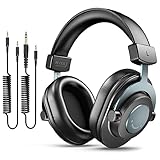
10. FIFINE Studio Monitor Headphones H8
FIFINE Studio Monitor Headphones for Recording, Wired Headphones with 50mm Driver, Over Ear Headset with Detachable Cables 3.5mm or 6.35mm Jack, Black, on PC/Mixer/Amplifier-H8
50mm Drivers
32 Ohms
20Hz-20kHz
Dual Detachable Cables
265g Lightweight
Pros
- Incredible value with dual detachable cables
- Dual detachable cables in 3.5mm and 6.35mm included
- 50mm drivers for full-range sound
- Lightweight 265g design for comfort
- Compatible with guitar amps mixers and interfaces
Cons
- Sound quality is good but not studio reference level
- Build quality reflects the ultra-budget price
- Brand recognition is low
The FIFINE H8 is the most affordable option in this entire roundup, and the fact that it includes 50mm drivers and dual detachable cables at this price point is remarkable. FIFINE has built a reputation for delivering surprisingly capable audio gear at budget prices, and the H8 continues that tradition.
Let me set expectations clearly: these are not going to match the detail and accuracy of the Sony MDR7506 or the Beyerdynamic DT 770 PRO. But for a guitarist who is just starting out and needs something that sounds decent for practice without spending much, the FIFINE H8 is a fantastic entry point.
The 50mm dynamic drivers deliver well-balanced sound with clear treble, stable mids, and dynamic bass. The sound signature is slightly warm, which works well for electric guitar tones. I tested these with clean and distorted tones through a practice amp, and both sounded surprisingly good. The passive noise-canceling closed-back design blocks enough ambient noise for focused practice.
The inclusion of two detachable coiled cables is what sets the FIFINE apart from other ultra-budget options. You get both a 3.5mm cable and a 6.35mm cable, meaning you can connect to any guitar amp, mixer, or audio interface without buying additional adapters. The cables are 9.8 feet long, giving you plenty of room to move while playing.
What to Expect at This Price Point
The build quality is where the budget nature of these headphones becomes apparent. The plastics feel lighter and less premium than what you get from Sony or Audio-Technica. The ear cushions are comfortable but may show wear more quickly than higher-end models.
That said, the sound quality punches well above what the price would suggest. For practice purposes, these deliver clear enough sound to work on technique, timing, and tone. They are not ideal for critical mixing, but for a guitarist learning their instrument, they are more than adequate.
Who Should Buy the FIFINE H8
If you are a beginner guitarist who needs headphones for silent practice and does not want to spend much, the FIFINE H8 is the obvious choice. You get dual connectivity, 50mm drivers, and a lightweight design for less than the cost of a set of guitar strings and a cable.
These are also a great backup pair. If you already own a high-end studio headphone and want a second pair for travel or rough use, the FIFINE H8 serves that purpose without breaking the bank.
Buying Guide: How to Choose the Best Headphones for Guitarists
Choosing the right headphones for guitar practice involves understanding a few key technical concepts. I want to break down everything you need to know so you can make an informed decision based on your specific setup and playing style.
Why Guitarists Need Specific Headphones
Guitarists need headphones that reproduce sound accurately without adding their own coloration. Consumer headphones from brands like Beats or Skullcandy are tuned to make music sound exciting by boosting bass and treble. While this sounds great for casual listening, it is counterproductive for guitar practice. When your headphones add bass boost, you cannot tell if your amp’s EQ is actually set correctly.
You end up dialing in settings that sound good through those specific headphones but fall apart when you play through a real amp or studio monitors. Studio headphones are designed with a flat or neutral frequency response. They reproduce what goes in without adding their own personality. This means the tone you hear through them is the tone your amp or amp simulator is actually producing.
That accuracy is essential for making good tone decisions and for recording guitar parts that will sit properly in a mix. Every recommendation in this guide is a studio monitor headphone designed for honest sound reproduction.
Closed-Back vs Open-Back Headphones
This is one of the most important decisions you will make when choosing guitar headphones. Closed-back headphones have ear cups that seal completely, trapping sound inside and blocking external noise. This design provides excellent noise isolation, which is ideal for silent practice and for recording guitar while monitoring through headphones.
Open-back headphones have perforated ear cups that let air and sound pass through. This creates a wider, more natural soundstage that many people find more comfortable for extended listening. However, open-back headphones leak sound in both directions. People around you can hear what you are listening to, and you can hear external noise.
For most guitarists, closed-back headphones are the right choice. The noise isolation lets you practice at any hour without disturbing others, and the contained sound is better for evaluating tone. Every headphone in this roundup is closed-back for this reason.
Impedance Guide for Guitar Setups
Impedance, measured in ohms, determines how much power your headphones need to reach adequate volume. Low impedance headphones, typically 32 to 80 ohms, are easy to drive from any source. You can plug them directly into a guitar amp headphone jack, a smartphone, or a budget audio interface and get full volume without any issues.
High impedance headphones, typically 150 ohms and above, require more power to drive properly. The Beyerdynamic DT 770 PRO at 250 ohms is the prime example in this list. You need a quality audio interface with a strong headphone output or a dedicated headphone amplifier to get the best performance from high impedance headphones.
If you are just plugging into a practice amp, stick with low impedance options like the Sony MDR7506 at 63 ohms or any of the Audio-Technica models at 35 to 38 ohms. If you are using a quality audio interface, you can take advantage of higher impedance headphones like the DT 770 PRO for their tighter, more controlled sound.
Wired vs Wireless: The Latency Problem
This is a critical topic for guitarists. Bluetooth wireless headphones introduce latency, which is a delay between when a sound is produced and when you hear it. For music listening, latency does not matter because the entire song is delayed equally. But for real-time guitar playing, even a small delay makes it impossible to play in time.
The latency of Bluetooth codecs ranges from about 40 milliseconds to over 200 milliseconds. For context, anything above 15 milliseconds is noticeable when playing guitar. You pick a note, and by the time you hear it through Bluetooth headphones, there is a perceptible delay that throws off your timing completely.
This is why every serious guitar headphone in this roundup is primarily wired. The OneOdio A70 includes Bluetooth capability, but you should only use it in wired mode for actual guitar practice. The wireless mode is useful for listening to music and watching tutorials, but not for real-time playing.
Studio vs Consumer Headphones Explained
The distinction between studio and consumer headphones is essentially the difference between accuracy and entertainment. Studio headphones are designed to reproduce sound as faithfully as possible. They are tools for professionals who need to hear exactly what is in a recording. Consumer headphones are designed to make music sound as pleasing as possible, often by boosting certain frequencies.
For guitarists, studio headphones are almost always the better choice. You want to hear your tone accurately so you can make informed decisions about your sound. Consumer headphones will make everything sound a bit better than it actually is, which can lead to poor choices when setting up your amp or mixing your recordings.
All ten headphones in this roundup are designed as studio monitor headphones. This means they prioritize accuracy over excitement, which is exactly what you want for guitar practice, recording, and tone evaluation.
Comfort for Long Practice Sessions
Comfort is more important than many guitarists realize. If your headphones cause discomfort after an hour, you will end up cutting your practice sessions short. Key factors include the weight of the headphones, the clamping force, and the ear pad material.
The Yamaha HPH-MT5 at 250 grams and the FIFINE H8 at 265 grams are the lightest options in this roundup. The Beyerdynamic DT 770 PRO uses velour ear pads that breathe better than pleather, making them ideal for very long sessions. The Sony MDR7506 at 8 ounces is also remarkably light and comfortable.
If you practice for more than two hours at a time, pay close attention to weight and ear pad material. Velour pads stay cooler than pleather but may not isolate sound as effectively. Look for headphones with replaceable ear pads, since all ear pad materials degrade over time.
Frequently Asked Questions About Guitar Headphones
What headphones do guitar players use?
Guitar players most commonly use closed-back studio headphones like the Audio-Technica ATH-M50x, Sony MDR7506, and Beyerdynamic DT 770 Pro. These models provide flat frequency response and excellent noise isolation for accurate tone monitoring during practice and recording.
Do I need special headphones for guitar?
While you can use any headphones with a guitar amp, studio-grade headphones with a flat frequency response are strongly recommended for guitarists. Consumer headphones add bass boost and coloration that mask tone details, making it harder to evaluate your actual sound and make accurate EQ decisions.
What kind of headphones work with a guitar amp?
Wired over-ear closed-back headphones work best with guitar amps. Look for headphones with 3.5mm or 6.35mm jack compatibility and low impedance of 32 to 80 ohms for direct amp connection. Higher impedance headphones of 250 ohms or above require a dedicated headphone amplifier or quality audio interface.
Why do guitar players wear headphones?
Guitar players wear headphones for silent practice without disturbing others, accurate tone monitoring during recording, better frequency detail when using amp simulators and DAWs, and to hear themselves clearly in loud stage or studio environments where monitoring through speakers is not practical.
Can I use Bluetooth headphones with my guitar amp?
Bluetooth headphones are not suitable for real-time guitar playing due to latency delays of 40 to 200 milliseconds. This delay makes it impossible to play in time. Use wired headphones for all guitar practice and recording. Bluetooth headphones are only useful for listening to backing tracks or tutorials separately from your guitar signal.
Final Thoughts on the Best Headphones for Guitarists in 2026
After testing all ten models extensively with guitar amps, audio interfaces, and amp simulators, the Sony MDR7506 remains my top overall pick for best headphones for guitarists. The combination of accurate flat response, lightweight comfort, and proven durability makes it the most versatile option for practice, recording, and monitoring. At its price point, nothing else delivers the same level of honest tone reproduction.
For guitarists who want the absolute best sound quality and are willing to invest in proper amplification, the Beyerdynamic DT 770 PRO at 250 ohms is the premium choice. The detail retrieval and comfort are unmatched. If you need maximum value, the Audio-Technica ATH-M50X gives you professional-grade monitoring with the convenience of detachable cables and swiveling earcups.
Budget-conscious players have excellent options too. The OneOdio A70 and MAONO MH601 deliver capable sound at very affordable prices, while the FIFINE H8 proves that even ultra-budget headphones can work for guitar practice. The key takeaway is that any studio-grade closed-back headphone on this list will be a massive upgrade over consumer earbuds or gaming headsets for evaluating your guitar tone.
Choose based on your setup, your budget, and your priorities. If you practice through a simple amp, low impedance models like the Sony MDR7506 or Audio-Technica ATH-M40x are perfect. If you record through an audio interface, the Beyerdynamic DT 770 PRO or ATH-M50X will give you the detail you need. Whatever you choose, investing in proper studio headphones will immediately improve your ability to hear and shape your guitar tone.