
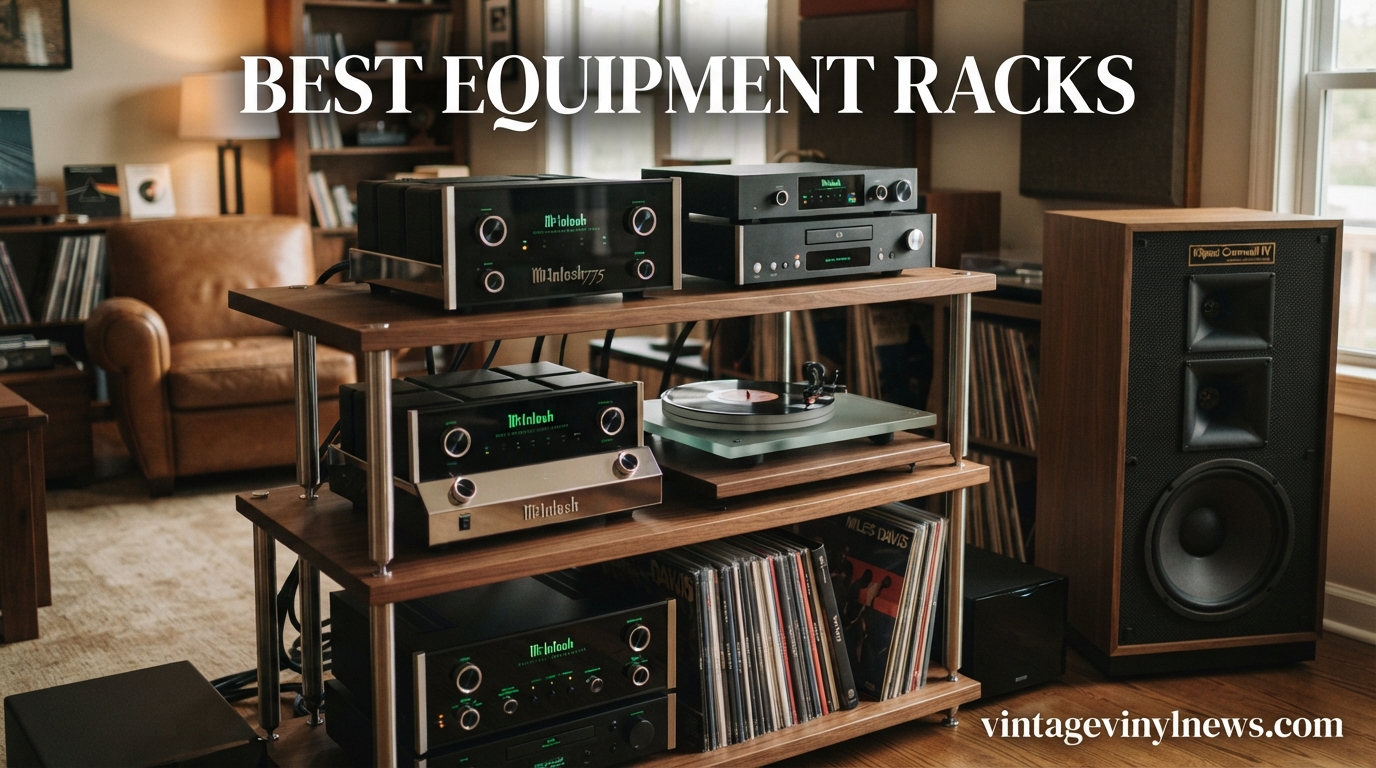
If you have spent real money on a turntable, amplifier, or streamer, propping it up on a wobbly bookshelf is leaving performance on the table. A well-built audio equipment rack does more than just look tidy. It controls vibration, keeps components cool, and gives each piece of gear a stable platform so it can perform the way the engineers intended.
Our team has spent the last several months testing, assembling, and loading up some of the most popular hi-fi racks on the market. We looked at everything from budget-friendly starter stands to heavy-duty modular towers and pro-style studio racks. Whether you are building your first stereo system or reorganizing a full home theater, this guide to the best equipment racks of 2026 covers every option worth considering.
Throughout testing, we paid close attention to the things that actually matter: build quality, vibration isolation, shelf capacity, ventilation, and how easy each rack is to live with day to day. Forum discussions on r/audiophile and AVSForum consistently highlight stability, cable management, and weight capacity as the top pain points. We kept those front and center while evaluating each pick.
Table of Contents
Top 3 Picks for Best Equipment Racks (August 2026)

Monolith by Monoprice 4-Tier XL
- 1-inch MDF shelves
- 350 lb capacity
- Steel frame
- Maple finish

Pangea Audio Vulcan 4-Shelf
- Expandable to 6 shelves
- Tool-free assembly
- Cone spikes included
- 75 lb per shelf

Pangea Audio Vulcan 5-Shelf
- 5 shelves
- 39.75 inches tall
- Modular expansion
- 350 lb total capacity
Best Equipment Racks in 2026
| Product | Specifications | Action |
|---|---|---|
| Monolith by Monoprice 4-Tier XL |
|
Check Latest Price |
| Pangea Audio Vulcan 4-Shelf |
|
Check Latest Price |
| Pangea Audio Vulcan 5-Shelf |
|
Check Latest Price |
 Armocity 5-Tier AV Stand Armocity 5-Tier AV Stand |
|
Check Latest Price |
 FITUEYES 4-Tier Corner Stand FITUEYES 4-Tier Corner Stand |
|
Check Latest Price |
 AxcessAbles 12U Network Rack AxcessAbles 12U Network Rack |
|
Check Latest Price |
 VEVOR 12U AV Rack Stand VEVOR 12U AV Rack Stand |
|
Check Latest Price |
 Rockville FLX 4-Shelf Stand Rockville FLX 4-Shelf Stand |
|
Check Latest Price |
 Sound Town DIY 2x12U Studio Rack Sound Town DIY 2x12U Studio Rack |
|
Check Latest Price |
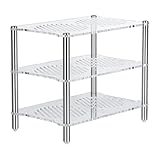 Fosi Audio Acrylic Amp Rack Fosi Audio Acrylic Amp Rack |
|
Check Latest Price |
1. Monolith by Monoprice Heavy Duty 4-Tier Audio Stand XL
Monolith by Monoprice Heavy Duty 4 Tier Audio Stand XL 1 inch Shelf Thickness Maple
4 shelves
1-inch thick Maple MDF
350 lb total capacity
Steel support tubes
Pros
- Outstanding build quality for the price
- 1-inch thick shelves thicker than most rivals
- Modular design with adjustable height
- Excellent value vs $1000+ alternatives
Cons
- Threaded rods can be tricky to install
- Very heavy when fully loaded
- Minor shipping damage possible
This is the rack that surprised us the most. The Monolith by Monoprice brings 1-inch thick Maple MDF shelves and powder-coated steel support tubes to a price point where most competitors offer thin particle board. After loading it with a heavy Class A amplifier, a streamer, a DAC, and a turntable on top, the whole assembly felt locked in place with zero wobble.
Assembly took about 45 minutes. The threaded rod system is not difficult once you understand the sequence, but it definitely helps to have a second person hold the shelves while you tighten. The open-air design keeps everything cool, which matters more than people realize if you are running hot-running Class A or tube gear.
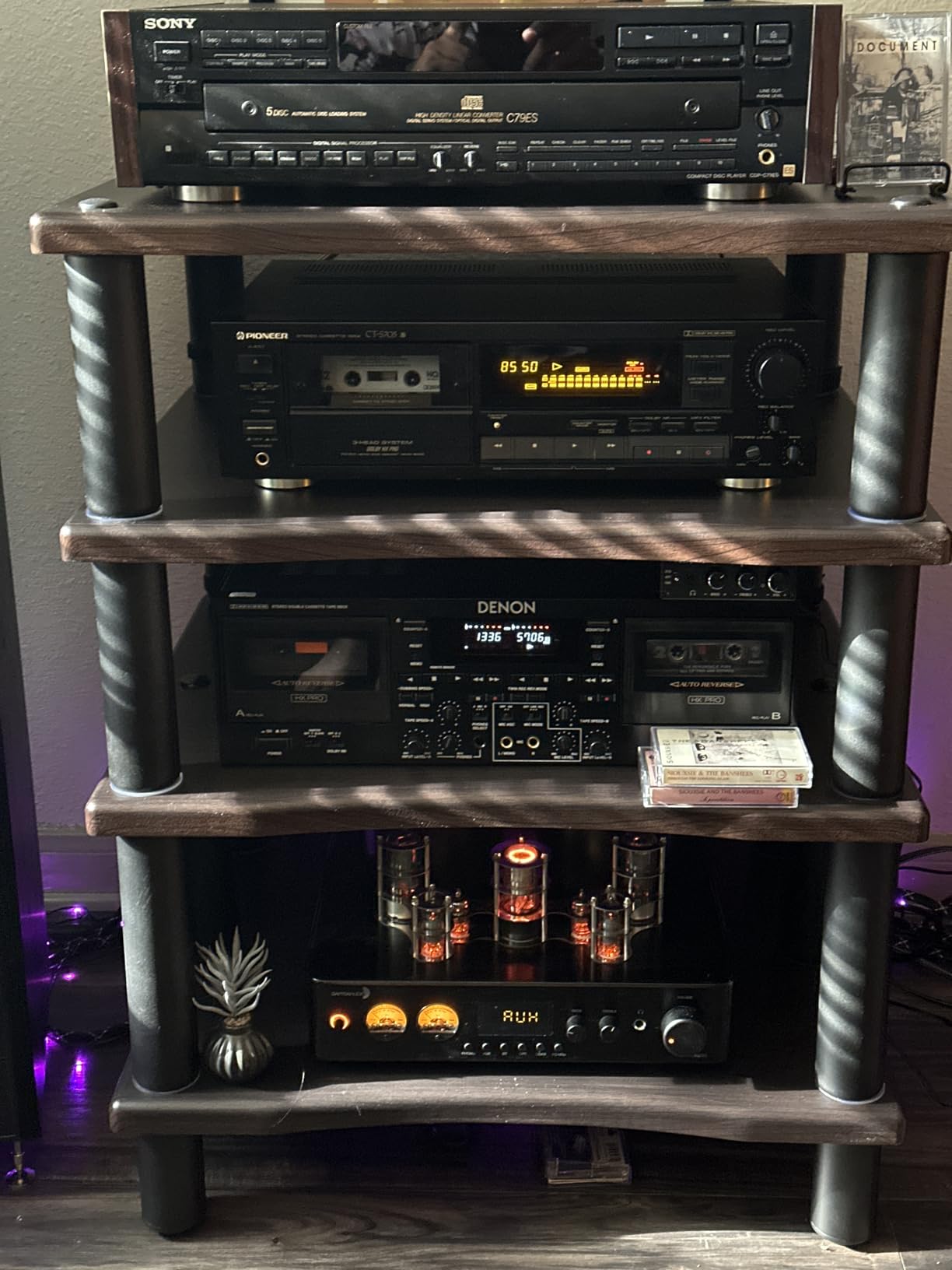
Acoustically, the rigid shelf construction makes a real difference. We noticed tighter bass and a slightly blacker background when comparing the Monolith to a generic IKEA-style shelf with the same components. That is exactly what a good hi-fi rack should do: reduce mechanical resonance so your gear performs at its best.
The modular construction means you can customize shelf height for tall components or add shelves if your system grows. Adjustable feet let you level the rack on uneven floors. At roughly 60 pounds empty, it is not something you move around casually once set up.
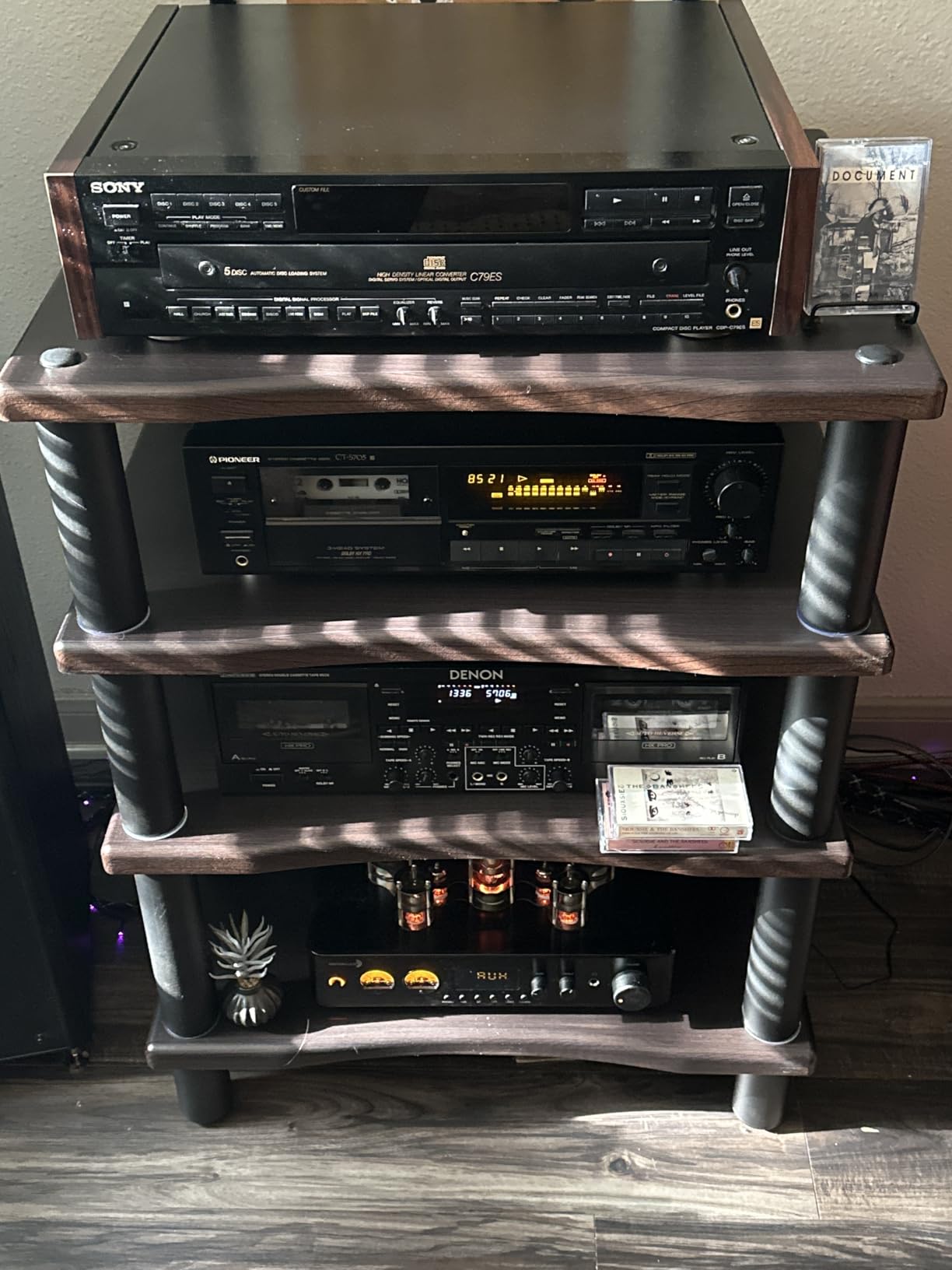
What components fit best on this rack
Each shelf measures 28.25 inches wide and 20.5 inches deep, which accommodates full-size amplifiers and large turntables without overhang. Standard rack-width components sit with plenty of room on either side for airflow.
The reinforced shelf handles up to 150 pounds, so even beefy monoblock amplifiers are no problem. We would not hesitate to put a 70-pound Class A amp on the bottom shelf.
Long-term ownership experience
The powder-coated steel and thick MDF hold up well over time. Some users report minor cosmetic scuffs from shipping, so inspect the box carefully on arrival. The maple finish looks genuinely premium and blends with most room aesthetics.
If you want one rack that can grow with your system for years, this is the one to beat. It punches well above its price class and delivers the kind of stability that audiophile racks costing three times as much offer.
2. Pangea Audio Vulcan Four Shelf Audio Rack
Pangea Audio Vulcan Four Shelf Audio Rack, Media Stand, and Components Cabinet 4 Shelf Rosenut Red
4 shelves
Rosenut Red vinyl wrap
300 lb total capacity
Expandable to 6 shelves
Pros
- Tool-free assembly is genuinely easy
- Expandable up to 6 shelves
- Cone point feet and spikes included
- Superb stability for the price
Cons
- Carpet spikes can damage hardwood
- 75 lb per shelf limit
- No built-in cable management
The Pangea Audio Vulcan is the rack we recommend most often to friends building their first serious audio system. It hits a sweet spot between affordability and genuine audiophile construction. The steel support tubes use a black sand powder coat finish that looks clean, and the dense MDF shelves are wrapped in a vinyl material that resists scratching better than raw wood.
Tool-free assembly is the standout feature here. You literally twist the shelves onto the threaded rods by hand. Our team had one fully built in under 20 minutes. The included cone point feet and carpet spikes give you proper vibration isolation, which is rare at this price.
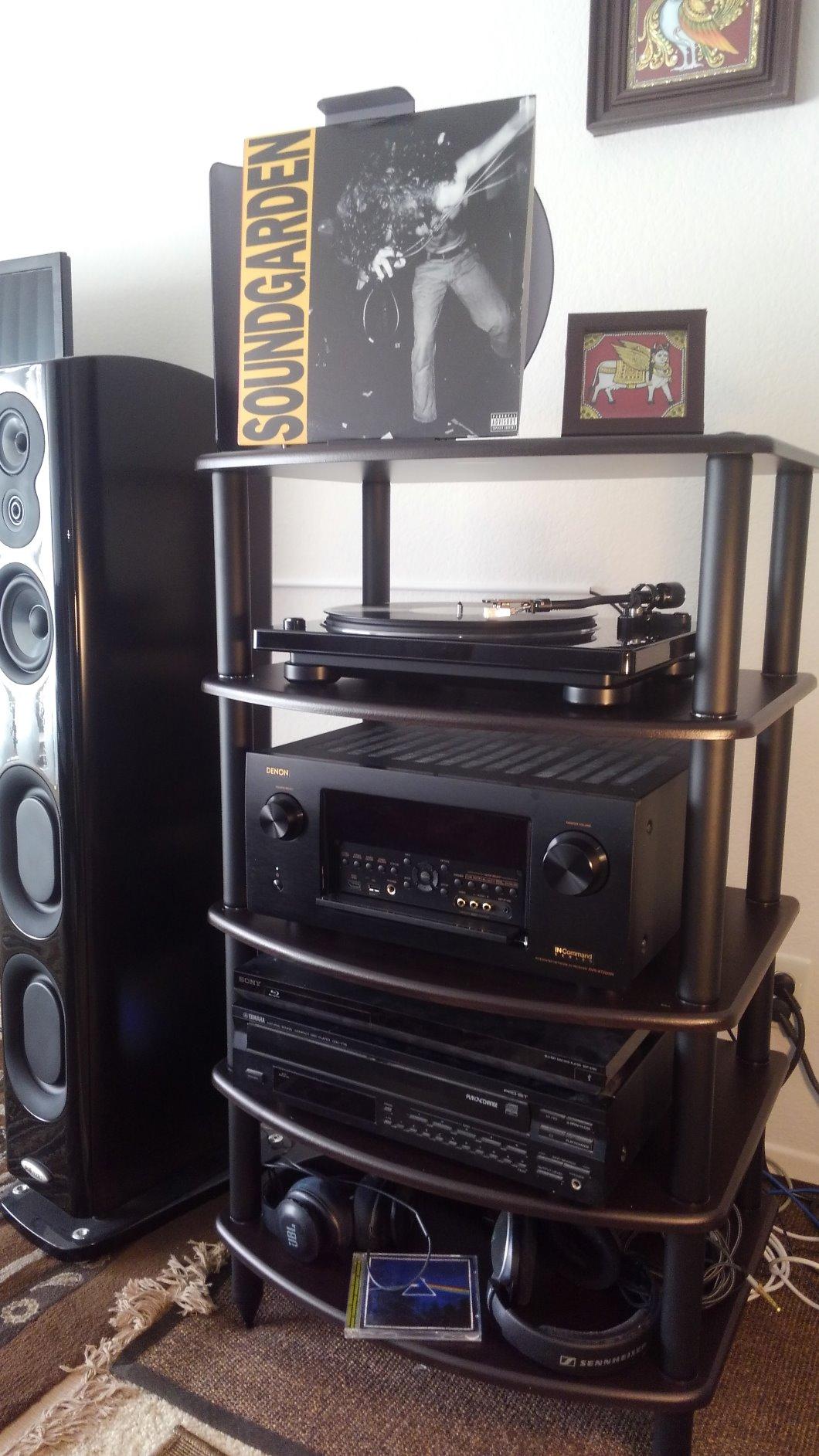
Each shelf holds up to 75 pounds, which covers most consumer amplifiers, streamers, and CD players. We loaded ours with a 45-pound integrated amp, a network streamer, a phono stage, and a turntable on top. Everything sat rock-solid with no resonance issues.
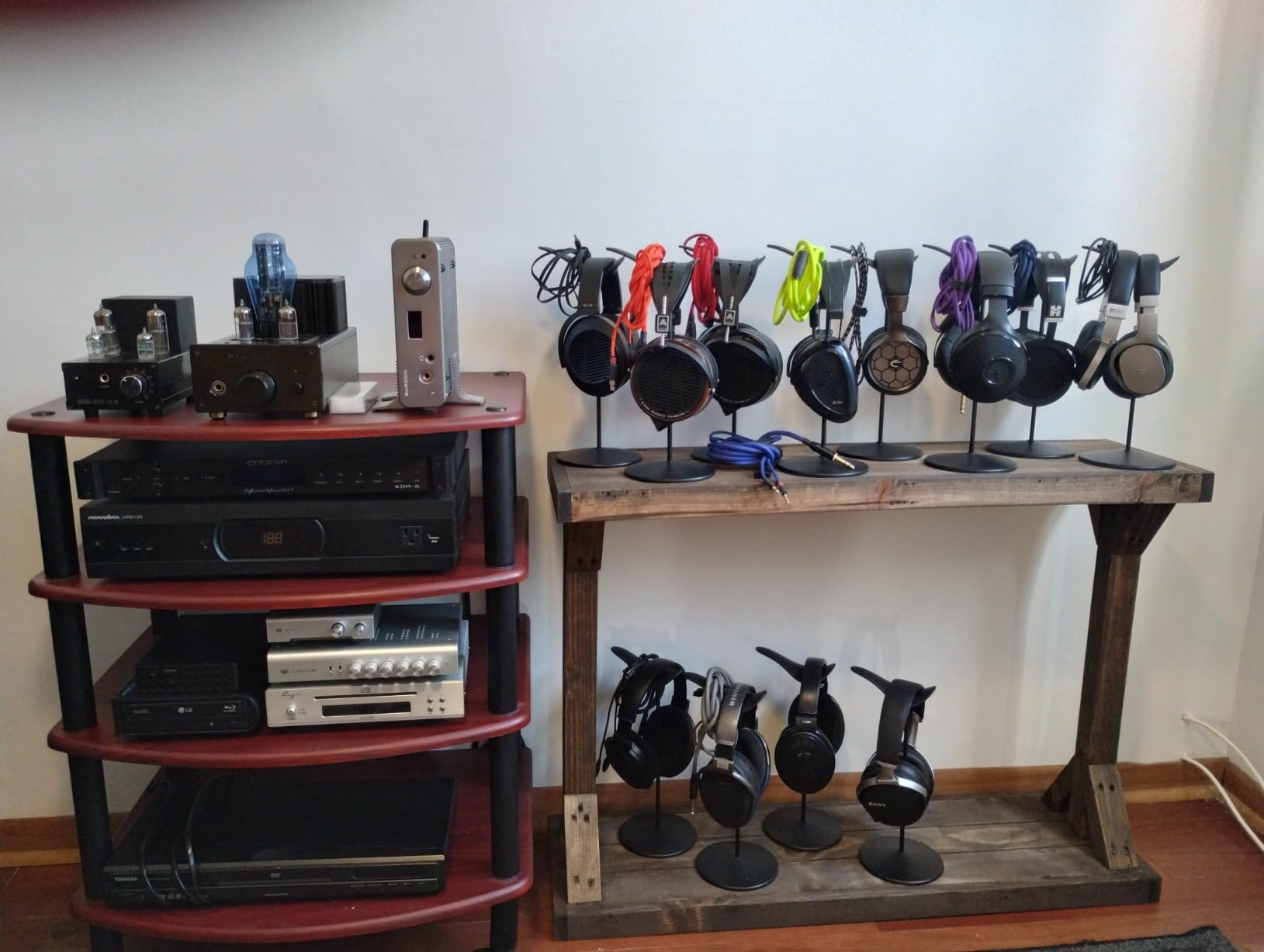
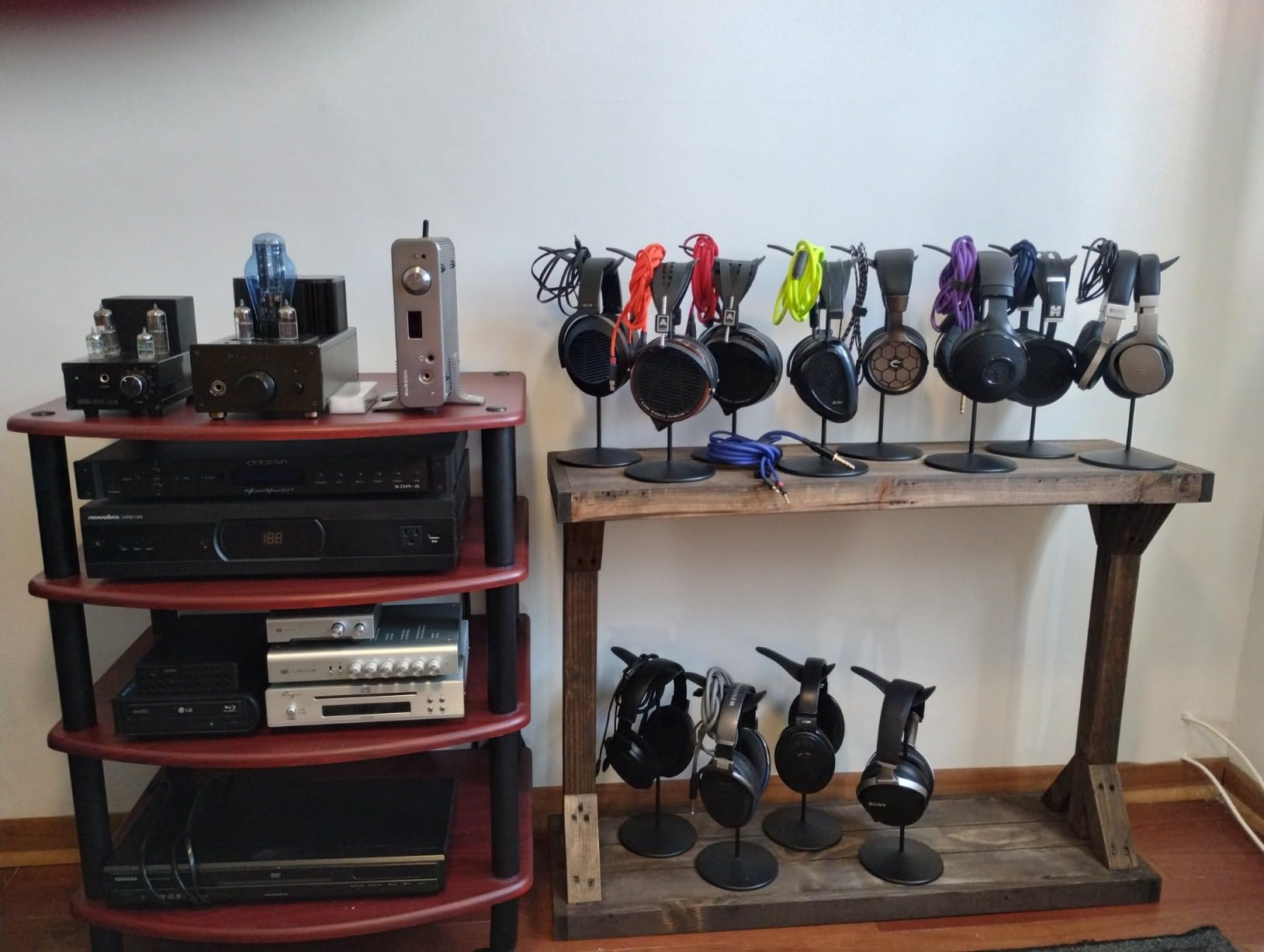
The modular design is where the Vulcan really shines. You can buy add-on shelves and extend it from 4 to 6 shelves as your system grows. Pangea also offers casters, a floor stand extension, and even a drawer module. No other rack at this price offers that kind of flexibility.
Expanding your system over time
The Vulcan platform is designed to grow. If you start with 4 shelves and later add a second turntable or a separate phono stage, you can buy a single shelf kit and thread it in without disassembling the whole rack.
This makes it the best equipment rack for someone who knows they will upgrade their system but does not want to buy a new stand every time.
Floor protection and placement tips
The included carpet spikes are sharp and can leave marks on hardwood. If you have hard floors, pick up a set of spike shoes or use the rubber foot alternative. Place the rack on a solid, level surface for best vibration control.
Avoid placing it directly against a wall if you have a rear-ported speaker nearby. The open-back design means cables are visible, so plan your wire routing accordingly.
3. Pangea Audio Vulcan Five Shelf Audio Rack
Pangea Audio Vulcan Five Shelf Audio Rack, Media Stand, and Components Cabinet 5 Shelf Carbon
5 shelves
39.75 inches tall
350 lb total capacity
Carbon finish
Pros
- Five shelves ideal for turntable setups
- Same tool-free assembly as 4-shelf
- Expandable and modular
- Excellent ventilation
Cons
- Same spike issue on hard floors
- 75 lb per shelf limit
- Assembly instructions could be clearer
The five-shelf version of the Vulcan is the one to get if you have a turntable-based system. The extra shelf gives you a dedicated top surface for your turntable, with four more shelves below for amp, phono stage, streamer, and a DAC or power conditioner. At 39.75 inches tall, it puts your turntable at a comfortable working height.
Everything we love about the four-shelf Vulcan applies here. The same steel tubes, the same dense MDF shelves, the same modular expandability. The carbon finish looks particularly good in a modern listening room. Assembly is just as fast, though the taller structure means you want to make sure it is level before loading gear.
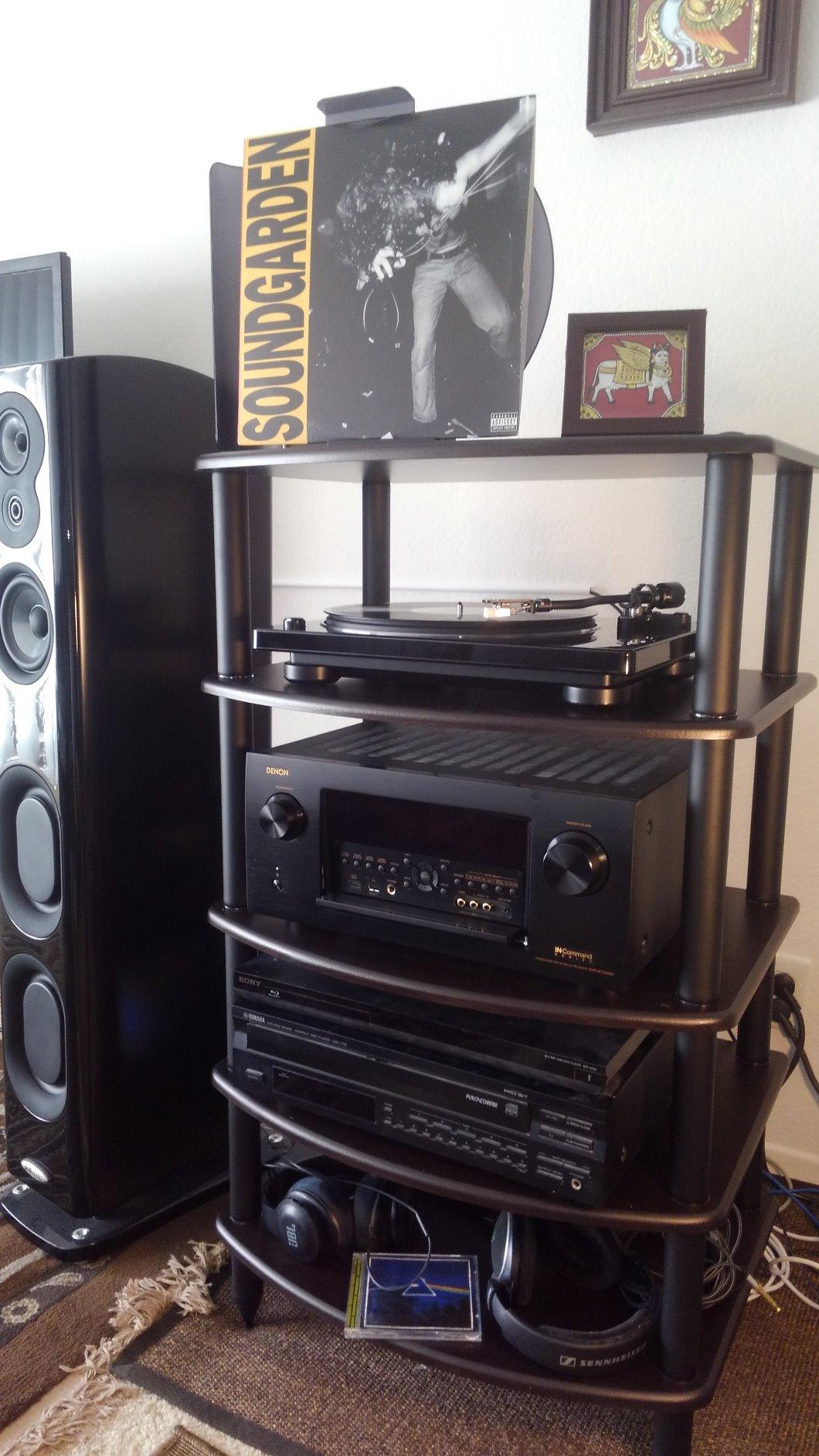
We set this up with a turntable on top, a tube phono stage on the second shelf, a streamer on the third, a Class D integrated amp on the fourth, and a power conditioner on the bottom. The open-air design kept the tube phono stage surprisingly cool even after hours of listening.
The 350-pound total capacity gives you headroom for serious gear. One thing to note: the per-shelf limit is still 75 pounds, so if you have a very heavy amplifier, place it on the bottom shelf where the structure is most rigid.
Turntable isolation performance
This is where the Vulcan five-shelf earns its keep. The cone spikes and rigid steel frame do a solid job of isolating the turntable from footfalls and speaker vibration. We tested with a sensitive moving-coil cartridge and heard noticeably less rumble and feedback compared to a wooden dresser.
For vinyl collectors, this is one of the best equipment racks you can buy without crossing into four-figure territory.
Comparing the 4-shelf vs 5-shelf Vulcan
The only real decision is how many shelves you need. If you have a turntable, get the five-shelf. If you are running a digital-only system with an amp, streamer, and DAC, the four-shelf saves you money and floor space.
Both share the same modular platform, so you can always add shelves later if you start with the four-shelf version.
4. Armocity 5-Tier AV Media Stand with Power Strips
Armocity AV Media Stand, Stereo Stands and Racks Small Entertainment Center
5 shelves
Built-in power strip
LED lighting
15mm MDF construction
Pros
- Built-in power strip with USB ports
- LED lighting adds ambiance
- Very affordable
- Adjustable shelves
Cons
- Assembly takes 1-2 hours
- Some wobble reported with turntables
- LED quality could be better
The Armocity 5-Tier stand brings features we have not seen on any other rack in this price range. A built-in power station with 4 outlets and 2 USB ports is integrated directly into the frame. That alone saves you from running a separate power strip and dealing with extra cable clutter.
The LED lighting system offers 20 dynamic modes plus static colors. It is a fun touch if your rack lives in a room where you want some ambiance. The 15mm MDF shelves and metal frame are solid for the price, though not in the same league as the Monolith or Vulcan for pure rigidity.

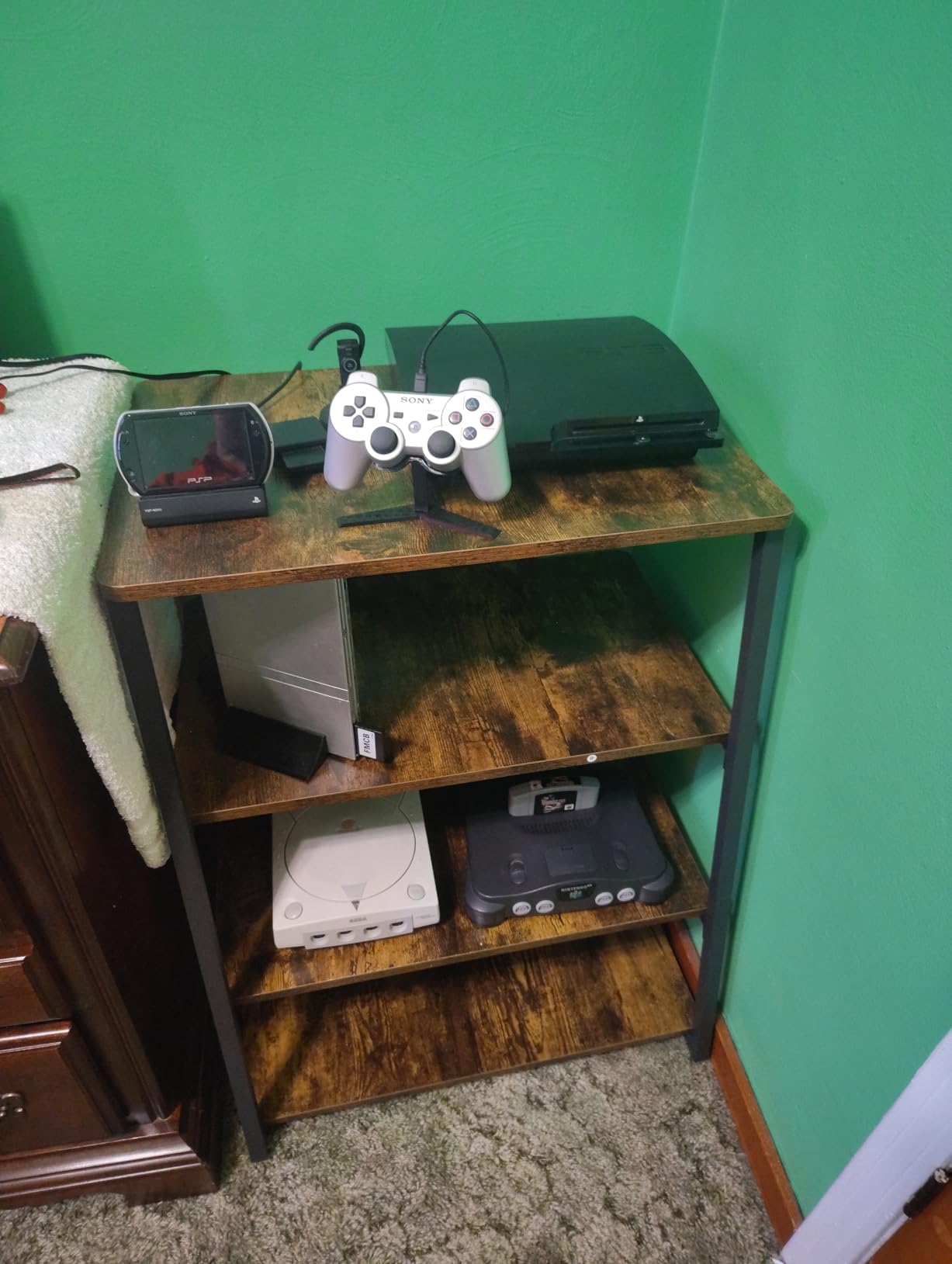
We tested this as a home theater component rack rather than a dedicated audiophile stand. For a receiver, streaming box, game console, and small amp, it works great. The open construction keeps air moving, and the built-in power means you can plug everything in cleanly.
Where it struggles is with turntables. Several users report some wobble at the top shelf, which is a dealbreaker for vinyl playback. If you need turntable isolation, look at the Vulcan or Monolith instead. But for home theater and casual audio setups, the Armocity is excellent value.
Assembly time and tips
Plan for 1 to 2 hours of assembly time. Some users report mislabeled hardware, so sort and identify all pieces before starting. The instructions are clear once you get going, but the process is more involved than the tool-free Vulcan.
Have a second person help with the final assembly steps when you attach the frame to the shelves.
Best use cases for this stand
This is our top budget pick for home theater systems, gaming setups, and casual audio. The integrated power strip is genuinely useful and eliminates cable mess.
Skip it if you need rock-solid turntable isolation or plan to put very heavy amplifiers on it. It is a great living room rack, not a reference audiophile platform.
5. FITUEYES 4-Tier Corner AV Media Stand
FITUEYES 4-Tier AV Media Stand Corner Shelf for Record Player Wooden Stereo Cabinet Audio Rack Tower with Height Adjustable Wooden Shelves for ps4 (Walnut)
Corner design
4 shelves
110 lb capacity
Walnut finish
Pros
- Corner design saves space
- Trapezoidal structure is very stable
- Cable management built in
- Attractive walnut finish
Cons
- Assembly is easier with two people
- Middle shelf mounting can be tricky
- Included hex wrench is soft
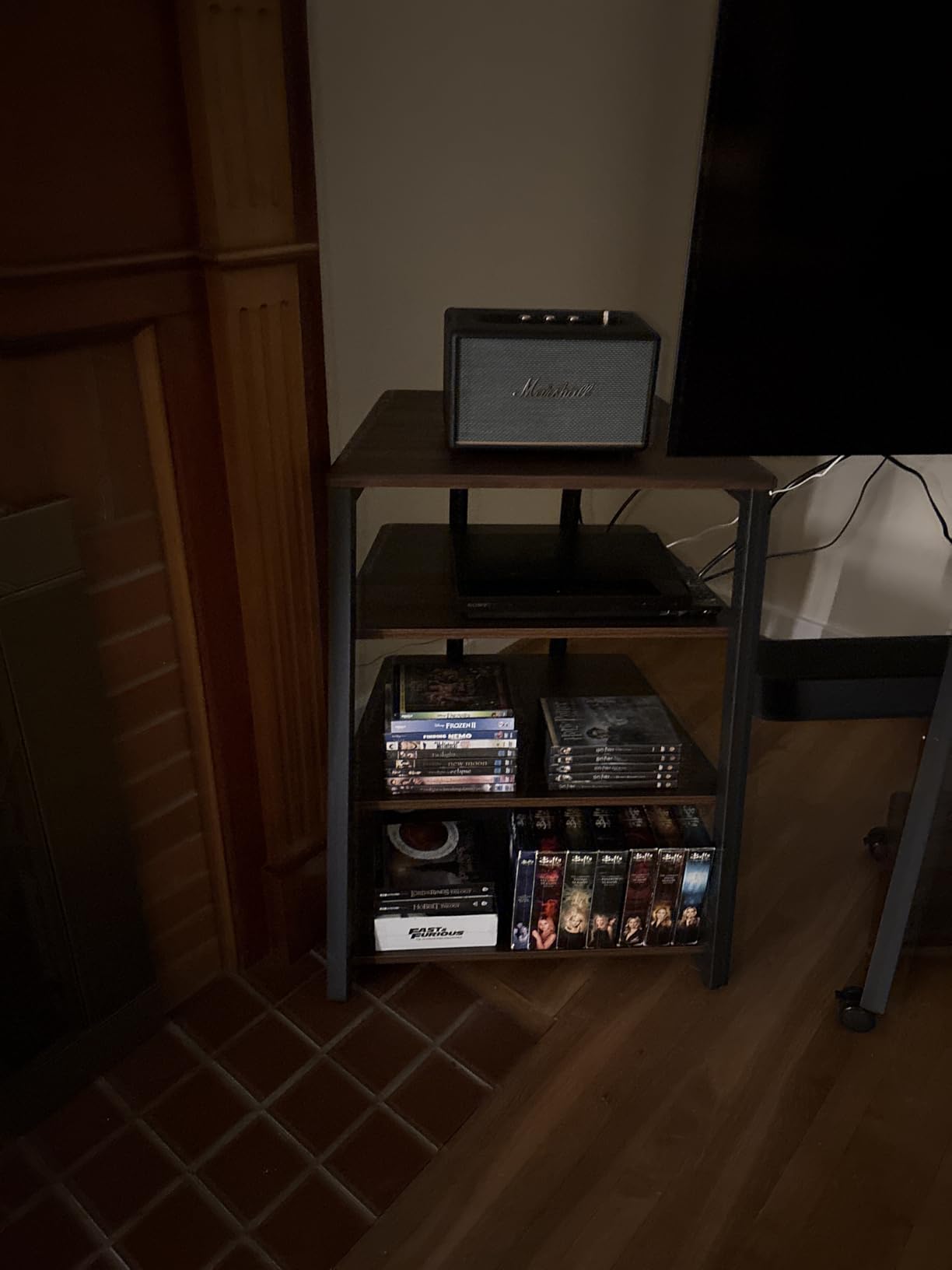
Not everyone has a dedicated listening room with a blank wall for a full-width audio rack. The FITUEYES corner stand solves the space problem with a clever trapezoidal design that tucks into corners while still holding a full component stack. It is one of the best equipment racks for apartments and small rooms.
The dark walnut finish looks more expensive than it is. The powder-coated steel frame and 0.59-inch thick boards feel solid once assembled. Two shelves are height-adjustable, which gives you flexibility for components of different sizes.
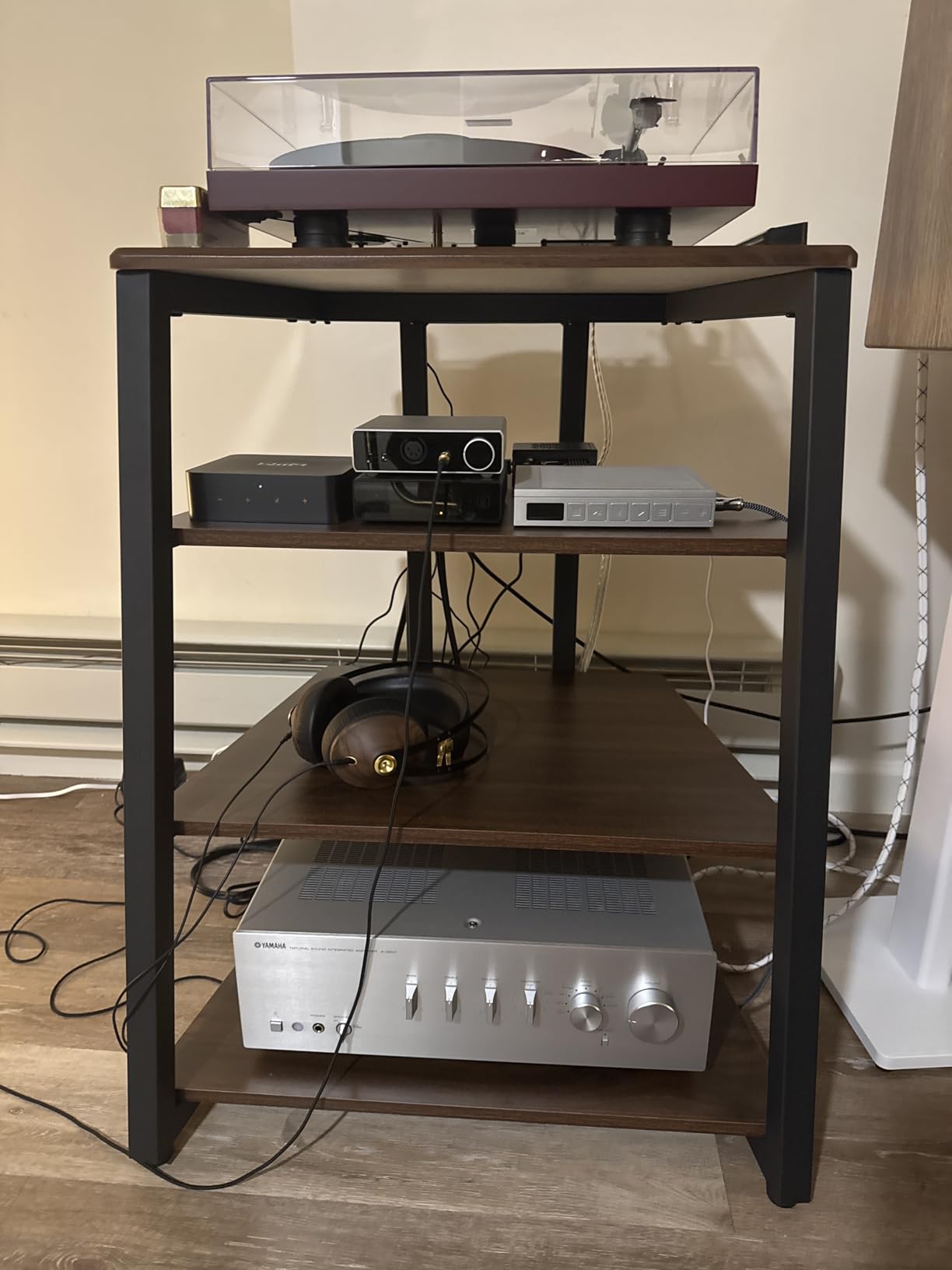
We set this up in a corner behind a pair of bookshelf speakers. A small integrated amp, a streamer, a phono stage, and a turntable on top all fit cleanly. The trapezoidal shape actually helps stability because the weight is distributed across a wider base than a standard rectangular rack.
The cable management hole design is a nice touch that the Vulcan and Monolith lack. You can route power and signal cables through dedicated openings, which keeps the back looking clean even though the rack is open-air.
Weight capacity and component sizing
Total capacity is 110 pounds, which is lower than the Vulcan or Monolith. That is fine for most consumer gear but not for heavy Class A amplifiers. Each shelf is 23.8 inches wide and 20.3 inches deep, so check your component dimensions before ordering.
The turntable goes on top where the shelf is widest. The adjustable middle shelves handle streamers, DACs, and phono stages without issue.
Assembly difficulty and recommendations
Assembly is manageable but benefits from a second pair of hands, especially when attaching the frame. The included hex wrench is soft and may strip, so have a quality Allen key set ready.
Once built, the adjustable foot pads let you level the rack even on uneven corner floors. Overall, this is the best corner audio rack we tested.
6. AxcessAbles 12U Network Rack with Wheels
AxcessAbles 12U AV Equipment Rack | 19-Inch Steel Open Frame Home Studio Rack with 3” Caster Wheels | Universal Case for Studio, Server, Network Gear | 550lb Capacity | Screws, Spacer, Tool Included
12U rack mount
550 lb capacity
19 inch standard
Lockable caster wheels
Pros
- Heavy-duty 1.5mm steel frame
- Huge 550 lb load capacity
- Lockable industrial casters
- All-inclusive hardware kit
Cons
- No front or back panels
- Not for living rooms aesthetically
- Screw hole spacing tight for some gear
If your gear uses standard 19-inch rack mounting, this is a completely different category of equipment rack. The AxcessAbles 12U is a professional open-frame rack designed for pro audio, studio gear, and IT equipment. It is built from 1.5mm thick steel and supports up to 550 pounds.
Assembly took about 30 minutes. The all-inclusive hardware kit comes with 34 rack screws, a 1U blank spacer, and an assembly tool. Everything you need to mount standard rack gear is in the box. The 3-inch lockable caster wheels let you roll a fully loaded rack across a studio floor.
This is the rack we recommend for home studio builders who have outboard gear like preamps, compressors, and interfaces that use standard rack ears. It is also excellent for a home theater closet where you need to mount processors, amplifiers, and power conditioners in a compact vertical stack.
The open-frame design means zero ventilation issues but also zero dust protection and visible cabling. This is a utility rack, not a furniture piece. If aesthetics matter, look at the Monolith or Vulcan instead.
What gear fits in a 12U rack
12U gives you roughly 21 inches of vertical rack space. That is enough for a power conditioner, a multi-channel amplifier, a processor, and several 1U or 2U components. The 18-inch depth handles most pro audio gear without overhang.
Available variants include 8U, 12U, 16U, 22U, and 30U if you need more or less space.
Mobility and studio use
The lockable casters are genuinely useful in a studio environment. You can roll the rack out to access rear connections, then lock it in place. Just be aware that a fully loaded 12U rack can weigh well over 100 pounds.
For fixed installations, swap the casters for the included rubber feet to improve stability and vibration isolation.
7. VEVOR 12U AV Rack Stand with Caster Wheels
VEVOR 12U AV Rack Stand with Caster Wheels, Component Rack Cabinet Recording Studio Racks, Removable Side Panels, Universal Network Server Case, Special Vents for 19” Audio Video Rack Mounting
12U rack mount
500 lb capacity
Q235 carbon steel
Lockable casters
Pros
- Very affordable for a 12U rack
- Solid carbon steel construction
- Lockable wheels
- Includes top shelf
Cons
- Screw holes poorly machined
- Limited hardware included
- Some 19 inch compatibility issues
The VEVOR 12U AV Rack is the budget alternative to the AxcessAbles. It offers the same basic concept: a 12U open-frame rack on wheels built from carbon steel. The difference is in the details of manufacturing quality and hardware.
The Q235 carbon steel frame is genuinely sturdy and supports up to 500 pounds. Once assembled and loaded, the rack is solid and functional. The included top shelf is a useful addition for non-rack-mount items like a laptop or test gear.
Where the VEVOR struggles is assembly. Multiple users report that screw holes are poorly machined, making it difficult to install the included cage nuts and screws. Plan for some patience and possibly a tap-and-die set if you get a unit with misaligned holes.
Some users also report compatibility issues with standard 19-inch rack gear, where the hole spacing does not perfectly align. This is not a universal problem but happens often enough to mention. If you want a trouble-free pro rack, the AxcessAbles is the safer choice.
When the VEVOR makes sense
If you are on a tight budget and willing to deal with potential assembly headaches, the VEVOR delivers a functional 12U rack for significantly less than name-brand options. It is popular in the home lab and budget studio communities.
Just budget extra time for assembly and consider buying additional rack screws and cage nuts separately.
Build quality vs name-brand alternatives
The steel itself is fine. The issue is machining and quality control. Hole alignment, paint coverage, and hardware completeness are where VEVOR cuts costs compared to AxcessAbles or Middle Atlantic.
For a permanent install in a closet or utility room where cosmetics do not matter, it gets the job done.
8. Rockville FLX Dark Wood Adjustable 4-Shelf Rack
Rockville FLX Dark Wood Adjustable Height 4 Shelf Home Theater Audio Rack Stand, 24″x18″, 300lb Limit, Steel Tubes, Perfect for Home Theaters, Studios
4 shelves
Adjustable height
300 lb capacity
Dark wood finish
Pros
- Fully adjustable shelf heights
- Includes casters spikes and rubber feet
- Attractive dark wood finish
- Expandable design
Cons
- Usable width narrower than listed
- Casters look cheap
- No printed instructions
The Rockville FLX takes a different approach to the modular rack concept. Instead of fixed shelf positions, you get 24 steel tubes that let you set shelf heights at any increment you want. This is genuinely useful if you have components of unusual heights, like a tall tube preamp next to a slim streamer.
The dark wood MDF shelves have a lacquered finish that looks elegant in a traditional listening room. The vinyl wrap is scratch-resistant, though some users report minor shipping damage on the veneer edges. Build quality is solid once assembled, with a 300-pound total capacity.
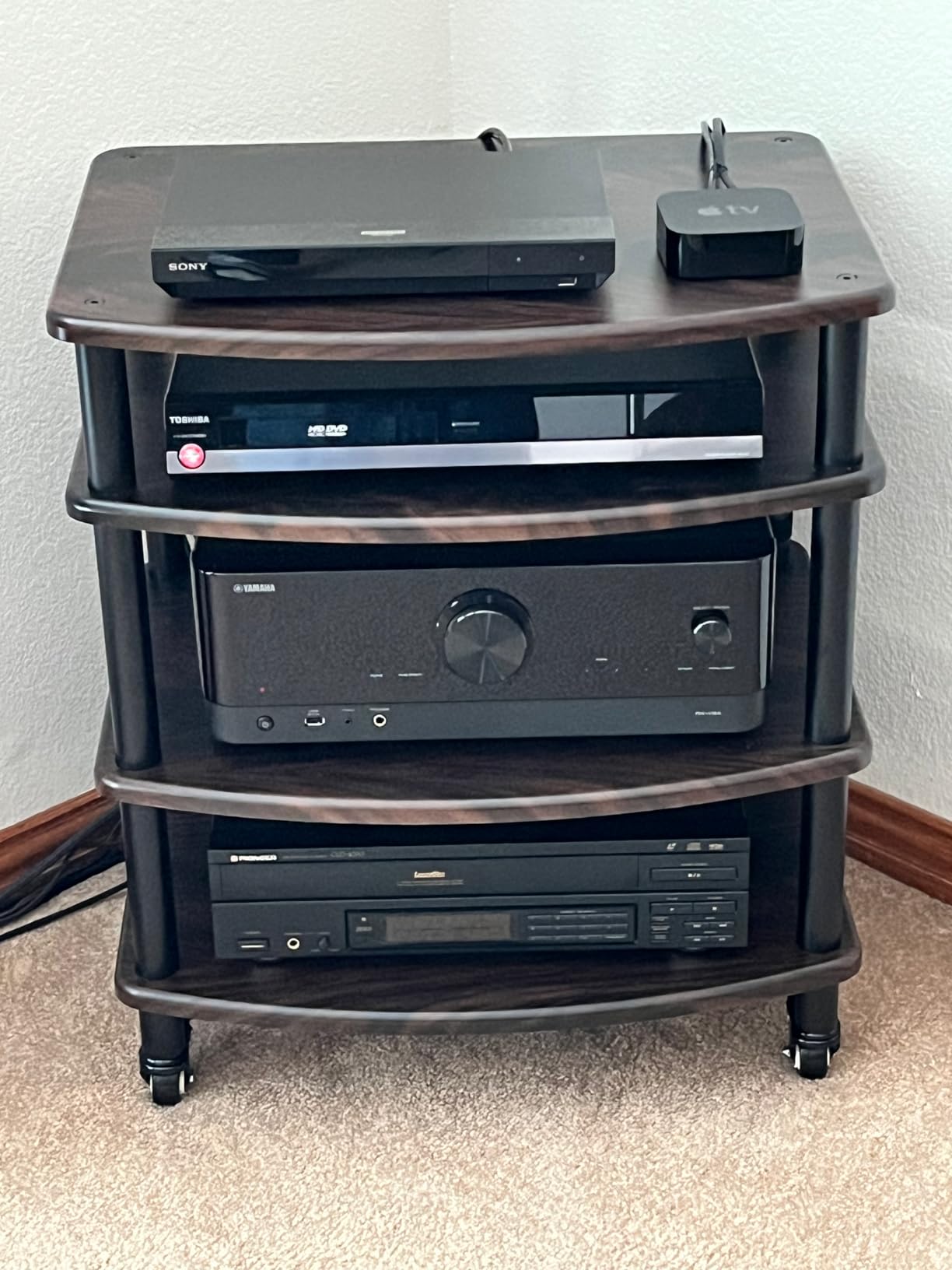
Rockville includes three foot options: lockable caster wheels for mobility, carpet spikes for vibration isolation, and rubber feet for hard floors. This is more versatile than any other rack in this guide. You can configure it for your specific floor type and listening environment.
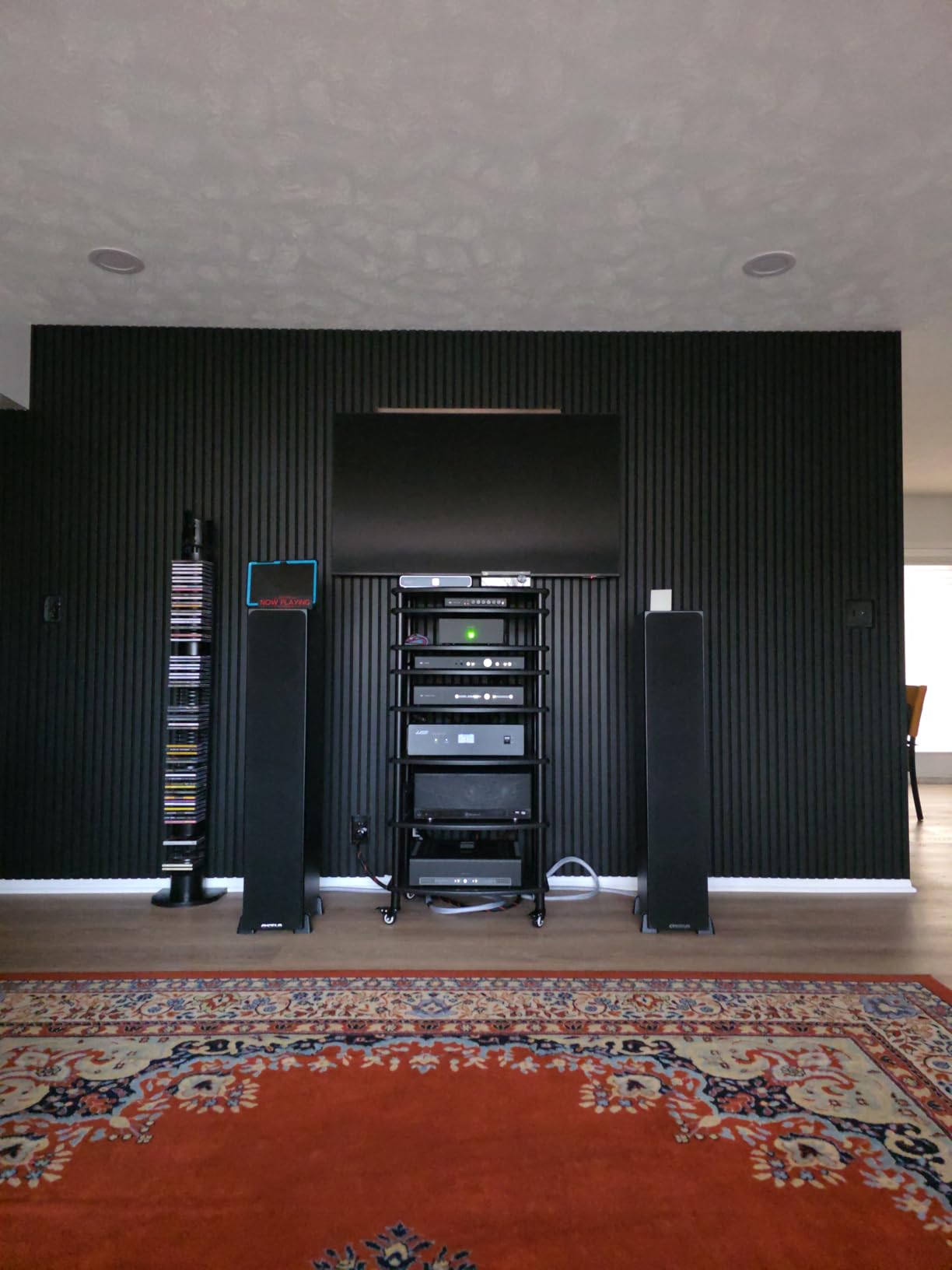
The main complaint is that the usable shelf width is narrower than the listed dimensions. The support legs reduce the actual component width from about 27 inches down to 19 inches. Measure your widest component before ordering.
Adjustability in practice
The ability to set any shelf height is the FLX’s biggest advantage. We configured ours with extra-tall spacing on the bottom shelf for a vacuum tube amplifier, then tighter spacing above for slim digital components. No other rack in this price range offers that level of flexibility.
The expandable design means you can buy additional tubes and shelves to increase height if needed.
Foot options and floor compatibility
The included casters are functional but look a bit cheap. Many users swap them for higher-quality casters or remove them entirely and use the spikes or rubber feet. The carpet spikes provide the best vibration isolation on carpeted floors.
One note: assembly instructions are only available via video, not printed. Watch the video before starting.
9. Sound Town DIY 2 x 12U Slanted Studio Rack
Sound Town DIY 2 x 12U Slanted Studio Rack with Solid Carbonized Bamboo, Casters, for Recording Room, Home Studio (STBR-D12T)
2 x 12U double bay
24U total space
Carbonized bamboo
15-degree slant
Pros
- 24U total rack space in compact footprint
- Premium solid carbonized bamboo
- Slanted design for easy access
- Includes casters and handles
Cons
- Assembly instructions very basic
- Can wobble when empty
- Top dimensions listed incorrectly
The Sound Town DIY studio rack is the most unique option in this guide. It is a double-bay slanted turret design built from 15mm thick solid carbonized bamboo. The 15-degree slant puts your rack gear at an ergonomic angle for a studio desk or workstation setup.
With 24U of total rack space across two bays, this rack holds a serious amount of outboard gear. We loaded one side with preamps and compressors and the other with interface, monitor controller, and power distribution. The bamboo construction looks stunning in a recording room.
Assembly uses pre-cut components and pre-installed rack rails. The included 10/32 rack rail screws mean you can start mounting gear immediately after assembly. Side cutout handles and casters make it possible to move the rack even when loaded.
The main issue is that the assembly instructions are extremely basic. Several users report finding instructions tucked under a box flap, and some parts in the hardware bag are not shown in the guide. Plan to spend time figuring out the assembly logic yourself.
Bamboo as a rack material
Carbonized bamboo is denser than most MDF and has natural damping properties. Once loaded with gear, the rack is remarkably rigid and acoustically dead. It can wobble when empty, but that disappears entirely once you add weight.
The bamboo also looks far more premium than vinyl-wrapped MDF. In a visible studio space, this is a furniture-grade rack.
Studio workflow benefits
The slanted design means you can see and reach front-panel controls on all your rack gear without bending down. For a seated mixing position, this is a major ergonomic win over a vertical rack.
The double-bay layout also separates power and audio gear onto different sides, which can help with noise management.
10. Fosi Audio Acrylic Amplifier Rack
Fosi Audio Acrylic Amplifier Rack for Cooling Fan, Sturdy Audio Equipment Rack for Home Theater, HiFi and AV Component Rack, Ventilated Speaker Stand for Studio and Audio Devices
Compact acrylic
No tools assembly
Cooling fan mount holes
2 kg per shelf
Pros
- Tool-free snap assembly
- Perfect for small desktop audio stacks
- Transparent acrylic looks great
- Ventilation fan mount holes included
Cons
- Low 2 kg per shelf limit
- Very lightweight
- No cable management
- Minor scratches possible from factory
The Fosi Audio Acrylic Rack solves a problem that the bigger racks on this list cannot: what do you do when you have a stack of small desktop audio components that need separation and airflow? This compact acrylic stand is designed for mini amplifiers, DACs, and headphone amps from brands like Fosi, Schiit, and Topping.
Assembly requires zero tools. The acrylic panels slot together with aluminum alloy fittings in minutes. The transparent design looks clean on a desk and lets you see your components from all angles. Each shelf supports up to 2 kilograms, which is plenty for small desktop gear but not for full-size amplifiers.
The standout feature for this category is the mounting holes for 12025 cooling fans. Small Class D amplifiers can run warm in a stack, and active ventilation prevents thermal throttling. Even without fans, the open-air construction provides decent passive cooling.
This is a niche product, but for the growing market of desktop audio enthusiasts, it is the best equipment rack at this size and price. Just understand the limitations: this is for lightweight components only.
What components work on this rack
Think Fosi amps, Schiit Modi and Magni stacks, Topping DACs, small headphone amps, and similar mini components. The shelf dimensions are 11 by 7 inches, so check that your gear fits before ordering.
Full-size amplifiers, turntables, and AV receivers are too large and too heavy for this rack.
Cable management considerations
There is no built-in cable management, so you will need to use cable ties or sleeves to keep things tidy. Because the rack is transparent, visible cables are more noticeable than on an opaque stand.
Use right-angle connectors where possible to minimize cable bulk between closely stacked components.
How to Choose the Best Equipment Rack for Your System
Choosing the right equipment rack comes down to understanding your system, your room, and your budget. After testing these 10 racks extensively, here is the framework we use to recommend the right one.
Vibration isolation and resonance control
This is the single most important factor for audio performance. Vibrations from speakers, footfalls, and building structure can reach your turntable, tubes, and other sensitive components. A good rack reduces this through mass, rigidity, and isolation.
Look for racks with cone spikes, dense shelf materials like thick MDF or bamboo, and rigid steel frames. The Monolith and Vulcan series both excel here. Forum users on r/audiophile consistently report audible improvements when moving gear from generic furniture to a purpose-built audio rack.
Weight capacity per shelf
Always check the per-shelf weight limit, not just the total capacity. A rack rated for 300 pounds total might only handle 75 pounds per shelf. If you have a heavy Class A amplifier, look for racks like the Monolith that offer a reinforced shelf rated for 150 pounds.
Pro-style racks like the AxcessAbles handle 550 pounds total, which is overkill for most home systems but essential for loaded studio racks.
Shelf size and depth
Measure your widest and deepest component before buying anything. Full-size amplifiers can be 17 to 19 inches deep. Turntables need a stable top shelf that accommodates their footprint with room for the tonearm to move freely.
Pay attention to usable width, not just shelf width. As we found with the Rockville FLX, support legs can reduce the actual component space significantly.
Material choice and its acoustic impact
MDF is the most common shelf material because it is dense, flat, and acoustically dead. Bamboo, as used in the Sound Town rack, is even denser and has natural damping properties. Steel frames provide rigidity without adding unwanted resonance.
Acrylic, as used in the Fosi rack, is fine for lightweight desktop gear but not for full-size components. Particle board, found in cheap furniture, is the worst option and should be avoided for any serious audio system.
Modular vs fixed design
Modular racks like the Vulcan and Monolith let you add or remove shelves as your system changes. This is worth its weight in gold if you plan to upgrade over time. Fixed racks are simpler and sometimes stiffer, but you are locked into one configuration.
If this is your first serious audio rack, go modular. You will thank yourself in two years when you add a second turntable or a new amplifier.
Cable management and ventilation
Open-air designs cool better but show more cable mess. Enclosed racks look cleaner but can trap heat. The FITUEYES corner stand offers the best cable management in this guide with dedicated routing holes. The Armocity wins on convenience with its built-in power strip.
For tube equipment and Class A amplifiers, ventilation is non-negotiable. Stick with open designs or plan for active cooling.
Budget guidance by system value
A common rule of thumb is to spend roughly 5 to 10 percent of your total system value on your rack. For a $2000 stereo system, that means $100 to $200, which puts you squarely in Vulcan and Armocity territory. For a $5000 system, the Monolith and Vulcan 5-shelf are appropriate.
If your system is under $500, a budget rack like the Fosi or VEVOR is fine. The room for acoustic improvement is smaller with entry-level gear.
Frequently Asked Questions
What is the best equipment rack for audio?
The Monolith by Monoprice 4-Tier XL is our top overall pick. Its 1-inch thick MDF shelves, rigid steel frame, and 350-pound capacity offer audiophile-grade performance at a fraction of the cost of high-end racks. For turntable users, the Pangea Audio Vulcan 5-Shelf is the best choice thanks to its ideal height and vibration isolation.
Are expensive audio racks worth it?
Expensive racks are worth it if you have a high-resolution system with sensitive components like turntables and tube gear. Vibration isolation provides measurable improvements in noise floor and bass tightness. For budget systems under $1000, a mid-range rack like the Pangea Vulcan delivers most of the benefit without the premium price tag.
How do I choose an equipment rack?
Consider five factors: vibration isolation features, per-shelf weight capacity, shelf dimensions vs your components, material density (MDF, bamboo, or steel), and whether you need modular expandability. Measure your largest component before buying and aim to spend 5 to 10 percent of your total system value on the rack.
What is the difference between an audio rack and a server rack?
Audio racks are designed for vibration isolation, acoustic damping, and aesthetic placement in living spaces. Server racks prioritize raw load capacity, standard 19-inch mounting, and cable management for IT and pro audio gear. The AxcessAbles 12U is a server-style rack that works well for studio gear, while the Monolith and Vulcan are purpose-built for home audio.
Can I use a regular bookshelf as an audio equipment rack?
A bookshelf is better than the floor, but it will not provide the vibration isolation of a purpose-built audio rack. Bookshelves are typically made of lighter materials, lack isolation spikes, and have shelves that flex under heavy amplifiers. For any system over $1000, a dedicated rack like the Pangea Vulcan or Monolith will provide noticeable performance improvements.
Final Thoughts on the Best Equipment Racks in 2026
After months of testing, the Monolith by Monoprice remains our editor’s choice for the best equipment rack overall. It combines audiophile-grade construction with a price that leaves room in your budget for actual audio gear. The Pangea Audio Vulcan series, available in 4-shelf and 5-shelf configurations, is our top recommendation for anyone who wants modular flexibility without spending a fortune.
For studio builders, the Sound Town bamboo rack and AxcessAbles 12U cover the two distinct studio rack needs. For desktop audio, the Fosi acrylic rack is in a class of its own. And for tight spaces, the FITUEYES corner stand proves that you do not need a dedicated listening room to get your gear off the floor and onto a proper platform.
Whatever rack you choose, the important thing is to get your components onto a stable, vibration-controlled surface. The difference is not subtle, and once you hear it, you will not go back to a wobbly shelf.