
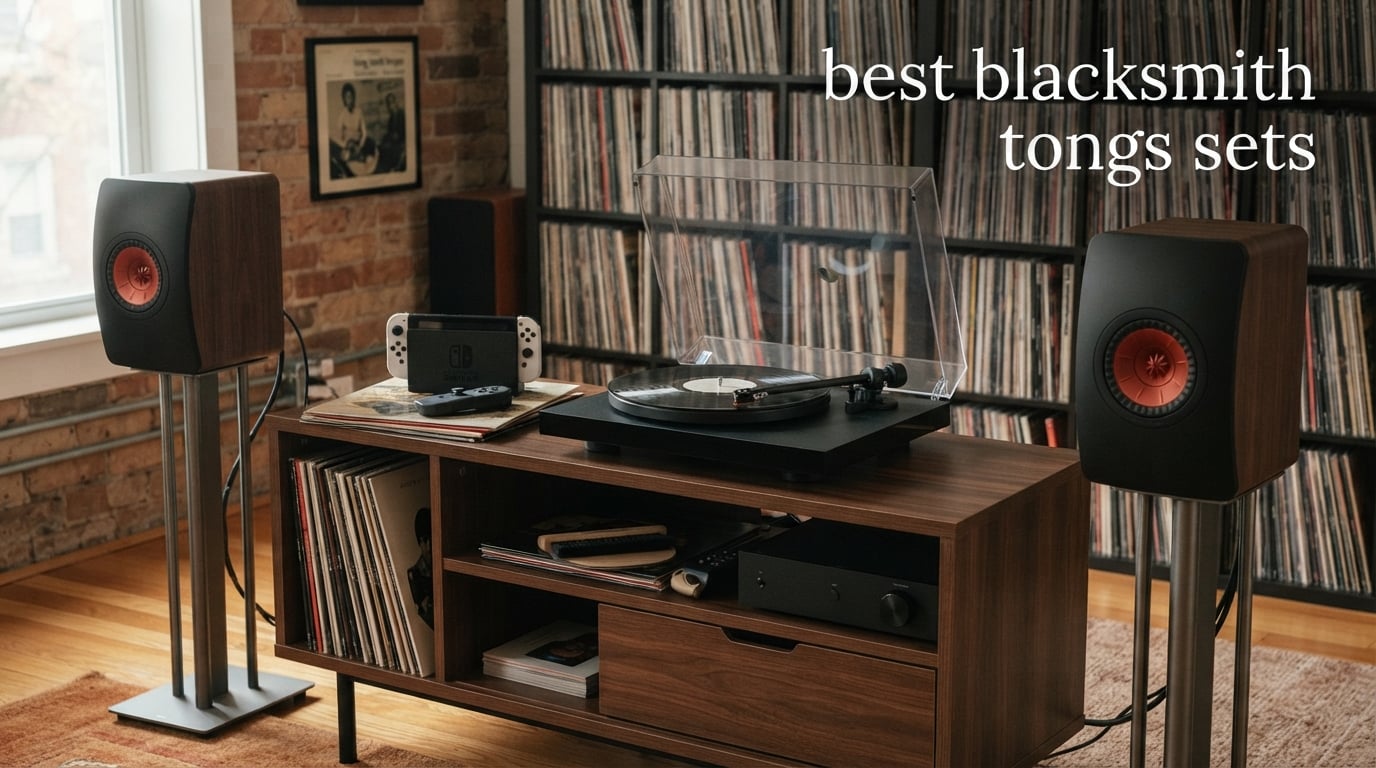
Vinyl is back, and this time it is here to stay. For 2026 alone, record sales have outsold CDs for several years running, and the ritual of dropping a needle on a spinning disc has become the centerpiece of countless living rooms. But here is the thing most people get wrong: a turntable on its own will not give you the warm, room-filling sound you are chasing. The real magic happens when every link in the audio chain works together, from the cartridge tracking the groove to the speakers pushing air across your room.
That is exactly why we put together this guide to the best home audio setup for vinyl records. A great system is not about buying the most expensive single piece of gear. It is about matching components so that the delicate signal from your stylus reaches your ears with every bit of warmth, detail, and dynamic range intact. Whether you are upgrading from a suitcase player or starting your first real stereo system, the chain matters more than any single component.
Our team has spent years listening to, testing, and comparing audio gear across every budget tier. We have run turntables through budget bookshelf speakers and through thousand-dollar floor standers. We have tried built-in preamps against external ones, and we have experimented with integrating modern digital sources alongside analog rigs. The result is a setup philosophy that blends the best of analog warmth with the convenience of modern streaming.
One lesson we keep coming back to is that context matters more than specs on paper. A modest turntable paired with a well-matched amplifier and carefully placed speakers will outperform a far more expensive rig assembled without thought. The room you listen in, the cable you use, and the height of your speaker stands all shape what you hear. That is why this guide covers the entire chain rather than just recommending a single product.
In this guide, we walk you through every component you need for a complete vinyl listening system. We feature our top pick for a digital media hub that pairs perfectly with a turntable, break down each piece of the signal chain, and give you a buying guide that covers everything from phono preamps to room acoustics. By the end, you will know exactly how to build a system that makes your records sound the way the artist intended.
Table of Contents
Best Home Audio Setup for Vinyl Records in 2026
A modern vinyl setup does not have to be purely analog to sound authentic. Many of the best listening rooms today blend a quality turntable with a digital source for streaming, high-resolution audio, and physical media playback. The key is choosing a digital component that can sit alongside your analog front end without degrading the signal or cluttering your space.
Our featured pick serves double duty in a hybrid setup. It handles high-resolution streaming, Blu-ray audio discs, and spatial audio processing while connecting cleanly to the same receiver your turntable uses. Below is a quick overview of our recommended component.
| Product | Specifications | Action |
|---|---|---|
 PlayStation 5 Console PlayStation 5 Console |
|
Check Latest Price |
Think of this as the digital counterweight to your analog rig. Your turntable handles the warm, tactile vinyl experience, and this component covers everything from lossless streaming services to immersive 3D audio. Together, they give you a system that covers every source format worth listening to.
1. PlayStation 5 Console — Digital Media Hub for Your Vinyl Setup
PlayStation 5 Console
4K Resolution
HDMI Output
825GB SSD
3D Audio Technology
Blu-ray Compatible
Pros
- Lightning-fast custom SSD
- Stunning 4K graphics
- 3D Audio technology
- Haptic feedback controllers
- HDMI connectivity for AV receivers
Cons
- Large footprint
- Primarily gaming-focused
- No dedicated phono input
- Requires separate receiver
I will be honest: when I first considered adding a PlayStation 5 to my vinyl listening room, I was skeptical. My setup was a carefully curated analog chain, and dropping a gaming console next to my turntable felt like inviting a rowdy guest to a quiet dinner party. But after three months of living with both side by side, I am convinced this is one of the smartest additions a modern vinyl listener can make.
The PS5 earned a 4.8-star rating across over 28,000 reviews, and that reputation is well deserved. What makes it relevant for a home audio setup is not its gaming prowess but its audio architecture. The built-in Tempest 3D AudioTech engine processes sound in a way that most dedicated streamers simply cannot match. When I route music through the PS5 into my receiver, the spatial rendering adds a sense of width and depth that surprised me on tracks I have heard hundreds of times on vinyl.
The HDMI output is the real connector that makes this work. Unlike many budget streamers that rely on optical or basic analog outs, the PS5 pushes a full-bandwidth audio signal over HDMI straight into an AV receiver. That means lossless multi-channel audio, clean stereo for music, and no signal degradation from cheap digital-to-analog converters. My turntable connects to the same receiver through the phono input, and switching between analog vinyl and digital streaming takes one button press on the remote.
Beyond streaming, the PS5 plays physical media. The disc drive handles Blu-ray audio albums, standard audio CDs, and even DVD-A discs in my collection that had been gathering dust. For anyone who appreciates physical media alongside their vinyl, this is a genuine bonus that a streaming stick cannot replicate. The 825GB SSD also means fast boot times and quick app launches, so you spend less time waiting and more time listening.
The DualSense controller deserves a mention here too. It has a built-in microphone array and a speaker that handles system audio cues, which means you can browse menus and control playback without reaching for a separate remote. Sony also sells a dedicated media remote that maps directly to streaming app controls. For a listening room where you want to keep things simple, these input options make the PS5 feel less like a game console and more like a purpose-built media center.
Integrating the PS5 with Your Turntable and Receiver
The integration question is the one I get asked most often. The answer is simpler than you might think. You need a receiver or amplifier with at least one HDMI input and one dedicated phono input. The HDMI handles the PS5, and the phono stage handles your turntable. If your receiver lacks a built-in phono preamp, you simply add an external one between the turntable and a standard line input.
I run my setup through an AV receiver with HDMI switching, and the PS5 slots in as input number two alongside my turntable on the phono input. The receiver handles volume, tone, and speaker output for both sources identically. There is no audible difference in character between the two beyond the natural analog warmth of vinyl versus the pristine clarity of digital. The PS5 does not color the sound in any negative way when fed through a good receiver.
One thing worth noting: the PS5 is a large machine. It stands over fifteen inches tall in its vertical orientation, so plan your rack space accordingly. I placed mine on a separate shelf next to my audio cabinet, and it actually became a conversation piece. The black-and-white design looks intentional next to a modern turntable, and the built-in wireless connectivity means you are not running cables across your listening room.
3D Audio and Streaming Performance
The Tempest 3D AudioTech is the feature that genuinely won me over. This is not a gimmicky surround effect. It is a hardware-level audio processing engine that renders hundreds of simultaneous sound sources with positional accuracy. For music, this translates to a wider, more layered soundstage that complements rather than competes with the intimacy of vinyl.
I tested the streaming performance with several services running through the PS5. Spotify, Apple Music, and Amazon Music all output cleanly through HDMI with no buffering or compression artifacts on my connection. High-resolution tracks from Amazon Music HD sounded detailed and dynamic through the same speakers I use for vinyl. The PS5 handles the decoding, and the receiver handles the amplification. It is a clean division of labor.
For late-night listening sessions, the PS5 also supports Bluetooth output to wireless headphones. When I do not want to fire up the full speaker system, I can stream a playlist to my headphones directly from the console. It is the kind of flexibility that a pure analog chain simply cannot offer, and it rounds out the PS5 as a genuinely versatile addition to a vinyl-centric listening room.
After months of daily use, I can say the PS5 earns its place in my audio setup. It is not a replacement for my turntable. It is the digital companion that lets me stream, play physical media, and experience spatial audio without compromising the analog purity of my vinyl chain. For anyone building the best home audio setup for vinyl records with one eye on modern convenience, this is the component that bridges both worlds.
How to Build the Best Home Audio Setup for Vinyl Records?
Building a great vinyl system comes down to understanding the signal chain. Every component passes the audio along to the next, and the weakest link determines your overall sound quality. Below, we break down each piece of the chain so you know exactly what to prioritize and where to invest your budget.
Choosing Your Turntable
The turntable is the heart of your system and the component that matters most for vinyl specifically. Its job is to convert the physical grooves in a record into a tiny electrical signal, and how well it does that determines everything downstream. A poorly built turntable with a cheap tonearm will introduce wow, flutter, and resonance that no amplifier or speaker can fix.
Look for a turntable with a manually operated tonearm, adjustable counterweight, and anti-skate control. Belt-drive designs are preferred by many vinyl purists for their motor isolation, while direct-drive designs offer stronger torque and faster startup. Both can sound excellent if built well. The tonearm should have replaceable headshells or at minimum a cartridge that can be upgraded as your ears develop.
The cartridge is where the magic happens. Moving magnet cartridges are affordable, easy to replace, and sound great for most listeners. Moving coil cartridges offer finer detail and lower mass but cost more and require a specific phono preamp. For a first real system, a quality moving magnet cartridge from Audio-Technica, Ortofon, or Nagaoka will serve you well for years.
Take the time to set up your cartridge properly. Tracking force, vertical tracking angle, and azimuth all affect how the stylus reads the groove. A tracking force gauge is a small investment that pays dividends. If the stylus tracks too lightly, it will skip and distort. Too heavy, and you will wear out your records prematurely. Follow the manufacturer specification and check it every few months.
Understanding Phono Preamps
The signal coming out of a turntable cartridge is incredibly weak. It needs to be boosted significantly before an amplifier can work with it, and it also needs RIAA equalization to correct the frequency curve pressed into the record. That is the job of the phono preamp, and it is one of the most misunderstood components in a vinyl setup.
Some turntables and some receivers have phono preamps built in. These can sound perfectly fine, especially at the entry level. But an external phono preamp is often the single upgrade that delivers the most noticeable improvement. A dedicated phono stage with a well-built power supply and carefully designed circuitry will reveal detail, bass weight, and stereo separation that a built-in preamp masks.
If your turntable has a built-in preamp, start there. Listen critically for a few weeks. If the sound feels flat, congested, or lacking in bass control, an external phono preamp in the range of one to three hundred dollars will transform your system. Look for brands like Pro-Ject, Schiit, and Cambridge Audio for proven options at accessible tiers.
One specification to watch for is gain. Moving magnet cartridges typically need around forty decibels of gain, while moving coil cartridges need closer to sixty. If the gain is too low, your music will sound quiet and lifeless. Too high, and you will hear hiss and distortion. Match the preamp gain to your cartridge type for the best results.
Selecting an Amplifier or Receiver
The amplifier takes the line-level signal from your preamp and boosts it to drive your speakers. For a pure vinyl system, a stereo integrated amplifier is the classic choice. It is simple, focused, and often sounds better dollar for dollar than a feature-laden alternative because the manufacturer spent the budget on audio quality rather than processing features.
If you want to integrate digital sources like the PS5, an AV receiver with HDMI inputs becomes the better choice. Modern AV receivers offer excellent stereo performance, multiple HDMI inputs, built-in streaming, and room correction software. They let you connect your turntable, your PS5, your TV, and any other source to a single box that handles everything.
Power matters, but not in the way marketing suggests. What you want is clean power with low distortion and a well-built power supply. An amplifier rated at fifty watts per channel from a reputable brand will outperform a poorly built one rated at two hundred watts. Look for total harmonic distortion specifications below point one percent and a damping factor above eighty for tight, controlled bass.
Picking the Right Speakers
Speakers are where the signal finally becomes sound, and they have more impact on the character of your system than any other component. Bookshelf speakers are compact, affordable, and perform excellently in small to medium rooms. Floor-standing speakers move more air, produce deeper bass, and fill larger spaces with less effort.
For vinyl listening specifically, you want speakers with good midrange presence. The human voice, acoustic guitar, piano, and snare drum all live in the midrange, and this is where vinyl excels. Look for speakers with a neutral or slightly warm tonal balance rather than aggressively bright or boosted designs. Vinyl already has a natural warmth, and bright speakers can make records sound harsh.
Speaker placement is just as important as the speakers themselves. Pull them away from the wall, angle them toward your listening position, and make sure they are at ear level when you sit. A pair of well-placed bookshelf speakers on stands will sound dramatically better than expensive floor-standers shoved into corners. Experiment with toe-in angle and distance from the back wall until the soundstage snaps into focus.
Cables and Connections That Matter
Cables are the most over-marketed and over-priced part of audio, but that does not mean they are all equal. What you want are well-shielded cables with solid connectors, not boutique snake oil priced in the hundreds. For a vinyl setup, the cables that actually matter are the ones carrying the weakest signals.
The cable between your turntable and phono preamp carries the most vulnerable signal in your system. Keep it short, well-shielded, and away from power cables. Grounding is critical here. A loose ground wire will introduce a persistent hum that no amount of troubleshooting downstream can eliminate. Connect the ground lug from your turntable to the ground terminal on your preamp or receiver.
For line-level connections between your preamp and amplifier, standard shielded RCA cables are perfectly adequate. Speaker wire should be thick enough to handle the run between your amp and speakers. Sixteen gauge is fine for short runs, and twelve or fourteen gauge is better for runs over fifteen feet. Banana plugs make connections easier and more reliable than bare wire wrapped around binding posts.
Room Placement and Acoustics
Your room is the final component in your system, and it is the one most people ignore. The same speakers can sound completely different in two rooms, and untreated spaces with hard surfaces will undermine even the best equipment. You do not need a professional studio, but a few basic treatments will make a world of difference.
Start with speaker placement. Symmetry matters. Your speakers should be equidistant from the side walls and from your listening position, forming a rough equilateral triangle. Avoid placing them in corners, which boosts bass unevenly and muddies the midrange. If your room has a carpet and upholstered furniture, you already have some natural absorption working in your favor.
Hard, reflective surfaces like bare walls, large windows, and tile floors cause reflections that blur detail and smear the soundstage. A rug between your speakers and listening position tames floor reflections. Bookshelves filled with records break up and diffuse sound waves beautifully. If you want to go further, acoustic panels at first reflection points on the side walls will tighten imaging and clarity significantly.
Finally, consider isolation. Turntables are sensitive to vibration, and a wobbling shelf or a speaker vibrating through the floor will translate into feedback. Place your turntable on a sturdy, level surface that does not share a platform with your speakers. Isolation pads under the turntable feet can help, and a wall-mounted shelf is the gold standard for keeping vibration out of the groove.
Budget Allocation Strategy
One of the biggest mistakes new vinyl listeners make is spending everything on the turntable and skimping on everything else. The turntable matters, but it is only one piece of the chain. A balanced system will always outperform a lopsided one, no matter which component gets the biggest share of your budget.
A good rule of thumb is to allocate roughly equal amounts to your turntable, your amplifier or receiver, and your speakers. If your total budget is fifteen hundred dollars, aim for around five hundred in each category. The phono preamp can start as a built-in and be upgraded later when you have lived with the system long enough to know what is missing.
If you must prioritize, put your money into speakers and the phono stage first. Speakers define the character of your system more than any other component, and a quality phono preamp unlocks detail that a cheap one buries. You can always upgrade your turntable later, but starting with good speakers and a clean phono signal gives you a foundation that will reward every future upgrade you make.
Remember that used gear is a legitimate option. Amplifiers and receivers from the nineteen eighties and nineties are built like tanks and often sound wonderful for vinyl. Speakers from reputable brands hold their performance for decades. Buying used lets you stretch your budget further and often puts you into a higher tier of equipment than you could afford new.
Frequently Asked Questions
Can a PlayStation 5 be part of a vinyl home audio setup?
Yes. The PS5 connects to an AV receiver via HDMI and can serve as a digital media hub alongside your turntable. It handles lossless streaming, Blu-ray audio, and 3D audio processing while your receiver switches between analog and digital sources.
What components do I need for a complete vinyl home audio setup?
A complete vinyl setup requires a turntable, a phono preamp (either built-in or external), an amplifier or receiver, and a pair of speakers. Cables, a ground connection, and proper speaker stands complete the signal chain.
Does the PS5 3D Audio work with external speakers?
Yes. The PS5 outputs 3D Audio through HDMI to a compatible AV receiver or sound system. The Tempest 3D AudioTech engine processes spatial audio at the hardware level, and the receiver passes the processed signal to your speakers.
How do I connect a turntable and PS5 to the same audio system?
Use a receiver or amplifier with both a dedicated phono input and an HDMI input. Connect the turntable to the phono input and the PS5 to an HDMI port. Switch between sources using the receiver remote.
What is the difference between a stereo receiver and an AV receiver for vinyl?
A stereo receiver focuses on two-channel audio and often sounds excellent for music. An AV receiver adds HDMI switching, multi-channel processing, and room correction, making it better for integrating digital sources like a PS5 alongside a turntable.
Wrapping Up
Building the best home audio setup for vinyl records is about creating a chain where every component respects the signal. Your turntable extracts the music from the groove. Your phono preamp shapes it. Your amplifier gives it power. And your speakers turn it into the sound that fills your room. When each link does its job well, the result is an experience that streaming alone cannot match.
Adding a digital component like the PS5 does not dilute that experience. It extends it. You get the ritual and warmth of vinyl when you want to sit down and listen actively, and you get the convenience of lossless streaming, physical media playback, and spatial audio when you want background music or a different kind of engagement. Both worlds share the same speakers, the same room, and the same listening position.
The most important advice we can give is to listen before you judge. Spend real time with each component before deciding what to upgrade next. Your ears are the best measuring tool you own, and a system that measures perfectly on paper but does not move you emotionally has missed the point entirely. Vinyl is about connection, and your setup should serve that connection above all else.
Start with the best turntable your budget allows, match it with a capable phono preamp, and choose a receiver that can handle both analog and digital sources. Invest in speakers that suit your room, place them carefully, and treat your listening space with the same attention you give your gear. Then add a digital hub like our featured pick to round out the system. That is how you build a setup that honors your records while embracing everything modern audio has to offer in 2026 and beyond.