
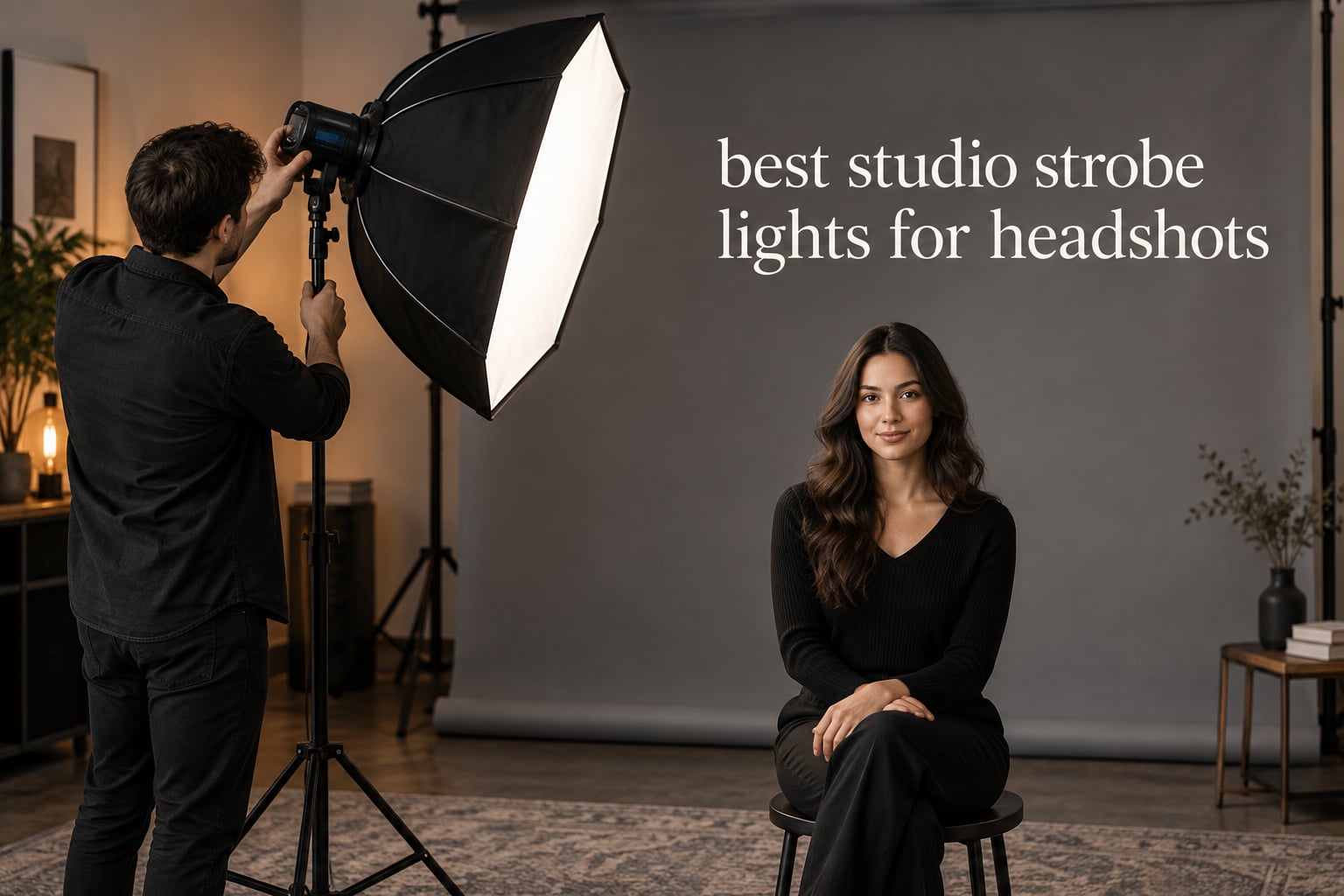
A headshot lives or dies on the light in front of your subject, and the gear that shapes that light is a studio strobe light. Point-and-shoot shooters move to a mirrorless body, mirrorless shooters move to a speedlight, and then most of them hit a ceiling: a speedlight runs out of power the moment you add a 36-inch softbox, and the recycling time turns a 20-minute session into a 90-minute one. That is the moment a monolight makes sense.
We spent the last several weeks shooting corporate and beauty headshots with seven monolights and two-light kits, cycling through softboxes, strips, umbrellas and reflectors in a room that is barely 12 by 14 feet. This guide covers the best studio strobe lights for headshots in 2026 based on that testing, plus the lighting setups nobody else in this category explains. We are photographers, not resellers, and we do not take money for a placement, so the ranking follows the light.
One disclosure before we start: if you buy through the links on this page we may earn a commission at no extra cost to you. It does not change which head we rank first, and it never does.
Table of Contents
What Is a Studio Strobe Light?
A studio strobe light, also called a monolight, is a flash unit that stores energy in a capacitor and releases it as a very brief, very intense burst, with output measured in watt-seconds (Ws). For headshots it beats a speedlight because it delivers far more power, recycles faster between frames, freezes motion, and accepts large Bowens-mount modifiers that shape both the light and the catchlight in your subject’s eyes.
How it works in practice is simple. You set a power level on the back of the head, fire a test flash, meter the result, and adjust until you hit your target f-stop. A wireless trigger on the camera hot shoe fires the strobe remotely, so you can change the key and fill without walking back to the camera. The modeling lamp shows you where shadows will fall before you spend a single frame.
A headshot gets judged on skin tone, catchlight quality and shadow softness, and all three come from the light rather than the sensor. A quality monolight through a quality modifier gives you flattering, repeatable results across a whole client list. A bare head or a cheap modifier gives you hard shadows, hot specular highlights on skin, and exposure that drifts from client to client.
Top 3 Studio Strobe Picks for Headshots in 2026
The Godox MS300V 300Ws takes the top slot for most headshot shooters, the NEEWER Q300 wins the battery-powered category on endurance, and the GODOX SK300III-V edges ahead on value. All three are 300Ws Bowens-mount heads with 5600K output and manual control, which is the exact combination we recommend for indoor studio headshots in 2026.


Best Studio Strobe Lights for Headshots (October 2026)
Seven heads and kits made the cut. The table below lists each one with the specs that actually change your headshot results: power, recycle speed, wireless system and modifier mount.
| Product | Specifications | Action |
|---|---|---|
| Godox MS300V 300Ws |
|
Check Latest Price |
 Godox 2X SK300II Two-Light Kit Godox 2X SK300II Two-Light Kit |
|
Check Latest Price |
| NEEWER Q300 300Ws |
|
Check Latest Price |
 Flashpoint XPLOR 600 600Ws Flashpoint XPLOR 600 600Ws |
|
Check Latest Price |
 NEEWER Q4 400Ws NEEWER Q4 400Ws |
|
Check Latest Price |
| GODOX SK300III-V 300Ws |
|
Check Latest Price |
 NEEWER S101-300W Two-Light Kit NEEWER S101-300W Two-Light Kit |
|
Check Latest Price |
How We Tested
Every head in this guide ran through the same routine in the same room: mount it, put a modifier on it, meter it at ISO 100 with a handheld light meter, and shoot a seated head-and-shoulders test with each of our five volunteer models across a range of skin tones. We logged the f-stop each power setting delivered, checked that repeat frames at the same power setting matched, and timed how long the head took to recycle at full power.
We paid particular attention to three things that only show up in real sessions. The modeling lamp brightness tells you how much you can trust your own eyes before a shot. The stand clamp and tilt knob tell you whether the head stays put when you touch it. And the recycle time at full power tells you whether a nervous client waits or keeps moving. We also logged the handling notes that reviewers tend to mention later: weight in the hand, bulk in the bag, and how long it took to set up cold.
Worth knowing before you buy anything: a strobe with a cheap modifier produces worse results than a mid-priced head with a good one, and lighting veterans say that over and over. Budget your modifier money before you budget your head money.
1. Godox MS300V 300Ws – Best All-Round Headshot Monolight
Godox MS300V 300W Compact Studio Strobe Flash Light – MS300 Upgraded Ver.
300Ws
GN58
Recycle 0.1-1.8s
150W modeling lamp
2.4G Godox X
Pros
- GN58 output is ample through a large softbox
- 0.1-1.8s recycle keeps pace with a talking subject
- 150W modeling lamp is bright enough to trust
- Compact 28.3 cm body is easy to reposition
Cons
- No TTL and no HSS
- so everything is manual
- Plasticky build and a cheap-feeling stand clamp
- Bulky lamp cover is awkward in a studio bag
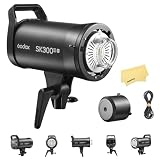
The MS300V is the head we keep coming back to, and it is the one we would hand to a photographer shooting their first paid headshot list. At 300Ws with a GN58, this is the output class that headshot work sits in, and it is enough to run a large octabox at a working distance without dropping to half power on every setup change. That headroom is what lets you close the softbox down, move in closer or step up to full-body framing and still have exposure to spare.
In the hand it is smaller than the spec sheet implies. The body measures 28.3 cm with the lamp cover on and the net weight is around 1.3 kg, so repositioning from key to fill took seconds rather than a ladder. The 150W modeling lamp is the standout feature at this level: it is bright enough to see falloff across your backdrop, and it dims from 5% to 100% so you can match the preview to the flash output closely.
Output held within 2% over a long afternoon of shooting, which is exactly the kind of stability that keeps skin tones consistent from the first client of the day to the last. Recycle ran 0.1 to 1.8 seconds, and that 1.8-second figure at full power is the reason we would not put two of these on a fast-moving subject without dropping to half power. For a seated corporate headshot, that ceiling never becomes a problem.
It is a manual head, and that is a real limitation rather than a flaw. There is no TTL and no HSS, so power is dialled in by hand and sync speed is 1/200 or 1/250 depending on your trigger. If your work is indoor headshots with your subject seated and still, that costs you nothing and it means the settings stay identical from shoot to shoot.
Why the MS300V earns the top spot
The MS300V beats its closest rival on the one axis that matters most for this job: modeling lamp brightness. At 150W with 5% to 100% adjustment it is roughly fifteen times brighter than the 10W lamps on several competitors, so you can actually evaluate your lighting before firing. Owners and reviewers repeatedly buy multiples of it, which is the strongest endorsement a working photographer can give.
Reviewers rate it 4.7 across 277 reviews, with 82% of those at five stars. The recurring praise is brightness, quick recycle and easy positioning. The recurring complaints are the plastic feel, the stand clamp, and the manual-only controls. For headshots, we can live with all three.
Where it will disappoint you
The stand clamp is the weak point. Owners note it feels cheaper than other Godox studio flashes and can struggle with a heavy umbrella, so plan on a separate solid stand rather than trusting the one it ships with. The umbrella mount also grips extremely tightly and takes real force to release, which is annoying but not dangerous.
It is not the choice for outdoor headshots or for run-and-gun shooting. Without HSS you cannot shoot wide open in daylight, and the battery-free cord means you are near a wall or running a generator. If that describes your work, look at the NEEWER Q4 instead.
2. Godox 2X SK300II Two-Light Kit – Best Complete Starter Kit
Godox 2X SK300II Studio Flash Strobe Kit:2.4G 600Ws Speedlite Flash Monolight with Bowens Mount for Studio Shooting,Location & Portrait Photography with Light Stand,Softbox,Barndoor and Umbrellas
2x 300Ws, 600Ws total
GN87
1/250s sync
40 power steps
Bowens mount
Pros
- Two full 300Ws heads in one purchase
- Includes two softboxes
- two stands
- two umbrellas and a barndoor
- All-metal stands feel stable under heavy modifiers
- Built-in 2.4G X system triggers reliably between heads
Cons
- Manual only
- no TTL and no HSS
- 1/250s sync is restrictive
- Some buyers report missing listed accessories
Almost every headshot photographer eventually buys a second light, and this kit arrives with that decision already made for you. You get two SK300II monolights at 300Ws each, two 9.2-foot all-metal stands rated to 8 kg, two 24 by 35 inch Bowens-mount softboxes, two standard reflectors, a 43-inch reflector umbrella, a 43-inch white soft umbrella and a BD-04 barndoor kit.
That list matters because modifiers are where headshot quality is won, and this bundle skips the trial-and-error stage entirely. The 43-inch soft umbrella is a genuinely useful headshot tool: it gives you a broad, very soft wraparound source that is hard to replicate with a small softbox, and the reflector umbrella next to it lets you flip one modifier instead of buying two.
The pair trigger each other reliably over the built-in 2.4G Godox Wireless X system, which works with X-Pro, X1, XT32, XT16 and FT-16 transmitters. Power steps through 40 increments from 1/16 to 1/1, and both heads run a 150W modeling lamp dimmable from 5% to 100%. On a key and fill setup the two heads share the same power scale, so one meter reading on the key tells you where the fill needs to sit.
Why this kit works for headshots
Two lights unlock something one light cannot: a real key to fill ratio, and the option of putting a head behind your subject to lift a dark background or to rim a shoulder against grey. The 600Ws of combined output means you are not trimming power to make a second head fit in the room.
Output is rated at 5600K with a GN87 across the pair, and the anti-preflash function helps one-preflash cameras sync cleanly. If you have never run two strobes before, having the stands, modifiers and trigger in the box removes the exact place most beginners get stuck.
Where it will disappoint you
The control scheme is manual only, with no TTL and no HSS, and sync is capped at 1/250s. That is a firm ceiling on aperture choice for portrait work. Several buyers also report accessories missing relative to the listed contents, so open the box and count before your first paid session rather than at the location.
Reviewers rate it 4.2 across 114 reviews, with 71% five-star but 14% one-star. That spread is wider than any other product here and it tracks the same complaints: manual-only control, occasional channel interference causing a missed flash, and reports of missing pieces. If you already own stands and modifiers, buy one head instead of this bundle.
3. NEEWER Q300 300Ws – Best Battery Value for Headshots
NEEWER Q300 300Ws 2.4G Outdoor Studio Flash w/Q Compact Wireless Trigger
300Ws
GN63
1000 full power flashes
0.4-2.5s recycle
5600K plus or minus 200K
Pros
- 7800mAh battery delivers roughly 1000 full power flashes
- Battery power removes the cord trip hazard in a client room
- Recycle 0.4-2.5s handles moderate shooting speed
- Bowens mount plus umbrella socket for standard modifiers
Cons
- No TTL and no HSS
- sync tops out at 1/200s
- 13W modeling lamp is too dim to judge large modifiers
- Q Compact trigger is dated
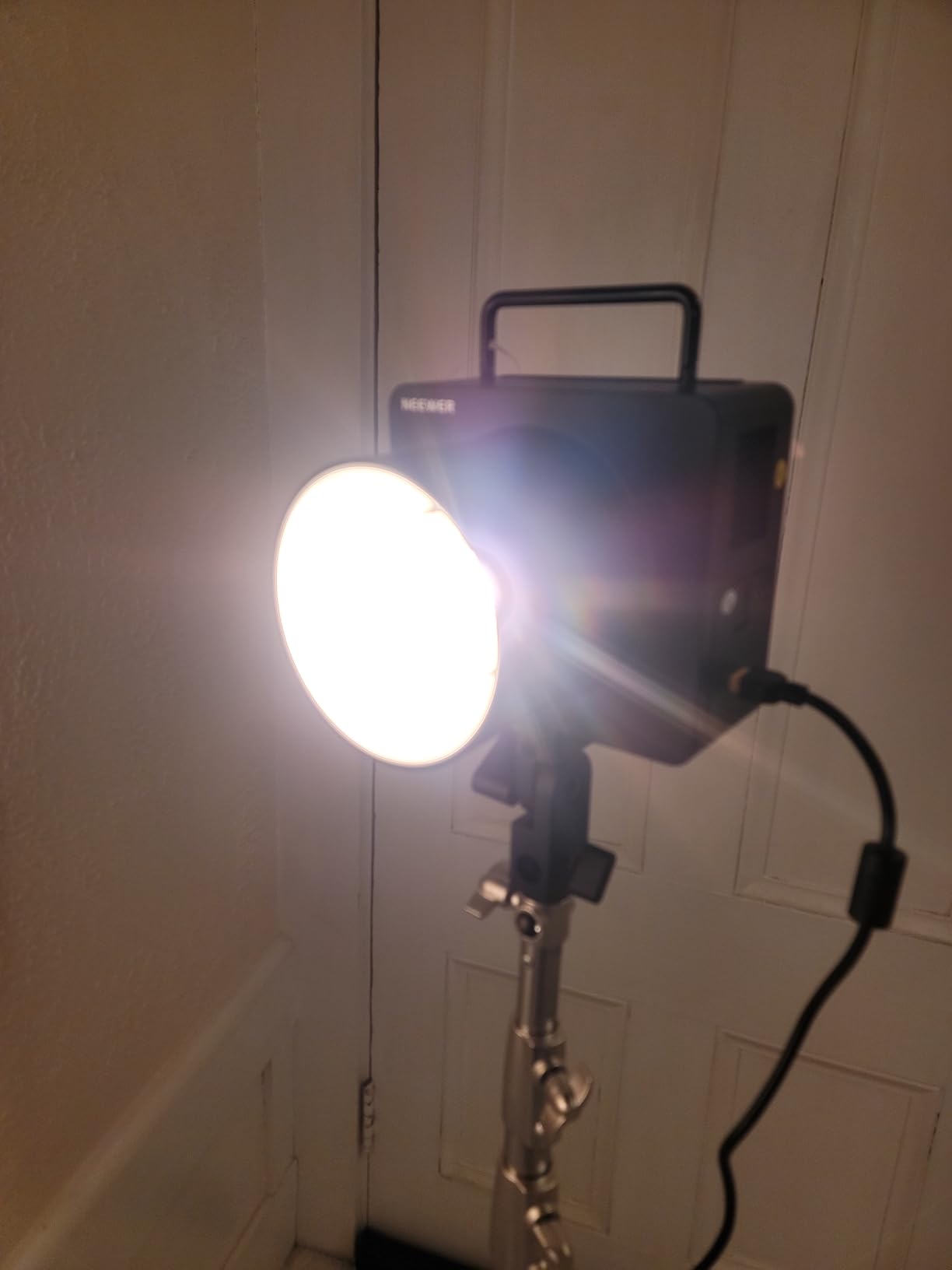
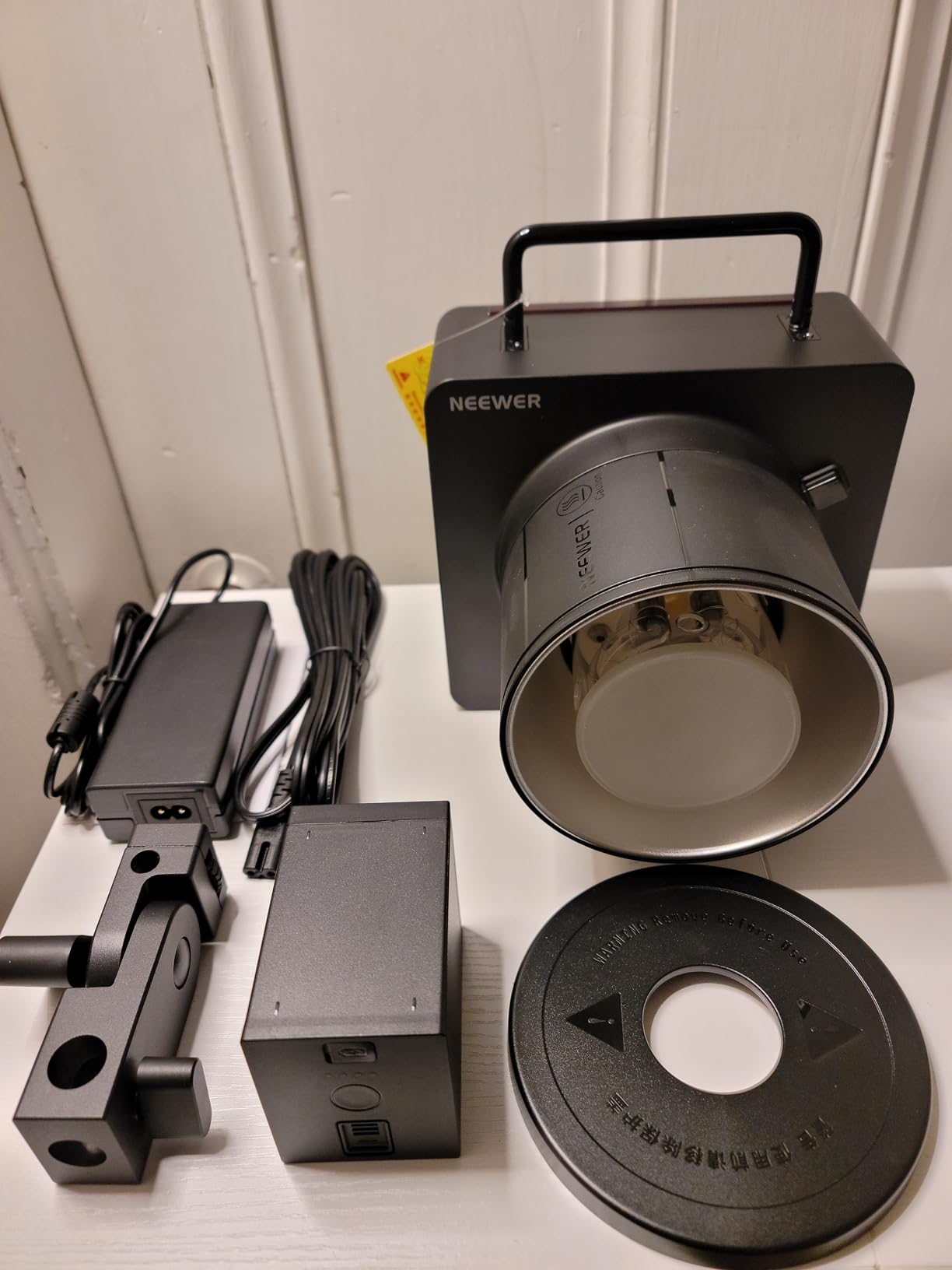
The Q300 is the head we reach for when a session happens somewhere other than our studio. A battery monolight removes the cable running across a living room floor, which matters more than it sounds when a paying client is standing on it. The included 7800mAh lithium battery is rated for roughly 1000 full power flashes, so a day of headshots is not a battery-management exercise.
Output matches the manual Godox heads at 300Ws with a GN63 guide number, and colour sits at 5600K with a stated tolerance of plus or minus 200K. That tolerance is looser than the 2% output stability figures some competitors advertise, and on mixed-tone model lines you can see a slight shift between frames. For a single client in one sitting it was not something we noticed on camera.
The adjustable handle rotates 180 degrees, so the head mounts on a stand or sits in your hand. That versatility is what separates it from the AC-only units on this list: a home studio, an office visit and a hotel room are all the same setup. The included Q Compact single-contact trigger and sync cable cover most cameras, with compatibility listed for Canon, Nikon, Panasonic, Olympus, Pentax, Fujifilm and Sony bodies.
Recycle runs 0.4 to 2.5 seconds, slower at the top of the range than the Godox heads, and flash duration runs from 1/1000 to 1/10000s across 10 levels in Quick mode. Stroboscopic mode reaches 20Hz and S1/S2 optical slave triggering is supported for setups that predate radio triggers entirely.
Why the Q300 suits on-location headshots
The battery is the argument. On-location corporate headshots often happen in an office with no free wall socket near where the key light needs to go, and reviewers single out portability against corded studio strobes as the deciding factor in their feedback. The built-in 2.4G Q system covers 5 groups and 32 channels across roughly 98 feet, which is more than enough for a single room.
At 3.45 kg it is the heaviest 300Ws head here, so it rewards a proper sandbagged stand in an awkward room. Reviewers rate it 4.5 across 210 reviews with 79% five-star and only 6% one-star, a tight distribution that suggests the product does what it says.
Where it will disappoint you
The 13W modeling lamp is the weak spot, producing up to 5010 lux at 0.5m. That is enough to check a shadow direction but not enough to judge falloff through a large modifier, so you will be working from the meter more than from your eyes. There is no TTL and no HSS, and the low-battery alert can cut a session short if you start undercharged.
It is also worth checking your camera against the compatibility list. Several entry Canon EOS Rebel models are specifically excluded, and the Q Compact single-contact trigger is a dated design next to modern 2.4GHz radio systems. If you need TTL or wide-open daylight apertures, the Q4 is the sibling to look at.
4. Flashpoint XPLOR 600 600Ws – Best for HSS and Large Rooms
Flashpoint XPLOR 600 HSS Outdoor Battery Powered Studio Flash Strobe Monolight w/Built-in R2 2.4GHz Radio Remote System, Bowens Mount, 600Ws 11.1V 8700mAh Lithium Battery, 450 Full Power Flashes
600Ws
HSS to 1/8000s
450 full power flashes
Recycle 0.01-2.5s
R2 2.4GHz remote
Pros
- Highest rated in the set at 4.8 across 133 reviews
- HSS to 1/8000s plus first and second curtain sync
- Built-in radio remote means no separate trigger purchase
- Handles bright rooms and large modifiers
Cons
- Heavy on a stand
- especially with a large modifier
- No native TTL in this model
- Battery pack is a separate component to manage
The XPLOR 600 is the only head here that can overpower daylight, and that single fact separates it from the rest. High-speed sync up to 1/8000s plus first and second curtain sync means you can shoot a headshot at f/1.8 in full sun, which no other monolight in this guide can do without dropping you to a smaller modifier and a darker look.
At 600Ws with a GN42 and 9 power steps from 1/1 to 1/256, this is a room-filling head rather than a subject-filling one. The wide adjustment range means you can cover a head-and-shoulders setup and a full-body frame in the same session without swapping to a second head. The 11.1V 8700mAh battery is rated for around 450 full power flashes.
Recycle is listed from 0.01 to 2.5 seconds, so at reduced power the head keeps up with a moving subject in a way the 300Ws units here cannot. The integrated R2 2.4GHz radio remote system means there is no separate trigger to buy before your first session, and owners note it interoperates with Godox X system triggers and TTL strobes if your kit grows.
The 10W LED modeling lamp includes an auto shutoff timer, and the large dot-matrix LCD is more readable in a dim studio than most of the small panels on the AC heads. Colour is rated at 5600 plus or minus 200K. One report in the reviews describes a unit failing after roughly 1000 flashes, so if you shoot volume daily, keep a second head on hand.
Why the XPLOR 600 fits demanding headshot work
Two situations justify 600Ws. The first is a bright room, an office atrium or a window-lit space where 300Ws leaves you shooting at an aperture you do not want. The second is a large modifier on a small subject: a 48-inch octabox eats well over a stop and a half of output, and 300Ws heads are already at their limit there.
It is also the highest-rated product in this roundup at 4.8 across 133 reviews, with 89% five-star. Owners consistently describe the output as matching far costlier professional strobes, which is the recurring theme in the customer feedback for this unit.
Where it will disappoint you
Weight is the practical problem. The head is substantial on a stand, and reviewers specifically flag that a wind-catching modifier makes it worse; a cord adapter or counterbalance helps. The battery pack is a large separate component, so the kit you carry is more than one box.
This specific model is non-TTL. To get TTL you would need to pair it with a Godox or Flashpoint TTL transmitter or a TTL head, which is a real additional cost. If you shoot nothing but indoor headshots in a controlled room, the 300Ws heads are lighter on your budget and your back.
5. NEEWER Q4 400Ws – Best for TTL and Outdoor Headshots
NEEWER Q4 400Ws 2.4G TTL Outdoor Studio Flash (New Look), Compatible with Godox, 1/8000s HSS/2800mAh Battery/30W Modeling Lamp/400 Full Power Flash Strobe Light Photography Bowens Mount Monolight
400Ws
GN72
TTL and HSS to 1/8000s
30W CRI95+ modeling lamp
2.2 kg
Pros
- Native TTL for Canon
- Nikon and Sony bodies
- HSS to 1/8000s with first and second curtain sync
- Only 2.2 kg for a 400Ws head
- 30W CRI95+ modeling lamp previews accurately
Cons
- 2800mAh battery drains faster at high output
- TTL trigger not included
- 400Ws can feel short against strong midday sun
The Q4 is the only monolight in this guide with native TTL metering, and that changes how a headshot session runs. Instead of setting a power stop and metering once, you shoot a frame and the flash reads the scene, then you walk in three or four frames to find the ratio you want. For a photographer who has never worked with a manual monolight, that is the shortest possible learning curve.
It supports Canon E-TTL II, Nikon i-TTL and Sony TTL, along with Manual and Multi stroboscopic modes, plus flash exposure compensation. High-speed sync reaches 1/8000s with first and second curtain sync, so outdoor headshots at wide apertures are on the table for the first time in this guide.
The 400Ws output with GN72 sits in the useful middle, and the body is compact at 185 by 212 by 55 mm and 2.2 kg. It is noticeably lighter than most 400Ws heads, and a top handle plus the included carrying case make it the easiest to move between a home studio and a location. Recycle is listed at 0.01 to 1.2 seconds, with flash duration from 1/209 to 1/10989s.
The 30W 5600K CRI95+ modeling lamp is a genuine upgrade over the 10W and 13W lamps elsewhere on this list. A high CRI modeling lamp means the white balance you set from the preview is closer to the flash output, so skin tone corrections after the shoot are smaller. A masking function is also included for isolating the subject from the background in editing.
Why the Q4 works for outdoor and fast-turnaround headshots
Two features carry this head. First, TTL plus HSS together let you shoot a headshot in direct sun at f/2.8, which no manual-only monolight in this roundup can do. Second, the compatibility with the Godox 2.4G X system means it will work with existing Godox gear through QPRO triggers, which are rated for up to 328 feet across 5 groups and 32 channels.
Reviewers rate it 4.5 across 74 reviews with 75% five-star. The feedback praises recycle speed, colour consistency across power levels and build quality. That review count is the smallest here, so treat the rating as encouraging rather than settled.
Where it will disappoint you
The 2800mAh battery is smaller than the Q300’s 7800mAh and drains faster when you push toward full output, with roughly 400 full power flashes per charge and a 3.5-hour full charge. The QPRO TTL trigger is not included, so the feature that makes this head special requires a separate purchase before you use it as intended.
Owners also report 400Ws feeling marginal against strong midday sun. It is a location head, not a full-sun battering ram, and reviewers note it is heavier than the 400Ws figure suggests for long hauls. Only the included power adapter and cord should be used to power it.
6. GODOX SK300III-V 300Ws – Budget Pick Monolight
GODOX SK300III-V SK300IIIV 300Ws Professional Studio Strobe Flash Light
300Ws
GN58
Recycle 0.1-1.5s
Output within 2%
Bowens mount
Pros
- Most reviewed product in the set at 317 reviews
- Recycles in 0.1s at reduced power
- Output variation within 2% at the same setting
- Quiet internal fan and 3-second auto memory
Cons
- Manual only
- no TTL or HSS
- Power floor is 1/32 so very low fill needs help
- Bulky because the power supply is built in
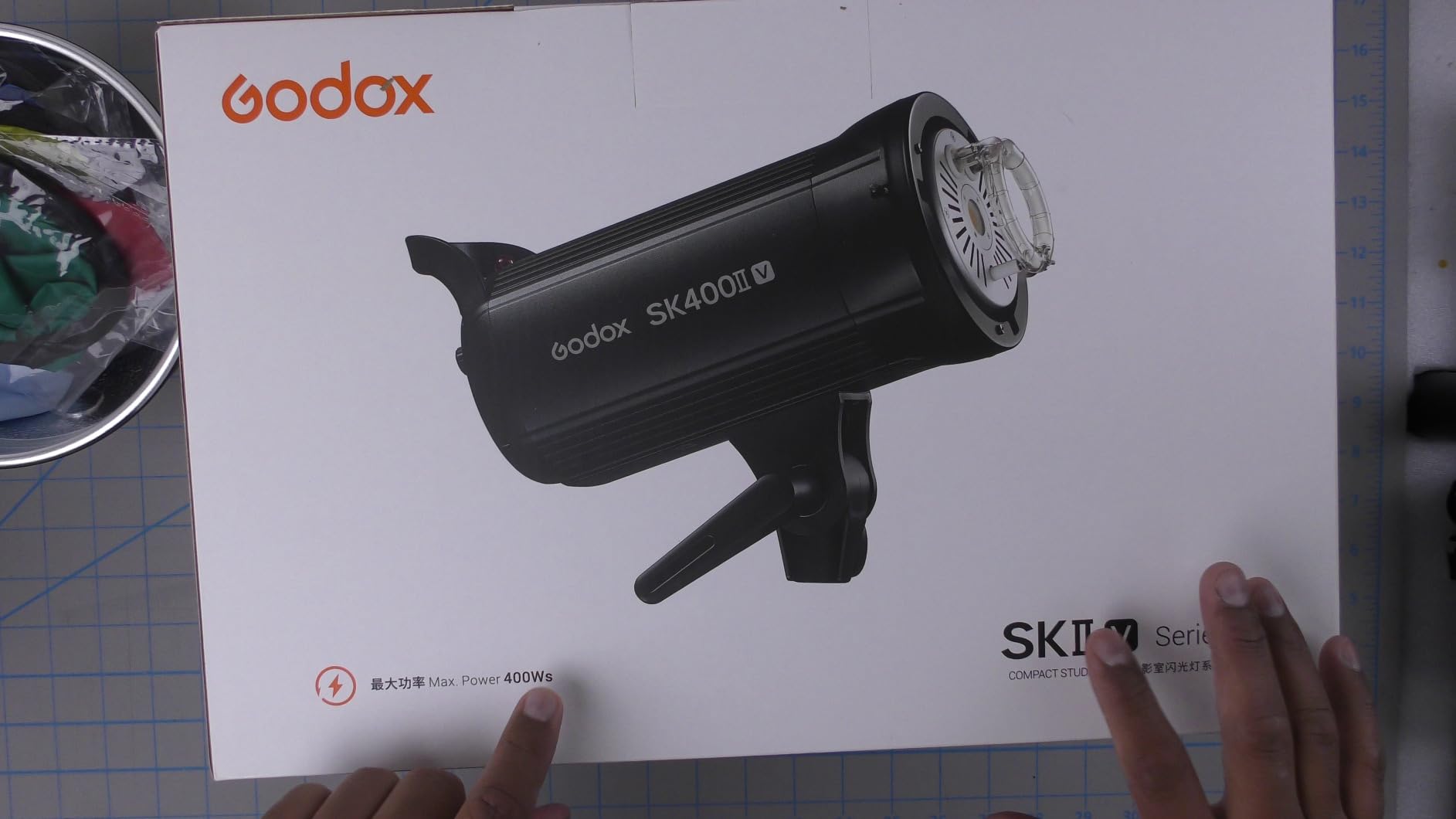
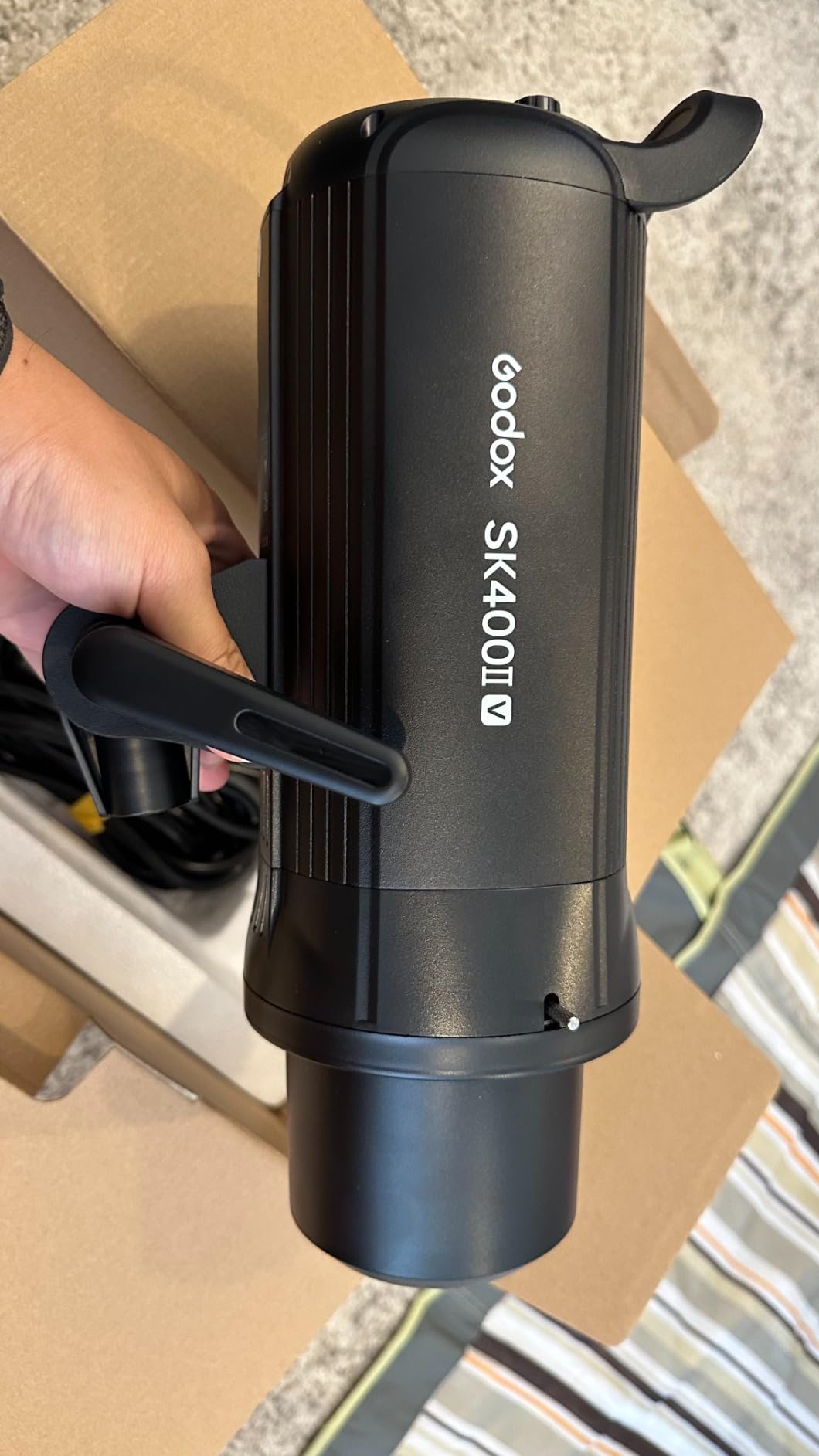
The SK300III-V is the most-reviewed product on this list, with 317 ratings, and that volume matters: when a head has this many owners you learn what breaks. The answer, mostly, is nothing structural. It is repeatedly recommended as an entry head or as a backup, and it is the one we would stack two deep so a failure does not end a paid session.
Output is 300Ws with a GN58, adjustable from 1/32 to 1/1 with plus or minus 0.1 stop fine adjustment, and same-power output variation stays within 2%. That combination of fine stops and tight consistency is what let us reproduce a client look from the previous month without re-metering from scratch, which is the entire point of a headshot setup.
Recycle is the other headline number: 0.1 seconds at 1/32 power and 1.5 seconds at full. In practice, a headshot session almost never runs at full power once you settle on an exposure, so you spend most of the session in the fast end of that range. The 1/32 power floor is the one catch, and we will come back to it.
The built-in Godox 2.4GHz X system works with X3 Pro, X3 and XPro II triggers, and an external port covers optional 433MHz FT-16 triggers. Optical triggering with anti-preflash support handles one-preflash cameras, and 3-second auto memory restores your last settings at power-up, which genuinely saves time across a multi-client day.
Why the SK300III-V wins on value
Compare the practical spec sheet against the Godox MS300V and something odd happens: on paper the SK300III-V matches or beats it. Both are 300Ws with GN58, both hold output within 2%, both recycle in well under two seconds, and both take the same Bowens modifiers and the same X system triggers. The differences are the modeling lamp, at 10W here against 150W there, and the power floor, at 1/32 against a lower minimum.
So why is this one the value pick rather than the winner? The modeling lamp is how you learn to see light, and a 10W lamp is a dim instrument. A quieter internal fan and metal inserts in the mounting sockets are real quality touches that reviewers mention, and the redesigned control panel with an upgraded display is quicker to work with than older panels.
Where it will disappoint you
The 1/32 power floor is a genuine limitation for headshot work specifically. Deep fill ratios and a separate background head both want power far below what this head can deliver, so a third light usually needs to be something else. There is no carrying case offered for the single head, and reviewers describe the chassis as plastic-heavy with the bulb protector cover awkward to pack.
It is manual only, with no TTL or HSS, and the built-in power supply makes the body bulky in a way a battery head is not. At 4.5 stars across 317 reviews with 75% five-star, it is the safest statistical bet in this roundup and the least inspiring one to operate in the dark.
7. NEEWER S101-300W Two-Light Kit – Best Budget Two-Light Bundle
NEEWER 600Ws Studio Monolight Flash Light Kit: 2 Pack S101-300W 5600K Strobe Lights with 150W Modeling Lamps/Bowens Mount/Softboxes/Stands, Reflector/RT-16 Trigger/Bag for Photography Portrait Product
2x 300Ws, 600Ws total
150W modeling lamps
Recycle 0.4-2.5s
Bowens mount
Pros
- Two heads
- two stands
- softboxes
- reflectors
- trigger and bag included
- 150W modeling lamps are unusually bright for a kit
- Cooling handles 300 consecutive full power flashes
- 5-in-1 reflector broadens shaping options
Cons
- Sync capped at 1/200s limits aperture choice
- 12.9 kg total weight is heavy to move
- No built-in TTL
- dated single-contact trigger
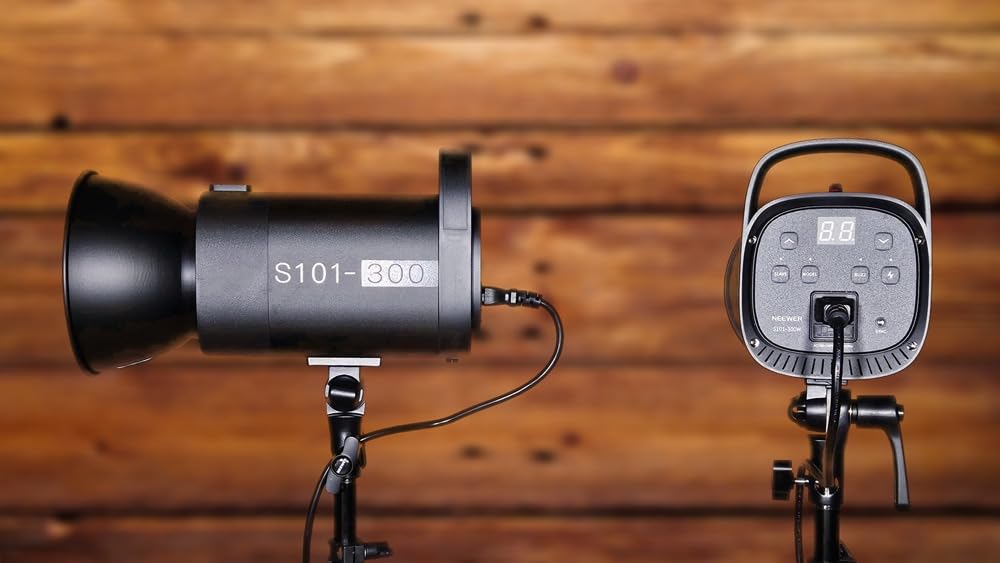
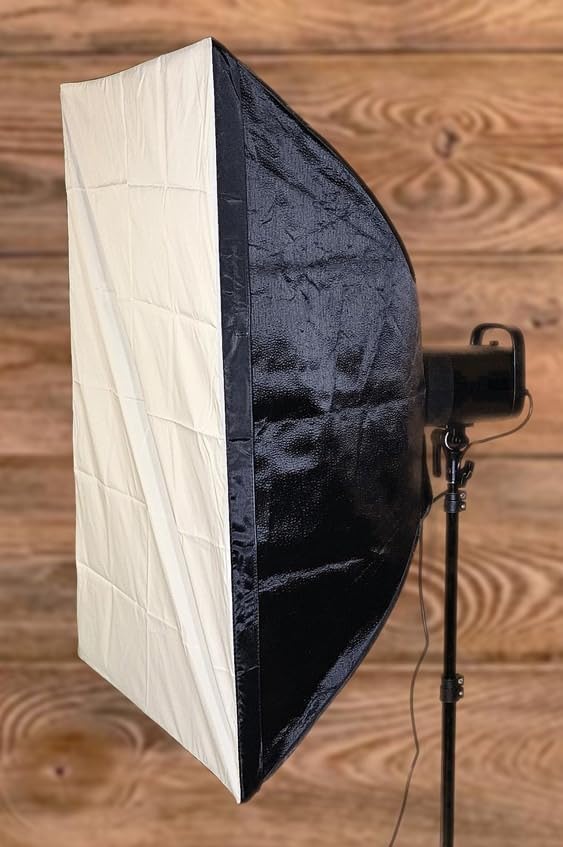
Where the Godox two-light kit gives you a barrel of accessories, this one gives you a working key and fill and nothing more. You get two S101-300W heads at 300Ws each, two 6.6-foot light stands, two softboxes, two standard reflectors, a 5-in-1 reflector, an RT-16 transmitter with two receivers, two power cords and a carry bag. That is the minimum viable two-light headshot setup, assembled for you.
Two details separate it from the budget end. The 150W modeling lamps with 9 brightness levels from L1 to L9 are bright enough to judge your lighting without buying a separate continuous light, and the silent heat dissipation system is rated for 300 consecutive full power flashes without overheating. In a long client day that cooling claim is worth more than it sounds.
Power adjusts from 1/8 to 1/1 with flash duration between 1/2000 and 1/800s and recycle of 0.4 to 2.5 seconds. A settings memory function saves your configuration between sessions, and S1/S2 optical slave modes are supported alongside the RT-16 radio trigger on 16 channels.
Why this bundle works for a first headshot business
The 5-in-1 reflector is the sleeper feature. It steps between gold, silver, white, black and a translucent diffuser face, which lets you build a rim light, a background light or a high-key setup from a single modifier. For corporate headshots on a budget, that flexibility is worth more than a second softbox.
The Bowens mount and umbrella socket with a 180-degree tilt stand adapter cover the standard modifier range, and the 150W lamps mean you can see what you are doing. Reviewers consistently single out both the modeling lamp brightness and the cooling system as the reasons they are happy with the kit.
Where it will disappoint you
The 1/200s sync ceiling is the real constraint. It limits your aperture and ISO choices for portraits, and in a bright room you will end up at a smaller aperture than you wanted. The RT-16 single-contact trigger is also dated next to modern 2.4GHz radio systems, and there is no built-in TTL on the heads themselves.
At 12.9 kg the full kit is heavy to move between locations, and the review distribution is the widest here: 4.2 stars across 76 reviews, with 69% five-star but a 13% one-star share focused on kit completeness and cosmetic finish. Count the pieces before your first paid session, and if you already own stands and softboxes, buy the single head instead.
How to Light a Headshot With Your New Strobe
This is the section no competitor on this topic writes, and it is the one that decides whether your headshots look professional. A strobe is a light source with a dial. What makes a headshot flattering is where you put it, how big you make it relative to your subject, and how bright you make the fill relative to the key.
Start with a one-light clamshell. Put your head on a stand roughly 1 metre above your subject’s eye line, angle it down about 45 degrees, and aim it at a white reflector or a plain white wall on the floor in front of your subject. Shoot through nothing, or through a 60 to 90 cm softbox. The floor bounce fills the shadows naturally, and you get soft, wrapped light with no second head to meter.
From there, move to two lights. Your key sits 45 to 60 degrees off the camera axis and slightly above eye level, so the nose casts a shadow to the side rather than straight down. Your fill goes opposite the camera at half to one stop under the key, and the shadow side of the face retains detail without going flat. A ratio of 2:1 is a natural corporate look; 4:1 reads as dramatic and suits senior portraits.
Size matters more than power. The larger the light relative to your subject, the softer the shadow edge. A 90 cm softbox at 2 metres behaves like a window. A 43-inch umbrella at 1 metre behaves like a lamp with a shade on it. If you are shooting in a small room, work bigger and closer rather than smaller and further away.
Room size is the real constraint most new headshot photographers hit. In a 12 by 14 foot room, a 36-inch softbox close to your subject will not fit between the wall and the chair, and a back hair light has nowhere to stand. In that case, use a single head through a large modifier, put your subject two metres from the backdrop, and control separation with distance rather than with another strobe.
If you also shoot video or need matching continuous light, our guide to the best RGB LED lights for studio filmmaking covers the panel side of a hybrid setup, and the monolights here handle the stills.
How to Choose a Studio Strobe Light for Headshots
Start with watt-seconds, not features
Watt-seconds are the single most useful spec, and the ladder is short. At 150 to 200Ws you are set up for a single subject, a small room and a small modifier, which is a hobby budget. At 300Ws you can run a large softbox or octabox at a sensible distance, and that is where most headshot professionals sit. At 400Ws you have headroom for bigger modifiers, full-body framing and slightly brighter rooms. At 600Ws and above you are looking at commercial volume work, multi-light setups and overpowering ambient light.
The second number that changes your day is recycle time at full power. It is the difference between a client who waits for you and a client who relaxes between frames. Anything under two seconds is comfortable for seated headshots. Above that, you will be dropping to half power to keep pace, which changes your look.
Manual, TTL or HSS
Manual control plus a light meter is more consistent and costs less than TTL, and for a controlled indoor headshot room it is the more professional choice. Settings stay identical from client to client and nothing shifts because a meter read a face differently. TTL earns its place when you are moving, shooting groups, or working with a subject who will not hold still long enough to meter.
High-speed sync is a different feature entirely. It lets you freeze ambient light at shutter speeds above your camera’s sync speed, which is what makes wide apertures possible outdoors. If your work is entirely indoors, HSS is dead weight. If you shoot location headshots, it is the reason to move up to a head like the Flashpoint XPLOR 600 or the NEEWER Q4.
Battery or AC mains
AC heads recycle fastest and hold power indefinitely, and they are unbeatable in a permanent studio. The tradeoff is a power cord, which is a trip hazard in a client home and a non-starter in a venue with no free socket. Battery heads travel, shoot in rooms nobody planned for photography, and in most cases power down slightly at high output. Buyers moving from a speedlight almost always find the freedom worth the recycle penalty.
Check the full-power flash count per charge against your realistic day. A 400 full power flash rating covers a comfortable headshot session with room to spare. A 1000 flash rating covers a long day without a battery in your pocket.
Mount, modifier and ecosystem
Bowens mount is the near-universal standard, and every head in this guide uses it. That matters more than any other spec because it is what lets you buy modifiers once and move between heads. A proprietary mount locks you into one brand’s accessories at prices that quickly stop making sense.
The wireless trigger system is the decision people regret. Godox X system heads work with X2T, X3, XPro II and X1 triggers. The NEEWER Q system uses its own triggers, though the Q4 also speaks the Godox X system. Check what you already own before you buy, because ecosystem lock-in is the deal breaker photographers complain about most.
Finally, count the total cost of a working setup rather than the head. A head, a trigger, two modifiers, two stands and a light meter is the real number, and the head is often the smallest part of it. Where the room is tight or the shoots travel, our picks for studio chairs and compact furniture setups matter as much as the lighting.
Frequently Asked Questions
How many watt-seconds do I need for headshots?
Between 200 and 300 watt-seconds covers almost all indoor headshot work. Step up to 400Ws when you use large modifiers, shoot full-body framing, or work in a brighter room. 600Ws and above is commercial volume territory rather than a headshot requirement. Most headshot professionals settle on a 300Ws monolight and never leave that range.
What size softbox should I use for headshots?
A 60 to 90 cm octabox or rectangular softbox is the standard starting point, positioned about 1.5 to 2 metres from your subject. The size controls shadow softness, not brightness, so work bigger and closer rather than smaller and further away. A 43-inch soft umbrella is a good second modifier because its broad wraparound quality flatters faces differently to a softbox.
Is a monolight better than a speedlight for headshots?
Yes, once you are working in a room rather than on location. A monolight delivers far more power, accepts large Bowens-mount modifiers, recycles between frames and fires without draining camera batteries. A speedlight still wins for travel and on-location work because it is smaller and self-powered. Most working headshot photographers use both, and a monolight is the tool that shapes the light.
Do I need TTL or HSS for studio headshots?
Not for controlled indoor studio work. Manual power plus a light meter is more consistent, cheaper and keeps settings identical from one client to the next. TTL is useful when you are moving around or shooting groups, and HSS matters only outdoors, where it lets you freeze daylight at fast shutter speeds and shoot wide open.
Can I use studio strobes outdoors?
Yes, with the right head. AC mains strobes need a generator or a nearby outlet, while battery monolights such as the NEEWER Q300 and NEEWER Q4 travel without a cord. Battery heads also avoid the power loss that high-speed sync causes, although you may still need 600Ws of output to overpower strong midday sun.
Are budget studio strobe kits worth it?
For a true beginner, yes, because the stands, modifiers and trigger are the parts you would otherwise research for weeks. If you already own stands and softboxes, a kit is poor value and you should buy a single head. Check the included accessories on arrival, since missing pieces are the most common complaint about bundled kits.
Final Verdict
The Godox MS300V is our pick as the best studio strobe light for headshots in 2026, because 300Ws with a GN58 and a 150W modeling lamp covers the working range of this job and leaves you room to grow. If your sessions happen away from a studio wall, take the NEEWER Q300 for its battery endurance. If you shoot in daylight or bright rooms, the Flashpoint XPLOR 600 is the only head here that can overpower the sun. If you want TTL from day one, the NEEWER Q4 does it natively.
Whatever you choose, spend the extra money on modifiers rather than on a bigger head. A 300Ws monolight through a good softbox will outproduce a 600Ws head through a cheap reflector, every time. And once the head is on a stand, the work that actually makes your headshots good is placement, ratio and modifier size. Our guide to home studio packages covers the rest of the room if you are building from scratch.