
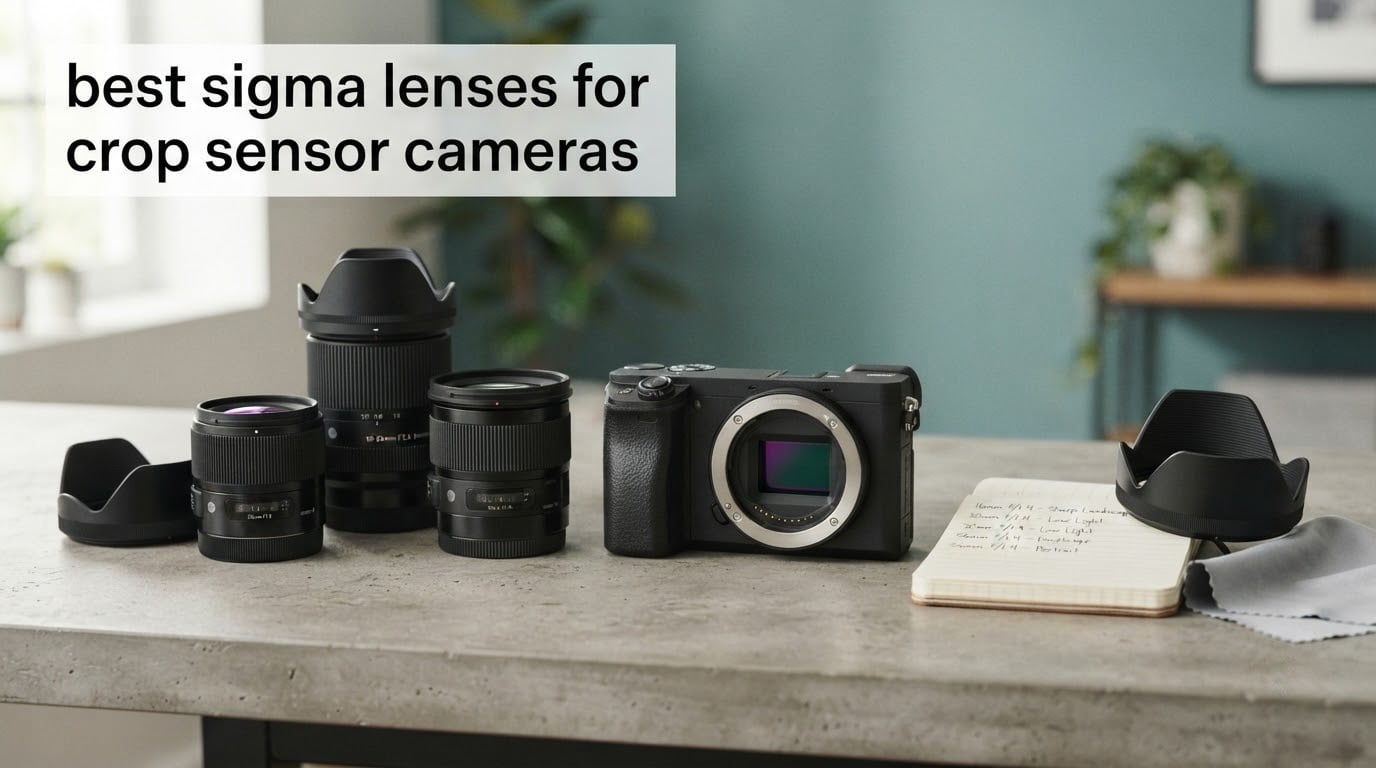
Sigma takes up more of the crop-sensor lens market than any other brand. Camera Decision’s own page-view tracking puts Sigma at 13.4% of all lens browsing, and four of the six most-viewed lenses in their data are Sigma or Tamron APS-C zooms. That is not a coincidence of marketing; it is what happens when a camera maker sells two decent kit lenses and its lens partner sells twelve.
So this guide covers the best Sigma lenses for crop sensor cameras, mount by mount, with the field-of-view math spelled out so you can stop guessing. We spent weeks with these lenses on Sony E, Fujifilm X, Canon RF and Nikon F DX bodies, plus the legacy EF-M version, and every entry below lists the mount, the full-frame equivalent angle of view, the maximum aperture, the weight and who the lens actually suits.
One naming rule first, because it confuses more people than anything else in this topic. Sigma’s APS-C designs carry the DC DN badge. Those lenses were drawn from the ground up for a cropped sensor, so they are small, light and quiet. Sigma’s DG DN lenses are full-frame glass that still mounts and works on a crop body, giving you the full-frame equivalent field of view multiplied by the crop factor. Two of the lenses in this roundup are DG DN primes, and they make a strong case for themselves.
If you are still assembling a kit rather than replacing one lens, our picks for the wider mirrorless market are in the budget lens guide and the 50mm lens guide.
Table of Contents
Top 3 Best Sigma Picks for Crop Sensor Cameras In 2026
Three lenses cover most of what a crop-sensor shooter actually needs. The 16mm f/1.4 wins on versatility, the 30mm f/1.4 wins on the balance of size and image quality, and the 18-50mm f/2.8 is the one lens that replaces most kit zooms.


Sigma 30mm f/1.4 DC DN
- 30mm standard prime
- 9 rounded blades
- Stepping motor AF
- 52mm filter thread

Sigma 18-50mm f/2.8 DC DN
- 18-50mm constant f/2.8
- Internal zoom design
- 290g weight
- 55mm filter thread
All Sigma Crop Sensor Lenses at a Glance (October 2026)
Every lens below, sorted by the kind of job it does. The full-frame equivalent column shows what the framing looks like compared with a 35mm-frame camera, which is the number most buyers leave out and most buyers need.
| Product | Specifications | Action |
|---|---|---|
| Sigma 16mm f/1.4 DC DN Contemporary |
|
Check Latest Price |
| Sigma 30mm f/1.4 DC DN Contemporary |
|
Check Latest Price |
| Sigma 18-50mm f/2.8 DC DN Contemporary |
|
Check Latest Price |
 Sigma 18-300mm f/3.5-6.3 DC Macro OS HSM Sigma 18-300mm f/3.5-6.3 DC Macro OS HSM |
|
Check Latest Price |
 Sigma 100-400mm f/5-6.3 DG DN OS Sigma 100-400mm f/5-6.3 DG DN OS |
|
Check Latest Price |
 Sigma 35mm f/1.4 DG DN Art Sigma 35mm f/1.4 DG DN Art |
|
Check Latest Price |
 Sigma 56mm f/1.4 DC DN Contemporary Sigma 56mm f/1.4 DC DN Contemporary |
|
Check Latest Price |
 Sigma 10-18mm f/2.8 DC DN Contemporary Sigma 10-18mm f/2.8 DC DN Contemporary |
|
Check Latest Price |
 Sigma 35mm f/2 DG DN Contemporary I Series Sigma 35mm f/2 DG DN Contemporary I Series |
|
Check Latest Price |
 Sigma 10-18mm f/2.8 DC DN Canon RF Sigma 10-18mm f/2.8 DC DN Canon RF |
|
Check Latest Price |
 Sigma 18-35mm f/1.8 Art DC HSM Sigma 18-35mm f/1.8 Art DC HSM |
|
Check Latest Price |
 Sigma 16mm f/1.4 DC DN Canon EF-M Sigma 16mm f/1.4 DC DN Canon EF-M |
|
Check Latest Price |
1. Sigma 16mm f/1.4 DC DN Contemporary for Sony E
Sigma 16mm f/1.4 DC DN Contemporary Lens for Sony E (402965) Black
16mm wide prime
f/1.4 max aperture
67mm filter thread
14.3 ounces
Pros
- f/1.4 aperture handles low light cleanly
- Very sharp corner to corner
- Compact and light for a fast wide prime
- Quiet stepping motor suits video
Cons
- Four diaphragm blades give polygonal highlights wide open
- No aperture ring for video shooters
This is the lens I put on any Sony APS-C body first. Sixteen millimetres gives you a 24mm equivalent angle of view, wide enough to fit a person into a small room without stepping backwards, which is exactly the situation where a kit lens struggles.
At f/1.4 it collects enough light to hand-hold indoor work and to shoot after sunset without dragging the ISO up. Reviewers consistently call the image quality sharp straight through the frame, and that holds up at the edges where wide primes usually soften.

The stepping motor is quiet and progressive, which matters more than spec sheets suggest if you record video. Owners on the Sony E system call it the go-to for vlogging and content work, and the 83.2 degree angle of view gives you room to move.
The catch is the four-blade diaphragm. Wide open, out-of-focus highlights render as small squares rather than the rounded discs you get from the nine-blade primes later in this list. Stop down a little and it largely disappears.

How it performs in low light
Handheld video is the case where the wide aperture earns its place. Without stabilization in the lens, a body with in-body stabilization is what makes smooth movement possible, and most current Sony APS-C bodies have it. On a body without IBIS you will want a tripod or a stabilised alternative.
Focus is acquired quickly and quietly even in dim rooms. The barrel takes a 67mm filter thread and Sigma backs the lens with a four-year warranty, though the body itself carries no weather sealing.
Who should skip it
If you shoot a lot of night scenes where point lights turn into bokeh balls, the four blades will disappoint you. Look at the 30mm f/1.4 instead, which has nine rounded blades in a body half the size.
Anyone who wants an aperture ring for click-based video control will not find one here. Sigma reserves that feature for its I Series lenses, covered further down.
2. Sigma 30mm f/1.4 DC DN Contemporary for Sony E
Sigma 30mm F1.4 Contemporary DC DN Lens for Sony E
30mm standard prime
f/1.4 max aperture
9 rounded blades
9.28 ounces
Pros
- Image quality rivals Art lenses at a much lighter weight
- Nine rounded aperture blades for smooth bokeh
- Only 9.28 ounces
- Very quiet stepping motor
Cons
- Not weather sealed
- No optical stabilization
Thirty millimetres on a 1.5x sensor frames like a 45mm lens on full frame. That makes it the most natural general-purpose prime in the Sigma APS-C lineup, and it is the one we carry most often.
The image quality surprised us. Reviewers describe it as rivaling Art-series glass, and the optical design uses aspherical and high-refractive-index elements to hold the corners together at f/1.4. There is SLD-type glass correction for axial colour fringing visible on high-contrast edges.

At 9.28 ounces with a 52mm filter thread, this is the smallest lens in the roundup by a wide margin. It disappears into a small bag, and it pairs well with a weather-sealed body for street work.
Depth of field is shallow enough at f/1.4 to separate a subject from a background without needing the extreme blur of a longer prime. For environmental portraits in daylight or at dusk, it is the one we reach for first.

Why the aperture blades matter here
Nine rounded blades render out-of-focus highlights as soft circles rather than polygons, which is why this lens separates itself from cheaper fast primes. The difference is obvious in night street scenes with point light sources and in portraits shot near windows.
The stepping motor is described as quiet and near-silent, and it tracks predictably in video. Focus is not manual override, so video shooters who need to pull focus by hand should look elsewhere.
Where it falls short
There is no optical stabilization, so on a body without IBIS handheld low-light stills will need a raised ISO. There is also no weather sealing, so keep it away from heavy rain.
The 30mm is a fairly normal angle of view. If your subject matter is tight portraits from a distance, the 56mm f/1.4 covers more ground for the same light.
3. Sigma 18-50mm f/2.8 DC DN Contemporary for Sony E
Sigma 18-50mm F2.8 DC DN Contemporary Zoom Lens (for E Mount), Black
18-50mm zoom
Constant f/2.8
290g weight
55mm filter thread
Pros
- Constant f/2.8 across the whole zoom range
- Internal zoom design that never extends
- 290g is remarkably light for a fast standard zoom
- Sharp edge to edge
Cons
- No optical stabilization
- Not weather sealed
- Zoom and focus rings feel similar at first
This is the lens that replaces a kit zoom. Eighteen to fifty millimetres gives you a 27-75mm equivalent, which covers street, family, travel and general documentary work, and it holds f/2.8 the whole way rather than stopping down as you extend.
The internal zoom design means the barrel never extends, so balance stays constant and the lens balances well on a gimbal. Zero Coating on the front element is meant to suppress flare and ghosting when a bright light sits in frame.

Sharpness holds across the frame according to owners, and Sigma supports in-camera aberration correction on bodies that offer it, which cleans up the slight distortion at the wide end in JPEG output.
At 290g it is light enough to carry all day on a neck strap. The stepping motor handles autofocus quickly and quietly, which makes it a workable video lens despite the missing stabilization on a body without IBIS.

Deciding between it and a prime
If you shoot one subject type from a fixed position, a prime gives cleaner backgrounds and a smaller body. If your subject moves or your framing changes constantly, nothing else in this list covers 27-75mm equivalent in one lens at a constant f/2.8.
The cost is manual aperture control only. There is no aperture ring, no AF/MF switch and no function button, which is a step back from Sony’s own 16-55mm f/2.8 in day-to-day handling.
Who should skip it
Anyone shooting outdoors in bad weather should note the lack of sealing. Same for anyone who needs stabilized handheld video on a body without in-body stabilization.
Travelers who want to go even smaller may find the 16mm f/1.4 and 30mm f/1.4 combination weighs less and covers more extreme angles, at the cost of swapping lenses.
4. Sigma 18-300mm f/3.5-6.3 DC Macro OS HSM for Nikon F DX
Sigma 886306 18-300mm F3.5-6.3 Contemporary DC Macro OS HSM Lens for Nikon, Black
18-300mm superzoom
Optical stabilization
Macro at 1:3.4
585g
Pros
- One lens covers wide to telephoto
- Optical stabilization helps at long focal lengths
- Macro mode works at close range
- Hyper Sonic Motor focus is reliable
Cons
- Heavy at 585g for an APS-C zoom
- Sharpness softens at the 300mm end
- Variable aperture drops to f/6.3
This is the one-lens answer for Nikon DX shooters. Eighteen to three hundred millimetres becomes 27-450mm equivalent, a 16.67x zoom range that means you can frame a wide scene and then fill the frame with a distant subject without changing lenses.
The optical stabilization is the feature that makes it usable at the long end, since the maximum aperture is a slow f/6.3 at 300mm. Owners on Nikon F DX bodies consistently note that the OS system recovers a couple of stops, which is what makes handheld wildlife shots possible at the far end.

The optical design uses one SLD and four FLD glass elements with Super Multi-Layer Coating, and the Hyper Sonic Motor focuses quickly and quietly. Minimum focus distance is 39cm with 1:3.4 maximum magnification, so it doubles as a short-range macro lens.
Nine rounded aperture blades give it bokeh that many superzooms do not manage, and the 76.5 degree angle of view at the wide end is genuinely wide.

What you give up for the range
Weight is the first cost. At 585g with a 72mm filter thread, this is a substantial lens to hang around your neck all day, and it front-heavies smaller bodies. Packing it for travel means committing to that bulk whether you use the long end or not.
The second cost is aperture. At f/3.5 wide and f/6.3 long, indoor and low-light work pushes the ISO up compared with a fast prime or a constant f/2.8 zoom.
Who should skip it
If you mostly photograph people, pets or events, this lens is too slow. The 18-35mm f/1.8 in this roundup covers the same range at three stops more light, in a body you will actually want to carry.
Sharpness is reported to drop toward 300mm. If long-end reach is your primary interest rather than occasional use, save up for a dedicated telephoto.
5. Sigma 100-400mm f/5-6.3 DG DN OS Contemporary for Sony E
Sigma 100-400mm F5-6.3 Contemporary DG DN OS for Sony E Mount
100-400mm telephoto zoom
Optical stabilization
Zoom lock at 100mm
1.1 kg
Pros
- Well under half the weight of the Sony GM equivalent
- Optical stabilization performs well
- Zoom lock stops creep
- Weather sealed with customizable AFL button
Cons
- f/6.3 at 400mm needs bright light or high ISO
- 1.1kg is heavy for long handheld sessions
- Tripod collar sold separately
This is a full-frame DG DN lens, and on a crop sensor it becomes a 150-600mm equivalent supertele. Owners regularly describe the image quality as roughly matching the Sony GM lens at a fraction of the cost, and the weight difference is the headline: 2.5 pounds against 3.4.
The optical stabilization includes a mode switch, and there is a focus limiter that lets you restrict the focusing range. Both are practical features when you are scanning a field rather than tracking a single subject.

The zoom lock holds the barrel at 100mm, which stops it creeping forward while you are panning. Nine rounded aperture blades keep out-of-focus backgrounds reasonably smooth, and the lens is water and dust resistant with a customizable autofocus button.
Autofocus is fast and accurate in good light. Reviewers note it can hunt at 400mm in low light, which is unsurprising given the aperture narrows to f/6.3 there.

Working distance and handling
On a 1.5x body you get the framing equivalent to a 150-600mm full-frame lens, which reaches well past most birds and field sports. Minimum focus is not specified by the manufacturer, so plan on shooting distant subjects rather than close details.
The zoom ring is positioned conventionally on this lens, which is unusual for Sigma and worth noting if you have used other Sigma zooms. The tripod collar is a separate purchase, and you will want one for long lens work.
Who should skip it
At 1.1 kg this is a heavy commitment for a small crop-sensor body, and it will unbalance a light mirrorless kit. Photographers who shoot birds from a hide or a vehicle may find it worth the weight; street shooters will not.
The f/6.3 end means daylight and fast shutter speeds are essential. For indoor sports or concerts, our telephoto lens guide covers faster glass.
6. Sigma 35mm f/1.4 DG DN Art for Sony E
35mm F1.4 DG DN for Sony E Mount
Art series prime
35mm f/1.4
11-blade diaphragm
454g
Pros
- Exceptional Art-series sharpness across the frame
- f/1.4 wide open with 11 rounded blades
- Customizable autofocus button and focus mode switch
- Weather sealed
Cons
- Heavier at 454g than Contemporary primes
- Higher cost than the f/2 alternative
- No optical stabilization in the lens
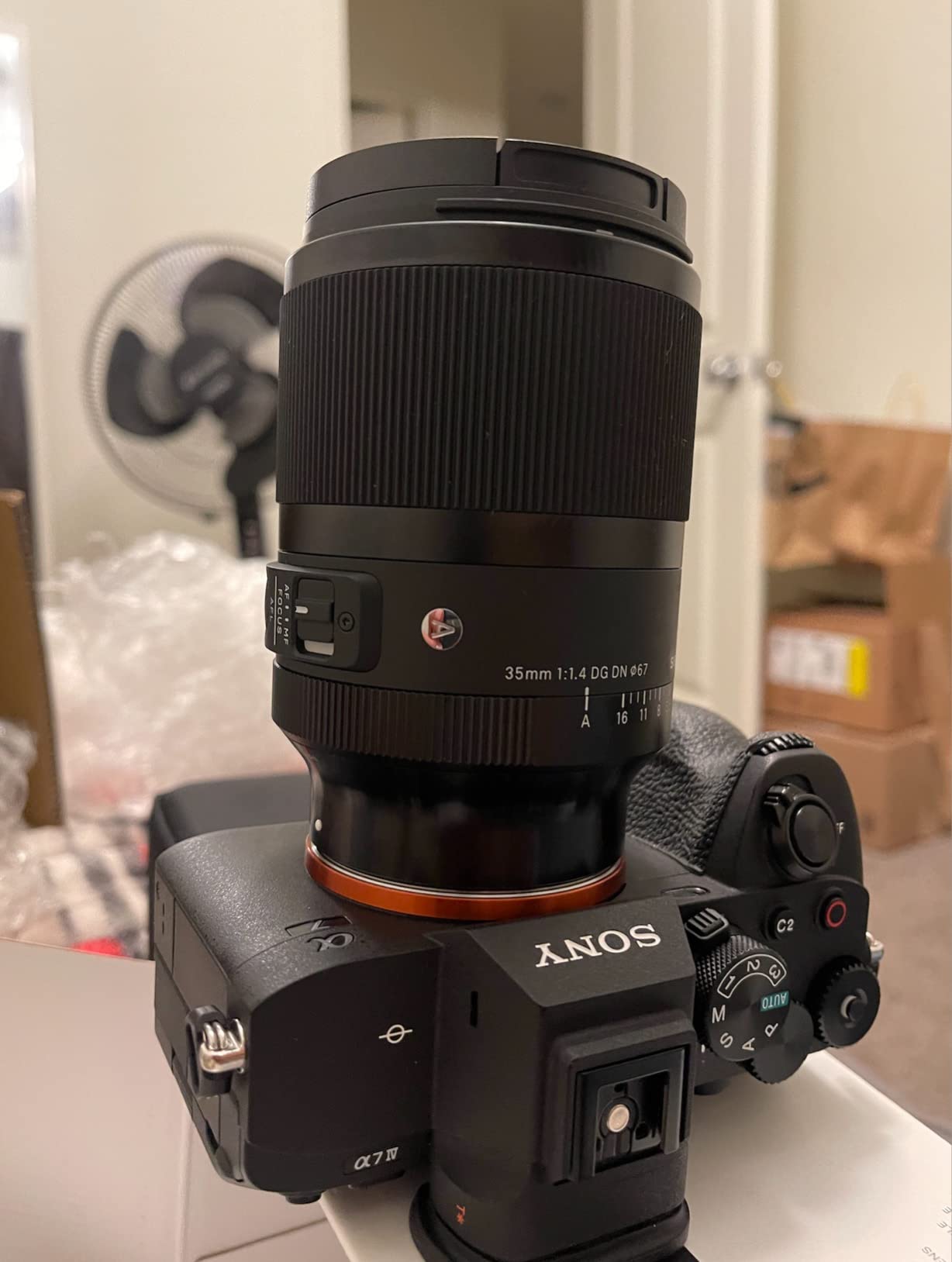
A full-frame 35mm at f/1.4 on a crop body behaves like a roughly 52mm lens, which puts it between the 30mm and 56mm primes in framing while out performing both optically. If you shoot one lens and want it to be exceptional rather than merely good, this is the pick.
The optical design is Art series throughout, and owners consistently describe corner-to-corner sharpness as outstanding. Eleven rounded aperture blades produce the smooth, near-circular bokeh that night and indoor work rewards.
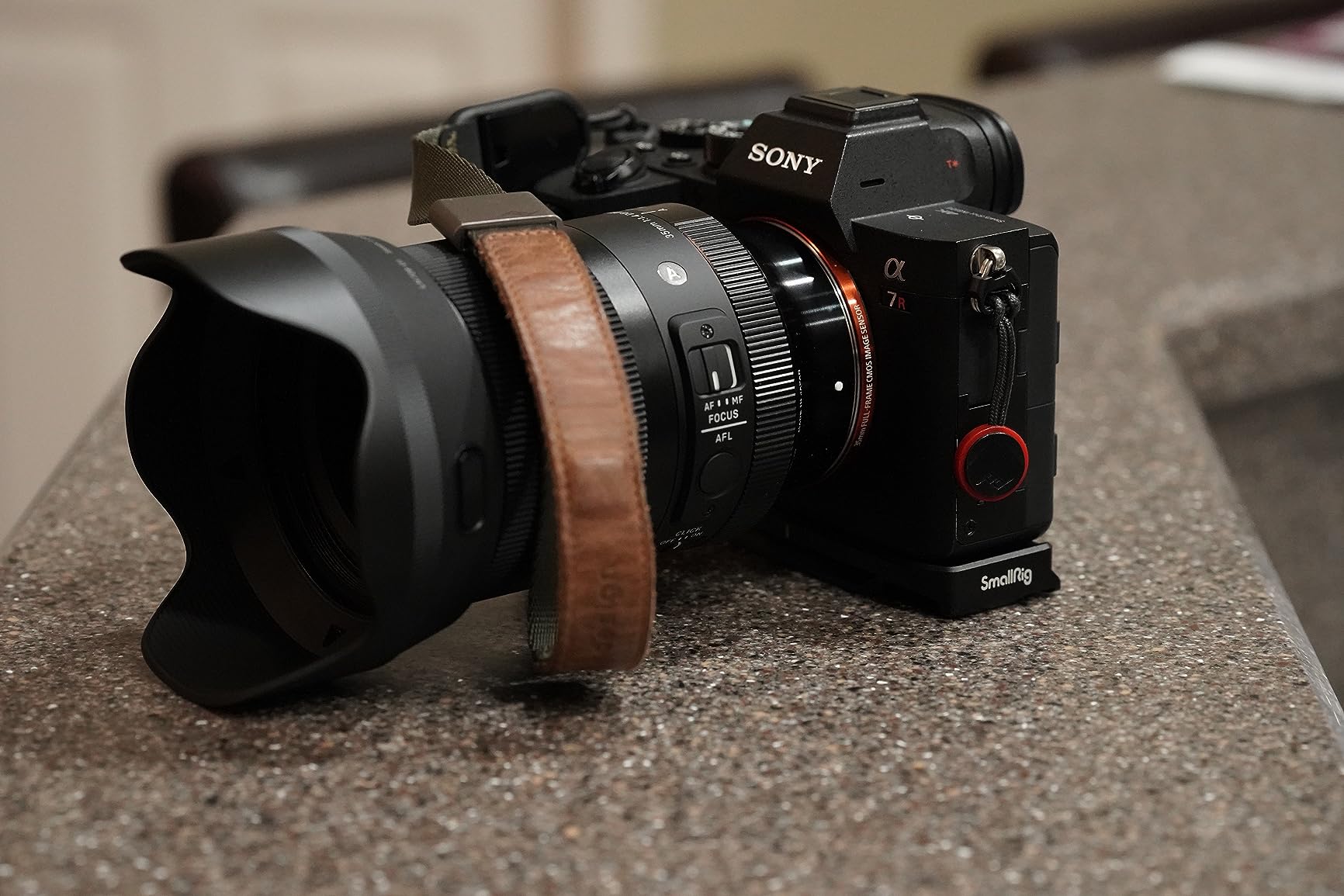
There is no optical stabilization in the lens, so on a body without in-body stabilization you will raise ISO or work from a support at slower shutter speeds. Sigma does fit it with a customizable autofocus button and a focus mode switch, which is uncommon on a fast prime.
Super Multi-Layer Coating handles flare well, and the 63 degree angle of view on full frame remains usable on APS-C. Weight is 454g, which is heavier than the Contemporary primes in this roundup but reasonable for an f/1.4 Art lens.
Where the extra light goes
The f/1.4 aperture is the reason to consider this over a 35mm f/2. One stop more light means a lower ISO in the situations where you actually need a fast lens: indoor events, evening street work, available-light portraits.
Because this is DG DN glass, mounting it on a crop body gives you 1.5x more reach at the same f/1.4. You keep the shallow depth of field and the low-light capability of a full-frame fast lens on a smaller, lighter body.
Who should skip it
If your budget does not stretch to Art-series pricing, the Contemporary 30mm f/1.4 gets you most of the way there for a fraction of the weight. The difference shows in raw files at f/1.4, not much else.
Those wanting a clickable aperture ring and magnetic metal cap should look at the 35mm f/2 I Series instead, which trades one stop of light for better tactile handling.
7. Sigma 56mm f/1.4 DC DN Contemporary for Fujifilm X
Sigma 56 mm F1.4 DC DN [Contemporary] for Fujifilm X-Mount
Fujifilm X mount
56mm f/1.4
300g weight
55mm filter thread
Pros
- 84mm equivalent framing suits portraits
- Only 300g despite the fast aperture
- Nine rounded blades for smooth background blur
- Quiet stepping motor tuned for video
Cons
- No optical stabilization
- X-mount version only
- 55mm filter thread limits filter choice
Fifty-six millimetres on a crop sensor is an 84mm equivalent, which is the classic portrait focal length. This is the version built for Fujifilm X bodies, and for anyone shooting weddings, headshots or environmental portraits on that mount it is the first lens to consider.
At f/1.4 you get background separation that a zoom at the same framing cannot match, and nine rounded aperture blades keep highlights smooth. Fujifilm bodies apply vignetting and distortion corrections in camera to tidy up the edges.
![Sigma 56 mm F1.4 DC DN [Contemporary] for Fujifilm X-Mount customer photo 1](https://vintagevinylnews.com/wp-content/uploads/2026/10/B09T78FM8M_customer_1.jpg)
Weight is 300g, which makes this one of the lighter fast telephoto primes available for any crop-sensor mount. The mount has a dust and splash resistant construction, and the stepping motor focuses quietly with behaviour tuned for video.
SLD glass element handles axial chromatic aberration, which is the correction that matters most on a fast lens at full aperture. Sharpness holds well into the corners for a lens of this class.
![Sigma 56 mm F1.4 DC DN [Contemporary] for Fujifilm X-Mount customer photo 2](https://vintagevinylnews.com/wp-content/uploads/2026/10/B09T78FM8M_customer_2.jpg)
Framing and working distance
The 84mm equivalent gives you just enough distance to work without a wide lens distorting faces, while still compressing the background naturally. It is long enough for a half-body portrait and short enough to move around a small venue.
Owners pair it with the 16mm f/1.4 for events, which covers the whole range from group shots to tight portraits with two lenses that together weigh less than many single zooms.
Who should skip it
There is no optical stabilization in the lens. Fujifilm bodies with in-body stabilization handle that well, but if your body does not have IBIS you will need higher ISO or a tripod for stills.
Note the mount. If you are on Sony E or Nikon Z, this exact lens is not the right one for you even though the focal length is right, so check the mount before buying.
8. Sigma 10-18mm f/2.8 DC DN Contemporary for Sony E
10-18mm F2.8 DC DN (for E Mount)
10-18mm ultra-wide zoom
Constant f/2.8
260g weight
67mm filter thread
Pros
- Extremely light at 260g for a constant f/2.8 ultra-wide
- Built-in optical stabilization
- Sharp from corner to corner
- Weather sealed with fast quiet autofocus
Cons
- Zoom ring turns the opposite way to most lenses
- Zoom ring sits furthest from the body
- Clip-on hood can be knocked off
- No aperture ring
Ten to eighteen millimetres gives you a 15-27mm equivalent, wide enough to take in a whole building or a star field without fisheye distortion. At a constant f/2.8 it also works well indoors, which is where most ultra-wide zooms fall short.
The optical stabilization is built into the lens, so this is one of the few ultra-wide zooms you can hand-hold for interior video or night scenes on a body without IBIS. It is listed as water resistant with a 67mm filter thread.

Owners describe sharpness as excellent across the frame and the stepping motor as fast and quiet. At 260g it is one of the lightest fast ultra-wide zooms made for any mount, crop or full frame.
The focal range covers vlogging, real estate interiors, astro work and street shooting in small spaces. It focuses very close at the 10mm end, which helps when you are shooting tight against a wall in a room.

Getting used to the zoom ring
This is the single most common complaint about the lens, and it appears repeatedly in owner threads. The zoom ring turns the opposite direction to almost every other lens, and it is positioned furthest from the body rather than nearest to it.
Most photographers adapt within a day or two. If you are moving from Canon or Nikon glass and the reversal genuinely bothers you, the Canon RF version has the same layout for the same reason, so it is a Sigma-wide trait rather than a mount issue.
Who should skip it
Anyone who needs an aperture ring for video exposure control should look elsewhere. The seven-blade diaphragm is also the smallest count in this roundup, so out-of-focus point lights form heptagons.
If you need to go wider than 15mm equivalent for astro, this will not reach it. If you only need moderate wide coverage, the 16mm f/1.4 prime is smaller and lighter.
9. Sigma 35mm f/2 DG DN Contemporary I Series for Sony E
Sigma 35mm f/2 DG DN Contemporary Lens for Sony E-Mount
I Series all-metal build
Aperture ring
35mm f/2
325g
Pros
- All-metal construction with a proper aperture ring
- Click and de-click aperture ring control
- Magnetic metal lens cap
- Optical stabilization built in
Cons
- Softest wide open at f/2
- Heavier than expected for an f/2 prime
- Metal hood adds weight
This is the only lens in the roundup with a real aperture ring, and for many photographers that single feature changes how a camera feels. Sigma’s I Series design is all metal, with a click-based ring you can switch to de-click for smooth video exposure pulls.
Like the other DG DN lenses here, a 35mm on a crop sensor frames like roughly a 52mm lens. The optical design uses one SLD and three aspherical elements, and the mount has a dust and splash resistant structure.
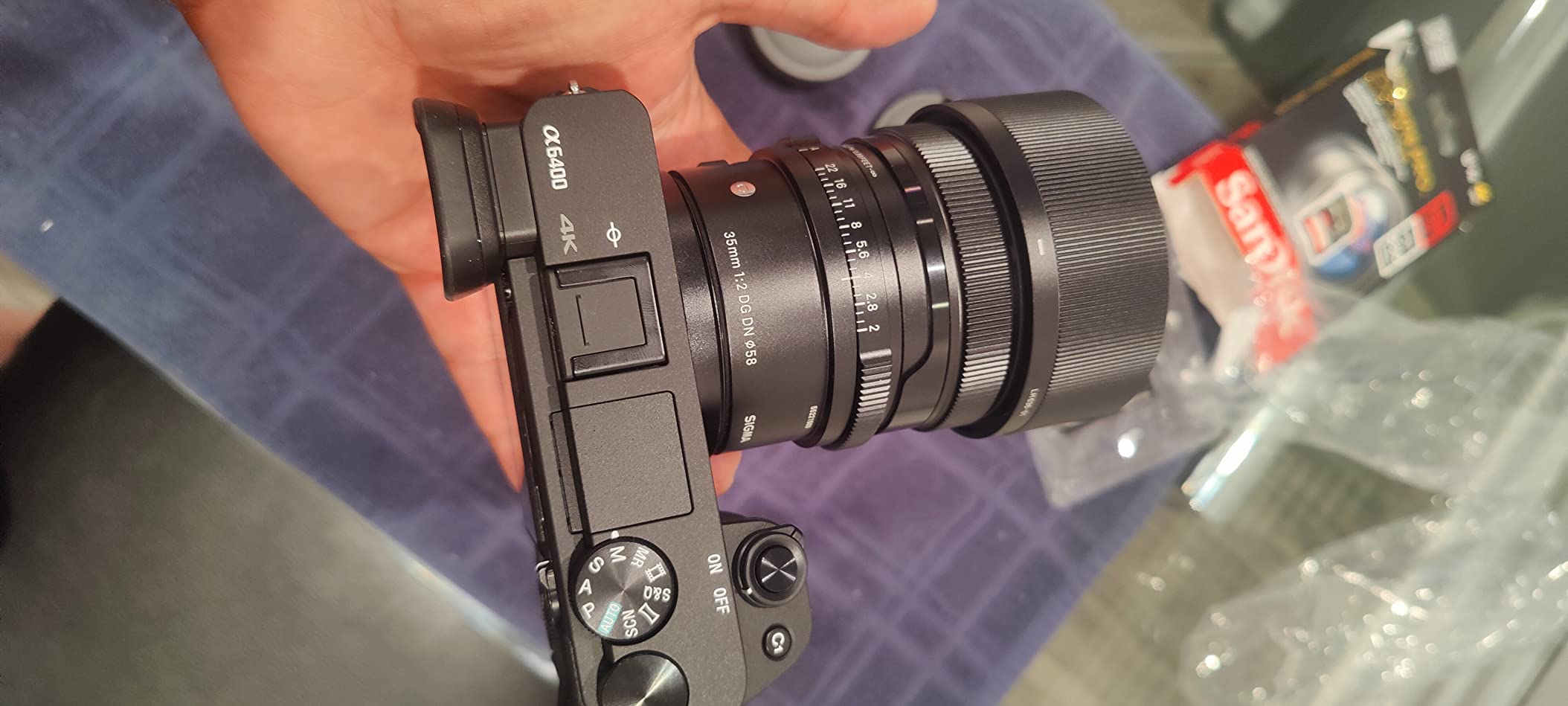
Optical stabilization is included, which matters on bodies without IBIS. Sony E bodies get DMF and AF+MF support, letting you pull focus manually without disengaging autofocus entirely, and lens-based optical correction is supported for distortion and vignetting.
Owners point to the rendering as characterful rather than clinically neutral. The magnetic metal cap is a small thing that feels expensive every time you use it.
Sharpness and where it holds up
The most common note is that f/2 is soft wide open, particularly at the edges, and that stopping down to f/2.8 fixes it. That is normal for a fast wide-ish prime and easy to plan around by shooting in good light.
Because the lens is stabilized, low-light handheld stills and video both benefit. On bodies with IBIS the stabilization becomes optional rather than necessary, which some owners consider redundant weight.
Who should skip it
If you need maximum light without stabilization, the Art 35mm f/1.4 gives you a full stop more. If you want the lightest possible kit, the Contemporary 30mm f/1.4 at 9.28 ounces is hard to beat.
The 325g weight surprises people who associate the f/2 class with lightweight plastic. It is compact, but it is not light.
10. Sigma 10-18mm f/2.8 DC DN for Canon RF
10-18mm F2.8 DC DN for Canon -RF Mount
Canon RF-S mount
10-18mm constant f/2.8
270g weight
67mm filter thread
Pros
- The only constant f/2.8 ultra-wide for Canon RF-S bodies
- Tiny at 270g
- Sharp with low distortion across the frame
- Weather resistant with fast silent autofocus
Cons
- No optical stabilization
- Zoom ring direction reversed from Canon lenses
- Clip-on hood is easy to dislodge
- Does not cover full frame at 10mm
Canon RF-S shooters have had very few fast ultra-wide options, which makes this lens fill a real gap. Ten to eighteen millimetres is a 15-27mm equivalent on the RF-S bodies, at a constant f/2.8 across the range.
Owners report excellent sharpness and low distortion, and it is described as the go-to for astro work at f/2.8 because the wide aperture keeps exposure times short enough to avoid star trails.
At 270g it is light, weather resistant, and comes with a push-on petal hood that is less prone to catching on a bag than a bayonet hood. Autofocus is fast and silent.
Which Canon bodies it fits
The lens is built for RF-S bodies, which cover the APS-C portion of the RF mount. It also mounts on full-frame RF bodies where the crop mode limits the field of view, though at 10mm it does not cover the full frame edge to edge.
Canon bodies with in-body stabilization handle the lack of lens stabilization well. Without IBIS you will be raising ISO or using a support for stills, and handheld video will shake.
Who should skip it
The same ergonomics complaints apply as on the Sony E version. The zoom ring turns opposite to Canon lenses and sits furthest from the body, which is a real adjustment period if you are coming from Canon glass.
The clip-on hood is easy to knock off, and there is no aperture ring. If you mostly shoot standard framing, the RF-S kit zoom covers everyday work with fewer quirks.
11. Sigma 18-35mm f/1.8 Art DC HSM for Nikon F DX
Sigma 18-35mm F1.8 Art DC HSM Lens for Nikon
18-35mm constant f/1.8
Nikon F DX mount
810g
72mm filter thread
Pros
- Constant f/1.8 across the zoom range
- Art-series sharpness that rivals primes
- Nine rounded blades for smooth bokeh
- Internal zoom and focus keep the size steady
Cons
- Heavy at 810g
- No image stabilization
- AF fine-tuning often needed
- Limited to an 18-35mm range
The 18-35mm f/1.8 Art is still the lens crop-sensor shooters mention most often in forum threads, and for good reason. It was the first zoom with a constant f/1.8 aperture, and on a DX sensor it gathers light like an f/2.8 lens on full frame.
Optical quality is Art series throughout, with SLD glass for aberration correction and Super Multi-Layer Coating. Owners regularly describe the result as rivaling prime lenses at focal lengths where most kit zooms fall apart.

Internal focusing and zooming mean the barrel does not extend or rotate, so the lens stays the same size throughout the range. The Hyper Sonic Motor focuses quickly and quietly, and nine rounded aperture blades deliver the creamy background blur the lens is known for.
It ships with a padded zippered case and a hood, which is unusual for a lens at this level. Build is solid metal with a 72mm filter thread.

Autofocus that needs attention
The most commonly reported issue is that the HSM motor often needs fine-tuning on the body to focus accurately. That is normal for an older DSLR-mount design paired with a modern body, and most users tune it once and then leave it alone.
There is no image stabilization, so at 810g you will want a body with in-body stabilization or a support at slower shutter speeds. That weight is the real issue for travel.
Who should skip it
Anyone who cares about total weight will find this punishing next to a contemporary APS-C zoom. If you want a single fast zoom for events, the 18-50mm f/2.8 Contemporary is two and a half times lighter and a stop and a half slower.
This is Nikon F DX glass, so it works with a Nikon DX DSLR directly and with a mirrorless body through an adapter. Check the adapter’s autofocus support before committing.
12. Sigma 16mm f/1.4 DC DN Contemporary for Canon EF-M
Sigma 16 mm f/1.4 (C) AF DC DN Lens for Canon EF-M Mirrorless
Canon EF-M mount
16mm f/1.4
Optical stabilization
405g
Pros
- Image quality rivals Art lenses
- Built-in optical stabilization in a fast wide prime
- Weather sealed
- Quiet stepping motor suits video
Cons
- Canon EF-M is a discontinued mount
- Limited future lens support
- Heavier than the non-stabilised version
This version of the 16mm f/1.4 is built for Canon EF-M mirrorless bodies. If you own an M-series Canon camera, this is the wide prime to buy, and on the used market it remains one of the better options for that mount.
Sixteen millimetres gives a 24mm equivalent field of view. The optical design is described as rivaling Art lenses, with coating that minimises flare and ghosting, and the stepping motor gives progressive, quiet focus.
Unlike the Sony E version of this lens, the EF-M one has a nine-blade diaphragm rather than four, so out-of-focus highlights are noticeably rounder. Optical stabilization and weather sealing are both included.
Know what you are buying into
Canon ended the EF-M mount, and there is no new first-party glass coming. That does not affect this lens, which continues to work normally, but it does mean your camera system has no future.
At 405g it is heavier than the Sony E 16mm f/1.4 at 14.3 ounces. The stabilization is the main reason for the extra weight, and it matters on EF-M bodies that lack in-body stabilization.
Who should skip it
If you are choosing a Canon mirrorless camera today, choose a body with the RF-S mount instead, where the lens roadmap still exists and where the 10-18mm f/2.8 fills the ultra-wide gap.
Existing EF-M owners who need something wider than 24mm equivalent have few options, and this remains the practical choice for street and documentary work.
What the 1.5x Crop Factor Actually Changes
Yes, APS-C lenses still carry a crop factor. Multiply the focal length by 1.5 and you get the full-frame equivalent framing. A 16mm on a crop body frames like a 24mm, a 30mm like a 45mm, and a 56mm like an 84mm.
For the zooms, here is the math. The 18-50mm becomes 27-75mm equivalent. The 10-18mm becomes 15-27mm equivalent. The 18-300mm becomes 27-450mm equivalent, and the full-frame 100-400mm becomes roughly 150-600mm equivalent on a crop body.
The aperture does not change. A 30mm f/1.4 still gathers the same light on a crop sensor as on a full-frame camera, which is exactly why fast primes feel so much more useful on APS-C. You get an 85mm-like field of view at f/1.4 in a lens weighing under 10 ounces.
Depth of field works in your favour for the same reason. Shorter equivalent focal lengths at wide apertures produce more background blur than an equivalent focal length on full frame, so a crop sensor paired with a fast prime is a legitimate way to reach shallow depth of field on a budget.
Which Sigma Lenses Fit Your Camera Mount
Mount availability is the single most common source of wasted spending in this category, so check it first.
Sony E: the broadest Sigma APS-C range. The 16mm f/1.4, 30mm f/1.4, 18-50mm f/2.8 and 10-18mm f/2.8 in this roundup are all DC DN designs for APS-C, and the 35mm f/1.4 Art, 35mm f/2 I Series and 100-400mm are DG DN lenses that also work here.
Fujifilm X: the 56mm f/1.4 DC DN is covered above. Sigma has released X-mount versions of several DC DN primes and zooms, but availability varies by lens.
Canon RF: the 10-18mm f/2.8 DC DN built for RF-S APS-C bodies is covered above, and it also mounts on full-frame RF bodies in crop mode.
Nikon F (DX): two lenses in this roundup are native DX glass. The 18-300mm f/3.5-6.3 and the 18-35mm f/1.8 Art are DSLR-mount lenses that work directly on DX DSLRs and on Nikon Z bodies through an FTZ adapter.
Canon EF-M: the 16mm f/1.4 DC DN is covered above. It is the newest lens Sigma ever released for that mount and the mount itself is now closed to new development.
Sigma Art vs Contemporary: What the Names Mean
Sigma’s three lines differ in build and optical ambition rather than in mount compatibility. Contemporary lenses are the compact, lightweight tier with image quality that now regularly matches Art glass. The 30mm f/1.4 at 9.28 ounces is the clearest example.
Art lenses use heavier metal barrels, higher-grade optical designs and larger diaphragms. The 35mm f/1.4 DG DN and the 18-35mm f/1.8 Art both sit in this tier. The I Series is a sub-tier of Contemporary with all-metal construction and a real aperture ring.
Sports lenses are built around long focal lengths and fast focusing for wildlife and action. Sports models are available across more mounts than Art lenses, so check availability if that is your priority.
Prime or Zoom: How to Narrow the List
A prime gives you cleaner backgrounds, a smaller barrel and often a lower weight. It also means moving closer or changing lenses every time your framing needs to change, which is a real cost in fast-moving situations.
A zoom gives you flexibility at the cost of aperture, size and sometimes a heavier build. The 18-50mm f/2.8 in this roundup is the middle ground most people settle on because 27-75mm equivalent covers most subjects.
Our rule: one subject, fixed position, go prime. Moving subject or mixed subjects, go zoom. If you shoot events, the 16mm plus the 56mm covers group shots through tight portraits in two small lenses.
Deal-Breakers: Sealing, Aperture Rings and Zoom Direction
Sigma’s APS-C zooms skip several conveniences you may take for granted. There is no aperture ring, no AF and manual focus switch, and no custom function button on the 10-18mm f/2.8 or the 18-50mm f/2.8.
Weather sealing is inconsistent. The 10-18mm f/2.8 and 56mm f/1.4 listings are water resistant, while the 18-50mm f/2.8 and 30mm f/1.4 are not. If you shoot outdoors in real rain, check the specific lens before buying.
The zoom ring on the 10-18mm f/2.8 turns opposite to most lenses and sits furthest from the body. Owners mention this more than any other Sigma handling issue. It takes a few days to adjust.
Autofocus in the DC DN line uses stepping motors rather than the linear motors in Sony’s own lenses. They are quiet and accurate for stills, but subject tracking toward the camera is generally reported as slower than first-party glass.
Frequently Asked Questions
Does Sigma make APS-C lenses?
Yes. Sigma’s APS-C designs carry the DC DN designation and were designed specifically for cropped-sensor mirrorless bodies. Examples include the 16mm f/1.4, 30mm f/1.4 and 56mm f/1.4 primes plus the 10-18mm f/2.8, 18-50mm f/2.8 and 16-300mm f/3.5-6.7 zooms. Sigma’s DG DN lenses are full-frame glass that still works on crop bodies with a 1.5x crop factor.
Which Sigma lens is considered the best?
The 18-50mm f/2.8 DC DN Contemporary is the most broadly useful Sigma APS-C lens, covering a 27-75mm equivalent range at a constant f/2.8 in 290g. The 16mm f/1.4 DC DN is the strongest single choice for vlogging and low light, and the 56mm f/1.4 DC DN is the standard portrait answer on Fujifilm X bodies.
Do APS-C lenses still have a crop factor?
Yes. Multiply the focal length by 1.5 to get the full-frame equivalent. A 30mm on an APS-C body frames like a 45mm on full frame, and a 56mm frames like an 84mm. The maximum aperture does not change, which is why fast primes deliver shallow depth of field on crop sensors at relatively low cost.
Is Sigma better than Tamron for crop sensor cameras?
It depends on the lens rather than the brand. Sigma covers more focal lengths and more mounts for APS-C, including fast primes such as the 16mm, 23mm, 30mm and 56mm f/1.4 DC DN. Tamron competes strongly with zoom lenses, particularly the 17-70mm f/2.8 and the 18-300mm. Compare the specific focal length you need before deciding.
What are the key differences between Sigma Art and Contemporary lenses?
Art lenses are the higher tier, with heavier metal barrels, larger diaphragms and more advanced optical designs, such as the 35mm f/1.4 DG DN. Contemporary lenses are the compact, lightweight tier, and current models regularly match Art image quality at a fraction of the weight, as the 30mm f/1.4 DC DN demonstrates. The I Series is a Contemporary sub-tier with all-metal construction and an aperture ring.
Which Sigma Lens Should You Buy in 2026
If you shoot general subjects on Sony E and want one lens, take the 18-50mm f/2.8 DC DN Contemporary. It covers most framings at a constant f/2.8, weighs 290g, and never extends when you zoom.
If you shoot one subject and care more about image quality than flexibility, the 16mm f/1.4 DC DN pairs a fast aperture with a compact body, and the 30mm f/1.4 is the one to carry every day. On Fujifilm X, the 56mm f/1.4 DC DN is the portrait pick; on Nikon DX, the 18-35mm f/1.8 Art is still unmatched for constant f/1.8.
Before any of that, confirm the mount matches your camera. That single check prevents almost every wasted purchase in this category.