
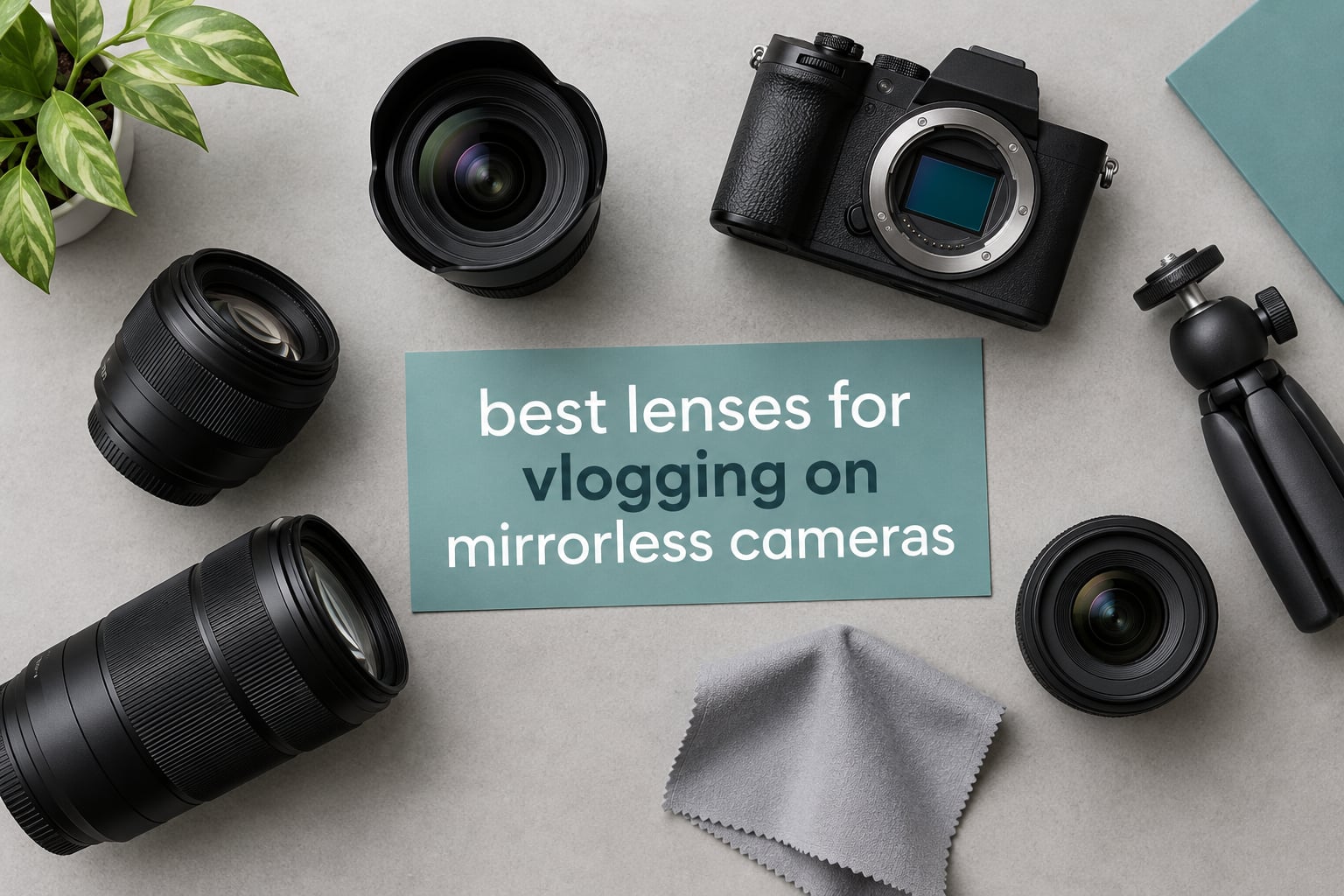
The best lens for vlogging on a mirrorless camera is a wide, fast prime or zoom with near-silent autofocus, because you shoot at arm’s length and need yourself fully in frame without the focus motor buzzing into your microphone. In practice that means a 16mm class lens on full frame, a 10mm to 16mm class lens on APS-C, or a 9mm to 12mm class lens on Micro Four Thirds, with an aperture as fast as your shooting light allows.
That answer hides a lot of nuance, so we spent weeks reading owner feedback, comparing specs and weighing the twelve options below on the four things that actually decide whether a take is usable: field of view, aperture, autofocus noise and how the frame behaves while you focus.
One thing to clear up before we start, because it is the single biggest source of wasted money. Lenses do not cross between mounts. A Canon RF 16mm will not fit a Sony body, and a Nikon Z 16mm will not fit a Fujifilm X body, no matter how similar the specs look. If you already own a camera, the mount list below is fixed. If you are still choosing a body, our guides to the best vlogging cameras and the best cameras for vlogging cover the body side first, and we list every compatible body under each lens here so you can match them up.
A note on what follows: each pick lists the mount and the bodies it fits, plus the weight in grams or ounces so you can check your gimbal’s payload before you commit. We have avoided ranking on spec sheets alone. Several lenses here with gorgeous numbers are ranked lower than reviewers expected, and one lens many vloggers treat as an afterthought earned its badge on footage quality alone.
Table of Contents
Top 3 Vlogging Lens Picks (October 2026)

Sigma 16mm f/1.4 DC DN Contemporary
- f/1.4 maximum aperture
- Stepping motor AF
- Water resistant
- 14.3 oz
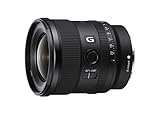

VILTROX 9mm F2.8 E-Mount APS-C
- f/2.8 aperture
- 113.8 degree angle of view
- Face and eye AF
- 0.17 kg
Best Lenses for Vlogging on Mirrorless Cameras in 2026
All twelve lenses below, with mount, key specs and the creator type each one suits best. Every ASIN links to the same mount system listed, so you can jump straight to the row that matches your camera body.
| Product | Specifications | Action |
|---|---|---|
| Sigma 16mm f/1.4 DC DN Contemporary (Sony E) |
|
Check Latest Price |
 Canon RF16mm F2.8 STM (Canon RF) Canon RF16mm F2.8 STM (Canon RF) |
|
Check Latest Price |
| Sony FE 20mm F1.8 G (Sony E) |
|
Check Latest Price |
| VILTROX 9mm F2.8 E-Mount APS-C (Sony E) |
|
Check Latest Price |
 VILTROX AF 16mm F1.8 FE (Sony E) VILTROX AF 16mm F1.8 FE (Sony E) |
|
Check Latest Price |
 Fujifilm XF16mmF2.8 R WR (Fujifilm X) Fujifilm XF16mmF2.8 R WR (Fujifilm X) |
|
Check Latest Price |
 Sigma 10-18mm F2.8 DC DN (Sony E) Sigma 10-18mm F2.8 DC DN (Sony E) |
|
Check Latest Price |
 Rokinon 12mm F2.0 NCS CS (Micro Four Thirds) Rokinon 12mm F2.0 NCS CS (Micro Four Thirds) |
|
Check Latest Price |
 VILTROX AF 16mm F1.8 Z (Nikon Z) VILTROX AF 16mm F1.8 Z (Nikon Z) |
|
Check Latest Price |
 Fujifilm XF14mmF2.8 R (Fujifilm X) Fujifilm XF14mmF2.8 R (Fujifilm X) |
|
Check Latest Price |
 Sony E 15mm F1.4 G (Sony E) Sony E 15mm F1.4 G (Sony E) |
|
Check Latest Price |
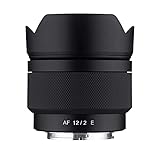 Samyang 12mm F2.0 AF (Sony E) Samyang 12mm F2.0 AF (Sony E) |
|
Check Latest Price |
1. Sigma 16mm f/1.4 DC DN Contemporary for Sony E – the all-round winner
Sigma 16mm f/1.4 DC DN Contemporary Lens for Sony E (402965) Black
Sony E mount
f/1.4 aperture
16mm prime
14.3 oz
Stepping motor AF
Pros
- Very fast f/1.4 aperture for low light
- Compact 14.3 oz body suits a vlogging kit
- Sharp wide open with Fast Hybrid AF
- Water resistant construction
- Fixed 16mm keeps framing consistent
Cons
- Fixed focal length with no zoom flexibility
- Only four diaphragm blades for rounder bokeh
Sigma 16mm f/1.4 DC DN Contemporary is the lens I keep coming back to, and it took a while to admit why. On an APS-C body the 16mm gives a 24mm equivalent field of view, which frames you and a good chunk of the room at arm’s length without the fisheye stretch that punishes anyone who steps toward the edge of frame.
It mounts to Sony E, which covers the a6000 and a6100 through the a6600 and a6700, plus the ZV-E10, ZV-E10 II and FX30 bodies. For full-frame Sony shooters the equivalent lens in this lineup is the 20mm F1.8 G further down.
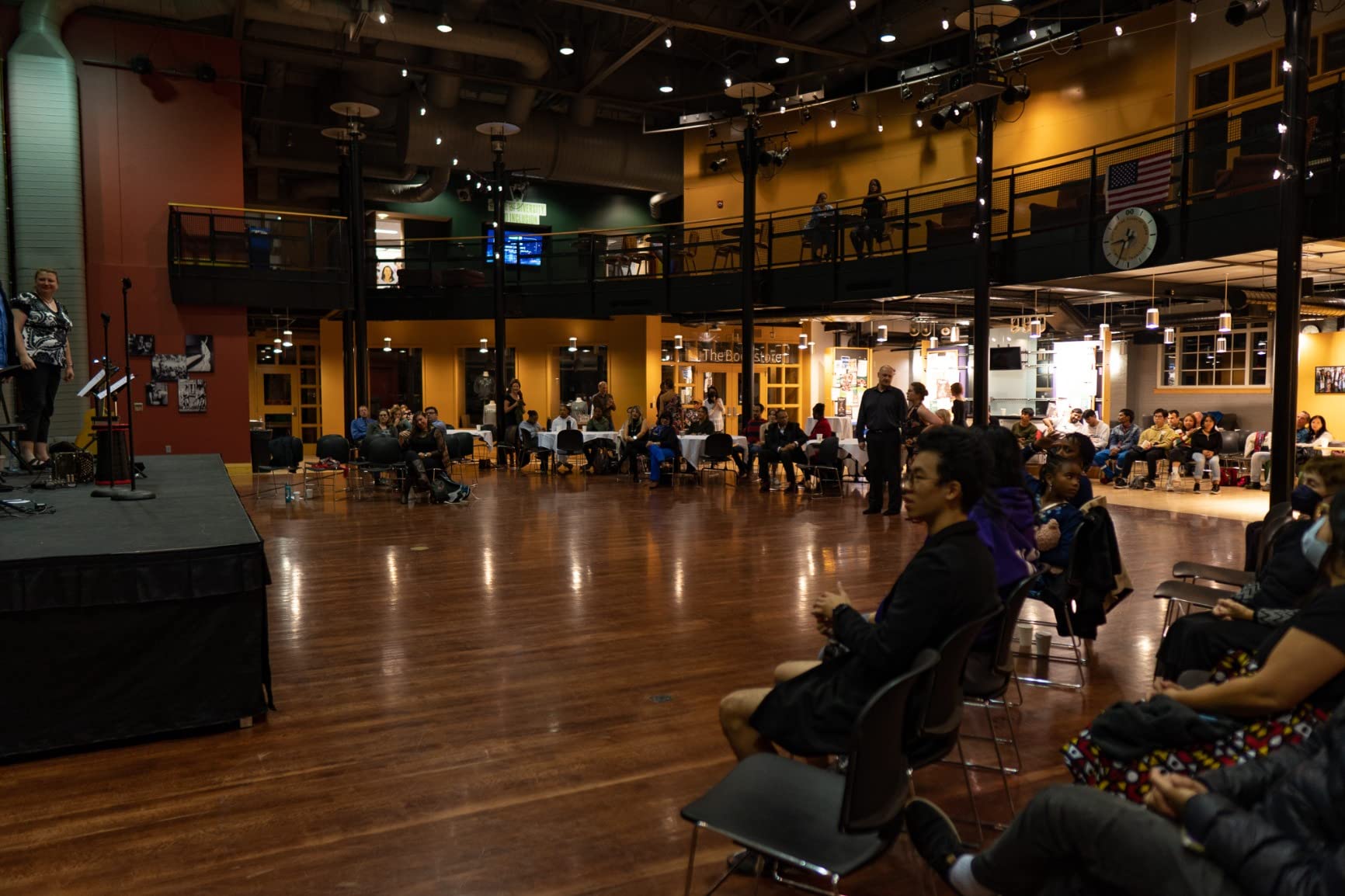
The f/1.4 aperture is the part that keeps pulling me back. Shoot indoors at dusk and you get a full stop and a half more light than an f/2.8, which is the difference between usable footage and grainy footage when you cannot add light. It also lets you hold the background soft behind your head without opening the aperture into unusable territory.
Autofocus is a stepping motor rather than a linear motor, and this is where the honest caveat sits. Owners report it as quiet in normal use and fast with Fast Hybrid AF, but it is not the near-inaudible linear-motor experience of the Sony G lenses. With a hot-shoe microphone on a windy day you will hear something.

Does the f/1.4 aperture cause focus misses when you move?
At f/1.4 the depth of field on APS-C is thin enough that a lean toward the camera can drift out of focus, so most shooters using this lens pull to f/2 or f/2.8 for walk-and-talk shots. Wide open it is still the brighter choice for a static talking head in a dim room, where focus is not going to change.
The lens keeps a compact barrel through the whole focus range, which helps on static handheld shots and when balancing the body on a gimbal. It does nothing for foot-mounted movement, where the crop mode and the gimbal do the work.
Who should pass on it?
If you need B-roll reach or a walk-around documentary style where you reframe constantly, a fixed 16mm will frustrate you. The four-blade diaphragm also renders out-of-focus highlights with visible polygonal shape, which shows up badly in night street footage with point light sources.
Check your body before buying: this is an APS-C lens, so on a full-frame Sony camera it behaves like a 24mm equivalent rather than a true ultra-wide.
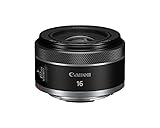
2. Canon RF16mm F2.8 STM – the compact full-frame entry point
Canon RF16mm F2.8 STM Lens
Canon RF mount
f/2.8 aperture
16mm prime
163 g
STM stepping motor
Pros
- Exceptionally small and light at 163 g for a full-frame ultra-wide
- Quiet smooth STM focusing suited to video
- Sharp centre with good colour
- A 5.11 inch minimum focus for close work
- Built-in lens profiles for correction
Cons
- Vignetting and barrel distortion need profile correction
- Edge chromatic aberration in high contrast scenes
- Autofocus is slow in low light
- No weather sealing and no hood included
This is the lens to look at if your camera is a full-frame Canon RF body and you want something that fits in a jacket pocket. At 163 g and 2.4 inches long it is the smallest full-frame ultra-wide in this group by a wide margin, and 16mm on full frame gives roughly a 105 degree horizontal field of view.
It fits the full-frame RF lineup including the EOS R5, R6 and R6 Mark II, R8 and R, and it covers the APS-C RF-S bodies too, where the field of view narrows to about 26mm equivalent. Canon includes built-in lens profiles, and that matters more here than on any other lens listed, because raw files need the vignetting and distortion correction applied.

The stepping motor gives smooth continuous autofocus during video recording, and owners consistently describe it as quiet. The minimum focus distance of 5.11 inches and 0.26x maximum magnification let you fill frame with a product or a hand, which is genuinely useful for B-roll inserts without changing lenses.
What you give up for the size is aperture speed and edge performance. f/2.8 is a stop slower than the f/1.4 and f/1.8 lenses here, so low-light indoor work pushes the ISO range harder, and chromatic aberration shows up along the frame edges in high-contrast scenes.

Is the corner quality good enough for YouTube delivery?
Centre sharpness is fine for delivery at standard resolutions. The corners are where you will see softness and colour fringing, most noticeably in 4K where the crop pulls more of the frame into view. Applying the Canon profile fixes geometry but not the fringing.
There is no weather sealing and no hood in the box, so in rain you need a filter ring and a cloth. For a creator shooting mostly indoors or on overcast days, neither issue comes up often.
Who should pass on it?
If you shoot outdoors at night or need the cleanest background separation, the f/2.8 aperture will not give you either. Low-light autofocus is also the weakest point: owners report the motor hesitating in dim rooms, which is exactly the scenario a vlogger is most likely to walk into.
Canon EF lenses do not fit RF bodies without an adapter, so this only makes sense if your body is already RF.
3. Sony FE 20mm F1.8 G – the full-frame sharpness king
Sony FE 20mm F1.8 G Full-Frame Ultra-Wide Prime Lens
Sony E mount
f/1.8 aperture
20mm prime
13.2 oz
Two XD linear motors
Pros
- Excellent sharpness wide open across the frame
- Fast f/1.8 aperture for low-light video
- Compact 13.2 oz full-frame ultra-wide
- Fast precise AF from dual XD linear motors
- Nano AR and fluorine coatings
Cons
- Wide-open corners lag the centre of frame
- No built-in image stabilisation in the lens
- Fixed 20mm limits framing on full frame
Full-frame Sony shooters should start here. Twenty millimetres is the classic vlogging focal length on a 35mm sensor, wide enough to hold you at arm’s length with room around you, and this one resolves cleanly wide open rather than only stopped down.
It fits any full-frame E-mount body including the a7 III, a7 IV, a7C, a7R IV, a7S III and a9, and it also mounts on APS-C bodies such as the a6600 and a6700, where it gives a 30mm equivalent field of view that suits desk-based talking head work.
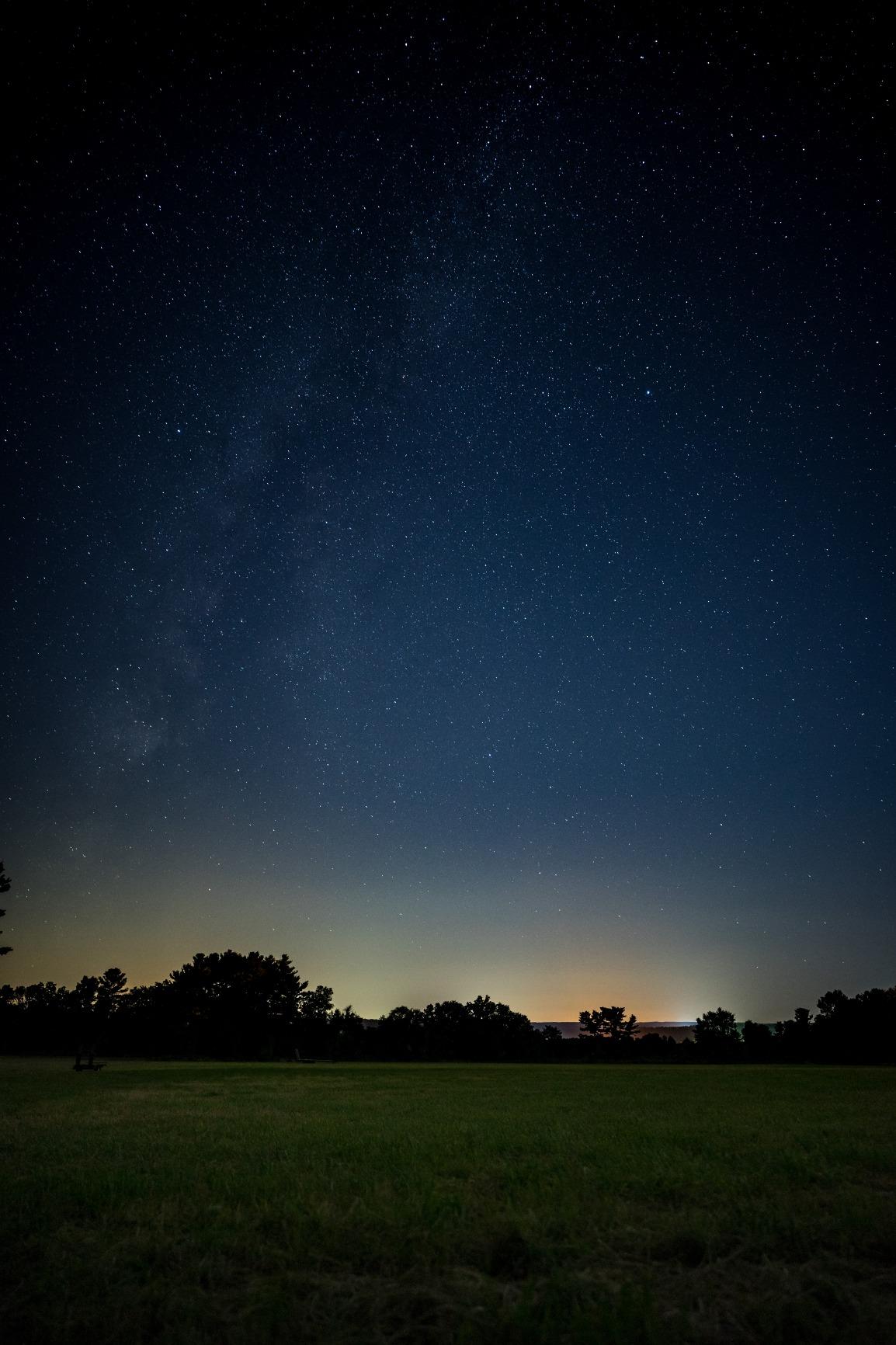
The two XD Extreme Dynamic linear motors are the reason this lens behaves so well in video. Linear motors drive the focus group with a linear sweep instead of a rotating gear, which means near-silent operation and quick, decisive movement between focus positions. With a hot-shoe mic on a walking shot, this is the difference between usable dialogue and a rustling soundtrack.
Nine diaphragm blades produce round, even bokeh for the out-of-focus background, and the aspherical elements hold high resolution into the corners of the frame even at f/1.8. At 13.2 ounces it stays comfortable for a full day of handheld shooting.

How much does the missing lens stabilisation matter?
Less than you would think, as long as your body has in-body stabilisation. Most full-frame Sony bodies do, and the combination is what carries static handheld shots. On a body without IBIS you are relying on a tripod, a gimbal or the improved stabilisation modes in video mode.
Corner performance does lag the centre wide open, which you will see in dim indoor scenes shot at f/1.8. Stopping to f/2.8 evens it out at the cost of one stop of light.
Who should pass on it?
If you are on APS-C you gain nothing over the Sigma 16mm f/1.4 listed above, which gives a wider field of view and a faster aperture for less. On full frame, if your budget stretches to a wider prime or you need a zoom, this is the wrong end of the range.
It is also not weather resistant, which matters if you shoot outdoors often.
4. VILTROX 9mm F2.8 E-Mount APS-C – the widest affordable self-framing view
VILTROX 9mm F2.8 E-Mount APS-C Lens for Sony, Auto Focus Ultra-Wide Prime Lens for Sony E-Mount Cameras FX30 ZV-E10 ZV-E10II A6700 A6600 A6500 A6400 A6300 A6100
Sony E mount
f/2.8 aperture
9mm prime (13.5mm equiv)
0.17 kg
STM with lead screw
Pros
- 113.8 degree angle of view keeps you framed at arm's length
- f/2.8 handles indoor and night work
- Eye and face autofocus for self filming
- 0.13 m minimum focus for tight interiors
- 13 elements in 11 groups
Cons
- Extreme perspective exaggerates edge distortion
- No image stabilisation in the lens
- Not weather sealed
A 9mm on APS-C equals about 13.5mm full frame equivalent, which is the widest framing in this roundup. That width is what makes it work for group vlogs, kitchen walk-arounds and any shot where you genuinely cannot fit yourself in frame with a normal wide.
It fits Sony E APS-C bodies including the a5100, a6000, a6100, a6300, a6400, a6500, a6600, a6700, ZV-E10, ZV-E10 II and FX30. It is not a full-frame lens, so check that your body is APS-C before ordering.

The internal focus design uses an STM with a lead screw, and owners report it as quiet in operation. Eye and face detection autofocus is genuinely useful when you are both the subject and the operator, because the camera can hold focus on your face as you move toward the lens.
At 0.17 kg it is one of the lightest lenses here, which matters if you are already carrying a gimbal. The 0.13 m minimum focus distance lets you frame something small without stepping away.
The trade is perspective. At a 113.8 degree angle of view, anything near the frame edge stretches noticeably, so composition matters far more than it does with a 16mm. Keep yourself near the centre of frame and the footage looks natural.

Will faces near the edges of the frame look stretched?
Yes, and there is no setting that removes it. The distortion is a function of the focal length and the distance to the subject. In practice it means shooting with yourself slightly off-centre rather than dead centre, and avoiding a second person standing at the frame edge.
The lens has no stabilisation and no weather sealing, so indoors and in fair weather it performs without complaint.
Who should pass on it?
Anyone filming B-roll or anything with subject matter where straight lines matter, such as architecture or product inserts, should look at the Sigma 10-18mm zoom instead. If your YouTube style is a static talking head, this is more lens than you need and the Sigma 16mm f/1.4 is a better buy.
It is APS-C only, which rules it out for full-frame Sony bodies entirely.
5. VILTROX AF 16mm F1.8 FE – the control-focused full-frame prime
VILTROX AF 16mm F1.8 FE Lens for Sony E Mount, f/1.8 Large Aperture Auto Focus Full Frame Wide-Angle Lens for Sony E-Mount Camera a7IV a7CII a7RV a7S III ZV-E10 II ZV-E10 a6700 a6400 a7iii a9 ZVE1 A1
Sony E mount
f/1.8 aperture
16mm prime
19.5 oz
STM with face detection
Pros
- Fast f/1.8 aperture for challenging light
- On-lens LCD shows aperture and focus distance
- Eye and face autofocus tracking
- Full metal body with dust protected internals
- Fn buttons and a click aperture ring switch
Cons
- Not weather sealed
- Metal barrel adds weight against plastic ultra-wides
- LCD and controls add bulk for a compact kit
This is the lens for a solo creator who films alone and needs to check exposure and focus distance without taking their eyes off the scene. The LCD panel built into the barrel shows aperture and focus distance directly, which removes the guesswork from a manual focus pull on a talking head.
It fits full-frame Sony E bodies including the a7 IV, a7C II, a7R IV, a7S III, a1 and ZV-E1, and the APS-C a6700 and a6400 as well. Sixteen millimetres on full frame is the sweet spot for arm’s-length framing.
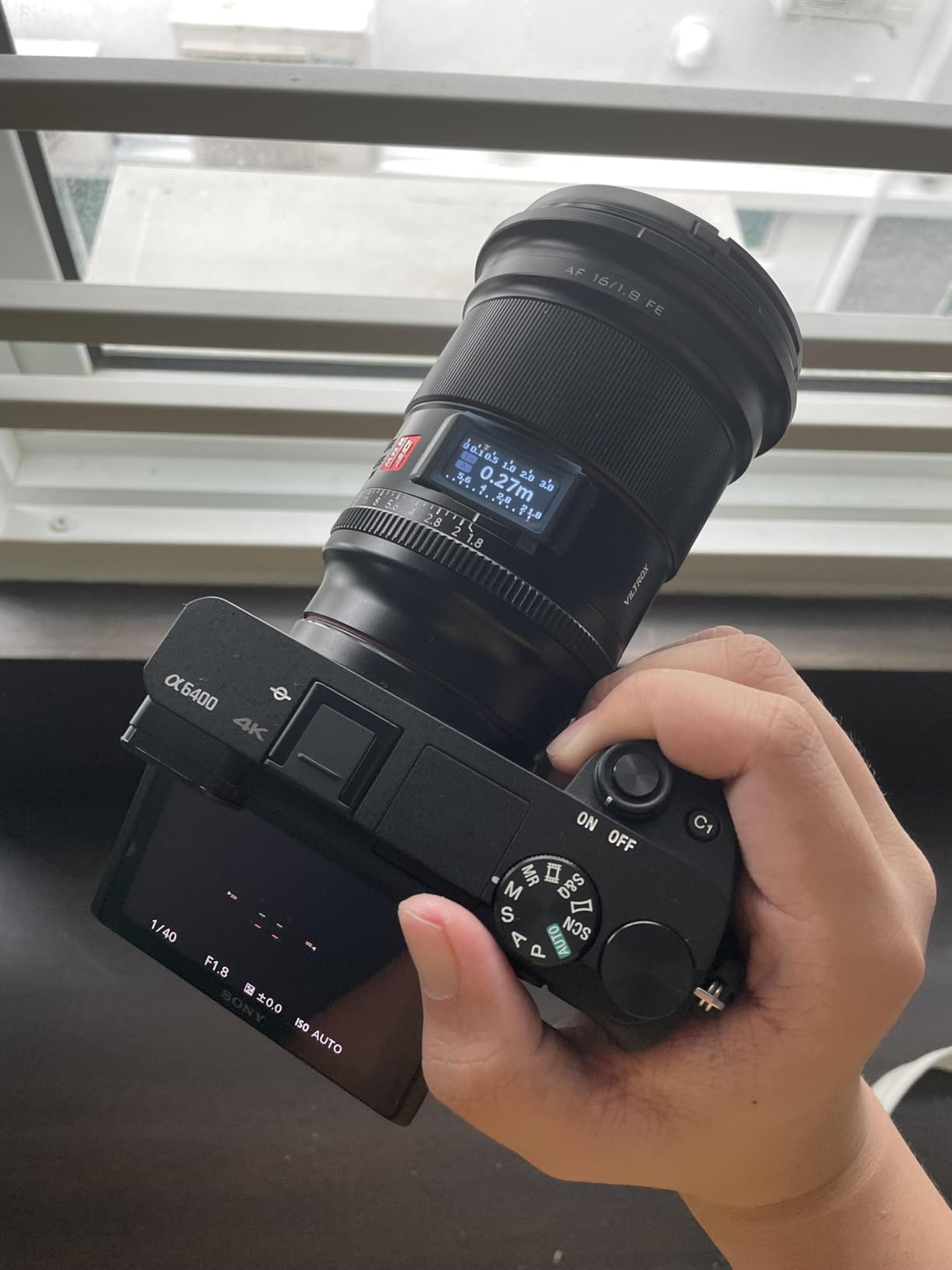
Fn1 and Fn2 buttons on the barrel can be assigned to focus hold and other functions, and the aperture ring has a switch that disables the click stops for stepless exposure changes during a take. That de-click behaviour is a real convenience when you want to fade from f/1.8 to f/4 between sentences without stepping the exposure.
The STM motor handles face and eye recognition autofocus, and the inner focus structure means the lens does not extend while focusing, which keeps the framing steady and the balance predictable on a gimbal. Fifteen optical elements in twelve groups include three aspherical elements.
Is the on-lens LCD useful in practice or just a gimmick?
Useful if you shoot solo, and irrelevant if you have an assistant. Once you learn to set a focus mark by feel at a fixed distance, the screen becomes a backup rather than a necessity. What it does buy you is speed on set, because you stop guessing at the distance to the lens hood.
Focus breathing is not listed as a controlled feature on this lens the way it is on the Nikon Z version, so plan rack focuses accordingly.
Who should pass on it?
At 19.5 ounces this is the second-heaviest lens in the roundup, and the metal barrel plus LCD add bulk to a kit you carry all day. Check your gimbal payload rating before committing.
There is no weather sealing, and reviewers who shoot outdoors in poor conditions report it as the main gap. If your budget is tight and you do not need the barrel controls, the Canon RF 16mm covers similar ground on full frame.
6. Fujifilm XF16mmF2.8 R WR – the travel-friendly Fujifilm wide
Fujifilm Fujinon XF16mmF2.8 R WR Lens – Black
Fujifilm X mount
f/2.8 aperture
16mm prime
155 g
Sealed at nine points
Pros
- Very compact 155 g pancake wide prime
- Edge-to-edge sharpness with two aspherical elements
- Weather and dust sealed for outdoor shooting
- Fast near-silent stepping motor autofocus
- Metal exterior with damped click stops
Cons
- f/2.8 is a stop slower than a fast prime in dim scenes
- Fixed 16mm offers no reframing flexibility
On a Fujifilm X body the 16mm gives a 24mm equivalent field of view, which is the framing most X-series vloggers settle on. At 155 g and 45.4 mm long it is the smallest weather-sealed option in the group, and it mounts to every X-mount body including the X-S20, X-T5, X-T30 II, X-H2S and X-H1.
We sealed at nine points and it is rated to operate down to 14 degrees Fahrenheit, which means it is the pick here for anyone shooting outdoors in poor conditions and who does not want a lens pouch.
The inner focusing system keeps the barrel from extending, and the stepping motor drives it quickly and quietly. Fujifilm X bodies pair well with that because the eye detection is dependable, so a walk-and-talk shot holds focus on your face without hunting.
Ten elements in eight groups with two aspherical elements give edge-to-edge sharpness, which matters because on a wide lens your subject is rarely dead centre. Super EBC coating handles flare reasonably well against a bright sky.
Is f/2.8 fast enough for indoor and night vlogging?
For most situations yes. Indoors with a window or a practical light behind you, f/2.8 on this sensor size gives a clean image at usable ISO values. It is night street shooting or a dim room with no light source that hurts, where a faster prime would let you stay at lower ISO and avoid noise.
On bodies without in-body stabilisation, the sealing and build let you shoot static handheld shots in poor weather without worrying about the lens.
Who should pass on it?
If your channel is built around extreme low-light work, an f/1.4 or f/1.8 prime serves you better. A fixed focal length also means no B-roll reach, so creators who shoot wide establishing shots regularly would be better served by a zoom.
If you are still choosing a Fujifilm body, start with our vlogging camera guide and match the lens after, since the mount choice locks the glass in.
7. Sigma 10-18mm F2.8 DC DN – the one-lens kit for APS-C shooters
10-18mm F2.8 DC DN (for E Mount)
Sony E mount
Constant f/2.8
10-18mm zoom
260 g
Stepping motor AF
Pros
- Framing flexibility from 10mm to 18mm at constant f/2.8
- Very sharp with little visible distortion
- Small and light at 260 g for an ultra-wide zoom
- Weather sealed construction
- Constant aperture across the zoom range
Cons
- Zoom ring sits close to the hood and pinches fingers
- Fixed f/2.8 gives less low-light headroom than an f/1.8 prime
- No in-lens image stabilisation
This is the lens to buy if you want one lens instead of two. Ten millimetres on APS-C equals about 15mm equivalent, and eighteen millimetres equals 27mm equivalent, so the same lens covers an arm’s-length walk-and-talk and a tight talking head without a lens swap.
It fits Sony E APS-C bodies, including the a6400, a6600, a6700, ZV-E10, ZV-E10 II and FX30. A constant f/2.8 across the zoom range means your exposure does not shift when you reframe, which is exactly what video work demands.
Reviewers consistently describe the image quality as sharp with little to no visible distortion, and the 10mm end still looks like a lens rather than a fisheye. At 260 g it is comfortably within the payload of most entry-level gimbals when paired with a body.
The zoom range is what sells it for travel vlogs. You can frame a wide landscape at 10mm, walk into a cafe and stay on the same lens at 18mm, and the constant aperture means you do not have to reset exposure between them.

Does the zoom ring make noise on camera?
Not badly, but the ring sits close to the hood, and reviewers report pinching fingers when zooming quickly. If you are doing fast zoom moves mid-take, that is worth knowing. Some shooters damp the ring with a small piece of friction tape.
Note that there is no stabilisation built into the lens itself, so plan around your camera’s in-body stabilisation for static handheld shots.
Who should pass on it?
If you only ever shoot a static talking head, the narrower end alone would serve you, and a prime is smaller, faster and usually cheaper. The f/2.8 constant aperture also gives away one stop against the f/1.4 Sigma listed above in dim rooms.
It is APS-C glass, so full-frame Sony bodies are out.
8. Rokinon 12mm F2.0 NCS CS for Micro Four Thirds – the budget manual-focus wide
Rokinon 12mm F2.0 NCS CS Ultra Wide Angle Fixed Lens for Olympus and Panasonic Micro 4/3 (MFT) Mount Digital Cameras (Black) (RK12M-MFT)
Micro Four Thirds mount
f/2.0 aperture
12mm prime (24mm equiv)
272.15 g
Manual focus
Pros
- Bright f/2.0 aperture for a manual-focus wide prime
- Very sharp at f/5.6 and above
- Solid metal build with a weighted focus ring
- Handles slow shutter speeds well on this sensor size
- Smooth bokeh wide open
Cons
- Manual focus only which is fiddly for video
- Noticeable vignetting wide open and flare into light
- Distorts people near the frame edges at close range
- Not weather sealed
On Micro Four Thirds the 12mm gives a 24mm equivalent field of view, the same framing as a 16mm on APS-C and a 24mm on full frame. It fits Olympus and Panasonic bodies, which makes it the only lens in this roundup for that mount and a useful option for MFT shooters who want a fast manual-focus prime.
The f/2.0 aperture is fast for the class and the 83 to 84 degree angle of view gives good arm’s-length coverage. Sharpness is strongest at f/5.6 and above according to reviewers, so treat it as a lens you stop down rather than one you shoot wide open.

Manual focus is the central decision here. The weighted focus ring is smooth and well damped, and on a Micro Four Thirds body the small sensor gives you roughly twice the depth of field of full frame at an equivalent framing, which makes manual focus far more forgiving than it is on larger formats.
Nano Crystal Coating handles flare reasonably, and the aperture ring has click stops for predictable exposure changes during a take.
Can you really focus a manual lens while vlogging?
Yes, if you fix your position. Set the focus distance once with a tape measure or a marked focus ring position for where you will stand, apply the tape method if you prefer, and then the lens is as hands-off as an autofocus prime. What manual focus will not do is follow you if you move closer or further away.
Reviewers report noticeable vignetting wide open and some flare when shooting into a light source, so a little post-production correction is part of the deal.
Who should pass on it?
Run-and-gun creators, solo shooters who move constantly, and anyone shooting solo at arm’s length where focus is critical. Manual focusing at arm’s length while also managing your own framing is genuinely difficult, and that is why most vloggers buy autofocus glass.
It is manual focus only and not weather sealed, so it will not handle wet outdoor shoots.
9. VILTROX AF 16mm F1.8 Z for Nikon Z – the video-first Nikon prime
VILTROX AF 16mm F1.8 Z Full Frame Lens for Nikon Z-Mount, AF 16mm F/1.8 Z with Built-in LCD Screen Wide Angle Lens for Nikon Z Mount Z7 Z7ii Z8 Z8ii Z9 Zf Z30 Z50 Zfc
Nikon Z mount
f/1.8 aperture
16mm prime
550 g
Negligible focus breathing
Pros
- Fast f/1.8 aperture for low light and shallow depth of field
- Negligible focus breathing for clean rack focuses
- Stepless aperture via the click ring on and off switch
- Good corner-to-corner resolution with four ED elements
- On-lens LCD aids manual focus
Cons
- Heavy at 550 g against other primes here
- No image stabilisation in the lens
- More mixed feedback on autofocus consistency
Sixteen millimetres on full frame gives about a 105 degree angle of view, and this is the lens in the roundup built most explicitly around video behaviour. It fits Nikon Z bodies including the Z30, Z50, Z7 II, Z8, Z9 and Z fc.
The headline feature is negligible focus breathing, which means the frame does not visibly zoom in or out during a focus pull. If you do deliberate rack focuses, that is the difference between a clean transition and one the viewer notices.
The CLICK switch on the aperture ring toggles between clicked stops and stepless adjustment. Switched on, the de-click mode lets you pull exposure smoothly between f/1.8 and f/22 without any audible steps, which is what you want when you are riding exposure through a scene.
Fifteen elements in twelve groups with three aspherical and four ED elements hold corner-to-corner resolution, and the STM motor carries face and eye detection for walking shots. An LCD panel on the barrel shows aperture and focus distance.

What does 550 g mean for a full shooting day?
It is the heaviest lens in this group, and on a Z50 or Z30 pairing it makes the kit noticeably front-heavy. Balance matters more than raw weight on a gimbal, so rebalance properly rather than assuming a payload rating will cover it, and consider a wrist strap or a chest rig for long handheld days.
There is no stabilisation in the lens itself, so steady static shots depend on your body’s in-body stabilisation.
Who should pass on it?
Autofocus consistency draws the most mixed feedback, with owners reporting slower acquisition in some conditions. If you film fast-moving subjects and cannot tolerate occasional hunting, the Sony 20mm F1.8 G with dual linear motors is the safer choice, though it is a full-frame lens with a narrower field of view.
At 550 g, creators who care most about a lightweight kit should weigh it against the far smaller Fujifilm 16mm option.
10. Fujifilm XF14mmF2.8 R – the manual-focus wide with character
Fujifilm XF14mmF2.8 R
Fujifilm X mount
f/2.8 aperture
14mm prime (21mm equiv)
235 g
Manual focus
Pros
- Classic Fujifilm rendering with a distinctive look
- f/2.8 suits low light and astrophotography
- Compact at 235 g for a manual-focus wide
- Aspherical and abnormal dispersion elements control aberrations
- Super EBC coating
Cons
- Manual focus only with no autofocus for video
- No image stabilisation
- Not weather sealed
- Older fixed design
The 14mm gives a 21mm equivalent field of view on Fujifilm X bodies, sitting between a classic wide and a normal. It fits the full X-mount lineup, and at 235 g it is light enough to carry without thinking about it.
Reviewers consistently describe the rendering as pleasing and distinctive, which is the reason to buy a manual-focus lens in a world of autofocus glass. The f/2.8 aperture handles low light and night-sky work, and ten elements in seven groups include two aspherical and three abnormal dispersion elements to hold aberrations in check.
The angle of view measures 89 to 90.8 degrees, which frames you comfortably at arm’s length without the fisheye stretch of an extreme ultra-wide. The 58 mm filter thread is modest, so filters are inexpensive and light.
This is a lens for a specific shoot: a locked-off camera, a marked focus distance, a tripod or a stand, and a creator comfortable pulling focus by hand. Under those conditions it produces footage that automated glass rarely matches.
Is manual focus workable if you are the only person on set?
Only with preparation. Mark your focus distance before you start, use a focus mark on the barrel so your fingers find the same spot every time, and stay in the same spot. The 4.4 average rating reflects that its lack of autofocus and stabilisation limits it for run-and-gun video work, and reviewers are direct about that.
Adding stabilisation would not fix the focus problem anyway, since stabilisation smooths shake rather than tracking a moving subject.
Who should pass on it?
Anyone moving while filming, and anyone who relies on face detection to hold focus. If you shoot solo at arm’s length, juggling a manual focus ring while holding the camera at the correct distance is a two-handed job.
It is also not weather sealed, which rules out wet-weather shooting. If you shoot on X-mount and want autofocus, the XF16mmF2.8 R WR is the more practical pick.
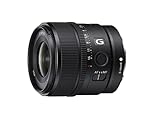
11. Sony E 15mm F1.4 G – the fastest option for dark rooms
Sony E 15mm F1.4 G APS-C Large Aperture Wide Angle G Lens (SEL15F14G)
Sony E mount
f/1.4 aperture
15mm APS-C prime
13.28 oz
Two linear motors
Pros
- Very fast f/1.4 aperture with excellent low-light capability
- Constant lens length while focusing for balanced video handling
- Aperture ring with silent de-click for video
- Reduced focus breathing and angle-of-view shift
- Compact 13.28 oz body
Cons
- Fixed 15mm focal length with no zoom flexibility
- Very wide perspective exaggerates edge distortion
- Not weather sealed
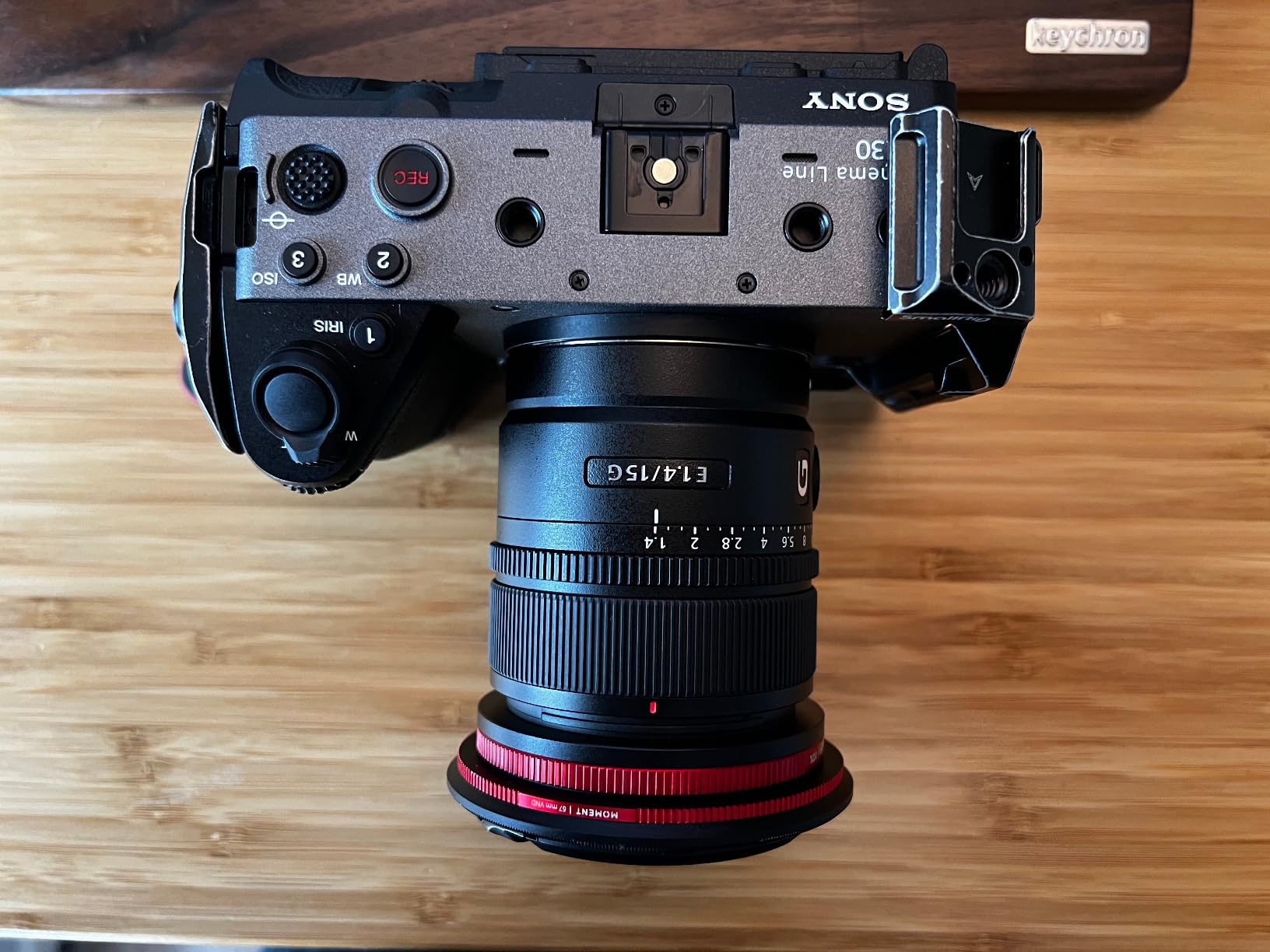
This is the brightest option in the roundup and the one to buy if your channel is shot in dim rooms. Fifteen millimetres on APS-C gives a 22.5mm equivalent field of view, slightly tighter than the 16mm primes here, which is useful when you want a little more subject in frame.
It fits Sony E APS-C bodies including the a6000, a6100, a6400, a6600 and a6700. Sony lists it as an APS-C G lens rather than a full-frame one, so verify your body before ordering.
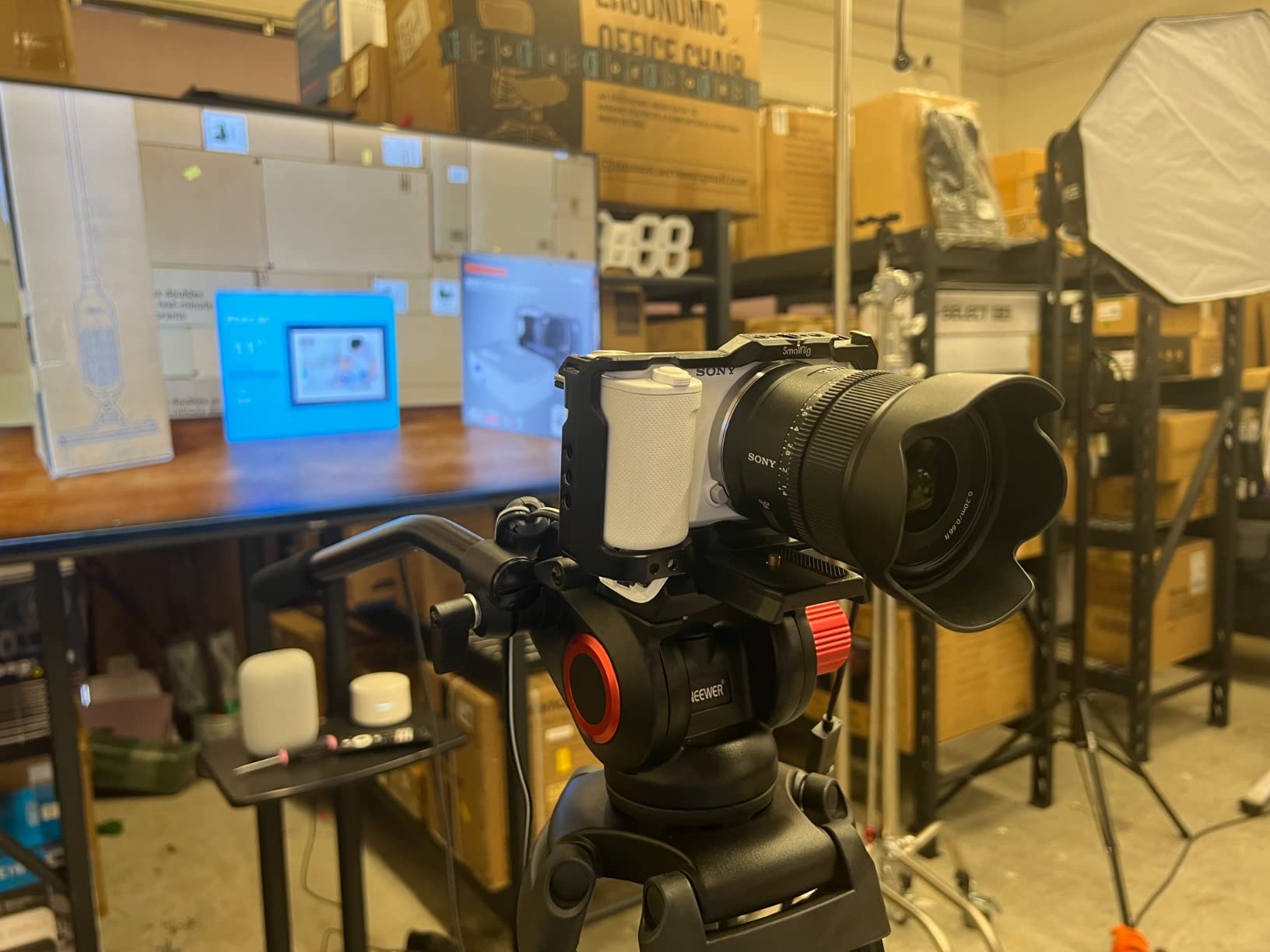
Two linear motors drive autofocus fast and quietly, which is the standard Sony video behavior you would hope for. The refined internal focus mechanism keeps the lens length constant while focusing, so your framing does not shift during a pull and the lens stays balanced on a gimbal.
The aperture ring has a click on and off switch, so you can switch to silent stepless adjustment for exposure changes mid-take. Sony also reduces focus breathing and angle-of-view shift, with compensation available on compatible alpha bodies.
Does f/1.4 actually let you shoot in places other lenses cannot?
Yes. At f/1.4 this lens gathers roughly two stops more light than an f/2.8, which in a dim room is the difference between a clean image and one you have to noise-reduce in post. It also gives you the option of keeping ISO low and the shutter fast enough for natural motion.
The trade is depth of field. At f/1.4 the focus plane is thin, so pull to f/2 or f/2.8 for walk-and-talk movement and keep f/1.4 for static shots in the dark.
Who should pass on it?
If you want to reframe without moving your feet, the fixed 15mm rules it out. The very wide perspective also exaggerates distortion on subjects near the frame edges, and at 22.5mm equivalent it is a tighter framing than most people expect from a vlogging prime.
It is not weather sealed, and it is APS-C glass, so it will not serve a full-frame Sony body.
12. Samyang 12mm F2.0 AF for Sony E – the extreme ultra-wide option
Samyang SYIO12AF 12mm F2.0 AF Ultra Wide Lens, Sony E
Sony E mount
f/2.0 aperture
12mm APS-C prime
213 g
Removable petal hood
Pros
- Very wide 99.1 degree field of view in a 213 g body
- Fast f/2.0 aperture for night and indoor work
- Quiet linear STM autofocus with minimal breathing
- Weather sealed metal build with removable petal hood
- UMC coating controls flare and ghosting
Cons
- Most mixed rating spread in the group with a high share of 3-star reviews
- Very wide perspective stretches subjects near the edges
- Autofocus can be slower in very low light
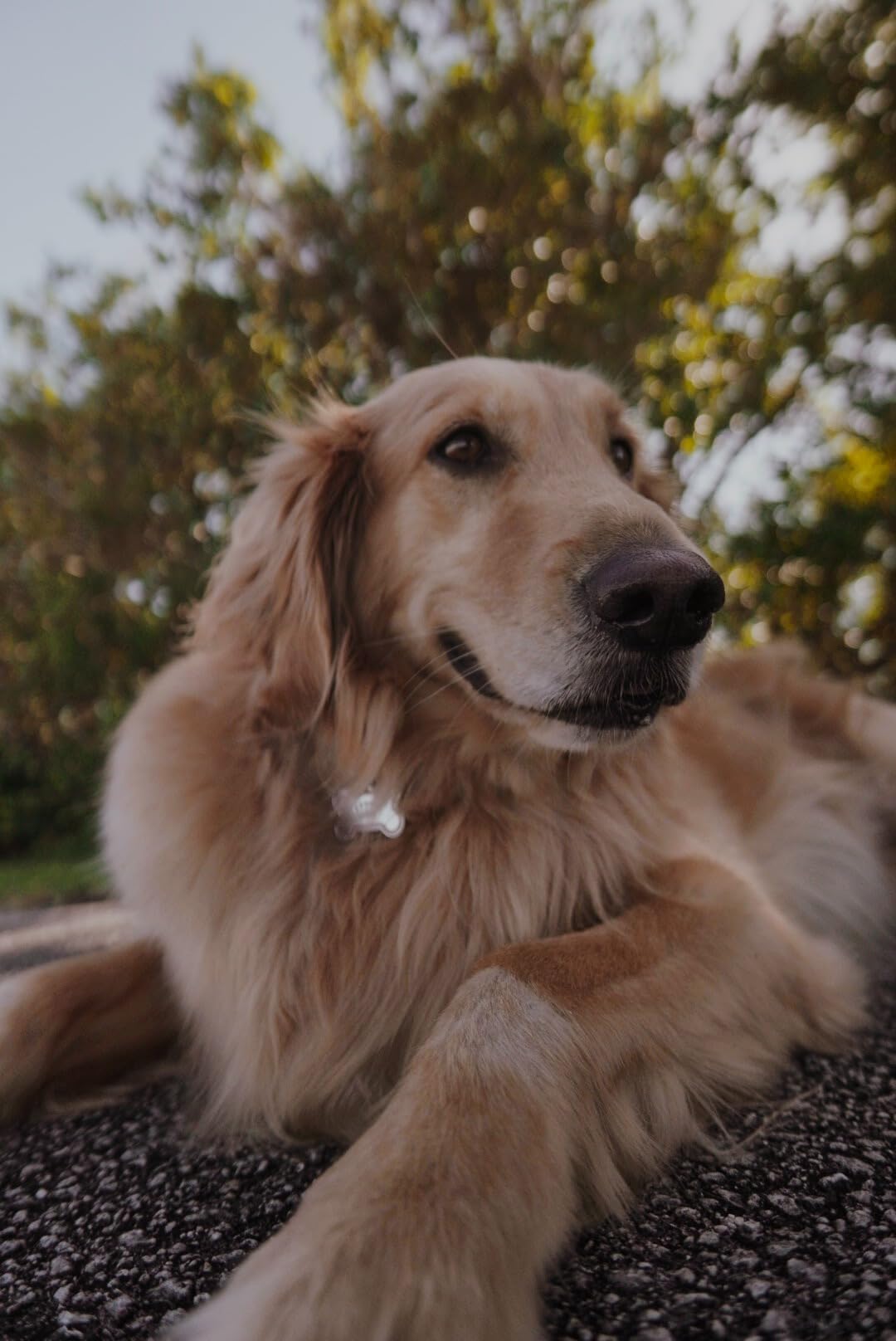
A 12mm on APS-C gives about an 18mm equivalent field of view, wider than the 16mm primes here and narrower than the 9mm Viltrox. That middle position is what makes it useful: wide enough to hold you and a whole room, without going fully extreme. It fits Sony E APS-C bodies.
The f/2.0 aperture is fast for the class, and the linear STM motor gives quiet autofocus with minimal focus breathing according to owners. At 213 g it is among the lighter options here.
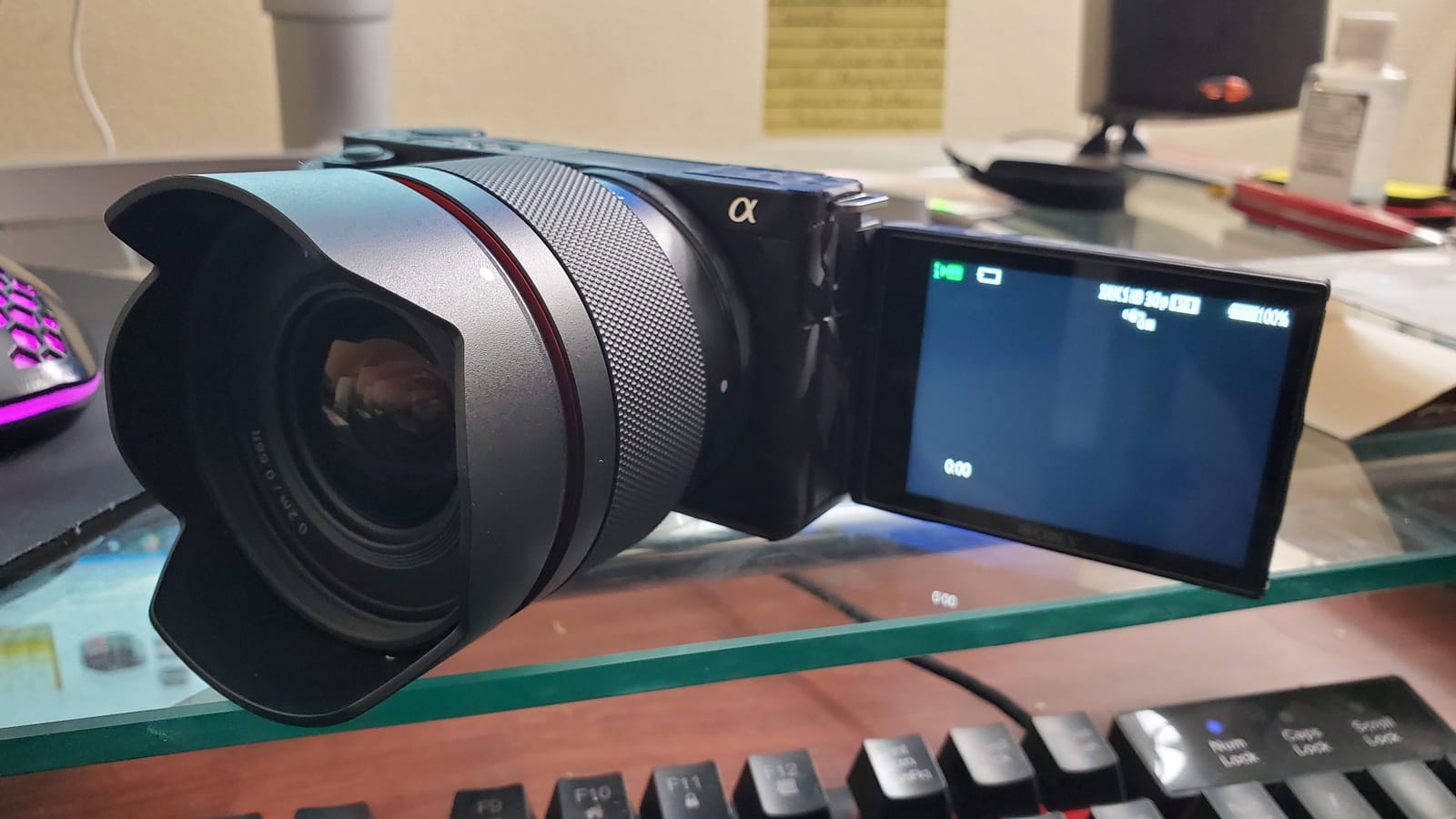
Twelve elements in ten groups include one aspherical, one high-aspherical and three extra-low dispersion elements, with Ultra Multi-Coating to hold flare and ghosting down when you are shooting toward a light source. The metal body is weather sealed and comes with a removable petal hood, which is unusual at this focal length and genuinely useful if you shoot outdoors.
The rear protective glass sits behind a recessed mount, which guards against flare from the front elements at wide angles where stray light is most likely to reach the sensor.
How does the rating compare to the rest of this list?
It is the lowest average here at 4.3, and the review distribution carries a higher share of 3-star feedback than the other lenses. The complaints cluster around edge distortion on subjects close to the frame and autofocus hesitation in dim conditions, both of which are characteristic of very wide fast glass rather than defects.
If autofocus hunting bothers you, check the lighting before you shoot or consider a lens with a faster focusing motor.
Who should pass on it?
Cinematic and travel creators who want natural-looking faces will find that subjects at the frame edges stretch. If your channel is a single static talking head, this focal length is wider than you need and the Sigma 16mm f/1.4 is a stronger everyday choice.
It is APS-C glass and will not cover a full-frame Sony body.
How to Choose a Vlogging Lens on Any Mirrorless Mount
Choose by framing first, aperture second, and everything else third. The order matters because a lens that solves your framing problem will still disappoint if it hunts in low light, while a beautifully engineered lens at the wrong focal length will not fit you in frame at all.
If you are still assembling a kit, our guides to budget lenses for mirrorless cameras and action cameras for vlogging cover the cheaper end of the conversation.
Focal length and arm’s-length framing
At arm’s length, roughly 60 to 70 cm from the lens, you need a field of view wide enough to include your head and shoulders with air around you. That works out to about 16 to 24mm equivalent on full frame, 10 to 16mm on APS-C, and 8 to 10mm on Micro Four Thirds.
The conversion matters more than the printed focal length. A 16mm on full frame and a 16mm on APS-C produce completely different framings, and the APS-C version equals about 24mm. When a listing quotes both numbers, check which one you are reading.
Wider lenses also distort more at the frame edges, so the practical rule is to stay slightly off-centre rather than dead centre and to avoid framing other people at the edges. The 9mm class lenses here are spectacular for interiors and genuinely rough on faces.
Aperture: how much light and background blur you actually need
Aperture controls two things at once: how much light reaches the sensor, and how much of the background is blurred. Faster apertures give you both, plus the ability to shoot at lower ISO in dim rooms.
The short version of the f/2.8 versus f/4 question: f/2.8 is one stop faster, so in low light it means half the ISO, half the noise, and noticeably softer backgrounds when you are close to your subject. That is a meaningful difference for video, where noise is harder to remove cleanly than in a still. f/4 is lighter, sharper corner to corner wide open, and often the better choice when you shoot outdoors in good light and carry weight all day.
Above f/1.8 the depth of field gets thin enough that focus misses become common, which is the most common complaint from vloggers moving while they talk.
Autofocus motor noise and your microphone
This is the issue that ruins more takes than any other. Whatever is recording audio on the camera records the lens motor too. Older screw-driven autofocus systems are audible at any aperture, and stepping motors like STM are much quieter, while linear motors such as Sony XD, Canon VCM and Nano USM are near-silent.
Before you record, test your specific lens with your specific microphone in a quiet room. Record ten seconds while focusing, then play it back on good speakers. Some bodies apply in-body noise reduction that can also reduce the motor noise, but you should not rely on it.
Focus breathing and the de-click aperture ring
Focus breathing is the frame shifting size as the lens focuses, caused by the lens extending or contracting internally. On a wide lens it is smaller than on a telephoto, but it is still visible on a rack focus. The Viltrox 16mm F1.8 Z is the pick here that explicitly controls for it, and the Sony 15mm F1.4 G reduces both breathing and angle-of-view shift.
Many bodies now offer electronic breathing compensation, which corrects the framing shift in camera. It helps with breathing but not with corner-to-corner focus shifts, which remain visible in a focus pull.
A de-click aperture ring lets you change exposure without audible clicks. The Sony 15mm F1.4 G and the Viltrox 16mm F1.8 Z both have a switch that disables the stops, and that switch matters if you ride exposure between sentences.
Stabilisation: lens IS, in-body IBIS or gimbal
Lens optical stabilisation and in-body stabilisation are two halves of the same system, and they combine where the body supports it. Neither one does much for foot-mounted movement on a gimbal, where the gimbal is doing the work, and neither rescues a shaky operator walking and talking.
For static and seated shots, stabilised bodies help a lot. For walk-and-talk, prioritise a lightweight lens and a gimbal over a stabilised lens, because balance and mass matter more. Several lenses here carry no stabilisation at all and are still strong choices, which tells you how much weight to put on that spec.
Weight budget and gimbal payload
Weight is the spec most often ignored and the one most likely to end your shoot. The range across this roundup runs from 155 g on the Fujifilm 16mm up to 550 g on the Viltrox 16mm F1.8 Z, so what looks like a small difference on a spec sheet is a completely different feel at the end of a six-hour shoot.
Add your body weight to the lens weight and compare it against your gimbal’s rated payload with headroom. Balanced matters more than under the limit, because an unbalanced rig drifts even when the numbers look fine. If you are handholding all day, treat anything above roughly 300 g on a compact body as a real load.
Should you upgrade from your kit lens?
Sometimes no, and forum discussion on this point is consistent enough to be worth stating plainly. Keep your kit lens if you shoot mostly outdoors in good light, use a tripod, and mainly frame a static talking head. A 16-50mm or 18-55mm kit zoom covers arm’s-length framing on its wide end, and that is genuinely enough for many channels.
Upgrade when one of these is true: you shoot indoors or at night and noise is a problem, your autofocus motor is audible on your microphone, your body has no stabilisation and you handhold, or you need a wider field of view than the kit lens provides. Forum owners widely agree that the biggest real-world upgrade is stabilisation and silent autofocus rather than sharpness.
If you decide your kit lens is fine, put the money toward a good microphone or lighting instead. That is the advice most experienced creators give, and it is correct more often than not.
Mount index: which of these fits your body
Sony E covers the most ground in this list. The Sigma 16mm f/1.4, the Sony FE 20mm F1.8 G, the VILTROX 9mm F2.8, the VILTROX AF 16mm F1.8 FE, the Sigma 10-18mm F2.8, the Sony E 15mm F1.4 G and the Samyang 12mm F2.0 all mount to E-mount bodies, though several are APS-C glass and will not cover a full frame sensor properly.
Canon RF is represented by the Canon RF16mm F2.8 STM. Nikon Z by the VILTROX AF 16mm F1.8 Z, which fits the Z30, Z50, Z7 II, Z8, Z9 and Z fc. Fujifilm X has two picks, the XF16mmF2.8 R WR and the XF14mmF2.8 R. Micro Four Thirds has the Rokinon 12mm F2.0, for Olympus and Panasonic bodies.
There are no Nikon F, Canon EF, Pentax K or Micro Four Thirds autofocus options in this roundup, so if your body uses one of those, you will need to look elsewhere or use an adapter with its compromises.
Frequently Asked Questions
What camera lens is best for vlogging?
A wide, fast prime or zoom with near-silent autofocus. On full frame that means a 16mm to 20mm prime at f/1.4 to f/1.8, on APS-C a 10mm to 16mm prime, and on Micro Four Thirds a 9mm to 12mm. Our top pick overall is the Sigma 16mm f/1.4 DC DN Contemporary for Sony E.
What focal length is best for vlogging?
About 24mm equivalent on full frame, 16mm equivalent on APS-C, and 12mm equivalent on Micro Four Thirds. That framing holds you at arm’s length with room around you. Anything much wider stretches faces near the frame edges.
Is f/2.8 or f/4 better for video?
f/2.8 is one stop faster, so it needs half the ISO in dim light, halves the noise and blurs backgrounds more when you are close to your subject. f/4 is lighter, sharper in the corners wide open, and fine if you shoot outdoors and carry weight all day.
Is my kit lens good enough for vlogging?
Often, yes. A 16-50mm or 18-55mm kit zoom covers arm’s-length framing on its wide end. Upgrade if you shoot indoors or at night, if the autofocus motor is audible on your microphone, if you handhold with no stabilisation, or if you need a wider field of view.
Does 4K crop affect lens choice?
Yes. Many bodies crop further when recording 4K at 60fps or above, which narrows your field of view and undoes the benefit of a wide lens. Check your body’s crop factor at your chosen frame rate before committing to an ultra-wide focal length.
Do I need image stabilisation for vlogging?
For static and seated shots it helps a lot, especially with in-body stabilisation on the body. For walk-and-talk shots it does very little, and a lightweight lens plus a gimbal matters more. Several strong picks here have no stabilisation at all.
Which lens is best for a Sony camera?
On APS-C Sony bodies the Sigma 16mm f/1.4 DC DN Contemporary is the strongest all-rounder, with the Sony E 15mm F1.4 G if you shoot in dim rooms. On full frame bodies the Sony FE 20mm F1.8 G wins on autofocus quietness and sharpness.
What do most vloggers use for a camera?
Most shoot a mirrorless body with a wide prime mounted permanently and a small tripod or gimbal for movement. That is a two-body habit most creators outgrow once they get a wide lens, since the lens choice matters more to the footage than the body.
Which Vlogging Lens Should You Buy?
For most creators the answer is the Sigma 16mm f/1.4 DC DN Contemporary on a Sony APS-C body. It frames correctly, it is bright enough for dim rooms, it is light enough to carry all day, and its autofocus is quiet enough for on-camera audio. It is our editor’s choice and the lens we would put on a body first.
Pick a different one if your situation is specific. Full-frame Sony shooters who want the quietest autofocus and the sharpest centre should take the Sony FE 20mm F1.8 G. Anyone who cannot fit in frame at 16mm equivalent needs the wider Viltrox 9mm F2.8. Nikon Z owners get their video-first answer in the Viltrox 16mm F1.8 Z, Canon RF owners in the small and light RF16mm F2.8 STM, and Fujifilm X owners in the weather-sealed XF16mmF2.8 R WR.
If you shoot one lens and want to travel with it, the Sigma 10-18mm F2.8 DC DN covers the most ground without a lens change. Before you order any of them, check the mount against your body, weigh the lens against your gimbal’s payload, and test the autofocus with your microphone before you record a single take. Those three checks prevent almost every disappointing vlogging purchase.
We update this roundup as new lenses land and as owner feedback shifts. If you have picked up one of these lenses and want to compare notes, the comments are open.