
If you’ve ever taken a glance at sheet music, you’re likely familiar with the intricate lines and symbols that look like a secret code to the uninitiated.
But fear not, because understanding the grand staff basics can transform those cryptic symbols into beautiful music.
The grand staff is the foundation upon which melodies are built and harmonies are structured.
It’s essentially the map that guides musicians through the landscape of a musical piece, and getting to grips with it is your first step toward reading and playing music with confidence.
So, let’s break down the essentials so you can start deciphering scores like a pro.
The grand staff basics aren’t just about knowing where the lines and spaces are; they’re about internalizing a system that has been in use for centuries to communicate musical ideas across cultures and generations.
With your curiosity at my side, I’m excited to lead you through this fundamental aspect of music theory.
Table of Contents
What is the Grand Staff and Why is it Essential in Music Notation?
The Grand Staff represents the core framework of western music notation, serving as a canvas for composers and musicians to create and interpret musical compositions.
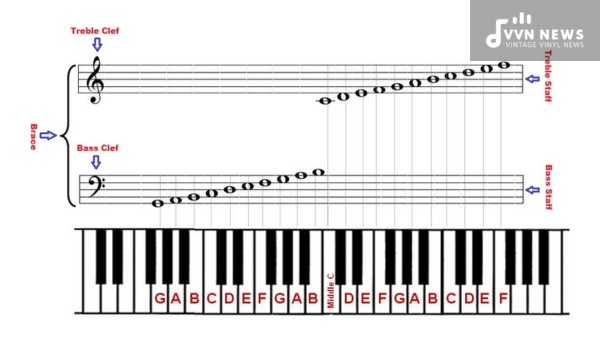
It consists of two staffs (staves) that are bound together— the treble clef on the top and the bass clef on the bottom.
These twin staves form a symbiotic relationship, with each one responsible for a specific range of pitches.
At their intersection lies Middle C, an anchor point balancing both realms of pitch.
Notably, this dual-staff system accommodates the vast array of notes necessary for complex musical expression.
Pianists heavily rely on it due to their instrument’s wide range, requiring simultaneous reading of both clefs.
Similarly, orchestral scores utilize the grand staff layout to orchestrate layers of sounds across different instruments.
Special symbols known as clefs assign individual lettered note values to lines and spaces on each staff.
The treble clef, resembling an ornate ‘G’, corresponds to higher pitches typically played with the right hand, while the bass clef, resembling a stylized ‘F’, aligns with lower pitches often played with the left.
Navigating this structure effectively facilitates accurate pitch production and rhythm execution across diverse instruments.
Henceforth, mastery over this notational paradigm empowers performers to translate written symbols into audible artistry with precision.
Also Read: Best Piano Players In The World [Melodies That Have Moved Millions]
How are the Treble and Bass Clefs Structured on the Grand Staff?

Within the grand staff, two clefs uniquely identify how notes correspond to particular pitches: the Treble Clef and the Bass Clef.
Signified by an ornate ‘G’, the treble clef swirls around the second line from the bottom, denoting that this line represents the note ‘G’ above middle C.
Musicians often associate this clef with higher-pitched instruments, such as the violin or flute.
In contrast, the bass clef, with its stylized ‘F’, hugs the fourth line from the bottom of its five-line staff.
This indicates that said line corresponds to the ‘F’ below middle C. It typically guides lower-pitched instruments like tuba or bassoon.
Each staff comprises five lines and four spaces where notes sit or hang. When a note falls on a line or space within these clefs, it represents a specific pitch—the building block for melodies and harmonies.
Remember, when combined on a grand staff:
- The Treble Clef governs higher notes
- The Bass Clef commands lower tones
This bifurcated structure allows pianists and other musicians to fluently read extended ranges of music without overwhelming ledger lines above or below either clef.
What Role Do Ledger Lines Play in the Grand Staff?
Ledger lines are those short, horizontal strokes you often see extending the grand staff.
These nifty extensions allow notes to be written beyond the usual five lines and four spaces of each clef.
Consider them as extra rungs on a ladder, permitting notes to ascend and descend into new musical territories.
When a note’s pitch is too high for the treble clef or too low for the bass clef, ledger lines come into play.
They provide a visual aid for reading these outlying notes. Each ledger line represents a single note line where notes sit or spaces where they hover in between.
For example, middle C (C4) sits on a ledger line when notated in either clef: below the treble or above the bass. It’s a pivotal reference point for transitioning between both clefs on a piano.
Ledger lines enhance the grand staff’s range substantially, making every pitch notatable and playable.
Without them, composers and musicians would be severely limited in expressing the full spectrum of sound their instruments are capable of producing.
Also Read: Guide Of Piano Chords [Unlock Your Musical Potential Today]
The Versatility of the Grand Staff Across Musical Genres

The grand staff is an indispensable tool that spans a multitude of musical genres.
With its dual-staff system, it accommodates a wide range of pitches, making it incredibly versatile for various styles of music.
Let’s explore how different genres exploit the grand staff’s abilities:
- Classical Music: In orchestral scores, each instrument is often allocated its staff within the grand structure. Classical compositions leverage the grand staff’s extensive range to accommodate complex harmonies and orchestral arrangements.
- Jazz: Jazz music frequently utilizes piano, bass, and wind instruments that all read from the grand staff. Pianists especially rely on it to play intricate chord voicings and improvisations that require both hands to span multiple octaves.
- Pop Music: The piano arrangements in pop songs generally use the grand staff. Songwriters notate chords, melodies, and accompaniment patterns which are essential for pianists in bands or solo performers.
- Musical Theatre: Scores for theatrical productions often involve piano-vocal arrangements written on the grand staff. This format assists singers and accompanists in delivering dramatic performances through clear notation of melody lines against piano harmonics.
- Choral Works: Choral scores typically use a modified grand staff system where each vocal part (soprano, alto, tenor, bass) gets its line. It allows conductors and singers to see how different parts interact on a single page.
As you delve into these diverse musical landscapes with their unique demands, the grand staff remains a constant—effectively translating the sonic ideas into visual symbols that facilitate performance regardless of genre.
The versatility of the grand staff not only serves myriad musical tastes but also underscores its status as a universal language in sheet music—an impressive testament to its foundational role in music education and practice.
Also Read: Grand Staff Basics [The Key To Reading Piano Music Notation]
What Are Key Signatures on the Grand Staff?
Key signatures are vital to music notation. They specify the key of the piece by indicating which notes are to be played sharp or flat throughout.
Situated at the beginning of the staff, right after the clef symbol, they shape the tonality without cluttering individual notes with accidentals.
Each key signature has a unique set of sharps (#) or flats (b), positioned on specific lines and spaces corresponding to notes in the scale.
For instance, a piece in G major will feature a single sharp on the F line, signaling F# is to play each time that note is encountered.
A quick way to identify major keys: The last sharp written mark is half a step below the tonic (keynote), while for flats, it’s four steps above the second-to-last flat.
This guideline swiftly reveals any key’s tonality. Crucially, key signatures also apply to relative minor keys, dictating their natural pitches alongside their major counterparts.
Comprehending key signatures enhances sight-reading proficiency, as it ensures musicians are attuned to scale alterations before striking a single note.
How to Play Music with the Grand Staff?

To effectively play music using the grand staff, recognizing the role of both the treble and bass clefs is imperative.
Each clef governs a separate set of pitches, with treble encompassing higher notes and bass the lower tones. Here’s a concise guide to get you started:
- Identify the treble clef notes, typically played with your right hand on a keyboard or plucked by your fingers for string instruments.
- Next, familiarize yourself with bass clef notations for your left hand or lower-pitched strings.
- Consider key signatures, which dictate which notes are to be played sharp or flat throughout a piece.
- Grasp rhythm by studying the time signature at the beginning of a staff which signifies beat consistency.
When approaching ledger lines, those above or below each staff, recognize they extend the existing five lines for additional notes.
As you practice reading and correlating these symbols with their respective sounds, proficiency will swiftly follow.
Playing music via grand staff translates notes into auditory artistry by visually guiding technique and expression for melodious compositions.
Also Read: B Flat Minor Chords [Complete Guide And Variants For Piano]
The Different Clef Combinations Along With Grand Staff
The grand staff traditionally combines the treble clef and bass clef, linked by a brace on the left side.
Your music journey will likely start with these two, but as you delve deeper, you’ll encounter other clefs that open up new dimensions on the staff.
Treble and Bass Clef Combination
Treble Clef (G Clef): Signified by an ornate symbol that loops around the G above middle C, this clef is used for higher-pitched instruments and voices.
Bass Clef (F Clef): Marked by two dots surrounding the F below middle C, it caters to lower-pitched sounds.
Alternatives and Additional Clefs
- Alto Clef (C clef): Centers on middle C. Violas commonly use it, offering a range in between treble and bass staves.
- Tenor Clef: Another version of the C clef, shifted slightly higher than alto; employed for upper ranges of bassoon or lower registers of trombone.
Switching It Up with Multiple Staves
Composers combine different staff configurations depending on instrument ranges or ensemble types. Here’s a quick look at some combinations:
- Piano: Treble + Bass clefs standard layout.
- Organ: Often three staves – Two for hands (treble + bass), one for feet (usually in bass).
- Choral Works: Four-stave setups – Soprano & Alto (treble), Tenor & Bass (bass/treble using tenor lines).
Clef Transitions for Instrumentalists
Certain instruments may shift between clefs within a single piece:
- Cello / Bassoon: Might start in bass then switch to tenor to alleviate excessive ledger lines.
- Trombone / Euphonium: Sometimes move from bass into tenor or even alto for higher passages.
Optimally combining clefs on a grand staff boils down to minimizing ledger line usage while maintaining legibility across all required note ranges.
Facilitating seamless music reading tailored to each instrument’s unique tessitura.
Also Read: G Sharp Diminished Triad [Explore Unique Guitar Chords]
FAQs About the Grand Staff
What is the difference between the grand staff and a single staff?
The grand staff combines both the treble and bass clefs, while a single staff represents just one clef, either treble or bass.
Can other instruments besides piano use the grand staff?
Absolutely! Instruments like the harp and organ also utilize the grand staff for their musical notation.
How do I tell sharp from flat notes on the grand staff?
Sharp notes have a # sign, whereas flat notes use a ♭ before the note on the staff to indicate their alteration.
Is middle C on one of the lines of the grand staff?
Middle C sits just below the treble clef or just above the bass clef, often on a short line called a ledger line.
Do I need to memorize all lines and spaces of both clefs in the grand staff?
Yes, it’s crucial for reading music effortlessly. Memorizing means quicker recognition and better fluency when playing an instrument.
Conclusion
As we wrap up, remember that the grand staff is your gateway to understanding and creating music.
It lays out the treble and bass clefs, key signatures, and everything in between in a visual format.
Take time to absorb the nuances of each line and space, delve into practicing with various clef combinations, and soon you’ll find yourself interpreting music fluidly.
Embrace this musical blueprint; it is indispensable for budding musicians and seasoned maestros alike.
Keep practicing, stay patient, and always enjoy the harmonious journey that the grand staff facilitates.