
As we delve into the fabric of music, two fundamental building blocks emerge: tones and semitones.
These elements serve as the DNA of melody and harmony, crafting the diverse tapestries of sound that resonate through genres and eras.
Whether you’re an aspiring musician or a curious listener, grasping the concept of tones and semitones will enrich your appreciation for the art of music.
You might have wondered why certain melodies stick in your mind or why some chords tug at your heartstrings more than others.
At the heart of these evocative sounds lie patterns composed of tones and semitones, threading together to form scales that are the backbone of musical structure.
In this post, I’ll guide you through what tones and semitones are, exploring their impact on music theory, and how they shape everything from catchy pop hooks to profound classical compositions.
Table of Contents
Tones and Semitones in Music Theory
At the core of music theory lie tones and semitones, intervals that separate one pitch from another.
They are the smallest steps found in Western music, creating scales when sequenced together.
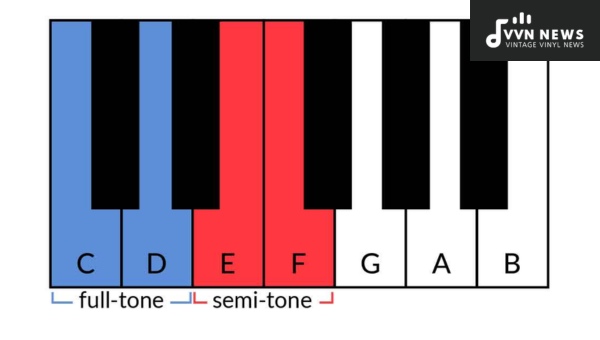
A tone, also known as a whole step, spans the distance between two pitches with another pitch in between.
For example, from C to D on a piano, there’s a black key (C# or Db) nestled in the middle. This leap is what we identify as a whole tone.
In contrast, a semitone is the immediate step from one pitch to the adjacent one with no intervening notes—think C to C# or E to F on your keyboard.
This is also referred to as a half-step. Semitones are crucial as they define the chromatic scale—a central sequence of twelve pitches within an octave.
Encompassing both types of intervals are scales. A major scale pattern, for instance, follows a specific formula: tone, tone, semitone, tone, tone, tone, semitone (T-T-S-T-T-T-S).
By perceiving how tones and semitones organize themselves within scales and melodies you’ll encounter a fundamental aspect of musical structure—essential for crafting harmonious compositions and insightful interpretations.
Also Read: Types Of Electric Guitars 2026 [Solid, Hollow & Semi-Hollow]
How Do Tones and Semitones Contribute to Musical Scales?

Musical scales are the cornerstone of melody and harmony in music. Tones and semitones are pivotal in constructing these scales, which serve as a framework for composers and musicians to create tunes that resonate emotionally with listeners.
The Building Blocks of Scales
Scales consist of a sequence of pitches in ascending or descending order.
The distance between these pitches is measured in tones (whole steps) and semitones (half steps). A full tone is equivalent to two semitones.
Major Scale Composition
Consider the C Major Scale, which follows a specific pattern: tone, tone, semitone, tone, tone, tone, semitone. Starting with C:
- From C to D is a whole tone
- From D to E also spans a whole tone
- Then E to F is just half a step, creating the first semitone interval
This series continues up the scale creating a familiar sound characterized by its particular sequence of tones and semitones.
Impact on Musical Mood
The placement of these intervals within a scale affects the overall mood of the music.
For instance, major scales tend to evoke brightness and joy due in part to their specific arrangement of tones and semitones; whereas minor scales include different positioning that often results in melancholic or somber tones perceived by the listener.
By manipulating intervals within scales, composers wield powerful control over emotional impact.
It’s through this mastery of musical building blocks that powerful connections between sound and feeling are forged.
The Difference Between a Tone and a Semitone
In the realm of music, two small but mighty intervals interplay to create the vast expanse of melodies and harmonies we hear: the tone and the semitone.
These are the smallest steps in Western music, but they hold significant power in crafting a musical language.
Tone
A tone, also known as a whole step, consists of two semitones. Visually on a piano, a tone spans over one key to another with one key in between—be it black or white.
For example, from C to D or from E to F#. In terms of frequency, each note is vibrating twice as fast for an upper octave.
Within that span, when you move from one note to another exactly halfway through that frequency change, you’ve moved by a tone.
Semitone
A semitone, or half-step, is the smallest interval used. On a piano keyboard, this is from one key directly to its neighbor with no keys in between.
This can be either white to black (C to C#), black to white (E♭ to E), or even white to white if there’s no black key between them (E to F).
The distinction between these two intervals is crucial musically and mathematically.
Musically because it affects melody and harmony; playing two notes together that are a semitone apart will produce a dissonant sound when compared with the consonance of playing notes a tone apart.
Also Read: G Flat Minor Pentatonic Scale [Interesting Tones For Your Music]
Different Types of Semitones

When you start exploring musical intervals, semitones make up the smallest step you’ll encounter on the Western chromatic scale.
There are two distinct varieties: chromatic semitones and diatonic semitones.
Chromatic Semitones
A chromatic semitone occurs when two notes are a half-step apart but share the same letter name, indicating that they’re variants of a single note.
This is achieved through alteration with sharps or flats. An example is C to C♯ (or D♭) – though acoustically identical, they’re written differently based on the musical context (known as enharmonic equivalents).
Diatonic Semitone
On the other hand, a diatonic semitone involves two notes with adjacent letter names and different pitches without alteration.
These can be seen from E to F or B to C in which no black piano keys are between them.
Think of it this way: they are ‘naturally’ occurring within the scale structure without any need for enhancement.
Familiarity with these intervals allows musicians to navigate and craft melodies with an intricate understanding of pitch relationships.
The subtleties between these semitones construct harmonic textures that can render music delicate, intense, or suspenseful.
How to Label Intervals with Tones and Semitones
Music theory can seem like an intricate web, but the ability to label intervals using tones (whole steps) and semitones (half steps) simplifies the process of recognizing and building scales.
Here’s how to navigate this fundamental aspect:
- Degrees of Scale: Each interval is determined by its position within a scale. Musicians typically use numbers to label these degrees, relative to the root note.
- Naming Intervals: A second, third, fourth, etc., represents the interval between the root and another scale degree. The type (e.g., major, minor, perfect) of these intervals depends on the number of tones and semitones between notes.
- Tones & Semitones Count: The stepwise progression from one note to another defines an interval.
- Major second: 1 tone
- Minor second: 1 semitone
- Using Interval Qualities:
- Unison and Octaves are considered perfect.
- Seconds, thirds, sixths, and sevenths can be major or minor depending on the presence of a tone or semitone.
- Sharps & Flats Impact: Accidentals alter the pitch slightly—by a semitone—thereby changing the quality of an interval.
Consistent practice in labeling these intervals will eventually make recognition instantaneous.
When reading music, analyzing chord progressions, or composing, this skill proves indispensable for musicians across all levels.
Also Read: How Does A Guitar Tone Knob Work? 2026 [Practical Guide]
How Enharmonic Equivalent Notes are Used in Semitones

Enharmonic equivalents are pairs of notes that sound identical but are written differently. For example, C♯ and D♭.
Although they resonate at the same pitch on a piano, their notation differs depending on the musical context or key.
In terms of semitones, enharmonic equivalents demonstrate how a single semitone can be represented in more than one way.
Consequently, when you shift one semitone up from C natural, you reach C♯; however, the same key on a keyboard can be notated as D♭ if descending a semitone from D natural.
This highlights how enharmonic equivalents factor into composers’ choices for scales or melodies.
Musicians leverage these alternatives to simplify notation or transition smoothly between keys. For instance:
- Compositional Clarity: Maintaining an aesthetically cleaner score avoiding unnecessary accidentals.
- Modulation: Assisting in smoother key changes by employing enharmonically equivalent notes that fit better with the new key signature.
Despite sharing pitches, their usage is solely reliant on their role within the piece’s overarching structure and harmony.
Enharmonic Equivalent Notes in Semitones
Enharmonic equivalents are distinct notes that sound identical but are written differently. For instance, the note C sharp (C#) sounds the same as D flat (Db).
These notes are said to be enharmonically equivalent because they occupy the same pitch, despite their different names and notation.
In terms of semitones, enharmonic equivalents demonstrate how a single semitone can bridge two seemingly different notes. Here’s an example:
- C to C#: Ascending a semitone
- D to Db: Descending a semitone
The distance between these pairs is identical; they both represent a semitone shift.
Enharmonic equivalents are particularly useful in musical contexts requiring modulation or when employing different scales that necessitate seamless transitions between keys.
Moreover, on instruments like the piano, where one key can serve multiple note names, understanding enharmonic equivalents becomes crucial for interpreting music accurately and performing it with the intended harmonic flavor.
Also Read: 17 Best Delay Pedals For Heavenly Echo Tones
FAQ: Understanding Tones and Semitones in Music
What is a semitone on a piano?
A semitone on a piano is the distance between two adjacent keys, whether they’re two white keys with no black key between them, or a white key and an adjacent black key.
Can a tone be made up of two semitones?
Yes, in music theory, a tone is equivalent to two semitones combined.
Are whole steps and tones the same thing?
Absolutely, in musical terminology, whole steps are synonymous with tones.
How do you identify tones and semitones in a scale?
Examine the distance between notes: one fret or key step on your instrument typically equals one semitone; two steps equal one tone.
Do all musical scales use tones and semitones?
While most conventional Western scales like major and minor involve patterns of tones and semitones, there are scales in other musical traditions that might use different intervals.
Conclusion
Tones and semitones form the bedrock of musical structure, enabling composers and musicians to weave intricate tapestries of sound.
Whether you’re creating your own music or deepening your understanding as a listener, recognizing these intervals is crucial.
They are the stepping stones that can elevate your musical journey, providing a clearer path through the enchanting world of sound.
By mastering these concepts, you can unlock new levels of expression and appreciation in the music that surrounds you.