
When it comes to building a solid foundation in music theory, mastering the B Major Triad is essential.
This fundamental musical structure is integral to understanding, playing, and composing virtually all types of Western music.
Incorporating the B Major Triad into your repertoire opens up new avenues of musical exploration. It’s like uncovering a secret language in your keyboard or fretboard.
The ability to identify, structure, and create melodies based on this triad can truly elevate your musical skills. So, let’s set out on this journey of discovery together.
Table of Contents
Explain the B Major Triad.
The B Major Triad is a simple yet powerful chord that embodies the essence of harmony in music. Three notes form this pleasing sound structure: B (the root), D# (the major third), and F# (the perfect fifth).
Significantly, the magic lies in these harmonious intervals. The triad forms when we stack the major third on top of the root, followed by a minor third to the fifth.
It’s as if you’re climbing a beautiful musical ladder from root to major third, then perfect fifth. The B Major Triad, itself, resonates with an unequivocal joyous sound that can add an instant zest to any piece of music.
How is the B Major Triad constructed?

The B Major Triad comprises three core notes: the root (B), the major third (D#), and the perfect fifth (F#).
This triad is generated from these keynotes using a simple method based on whole steps and half steps, connecting fundamental principles of music theory.
Identify the Root
The initial stage in building any triad is first to determine your root note or base. For our B Major Triad, this would naturally be B.
Discovering the Major Third
A major third interval in music theory incorporates four half steps. Count four half steps up from our root note of B, and we find ourselves reaching note D#. This becomes the second crucial ingredient in our triad.
Recognize the Perfect Fifth
Similarly, arriving at the perfect fifth entails traveling seven half steps forward from B. Reflecting upon your instrument, your journey should lead you to F#, finalizing your trio of notes.
It’s important to remember that while this exercise outlines how to form a B Major Triad, this technique can be applied universally to construct other major triads as well.
Persistently practicing and mastering these rudimentary constructs bolsters proficiency and inspires a deeper correlation with all elements of music composition.
Also Read: 20 Best Compressor Pedals In 2026 [Achieve Tone Control Mastery]
What are the primary triads in B Major?
The primary triads in any key are the I, IV, and V chords. In B Major, these are the B Major (I), E Major (IV), and F# Major (V) chords. Here’s a quick breakdown:
- B Major (I): This is composed of the notes B – D# – F#. B is the root note, also known as the 1st degree. It sets the foundation for your triad.
- E Major (IV): Constructed from E – G# – B. This chord’s root note E is the 4th degree of the B major scale.
- F# Major (V): Comprising of F# – A# – C#. The root note here, F#, is positioned as the 5th degree in B major scale.
To further ease your journey into playing these chords, you might find it beneficial to visualize them on a piano keyboard or guitar fretboard.
You’ll notice that their shapes differ on different instruments due to distinct string tuning and keyboard geometry.
In music theory, being aware of these essential triads opens up possibilities to delve into more complex structures like 7th chords and extended chords.
How do you play the B Major Triad on a piano and guitar?

The illustrious sounds of the B Major Triad can, indeed, be expressed beautifully on both piano and guitar. Therefore, let’s delve into the specifics of unraveling this triad on both instruments.
Playing the B Major Triad on Piano
The B Major Triad, like all major triads, is made up of the root note (B), the major third (D#), and the perfect fifth (F#).
To play it on a piano, you follow these steps:
- First, locate the B note on your keyboard. This is usually the 7th white key from the left of your keyboard or piano.
- Next, you count four half-steps to the right of B to find D#. Each half-step corresponds to moving one key to the right, whether that key is black or white.
- Finally, starting from D#, count three half-steps further to locate F#.
Voila! You’ve successfully played a B Major Triad on your piano. With time and practice, recognizing and playing these notes will become second nature.
Also Read: 20 Best Eq Pedals For Perfect Tone [Shape Your Guitar Sound]
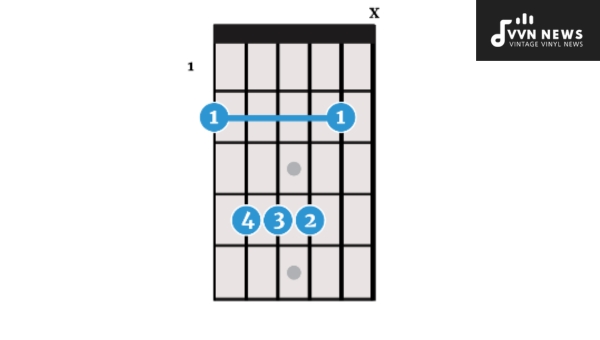
Strumming the B Major Triad on Guitar
Now for those of us more comfortable with six strings than 88 keys: how do we go about mastering this triad on a guitar?
Here’s a beginner-friendly way to play a B Major:
- Your first step is location again – in this case, finding where to place your fingers. Start by putting your index finger on the second fret of A (5th) string – that’s our root note, B.
- Next comes our major third. Press down with your middle finger on D# which is located at the fourth fret of the B (2nd) string.
- Finally – you guessed it – it’s time for our perfect fifth: F#. This is found at the fourth fret of the D string.
You may have realized that playing a triad isn’t simply about hammering out notes one after another – it’s all in how these sounds blend to form something greater than their parts.
It’s all in rhythm and harmony; tell yourself as it will help in your journey to mastering the B Major Triad.
What are the different inversions of the B Major Triad?
Before diving into the specifics, we must grasp what an inversion is. An inversion simply refers to rearranging the order of notes in a chord. In our case, for the B Major Triad, the notes are B, D#, and F#.
The Root Position
In its most basic form or root position, this triad starts with B at the bottom (or as the “root”), followed by D# (the third), and ending with F# (the fifth).
This is often depicted as B-D#-F#. For a first-time player or someone still getting their bearings in playing chords, this is the most straightforward position to grasp.
Also Read: 24 Best Chorus Pedals In 2026 [Deliver A Rich & Wide Guitar Sound]
First Inversion
The first inversion involves shifting the root note (B) up an octave. Hence, in place of having our usual B-D#-F#, we now have D#-F#-B.
Even though we have altered this original arrangement, it remains a B Major Triad since it comprises the same notes. However, it just feels different when played due to this modification in arrangement.
Second Inversion
Similarly, during a second inversion of this triad, we take our ‘third note’ – D#, and move it up an octave resulting in F#-B-D#.
Just like with our first inversion, despite modifying our note arrangement again, it still qualifies as a B Major Triad because we still have those original notes.
How can you play these inversions on the piano?
As we continue our deep dive into the B Major Triad, let’s switch gears and learn how you can play these inversions on a keyboard. Remember, practicing regularly is key to mastering these techniques.
Root Position: B-D#-F
For the root position of the B Major Triad on a piano:
- Place your thumb (1st finger) on B.
- Your middle finger (3rd finger) goes on D#.
- Lastly, place your pinky (5th finger) on F#.
This is your starting point—the very first bluesy note in this jazzy ensemble!
First Inversion: D#-F#-B
For the first inversion:
- Start by placing your thumb (1st finger) on D#.
- Your index finger (2nd finger) should then be set on F#.
- Then comes the ring finger (4th finger), placed firmly on B.
Interesting tip: This inversion could feel a little “cramped” due to the black keys’ positioning. Don’t fret! It gets easier over time.
Second Inversion: F#-B-D
And for our last stop, second inversion:
- The thumb (1st finger) goes to F#.
- The Middle Finger (3rd Finger) should press down on the B key.
- Pinky (5th Finger), will find its place softly at D#.
How can you play these inversions on the guitar?
Compared to the piano, playing inversions of a triad like B Major can feel more complex due to the guitar’s physical setup with six strings spread across a spacious fretboard.
Root Position: B-D#-F
Your starting point will look something like this:
- 7th fret (low E string) – Your index finger
- 9th fret (A string) – Your ring finger
- 9th fret (D string) – Your pinky finger
First Inversion: D#-F#-B
A common fingering for this would be:
- 6th fret (A string) – Index finger
- 9th fret (D string) – Ring or pinky finger
- 8th fret (G string) – Middle finger
Second Inversion: F#-B-D
The placement of your fingers might feel a bit challenging for this one:
- 9th fret (A string) – Index finger
- 9th fret (D ) – Middle finger
- 8th fret (G string) – Ring Finger
Whether you’re delving into piano or guitar, remember, that mastering the B Major Triad doesn’t happen instantly.
But with patience and consistent practice, the sonic beauty of this triad will start to unfold before you.
Also Read: 32 Best Guitar Synth Pedals [Upgrade Your Guitar Effects]
Popular Songs and the B Major Triad

The influence of the B Major Triad extends far beyond just classical compositions and orchestras. Regardless of the genre – pop, rock, jazz, or country – you will spot a B Major Triad.
Owing to its rich, uplifting sound, it’s a prevalent chord in myriad popular songs.
Lenny Kravitz’s “Fly Away”
One notable example of a song that heavily utilizes the B Major Triad is “Fly Away” by Lenny Kravitz.
This catchy 90s hit opens up with a classic riff that swings back and forth between E Major and the B Major triad.
Although simple in structure it creates an infectious rhythm which sets the tone for this rock classic.
The Beatles’ “Hey Jude”
Few bands have impacted popular music as profoundly as The Beatles. An intricate dissection of their song “Hey Jude” reveals the creative usage of our triadic friend.
In Paul McCartney’s original piano part, his left hand frequently alternates between F# (the fifth) and D# (the third) – two-thirds of our beloved triad.
Taylor Swift’s “Love Story”
Even contemporary pop music often employs this triad. Taylor Swift’s mega-hit, “Love Story,” prominently features B Major in its chord progression.
This usage sets up an emotional high point during the song’s refrain, attesting to the chord’s versatility.
Whether you’re reinterpreting these well-known hits or composing your masterpiece, mastering this tricolor friend can turn out to be quite useful indeed.
FAQs About the B Major Triad
How are the notes of the B Major Triad identified?
The notes of a B Major Triad are B, D#, F#. It consists of the root note (B), the major third (D#), and perfect fifth (F#).
Why do I need to practice different inversions of the B Major Triad?
Practicing different inversions of the B Major Triad can offer you more flexibility when playing melodies and might enable smoother musical transitions.
What is an octave about triads?
An octave refers to eight notes up or down from a particular note. Changing an octave in a triad involves shifting one note up or down by this eight-note distance.
How is a B Major Chord different from a B Major Triad?
Though often used interchangeably, a chord may consist of more than three notes, while a triad specifically includes three notes. Since a B Major Chord also includes only the pitches B, D#, and F#, it’s technically also considered a type of triad.
What’s the relevance of knowing about triads for composing music?
Understanding triads helps with creating well-balanced melodies and harmonies in composing music because it forms basic building blocks for more complex chord structures.
Conclusion
Mastering the B Major Triad can be instrumental in progressing your skills as a musician, whether you’re playing the guitar or piano.
Familiarizing yourself with its structure and the concept of inversions can bring a new depth and nuance to your playing. Most importantly, it’s about honing your craft little by little, every day.
Be patient, keep practicing, and stay passionate. Always remember that music is a voyage, and each chord learned is another beautiful destination discovered along the journey. You’ve got this!