
Music, in its broad spectrum, has something for everyone. One such melody that strikes a balance between soothing and stirring is the G sharp major triad.
This harmony holds a unique place in the music universe, becoming an essential tool for every music enthusiast, whether composers or performers.
The intricacy of mastering this tone might seem a bit overwhelming at first. But worry not! I’m here to break down everything you need to know about the G sharp major triad.
So, whether you’re looking to elevate your knowledge or you’re seeking to implement this triad into your compositions, I’ve got you covered.
Table of Contents
Explain The G Sharp Major Triad
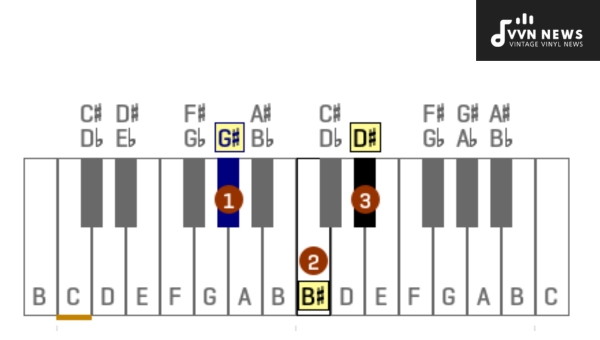
The G Sharp Major Triad is a three-note chord made up of the notes G#, B#, and D#. It is formed by taking the 1st, 3rd, and 5th notes of the G# Major scale.
- The G# Major scale consists of the following seven notes: G#, A#, B#, C#, D#, E#, and F#.
- To build the triad, start with the first note (G#) as the root, add the third note (B#), and then add the fifth note (D#).
- The distance between each note in the triad is measured in intervals. In this case, there is a major third interval between G# and B#, and a minor third interval between B# and D#.
- The structure of a major triad follows a specific pattern: root, major third, and perfect fifth.
The construction of the G Sharp Major Triad is crucial for musicians who want to compose or play music.
This chord serves as a foundation in various musical genres like jazz, pop, rock, and classical music. It evokes feelings of brightness, energy, and joy when used in compositions.
Also Read: C Sharp Minor Pentatonic Scale [Add Color To Your Solos & Riffs]
How Do You Build a G Sharp Major Triad?

Building a G sharp major triad is a relatively easy process if you understand the basics of music theory. Here’s how you do it:
Understand the Major Scale
A major scale, such as the G sharp major scale, is made up of seven distinct notes. The key to building a triad lies in these seven notes. The G sharp major scale consists of the following notes: G#, A#, C, C#, D#, F, and G.
Identify the Root Note
The root note in our case is, unsurprisingly, G#. This will serve as our starting point for constructing the triad.
Find the Third and Fifth Notes
The beauty of a triad lies in its simplicity – it just involves three notes: the root note, its third note, and the fifth note from the scale. Counting from G# (0), D# would be third(3) and B# would be fifth(5).
You have built your G sharp major triad – G#, B#, and D#. This pattern holds for any major scale. Find your root, then add its third and fifth intervals from your scale to complete your triad.
Whether you’re working with guitar strings or piano keys, these steps guide you towards forming that melodious sound that a perfectly strummed or pressed G Sharp Major Triad brings.
Why is the G Sharp Major Triad Significant in Composition?
The G Sharp Major Triad holds immense significance in composition across various musical genres. Here are some reasons why it plays a crucial role for composers:
- Tonal Center: The G Sharp Major Triad serves as the tonic chord of the G# Major scale, making it a cornerstone of composition in that key. It provides a sense of stability and resolution, anchoring the listener’s ear to a specific tonal center.
- Harmonic Function: In functional harmony, the G Sharp Major Triad often functions as a major tonic chord, establishing and reinforcing the tonality of G# Major within a composition. It contributes to creating a cohesive and coherent musical structure.
- Chord Progressions: The A#/G♯ Major chord progression is commonly found in popular songs across different genres. Composers use this triad to create harmonic movement and build tension and release within their compositions.
- Rich Timbre: The combination of G#, B#, and D# creates a rich, vibrant timbre that can add depth and color to a musical piece. Composers can utilize this bold sound to evoke specific emotions or enhance certain sections of their compositions.
- Modal Interchange: The G Sharp Major Triad can be borrowed from related keys to introduce new harmonic flavors or modal interchange techniques. This adds complexity and interest to the tonal palette available to composers.
- Melodic Development: By incorporating the G Sharp Major Triad into melodic lines or motifs, composers can develop memorable themes in compositions. This offers opportunities for improvisation, variation, and innovation within the framework of their musical works.
- Transposition: The versatility of the G Sharp Major Triad allows composers to transpose it into different keys, providing flexibility when crafting melodies and harmonies across various musical contexts.
The significance of the G Sharp Major Triad in composition is that musicians and composers can effectively incorporate this chord progression.
Also Read: F Sharp Major Scale [Add Unique Tones To Your Musical Palette]
How Can You Play the G Sharp Major Triad on Various Instruments?

Playing the G Sharp Major Triad on different instruments requires understanding the specific fingerings and positions unique to each instrument.
Here’s a breakdown of how you can play the G Sharp Major Triad on some common instruments:
Piano/Keyboard:
On a piano or keyboard, you can easily play the G Sharp Major Triad using three adjacent white keys and one black key:
- Place your right hand in the middle of the keyboard.
- Position your thumb (1st finger) on G#.
- Place your middle finger (3rd finger) on B#.
- Use your pinky finger (5th finger) to play D#.
Guitar:
On a guitar, you have several options for playing the G Sharp Major Triad across different positions and voicings. Here’s a simple way to play it in an open position:
- Place your index finger (1st finger) on the 4th fret of the low E string to fret G#.
- Use your ring finger (3rd finger) to press down the 6th fret of the A string for B#.
- Finally, bar your index finger across the top three strings at the 4th fret to play D#.
Ukulele:
The ukulele is tuned similarly to a guitar but with different notes. To play the G Sharp Major Triad on a ukulele:
- Position your ring finger (3rd finger) on the 4th fret of the top A string to fret G#.
- Use your middle finger (2nd finger) to press down B#, also on the 4th fret, but this time on the E string.
- Lastly, place your pinky finger (4th finger) on D#, which is located two frets higher at the 6th fret of the C string.
These fingerings are just a starting point. Experiment with different positions and voicings to find what works best for your playing style and musical needs.
By practicing these fingerings and exploring other variations, you’ll become more comfortable playing the G Sharp Major Triad on your instrument of choice.
Also Read: F Sharp Major Chords [Boost Your Guitar Skills Today]
Chord Progressions in the G Sharp Major Triad
Chord progressions are a series of chords played in a specific sequence that form the backbone of a song.
They provide a sense of movement and stability within the music. In the context of the G Sharp Major Triad, chord progressions can greatly enhance your ability to compose and play music.
Common Chord Progressions
- I-IV-V: This is one of the most popular chord progressions in music. In the key of G# major, it would consist of G# (I), C# (IV), and D# (V).
- vi-ii-V-I: Another widely used progression is vi-ii-V-I. In the key of G# major, it would be E# minor (vi), A# minor (ii), D# (V), and G# (I).
Secondary Dominant Chords
- V/vi: The dominant chord built on the 5th note of the vi chord acts as a secondary dominant. In G# major, this would be D#7, resolving to E# minor.
- V/iii: Similarly, the dominant chord built on the 5th note of iii serves as a secondary dominant. For example, Fx7 resolves to A# minor.
Modal Interchange
Modal interchange involves borrowing chords from parallel scales or modes. Here are some common modal interchange chords about G Sharp Major:
- bIII: B major borrowed from G# minor.
- bVI: E major borrowed from G# minor.
Suspended Chords
Suspended chords can also be incorporated into your chord progressions to add texture and tension. Some suspended chords that work well with G Sharp Major include:
- Gsus2: G#, A#, D#
- Gsus4: G#, C#, D#
Experimenting with different chord progressions within the G Sharp Major Triad will lead to unique musical expressions.
Also Read: A Sharp Diminished Triad [Discover This Unique Chord]
What Are the Inversions of the G Sharp Major Triad?

In music theory, an inversion refers to rearranging the order of the notes in a chord. The G Sharp Major Triad has three possible inversions: the first inversion, the second inversion, and the root position.
- Root Position: The root position is when the root note (G#) is at the bottom of the chord, followed by the major third (B#), and then the perfect fifth (D#). This is considered the standard or default position for a triad.
- First Inversion: In a first inversion, we take the third note of the triad (B#) and move it up an octave. So, from bottom to top, it becomes B#, D#, G#. The first inversion is denoted by adding a 6/3 after the chord symbol.
- Second Inversion: For a second inversion, we move both the root note (G#) and third note (B#) up an octave. The order from bottom to top will be D#, G#, B#. The second inversion is indicated by adding a 6/4 after the chord symbol.
Inversions allow musicians to create smoother transitions between chords and add variety to their compositions.
Each inversion has a distinct sound and feel that can be used strategically in different musical contexts.
How Do You Utilize the A Sharp Major Triad on Guitar and Piano?
The A Sharp Major Triad is a versatile chord that can be played on both the guitar and piano. Let’s explore how you can utilize this triad on each instrument:
On Guitar:
To play the A Sharp Major Triad on guitar, you will need to position your fingers correctly on the fretboard. Follow these steps:
- Start by locating the root note, A# (also known as Bb), on the guitar. It can be found on the 6th string, 1st fret.
- Place your index finger on the 1st fret of the 5th string (A#).
- Keep your index finger in place and use your middle finger to press down the 3rd fret of the 4th string (C).
- Use your ring finger to hold down the 3rd fret of the 3rd string (F).
Strumming these three strings together will produce a harmonious A Sharp Major Triad sound.
On Piano:
Playing the A Sharp Major Triad on piano involves pressing specific keys with your fingers. Follow these steps:
- Locate the root note, A# (also known as Bb), on the piano keyboard.
- Place your thumb (finger 1) on A#.
- Use your middle finger (finger 3) to press down B#.
- Stretch your little finger (finger 5) to hold down D#.
Pressing these three keys together simultaneously will create an A Sharp Major Triad sound on the piano.
When utilizing this triad, it is important to consider different chord progressions and inversions to add variety and complexity to your playing or composition.
How Can You Identify the G Sharp Major Triad by Ear?

Identifying the G Sharp Major Triad by ear is an essential skill for musicians. It allows you to quickly recognize and play the chord without relying on sheet music or chord charts.
Here are some tips to help you develop your ear training and identify the G Sharp Major Triad:
- Familiarize yourself with the sound: Begin by listening to examples of songs or compositions that feature the G Sharp Major Triad. Pay attention to the overall sound and quality of the chord.
- Isolate each note: Once you’re familiar with the sound, try to isolate each note within the triad. Listen carefully to distinguish between G#, B#, and D#. Mentally focus on each note’s pitch and how it sounds about the others.
- Pay attention to intervals: The intervals between each note in the G Sharp Major Triad are crucial for identification. Familiarize yourself with the specific distance between G# and B# (a major third) and B# and D# (a minor third). Train your ears to recognize these intervals through practice and repetition.
- Sing or hum along Singing or humming along with a piece of music that contains the G Sharp Major Triad will help internalize its sound. Mimic each note as accurately as possible, focusing on pitch, tone, and interval relationships.
- Practice chord progressions: Work on recognizing how the G Sharp Major Triad fits into different chord progressions. Train your ears to pick out this specific triad when it occurs in a song.
- Use reference songs: Try listening to popular songs that prominently feature the G Sharp Major Triad, such as “Stairway to Heaven” by Led Zeppelin or “All You Need Is Love” by The Beatles.
- Ear training exercises: There are various ear training exercises available online or through apps that can help improve your ability to identify chords by ear. Utilize these tools regularly to sharpen your skills.
Consistent practice and exposure to the G Sharp Major Triad will enhance your ability to identify it by ear.
Develop your skills gradually, and over time you will be able to recognize this chord effortlessly in any musical context.
Also Read: G Sharp Diminished Triad [Explore Unique Guitar Chords]
FAQs about the G Sharp Major Triad
How do I play the G Sharp Major Triad on guitar?
To play the G Sharp Major Triad on guitar, place your index finger on the 4th fret of the low E string (G#), your middle finger on the 5th fret of the A string (B#), and your ring finger on the 6th fret of the D string (D#).
What are the inversions of the G Sharp Major Triad?
The inversions of the G Sharp Major Triad are B#-D#-G#, D#-G#-B#, and G#-B#-D#. In each inversion, different notes are used as the bass notes while maintaining the same three-note structure.
How can I identify the G Sharp Major Triad by ear?
By training your ear to recognize major chords, you can identify a G Sharp Major Triad by listening for its bright and uplifting sound. Practice listening to chord progressions and focusing specifically on major triads.
How does harmonization enhance the G Sharp Major Triad?
Harmonization with complimentary chords or voicings can amplify the richness and depth of a G Sharp Major Triad. Experiment with different harmonization techniques to add complexity and texture to your compositions.
What makes the G Sharp Major Triad significant in composition?
The G Sharp Major Triad is significant in composition because it is versatile, allowing for a range of emotions to be expressed. Its bright sound can bring energy to a composition, while its harmonic stability adds depth and balance.
Conclusion
The G Sharp Major Triad is a powerful chord progression that can elevate your musical compositions and performances.
By understanding its construction and intervals, you can create captivating melodies and harmonies.
Whether you’re a guitarist, pianist, or any other musician, incorporating the G Sharp Major Triad into your repertoire will enhance your musicality and broaden your creative possibilities.
So take this guide as a stepping stone towards mastering the G Sharp Major Triad and unlocking its potential in your musical journey.