
Understanding the intricacies of music theory produces not only a better musician but also a more fulfilled one.
Take, for instance, the E Flat Major Scale, with its divine resonance and inter-connected series of chords.
E flat major scale is a guide to the scales and chords; I’ll take you on an enriching journey to master this major scale and delve into its vast repertoire of chords.
Think of your favorite song. It has likely been constructed using a combination of scales and chords, including perhaps even the E flat major scale.
Grasping the complexities behind these critical elements can immensely improve your musical prowess while offering a newfound appreciation for the art itself.
Are you ready to sharpen your understanding of the captivating world of the E flat Major scale and its vivid array of chords?
Table of Contents
What Constitutes the E Flat Major Scale?
The E Flat Major Scale, wonderfully rich and warm in its tonality, is a sequence consisting of eight notes: E-Flat (Eb), F, G, A-Flat (Ab), B-Flat (Bb), C, D, and finally wrapping back around to E-Flat (Eb).
It’s formed using the general major scale formula of whole and half steps.
Starting from Eb as the root note or first degree, you move up by a whole step to F (second degree), another whole step to G (third degree), a half step to Ab (fourth degree), whole steps to Bb, C, and D (fifth to seventh degrees respectively) with a final half step returns you to Eb.
Take this musical journey and feel the magic! Remember not just to rote learn but embrace the beauty contained in every note.
It’s in experiencing these subtle nuances that you truly begin engaging with music’s heart.
Also Read: A Flat Diminished Triad [Delve Into Rare Guitar Chords]
How to Play the E Flat Major Scale on Piano

Conquering the E Flat Major scale on piano can enrich your repertoire remarkably. Let’s break down the procedure step-by-step.
- Find E Flat on Keyboard: Your first step is to locate E flat (Eb) on the keyboard. It’s the small black key immediately to the left of the white key ‘E’.
- Keys of the Scale: The E flat Major scale involves seven distinctive keys chronologically arranged as follows: Eb-F-G-Ab-Bb-C-D.
- Position of Fingers: Positioning plays a pivotal role while playing any scale on the keyboard, ensuring your hands glide over keys effortlessly. For right-handed beings, initiate with your 2nd finger for Eb, followed by 3rd for F, thumb under to G, and continue right till D with a sequence as 2-3-1-2-3-4-5.
For left-handed folks, start with your 3rd finger followed by a similar pattern of 2nd for F, thumb under to G, and so forth right till D: 3-2-1-4-3-2-1.
Playing E Flat Major Scale on Guitar
When it comes to guitar, maneuvering through scales presents its own set of challenges, but certainly achievable with practice. Here’s how:
- Begin from Lowest Root Note: Identify ‘Eb’ as it’s our lowest root note found at the 6th fret on the A string (5th string).
- Notes in Sequence: Traverse through each note of the scale in sequence: Eb-F-G-Ab-Bb-C-D-Eb.
- Finger Placement: Proper finger placement directs smooth transitions between notes:
- For low Eb (6th fret), use Index Finger (I)
- For F (8th fret), use Ring Finger (R)
- For G (10th fret), use Pinky Finger (P)
- Move to the next string, start with Eb at the 6th fret using the Index finger
- Proceed in the same fashion for all notes.
Consistency is key in mastering the E flat Major Scale on piano and guitar. So keep practicing.
Also Read: A Flat Minor Triad [Guide to Unusual Guitar Chords]
The Tonal Degrees of the E Flat Major Scale

E Flat Major is a unique scale, with each note having its degree or position.
This system of degree annotation allows us to identify and communicate about each note uniquely within the context of music theory. Let’s deep dive into the subject.
E Flat Major Scale Degrees
The E Flat Major scale has a total of seven distinct degrees, which are as follows:
- First Degree: The first degree is also known as the Tonic, and in this case, it is E Flat (Eb).
- Second Degree: Following the Eb, the second degree or Supertonic is F.
- Third Degree: Known as the Mediant, this is G in the E flat major scale.
- Fourth Degree: Also called Subdominant, this corresponds to Ab.
- Fifth Degree: This level gets termed Dominant, it’s Bb for our scale.
- Sixth Degree: The Submediant in E flat major scale corresponds to C.
- Seventh Degree: Finally we have D as the Leading Tone.
Each of these tones contributes significantly to melodies created in the E flat major scale; they may stand alone or harmonize together to create rich musical pieces.
Embrace these scales and chords to unlock one’s potential for music creation and performance!
They are fundamental parts of understanding music theory that provides endless musical growth opportunities.
How is the Key Signature of the E Flat Major Scale Determined?
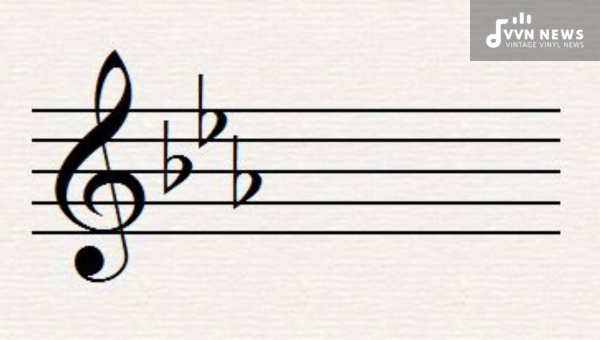
The key signature of the E Flat Major Scale revolves around three distinct flats: E Flat (Eb), A Flat (Ab), and B Flat (Bb).
These three flat notes lay down the framework upon which this intriguing key scale is constructed.
The Flat Notes
- E Flat (Eb): The first note in this scale and its root.
- A Flat (Ab): This is a defining note for our scale and makes it distinct from others.
- B Flat (Bb): The last flat note in our mix, adds to the characteristic sound of this scale.
Remember that these notes are not random placements. They follow a certain systemic pattern that helps us identify the key signature swiftly.
Circle Of Fifths
An easy method to determine the E flat major’s key signature involves resorting to an essential music theory tool known as the Circle of Fifths.
In this circle, E flat major resides three places counterclockwise from C. Hence, it signifies three flats in its key signature.
Mastering this trio of flats along with a useful grip on the Circle Of Fifths can successfully help get your bearings about the distinctive key signature of E flat Major Scale.
Also Read: G Flat Minor Triad [Mastering Complex Guitar Chords]
How Does the E Flat Major Scale Appear in Different Clefs?

The E flat Major Scale is a beautiful scale that resonates differently in various clefs.
To develop total fluency on your instrument, you need to get familiar with how this scale maps out on the treble, bass, alto, and tenor clefs.
Treble Clef
Those using a treble clef will find the key signature for this scale incorporates three flats: B, E, and A.
It begins on the E flat note located just above middle C when reading from the treble clef.
Starting from this E flat note, continue up the staff line until you reach another E flat note. You’ve now successfully navigated through an octave of the E Flat Major Scale.
Bass Clef
For musicians referring to a bass clef, it’s similar – the key signature includes three flats: B, E, and A.
However, when it comes to playing this scale on bass-clef instruments like trombones or tubas, you should start at the E flat note, two lines above middle C, and continue along until reaching an octave higher.
Alto Clef
On an alto clef – predominantly used by viola players – the play starts from the same three flats (Bb Eb Ab).
You commence with E flat, found as the third space from top to bottom. From here journey upwards till the next higher E flat, signaling your one-octave passage through all nodes of this tuneful scale.
Tenor Clef
Lastly for those using a tenor clef – mainly utilized by cellists and trombonists – all stay consistent: three flats (Bb Eb Ab) are at play here forming its key signature.
Start at E-flat appearing as a second line from the top counting downwards to reach another E flat on space above the topmost line, thereby attaining an elegant octave walk-through.
No matter the clef, each execution of the E flat Major Scale loop adds a fresh dimension to your playing style and overall music connoisseurship.
Reading and playing scales accurately across different clefs is an essential exercise for advancing your musical workmanship.
In the realm of music theory, each major key is associated with a relative minor.
The two share the same key signature and are intrinsically linked on the circle of fifths.
Although they are inherently different in mood and feeling, they contain the same notes.
Exploring the Relative Minor
The relative minor scale of a major scale begins on its sixth degree. In music, this critical feature brings an array of possibilities.
For example, if you commence the E Flat Major scale from its sixth note, you encounter C minor. Happily, C minor is indeed the relative minor scale for E Flat Major.
Key Attributes
C Minor, as one hereby infers, shares the very same set of notes as E flat Major.
Yet despite employing identical elements, their melodies evoke a glaringly distinct feel or temperament that enriches one’s musical sensibility.
Delving into chords
Since both scales possess similar notes, their basic chords (triads and seventh chords) happen to originate from these shared points too.
Delving deeper into triads and sevenths illustrates how such a connection adds texture to your music through appropriate chord choices from either platform.
C minor represents your key to understanding the relative minor of E flat major. It thus lets you explore new melodic terrains while cementing your prowess in music theory further.
Also Read: E Flat Minor Pentatonic Scale [Master This Key With Our Guide]
Chords in the E Flat Major Scale

The E Flat Major Scale opens the door to a wide array of beautiful chords, each carrying its unique resonance and harmonic interplay.
The chords embedded within this scale are fundamental building blocks for melodies across multiple genres of music.
Primary Triads (Chords) in E Flat Major
Triads, constructed with three notes, play host to incredible harmonic depth. The primary triads in the E flat major scale include:
- E Flat Major: Formed with Eb-G-Bb notes, the E Flat Major is the home chord of this scale.
- F Minor: This is a pensive and reflective chord comprising F-Ab-C.
- G Minor: Consisting of G-Bb-D, this chord communicates an air of somberness.
- Ab Major: Comprising Ab-C-Eb, it’s a warm and balanced chord.
- Bb Major: Bearers of joy and optimism, this chord is formed with Bb-D-F.
- C minor: An emotive powerhouse carrying an essence of melancholy, C-Eb-G forms this chord.
- D Diminished: This ‘odd one out’ amongst major scales comprises D-F-Ab.
It would be best if you had gained some valuable insights into the chords within E flat major after reading this segment.
FAQs About the E Flat Major Scale
What is the E Flat Major Scale?
E Flat Major Scale is a series of notes in music starting with E flat (Eb), following a specific sequence of whole and half steps.
How many sharps are in the E Flat Major Scale?
The E Flat Major Scale doesn’t contain any sharps. Instead, it has three flats: Eb, Ab, and Bb.
What is the structure of an E flat Major Chord?
An E flat Major Chord typically consists of three notes: Eb (root note), G (major third), and Bb (perfect fifth).
How do you identify an E flat Major chord on sheet music?
An E flat Major chord on sheet music can be identified by its key signature which contains three flats: Bb, Eb, and Ab.
What is the relative minor of the E Flat major scale?
The relative minor of the E Flat major scale is the C minor scale.
Conclusion
Knowledge of scales and chords significantly enhances your musical abilities, deepens your appreciation for the art, and broadens your creative horizons.
As we’ve outlined, the E Flat Major Scale is not only harmonious but also offers a lot of versatility.
With this newfound information in bold, including italicized pointers, manifesting the versatile E Flat Major Scale’s potential into your favorite tracks should be easier than ever before.
Embrace its chords and let its notes guide the melody of your musical journey, enriching each tune with soulful resonance.