
Welcome to my blog post, A Guide On F Sharp Diminished Triad. Today, we will be exploring the fascinating world of music theory as we delve into the intricacies of the F Sharp Diminished Triad.
This diminutive yet powerful chord has a unique character that sets it apart from other chords, making it a valuable addition to any musician’s repertoire.
I will provide a comprehensive overview of the F Sharp Diminished Triad, breaking down its structure and discussing its various applications. So grab your instrument, and let’s dive right in.
Before we begin exploring the nuances of the F Sharp Diminished Triad, it’s important to understand its fundamental components.
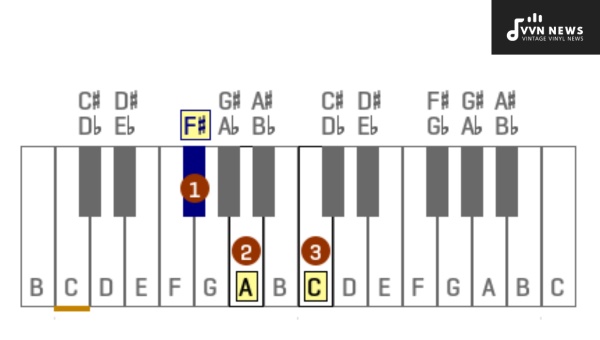
The triad is built upon three notes: the root note (F#), the minor third (A), and the diminished fifth (C).
When combined together, these notes create a distinctively dissonant sound that can add tension and suspense to your musical compositions.
While this chord may seem complex at first glance, with some practice and guidance, you can master its unique melodic potential.
Throughout this guide, I will demystify the F Sharp Diminished Triad and provide useful tips on how to incorporate it effortlessly into your playing.
Table of Contents
What is a Triad in Music Theory?
In music theory, a triad is a three-note chord consisting of a root note, a third interval, and a fifth interval.
Triads are the building blocks of harmony in Western music and form the foundation for many melodies and compositions.
There are four main types of triads: major, minor, augmented, and diminished.
Each triad type has its unique sound and emotional quality. Triads are essential for understanding chord progressions, harmonizing melodies, and creating musical tension and resolution.
By learning about triads and their various forms, musicians can expand their harmonic vocabulary and enhance their musical compositions.
Also Read: G Flat Minor Triad [Mastering Complex Guitar Chords]
How is the F Sharp Diminished Triad Constructed?

The F Sharp Diminished Triad is built upon the root note F#, a minor third interval (A), and a diminished fifth (C). Here’s a breakdown of how it is constructed:
- Root note (F#): The root note serves as the foundation of the chord. In this case, it is F#, which is one semitone above F.
- Minor third (A): The minor third interval consists of three semitones above the root note. In the case of F#, A would be three semitones higher.
- Diminished fifth (C): The diminished fifth interval consists of six semitones above the root note. In this chord, C would be six semitones higher than F#.
Putting it all together, we have the notes F#-A-C, which make up the F Sharp Diminished Triad.
It’s important to note that while this chord may appear dissonant and somewhat tense on its own, it plays a crucial role in harmonic progressions and adds tension that can lead to resolution in music compositions.
Experimenting with various chord progressions and combinations involving the F Sharp Diminished Triad can result in unique and captivating musical moments.
Understanding how chords are constructed gives musicians more control over their compositions and helps them create harmonic interest within their music.
What are the Notations for F Sharp Diminished?
The F Sharp Diminished Triad can be notated in a few different ways, depending on the context and musical notation system being used. Here are three common notations:
- Letter Notation: In the letter notation system, the F Sharp Diminished Triad is written as F#dim or F#°. The letter “F#” represents the root note of the triad, and “dim” or “°” signifies that it is a diminished chord.
- Numeric Notation: In numeric notation, each note of the triad is represented by a number based on its position in the major scale. The F Sharp Diminished Triad can be notated as 1-♭3-♭5 or 1-3♭-5♭. The “1” refers to the root note (F#), the ♭3 represents the minor third (A), and ♭5 stands for the diminished fifth (C).
- Staff Notation: In staff notation, each note of the F Sharp Diminished Triad is represented by a specific position on a musical staff. For example, in treble clef, the notes would be notated as F#, A, and C on different lines or spaces.
These notations provide musicians with different ways to communicate and interpret musical information effectively.
By understanding these notations, you will have an easier time reading and understanding music sheets or communicating with fellow musicians about chord progressions or arrangements involving the F Sharp Diminished Triad.
Also Read: G Minor Triad [Demystify This Common Guitar Chord]
Uses of F Sharp Diminished Triad

The F Sharp Diminished Triad is a versatile chord that can be used in a variety of musical contexts. Its unique sound adds tension and complexity to compositions, making it a favorite among composers and improvisers. Here are some common uses for the F Sharp Diminished Triad:
- Harmonic Function: The F Sharp Diminished Triad can function as a passing chord, connecting two other chords in a progression smoothly. It creates a sense of movement and anticipation, leading the listener to the next chord in an engaging way.
- Diminished Chord Substitution: The F Sharp Diminished Triad can be used as a substitute for other diminished triads or dominant chords. This substitution adds interesting harmonic color and can enhance the overall complexity of the music.
- Chromatic Movement: Incorporating the F Sharp Diminished Triad into your compositions allows for chromatic movement between chords. This creates an interesting melodic contour and adds sophistication to your music.
- Modulation: The diminished triad’s symmetrical structure makes it an excellent tool for modulating to different keys smoothly. By using the F Sharp Diminished Triad, you can explore different tonalities and add depth to your compositions.
- Jazz Improvisation: Jazz musicians often use the diminished scale derived from the F Sharp Diminished Triad for improvisation over dominant chords or altered dominants. This scale choice adds tension, creating room for creative melodic exploration.
- Film Scoring: Composers in film and television often utilize diminished chords to create suspenseful moments or underscore dramatic scenes. Using the F Sharp Diminished Triad allows them to add an element of mystery and intrigue to their compositions.
While these are common uses for the F Sharp Diminished Triad, they are not exhaustive.
Music is subjective and ever-evolving, so feel free to experiment and incorporate this chord in your own unique way.
Whether you’re composing, improvising, or performing, the F Sharp Diminished Triad can be a powerful tool in your musical arsenal.
How to Play the F Sharp Diminished on Various Instruments?
Playing the F Sharp Diminished Triad might seem challenging at first, but with some practice and guidance, you’ll be able to fluently incorporate it into your music. Let’s explore how to play this triad on various instruments.
Piano/Keyboard:
- Locate the root note F# on your keyboard.
- Count four half steps up from F# and press the A key.
- Count another three half steps up from A and press the C key.
- Play these three notes simultaneously (F#, A, C) to achieve the F Sharp Diminished Triad sound.
- Experiment with different inversions of this triad by rearranging the order of the notes (e.g., A-C-F#).
Guitar:
- Place your index finger on the second fret of the low E string (F# note).
- Use your middle finger to press down on the third fret of the B string (A note).
- Lastly, place your ring finger on the second fret of the G string (C note).
- Strum all six strings together for a full-sounding F Sharp Diminished Triad.
- Explore different voicings along other areas of the guitar neck.
Ukulele:
- Position your index finger on the second fret of G string (F# note).
- Press down on the third fret with your middle finger on C string (A note).
- Lastly, place your ring finger on the second fret of E string (C note).
- Strum all four strings from top to bottom for a complete F Sharp Diminished Triad sound.
These instructions provide a starting point, but feel free to experiment with different positions and strumming techniques to find what works best for you.
Also Read: A Flat Minor Triad [Guide to Unusual Guitar Chords]
What are the Inversions of the F Sharp Diminished Triad?

In music theory, an inversion is a rearrangement of the notes in a chord. This allows for different voicings and melodies to be created using the same set of notes. The F Sharp Diminished Triad has three possible inversions: the first inversion, second inversion, and third inversion. Let’s explore each one in detail:
First Inversion
In the first inversion of the F Sharp Diminished Triad, the root note (F#) is moved up an octave. This means that A becomes the new bass note, while C and F# remain unchanged. The first inversion is notated as “F#/A” or “F#m/A”.
Second Inversion
The second inversion of the F Sharp Diminished Triad involves moving both the root note (F#) and the first inverted note (A) up an octave. This results in C becoming the new bass note, while F# and A remain unchanged. The second inversion is notated as “F#/C” or “F#m/C”.
Third Inversion
The third inversion of the F Sharp Diminished Triad requires moving all three notes up an octave. This means that A becomes the highest note, while C and F# become lower notes in relation to it. The third inversion is notated as “F#/A/C” or “F#m/A/C”.
These inversions allows you to create different chord voicings and explore different melodic possibilities within your compositions or arrangements.
How is the F Sharp Diminished Different from Other Triads?
The F Sharp Diminished Triad stands out from other triads due to its unique structure and sonic characteristics. Here are a few key points that distinguish it from other triads:
- Diminished Structure: The F Sharp Diminished Triad consists of the root note (F#), the minor third (A), and the diminished fifth (C). This combination of intervals creates a dissonant and tense sound, adding a distinct flavor to compositions.
- Symmetry: Unlike major and minor triads, which have a symmetrical structure in terms of interval patterns, the diminished triad is symmetrical throughout. This means that each interval between notes is a minor third apart. In the case of F Sharp Diminished Triad, you can also think of it as an inversion of a D sharp diminished triad or an A diminished triad.
- Multiple Names: One interesting aspect of the F Sharp Diminished Triad is that it goes by different names depending on context. It can also be referred to as G Flat Diminished Triad due to enharmonic equivalence, where G flat and F sharp are considered the same pitch.
- Tonal Ambiguity: The dissonance created by the diminished fifth in the F Sharp Diminished Triad gives it a sense of tonal ambiguity. This means that this chord doesn’t have a strong tonal center and can create tension in a musical piece, making it perfect for creating suspenseful moments or resolving to another chord smoothly.
- Harmonic Function: The F Sharp Diminished Triad has various harmonic functions in music theory. It can act as a passing chord, connecting two neighboring chords smoothly. It’s also commonly used as an altered dominant chord within jazz improvisation and has applications in creating chromatic bass lines or harmonizing melodies.
The differences and unique qualities of the F Sharp Diminished Triad open up a world of musical possibilities. By experimenting with its distinct sound and incorporating it effectively into your compositions, you can take your musical creations to exciting new heights.
Also Read: A Flat Diminished Triad [Delve Into Rare Guitar Chords]
What Are Some Famous Songs Featuring the F Sharp Diminished Triad?

The F Sharp Diminished Triad has found its way into many iconic and memorable songs across various genres. Musicians and composers have utilized its unique sound to add tension, excitement, and intrigue to their compositions. Here are some well-known songs that feature the F Sharp Diminished Triad:
- “Lucy in the Sky with Diamonds” by The Beatles: This timeless classic from The Beatles’ Sgt. Pepper’s Lonely Hearts Club Band album incorporates the F Sharp Diminished Triad during the “cellophane flowers of yellow and green” line in the chorus. Its use adds an ethereal and dream-like quality to the song.
- “Smells Like Teen Spirit” by Nirvana: This grunge anthem prominently features the dissonant sound of the F Sharp Diminished Triad in its opening guitar riff. The chord progression creates an intense and explosive atmosphere that defines the rebellious spirit of the song.
- “Best of My Love” by The Eagles: In this soft rock ballad, The Eagles employ subtle harmonic variations throughout, including moments where they incorporate the F Sharp Diminished Triad. These moments add emotional depth and intrigue to an already beautiful composition.
- “Isn’t She Lovely” by Stevie Wonder: This soulful masterpiece showcases Stevie Wonder’s talent as a songwriter and musician. In one section of this track, Stevie plays an arpeggiated sequence that includes the F Sharp Diminished Triad on piano, contributing to its dynamic harmony.
- Classical Compositions: Additionally, various classical pieces, such as Franz Liszt’s “Liebestraum No. 3,” and Gustav Mahler’s Symphony No. 9 also utilize the F Sharp Diminished Triad in different contexts to evoke intense emotions within the listener.
It’s important to note that while these songs feature the F Sharp Diminished Triad, they incorporate it in different ways and musical contexts. This highlights the versatility and adaptability of this chord in various genres.
By listening to and studying these songs, aspiring musicians can gain a deeper understanding of how the F Sharp Diminished Triad can be used expressively and creatively.
Experimenting with this chord in your own compositions can open up a world of possibilities for adding depth, tension, and intrigue to your music. So, don’t be afraid to incorporate this powerful triad into your musical toolbox.
FAQs about F Sharp Diminished Triad
How is the F Sharp Diminished Triad Constructed?
The F# Diminished Triad is constructed using the root note (F#), the minor third (A), and the diminished fifth (C).
What are the Notations for F Sharp Diminished?
The F# Diminished Triad can be notated as F#dim, F#°, or F#o.
What are the Uses of F Sharp Diminished Triad?
The F# Diminished Triad is commonly used as a passing chord to create tension and in chromatic progressions.
How do you play the F Sharp Diminished on Various Instruments?
On instruments like guitar or piano, you can play the F# Diminished Triad by pressing down the root note and adding the minor third and diminished fifth in close proximity.
Conclusion
The F Sharp Diminished Triad is a fascinating and versatile chord that can add depth and complexity to your musical compositions.
By understanding its structure and applications, you can unleash its melodic potential and explore new musical horizons.
Whether you are a guitarist, pianist, or any other instrumentalist, incorporating the F Sharp Diminished Triad into your playing will undoubtedly elevate your musical abilities.
So don’t hesitate to experiment with this unique chord and unlock its melodic magic.