
Music, in its intricate and expressive language, can often feel like an enigma waiting to be decoded. This keystroke of melodic genius is crucial in setting the mood of any composition.
One intriguing aspect I find myself frequently swept up in, is the complex yet beautiful realm of the D sharp harmonic minor scale.
If you’re new to this world of musical scales or bent on adding another feather to your cap as a seasoned professional, mastering the D sharp harmonic minor scale can offer you a wealth of depth and emotion in your musical journey.
Trust me when I say, this minor scale is far from minor in terms of its impact! Let’s dive deeper into the mysterious universe of this enchanting scale.
Table of Contents
What are the Intervals in the D Sharp Harmonic Minor Scale?
Just like every other harmonic minor scale, the D sharp harmonic minor scale is underpinned by a unique combination of intervals. They are as follows:

- D#-E# (Whole)
- E#-F# (Half)
- F#-G# (Whole)
- G#-A# (Whole)
- A#-B (Half)
- B-C# (Whole + Half)
- C#-D# (Whole)
This particular pattern of whole, half, whole, whole, half, whole plus half, and whole renders a hauntingly beautiful sound that is distinctive to harmonic minor scales such as our focus today – the D sharp harmonic minor scale.
Also Read: D Sharp Major Pentatonic Scale [A Bright And Positive Tone]
Explain the Harmonic Minor scale formula?
At its core, the harmonic minor scale formula can be seen as a sequence of whole and half steps. In music terminology, W signifies a whole step (or two frets on the guitar), H denotes a half step (one fret on the guitar), and A denotes an augmented second (three frets on the guitar).
It follows this pattern: H – W – W – H – W – A – H. At this point, it’s important to note that the distinctive characteristic of the harmonic minor scale is the augmented second interval between 6th and 7th degrees causing a three-semitone leap you won’t find in natural minors.
This peculiar jump creates a unique – some may say exotic- sound that makes it a favorite among composers and musicians alike.
So, when you’re toying with your keyboard or strumming away, remember this formula; it’ll provide you with that intriguing tonal quality exclusive to the scales like D Sharp Harmonic Minor.
What notes make up the D Sharp Harmonic Minor scale?
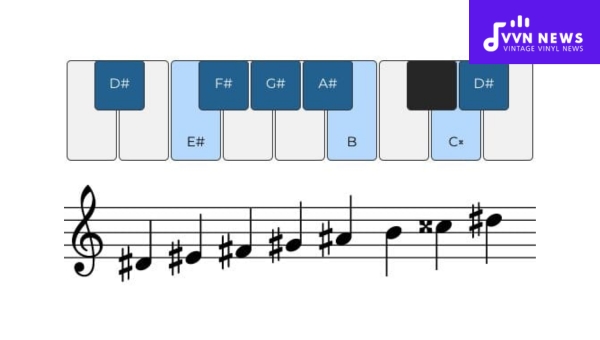
There’s a mysterious allure to the D Sharp Harmonic Minor scale, which is primarily constituted of seven unique notes.

The roots of the scale are found within the D# note, giving it its name. Building from there, we encounter seven integral notes that make up this scale.
Here they are:
- 1st degree – D# (D sharp)
- 2nd degree – E# (E sharp)
- 3rd degree – F# (F sharp)
- 4th degree – G# (G sharp)
- 5th degree – A# (A sharp)
- 6th degree – B
- 7th degree – Cx (C double sharp)
Herein lies the magic of this minor harmonic scale – its unique combination of notes that allows such distinct character and depth to emerge in the music itself.
Before practicing these degrees, remember that each step in this process encompasses a specific tone or semitone and is foundational in creating the complete D Sharp Harmonic Minor scale.
One interesting aspect you will notice with this arrangement is that between B and Cx there is an interval of a minor 3rd unlike in most other scales where the largest interval is usually a major 2nd.
Also noteworthy is how perfectly conducive these notes are for making richly textured harmonies which can add an intriguing sense of drama and tension to your compositions.
What are the modes of the D Sharp Harmonic Minor scale?
In the landscape of music, modes are distinct scales that are derived from the major or minor scales. The D sharp harmonic minor scale is astonishingly rich, offering seven unique modes.
What makes each mode unique is the starting note; each one has its own distinctive mood and sonic palette.
- D# Minor (Aeolian): Also known as the natural minor scale, this mode produces a somber or profound sound.
- E# Locrian: An entity of its own, this mode carries a mysterious, almost eerie aura.
- F# Ionian ♯5: Known for its augmented fifth interval, this mode has a remarkably tensed and dramatic feel.
- G# Dorian ♯4: Adding an exotic twist to the traditional Dorian mode, it evokes a sense of deep melancholy.
- A# Phrygian ♯3: Yet another altered mode with a strikingly expressive emotional outcome.
- B# Lydian ♯2: This distinctive sound leaves an everlasting extravagant musical sensation on your fingertips and earlobes.
- C## Mixolydian ♯1: Pushing boundaries with a heightened first degree that creates an air of suspense.
Each mode lends itself to diverse melodies and chords; their journey leads to the comprehensive depth of the D sharp harmonic minor scale’s potential musicality.
Also Read: D Sharp Major Pentatonic Scale [A Bright And Positive Tone]
How do you play the D Sharp Harmonic Minor scale on piano and guitar?
The D sharp harmonic minor scale is a rich tapestry of tonal color and strategic tension that can add immense emotional depth to your music.

Learning to create this symphony of sound on the piano and guitar requires an understanding of the scale’s specific intervals, patterns, and note relationships.
While its expression can bewitch us with its soulful ruminations, its composition at its heart is grounded in theory.
Playing the D Sharp Harmonic Minor Scale on Piano
To play the D# harmonic minor scale, one must begin on the note D#. Then, following a specific pattern of half steps (H) and whole steps (W), we progress our journey through this elegant minor scale.
Look closely at this sequence: W, H, W, W, H, WH (Whole plus Half), H.
Tread through these steps:
- Start with your thumb (index finger) on D#(black key directly to the right of D). This initiates your excursion into this mystifying minor scale.
- Move a whole step to E# (F on piano – white key directly to the right of E).
- Proceed with a half step up to F#(black key directly to the right of F).
- Now take a full stride – A whole step – up to G# (black key directly to the right of G).
- Continue your trek with another whole step up to A#(black key directly adjacent to A).
- Now close in with a half-step upward move landing you in B.
- Make use of the WH next Not waiting long you walk along and land at C##(actually it’s just good old D played again but theoretically it’s still C##). This anticipatory double-step is known as an augmented second
- Finally culminating this beautiful saga by moving half-step up back home at your starting point- that is in D#. Here’s where your musical journey loops back in a harmonious melody.
Mastering The Scale On Guitar
Venturing into strings? No fret! Well actually there are frets…quite literal ones! Nevertheless here’s how to find you pal: D sharp harmonic minor scale across six strings:

- Start your journey on the low E string at the 6th fret (D#).
- Without moving further along, go straight up to F# on the next string, and onto G# on the D string.
- Continuing this path, encounter A# on the G string, B on B your next string named after its first open note.
- As it approaches C##, skip a step to hit this note located 2nd fret higher from your last note on E.
- Return to D#, ending at your starting point rounding up your exercising of fingers in perfect harmony.
The D sharp harmonic minor scale echoes with a deeply intense and brooding sound that resonates within every listener’s heartstrings.
Get ready to play impressive solos or simply start improvising with this quirky scale as you dive into its characteristically poignant yet intriguing world!
Also Read: A Sharp Minor Pentatonic Scale [Unique Harmonic Possibilities]
What is the key signature for D Sharp Harmonic Minor?
The key signature for the D Sharp Harmonic Minor scale consists of six sharps and one double sharp. It indicates that when we play this scale, almost every note we encounter will be sharp or double sharp, except for the natural notes.
It’s marked by a grand staff with sharps placed before each line and space. The order in which they appear does relate directly to the notes of the scale: F##, C##, G#, D#, A#, E#, and B#.
These specific indications aid in ensuring that your rendition of the D sharp harmonic minor scale rings true to its inherently poignant vibes.
The D Sharp Harmonic Minor Scale Notated in Different Clefs

The art of writing and reading sheet music takes practice, and to accurately represent the D sharp harmonic minor scale in different clefs can be a significant triumph for anyone diving into the realm of musical learning.
To truly fathom this exceptional scale, you need a basic comprehension of treble, bass, alto, and tenor clefs.
Notation differs according to the type of clef being utilized. So let’s explore these differences through the lens of the D sharp harmonic minor scale.
Bass Clef
When you start with bass clef notation from D sharp—written as ‘D#’—the harmonic minor scale ascends like this: D#, E#, F#, G#, A#, B, C##, D#.
Get comfortable with these notes; they will be your guiding light in creating bass-heavy masterpieces with an emotional resonance distinctive to this scale.
Treble Clef
In terms of treble clef notation, we retain the same sequence we found in the bass clef: still beginning with our familiar friend ‘D#’.
The subsequent notes E#, F#, G#, A#, B, C## follow suit and conclude at high D#. Perfect for those soaring melodies that tug at your heartstrings!
Alto Clef
The alto clef throws a wild curveball at us primarily used by violists.
Starting once more from D#—always our leading voice—the notes that follow are E#, F#, G#, A#, B, C##, and inevitably back to D#.
It takes precision to read this on sheet music due to its mid-range placement. Patience is indeed a virtue here!
Tenor Clef
Though primarily favored by cellists and trombone players for higher passages—doesn’t mean it’s off-limits for exploratory enthusiasts. Of course, we arrive again at our home note D#, and the following sequence, E#, F#, G#, A#, B, C##, and again to D#.
The beauty of the D sharp harmonic minor scale spans across all clefs and treating each one with its due consideration can allow you to experience music in a profound new mentality.
It illuminates a path through any melodic wonder you wish to create! Mastering this scale in various clefs is a rewarding journey into musical prowess.
Let it help shape your passion for music into a tangible form that speaks from the soul and resonates with others. After all, isn’t that what truly matters?
Also Read: How To Transpose Bass Clef To Treble Clef [A How-To Guide]
What are the enharmonic equivalents of D Sharp Harmonic Minor?
The concept of enharmonic equivalence in music refers to the idea that two notes, though named or notated differently, can sound the same pitch. As for the enharmonic equivalent of the D Sharp Harmonic Minor scale, this would be the E Flat Harmonic Minor scale.
Now, don’t be fooled: while D sharp and E flat are effectively the same note on your keyboard or fretboard, how they function within their respective scales does diverge.
In terms of composition or musical interpretation, these two scales aren’t utilized interchangeably due to their harmonic context.
Essentially, what this means is that even though D sharp and E flat may be one and the same note physically, their tonal relationship to other notes within a composition causes them to express different musical roles.
What chords can be formed from the D Sharp Harmonic Minor scale?
Let’s delve right into the chords that can be formed within the D sharp harmonic minor scale.

The flipside to the harmonic minor scale versus its natural and melodic counterparts is in its ability to concoct richer chords. This opens up a world of creativity for us!
The D# harmonic minor scale can harbor seven chords, each corresponding to a note in the sequence of the scale. Those resulting chords become D# minor, E# diminished, F## Major, G# minor, A# Major, B# diminished, and C## Major.
In practice though, many musicians choose F#, G#, A#, C#, and D# instead of double sharps for their notation.
These chords provide that characteristic balance between melancholy and hope that defines compositions within this intriguing scale.
Also Read: Mastering Chords In A Minor [Improve Your Composition Skills]
FAQs
What is the D Sharp Harmonic Minor scale?
The D Sharp Harmonic Minor is a seven-note scale that follows the pattern of semitones and tones: 2 – 1 – 2 – 2 – 1 – 3 – 1.
What are some practical uses for the D Sharp Harmonic Minor?
The exotic sound of this scale is perfect for adding emotion to solo performances or creating tension in compositions.
Can anyone learn to play the D Sharp Harmonic Minor scale?
Absolutely! Regardless of your musical experience, practice and patience will have you mastering it in no time.
What instruments use the D Sharp Harmonic Minor scale?
You’ll commonly find this used in all sorts of instruments from guitar and piano right through to violin and more!
Why does the D sharp harmonic minor create such a distinct mood?
That’s due to its unique step pattern, which includes a characteristic leap that creates an emotional intensity unlike any other.
Also Read: F Sharp Major Triad [Enhance Your Musical Compositions]
Conclusion
The D Sharp Harmonic Minor scale, also commonly referred to as the apocalyptic scale, is a stimulating venture into the realm of minor keys producing an array of captivating sounds.
Its distinct pattern of notes offers beautiful resolutions and a plethora of chord possibilities, adding depth and complexity to your composition.
Whether you’re dabbling on your guitar or exploring melodies on your piano, this harmonic minor scale retains an aura of peculiarity that can give your music that extra dash of mystery and intrigue.
So go ahead, get out there, and dive deep into the world of D Sharp Harmonic Minor – unlock that hidden potential in your music that you never knew existed. Embrace the magic!