
If there’s one thing I enjoy as much as playing the piano, it’s diving into the intricacies of musical theory.
When it’s about pentatonic scales, there’s hardly a more intriguing one than the G flat major pentatonic scale.
This little gem of a scale holds a host of sonic treasures that have been used by musicians throughout history to weave incredible pieces of music.
The G flat major pentatonic scale is essentially five enticing notes that can shift an ordinary progression into something far beyond the regular rhythm and harmony.
Interwoven in these five notes are elements of both majesty and subtlety which allow you to get creative with your compositions.
Today, allow me to guide you through this sophisticated and melodious path that is bound to stir your musical pot for sure.
Table of Contents
What are the basics of the G Flat Major Pentatonic Scale?
The G flat major pentatonic scale, as the name suggests, is based on the key of G flat.
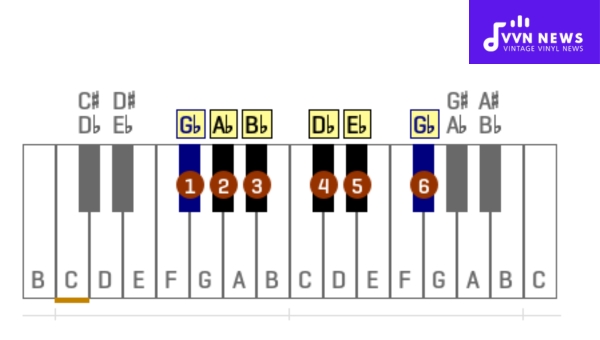
It consists of a series of five notes or pitches: namely G flat (Gb), A flat (Ab), B flat (Bb), D flat (Db), and E flat (Eb).
This pattern makes it devoid of any semitones, which results in a scale that is free from the sense of tension typically found in other scales.
It’s this unique characteristic that gives it an appealing and harmonious sound often favored in many styles of music ranging from jazz to pop.
Also Read: D Flat Major Pentatonic Scale [Master Its Joyful Tones]
How do you put together the G Flat Major Pentatonic Scale?
Assembling the G Flat Major Pentatonic Scale involves selecting five specific notes from its parent major scale.

Begin with the G flat major scale, which follows the pattern of tones and semitones as Tone, Tone, Semitone, Tone, Tone, Tone, Semitone. These intervals are your roadmap.
Here’s how to extract the pentatonic from the full scale:
- Start on G flat (also known as F sharp), which is your root note.
- Skip to B flat, bypassing A flat.
- Move to D flat, omitting C flat.
- Continue to E flat; no need for F.
- Cap it off with A flat.
Your resulting G Flat Major Pentatonic Scale has these notes:
- G♭ (Root)
- B♭ (2nd Note)
- D♭ (Major third)
- E♭ (5th Note)
- A♭ (6th Note)
This sequence frees you from half-tones and creates a clear, open sound field for melody crafting or improvisation.
Each note should be articulated with precision to achieve the harmonious blend that this scale offers.
Also Read: E Major Pentatonic Scale [Express Emotion Through Music]
What are the five styles of the G Flat Major Pentatonic Scale?
The G Flat Major Pentatonic Scale is a musical odyssey made richer through its five distinct shapes on the fretboard.
Each shape offers a different perspective, like unique colors to paint your musical landscape.
Shape 1: The Root Position
The first shape takes root around the G flat note on the sixth string. You often begin learning this scale with this form because it grounds you in the home base of G flat major.
The fingering pattern here stretches across four frets, providing a comfortable introduction to the scale.
- Fingers: Use fingers 1, 3, and 4 for optimal reach
- Frets: Navigate between frets two through six for complete expression
Shape 2: The Second Position
Moving up the neck, we encounter what guitarists refer to as Shape 2.
This form starts on the second note of the pentatonic scale and emphasizes a new group of intervals while still retaining that familiar pentatonic sound.
- Hand Placement: Shift your hand up one position from where Shape 1 left off
- Note Flow: Seamlessly blend this shape with Shape 1 for extended solos
Shape 3: Mid-Neck Exploration
Shape 3 beckons you to explore further up the neck. It’s like discovering an uncharted territory within familiar lands.
You’ll find new melodic opportunities weaving through this pattern as you learn to incorporate it into your playing.
- Stretching: Engage more with your pinky finger for those wider intervals
- Connection Points: Bold connections between shapes ensure fluid transitions on and off stage
Shape 4: High-Octave Elevation
Climbing towards the body of your instrument, Shape 4 delivers high-octave brilliance—the heart-stirring area often reserved for climactic solos or emotive fills.
- Pitches: Revel in these upper register notes that soar above basic chords
- Timing: Improve your timing by practicing this shape with metronomes or backing tracks
Shape 5: Completing the Circuit
Shape 5 presents itself just below where Shape 1 can begin again—completing our cyclical journey around the G flat Major Pentatonic Scale.
It’s reminiscent of returning home after a long journey and having gathered new experiences.
These five shapes are not just positions but doorways to improvisational fluency in G flat major.
Memorize them well, integrate them into your practice routine, and watch as they transform both creativity and technical prowess in your performances.
What Connects Relative Major and Minor Pentatonic Scales?
The link between relative major and minor pentatonic scales is a cornerstone in music theory, allowing musicians to transition seamlessly between emotional tonalities.

The beauty lies in their shared set of notes; each minor pentatonic scale finds its counterpart in a major pentatonic scale that starts three semitones—or three frets on the guitar—higher.
Specifically, if you begin with a G flat major pentatonic scale, E flat minor is its relative minor compatriot.
Here’s how you can visualize this alliance:
- G flat Major Pentatonic: G♭ – A♭ – B♭ – D♭ – E♭
- E flat Minor Pentatonic: E♭ – G♭ – A♭ – B♭ – D♭
This relationship allows for an incredible duality: evoke brightness using G flat major or dipping into sombreness with E flat minor—without altering the note palette.
This gives composers and improvisers alike the freedom to toggle between moods while maintaining melodic integrity.
Also Read: E Flat Major Pentatonic Scale [Play Warm And Harmonic Tunes]
How do backing tracks aid in practicing the G Flat Major Pentatonic Scale?
Integrating backing tracks into your musical practice can be transformative.
These accompaniments don’t just add a layer of fun to your sessions, but they also provide several essential benefits, especially when focusing on specific scales like the G Flat Major Pentatonic. Here are five points to consider:
Develop a Sense of Rhythm and Timing
Firstly, using backing tracks lays a foundation for impeccable rhythm and timing.
As you play the G Flat Major Pentatonic scale over these tracks, you attune your ears and fingers to maintain tempo consistency.
This synchronization is crucial for any musician aiming to deliver fluid and seamless performances.
Enhance Musical Ear
Practice with backing tracks can significantly sharpen your listening skills.
The harmonic backdrop helps you discern how the G Flat Major Pentatonic scale fits within various chord progressions – a skill that’s vital when jamming with others or improvising during a solo.
Contextual Practice
These tracks offer a contextual background. It’s one thing to play scales in isolation; it’s quite another to hear how they work in an actual piece of music.
Backing tracks equip you with the scale’s practical application—how each note interacts with different chords and how it contributes to the overall feel of a song.
Boost Confidence
Practicing alongside pre-recorded elements diminishes performance anxiety.
It creates a safe environment where you can experiment with dynamics, phrasing, and expression without the pressure of an audience.
Reinforce Muscle Memory
Frequent repetition over backing tracks aids in developing solid muscle memory for scale patterns.
Your fingers become accustomed to moving across the keyboard with ease within the framework of G Flat Major Pentatonic scale positions.
Integrating backing tracks into your practice routine when exploring pentatonic scales isn’t just beneficial—it’s instrumental for comprehensive musical development.
It supports rhythm upkeep, sharpens auditory skills, gives real-world context, boosts performative confidence, and reinforces kinesthetic familiarity.
Also Read: Master The F Sharp Major Pentatonic Scale [Music Theory Guide]
FAQs About The G Flat Major Pentatonic Scale
What is the G Flat Major Pentatonic Scale?
The G Flat Major Pentatonic Scale is a five-note musical scale with the notes G♭, A♭, B♭, D♭, and E♭.
How can I use the G Flat Major Pentatonic Scale in improvisation?
You can use the G Flat Major Pentatonic scale to improvise melodies over major chords or chord progressions in the key of G♭.
What is a simple way to find the notes of any major pentatonic scale on my instrument?
Start by playing the root note, then skip each subsequent whole step, include one and a half steps, and then continue with whole steps till you have five distinct notes.
In what genres is the G Flat Major Pentatonic commonly found?
The G Flat Major Pentatonic scale is commonly used in genres like jazz, blues, pop, rock, and folk music for its smooth and pleasing sound.
Are there any well-known solos that use pentatonic scales?
Yes, many famous guitar solos such as “Stairway to Heaven” by Led Zeppelin or keyboard solos like those in “Man in the Mirror” by Michael Jackson feature pentatonic scales heavily.
Conclusion
In summing up our exploration of the G flat major pentatonic scale, it’s clear this scale is a powerhouse for musical expression.
Embrace its simplicity and elegance. Practice with backing tracks, utilize its notes in your compositions, and you’ll find yourself mesmerized by its sonic beauty.
The connection between major and minor pentatonic scales paves the way for versatility in your playing.
Dive into this scale, and soon enough, the music you create will be as fluent as it is enchanting.