
In the beautifully diverse world of music theory, one scale often stands out due to its unique melody and distinct sound; this is the B flat major pentatonic scale.
Perhaps, you’ve heard of it in passing or maybe have been looking for new ways to enhance your musical abilities. Regardless of your familiarity with this topic, delving into such a musically rich theme will undeniably enrich your appreciation for the complexities of sound.
The nuances of scales like the B flat major pentatonic scale can be a bit challenging at first, but nothing quite compares to the satisfaction that follows after grasping new elements in music.
Over time and with practice, you’ll discover how these scales offer a foundation for composing or improvising music across various genres.
If you’re an aspiring musician or simply someone who loves understanding all aspects of music, delving into this particular scale is certainly worth your while.
Table of Contents
What is The B Flat Major Pentatonic Scale?
At its most basic form, the B flat major pentatonic scale is a five-note musical scale with a unique configuration of tones.
It’s denoted as Bb, D, F, G, and C in the musical language. This subset of the full seven-note major scale is what gives it its distinct melodious sound.
Each pitch in this variant heavily contributes to its overall appeal, making it an invaluable tool for composers and musicians across many genres. Whether it’s rock or soul music you’re exploring, the B flat major pentatonic scale promptly finds its voice within the soundscape!
Also Read: E Minor Pentatonic Scale [How To Use In Your Music Composition]
How is the B Flat Major Pentatonic Scale formed?
The B flat major pentatonic scale is elegantly simple, yet its formation is rooted in music theory’s systematic process.

This scale emerges from the full B flat major scale, which consists of seven notes: B♭, C, D, E♭, F, G, and A. The pentatonic version comprises only five of these tones.
To construct this streamlined scale:
- Begin by selecting the first (root) note, B♭.
- Move to the second pitch of the full major scale which is C.
- Skip the third and elevate to E♭ as your third pentatonic tone.
- Include F as your fourth note.
- Lastly, add G as your fifth and final tone.
These chosen pitches – B♭, C, E♭, F, and G – craft a framework known for its pleasing sonic quality.
Stripping away the half-step dissonances inherent in a full scale allows like this one results in a collection of intervals that are agreeable to most listeners’ ears and a staple among diverse musical styles.
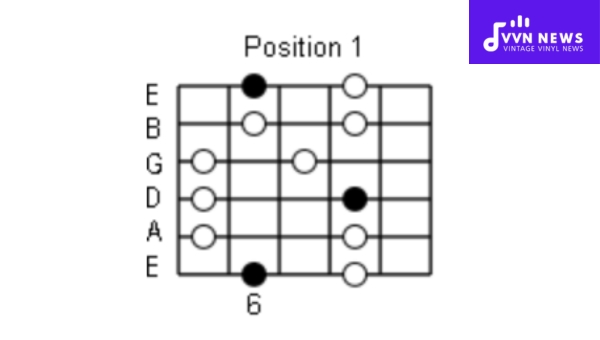
Five layouts of B Flat Major Pentatonic Scale?
When we consider the B Flat Major pentatonic scale, it is important to remember that there are five significant layouts or shapes to learn.
These shapes offer diverse ways to approach this indispensable scale. For ease of exploration, we will discuss these five layouts in order and see how each contributes to expanding our musical proficiency.
First Layout: The Root Position
Simply named as Root Position, this layout starts on the root note of B flat.
The positions include B flat (1st fret, 5th string), C (3rd fret, 5th string), D (open, 4th string), F (3rd fret, 4th string), G (open, 3rd string) and back to B flat (3rd fret, 3rd string).
It is a fundamental structure from which many melodies and solos can be built.
Second Layout: Extended Up
The second layout known as Extended Up, is so-called due to moving up on the fretboard from the root position.
Starting on B flat again (1st fret, 5th string) it spans more notes since it includes D (5th fret, 5th string), F (3rd fret, 4th string), and G(5th fret, 4th string). This shape allows players greater melodic range.
Third Layout: Above Root
The third layout for our scale is named Above Root. This pattern commences from D (10th-foot note on E-string).
Compared to previous patterns this one looks significantly different because it does not begin from a B-flat.
Harmonically it remains a part of our core pentatonic scale while offering us more flexibility.
Fourth Layout: Extended Down
Our fourth shape is a reflection of the second pattern we learned above. It is also extended but in this case, Extended Down towards the open strings.
This shape is well appreciated by musicians for its potential to spark unique improvisational ideas and develop more complex musical patterns.
Fifth Layout: Below Root
The last of our layouts is Below the Root. As the name indicates, begins below our initial root note of B flat (6th-string, 6th-fret).
This shape offers yet another musical perspective on our central scale, allowing further options for creating and recognizing sonic possibilities within a song or piece.
By mastering these five fundamental shapes on the B flat major pentatonic scale, you can enhance your creative freedom and musical vocabulary.
Also Read: Mastering Chords In A Minor [Improve Your Composition Skills]
How are major and minor pentatonic linked?
The connection between major and minor pentatonic hinges on relative relationships.

B flat major pentatonic shares the same notes with G minor pentatonic; these scales are relatives.
Simply put, if you begin the B flat major pentatonic scale (B♭-C-D-F-G) from its third note, D, you seamlessly transition into the G minor pentatonic (D-F-G-B♭-C).
This link allows musicians to switch between emotive landscapes – the brightness of a major tonality and the introspective hue of a minor tone – by pivoting around these shared pitches.
Grasping this concept expands your improvisational toolkit across various musical contexts.
Role of Backing Tracks for B Flat Major Pentatonic Scale
When it comes to mastering any musical scale, practice is your greatest ally.
This is particularly true when we talk about the role of backing tracks. Let’s dive into the ways backing tracks can be a game-changer when learning and applying the B Flat Major Pentatonic Scale.
Introduces Contextual Learning
The B Flat Major Pentatonic Scale, while beautiful on its own, is not just a sequence of notes to memorize—it’s also about knowing where those notes fit within musical compositions.
By playing along with backing tracks in the same key, musicians gain insights into contextual applications, encouraging deeper musical intuition rather than mere rote learning.
- Fosters Improvisational Skills: As you improvise over backing tracks, you experiment with note combinations and rhythmic variations within a framework that supports your chosen scale. This cultivates an improved ability to create spontaneous music that grooves with an underlying track.
- Improves Timing and Rhythm: Practicing scales in isolation may lead you to overlook timing nuances. Backing tracks enforce a rigid tempo, compelling you to match your playing speed and rhythm with the background music–a fundamental skill for ensemble performance.
Builds Confidence
Performing solo can feel daunting without the cushion of other instruments.
Backing tracks simulate a band environment, bolstering confidence as you play along.
You’ll learn to hold your own against other musical elements—essentially preparing yourself for live situations involving other musicians or bands.
Aids Ear Training
Listening closely to how your scale notes fit within the harmony provided by backing tracks enhances your ear-training capabilities significantly; recognizing interval relationships and chord progressions becomes second nature over time.
Provides Enjoyment and Motivation
Let’s face it—repetition can be monotonous even if it’s beneficial. Incorporating enjoyable backing tracks keeps practice sessions fresh and invigorating.
Delight in creating new melodies over catchy rhythms keeps motivation high and encourages regular practice—a critical factor in mastering any instrument or scale.
Integrating backing tracks into practice sessions when working on the B Flat Major Pentatonic Scale—or any scale for that matter—provides invaluable benefits beyond mere memorization: it facilitates compositional learning, improvisational flair, rhythmic accuracy, performance confidence, auditory discernment skills as well as sustained interest and enjoyment in one’s musical journey.
Also Read: How To Transpose Bass Clef To Treble Clef [A How-To Guide]
Popular Songs in B Flat Major Pentatonic Scale
The B flat major pentatonic scale, with its warm and uplifting sound, has been used in various memorable songs.

Here are five important tracks that make use of this melodic gem:
“My Girl” by The Temptations
One of the most iconic uses of the B flat major pentatonic scale can be heard in The Temptations’ hit “My Girl.”
What stands out here is the song’s bassline which moves gracefully within the pentatonic framework.
Smokey Robinson’s genius as a songwriter shines through as he crafts a melody that is simultaneously simple and irresistible.
“Ain’t No Sunshine” by Bill Withers
Another classic, “Ain’t No Sunshine” by Bill Withers, leans heavily on the emotive impact of the B flat major pentatonic scale.
The tune revolves around a sequence that taps into the soothing quality of the scale, and Withers’ soulful vocals bring this aspect to life.
This song demonstrates how limitations within a scale can still allow for profound emotional expression.
“Sweet Child o’ Mine” by Guns N’ Roses
Surprisingly, sections of this rock anthem by Guns N’ Roses incorporate elements from the B flat major pentatonic scale.
While it might not be immediately obvious given its rock credentials, listen closely to certain guitar solos where Slash incorporates notes from this Pentatonic powerhouse to add flavor to his riffs.
“Dock of the Bay” by Otis Redding
Otis Redding’s timeless tune, “Dock of the Bay,” also features traces of our highlighted scale.
Examine the whistling parts or breakdowns where Redding’s vocal improvisations utilize notes of B flat major pentatonic.
Though subtle, they contribute to giving this piece its unforgettable melody.
“Human Nature” by Michael Jackson
Lastly, we have Michael Jackson’s “Human Nature,” a track underscored by lush synthesizers picking out notes from – you guessed it – our cherished pentatonic scale.
Interestingly for musicians to note is how seamlessly these notes merge with other scales to form a captivating hybrid harmony.
It’s astounding how these five songs cut across different genres – from soul and R&B to hard rock – all-embracing components from one unifying source: the B flat major pentatonic scale.
These tracks illustrate not just versatility but also how musicians manage to infuse their unique style into a predefined set of musical bounds.
Also Read: How To Transpose Into The Tenor Clef? [Mastering In Notation]
FAQs
What notes comprise the B Flat Major Pentatonic Scale?
The B flat major pentatonic scale consists of five notes: B♭, C, D, F, and G.
Can I play the B Flat Major Pentatonic Scale on any instrument?
This scale is versatile and can be played on virtually any melodic instrument.
Is there a simple pattern to remember for the B Flat Major Pentatonic Scale on guitar?
Yes, the pentatonic scale has a box pattern that is often easy to memorize and use for improvisation.
How does the B Flat Major Pentatonic differ from the full major scale?
The B flat major pentatonic skips the fourth and seventh notes of the full scale, removing potential dissonance and creating a smoother sound.
Are there any exercises to master the B Flat Major Pentatonic Scale faster?
Practicing scales in ascending and descending order along with metronome usage or playing along with backing tracks can quicken mastery.
Also Read: How To Transpose Treble To Bass Clef [Music Guide]
Conclusion
The B flat major pentatonic scale serves as a cornerstone for countless melodies and improvisations across musical genres. Its five-note structure and practice via backing tracks can significantly enhance your musicality.
It’s also fascinating to see how this scale interlocks with its minor counterpart, offering a deeper insight into the intricacy of music theory.
For all aspiring musicians, mastering this pentatonic pattern paves the way to fluency in the universal language of music. It’s truly a worthwhile pursuit that promises to enrich your sonic palette.