
Learning the art of musical transposition is an aspect of music theory that can open up a world of possibility for any musician.
One common transposition you may come across is from E flat to C. That might sound a little intimidating, but trust me, with a little practice and guidance, you will master this skill in no time.
Transposing music from one key to another is like language translation; we convey the same message but in a different dialect.
Dealing particularly with the task at hand – to transpose E flat to C – might seem daunting initially, but I assure you, it’s not quite as tough as it sounds.
Just like learning a new instrument or song requires practice, so does this, and trust me when I say, the result would be worth your effort!
Table of Contents
What is Transposition from E flat to C?
Transposition, in a musical context, refers to the process of moving individual notes or an entire piece from one key to another.
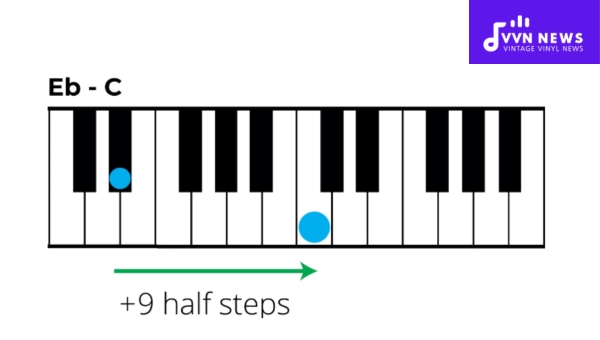
Specifically, when we discuss transposing from E flat (Eb) to C, we are moving the key of a piece down a minor third or up a major sixth.
This transition fundamentally alters the sound and feel of the piece while maintaining its original structure and integrity.
This change potentially allows musicians to play pieces that were previously out of their range or facilitates playing with instruments tuned differently. The process requires careful adjustment of each note by its relation to the new key.
Also Read: A Minor Scale [Unlock The Mysteries Of Musical Composition]
Why Transpose E Flat to C?
Transposing from E flat to C can be critical for several reasons. This knowledge not only expands your versatility as a musician but also comes in handy when playing music with different instruments or musicians.

- Playing with Different Instruments: If you’re jamming with a group and one instrument is designed to play in E flat while yours is tuned to C, you’ll need to transpose the music so everyone is harmonizing.
- Musical Adaptability: There might be songs that naturally fall in the E flat key but are too difficult for some instruments or vocal ranges. Transposing it down to the key of C may make the song more doable and comfortable.
- Ease of Playing: The key of C is often regarded as an easy key to play on many instruments due to its lack of sharp or flat notes. It’s especially beginner-friendly on piano and guitar.
- Composition & Arrangement: If you’re arranging a piece of music or composing your own, transposing keys can offer a fresh take on melodies and harmonies, providing a unique sound experience.
Music should never be bound by keys. Life would be boring if we only played in one key.
Transposing from E flat to C can breathe new life into your music-making process, expand your repertoire, and give you the flexibility to adapt.
What are the Steps to Transpose Eb to C?
Transposition can appear challenging at first glance, but with some tried-and-true methods, the task becomes much more manageable.
Here, we’ll go into detail about two approaches: moving each note up one at a time and transposing the key signature.
Method One: Move Notes Up One At A Time
Transposing from E flat to C is all about adjustment and attention to detail. Here’s a comprehensive method that will simplify the process for you:
Step 1: Acknowledge that We are Transposing Down
Given we’re moving from E flat (a high note) to C (a lower note), each note on the scale will need to descend.
In essence, every single note in your piece has to move two half-steps downward.
Step 2: Modify Each Note Independently
To effectively carry out a transpose from E flat to C, change each note individually.
For instance, an E flat would become a C after descending two half-steps whereas an A becomes F and so on.
The crucial key point here is maintaining the same rhythm and duration while just altering the pitch.
Step 3: Confirm That All Observations Accord With the New Key
After altering the notes, ensure they are all consistent with the new key you have set. This means every note should be compatible with the key of C.
Method Two: Transpose The Key Signature
Alternatively, we can change the entire tune’s key signature as well in these steps:
Step 1: Identify Your Current Key Signature
Firstly, determine what your existing signature is – in this case, E flat which has three flats – Bb, Eb, and Ab.
Step 2: Change From the Original Key Signature to Desired Key Signature
In this case, we desire to transpose it into a c key; therefore, eliminate any flats or sharps present in your key signature as our target C major doesn’t have any sharp or flat associated with it.
Step 3: Adjust Each Note Accordingly
Now tweak each note by three half-steps. For instance; C will convert into A after reducing three half-steps while reading from the bass clef.
Once again, don’t adjust the duration of notes, just alter the pitch.
Making use of either method or combining both would result in a transposition from E flat to C.
The goal of transposition is not to create entirely new music but to maintain the original melody while changing its key adequately.
Also Read: How To Transpose Treble To Bass Clef [Music Guide]
How to Deal with Accidental Notes in Transposition?
When you’re transposing music, the process isn’t only about moving the entire piece up or down a step or two; it’s also about dealing with accidental notes.

In music, an ‘accidental’ is a note that is not within the scale key but has been altered by a sharp or flat symbol. Let me share my insights on handling accidentals when transposing from E flat to C.
- Analyze the Accidentals: First things first, figure out what accidentals you’re dealing with. For example, in E flat major you would typically encounter B, E, and A flats.
- Shift Considering the Key Signature: When transposing from E flat (composed of Bb, Eb, and Ab) to C (which has no sharps or flats), all accidentals must be adjusted accordingly. The Bb becomes a natural A when playing in key C; Eb shifts down to D; and Ab converts to G.
- Proper Notation: Mark these new notes properly in your sheet music so you don’t forget their altered state while performing.
- Practice: Try experimenting with different scales that carry the same accidentals until your fingers get accustomed to naturalizing those notes when playing in key C.
Dealing with accidental notes ensures we bridge the gap between E flat and key C by shifting such notes suitably. Mastering this would truly underline your proficiency as a skillful musician!
Also Read: E Major Triad [Master This Staple Of Music Composition]
What Instruments Commonly Require Transposing E flat to C?
Several musical instruments require the transposition of E flat to C, and if you are a player of one of these, your musical journey will inevitably bring you face to face with this task.
Alto and Baritone Saxophones
These instruments are pitched in E flat. When you play a C on these saxophones, it sounds like an E flat on a piano.
Thus, for an E flat alto or baritone saxophone piece to be played in conjunction with a piano or another C instrument, the notes have to be transposed from E flat to C.
Alto and Bass Clarinets
Similar to alto and baritone saxophones, these clarinets are also pitched in E flat.
This necessitates their transposition repertoire from E flat down to concert pitch which is C.
Instruments That Are Naturally Pitched in E Flat
Other instruments that could require transposing from E flat include the mellophone (an instrument similar in shape and nature to the French horn) as well as certain types of tubas and cornets.
Being aware of your instrument’s pitch is crucial for group performances like jazz bands, school orchestras, or ensembles where everyone needs to harmonize seamlessly.
Also Read: How To Transpose Up A Major Second? [Boost Your Music IQ]
How Can Computer Software Aid in Transposition?
In our current digital age, computer software can be a valuable tool for musicians.

When it comes to transposing E flat to C, there are many software options out there that can help streamline the process.
Below, I’ll share details on five top-notch applications that handle transposition tasks adeptly.
- MuseScore: MuseScore is a free software program that allows musicians to notate and transpose music with ease. Its user-friendly interface helps you select the key perceived best for your composition, namely E flat or C.
- Finale: Finale is one of the pioneer names in music notation software, catering to professional musicians & composers. This comprehensive program contains strong features for transposing keys along with countless other musical aspects.
- Sibelius: Sibelius holds a strong reputation as an advanced yet accessible music notation application that aids the key-transposition process tremendously. You can select passages and swiftly transpose them into desired keys.
- Transposr: Transposr is an online tool where you just upload your file and choose the key you want to transpose into (E flat or C). It then performs the task with amazing precision.
- Ableton Live: Largely explored by electronic music creators, Ableton Live also features robust capabilities for traditional musicians including a MIDI ‘pitch’ effect facilitating instant transposition of melodic lines & chords.
No matter which option you choose from these sophisticated computer applications all are designed to make your life as easy as possible when looking to transpose your original compositions from E flat to C.
Also Read: Mastering Chords In A Minor [Improve Your Composition Skills]
FAQs
Why do musicians transpose music?
Musicians transpose music to accommodate different instruments or vocal ranges, ensuring that everyone can play comfortably in a key that suits them.
Do I need to know how to read music to transpose from E flat to C?
Yes, you should be able to read music as transposition requires an understanding of the relationship between notes on the page and their pitch.
Is transposing from E flat to C difficult?
Transposing from E flat to C might seem challenging at first, but it’s manageable with practice and a good grasp of music theory.
Can I use a capo to transpose guitar music from E flat to C?
Certainly! A capo can change the key of your guitar instantly; however, you’ll need to know the correct placement to achieve the key of C.
Will transposing from E flat to C change the quality of the music?
No, when done correctly, transposing alters only the key but maintains the original quality and character of the piece.
Also Read: Transposition Chart [A Lifesaver For All Musicians]
Conclusion
In the grand scheme of honing your musical prowess, transposing from E flat to C may present challenges, but it’s definitely within your reach. Take each step methodically, practice with patience, and remember that this skill greatly enhances your versatility as a musician.
Whether manually or with software assistance, transposition is a valuable tool in your repertoire. You’re now equipped to bridge keys fluently, making not only E flat to C a breeze but also embarking confidently on future transpositions.