
Time signatures are vital in grasping the structure and pace of the music. The time signature 6/4, though not as popular as its counterparts, holds its unique rhythm and charm that calls for our attention.
In music notation, this time signature is indeed a sight to behold, setting itself apart with its distinct characteristics. The rich depth and inventive possibilities it carries are one of the many reasons why musicians from different genres play around with it.
Let’s journey together to appreciate the interesting enigma that is the time signature 6/4.
Table of Contents
What is Time Signature 6/4?
A time signature in music is a notational convention that specifies how many beats are contained in each measure, and which note value amounts to one beat.
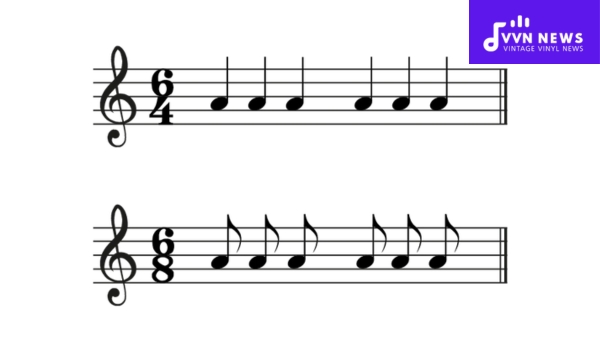
The time signature 6/4, pronounced ‘six-four’, tells us that there are six beats in a measure, and the quarter note symbolizes a single beat.
This indicates that music written in 6/4 could involve six steady pulses on each line or bar of the music sheet where the quarter (1/4) note holds the pulse.
To break it down further, the upper number ‘6’ denotes the total count of beats per measure, while the lower number ‘4’ reveals that these counted units would be quarter notes.
Enriching and engaging, this time signature truly brings another level of depth to any masterpiece.
Also Read: A Minor Scale [Unlock The Mysteries Of Musical Composition]
How to Count in 6/4?
When approaching a 6/4 time signature, imagine each measure as having six quarter-note beats.

To count this effectively, you’d utilize a series of numbers up to six ‘1-2-3-4-5-6’, where each number corresponds to a quarter note.
Emphasize the first beat as it’s the strongest, marking the beginning of the cycle.
Subsequently, give a lesser accent on the fourth beat to signify the secondary strong beat within the measure.
This creates a rhythmic pattern that feels like two trios of beats fused: one (strong), two (weak), three (weak), four (semi-strong), five (weak), and six (weak).
Implementing this counting technique enhances your rhythmic foundation, preparing you for more complex compositions.
What Makes 6/4 a Compound, Duple Time Signature?
Time signatures define the rhythmic framework of a piece of music. When dissecting 6/4 time, we encounter an intriguing blend: it’s both compound and duple. How can this be?
Compound Nature
Each beat in a compound meter divides naturally into three smaller sub-beats.
In 6/4, you’re dealing with six quarter notes per measure – which pairs up into three beats made of two quarters each.
Duple Aspect
Despite its compound characteristics, 6/4 preserves the essence of duple meters where measures are split into two main pulses.
These primary beats are likened to a pair of waltzes strung together – each carrying that triplet undertone.
Therefore, 6/4 can be visualized as two larger beats per bar (the duple factor), with each beat encompassing a trio of subdivisions (the compound element).
By absorbing this nuanced meter through listening and practice, your rhythmic skill set will expand considerably.
Also Read: Phrygian Mode [Adding Exotic Flair To Your Musical Compositions]
What are Some Famous Songs with a 6/4 Time Signature?
Navigating through the spectrum of musical rhythms reveals a fascinating lineup of songs composed in the uncommon but compelling time signature of 6/4.

These tracks demonstrate how this meter can contribute to the emotive and structural richness of music. Here are five noteworthy examples:
- “Manic Depression” by Jimi Hendrix
This iconic song from the legendary guitarist Jimi Hendrix showcases a dynamic use of the 6/4 time signature. The fluidity of Hendrix’s playing marries beautifully with the rolling rhythmic foundation, creating a hypnotic effect that’s emblematic of his psychedelic sound. - “Happiness is a Warm Gun” by The Beatles
The Beatles were known for their experimental approaches to songwriting and rhythm. In “Happiness is a Warm Gun,” the mixture of various time signatures includes segments constructed on a 6/4 meter, adding to the song’s intricate artistry and setting it apart in their discography. - “Fix You” by Coldplay
Coldplay’s “Fix You” demonstrates how this time signature can underscore an emotional crescendo within modern pop-rock ballads. As each measure rolls into the next, listeners feel an almost tangible buildup that perfectly complements the song’s theme of consolation and support. - “Sound and Vision” by David Bowie
Bowie’s aptitude for innovation came through in songs like “Sound and Vision,” where he creatively leveraged the 6/4 time signature to give this piece an avant-garde edge that melds with its introspective lyrics. - “The Mission: How Great Thou Art” by The Piano Guys
In fusing classical sensibilities with contemporary flair, The Piano Guys employ 6/4 timing in “The Mission: How Great Thou Art” to entwine grandeur with devotion seamlessly.
These selections illuminate just how conducive the 6/4 rhythm is to musical storytelling, allowing each artist to craft a unique auditory landscape that challenges traditional conventions while resonating deeply with their audience.
How does Ear Training help with recognizing Meters?
Ear training is an essential tool for musicians that aids in discerning the nuanced elements of music, including rhythm and meter.
When it comes to meters, specifically, here is how honing one’s auditory skills can be beneficial:
Comprehension of Rhythmic Patterns
Firstly, proficient ear training allows you to pick up on rhythmic patterns more efficiently.
Patterns that might seem abstract on paper come to life when you hear how they pulse and flow.
This skill is vital for meters like 6/4, where the beat grouping isn’t always intuitive.
Recognition of Pulse Groupings
Secondly, meticulous listening facilitates the recognition of underlying pulse groupings.
Meters are essentially about how beats are divided and grouped within a bar.
In a 6/4 meter, you’re likely to encounter two groups of three beats or three groups of two; ear training aids in detecting these without visual cues.
Enhancement of Musical Memory
Practicing musicianship also enhances your musical memory – crucial in recalling and identifying different meter signatures.
Remembering how a 6/4 meter ‘feels’ through past exposure can simplify its identification in future pieces.
Cultivation of Intuitive Syncopation
Furthermore, musicians develop an intuitive sense for syncopation and off-beat rhythms through effective ear training—skills that are particularly necessary for navigating the complexity within meters like 6/4 where the emphasis can shift unexpectedly.
Differentiation between Similar Time Signatures
Finally, sharpening your ears equips you with the ability to differentiate between closely related time signatures.
For example, distinguishing a 6/8 from a 6/4 time signature becomes more instinctual as your auditory analysis grows more profound.
By consistently engaging in ear training exercises, capturing the essence and variations offered by different meters such as 6/4 becomes second nature.
It’s through this practice that one truly appreciates not just the technicality but also the melodic beauty that different time signatures impart upon music.
Also Read: C Minor Triad [Simplify Music Composition With This Guide]
What’s the Difference Between 6/4 and 6/8?
The distinction between the time signatures 6/4 and 6/8 might seem subtle at first glance, yet they dictate markedly different rhythmic feels:

- Pulse: In 6/4, you often find a duple meter, basically two primary beats per measure, which can be subdivided into three. In contrast, 6/8 is a type of compound meter, consisting of six quavers that create two groups of three beats, making it feel as though there are two stronger pulses.
- Beat Division: The beats in 6/4 are divided into quarter notes; thus, each beat is a dotted half note. Meanwhile, each beat in 6/8 consists of a dotted quarter note.
- Flow and Cadence: The rhythm within a measure in 6/4 typically feels broader or more spacious. On the other side, the cadence of 6/8 can imply urgency or forward propulsion due to its shorter beat units.
- Common Genres: You’ll frequently encounter waltzes and ballads employing 6/4 for its sweeping breadth, while various forms of traditional and world music favor 6/8 for a flowing pace.
It’s crucial to visually and audibly recognize these differences to accurately interpret music pieces across diverse styles.
FAQs
What is a simple way to learn a 6/4 time signature?
A 6/4 time signature means you count six quarter-note beats per measure, allowing for various rhythmic subdivisions.
Can you mix 6/4 with other time signatures in a piece of music?
Yes, composers often switch between time signatures, including 6/4, to add rhythmic variety to their music.
Is the 6/4 time signature more common in any specific genre?
The 6/4 meter is somewhat rare but can be found across genres, particularly in progressive rock and classical music.
How do you tap your foot to a 6/4 rhythm?
In 6/4 time, you might tap your foot steadily at each quarter note beat while counting from one to six for each measure.
Does playing in 6/4 require special techniques on instruments?
Not necessarily special techniques, but musicians may need to adapt their playing style to fit the unorthodox flow of the meter.
Also Read: C Minor Triad [Simplify Music Composition With This Guide]
Conclusion
In exploring the distinctive pulse of 6/4 time, you’ve equipped yourself with musical insight that enhances your learning of rhythmic complexity.
It’s a meter that offers both challenge and creative freedom. By internalizing its flow through practice, you develop a keen ear for such nuanced signatures.
The key takeaway is to recognize 6/4 not as daunting but as an exciting opportunity to diversify your rhythmic repertoire.
Music is a language, and the more ‘dialects’ you learn – such as 6/4 – the more fluently you speak it.