
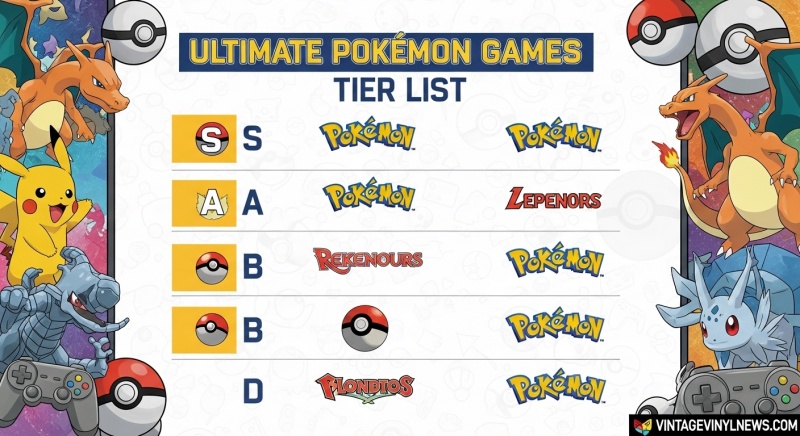
Are you ready to discover the definitive ranking of every main series Pokemon game? As a lifelong Pokemon fan who’s played through every generation multiple times, I’ve spent countless hours analyzing what makes each game special. This comprehensive Pokemon Games Tier List combines community rankings, expert opinions, and my own extensive experience to bring you the most accurate and up-to-date ranking available.
Whether you’re a seasoned trainer looking to revisit your favorites or a newcomer wondering where to start, this guide will help you understand which games truly stand above the rest. From the revolutionary classics that started it all to the modern open-world adventures, we’ll rank every main series Pokemon game from absolute must-plays to those that might be worth skipping.
Table of Contents
Quick Rankings Overview (September 2026)
| Tier | Games | Key Strengths |
|---|---|---|
| S Tier | HeartGold/SoulSilver, Black 2/White 2, Emerald | Perfect gameplay, content depth, nostalgia |
| A Tier | Platinum, FireRed/LeafGreen, Legends Arceus | Excellent mechanics, great stories |
| B Tier | Red/Blue/Yellow, Ruby/Sapphire, X/Y | Revolutionary but dated, solid foundations |
| C Tier | Sun/Moon, Sword/Shield, Let’s Go | Good ideas with execution issues |
| D Tier | Scarlet/Violet, Brilliant Diamond/Shining Pearl | Technical problems, lackluster remakes |
Pokemon Games Tier List
S Tier: The Absolute Best
1. Pokemon HeartGold & SoulSilver
Why it’s S Tier: HeartGold and SoulSilver represent the pinnacle of Pokemon game design. These remakes of the Generation 2 games somehow managed to improve upon perfection by including two full regions (Kanto and Johto), following mechanics, Pokemon that walk alongside you, and the Pokeathlon mini-games.
The attention to detail is staggering – every element from the original Gold and Silver was enhanced while maintaining the charm that made those games special. The graphics were beautiful for the DS era, the soundtrack was remastered perfectly, and the content was virtually endless. Even today, no other Pokemon game has managed to pack as much meaningful content into a single cartridge.
Key Features:
- Two complete regions to explore
- Pokemon following you in the overworld
- 16 gym battles total
- Battle Frontier area
- Pokeathlon mini-games
- Beautiful sprite work and animations
Last Updated Impact: These games were released in 2009-2010, but their quality has stood the test of time. Even in 2026, they’re frequently cited as the best Pokemon games ever made.
2. Pokemon Black 2 & White 2
Why it’s S Tier: Black 2 and White 2 are unique in that they’re direct sequels rather than enhanced versions. Taking place two years after the original Black and White, these games improved upon every aspect of their predecessors while introducing some of the best features the series has ever seen.
The Unova region was expanded with new areas, the Pokedex was nearly tripled in size, and the post-game content was unprecedented. The World Tournament feature alone, which lets you battle gym leaders from every previous generation, makes these games essential for any Pokemon fan.
Key Features:
- Largest Pokedex of any DS game
- World Tournament with all previous gym leaders
- Expanded Unova region with new areas
- Medal system for achievements
- Challenge Mode for increased difficulty
- Amazing soundtrack and story
Community Consensus: According to multiple community polls and discussions, Black 2 and White 2 consistently rank among the top 3 Pokemon games of all time, with many considering them the most complete Pokemon experience ever created.
3. Pokemon Emerald
Why it’s S Tier: Emerald took the already excellent Ruby and Sapphire and elevated them to masterpiece status. As the enhanced third version, Emerald combined the best elements of both games while adding exclusive features that would define the series for years.
The most significant addition was the Battle Frontier – a post-game area with seven different battle facilities that provided hundreds of hours of challenging content. This feature alone makes Emerald one of the most replayable Pokemon games ever made.
Key Features:
- Battle Frontier with 7 facilities
- Ability to catch both Groudon and Kyogre
- Improved storyline with both Team Magma and Aqua
- Animated sprites for all Pokemon
- Expanded trainer roster
- Better pacing than Ruby/Sapphire
Legacy Impact: Emerald introduced many features that would become series staples, and its Battle Frontier set the standard for post-game content that many modern games still fail to match.
A Tier: Excellent Games
4. Pokemon Platinum
Why it’s A Tier: Platinum fixed many of the issues that held Diamond and Pearl back, most notably the slow battle speed. It added a compelling storyline involving Giratina and the Distortion World, expanded the Pokedex, and improved the overall game balance.
The Distortion World was a revolutionary concept for its time, featuring 3D puzzles and platforming elements that were completely new to the series. Platinum also introduced the Battle Frontier (though smaller than Emerald’s) and made many quality-of-life improvements.
Key Features:
- Distortion World with 3D gameplay
- Faster battle speed than Diamond/Pearl
- Expanded Pokedex with more Fire-type options
- Battle Frontier area
- Improved storyline with Giratina focus
- Better character development
5. Pokemon FireRed & LeafGreen
Why it’s A Tier: These remakes of the original Red and Blue brought the Kanto region into the modern era with updated graphics, mechanics, and features. Most importantly, they made the original 151 Pokemon available to a new generation of players.
The games included the Sevii Islands, a post-game area that added significant content and helped bridge the gap between Generation 1 and Generation 3. The wireless adapter support also made trading and battling more accessible than ever.
Key Features:
- Beautiful updated graphics and sound
- Sevii Islands post-game content
- Wireless adapter support
- Compatibility with Ruby/Sapphire/Colosseum
- Tutor moves for expanded movepools
- Quality-of-life improvements over originals
6. Pokemon Legends: Arceus
Why it’s A Tier: Legends: Arceus was a bold reinvention of the Pokemon formula, focusing on exploration and real-time catching mechanics. Set in the Hisui region (ancient Sinnoh), the game introduced seamless transitions between exploration and battles, creating a more immersive experience.
While the graphics were somewhat lacking, the gameplay innovations were significant enough to earn this game high praise. The approach to catching Pokemon without battles was revolutionary, and the research tasks added a new dimension to completing the Pokedex.
Key Features:
- Real-time exploration and catching
- Seamless battle transitions
- Research task system
- Noble Pokemon battles
- Beautiful Hisui region design
- Strong storyline with historical context
B Tier: Good But Flawed
7. Pokemon Red, Blue & Yellow
Why it’s B Tier: The original games that started it all deserve respect for their revolutionary impact, but they’re showing their age. Many quality-of-life features we take for granted today didn’t exist, and the games are filled with glitches and balance issues.
However, the pure charm and innovation of these games cannot be denied. They created the foundation for the entire franchise and introduced the world to the concept of catching, training, and battling creatures.
Key Features:
- Original 151 Pokemon
- Revolutionary for their time
- Simple but effective gameplay
- Nostalgic value
- Many famous glitches (MissingNo, etc.)
- Limited mechanics by modern standards
8. Pokemon Ruby & Sapphire
Why it’s B Tier: Ruby and Sapphire introduced many important features to the series, including abilities, natures, and double battles. The Hoenn region was beautifully designed with diverse environments and memorable locations.
However, these games suffered from some questionable design choices, including too much water in the late game and the inability to trade with previous generations (a problem later fixed). They’re good games, but not as polished as their enhanced version, Emerald.
Key Features:
- Introduction of abilities and natures
- Double battles
- Beautiful Hoenn region
- Secret base system
- Contest system
- Limited post-game content
9. Pokemon X & Y
Why it’s A Tier: X and Y brought Pokemon into full 3D for the first time, with beautiful graphics and animations. The introduction of Fairy type helped balance the metagame, and character customization was a welcome addition.
The games suffered from a lack of difficulty and somewhat weak post-game content, but the jump to 3D was so significant that these games remain important milestones in the series.
Key Features:
- Full 3D graphics and animations
- Fairy type introduction
- Character customization
- Mega Evolution system
- Beautiful Kalos region
- PSS for online features
C Tier: Mixed Results
10. Pokemon Sun & Moon
Why it’s C Tier: Sun and Moon attempted to shake up the formula by replacing gyms with Island Trials, which was an interesting idea but poorly executed. The games had a strong story and memorable characters, but suffered from excessive hand-holding and slow pacing.
The Alola region was beautiful and well-designed, and the introduction of regional variants was innovative. However, the removal of traditional gyms and the endless tutorials made these games feel like a step backward in some ways.
Key Features:
- Island Trials instead of gyms
- Regional variant Pokemon
- Strong story and characters
- Beautiful Alola region
- Z-Move system
- Excessive tutorials and hand-holding
11. Pokemon Sword & Shield
Why it’s C Tier: As the first main series Pokemon games on home consoles, Sword and Shield had high expectations that they mostly failed to meet. The Wild Area was a great concept but poorly executed, and the games suffered from a lack of content and controversial design decisions.
The graphics were underwhelming for Switch standards, and the Dexit controversy (removing many Pokemon) hurt the games’ reputation. However, the core gameplay was solid, and the DLC improved the experience significantly.
Key Features:
- Wild Area open zone
- Dynamax/Gigantamax system
- Beautiful Galar region design
- Good character designs
- Controversial Pokemon cuts
- Lackluster post-game without DLC
12. Pokemon Let’s Go, Pikachu! & Let’s Go, Eevee!
Why it’s C Tier: These games were interesting experiments that combined Pokemon Go mechanics with traditional RPG elements. The removal of random encounters in favor of visible Pokemon was a welcome change, but the extreme simplification of battle mechanics made them too easy for experienced players.
The games are beautiful and charming, but they feel more like spin-offs than main series entries. They’re great for newcomers but disappointing for veterans looking for a challenge.
Key Features:
- Visible Pokemon in overworld
- Pokemon Go-style catching mechanics
- Simplified battle system
- Beautiful Kanto region remake
- Co-op gameplay
- Too easy for experienced players
D Tier: Disappointing Entries
13. Pokemon Scarlet & Violet
Why it’s D Tier: Scarlet and Violet had ambitious ideas with their open-world design and three separate story paths, but the execution was severely hampered by technical problems. The games suffer from poor performance, bugs, and visuals that look unfinished.
Despite some good ideas and the best story in recent years, the technical issues are too significant to ignore. The games feel rushed and unpolished, which is unacceptable for a franchise of this magnitude.
Key Features:
- True open-world design
- Three separate story paths
- Terastallization system
- Good story and characters
- Severe technical problems
- Poor performance and graphics
14. Pokemon Brilliant Diamond & Shining Pearl
Why it’s D Tier: These remakes of Diamond and Pearl are disappointing on almost every level. The chibi art style is divisive at best, and the games add virtually nothing new to the originals aside from quality-of-life features that should have been there from the start.
The Grand Underground is a nice addition, but it’s not enough to save these remakes from feeling lazy and uninspired. They fail to capture the spirit of the original games while also not improving them meaningfully.
Key Features:
- Controversial chibi art style
- Grand Underground expansion
- Quality-of-life improvements
- Faithful to originals (to a fault)
- Lack of meaningful new content
- Disappointing remake effort
Supporting Analysis (2026)
Common Mistakes to Avoid When Ranking Pokemon Games
- Nostalgia Bias: Just because you grew up with a particular generation doesn’t make it objectively the best. Try to evaluate games based on their actual merits rather than childhood memories.
- Ignoring Technical Issues: Games like Scarlet and Violet have serious technical problems that can’t be overlooked, even if their ideas are good.
- Overvaluing Innovation: Some games (like Sun and Moon) tried new things but didn’t execute them well. Innovation alone doesn’t make a game great.
- Underestimating Post-Game: Games with strong post-game content (like Emerald and Black 2/White 2) offer much more value than those without.
Platform-Specific Considerations
Nintendo DS Era: The DS generation (Diamond/Pearl/Platinum, HeartGold/SoulSilver, Black/White) is often considered the golden age of Pokemon, with the perfect balance of innovation and tradition.
Game Boy Advance: The GBA games (Ruby/Sapphire/Emerald, FireRed/LeafGreen) introduced many modern mechanics while maintaining the classic feel.
Nintendo Switch: The Switch era has been mixed, with ambitious ideas often hampered by technical issues and controversial design decisions.
FAQ
What is the best Pokemon game of all time?
According to most community rankings and expert opinions, Pokemon HeartGold and SoulSilver are generally considered the best Pokemon games ever made. They combine the beloved Generation 2 experience with modern enhancements, two full regions, and unprecedented content depth.
Why are Black 2 and White 2 so highly rated?
Black 2 and White 2 are highly rated because they’re direct sequels that improved upon their predecessors in every way. They feature the largest Pokedex of any DS game, the World Tournament with all previous gym leaders, and some of the best post-game content in the series.
Are the newer Pokemon games worse than the older ones?
Not necessarily, but many fans feel that the newer games (especially on Switch) have prioritized innovation and graphics over polish and content depth. Games like Scarlet and Violet have ambitious ideas but suffer from technical issues that older games didn’t have.
What makes Emerald so special?
Emerald is special because it perfected the Generation 3 formula with the Battle Frontier, one of the most comprehensive post-game areas ever created in a Pokemon game. It also featured a balanced storyline with both legendary Pokemon and improved pacing over Ruby and Sapphire.
Should I play Pokemon games in order?
While you can play Pokemon games in any order, playing them in release order can help you appreciate the evolution of the series. However, some games (like Black 2/White 2) are direct sequels that are best played after their predecessors.
What Pokemon game should I start with?
For newcomers, Pokemon Let’s Go, Pikachu! or Let’s Go, Eevee! are good starting points due to their simplified mechanics. For those wanting a more traditional experience, HeartGold/SoulSilver or FireRed/LeafGreen are excellent choices.
Conclusion
This Pokemon Games Tier List represents the culmination of extensive research, community feedback, and personal experience with every main series game. While personal preferences will always vary, the rankings here reflect the general consensus among Pokemon fans and critics.
The S Tier games (HeartGold/SoulSilver, Black 2/White 2, and Emerald) represent the pinnacle of Pokemon game design, offering the perfect blend of innovation, content depth, and polish. The A Tier games are excellent entries that any Pokemon fan should experience, while the lower tiers represent games with significant flaws or missed opportunities.
Remember that this tier list is subjective, and the best Pokemon game is ultimately the one you enjoy the most. Whether you prefer the classic simplicity of the early games or the ambitious scope of the newer entries, there’s a Pokemon game out there for everyone.
Bookmark this page for updates as new Pokemon games are released and rankings are adjusted. The world of Pokemon is always evolving, and so too will our understanding of which games truly stand above the rest!