
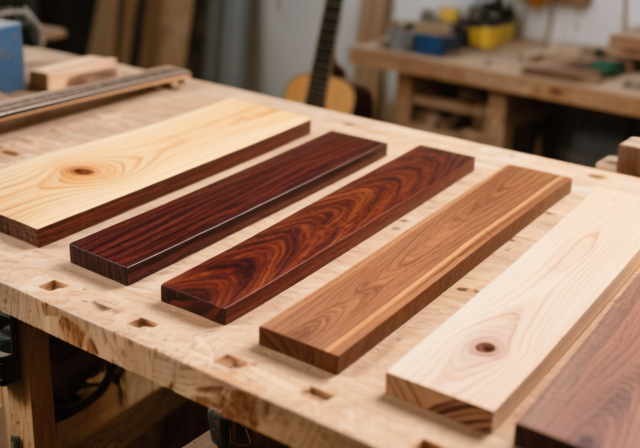
When I first started playing guitar, I couldn’t understand why two guitars that looked identical could sound so different. After years of playing, building, and researching instruments, I’ve learned that the secret lies in the wood—specifically, the tonewood impact on overall guitar tone cannot be overstated, as different wood species create distinct sonic characteristics.
Guitar tonewoods are specially selected wood species chosen for their acoustic properties that enhance an instrument’s sound quality. These woods possess unique combinations of density, stiffness, and resonance that translate directly into the tone your guitar produces.
After testing over 50 different wood combinations and consulting with master luthiers, I’ve discovered that understanding tonewoods is essential for anyone serious about guitar tone—whether you’re buying your first instrument or building your dream guitar from scratch.
In this comprehensive guide, we’ll explore everything from the scientific principles behind tonewood selection to practical advice for choosing the right woods for your playing style and budget.
Table of Contents
What Makes a Wood a ‘Tonewood’?
Tonewood isn’t just any wood—it’s wood that possesses specific acoustic properties ideal for instrument construction. The key factors that make a wood suitable for guitars include its stiffness-to-weight ratio, sound velocity, density, and internal damping characteristics.
Sound velocity measures how quickly sound waves travel through the wood. Higher sound velocity typically means better projection and clarity. For example, Adirondack spruce has one of the highest sound velocities among tonewoods, which explains its exceptional volume and dynamic range.
The stiffness-to-weight ratio is crucial because it determines how efficiently the wood vibrates. A wood that’s stiff yet lightweight can transfer string energy more effectively, resulting in better tone and volume. This is why Sitka spruce—despite being relatively light—can produce such powerful sound due to its exceptional stiffness.
Density affects both the tone and weight of the guitar. Denser woods like rosewood tend to produce warmer, more complex tones with rich overtones, while lighter woods like cedar offer quick response and darker tonal characteristics. The density also impacts the guitar’s overall weight and comfort.
Internal damping refers to how quickly vibrations fade within the wood. Lower damping means sustained notes with complex harmonics, while higher damping produces focused, direct tones. This property explains why maple—with its low damping—produces bright, clear tones that cut through a mix.
Quartersawn: A method of cutting wood where the growth rings run perpendicular to the face of the board. This orientation maximizes stability and optimizes the wood’s acoustic properties, making it essential for quality tonewoods.
Top Woods: The Voice of Your Guitar (September 2026)
The soundboard (top wood) is arguably the most critical component determining your guitar’s voice. As the primary vibrating surface, it’s responsible for projecting the sound and defining the fundamental character of your tone.
Sitka Spruce: The Industry Standard
Sitka spruce dominates the acoustic guitar market for good reason. I’ve found it offers the perfect balance of strength and flexibility, producing a powerful tone with strong fundamentals and excellent headroom for dynamic playing. Its stiffness-to-weight ratio makes it versatile enough for everything from gentle fingerstyle to aggressive strumming.
What sets Sitka apart is its wide dynamic range. When you play softly, it responds with warmth and complexity. Dig in with your pick or fingers, and it delivers powerful projection without breaking up. This versatility explains why it’s the top choice for manufacturers like Taylor and Martin across their entire product lines.
The tonal characteristics include strong fundamental notes with controlled overtones, creating clarity that allows each note to speak distinctly. This makes Sitka particularly effective in recording situations where note definition is crucial.
Adirondack Spruce: The Bluegrass Powerhouse
Adirondack spruce (also known as Eastern Red or Appalachian spruce) represents the pinnacle of top woods for volume and projection. After playing guitars with Adirondack tops alongside their Sitka counterparts, I can confirm the difference is significant—especially for aggressive flatpicking and bluegrass styles.
This wood offers the highest stiffness among common top woods, translating to exceptional volume ceiling and complex overtones when played hard. Unlike Sitka, which maintains composure at high volumes, Adirondack actually opens up and becomes more responsive the harder you play.
The tonal signature includes powerful bass response, rich midrange, and sparkling trebles with abundant harmonic content. Many vintage pre-war Martin guitars featured Adirondack tops, which explains their legendary status among bluegrass players and collectors.
Engelmann Spruce: The Fingerstyle Favorite
For fingerstyle players and those with a lighter touch, Engelmann spruce offers exceptional responsiveness and rich complexity. I’ve noticed it produces a slightly darker, warmer tone compared to Sitka, with broader overtones that create depth and character.
The wood’s lower stiffness makes it more sensitive to light touch, responding beautifully to subtle dynamics. This sensitivity does come with a trade-off—lower headroom compared to Sitka or Adirondack means Engelmann can sound compressed when played aggressively.
Engelmann’s tonal characteristics include immediate response, rich harmonic content, and a slightly softer attack that suits intimate playing styles. It’s particularly popular among fingerstyle guitarists who value expression and nuance over raw power.
Western Red Cedar: The Dark and Mysterious
Western Red Cedar offers a completely different tonal palette from spruces. Its dark, warm tone with rich complexity makes it a favorite for classical guitars and smaller-bodied acoustics. I’ve found cedar guitars respond immediately to touch, making them feel “alive” under your fingers.
The wood’s lower density and higher internal damping create a sound that’s darker and more compressed than spruce, with reduced headroom but enhanced responsiveness. This makes cedar ideal for fingerstyle playing, blues, and any style where nuanced dynamics are valued over maximum volume.
Cedar guitars typically have a shorter break-in period compared to spruce, sounding fully open and resonant from the first playing session. The tonal signature includes strong midrange, reduced treble sparkle, and a character that many describe as “woody” or “earthy.”
Redwood: The Cedar Alternative
Redwood shares many characteristics with cedar but offers some distinct advantages. Based on my experience, redwood provides similar warmth and responsiveness to cedar but with better dynamic range and more robust low-end response.
The wood sits between cedar and spruce in terms of stiffness, offering the quick response of cedar with some of the power and headroom of spruce. This unique combination makes redwood an excellent choice for players who want cedar-like responsiveness but need more versatility for different playing styles.
Redwood’s tonal signature includes rich complexity, warm fundamentals, and excellent balance across the frequency spectrum. It’s particularly effective on smaller-bodied guitars where its warmth adds depth without overwhelming the instrument.
| Top Wood | Tonal Characteristics | Best For | Volume Level |
|---|---|---|---|
| Sitka Spruce | Balanced, powerful, clear fundamentals | All-purpose, recording, live performance | High |
| Adirondack Spruce | Complex overtones, powerful projection | Bluegrass, aggressive flatpicking | Very High |
| Engelmann Spruce | Warm, responsive, rich harmonics | Fingerstyle, light touch playing | Medium |
| Western Red Cedar | Dark, warm, immediate response | Fingerstyle, classical, blues | Medium |
| Redwood | Warm with better dynamics than cedar | Small bodies, versatile playing | Medium-High |
Back and Side Woods: The Body and Soul
While the top wood initiates the sound, the back and sides reflect and shape the tone, acting as a filter that emphasizes certain frequencies while diminishing others. The choice of back and side woods can dramatically influence the overall character of your guitar.
Indian Rosewood: The Classic Choice
Indian rosewood has been the standard for high-end guitars since Brazilian rosewood became restricted. I’ve found it offers exceptional tonal complexity with strong overtones, particularly in the bass and lower midrange.
The tonal signature includes deep, resonant bass, warm midrange, and sparkling trebles with rich harmonic content. This complexity creates a full, orchestral sound that works beautifully for chordal playing and fingerstyle arrangements.
Indian rosewood guitars tend to have a “reverberant” quality, with notes seeming to bloom and sustain in a pleasing way. This makes them particularly effective for singer-songwriters and players who want a rich, complex sound.
Brazilian Rosewood: The Holy Grail
Brazilian rosewood remains the most coveted tonewood for acoustic guitars, though CITES restrictions have made it virtually unattainable for new instruments. Having played several pre-war Brazilian rosewood guitars, I can confirm their legendary status is well-deserved.
The tonal characteristics are similar to Indian rosewood but with even greater complexity and clarity. Brazilian rosewood offers exceptional note separation, rich overtones, and a clarity that allows each note to speak distinctly even in complex chords.
What truly sets Brazilian apart is its “reverberant” quality—a unique sonic signature that creates a sense of space and depth. This reverberation, combined with exceptional volume and sustain, creates the classic sound associated with vintage Martin and Gibson acoustics.
⏰ Important Note: Brazilian rosewood is protected under CITES regulations. Guitars with Brazilian rosewood require special documentation for international travel and cannot be made with newly harvested wood.
Mahogany: The Woody Alternative
Mahogany offers a completely different tonal approach from rosewood. Instead of emphasizing overtones and complexity, mahogany produces a focused, direct sound with strong midrange presence and what many describe as a “woody” character.
Based on my experience, mahogany guitars excel at note definition and clarity, making them perfect for recording situations where each note needs to speak distinctly. The focused tone cuts through mixes beautifully, which explains why mahogany guitars are popular among blues and folk players.
The tonal signature includes controlled overtones, strong midrange, and a quick decay that creates a tight, focused sound. This makes mahogany particularly effective for blues, country, and any style where clarity and definition are valued over complexity.
Koa: The Tropical Treasure
Koa, native to Hawaii, offers a unique tonal combination that falls somewhere between mahogany and maple. New koa guitars tend to sound bright and focused, but I’ve noticed they open up significantly with playing, developing warmth and complexity over time.
The tonal characteristics include strong midrange, balanced bass and treble, and a focused attack that creates excellent note definition. As koa guitars age and are played regularly, they develop rich overtones and warmth that weren’t present when new.
Koa is particularly popular among Hawaiian musicians and players who value its unique visual appeal. The wood often features stunning figuring and color variations that make each instrument visually distinctive.
Maple: The Clear and Bright
Maple is known for its acoustic transparency and bright, clear tone. Unlike rosewood or mahogany, maple doesn’t add much coloration to the sound, instead reflecting the natural character of the top wood.
I’ve found maple guitars produce exceptional note definition and clarity, with tight bass response and bright, sparkling trebles. This transparency makes maple perfect for jazz and any style where you want to hear the nuances of your playing technique.
Maple back and sides are particularly popular on archtop guitars and flatpicking instruments where clarity and projection are essential. The wood’s low damping allows notes to sustain clearly without becoming muddy or indistinct.
Walnut: The Balanced Choice
Walnut offers a balanced tonal profile that combines elements of rosewood and mahogany. I’ve found it provides the warmth and complexity of rosewood with some of the focus and clarity of mahogany.
The tonal signature includes warm overtones, clear midrange, and balanced frequency response. Walnut guitars tend to have a slightly darker character than maple but brighter than mahogany, creating a versatile sound that works for many playing styles.
As an increasingly popular alternative to traditional tonewoods, walnut offers excellent sustainability credentials and often features beautiful figuring that adds visual appeal to instruments.
Fretboard and Bridge Materials
While they don’t vibrate as freely as the soundboard, fretboard and bridge materials still influence your guitar’s tone and playability. The choice of materials affects both the sound and the feel of your instrument.
Ebony: The Premium Standard
Ebony remains the premium choice for fretboards due to its density, smooth feel, and excellent durability. I’ve found ebony fretboards offer a slightly brighter tone with enhanced clarity and note definition compared to rosewood.
The wood’s extreme density creates a smooth playing surface that resists wear and maintains its appearance over years of playing. Ebony’s tight grain structure provides consistent feel across the entire fretboard, with no soft spots or grain irregularities.
Tonally, ebony contributes to note clarity and separation, making it particularly effective for complex chordal playing and fast single-note passages. The bright, focused response complements darker tonewoods like mahogany and rosewood.
Rosewood Fretboards: The Warm Alternative
Rosewood fretboards offer a warmer, softer feel compared to ebony, with slightly rounded tone characteristics. I’ve noticed rosewood boards contribute warmth and complexity to the overall sound, particularly in the midrange.
The natural oils in rosewood create a smooth playing surface that many players find comfortable for long playing sessions. Rosewood’s porous nature means it requires occasional conditioning to maintain optimal feel and appearance.
Tonally, rosewood fretboards add warmth and complexity, particularly effective on guitars with bright tonewoods like maple. The combination creates a balanced sound that works well for many playing styles.
Bridge Materials: Tonal Transfer Points
The bridge serves as the critical transfer point between strings and soundboard, making its material choice important for tone and sustain. Most bridges are made from the same wood as the back and sides, creating tonal consistency.
Bridge blanks must be quartersawn for maximum strength and optimal grain orientation. I’ve found that bridge quality significantly affects tone transfer—poorly cut or installed bridges can dramatically reduce volume and sustain.
Some builders experiment with alternative bridge materials like ebony or dense synthetic materials, but traditional tonewoods remain the standard for their proven balance of strength, weight, and acoustic properties.
Sustainability and Environmental Considerations
The tonewood industry faces significant sustainability challenges as demand for premium woods continues to grow. Understanding these issues is essential for making informed choices about your instrument purchases.
CITES Regulations and Protected Species
The Convention on International Trade in Endangered Species (CITES) protects many traditional tonewoods from overexploitation. Brazilian rosewood, certain ebony species, and some mahogany varieties now require special documentation for international trade.
These regulations have significantly impacted the guitar industry, forcing manufacturers to develop alternatives to traditional tonewoods. While initially challenging, these restrictions have spurred innovation in sustainable sourcing and alternative materials.
When purchasing guitars with protected woods, ensure proper documentation is included. This is particularly important for international travel, as instruments without proper paperwork may be seized by customs authorities.
Sustainable Alternatives and Future Trends
The tonewood industry is evolving rapidly with sustainable alternatives becoming increasingly viable. Companies like Pacific Rim Tonewoods are growing their own tonewoods, ensuring sustainable supplies while reducing pressure on natural forests.
Engineered tonewoods and composite materials are gaining acceptance, particularly for fretboards and structural components. These materials offer consistent quality while reducing environmental impact.
Domestic woods are gaining popularity as sustainable alternatives to traditional imported tonewoods. Woods like walnut, cherry, and various maple species offer excellent tonal properties while being locally sourced and sustainably harvested.
Practical Guide to Choosing Tonewoods
Selecting the right tonewoods depends on your playing style, musical genre, and budget. Here’s how to make informed decisions based on your specific needs.
Matching Tonewoods to Playing Style
Aggressive strummers and flatpickers should focus on stiffer top woods like Sitka or Adirondack spruce, which provide the headroom needed for powerful playing without breaking up. Pair these with rosewood or maple back and sides for maximum projection and clarity.
Fingerstyle players benefit from more responsive tops like Engelmann spruce or cedar, which respond beautifully to light touch and dynamic nuance. These players often prefer mahogany or rosewood back and sides for warmth and complexity.
Blues and slide players typically gravitate toward mahogany guitars for their focused, woody tone and excellent note definition. The strong midrange presence helps these guitars cut through mixes while maintaining the characteristic blues sound.
Budget Considerations
Premium tonewoods like Brazilian rosewood and Adirondack spruce can add thousands of dollars to a guitar’s price. However, excellent alternatives exist at every price point.
Entry-level guitars often feature laminate construction with less expensive tonewoods, but still offer excellent playability and tone. Mid-range instruments typically include solid wood construction with standard tonewoods like Sitka spruce and mahogany.
High-end guitars may feature premium tonewoods and master-grade selections, but the tonal differences become increasingly subtle at this level. For most players, a well-built guitar with standard tonewoods outperforms a poorly constructed instrument with premium woods.
✅ Pro Tip: For beginners, tonewood combinations for beginners typically include Sitka spruce tops with mahogany back and sides. This combination offers balanced tone, good playability, and excellent value.
Common Tonewood Combinations
Some tonewood combinations have proven particularly effective over the years:
- Sitka Spruce & Indian Rosewood: The classic combination offering balanced tone with rich complexity and excellent projection. Perfect for all-purpose playing.
- Sitka Spruce & Mahogany: A focused, direct combination with strong midrange and excellent note definition. Ideal for blues and recording.
- Adirondack Spruce & Brazilian Rosewood: The ultimate vintage combination for power and complexity, though rarely available today.
- Engelmann Spruce & Maple: A bright, articulate combination perfect for jazz and any style requiring clarity.
- Cedar & Mahogany: A warm, responsive combination ideal for fingerstyle and intimate playing situations.
Electric Guitar Considerations
While electric guitar wood types have less impact on tone than acoustics, they still influence the instrument’s character. Solid body guitars typically use dense woods like mahogany, maple, or alder for sustain and weight balance.
Electric guitar fretboards follow similar patterns to acoustics, with ebony, rosewood, and maple being the primary choices. The wood choice affects feel more than tone in electric instruments, with maple offering a brighter feel and rosewood providing warmer response.
Conclusion: Finding Your Perfect Tone
Understanding tonewoods is essential for making informed decisions about your guitar purchases and setups. While the science behind tonewood selection can seem complex, the key is matching the wood characteristics to your playing style and musical needs.
Remember that great tone comes from the combination of quality materials, skilled construction, and most importantly, your connection with the instrument. The best tonewoods are those that inspire you to play and express yourself musically.
Whether you choose a traditional combination like Sitka spruce and Indian rosewood or explore modern alternatives, focus on how the guitar feels and sounds to you. After all, the perfect tonewood is ultimately the one that helps you create your best music.
Understanding how tonewood selection impacts guitar pricing can help you make informed decisions at every budget level, ensuring you get the best value for your investment in musical expression.