
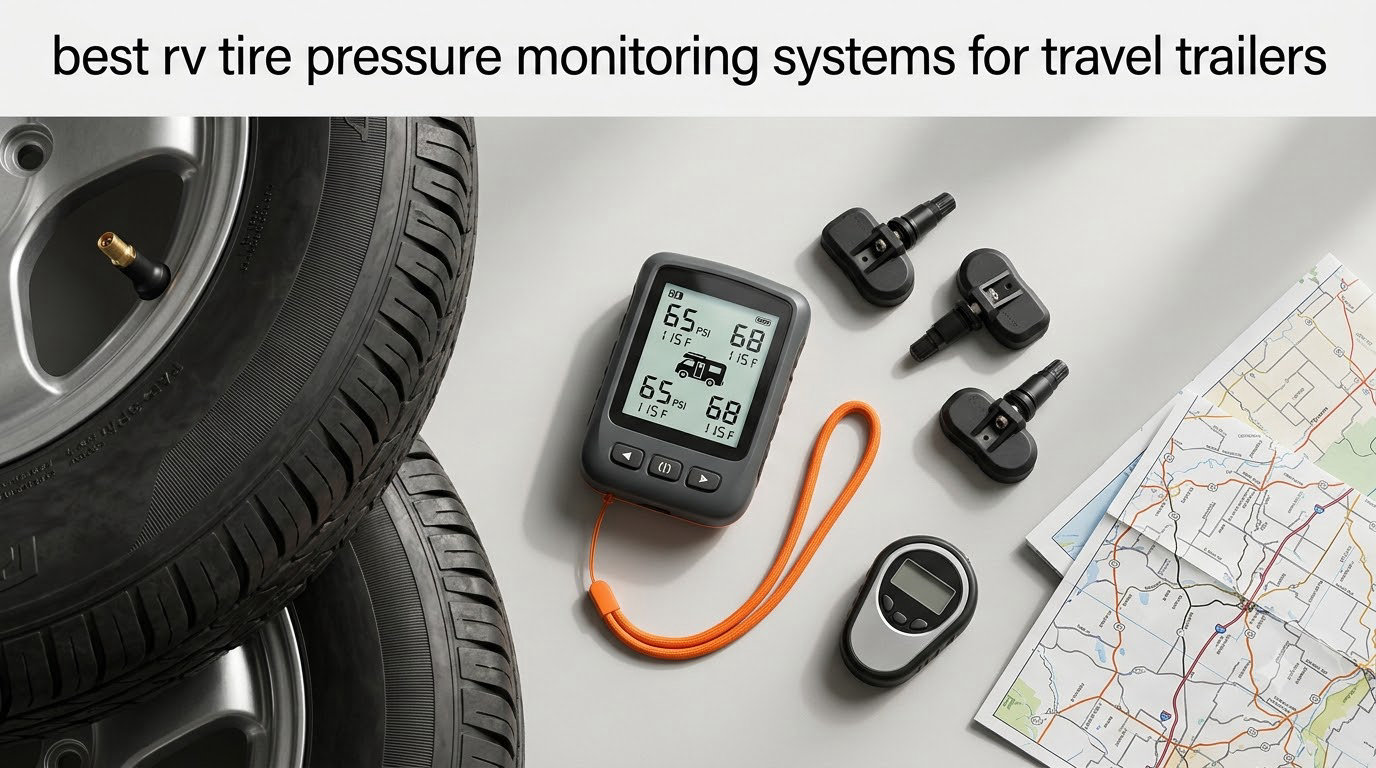
Short answer: the TST 507 is the best RV tire pressure monitoring system for most travel trailers, the TireMinder i10 is the pick if you want room for 40 tires and a signal booster in the box, and the GUTA GT30 is the one to buy when you want ten sensors and multi-tire support without moving up a tier. We compared eight systems for a dual-axle trailer, weighing alert reliability, sensor type, signal range, battery life and warranty rather than feature checklists alone.
A trailer tire is a slow-leak waiting room. Cold inflation pressure bleeds away through a nail, a bead seat or a compromised valve, the tire heats as you drive, and by the time you see it in the mirror the sidewall is already compromised. A tire pressure monitoring system puts pressure and temperature readings in front of you while you can still pull into a parking lot and add air.
That is the whole job, and the systems below all do it. The differences are in the details that decide whether you trust the alarm or start ignoring it: how fast the sensor transmits, whether the reading range actually covers your tire pressure, whether the battery inside the sensor can be replaced, and whether the display is readable in direct sun. We are not affiliated with any brand on this page, and none of the manufacturers here paid for placement.
Everything below reflects what owners report after real miles, not what the packaging promises. Where a spec is a marketing number, we say so.
Table of Contents
Top 3 Best RV Tire Pressure Monitoring Systems (October 2026)

TST 507
- 3.5 inch color display
- 4 cap sensors with repeater
- Expandable to 4 towable vehicles
- 3-year warranty

The TST 507 earns the top spot because it is the system owners name most often on Airstream, Grand Design and Thor threads, and because the sensor batteries are user-replaceable. The TireMinder i10 pairs a booster in the box with a 0-199 PSI window and room for 40 tires. The GUTA GT30 wins on value because ten sensors and a 46-tire ceiling cost less than four-sensor kits from the premium brands.
Travel Trailer TPMS Comparison in 2026
Every system below reads pressure and temperature, sounds an alarm outside your thresholds and works on a dual-axle travel trailer without drilling. The differences that matter are range, update speed, sensor type and how much of the tire pressure window the sensor can actually read.
| Product | Specifications | Action |
|---|---|---|
| TST 507 4-Sensor RV TPMS |
|
Check Latest Price |
| TireMinder i10 RV TPMS |
|
Check Latest Price |
 EEZTire 518C TPMS Pro EEZTire 518C TPMS Pro |
|
Check Latest Price |
 GUTA GT30 10-Sensor Kit GUTA GT30 10-Sensor Kit |
|
Check Latest Price |
 Tymate TM7 4-Sensor Kit Tymate TM7 4-Sensor Kit |
|
Check Latest Price |
 Masoll M13 4-Sensor Kit Masoll M13 4-Sensor Kit |
|
Check Latest Price |
 EEZTire 6-Sensor 6ATC System EEZTire 6-Sensor 6ATC System |
|
Check Latest Price |
 GUTA GT80 Flow-Through Kit GUTA GT80 Flow-Through Kit |
|
Check Latest Price |
One thing the table cannot show is sensor type. The GUTA GT80 ships with flow-through sensors, the EEZTire 6-ATC accepts anti-theft, flow-through or a mix of both, and the remaining kits use screw-on cap sensors. That choice affects how fast you can inflate a tire and whether the sensor will fit your valve stems, so we cover it in every review.
1. TST 507 is the best overall travel trailer TPMS for most owners
TST 507 Series TPMS – RV Tire Pressure Monitoring System with 4 Cap Sensors & Color Display Monitor for Travel Trailers, Campers and Motorhomes
3.5 inch color display
Cap sensors with CR2032 batteries
Includes repeater and charging cable
Pros
- Alerts for low pressure
- high pressure
- fast leaks and high temperature with auto-lock on the problem tire
- Expandable from the trailer to the tow truck and up to four towable vehicles
- User-replaceable CR2032 batteries inside every cap sensor
- Three-year warranty with USA-based live support
- Kit includes display
- 4 cap sensors
- repeater
- magnetic mount and charging cable
Cons
- Cap sensors have to be unscrewed to add air
- The repeater is one more component to mount and power
- Higher cost than entry-level four-sensor kits
This is the kit our team kept coming back to. The 507 covers the four tires of a dual-axle travel trailer out of the box, and the same receiver can pick up your tow truck plus up to four towable vehicles if you eventually add a fifth wheel or a boat trailer.
The alert set is the reason it earns the top spot. It watches for low pressure, high pressure, fast leaks and high temperature, and when a tire trips an alarm the display locks onto that tire rather than cycling past it. On a long highway run that auto-lock is the difference between reacting in two seconds and reacting after you have scrolled.
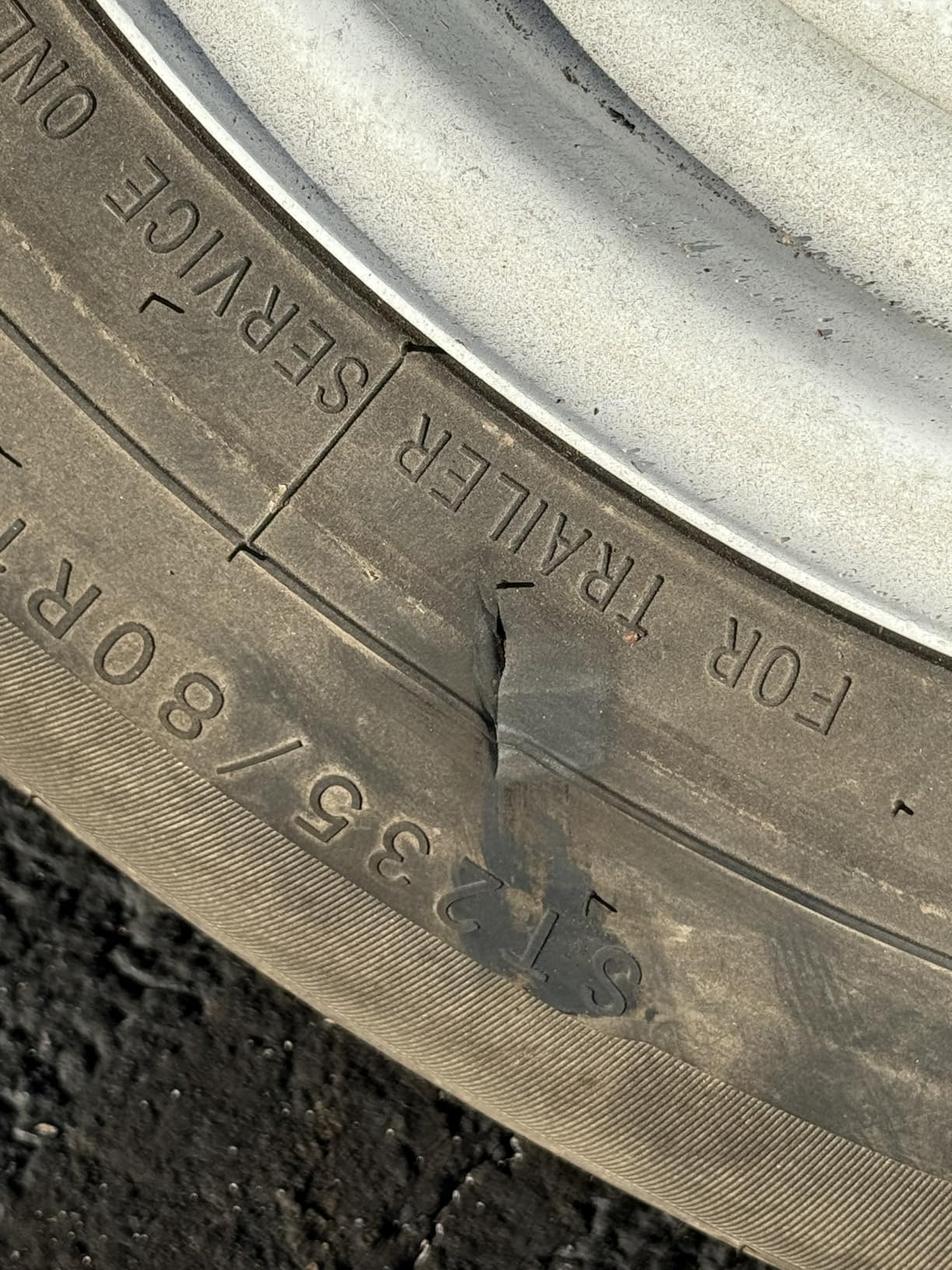
Sensors are external cap style with user-replaceable CR2032 cells. That last detail matters more than it sounds: when a sensor starts behaving oddly across a whole season, the first fix owners try is a battery change, and with this kit you can do it at the tire with a coin rather than shipping a sensor back.
The kit includes the display, four cap sensors, a repeater, a magnetic mount and a charging cable. The 3.5-inch color screen runs on a rechargeable battery with a Micro-USB charger, so you can pull it off the dash and take it with you when you walk around camp.
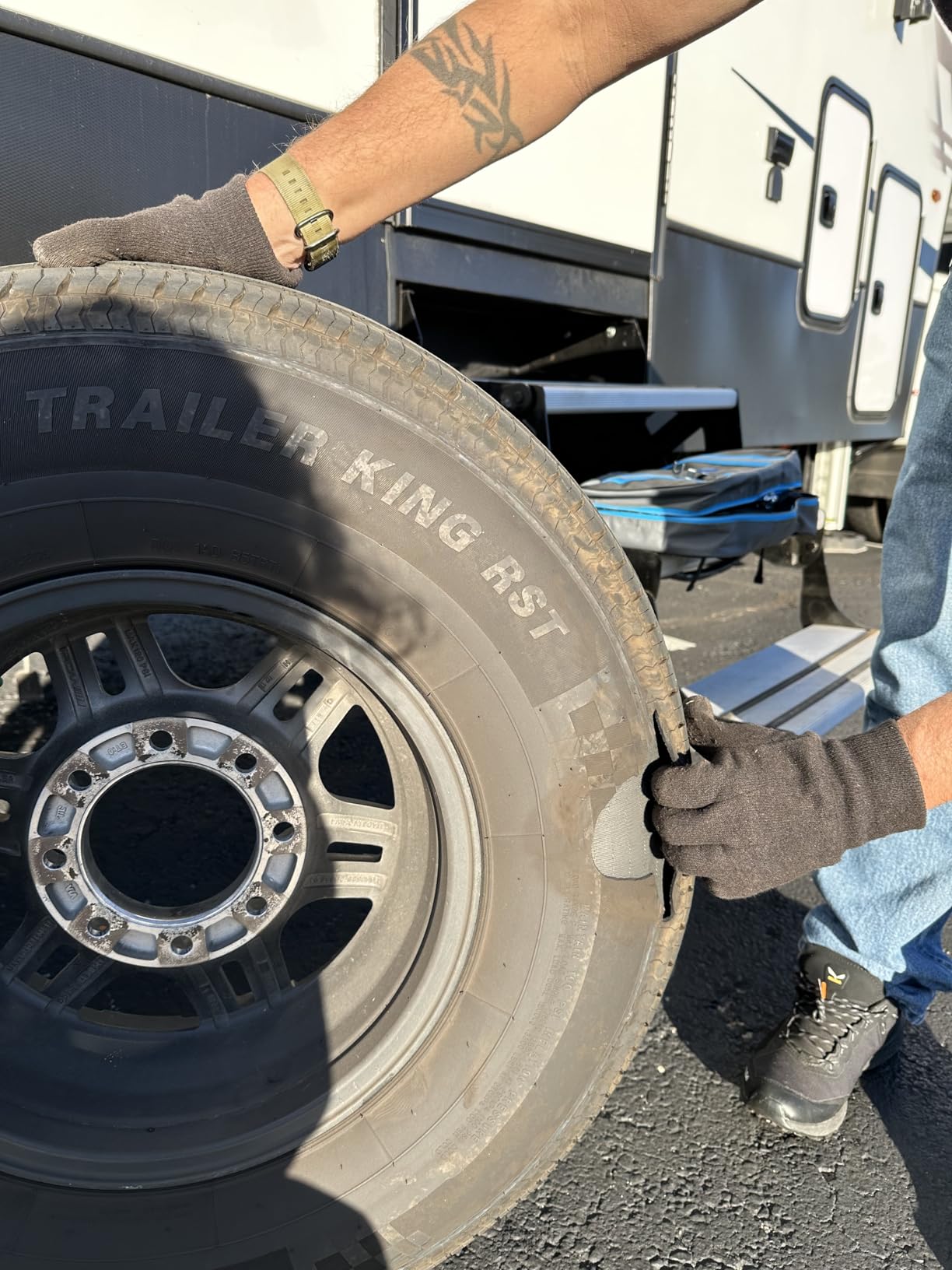
Warranty is three years with USA-based live customer service, which is double the one-year norm in this category. Owners across the RV forums consistently recommend pairing the kit with metal valve stems, and that advice applies here: the caps are heavier than a factory rubber stem and the stem is what holds the seal.
Our own read on the display size is worth stating plainly. The color screen is genuinely nice in the shade and at dusk, but in direct midday sun a lot of owners on these forums say it washes out, and several moved to the smaller monochrome version of the same system. If your rig lives in bright sun most of the year, factor that in before you fall for the bigger screen.
The TST 507 is the right pick for owners who want alerts they can trust
Long-term reports are the strongest evidence we found. One owner on the Grand Design forum reports five years and more than 50,000 miles on the original sensors. On the AirForums thread, the 507 with external sensors, metal valve stems and the monochrome display is the single most-repeated recommendation in the conversation.
That consistency matters because false alarms are the complaint that kills these systems. A tire pressure monitor you have learned to ignore is worse than no monitor at all. If you have been burned by a system before, buy the one with the longest owner track record, not the one with the longest feature list.
The TST 507 is a poor fit if you inflate your tires often
Cap sensors come off for every pressure check and every top-off. The threads are consistent on the timing: pulling a cap takes under a second, while pushing air through a flow-through unit is measured in minutes. If you check your tires weekly or top off before every trip, that adds up across a season.
There is a second cost. The included repeater has to be mounted near the front of the trailer and given power, and that is one more thing to install correctly on the first attempt. Follow the placement instructions rather than guessing, because a badly placed repeater is the leading cause of the dropouts owners report on the rear tires.
2. TireMinder i10 is the pick with 40 tire capacity and a booster in the box
TireMinder i10 RV TPMS with 4 Transmitters, Black
3.15 inch color LCD
Scans every 6 seconds
0 to 199 PSI, plus 1 PSI
Pros
- Over 1000 reviews averaging 4.4 stars
- Signal booster included in the box for longer rigs
- Scales to 40 tires across multiple vehicles
- Checks for slow leaks
- rapid leaks
- blowouts
- low and high pressure and high temperature
- Compact 0.75 x 4.15 x 4 inch body weighing 1.8 pounds
Cons
- Monitor cycles through tire groups rather than showing every tire at once
- Small 3.15 inch screen next to the larger color displays
- Transmitter batteries still need periodic replacement
With more than a thousand reviews averaging 4.4 stars, the i10 has one of the deepest piles of real-world feedback in this roundup, and 76 percent of those ratings are five stars. That is a useful signal on a product category where reliability claims are mostly unverifiable marketing.
The 3.15-inch color LCD shows simultaneous PSI or temperature readings, and the monitor rescans every six seconds. Six seconds is fast enough to catch a fast leak while you are still merging onto the highway, and the alarm set covers slow leaks, rapid leaks, blowouts, low pressure, high pressure and high temperature.
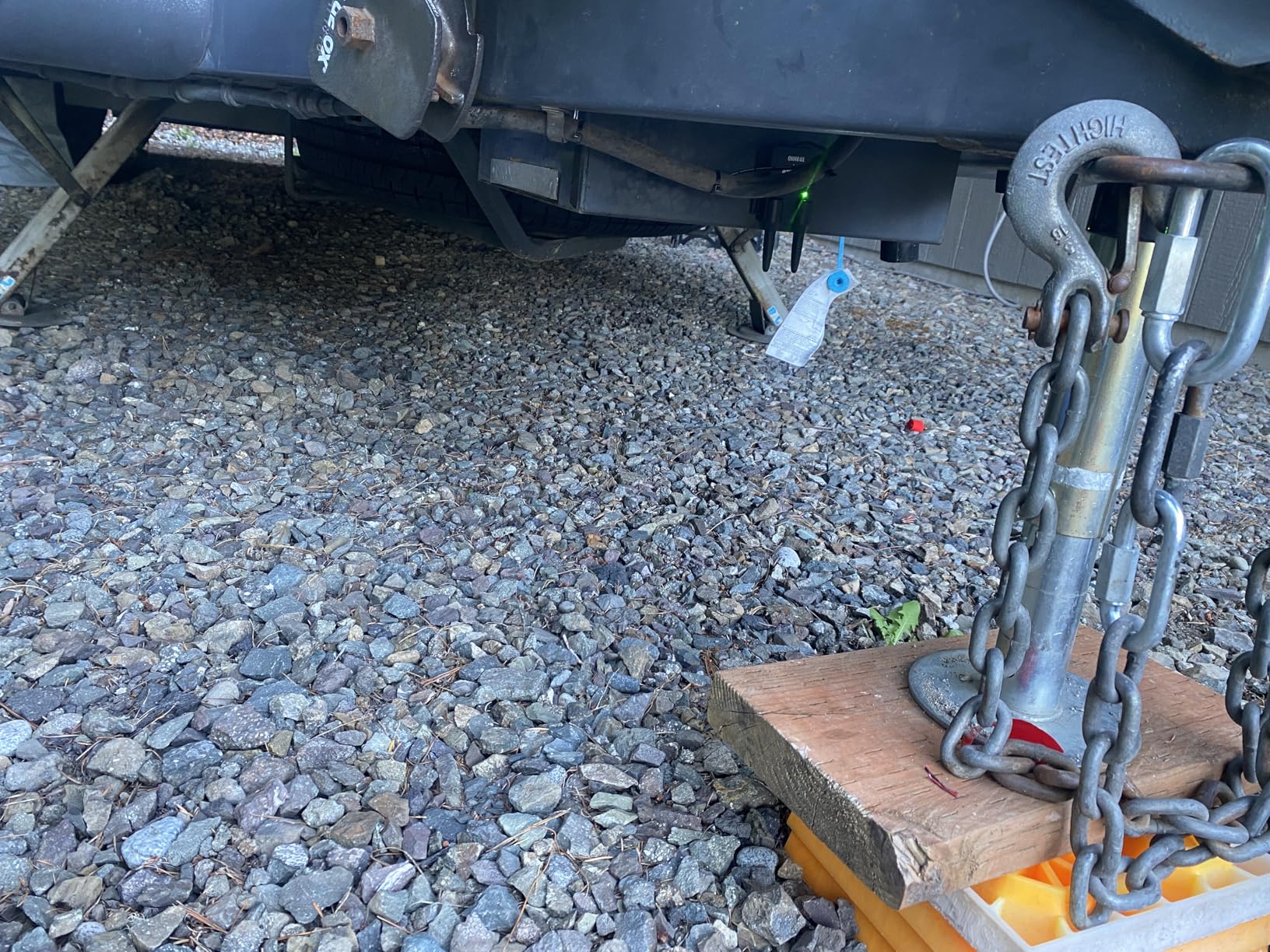
The range is the differentiator. It monitors up to 40 tires from 0 to 199 PSI with a stated accuracy of plus or minus 1 PSI, which means it reads low-pressure trailer tires and high-pressure truck tires without a mode switch. The four transmitters in the kit cover a dual-axle trailer, and you add more as your rig list grows.
Four transmitters plus a signal booster are in the box. On rigs where the rear tires sit far from the receiver, that booster is the difference between a clean readout and a tire that keeps dropping off the display. Eight lithium batteries are included for the transmitters.
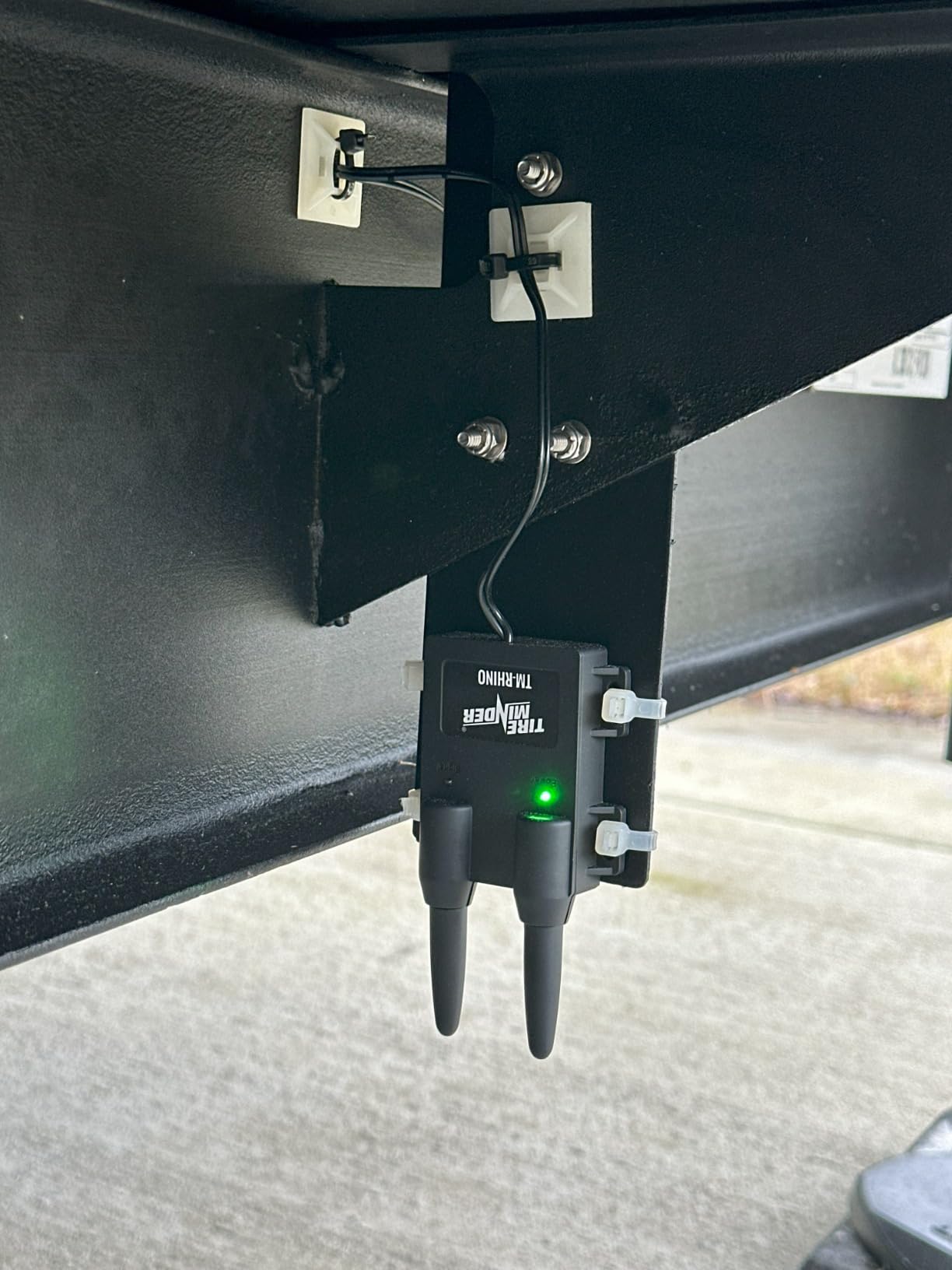
Owners describe the i10 as accurate and steady over time, including a long run from Minnesota to Arizona in December that swung through serious temperature change. Support is repeatedly praised for actually answering the phone, which sounds like a small thing until you have a sensor fail two hours from a town with no parts store.
One design choice trips people up. The monitor cycles through tire groups rather than laying out every tire on one screen, so reading the whole rig takes a couple of seconds of button pressing. Owners who got used to it rarely complain again, but if you want a single glance at all four tires, this is not that display.
The TireMinder i10 is the right pick for owners running more than one rig
A 40-tire ceiling and a 0-199 PSI window make this the natural choice if you tow a truck with a fifth wheel, run a boat trailer alongside the camper, or want one monitor to cover the whole yard. It is the only kit here that pairs a booster with that much capacity in the box.
It is also the safest answer for anyone whose tire pressures run high. Several budget systems in this category cap out far below what many trailer tires are inflated to, and a monitor that cannot read your pressure range is not a discount, it is a blind spot.
The TireMinder i10 is a poor fit if you want every tire on one screen
The screen is 3.15 inches, which is smaller than the 4.5-inch screens on the EEZTire systems and the upright touchscreen on the GUTA GT80. In bright sun that size is a real constraint, and the group-cycling layout means there is no single frame that shows the whole trailer.
The transmitters also need batteries on a schedule. Treat the first season as a learning period, note when each one was changed, and the ongoing cost of ownership stays small. Budget for it up front and the system is unremarkable in the best way.
3. EEZTire 518C is the pick for high tire counts and the highest PSI ceiling here
EEZTire-TPMS Pro (518C) Tire Pressure and Temperature Monitoring System with 3.5″ Color Display + 4 AT Sensors, Not Compatible with Our Previous Models T515, E518, E618 Systems
26 tires up to 210 PSI
6 second motion sensitive scan
60 hour rechargeable battery
Pros
- 210 PSI ceiling ties for the highest in this roundup
- Color display described as easy to read in daylight and through polarized sunglasses
- Rechargeable lithium battery reported by owners lasting multiple long trips on one charge
- Sensors have user-replaceable batteries
- Three-year parts warranty with technical support
Cons
- Monitor takes 10 to 20 minutes to link with all sensors at start-up
- Signal interference from wireless backup cameras or dash electronics can drop a sensor
- Dated non-touch menu makes per-tire adjustments awkward
The 518C is the system to look at if your tire pressures run high or you monitor a lot of tires. It reads up to 26 tires and handles pressures to 210 PSI, the highest ceiling in this roundup.
The monitor is motion-sensitive and scans pressure and temperature on six-second intervals, with visual and audio alarms when readings leave the parameters you set. After 15 minutes without motion it drops into a power saving mode, which is exactly the behavior you want on a trailer parked at a campsite overnight.
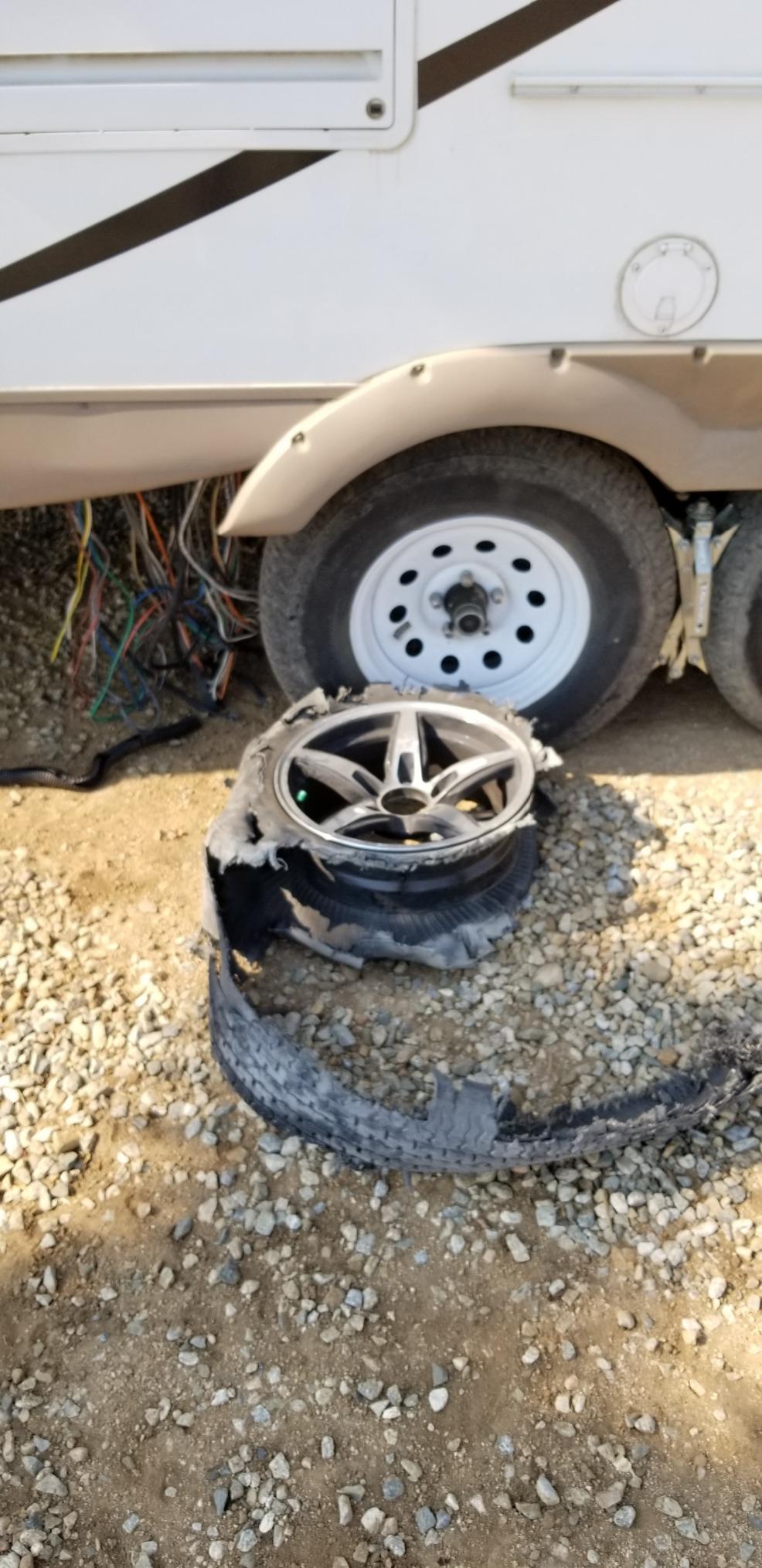
The display is 4.5 by 3 inches and runs on a built-in rechargeable lithium battery rated for up to 60 hours per charge. Owners on these forums repeatedly describe the screen as readable in daylight and while wearing polarized sunglasses, which is not a small advantage on an open dash.
Separate RV and trailer sensor controls let you set different alarm limits for the trailer and the tow vehicle, and the sensors themselves take user-replaceable batteries. The three-year parts warranty excludes batteries but includes technical support, and owners report support sending a reset procedure that solved a problem without a replacement.
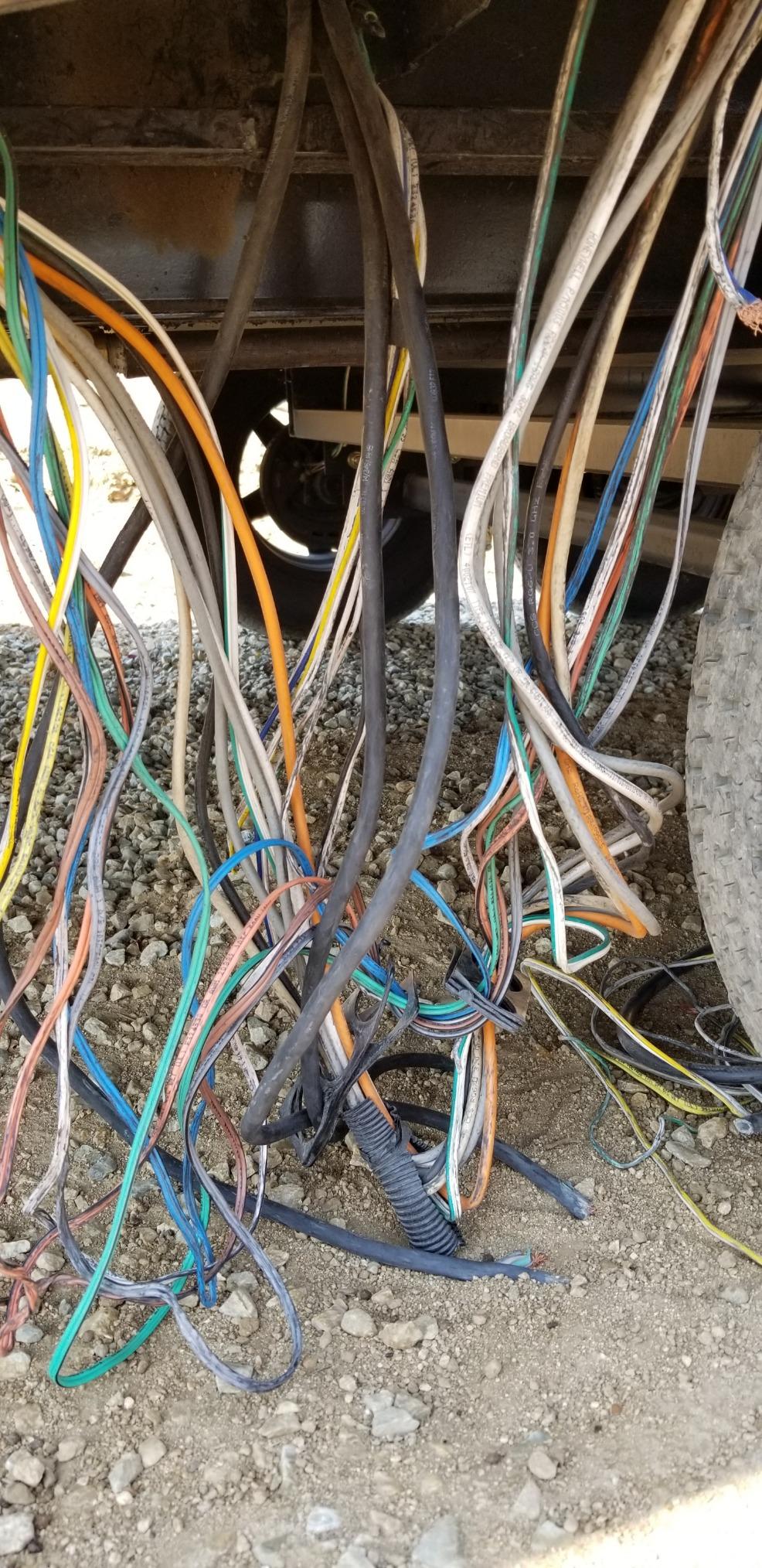
One compatibility note before you buy: this model is not compatible with earlier EEZTire systems such as the T515, E518 and E618. If you are upgrading from an older EEZTire install, the sensors do not carry over, and that is a real cost of ownership calculation rather than a footnote.
The most common complaint is the start-up link. The monitor can take 10 to 20 minutes to acquire all four sensors the first time it powers up, which alarms people who assume something is broken. Once it has the full set, the recurring reports are dependable.
The EEZTire 518C is the right pick for owners with a bright, open dash
The readability reports are consistent enough to plan around. If your tow vehicle has no windshield visor and the display sits in full sun, a larger screen with a color panel that holds contrast is worth more than a touchscreen or extra alarm modes. The audio alarm is genuinely loud, so the screen matters most when you are parked or crawling through a lot.
Owners also report running it without a repeater on a 19-foot travel trailer behind a pickup, which tells you the raw signal is strong. For a longer rig, plan on adding the optional booster rather than discovering the problem on the highway.
The EEZTire 518C is a poor fit if you want a modern interface
The menu is non-touch and dates from an earlier era of these systems. Setting per-tire limits means working through buttons rather than tapping a screen, and owners describe the process as functional rather than pleasant. Nobody in our reading called it a deal breaker, but it is the one thing people mention most when they compare it to a touchscreen.
Signal interference is the second real limitation. Wireless backup cameras and other dash electronics have been reported dropping a sensor, and the failure mode is an annoying beep with one tire missing from the display. Relocating the monitor higher with a clear line of sight, or adding a booster, resolves most of these cases.
4. GUTA GT30 is the best value pick when you want ten sensors in one box
GUTA GT30 Trailer Tire Pressure Monitoring System, RV TPMS with 10 Sensors
Up to 10 tires per page
Supports 46 tires to 188 PSI
CR2032 sensor batteries up to 4 years
Pros
- Ten sensors cover the trailer plus spares or a second rig
- Large screen showing up to 10 tires per page with automatic section switching
- Wireless pairing sets the current pressure as the reference
- Rechargeable monitor runs 12 to 14 days after a 4 hour charge
- Six alert types including missing signal and low sensor battery
Cons
- Monitor refreshes on 5 minute intervals rather than continuously
- Reference pressure alarms can need re-setup after a large inflation
- Optional booster may be needed on longer rigs
The GT30 answers a question most kits ignore: what happens when one sensor fails three states away from a parts counter. Ten sensors in the kit means a full trailer, a spare set and still coverage for a second rig.
The display is large and shows up to 10 tires per page with automatic front and rear section switching. It supports up to 46 tires, handles pressure to 188 PSI and temperature to 185 degrees F, which covers heavy trailers and fifth wheels without a mode switch.
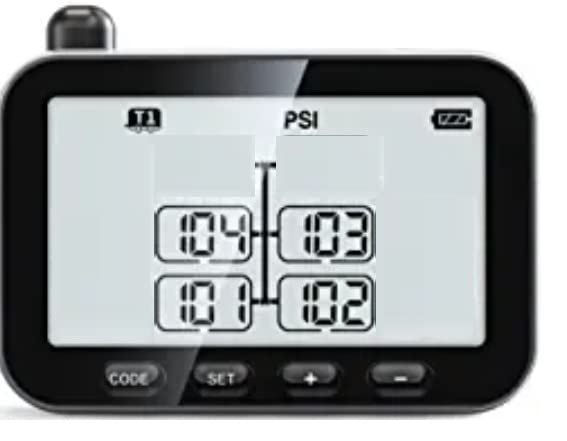
Setup is wireless. Sensors pair to the monitor and the current pressure at each tire becomes the reference, with a programmable alarm range of plus 25 percent to minus 15 percent of that reference. That removes the tedious step of typing a number for every tire, though it also means your thresholds drift if you reinflate a tire significantly.
The monitor battery is the quiet strength here. A four-hour charge gives 12 to 14 days of use, with a 10-minute power saving mode when there is no motion. Sensor batteries are user-replaceable CR2032 cells rated at up to four years, longer than the interval the other kits here state.
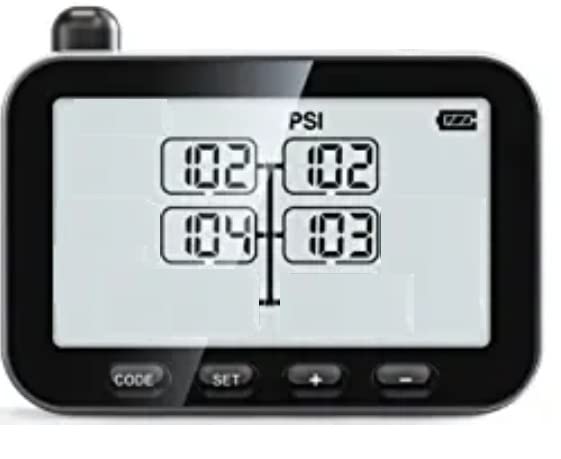
Alert types cover high and low pressure, high temperature, fast leak, missing sensor signal and low sensor battery. That last two are underrated: a missing-signal alert tells you a sensor died rather than a tire failed, which stops the two problems from being confused.
The kit ships with cap sensors, and the manufacturer is explicit that they belong on metal valve stems. On a trailer still running rubber stems, plan on replacing them as part of the install. The kit weighs about 1.5 pounds and measures roughly 11.6 by 2.8 by 8.9 inches.
The GUTA GT30 is the right pick for owners who rotate rigs or carry spares
Ten sensors is a genuinely different proposition from four. If you tow a fifth wheel in summer and a utility trailer in fall, or you simply want a full spare set on hand, this kit removes a recurring long-term cost: dead sensors on a trip.
It is also the strongest choice here for owners who monitor a lot of tires at once, with a 46-tire ceiling and a screen that shows ten at a time. For a full-time traveler with a toad, or a family running a camper plus a boat trailer, the layout scales without a second monitor.
The GUTA GT30 is a poor fit if you need second-by-second updates
The monitor sends sensor updates on five-minute intervals rather than continuously. That is fine for trend watching, which is what most owners use it for, but it is not a fast-leak detector. A tire that goes from 50 PSI to 10 in ten minutes may not register the way a six-second scan would.
The reference-pressure system is the second limitation to plan for. Inflate a tire from 50 to 60 PSI and the alarm band moves with it, which means the threshold you carefully set is no longer the threshold in force. Re-pair or reset after any significant pressure change, and do not treat the monitor as a fixed-limit gauge.
5. Tymate TM7 is the budget pick for trailers under 36 feet
Tymate TM7 RV Tire Pressure Monitoring System, TPMS Set of 4 Sensors
0 to 144 PSI range
Six alarm modes
12V plug-in with dual USB
Pros
- Lowest cost kit in this roundup
- Highest review count of any system here with 2567 reviews
- Plugs straight into the 12V socket with no wiring or permanent install
- Color LCD with adjustable backlight for day and night
- Setup takes about 5 minutes and 4 CR1632 batteries are included
Cons
- 144 PSI ceiling is lower than the premium RV systems
- Repeater recommended for trailers 36 ft or longer
- One-star reviews are 12 percent of the total
The TM7 is the system to look at when cost is the first filter. It is the least expensive kit here and carries more reviews than anything else in the group, which means the failure modes are well documented rather than mysterious.
Accuracy is stated at plus or minus 1.5 PSI or plus or minus 3 degrees F, with selectable Celsius and Fahrenheit plus BAR and PSI units. Detection range runs 0 to 144 PSI, and the monitor calibrates automatically to the center tire pressure when you pair it.
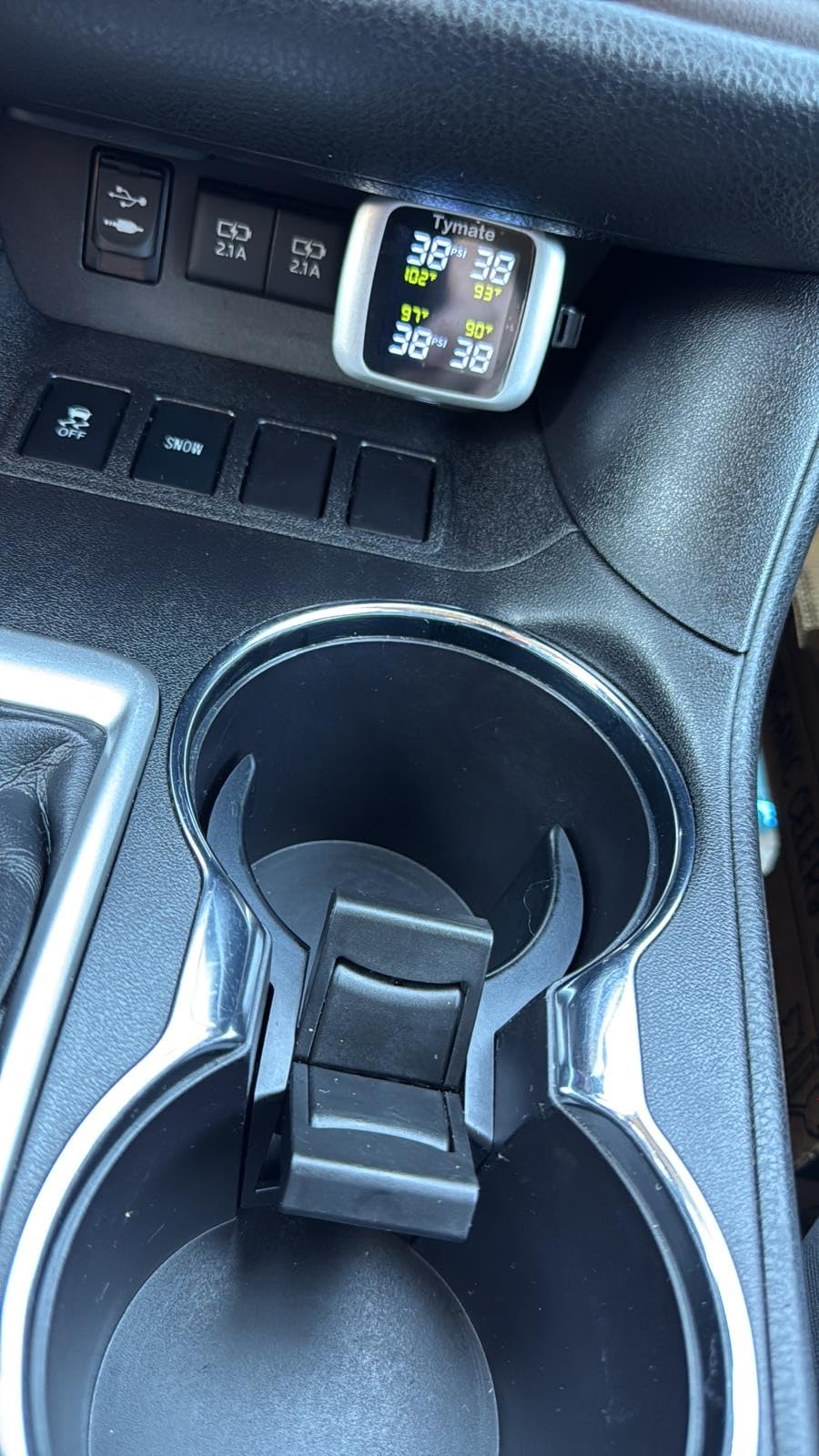
Power is the practical strength. It plugs directly into the vehicle 12V socket and includes two USB charging outlets on the housing, so a passenger can charge a phone from the same unit that powers the display. No wiring, no mount to the trailer, nothing to remove when you sell the rig.
There are six alarm modes: high and low pressure, fast leakage, high temperature, low sensor battery and signal lost. The color LCD has an adjustable backlight, and setup takes about five minutes with pairing videos on the product page and four CR1632 replacement batteries in the box.
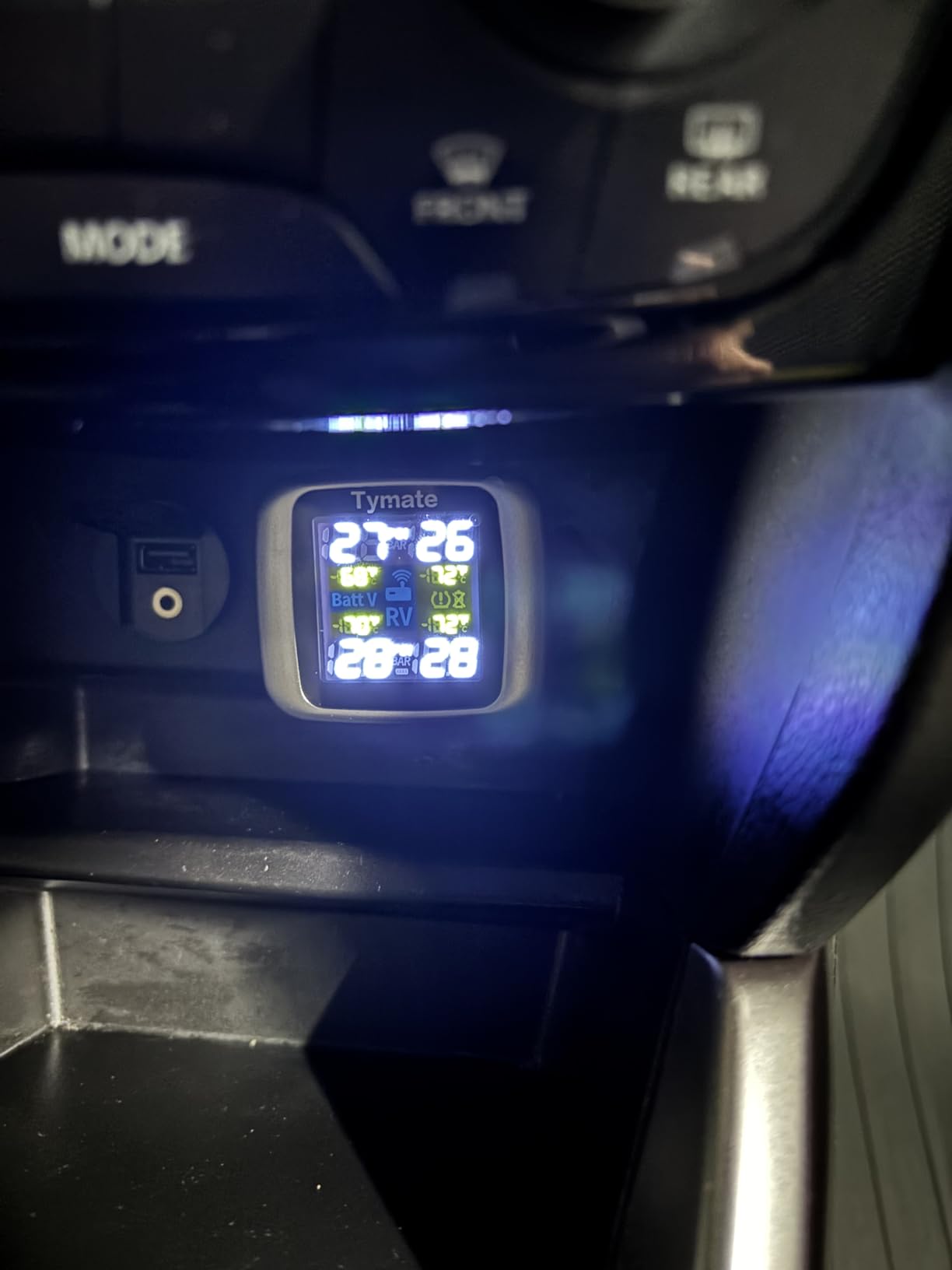
Be clear-eyed about the ceiling. A 144 PSI maximum is comfortably above normal travel trailer tire pressure, but it is well below the range the premium systems cover. If your trailer runs high-PSI tires, or you plan to monitor a truck as well, this is not the kit.
The one-star share is 12 percent here, the highest of the eight, and the recurring theme is range rather than accuracy. Metal valve stems are recommended, and a repeater is suggested for trailers 36 feet or longer, where the display switches into a trailer mode.
The Tymate TM7 is the right pick for weekend trailers on a tight budget
For a small utility trailer, a pop-up or a short dual-axle that never leaves smooth highway, the TM7 covers the job. Plug it in, pair four sensors, set your alerts and the core failure mode of a slow leak is covered.
The USB hub is a detail that gets more appreciation with use. Long trips with passengers mean phones that need charging, and having two outlets on the monitor removes the need for a separate adapter in the cigarette lighter socket.
The Tymate TM7 is a poor fit for a long fifth wheel
At 36 feet and beyond, you need the repeater, and the monitor changes behavior when the trailer mode triggers. That is a solvable problem, but it turns a plug-and-play install into a two-piece install with a mounting decision.
Sensor batteries need replacing on a schedule and rubber valve stems are not recommended. Owners running this kit long-term report that the CR1632 cells are the recurring maintenance item, along with occasional signal loss on the rearmost tire. Budget accordingly and it stays a cheap way to cover a short trailer.
6. Masoll M13 is the pick for solar charging and automatic calibration
Masoll M13 Tire Pressure Monitoring System, RV/Trailer TPMS with 4 Sensors
Solar charged display
0 to 87 PSI range
4 sensors with accessories
Pros
- Solar panel removes most plug-in charging
- Automatic reference pressure calibration sets the alarm bands for you
- Anti-reflective color LCD with automatic backlight adjustment
- Weighs 8 ounces and mounts anywhere on the dash
- Four sensors cover a typical travel trailer
Cons
- 87 PSI range is the narrowest of the eight systems here
- Signal booster recommended beyond 38 ft
- Warranty is 1 year on the monitor and 6 months on sensors
The M13 is built around a simple idea: the display should never be dead when you need it. The solar panel charges the unit continuously, with overheat and overcharge protection, so there is no cable to run and no habit of forgetting to plug it in.
Calibration is automatic as well. The pressure at pairing becomes the reference, and the alarm triggers at plus 25 percent and minus 15 percent of it. For most trailer tires that band is a reasonable window, which means the install is a five-minute job with no threshold menu to fight.
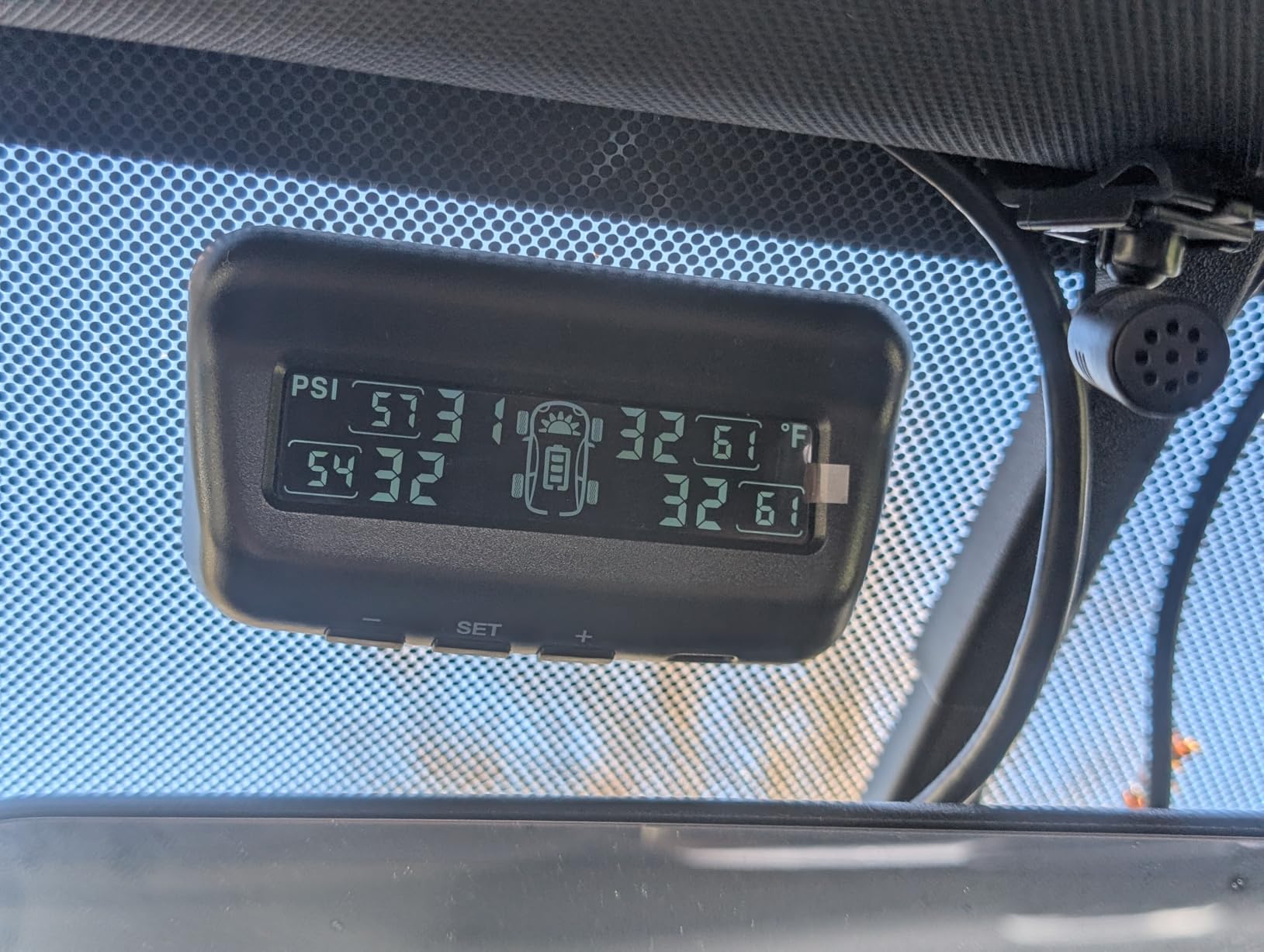
The display is a high-definition color LCD with an anti-reflective coating and automatic backlight adjustment for day and night. That combination is what we would want on a dash with no visor, and the anti-reflective coating is what keeps the readout legible in the glare that washes out simpler screens.
Pressure detection runs 0 to 87 PSI with 1.5 PSI accuracy from the built-in pressure chip, and auto wake-up and sleep modes handle the power management when the rig is parked. The box contains the LCD monitor, four sensors and accessories.
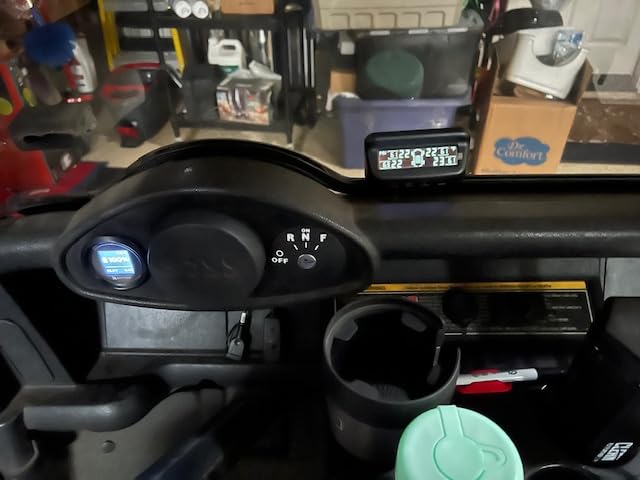
Here is the trade we would not take on a truck. An 87 PSI ceiling is the narrowest range of the eight systems here, and it will not read high-PSI truck or commercial tires. The stated application is travel trailers under 38 feet, with a signal booster recommended past that length.
The warranty is the other honest limitation: one year on the monitor and six months on the sensors. That is well short of the three-year coverage on the TST 507 and the EEZTire systems, and it is worth remembering when you are weighing a solar panel against a serviceable battery.
The Masoll M13 is the right pick for owners who forget to charge things
If your previous monitor died in the storage lot because the battery ran flat, solar charging removes that failure mode entirely. It also means you can mount the unit wherever it is most visible instead of routing a power cable to a specific socket.
The automatic reference calibration suits owners who inflate to a different pressure depending on load. Set the tires to the loaded condition you actually tow in, and the alarm band follows that number rather than a factory default you never touched.
The Masoll M13 is a poor fit if you monitor a truck as well as a trailer
The 87 PSI range stops short of most pickup tire pressures. Trying to use one monitor for a truck and a trailer on this kit means the truck readings are simply out of scope, and you are back to a second system for the tow vehicle.
Past 38 feet, the signal booster becomes necessary rather than optional. Short trailers are the sweet spot, and treating a 40-foot fifth wheel as a supported application means budgeting for the booster at the same time as the kit.
7. EEZTire 6-ATC is the pick when six sensors and flexible sensor types matter
EEZTire-TPMS6ATC Real Time/24×7 Tire Pressure Monitoring System – Color Monitor + 6 at Sensors
6 anti-theft sensors
26 tires up to 210 PSI
60 hour rechargeable monitor
Pros
- Six sensors cover a full trailer plus a spare or a second axle group
- Anti-theft sensors sit lower and weigh less than flow-through units
- Monitor can be programmed indoors on a table before install
- Battery indicator shows remaining charge so no permanent wiring
- 3 volt lithium sensor batteries are user replaceable
Cons
- Cap sensors on dual wheels are awkward to reach for inflation
- Occasional dropouts that need a repeater or better monitor placement
- Programming gives no immediate confirmation a sensor locked in
The six-sensor version of the EEZTire system solves the coverage problem that four-sensor kits leave open. Six anti-theft sensors cover a dual-axle trailer with a spare in the box, which for most owners means one flat tire does not end the trip.
It shares the platform strengths: up to 26 tires, pressure to 210 PSI, a motion-sensitive six-second scan, and a 4.5 by 3-inch display with a built-in rechargeable lithium battery rated for up to 60 hours. Visual and audio alarms fire when readings fall outside the parameters you set.
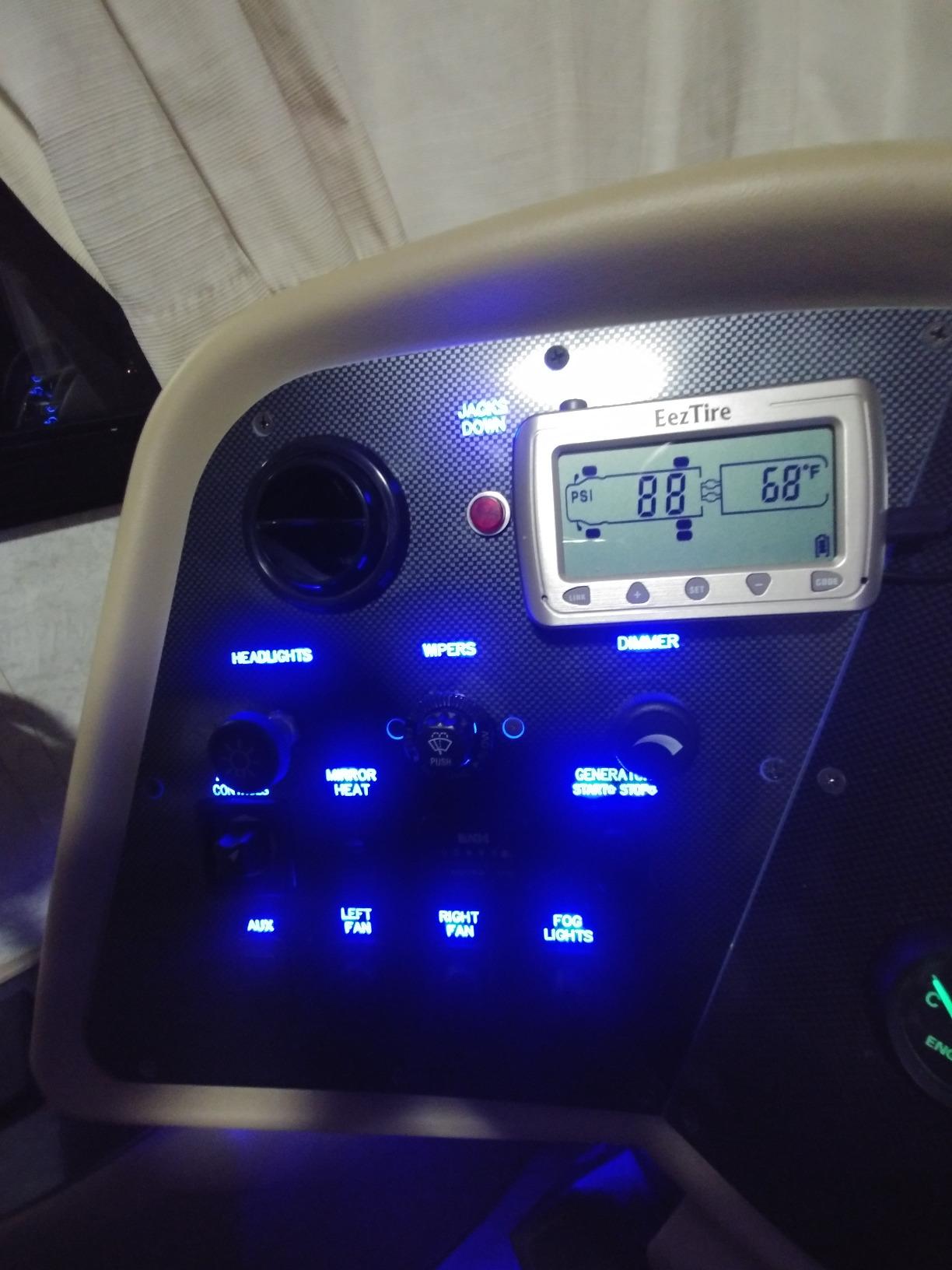
The anti-theft sensors have a lower profile, lower weight and lower height than flow-through units, so they sit closer to the rim and are less likely to be clipped. That is also why the system accepts anti-theft sensors, flow-through sensors or a mix of both, depending on which wheel you are working on.
Owners like that the monitor can be programmed indoors on a table before you go near the trailer. The battery indicator shows remaining charge, so you can run the unit without permanent wiring, and the USB charging cord works from 12V or a USB port.
Long-term reports are the strongest part of this review base. One owner describes accurate, reliable readings across five years and 14,000 miles, and others report the system alerting them to going-flat situations before they became a roadside emergency.
The EEZTire 6-ATC is the right pick for owners who want sensor flexibility
The ability to mix anti-theft and flow-through sensors on the same rig is unusual in this category. It lets you use low-profile anti-theft caps on exposed wheels and keep flow-through units where you inflate often, instead of choosing one type for everything.
Owners consistently point out that the alerts are loud enough to grab attention in an emergency. On a highway at highway speed, an audible alarm does the work that a screen glance cannot, and that is the feature that actually earns the repeat purchase.
The EEZTire 6-ATC is a poor fit if dual wheels make you reach a lot
On dual-wheel setups the inner cap sensors are hard to reach. Owners describe the awkwardness of unscrewing a sensor wedged between rims just to add air, and it is a bigger irritation on a trailer with duals than on a single-axle utility rig.
Signal dropouts are the other recurring theme, and the fix is usually placement rather than a fault: relocating the monitor for a clear line of sight, or adding the optional booster to overcome distance and electromagnetic interference. Programming also gives no immediate confirmation that a sensor has locked in, which makes the first setup slower than it should be.
8. GUTA GT80 is the pick for owners who want flow-through sensors with no programming
GUTA GT80 RV Tire Pressure Monitoring System, 10 Flow-Thru Sensors TPMS
Vertical color touchscreen
10 flow-through sensors
Booster reaches 164 feet
Pros
- Factory pre-paired and labeled sensors so there is no programming step
- Flow-through sensors let you top off tires without pulling a cap
- Large upright touchscreen readable in daylight and at night
- Battery powered repeater included so no 12V wiring is needed
- Sensors rated from -40 F to 176 F
Cons
- Shortest review history in the roundup at 118 reviews
- Flow-through sensors only fit metal valve stems
- Inner rear tires briefly drop out on rough roads before reconnecting
The GT80 is the most refined kit in the roundup on paper, and the ten sensors arrive pre-labeled and factory-paired to the monitor. There is no programming step at the wheel, which removes the single most tedious part of installing a TPMS.
The display is a large vertical full-color LCD touchscreen with touch and sound feedback, monitoring 0 to 188 PSI and tire temperature in real time. Up to 22 tires fit on one page, with switching between five vehicle types, so a large multi-rig setup stays readable.
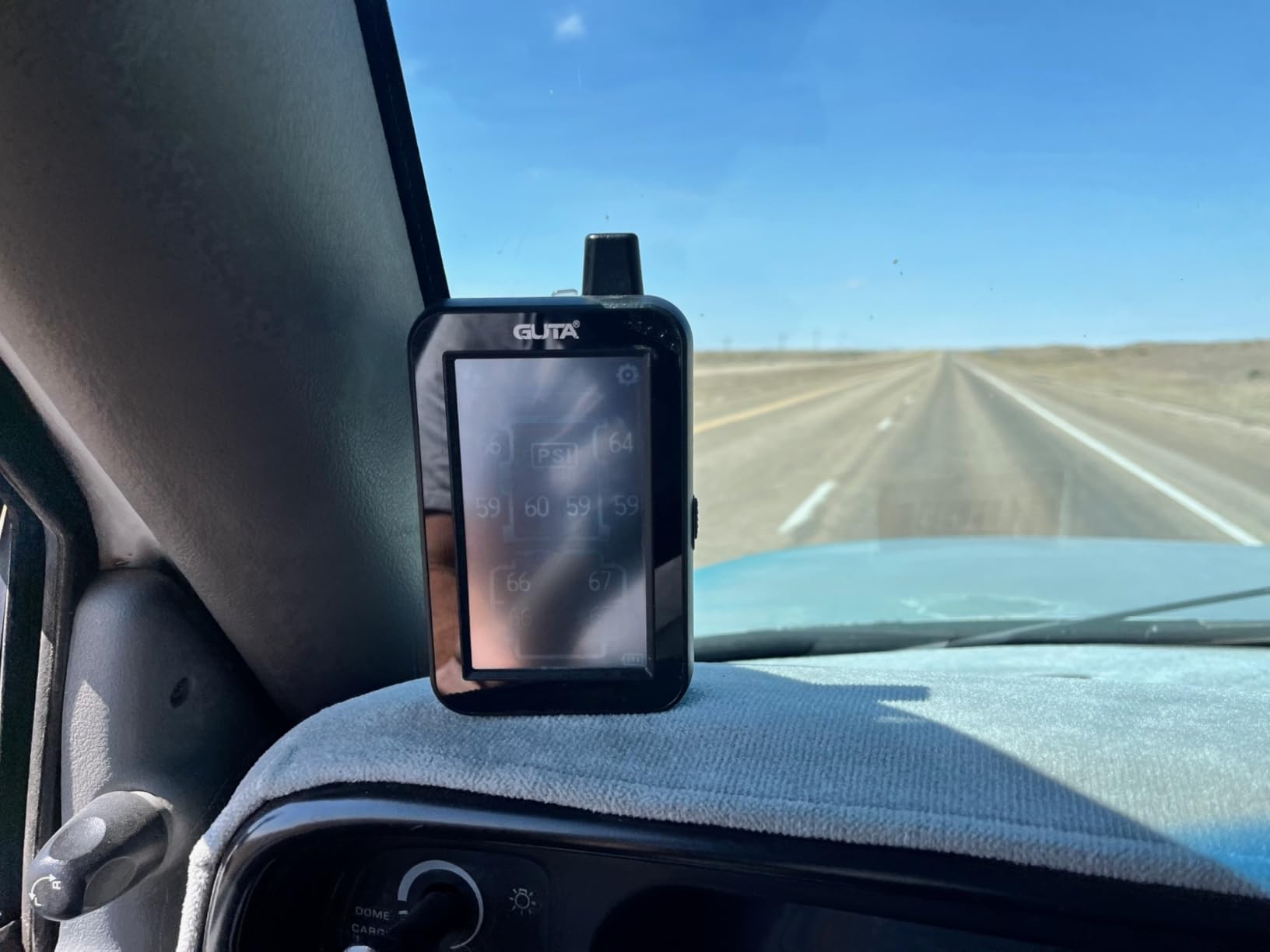
These are genuine flow-through sensors. You can add air without removing anything, which is the single feature owners of cap-sensor systems ask for most often. The sensors are waterproof and dustproof with user-replaceable CR2032 batteries, rated from minus 40 degrees F to 176 degrees F.
The signal booster is included with all models and extends connectivity up to 164 feet, and it runs on its own battery so there is no 12V wiring to run at the tongue. A vibratory sensor wake-up also means the sensors keep reporting on a stationary spare tire, which is more than the competitors manage.
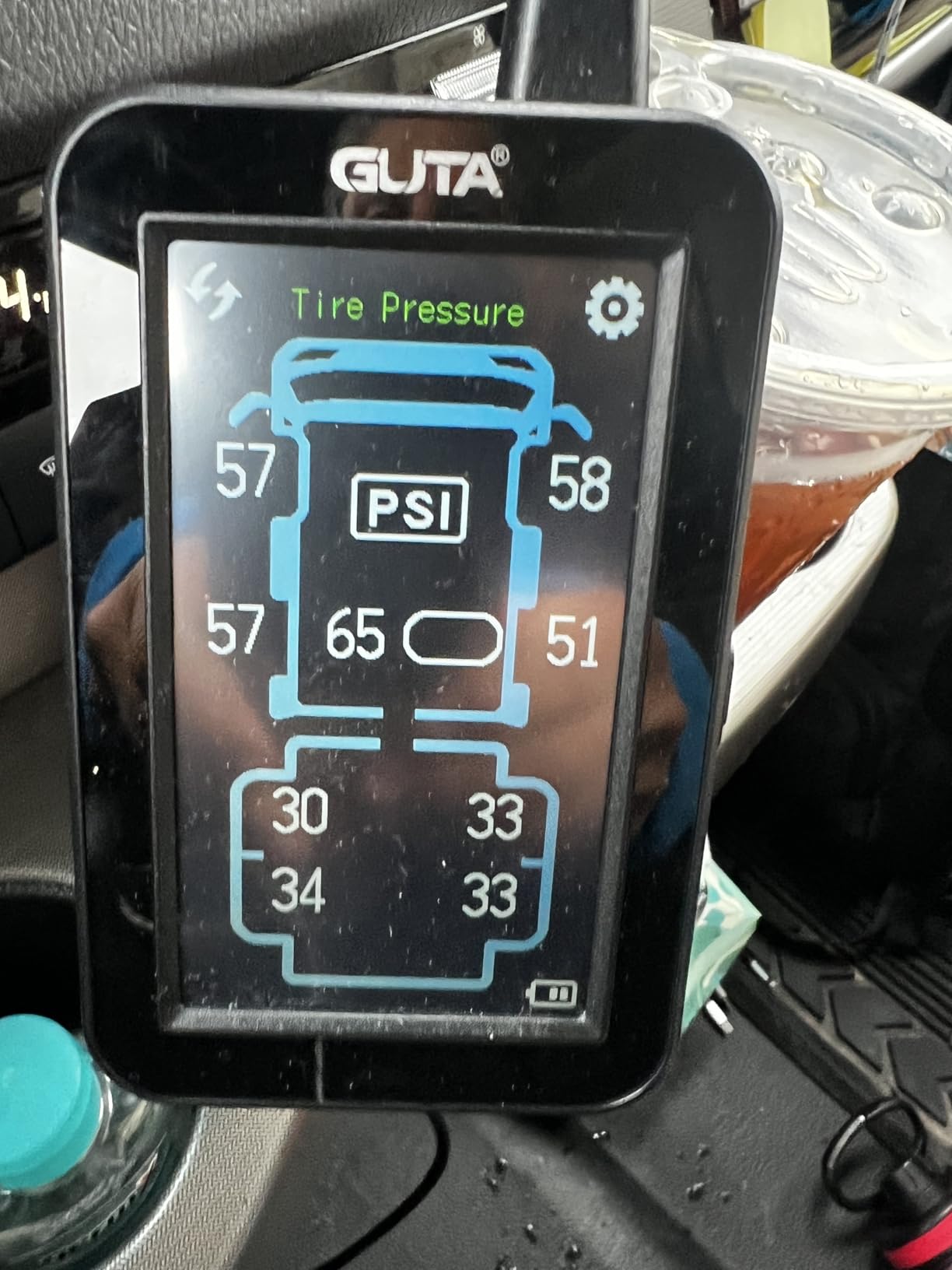
There is a power saving mode after 10 minutes without motion or vibration, and firmware updates come through the GUTA website rather than an app. Six alarm modes cover high and low pressure, high temperature, fast leak, missing signal and low sensor battery. A 29-page printed manual is included in the box, with listed phone and email support.
One limitation deserves a straight mention. At 118 reviews this is the smallest sample in the roundup, and a high average on a young listing tells you less than a slightly lower average across a thousand reviews. We are recommending the design, and the review history is still being written.
The GUTA GT80 is the right pick for owners who inflate at every fuel stop
If topping off tires is part of your routine, flow-through sensors remove the single most common complaint on the forums: unscrewing caps at a gas station. The trade is real, though. Owners report that pushing a few PSI through a flow-through unit takes minutes rather than seconds, so it is faster than nothing and slower than a cap.
Pre-paired and labeled sensors are a bigger practical win than the spec sheet suggests. There is no menu, no reference-pressure entry and no risk of programming a sensor onto the wrong tire position, which is where a lot of first-time installs go wrong.
The GUTA GT80 is a poor fit if you cannot change your valve stems
Flow-through sensors require metal valve stems. They are heavier and longer than a stock rubber stem, they will not fit certain wheels, and running them on rubber is a leak risk rather than a shortcut. If your trailer is still on original rubber stems, the conversion is part of the install cost.
Some owners report inner rear tires briefly dropping out on rough roads before reconnecting, and it is the same inner-tire positioning problem that shows up on other systems. Mount the monitor where it has a clear view down the trailer and add the booster where it helps, and the dropouts largely disappear.
What to look for when you buy a travel trailer TPMS
Read range before anything else. A system cannot protect a tire it cannot measure, and the cheapest kits in this category top out well below what many trailer tires run. The two EEZTire systems and the TireMinder i10 reach past 190 PSI, the GUTA kits cover 188 PSI, the Tymate TM7 stops at 144 PSI and the Masoll M13 at 87 PSI. Below 60 PSI on a small utility trailer, almost anything works.
Second, decide between a cap sensor and a flow-through sensor honestly. A cap sensor is smaller, cheaper and easier to seal. A flow-through sensor lets you inflate without removing it, but it needs a metal valve stem, adds length and weight, and is slower to push air through. The forums are consistent on the timing: pulling a cap takes under a second, adding PSI through a flow-through unit takes minutes.
Third, treat internal rim-mounted sensors as a separate category. Mounted inside the rim, they are invisible, balanced out of the way and immune to road debris, but owners on the AirForums thread report internal sending units breaking loose and floating inside the tire, which generated wild false over-pressure and heat warnings on a tire that measured normal. External cap sensors give you something you can see and check.
Fourth, look at the display in the light you actually drive in. Monochrome and small screens are easier to read in direct sun and tend to last longer on a charge. Color and touchscreen displays are more pleasant at a campsite and larger on the dash, which owners treat as both a benefit and clutter. The audible alarm does most of the work while you are moving.
Fifth, check the sensor battery story. CR2032 and CR1632 cells are the standard, and the difference between a kit where you can swap them yourself and one where you cannot is the difference between a two-minute fix at the tire and a return shipment. The TST 507, GUTA GT30, GT80, TireMinder and both EEZTire systems all take user-replaceable cells.
Sixth, plan the repeater. On anything over about 35 feet, a signal booster mounted near the front of the trailer is what keeps the rear tires on the display. The TireMinder i10 and GUTA GT80 include one. The others treat it as an accessory, and adding it later is easier than adding it during a roadside failure.
How to set your PSI and temperature alert thresholds
Start at the tire placard inside the driver’s door jamb or on the trailer frame, not at the maximum rating molded into the tire sidewall. The sidewall number is what the tire can survive; the placard number is what your trailer axles are rated for, and the lower of the two is your cold inflation target.
Then set the low alert 3 to 4 PSI under that number and the high alert 5 PSI over it. A tire running 10 PSI under cold inflation pressure loses roughly 1 PSI per 10 degrees Fahrenheit of ambient temperature drop, so a cold morning start is the fastest way to generate a false alarm if your band is too tight.
For temperature, 120 to 130 degrees F is a reasonable ceiling for a trailer tire on an interstate pull. Higher readings are normal on a mountain grade in summer, lower readings are normal in January, and an alarm set too aggressively will train you to ignore it. Systems that alert on a rate of rise rather than a fixed number are the ones worth paying up for.
Recheck every tire with a trusted gauge the morning of a long trip, then compare what the tire reads against what the monitor reports. A gap of more than 2 PSI on any sensor is a reason to swap that sensor before you leave, and it is the fastest diagnostic in the whole category.
How to fix the four most common TPMS problems
If a tire drops off the display randomly, the first check is the sensor battery, not the monitor. A weak CR2032 or CR1632 cell produces erratic behavior that looks identical to a failed sensor: intermittent readings, phantom alarms, a tire that comes and goes on rough pavement. Owners report odd faults that simply resolved after a battery change.
If every sensor reads but the display is blank, test the monitor on 12V power before replacing anything. One owner found a display that would not power on while plugged in until the internal battery was replaced, which is a far cheaper fix than a new unit and an easy mistake to make because the wiring looked fine.
If one rear tire keeps dropping out and the others are solid, it is positioning. Mount the monitor higher and with a clear line of sight down the trailer, and add a repeater at the tongue. The same symptom on a rig with wireless backup cameras or a dash-mounted inverter is often interference rather than range, and moving the display away from those devices is the fix.
If a sensor shows a wild high-pressure or high-temperature reading that a gauge contradicts, and the tire was not recently inflated, suspect an internal rim-mounted unit that has detached and is floating inside the tire. The alarm is real, the reading is not, and the only fix is pulling the tire and reseating or replacing the sensor.
For a system with no permanent wiring, disconnect the monitor or unplug the 12V plug during long storage so nothing draws down the vehicle battery. Keep sensor batteries charged if the kit uses coin cells, and expect to re-pair after a full winter of storage rather than treating a lost connection as a failure.
Frequently Asked Questions
Who makes the best tire pressure monitoring system?
For most travel trailer owners the TST 507 is the best overall pick, with user-replaceable CR2032 sensor batteries, a three-year warranty and the strongest long-term owner track record on RV forums. The TireMinder i10 is the alternative if you want the widest 0-199 PSI range, a booster in the box and capacity for 40 tires. Both cover a dual-axle trailer with four cap sensors.
Which tire pressure monitoring system is the best?
The best system is the one whose pressure range covers your tires and whose alerts you do not learn to ignore. The EEZTire systems read to 210 PSI, the TireMinder i10 to 199 PSI, the GUTA kits to 188 PSI, the Tymate TM7 to 144 PSI and the Masoll M13 to 87 PSI. Match the ceiling to your tire placard before you match the price.
What is the best tire pressure monitoring system for a 5th wheel camper?
For a fifth wheel, pick a system with enough tire capacity and a signal booster. The TireMinder i10 covers up to 40 tires and ships with a booster, and the EEZTire 6-ATC gives you six sensors with a 210 PSI ceiling. The GUTA GT30 is the value option with ten sensors and a 46-tire ceiling, though it refreshes on five-minute intervals rather than every few seconds.
What is the recommended tire pressure for travel trailers?
Use the cold inflation pressure on the trailer placard or the frame sticker, not the maximum rating on the tire sidewall. Set your low alert 3 to 4 PSI below that number and your high alert about 5 PSI above it, since a tire loses roughly 1 PSI for every 10 degrees Fahrenheit the ambient temperature drops.
Can a low battery cause TPMS issues?
Yes, and it is the most common cause of the strange faults people report. A weak CR2032 or CR1632 cell produces intermittent readings, phantom alarms and tires that appear and disappear from the display, all of which look like a failed sensor. Most systems in this roundup use replaceable coin cells, so swapping the battery at the tire usually resolves it in minutes.
How to know if a TPMS receiver is bad?
Check the monitor on 12V power first, since an internal display battery can die while the wiring still looks fine. If the display powers up but one or two specific sensors never appear, the fault is at the tire. If all sensors drop at once, or the display stays blank after a known-good power source, the monitor itself is the likely problem.
How many TPMS sensors does a dual axle trailer need?
Four sensors, one for each tire on the two axles. Four-sensor kits cover a standard dual-axle travel trailer out of the box, and most of those systems can be expanded if you later add a truck, a fifth wheel or a boat trailer to the same receiver.
If you want more background on the tools that sit alongside a TPMS, our picks for the [best tire pressure gauges](https://vintagevinylnews.com/best-tire-pressure-gauges/) and the [best RV wheel chocks](https://vintagevinylnews.com/best-rv-wheel-chocks/) are worth a look before a long trip. We have also covered [tire pressure monitoring systems for RVs](https://vintagevinylnews.com/best-tire-pressure-monitoring-systems-for-rvs/) from a different angle, and the earlier [RV TPMS roundup](https://vintagevinylnews.com/best-rv-tire-pressure-monitoring-systems/) covers entry-level kits in more detail.
The bottom line for travel trailer TPMS buyers in 2026
Buy the TST 507 if you want one system that covers a dual-axle trailer, expands to the truck and four more towables, and comes with a three-year warranty and user-replaceable sensor batteries. It is the pick the RV forums return to most often, and the least likely to make you doubt your own alarms.
Buy the TireMinder i10 if you run more tires than that, or if your tire pressures sit high. Buy the EEZTire 6-ATC if you want six sensors and 210 PSI of headroom. Buy the GUTA GT30 if you want ten sensors and a 46-tire ceiling for less than the premium four-sensor kits, and the GUTA GT80 if flow-through sensors matter more to you than a long review history.
Whatever you pick, install metal valve stems, mount the repeater where the instructions say, set your alerts from the tire placard and check every sensor against a trusted gauge before the first long haul. That last habit catches more problems than any feature on any of these screens.