
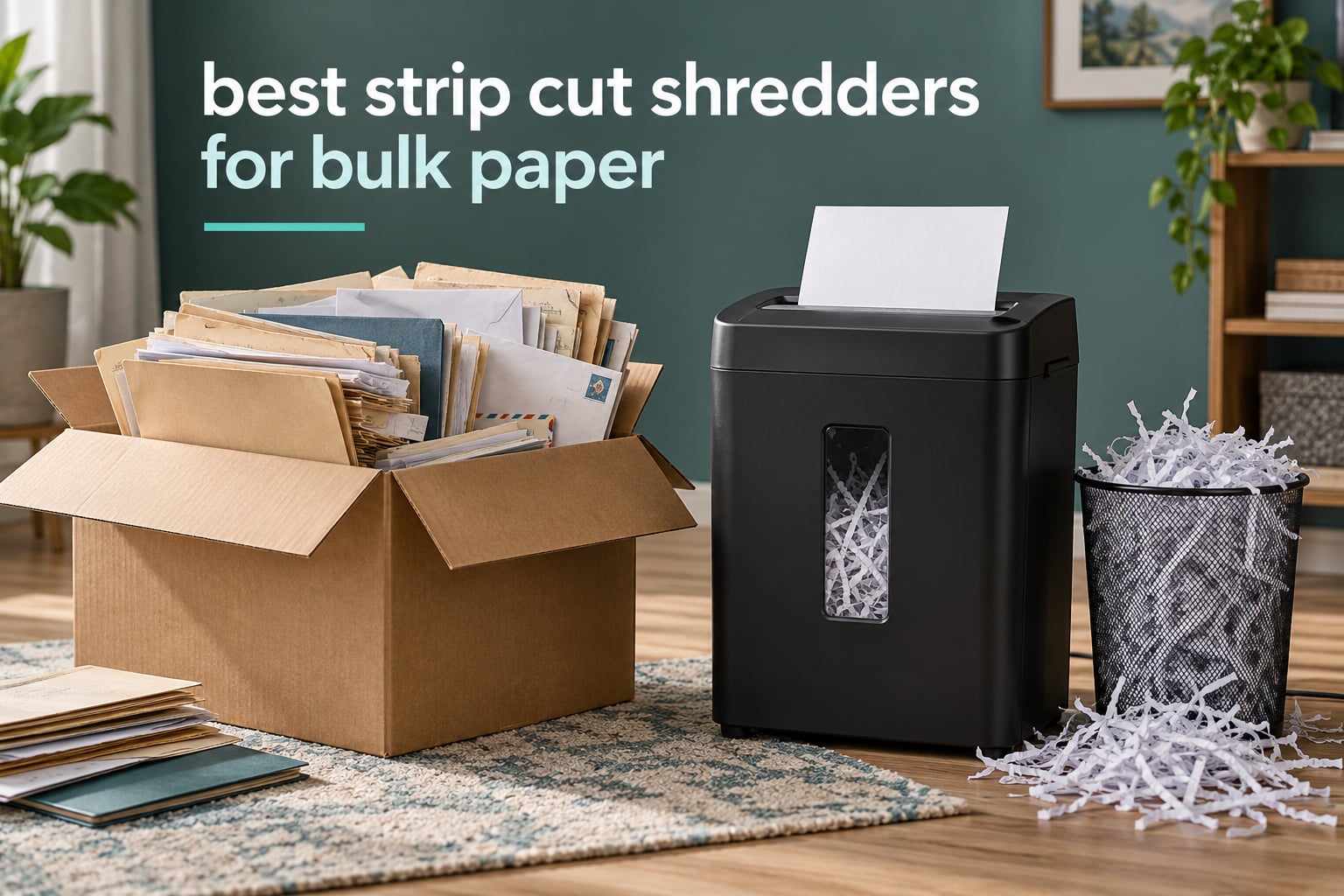
Strip cut is the fastest paper shredder cut type and the least secure, and that trade is exactly what makes it the right pick for bulk paper. A strip cut shredder slices documents into continuous strips instead of chopping them into confetti, so it moves more sheets per minute and packs more output into a smaller bin. If the paper going in is junk mail, expired bills, catalogs or moving boxes, speed matters far more than a P-4 security rating.
That is the whole argument this roundup is built on. Almost every comparison guide on the topic is written around cross cut and micro cut machines, and those are the right answer when the documents carry names, account numbers and tax IDs. They are the wrong answer when you are standing in a hallway with nine moving boxes of paper and one weekend to get through them. Strip cut shredders are the fastest and cheapest way to destroy a large volume of low sensitivity paper.
I compared 7 strip cut shredders for this guide and focused on the numbers that actually decide a bulk job: sheets per pass, continuous run time before thermal shutdown, how long the cool down takes, and how many gallons of output the bin holds. I also weighed the things that only show up after a few months of real use, which are the bin full indicator that lies, the feed throat that stalls on a double staple, and whether the machine can be moved from room to room by one person.
Before you start, if you have not settled on a cut type yet, our complete paper shredder guide covers the full range, and our micro cut shredder picks are the right read if the paper is sensitive. This page stays narrow on purpose: strip cut machines only, judged on bulk throughput.
Table of Contents
Top 3 Best Strip Cut Shredders for Bulk Paper in 2026
Aurora AU800SD 8-Sheet Strip Cut
- 8 sheets per pass
- P-2 strip cut
- Basketless with 15 inch arm
- Auto start stop and thermal protection

Aurora AS810SD 8-Sheet With Basket
- 8 sheets per pass
- 3.2 gallon basket
- 9.7 feet per minute
- Jam proof design

Bonsaii S120-C 8-Sheet Strip Cut
- 15/64 inch strips
- 3.4 gallon basket with window
- 2 min run 15 min cool down
- Overheat indicator light
The AU800SD takes the top slot because it has the largest review base in this group by a wide margin, which means its long service life is well documented rather than anecdotal. The AS810SD is the smarter buy if you would rather have a bin in the box than mount the machine over a basket. The Bonsaii S120-C is the cheapest way to start a bulk purge.
All 7 Strip Cut Shredders Compared in 2026
| Product | Specifications | Action |
|---|---|---|
| Aurora AU800SD 8-Sheet Strip Cut Shredder |
|
Check Latest Price |
| Aurora AS810SD 8-Sheet With 3.2 Gallon Basket |
|
Check Latest Price |
| Bonsaii S120-C 8-Sheet Strip Cut Shredder |
|
Check Latest Price |
 Amazon Basics S120-E Basketless Strip Cut Amazon Basics S120-E Basketless Strip Cut |
|
Check Latest Price |
 Woolsche SD108 10-Sheet Strip Cut Shredder Woolsche SD108 10-Sheet Strip Cut Shredder |
|
Check Latest Price |
 Fellowes Powershred 225i 20-Sheet Strip Cut Fellowes Powershred 225i 20-Sheet Strip Cut |
|
Check Latest Price |
 Bonsaii S123 6-Sheet Compact Strip Cut Bonsaii S123 6-Sheet Compact Strip Cut |
|
Check Latest Price |
Why Strip Cut Shreds Bulk Paper Faster
A strip cut shredder is an electric shredder that slices documents lengthwise into continuous strips, typically between 1/8 and 1/4 inch wide. A motor drives rotating cutters that pull paper in through a throat and slice it as it passes. Nothing about the machine has to stop and reposition the way a cross cut head has to, which is where the speed advantage comes from.
The number that matters for a bulk job is throughput, and throughput is simple math: sheets per pass multiplied by passes you can realistically run before a cool down. A machine rated at 8 sheets with a 2 minute run time sounds modest until you realize how little actual cutting happens in those 2 minutes. The motor is running far below its limit for most of that window, and the real limiter is how fast a person can feed paper.
That is the second reason strip cut wins on bulk work. A 2 minute run window on a Bonsaii S120-C can hold roughly 16 sheets, or about 480 sheets an hour if you feed like the machine allows. A cross cut head doing the same job needs several times as long because it makes far more cuts per sheet, and the extra time is spent chopping, not feeding.
The third advantage is bin volume. Micro cut produces roughly ten times as many particles as strip cut for the same sheet of paper, so shredded output packs down denser and fills a bin sooner. Strip cut strips stay airy. The practical effect is that a 3.2 gallon basket on the AS810SD swallows considerably more sheets before it needs emptying than a 4 gallon cross cut bin, which matters when you are standing there working through a stack of boxes.
The trade is security, and it is a real one. Strip cut is a P-2 security level under the DIN 66399 standard. The strips are long and regular, and a determined person with tape and patience can put a document back together. If the paper carries personal information, that risk is not acceptable. If the paper is a directory of the neighborhood, the trade is easy.
1. Aurora AU800SD – Best Strip Cut Shredder Overall for Bulk Paper
Aurora AU800SD Professional Strip Cut Paper Shredder/CD/Credit Card Shredder Without Wastebasket, 8-Sheet Strip-Cut No Basket, Black
8 sheets per pass
P-2 strip cut
4.6 lb basketless body
15 inch extendable arm
Pros
- Largest review base in this group at 4.6 stars over 12000 ratings
- Basketless arm clamps onto the bin you already own
- Auto start stop with thermal protection
- Handles staples cards and discs without stalling
Cons
- Eight sheet limit per pass
- Thermal cut off interrupts long sessions
- No wastebasket included
- Blades eventually need replacing
The AU800SD is a 4.6 pound machine with an extendable arm that reaches 15 inches, so it sits on top of whichever wastebasket you have rather than owning one of its own. That sounds like a small detail until you are doing a bulk job, because there is nothing to lift out and carry to the curb. Paper drops straight through into a bin you can swap in seconds.
What convinced me this is the one to build a bulk workflow around is the size of its review base. More than 12000 ratings sit behind this machine, and the recurring theme in them is time, not features. Owners describe years of service on the same unit, which is unusual in a category where people usually report a breakdown after one to three years.
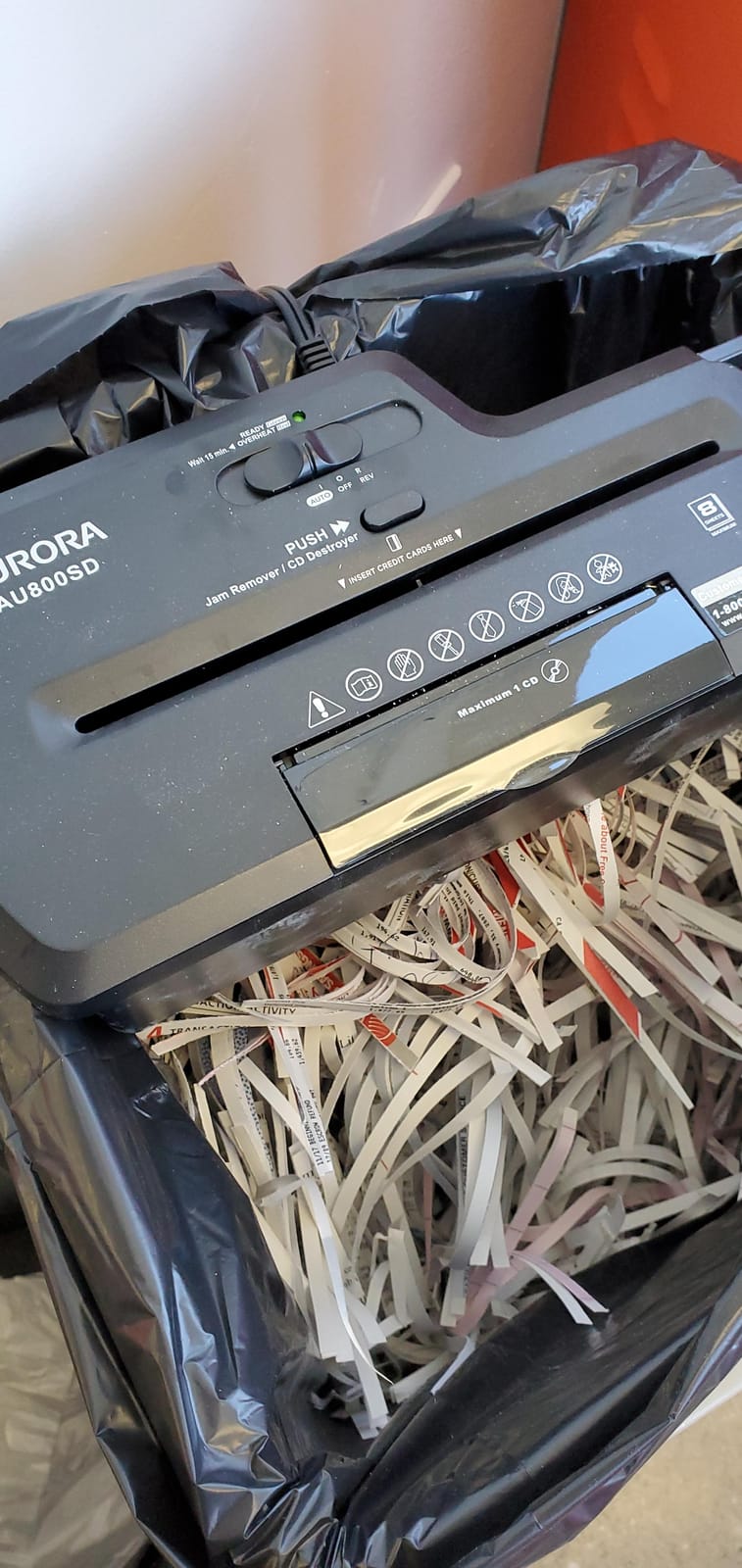
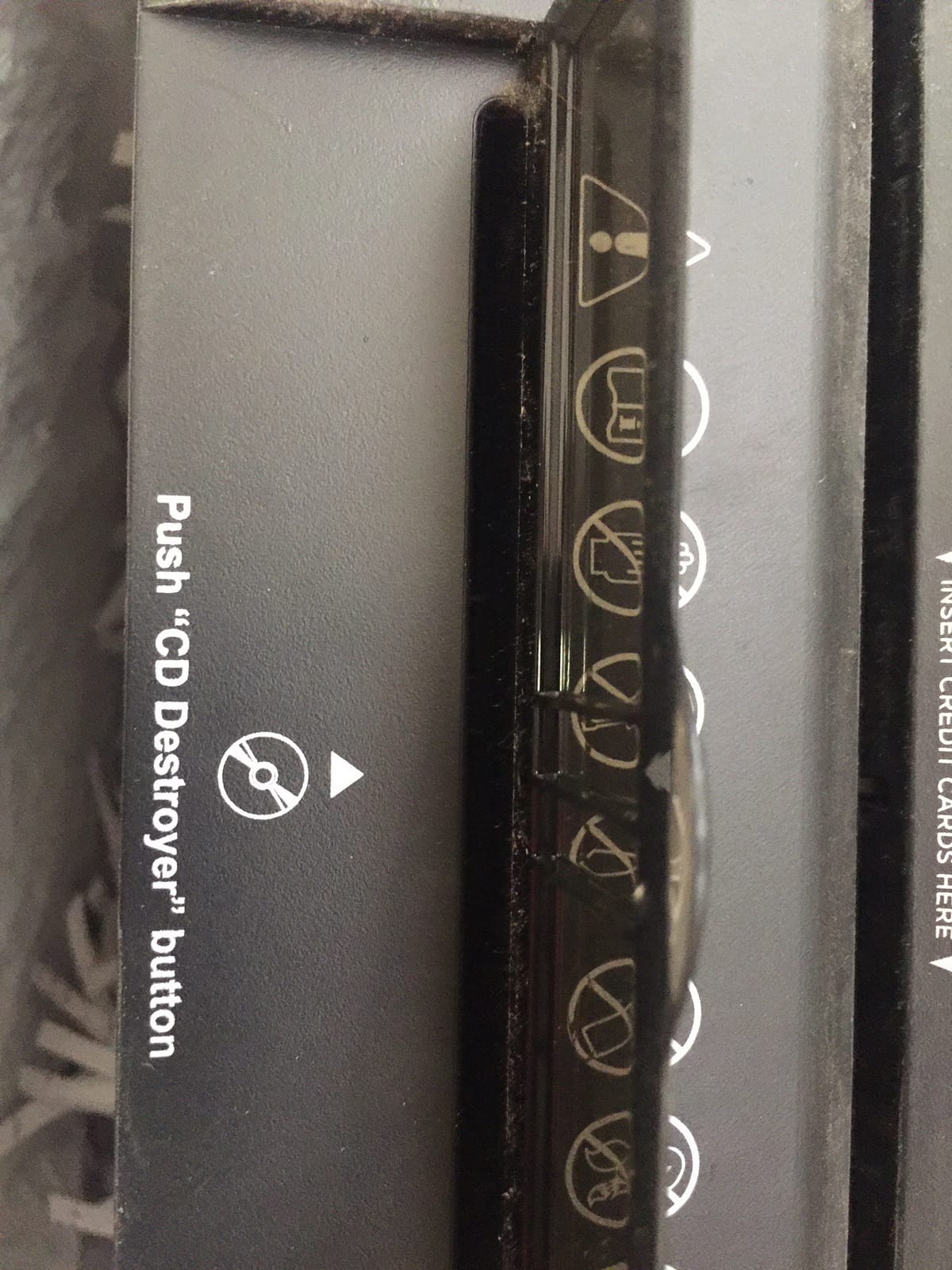
It takes 8 sheets per pass and is rated P-2, so it will eat the same clipped junk mail, old bills and envelopes that make up most of a household pile. It also handles CDs and credit cards, and a forward jam remover with manual reverse clears the occasional feed problem without a trip to the car for a screwdriver.
The specification to plan around is thermal protection. The machine runs continuously but cuts out when the motor gets hot, and that cool down period is what shapes a bulk session. I would treat it as a 2 to 3 minute active shred followed by a pause, not as a machine you can walk away from for an hour.
What works well for bulk paper jobs
Because there is no bin to empty, this is the fastest unit here to keep in motion. When the basket fills you lift the basket out, dump it and drop it back, with no liner to tie off and no second container to balance. That cycle repeats maybe eight or nine times across a full weekend of paper work, and each one takes under a minute.
The 4.6 pound weight also matters more than it sounds. Most of these machines are chained to a desk in a home office, and a machine you can carry to the box, the garage shelf and back again gets used far more often than one that stays put.
Where it falls short
Eight sheets per pass is a modest feed, and on thick stock you will feed six or seven and be happy about it. There is also no basket, so on the day you shred you need a container within reach of a 15 inch opening. If your kitchen bin is too small, the shredding stops because of the trash can, not the machine.
Owners do report needing replacement blades after extended heavy use, and the one year limited warranty is short compared with the commercial units in this list. Neither issue is a deal breaker for paper, but both are worth knowing before you commit.
2. Aurora AS810SD – Best Value Strip Cut Shredder With a Basket
Aurora AS810SD 8-Sheet Strip-Cut Paper, CD and Credit Card Shredder Basket
8 sheets per pass
3.2 gallon basket
9.7 ft per minute
Jam proof P-2
Pros
- 3.2 gallon wastebasket included in the box
- Owners report 10+ years of service
- Shreds staples cards and discs
- Documented 9.7 feet per minute cutting speed
Cons
- Overheats after roughly 15 minutes of continuous use
- Basket fills quickly during bulk work
- Loud during long runs
The AS810SD is the same 8 sheet strip cut head as the AU800SD with a real bin attached. The basket is listed at 3.2 gallons in the product details and 4.5 gallons in the technical listing, so treat the smaller figure as the working number when you plan a session. Pull it out, carry it to the recycling bin, slide it back in. It is the least fussy setup on this list.
Durability is where this one separates itself. Reviewers repeatedly describe this specific model lasting 10 years or more, and that is the number that matters for someone who wants a bulk purge tool to still work next spring. The jam proof design is also widely credited with smooth feeding on clipped and stapled paper.
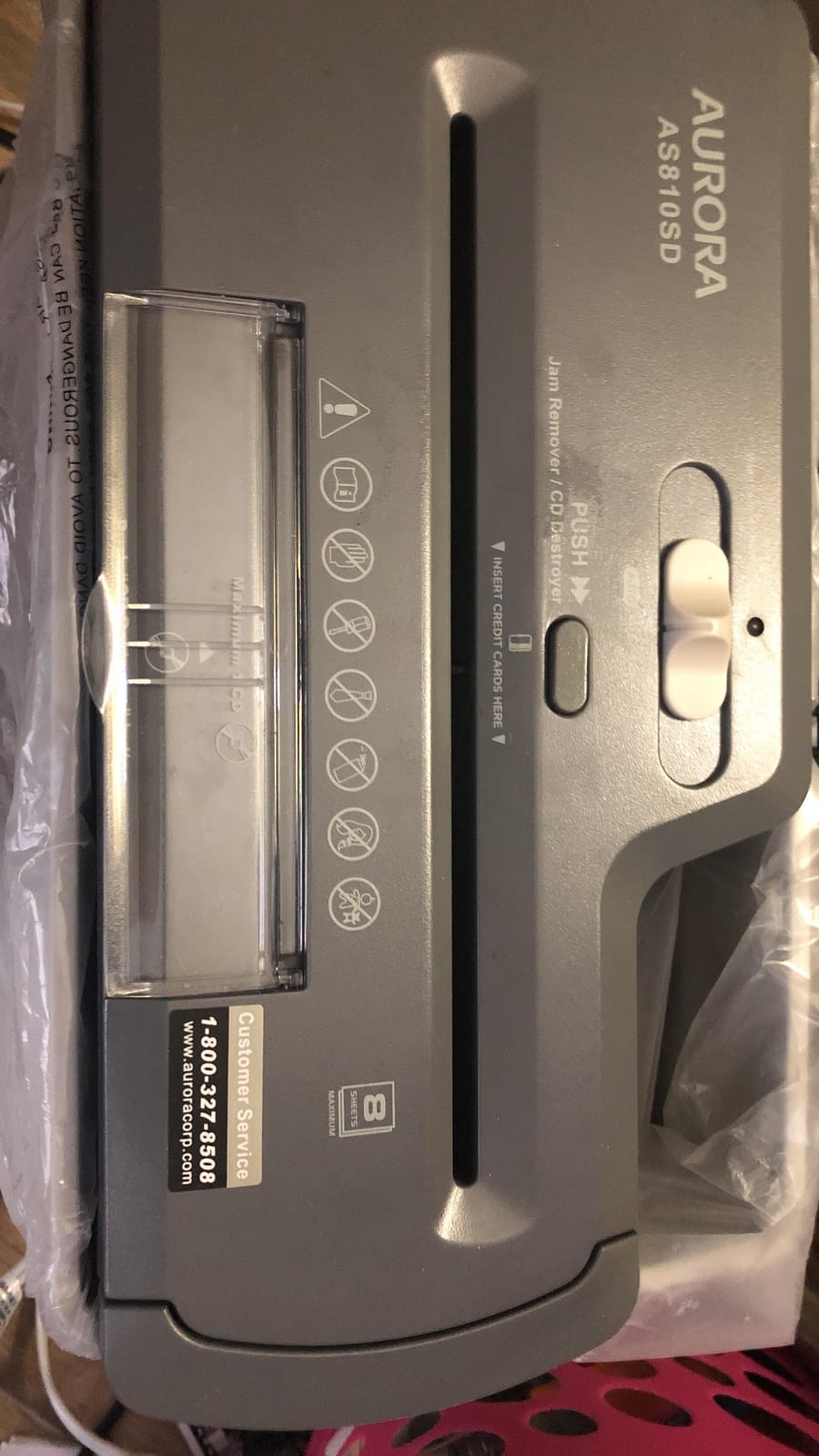
Cutting speed is documented at 9.7 feet per minute, which puts it at the fast end of the machines in this roundup and is a large part of why it is the value pick. The head also handles staples, credit cards and CDs, and it is one of the few strip cut machines here that owners report will take on cardboard without complaint.
For a moving or downsizing job, the included basket is the feature that saves the most time. You are not shuttling between the shredder and a separate container, which removes a step from a workflow you repeat dozens of times per project.
Why it earns the value badge
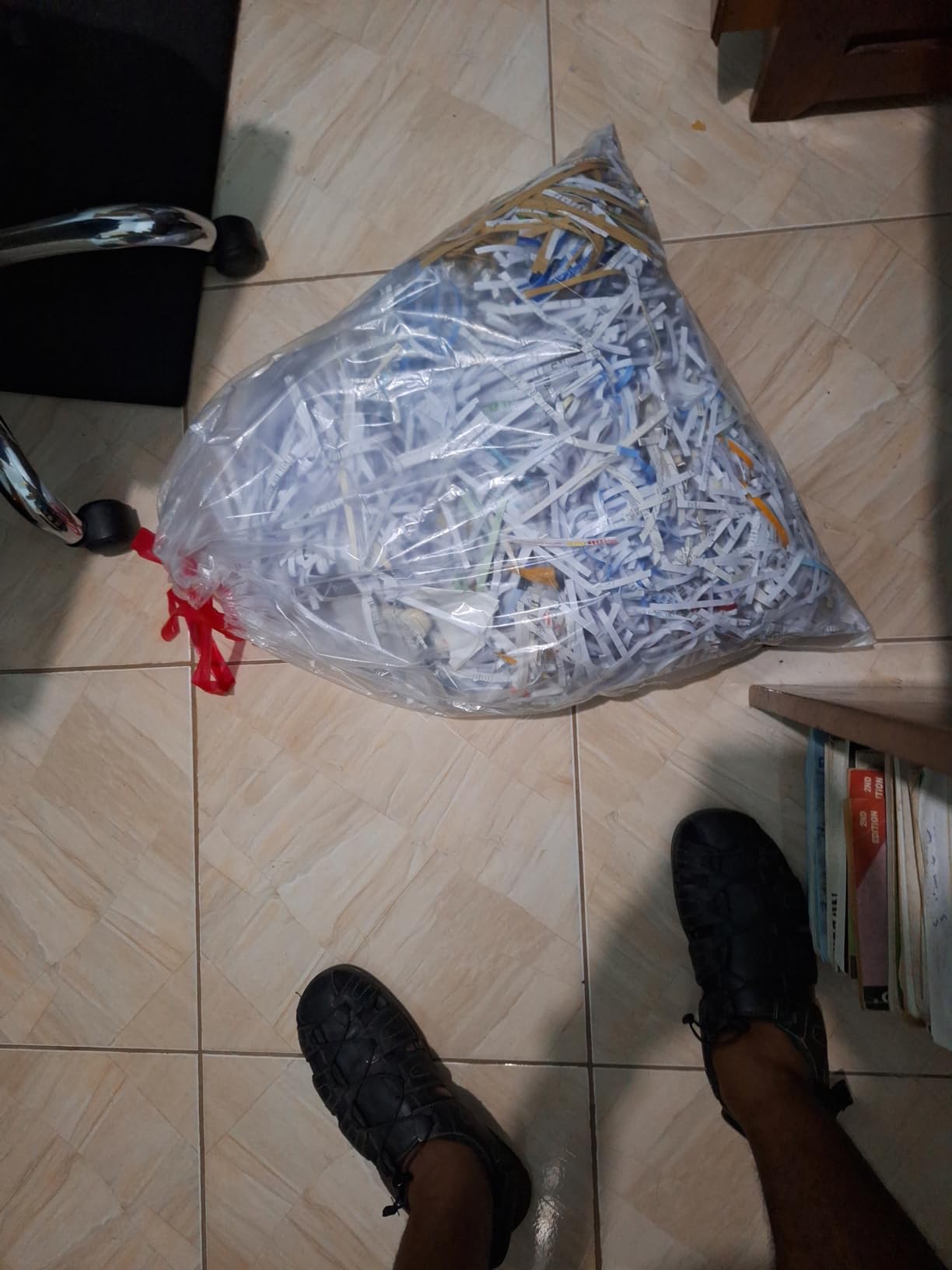
It costs less than a mid tier cross cut machine and shreds noticeably faster, because the strip head makes fewer cuts per sheet. When your constraint is how many boxes you can clear before Sunday night, that difference is the entire decision. The bin is a genuine bonus rather than a marketing line item, since it is a real 3.2 gallon part in the box.
It also handles the two things that jam cheap shredders, staples and cardboard. For a household that is unpacking years of stored paper at once, that is the difference between finishing the job and stopping every few minutes.
Where the limits show
The basket is the first constraint. Three gallons fills up well before you finish a stack of moving boxes, and because strips pack loosely it takes several emptying cycles to get through one closet. If bulk volume is the main goal, the 16 gallon basket on the Fellowes later in this list exists for that reason.
Thermal protection also trips after roughly 15 minutes of continuous running, and operation is noticeably loud. In a small apartment that matters. Plan sessions in blocks and give the motor a rest rather than feeding it one stack after another for an hour.
3. Bonsaii S120-C – Best Budget Strip Cut Shredder for Clearing Boxes
Bonsaii 8-Sheet Strip Cut Paper Shredder for Home, Shred CDs & Credit Cards
8 sheets per pass
15/64 inch strips
3.4 gallon basket
2 min run then 15 min cool down
Pros
- 3.4 gallon basket with a transparent window
- Rarely jams on staples and clips
- Overheat light tells you when to wait
- Cuts discs into three pieces
Cons
- Only 2 minutes of continuous run time
- 15 minute cool down between loads
- Loud at full output
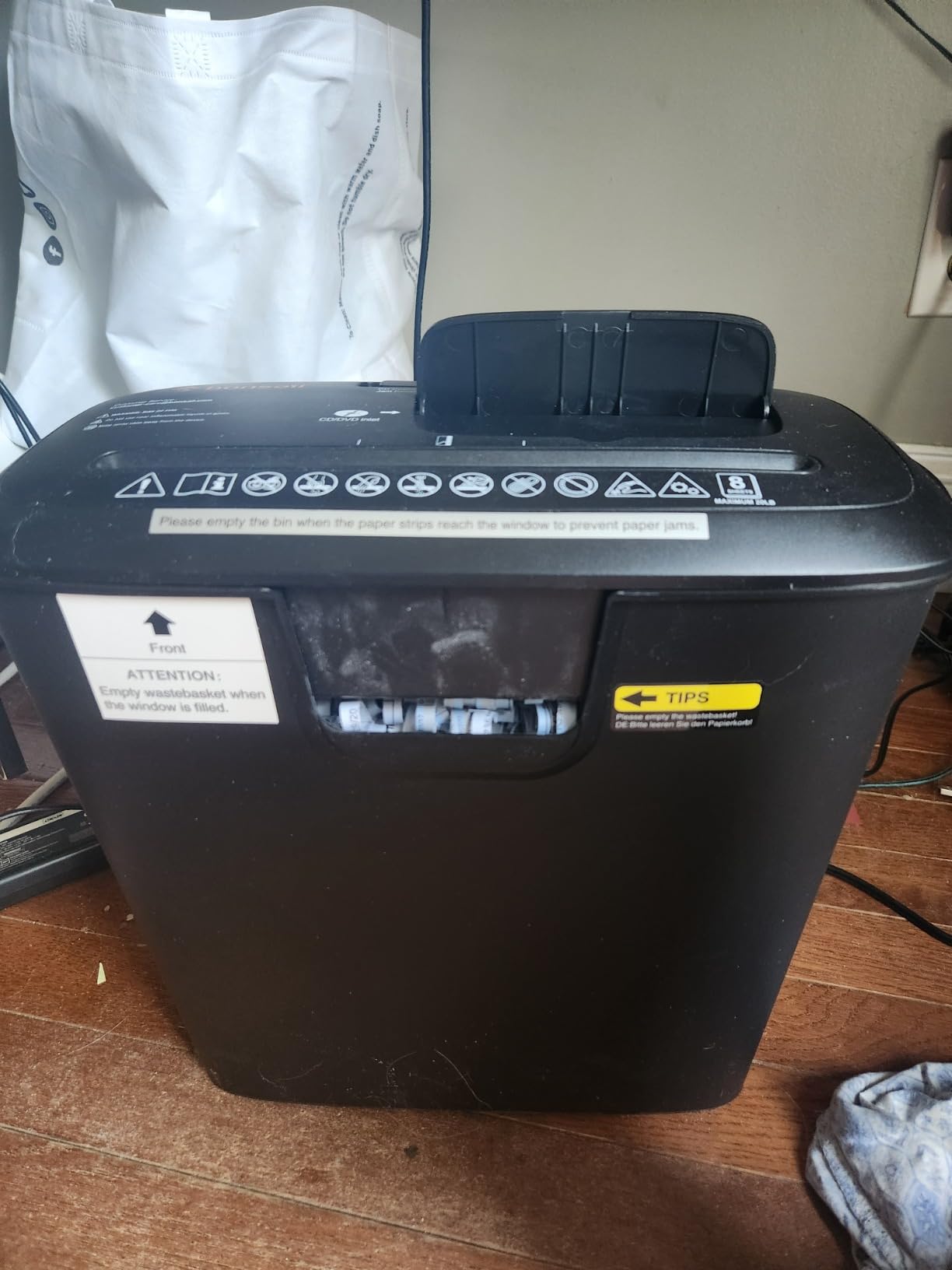
The S120-C strips at 15/64 inch and pairs that with a 3.4 gallon basket that has a clear window, so you can see how full it is without lifting the head. For a first bulk project that visibility is worth more than it sounds, because the fastest way to waste ten minutes on a shredder is to keep feeding a full bin.
At 4.4 stars across more than 8000 ratings, it sits in the middle of this group on satisfaction and near the top on volume of owners. The most common remark is that it rarely jams, which on a machine handling real household paper with staples and clips attached is the thing you are actually buying.
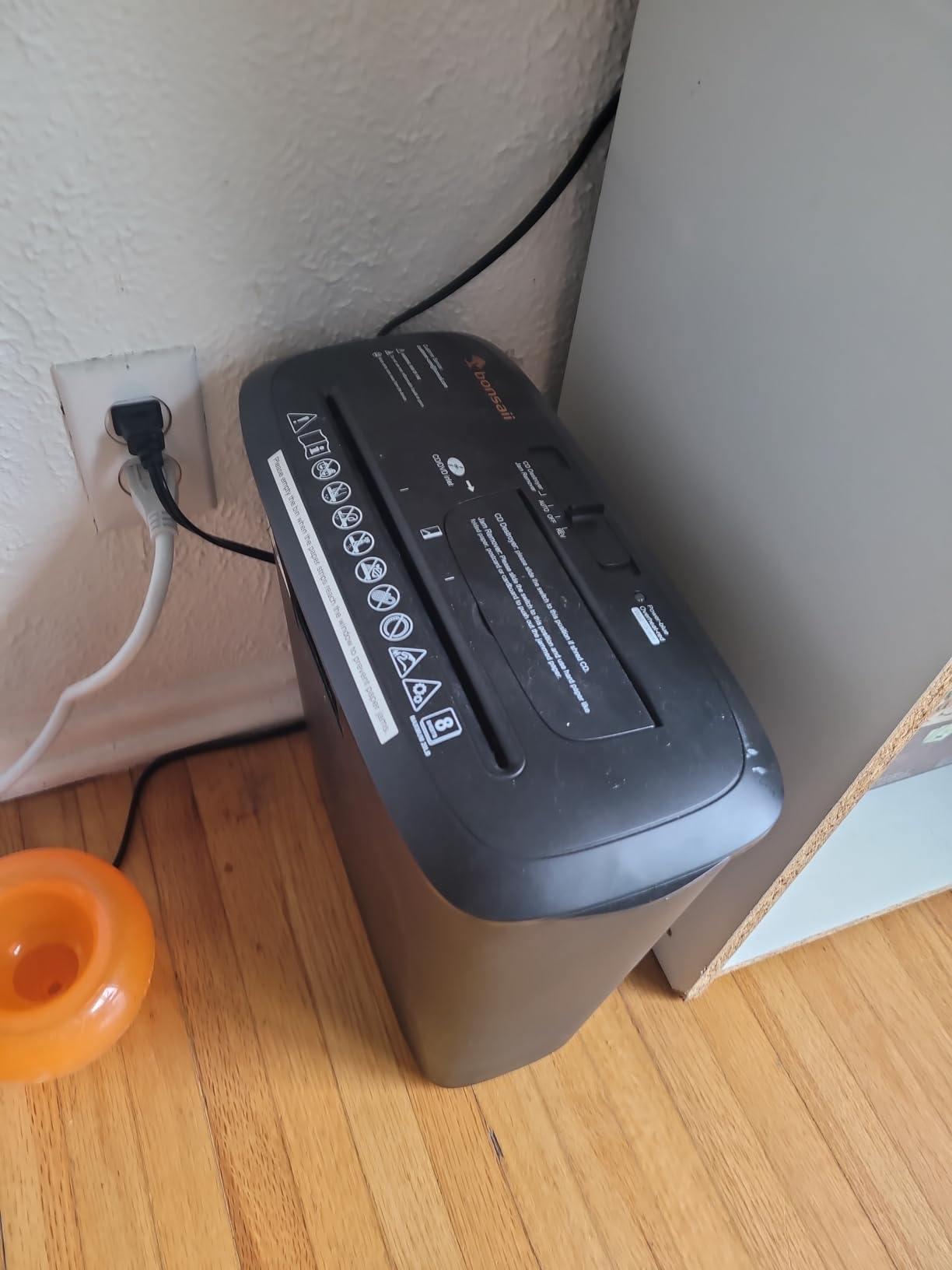
The head shreds CDs and DVDs into three pieces and handles credit cards and staples. It has auto start and stop, a manual reverse for clearing a feed, and an LED indicator that lights when the thermal protection has cut in. That indicator is a genuine convenience, because the alternative is discovering the machine has stopped by feeding paper into a head that is no longer moving.
What you are working with is a 2 minute continuous run followed by a 15 minute cool down. Write those numbers on the box before you start, because they define the rhythm of the whole job. Two minutes of feeding is short, but the motor recovers fast.
Where it fits a bulk workflow
This is the machine to buy when the pile is paper that does not need to be secure and the goal is simply to make it go away. Roughly 8 sheets every couple of minutes adds up quickly across an evening, and the 3.4 gallon basket means you are emptying maybe five or six times per session rather than a dozen.
It is also the one in this group people mention as a starter that gets replaced later. If you are unsure whether you will ever shred more than a shoebox of junk mail, this is a reasonable first machine. If you already know you have multiple boxes waiting, the two Auroras hold more and last longer.
What to watch out for
The 2 minute duty cycle is the real limiter. It suits steady work with pauses, not someone trying to finish a garage in one sitting, and the 15 minute cool down has to be respected or the machine will keep shutting itself down. Operation is also loud, so it does not belong in a bedroom or a shared wall.
Some owners report a cracked basket on arrival, which is a packing problem rather than a machine problem, and a handful note that it is built for 110 to 120 volt regions only. Wide strips also mean this is the wrong tool for anything with your identity on it.
4. Amazon Basics S120-E – Best Strip Cut Shredder for Small Spaces
Amazon Basics 8-Sheet Strip Cut Portable Paper, CD, and Credit Card Shredder with Auto-Off, Overheat Protection, Compact Design, No Basket, Extendable Arm, Black
8 sheets per pass
0.24 inch P-2 strips
16.7 inch arm
2.5 min on then 15 min off
Pros
- Longest extendable arm in this group at 16.7 inches
- Quality tested before it leaves the factory
- Four mode switch including reverse
- Takes staples and paper clips
Cons
- No basket in the box
- 2.5 minute run time with a 15 minute rest
- Light body shifts on thick stacks
The S120-E is a basketless 4.1 pound machine whose arm extends to 16.7 inches, the widest reach of any unit in this roundup. That number decides whether the thing works in your space at all, because it determines the range of wastebasket and bin openings you can mount it on. A 16 inch kitchen bin fits. Most desk sized wastebaskets do not, and neither would the 11 to 15 inch arms on the smaller units here.
It shreds at 0.24 inch strips and carries a P-2 rating, handles CDs and DVDs down to three pieces per disc, and accepts credit cards. Staples and paper clips are not a problem, which removes the single most common cause of a stall on a first bulk run.
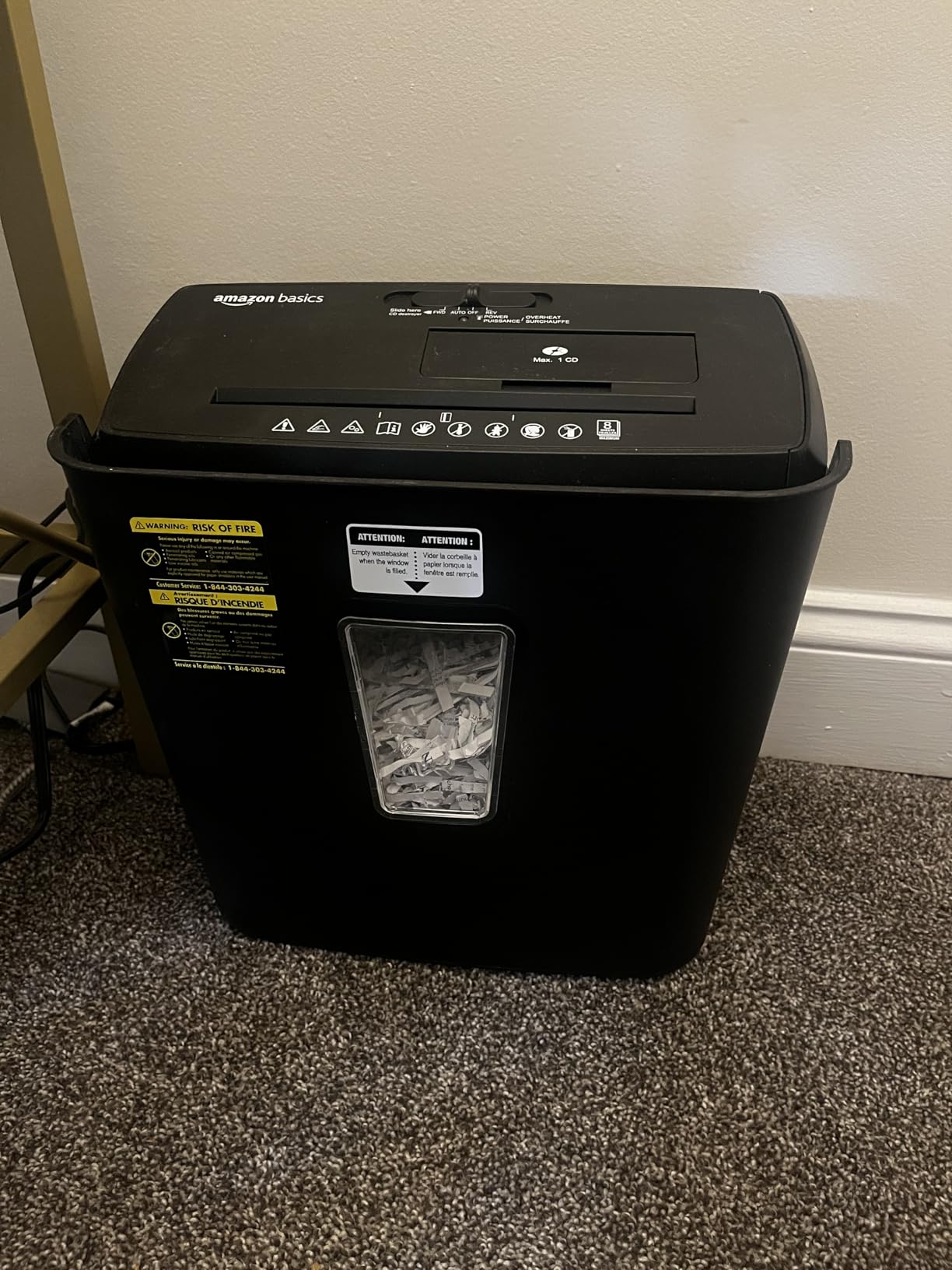
The switch offers auto, off, forward and reverse positions, and the head has auto start and stop with a sensor, so it runs only while paper is in the throat. A 2.5 minute on cycle followed by 15 minutes off defines the working rhythm, and thermal protection handles the rest.
It is also one of the few machines here that is quality tested before it leaves the factory, and that shows up in the reviews. At 4.5 stars across nearly 4000 ratings, the complaints cluster around size and duty cycle rather than reliability.
Why the reach matters for a bulk job
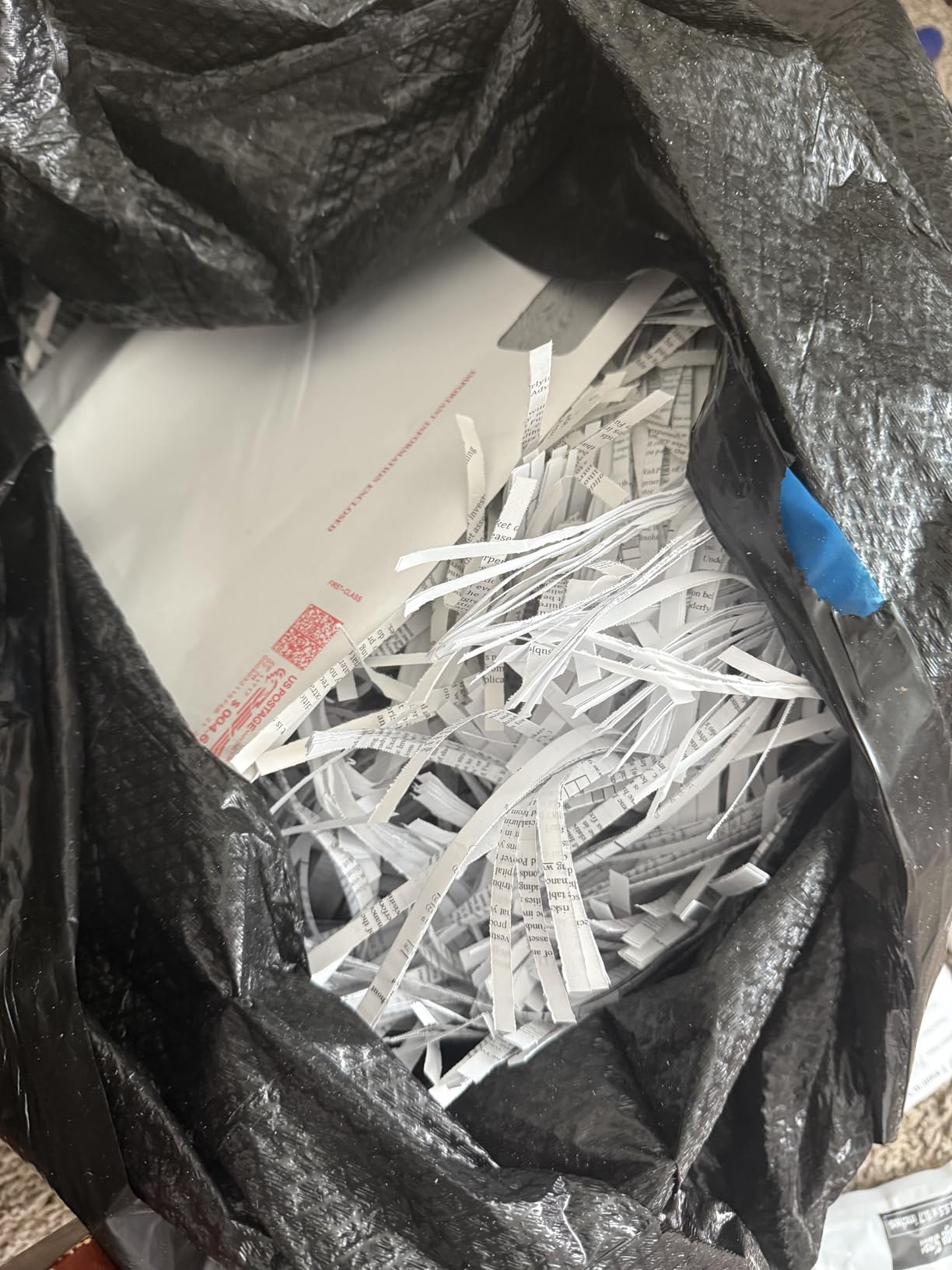
A wide arm means one machine can cover a kitchen bin for envelopes, a larger utility bin for boxes, and a patio can when you take the whole project outside. On a basketless design, that flexibility is the entire feature, and 16.7 inches gives you room to swap containers mid job without moving the shredder.
At 4.1 pounds it also moves easily between rooms, so a garage purge and a home office purge can use the same unit. For someone who shreds in bursts rather than daily, that is a better use of money than paying for capacity you will not touch.
Where it does not fit
There is no basket, so on shredding day you need a container ready. The short 2.5 minute run time means a lot of pauses during a long session, and the light plastic body can shift on the counter if you feed a thick stack. Plan to brace it with one hand.
It is strip cut only, so anything with a name, an account number or a signature on it should go to a different machine. We covered the secure end of the range in our cross cut shredder guide for home offices if that is your situation.
5. Woolsche SD108 – Best Quiet Strip Cut Shredder for Shared Rooms
Home Office Paper Shredder,Woolsche 10-Sheet Strip Cut with 3.17-Gallon Basket,P-2 Security Level,CD & Credit Card Shredder,Durable & Fast – Jam Proof System – ETL Certified
10 sheets per pass
5 min continuous run
3.17 gallon basket
patented anti jam cutter
Pros
- 10 sheet capacity is the largest of the consumer machines here
- 5 minute continuous run time
- Marked as low noise for shared rooms
- ETL certified with a 1 year replacement warranty
Cons
- 30 minute cool down after a thermal trip
- Some owners report failure after 1 to 2 years
- Credit cards sometimes need a second pass
The SD108 takes 10 sheets per pass, which is the highest feed rating among the consumer grade machines in this roundup, and it holds a run time of 5 continuous minutes. Those two numbers together are the strongest bulk combination below the commercial tier, and on a paper-only job where nothing is stapled, the difference between feeding 8 and feeding 10 is real.
The other headline is noise. It is listed as a low noise unit, and for a shared room or a small apartment that is often the deciding factor. Most strip cut machines in this group are described as loud, so if someone else works nearby this is the one to shortlist.
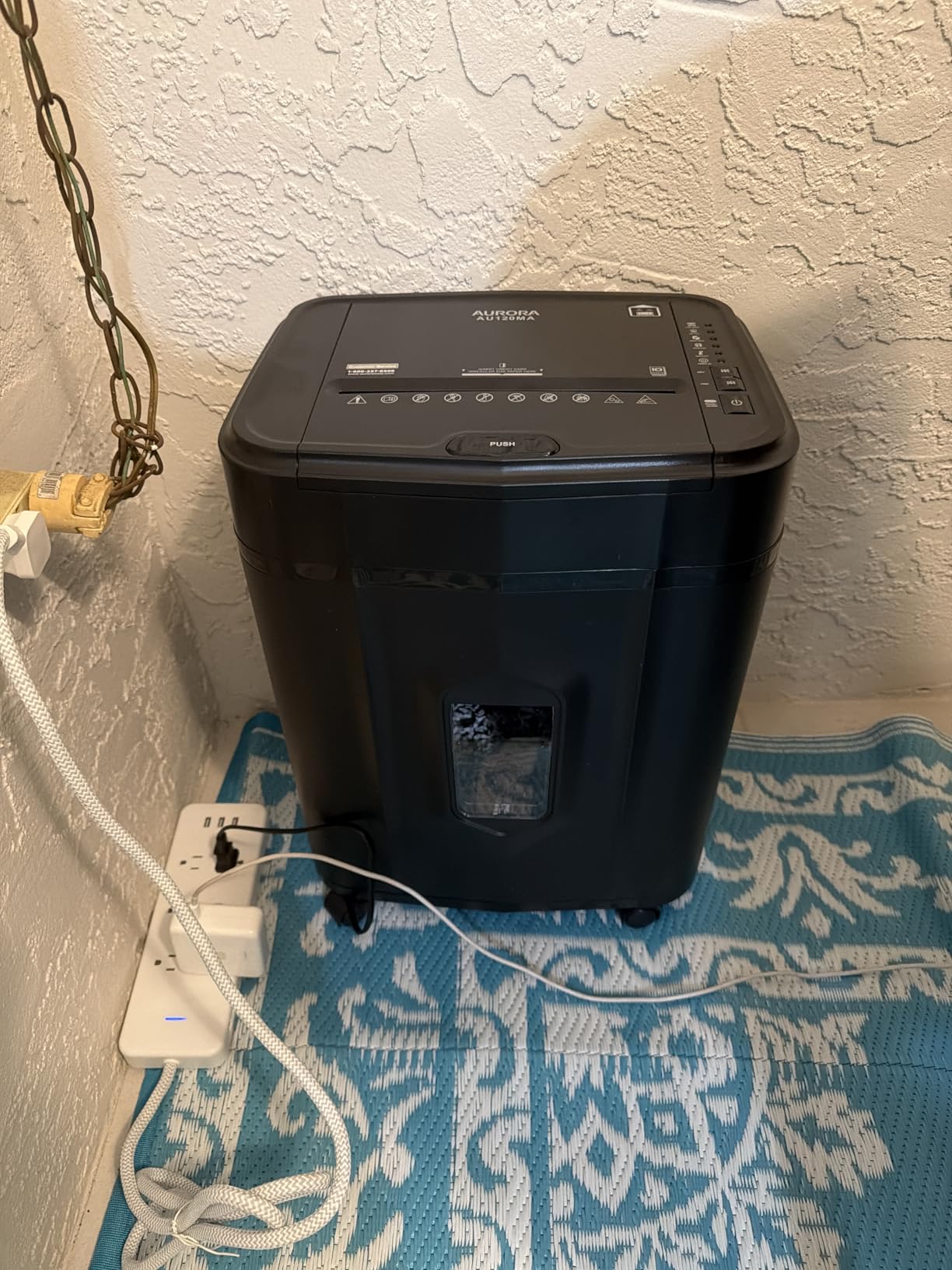
The basket is 3.17 gallons with a transparent window, and the cutter is covered by a US patent for jam resistance. Staples, CDs, credit cards and junk mail are all listed as acceptable feed material, and the control switch offers auto, off and reverse.
It carries a 1 year replacement warranty and ETL certification, which is a slightly stronger safety story than most of the budget units here. Strip width is 15/64 inch, the same as the Bonsaii S120-C, so output density is comparable between the two.
Where it earns its place
The 5 minute run window is the reason this one suits a longer session. Rather than the usual rhythm of feed for two minutes and then stare at a wall, you can push a real quantity of paper through before the thermal protection intervenes. For a closet or a single storage unit, that is a meaningful reduction in total time.
The anti jam cutter and the larger throat also make it the better choice of the two consumer units here for thick or mixed material. If your bulk pile contains envelopes with inserts, folded paper or light cardboard, the extra headroom costs you nothing.
What to know before buying
The 30 minute cool down after a thermal trip is long, and on a repeated heavy duty job you will feel it. Reliability is also the soft spot: at 4.2 stars, this is the lowest rated machine in the roundup, with a scattering of owners reporting a failure after one to two years and a few reporting card shredding that needed more than one pass.
Reviewers also note that the small basket fills quickly, so the 5 minute run time gets interrupted by emptying more often than the specifications suggest. Budget for pauses in your plan rather than treating the run window as uninterrupted cutting time.
6. Fellowes Powershred 225i – Best Heavy Duty Strip Cut Shredder for Small Teams
Fellowes Powershred 225i 100% Jam Proof 20-Sheet Strip-Cut Shredder (3322001)
20 sheets per pass
16 gallon removable basket
continuous duty motor
60 dB operation
Pros
- Continuous duty motor built for non stop shredding
- 16 gallon removable basket
- Lifetime warranty on the cutters
- 100 percent jam proof system plus SafeSense
Cons
- 76.6 pounds and 31.75 inches tall
- Bin full light trips before the basket is full
- Cardboard basket needs its own liner bags
- Far more machine than a home office needs
This is the only true commercial machine in the roundup and the only one with a continuous duty motor, which means it is designed to run without cooling down while you work. At 20 sheets per pass, 7/32 inch strips, a 16 gallon removable basket and a documented 60 dB noise level, it is the answer for a shared office or a small team clearing records on a schedule.
Fellowes rates it for 3 to 5 users, and the design reads like it. SafeSense stops the cutters when a hand touches the paper opening, the 100 percent Jam Proof system handles the feeding, and the basket has an LED full indicator plus a support for a liner bag. The warranty is two years on the product and lifetime on the cutters.
It handles staples, paper clips, credit cards, CDs and DVDs and junk mail, which covers everything a records purge throws at it. The lift is a paper basket rather than a metal can, so you can bag the output and carry it out in one trip instead of balancing loose strips across the office.
Its measured noise level of 60 dB is worth noting because it is lower than most consumer strip cutters in practice, even though the machine itself is large. For an open plan office, a quiet commercial unit is easier to live with than a small loud one.
Where it changes the math
With a 16 gallon basket you are emptying roughly five times fewer than a 3 gallon consumer bin over the same project. Combined with a continuous duty motor and a 20 sheet feed, a full day of records disposal becomes an afternoon. That is the entire justification for a commercial machine, and no amount of extra bin capacity on a 2 minute duty cycle will get you there.
It also has no thermal cool down to plan around, so you can feed steadily for as long as the work lasts. SafeSense makes it usable in a space where other people walk past, which is not true of every commercial head.
Where it is the wrong call
It weighs 76.6 pounds and stands 31.75 inches tall. That is a permanent floor fixture in a small office and an impossible one in a home, and moving it requires two people or a hand truck. The bin full light is also reported as overly sensitive, stopping the machine before the basket is genuinely full, which adds trips.
Owners note that the cardboard basket needs specific bags to work properly, and that the unit ships with bolts that have to be removed before it will operate. At 4.5 stars across 107 ratings, the owner base is small, so treat the long term durability reports as encouraging rather than settled.
7. Bonsaii S123 – Best Compact Strip Cut Shredder for Occasional Use
Bonsaii 6-Sheet Small Strip Cut Paper Shredder for Home,Without Basket
6 sheets per pass
15/64 inch strips
3 lb body
2 min run then 20 min cool down
Pros
- Only 3 pounds so it stores on a shelf or in a drawer
- Extendable arm covers 11 to 15 inch bins
- Quiet for a machine in this class
- Red LED warns before thermal stop
Cons
- Six sheets per pass is the smallest rating here
- 2 minute run with a 20 minute cool down
- Strips can be put back together
- No wastebasket included
The S123 is 3 pounds and measures under 5 inches tall, so it disappears into a closet when it is not being used. It is the smallest machine here, both physically and in capability, and it is included because a lot of people do not need bulk capacity at all. If your shredding is a stack of junk mail twice a year, this is the right size.
It takes 6 sheets at 15/64 inch strips, shreds credit cards and CDs, and has auto start and stop with both automatic and manual jam clearing modes. The extendable arm covers bins from 11 to 15 inches, which covers most household wastebaskets.
What it does well
Storage and noise. A machine you can carry in one hand and put away after ten minutes of work gets used far more often than a 16 gallon commercial unit parked in the corner of an office. It is also described as quiet relative to larger strip cutters, which makes it bearable in an apartment.
At 4.5 stars across nearly 1500 ratings, the feedback is mostly about convenience rather than capability. The red LED overheat warning with automatic stop is a nice touch on a machine this small, because it tells you why it stopped instead of leaving you guessing.
Where it stops being enough
Six sheets per pass and a 2 minute run time with a 20 minute cool down is the smallest combination here. That cadence suits bills and envelopes, not a box of paper. The moment your pile includes folders, cardstock or moving boxes, you will outgrow it quickly.
Wide strips also mean it should stay away from anything with personal information on it, since the output can be reassembled. Some owners report early failures and plastic construction that feels light in the hand, so for a machine that will sit unused for months at a time, weigh that against the convenience.
How to Choose a Strip Cut Shredder for Bulk Paper?
Start with the honest question: is any of this paper sensitive? If yes, stop reading this guide. Strip cut is a P-2 security level, and P-2 strips can be taped back together. Our micro cut shredder roundup covers the secure end of the range, and for regulated records you should be looking at P-4 or above with a documented certificate of destruction.
Assuming the answer is no, the next thing to size is total volume, not sheet count. Count the boxes, not the pages. Under three boxes is a home job and an 8 sheet machine with a small basket handles it. A closet or a garage clear out is a mid sized project where bin capacity and duty cycle start to matter more than anything else. A shared office doing scheduled records disposal needs a continuous duty motor.
Then check the duty cycle honestly, because this is the number people skip. A machine with a 2 minute run time and a 20 minute cool down will not get faster because you want it to. Multiply the run time by the number of sessions you are willing to do, and compare that against your pile. The Woolsche SD108 at 5 minutes and the Fellowes 225i with no cool down are the two that scale best to repeated work.
Bin capacity is the fourth filter. Output volume is easier to estimate than people expect: count the strips in a full basket, then multiply by the number of baskets. Consumer machines here run between 3.17 and 3.4 gallons, which is roughly four to six emptying cycles per moving box job. The 16 gallon basket on the commercial unit cuts that to about one.
Feed style matters less than most guides suggest. Auto feed is genuinely faster for large stacks because you can walk away from the machine, but none of the strip cut units in this roundup include one, and basketless designs trade a bin for a mounting arm instead. Manual feed with a good auto start sensor is the norm here and works fine if you stand in front of it.
Finally, check the warranty and the noise. Two years plus a lifetime cutter warranty signals a company that expects the machine to last, while a 1 year warranty is the norm on consumer units. On noise, the only shredders in this roundup with a published decibel figure are the commercial ones, so for an apartment treat the described low noise units as your shortlist and everything else as an interruption.
When Not to Buy a Strip Cut Shredder
Do not buy a strip cut shredder for anything with your name on it. Strips are long, uniform and easy to align. A determined person can reassemble a shredded page, and that risk is why shredder manufacturers and security guidance treat P-2 as the bare minimum for anything personal.
The failure mode that gets discussed most is the dumpster. Shredded paper still leaves the building in a bag, and a wide strip strip is far easier to reassemble than micro cut confetti. On r/MitchellAndWebb users make exactly this point, describing strip cut as a security risk even while acknowledging it is the hard working and fast option. On r/DataHoarder the same debate runs in the other direction, with people arguing that cutting a document in half is not secure destruction. Both are right, and the resolution is simple: paper containing personal information goes into a cross cut or micro cut machine, everything else can go fast.
There is also a middle case worth naming. Junk mail with your name and account number on the return address is sensitive even though it feels like nothing. Statements, tax documents, medical paperwork and anything with a signature should all leave the strip cut workflow entirely. Shred the sensitive documents separately, then run everything else at speed.
And if you are shredding for compliance reasons, a residential strip cut machine will not satisfy it. Regulated destruction usually requires a P-4 or higher machine and a certificate of destruction from a service that will tell you who destroyed what and when. The commercial model in this roundup is a P-2 unit, so it is a high volume tool rather than a compliance tool.
How to Shred Bulk Paper Without Jamming the Machine
Sort before you shred. Pull out anything plastic first, and this is where a lot of bulk jobs go wrong. Users on r/recycling describe gray plastic shipping mailers clogging shredders repeatedly, and a poly mailer folded into the head will not be cleared by a reverse cycle. Open every envelope, flatten the paper, and put the plastic aside for recycling.
Pull staples and paper clips. It takes five minutes for a ream of paper and it removes the most common cause of a stall. Most of the machines here are rated to take staples and clips, but a small clump of clipped metal hitting a warm cutter is what turns a smooth session into a blade replacement.
Break cardboard down before feeding it. Flatten moving boxes, cut the corrugate down so each piece fits the throat, and feed one layer at a time rather than folding a box into a thick block. The Aurora AS810SD and the Fellowes 225i handle cardboard most gracefully, but every machine here will work better on flattened board than on a folded box.
Work in duty cycle blocks rather than one long feed. Set a timer for the stated run time, feed continuously for that window, then stop and let the machine cool for the stated period. Fighting a thermal cut off wastes more time than the pause does, and topping up the machine while it is hot is the fastest way to shorten blade life.
Oil the blades, and never use an aerosol. Shredder oil applied to the cutting head keeps blades clean and reduces load on the motor during long runs. Aerosol sprays are the specific hazard: a flammable propellant near a hot cutter assembly is a genuine fire risk, and it is a warning worth taking seriously on any machine you run hard.
Recycle the output, but sort it first. Shredded paper generally goes in recycling, while the strips of destroyed credit cards, CD fragments and any non paper debris belong in the trash. A 3 gallon basket is roughly a grocery bag of output, and pulling that plastic liner out and tying it is the fastest end-of-session step there is. For more on matching a machine to the room it lives in, our home office shredder guide goes into the footprint and noise tradeoffs in more detail.
Frequently Asked Questions
What is the best cut for a paper shredder?
Strip cut is the fastest and least secure cut type. It is the right choice for bulk paper with no personal information on it, such as junk mail, expired bills, catalogs and moving boxes. Cross cut is the better all round option for everyday documents, and micro cut is for medical, financial and other regulated records.
Is a cross cut shredder better than a strip cut shredder?
Cross cut is better if security matters, because it cuts paper into small confetti that is much harder to reassemble. Strip cut is better if volume matters, because it runs faster and its longer strips pack loosely so more output fits in a bin. Many households run a cheap strip cut machine for bulk and a cross cut machine for anything with an account number on it.
What is the best heavy-duty paper shredder?
For a small team doing scheduled records disposal, the Fellowes Powershred 225i is the heavy-duty option in this roundup. It has a continuous duty motor with no cool down, a 20 sheet feed and a 16 gallon removable basket. For a home or one person job, the Aurora AU800SD handles heavy sessions well and is far easier to move.
Can a paper shredder handle cardboard?
Most can, if you flatten and cut it down first. Folded moving boxes are too thick for the throat and will stall the machine. Flattened corrugate fed one layer at a time is usually fine, and the Aurora AS810SD and Fellowes Powershred 225i are the two in this roundup reported to take cardboard most reliably.
How often should I empty a shredder bin?
Empty it well before it looks full, because output compacts and strips can feed back into the cutter area. Consumer bins in this roundup run from about 3.17 to 3.4 gallons, which for a household means a basket every 20 to 30 minutes of active shredding. The 16 gallon basket on the commercial model cuts that to roughly one emptying per project.
The Best Strip Cut Shredder for Bulk Paper in 2026
The Aurora AU800SD is the best strip cut shredder for bulk paper in 2026. With 4.6 stars across more than 12000 ratings, the largest review base in this group, a 4.6 pound body you can carry from room to room and an extendable arm that mounts on whatever bin you already own, it removes the two things that slow a bulk job down: carrying a full basket and dealing with a machine you cannot move.
For anyone who would rather have a bin in the box, the Aurora AS810SD is the value pick. Its 3.2 gallon basket and documented 9.7 feet per minute cutting speed make it the fastest consumer machine here, and owners report the same model lasting 10 years or more. The Bonsaii S120-C is the cheapest way into the category and rarely jams on clipped paper.
Two picks cover the ends. The Fellowes Powershred 225i is the only continuous duty machine here and the right tool for a small team doing records disposal, with a 16 gallon basket that cuts the number of emptying cycles to almost nothing. The Bonsaii S123 is the one to buy if you shred bills twice a year and want the machine to live in a closet.
Whichever you pick, the decision comes down to one question: does any of this paper identify you? If it does, a strip cut machine is the wrong tool and you want a cross cut or micro cut model instead. If it does not, buy for bin capacity and duty cycle, clear the plastic mailers first, and let the strip head do what it does better than anything else on the market.