
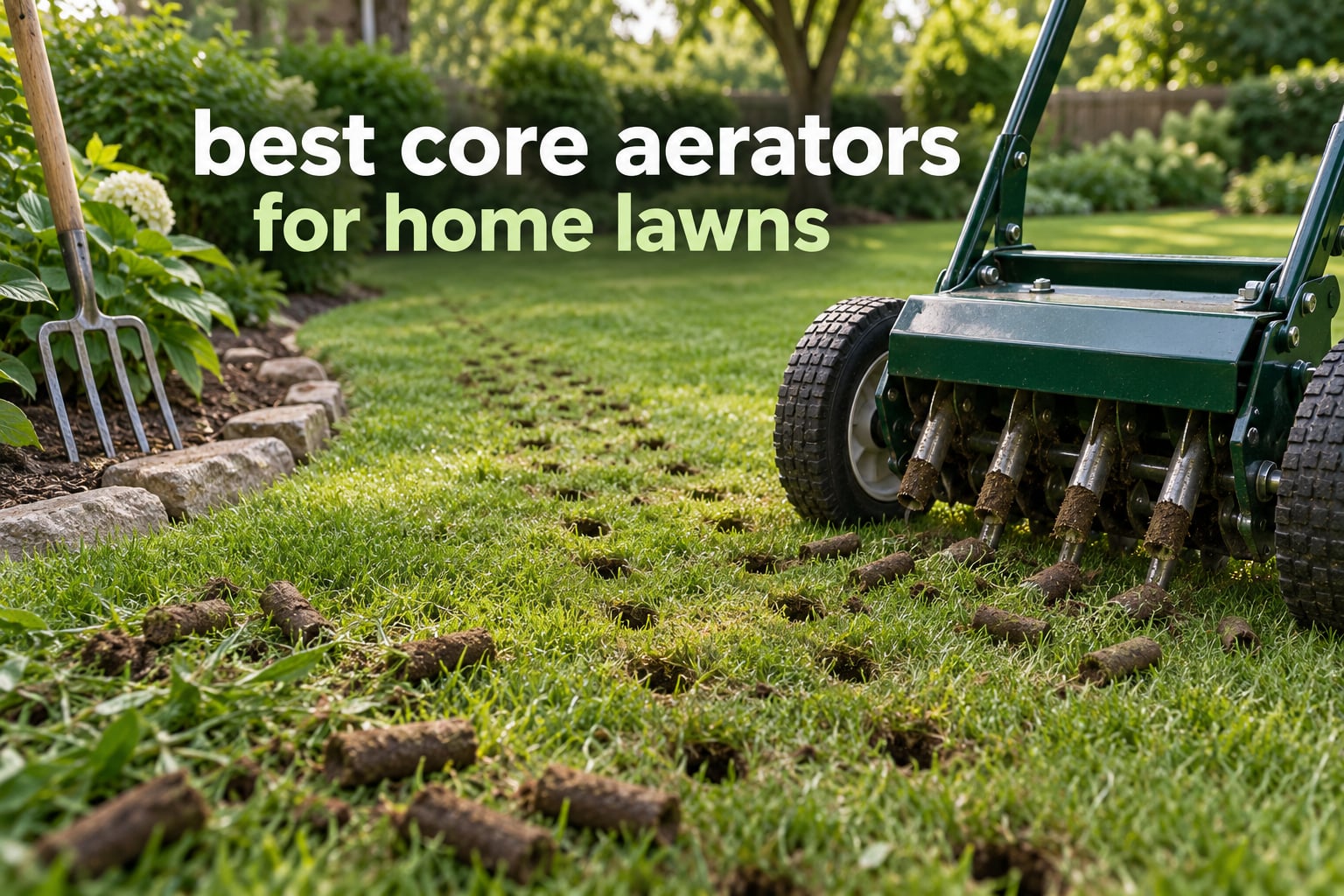
Most lawn problems are not fertilizer problems. They are compaction problems, and no amount of nitrogen will fix a root zone that has been compressed until water runs off the top and air never reaches the grass. Core aeration is the only home method that physically removes that layer, which is why it belongs at the front of any seasonal lawn plan.
A core aerator is a lawn tool with hollow steel tines that punch into the soil and pull out small plugs of earth, typically 2 to 3 inches deep, creating openings that let air, water and nutrients reach grass roots. The cores stay on the surface, break apart over a few weeks and return organic matter to the topsoil.
If you are shopping for one, the search terms run together fast: core aerator, plug aerator, coring aerator and hollow-tine aerator all describe the same hollow-cylinder machine. Every pick below is a true hollow-tine model. Spike aerators, aerator shoes and scarifiers pull nothing, so they are excluded except where one pick earns its place for a different reason, and I say why.
Five signs point to compaction worth treating: water puddles or runs off minutes after rain, fertilizer greens nothing, bare thin patches appear in traffic zones, a shovel or garden fork goes in only an inch or two, or the ground rings hard underfoot. If none of those show up, you may be aerating out of habit rather than need.
We put together the best core aerators for home lawns by comparing lawn-size fit, soil compatibility, tine geometry, ballast capacity, assembly complexity and review volume across the ten models below. For the wider spread of machine types, including spike and slicing designs, read our general lawn aerator roundup.
Table of Contents
- Top 3 Best Core Aerators for Home Lawns in 2026
- All 10 Core Aerators Compared at a Glance in 2026
- 1. Yard Butler ID-6C Manual Lawn Coring Aerator: Best Overall
- 2. Agri-Fab 48 Inch Tow Behind Plug Aerator: Best for Large Lawns
- 3. Brinly 40 Inch Tow Behind Plug Aerator: Best Tow-Behind Finish
- 4. Gardzen Hand Hollow Tine Plug Aeration Tool: Best Budget Core Aerator
- 5. Landzie 42 Inch Hollow Tine Core Aerator: Best Self-Cleaning Tine Design
- 6. Dolibest 4 Corer Stainless Steel Plug Aerator: Best Four-Tine Coverage
- 7. LawnVigor Manual Core Aerator: Best for Compact Small Yards
- 8. K.D STONEDGE Patented Rolling Lawn Aerator: Best Rolling Corer
- 9. Xuperace Alloy Steel Core Aerator: Best for Hard Clay
- 10. Brinly Combination Aerator and Spreader: Best 2-in-1, But Not a True Corer
- Core Aerator vs Spike Aerator: Which One Actually Relieves Compaction?
- How to Aerate Your Lawn Without Damaging It?
- Why Tines Clog and How to Fix It
- When to Aerate Your Lawn by Grass Type and Season
- How to Choose a Core Aerator: Buying Guide by Lawn Size and Soil
- Renting vs Buying a Core Aerator
- Frequently Asked Questions
- Final Verdict: Best Core Aerator by Yard Type
Top 3 Best Core Aerators for Home Lawns in 2026

Yard Butler ID-6C Coring Aerator
- Dual hollow plug tines
- Foot bar for pressing power
- Powder-coated steel
Agri-Fab 48 Inch Tow Plug Aerator
- 48 inch width
- 32 galvanized knives
- 175 lb weight tray
- 3 in plugs

Brinly 40 Inch Tow Behind Plug Aerator
- 24 heat-treated spoons
- 3 in plug depth
- 150 lb enclosed tray
- Single-lever transport
All 10 Core Aerators Compared at a Glance in 2026
| Product | Specifications | Action |
|---|---|---|
| Yard Butler ID-6C Coring Aerator |
|
Check Latest Price |
| Agri-Fab 48 Inch Tow Plug Aerator |
|
Check Latest Price |
| Brinly 40 Inch Tow Behind Plug Aerator |
|
Check Latest Price |
 Gardzen Hand Hollow Tine Aerator Gardzen Hand Hollow Tine Aerator |
|
Check Latest Price |
 Landzie 42 Inch Hollow Tine Aerator Landzie 42 Inch Hollow Tine Aerator |
|
Check Latest Price |
 Dolibest 4 Corer Plug Aerator Dolibest 4 Corer Plug Aerator |
|
Check Latest Price |
 LawnVigor Non-Clogging Core Aerator LawnVigor Non-Clogging Core Aerator |
|
Check Latest Price |
 K.D STONEDGE Rolling Core Aerator K.D STONEDGE Rolling Core Aerator |
|
Check Latest Price |
 Xuperace Alloy Steel Core Aerator Xuperace Alloy Steel Core Aerator |
|
Check Latest Price |
 Brinly Aerator Spreader 2 in 1 Brinly Aerator Spreader 2 in 1 |
|
Check Latest Price |
1. Yard Butler ID-6C Manual Lawn Coring Aerator: Best Overall
Yard Butler Manual Lawn Coring Aerator, ID-6C – Lawn Care Tool for Aerating – Long-Handled – Power-Coated Steel Construction – Comfortable Cushioned Handles Garden Tool – Easy to Use
Dual hollow plug tines
Foot bar for pressing power
Powder-coated steel
1.77 lb and 38 in long
Pros
- Long handle keeps your back upright
- Powder-coated steel frame
- Foot bar adds real force in hard soil
- Cushioned handles
- 8721 reviews of long-term use
Cons
- Demanding on large lawns
- Cores need emptying as you work
The Yard Butler ID-6C is the tool we keep coming back to. It is a long-handled, foot-powered corer with two hollow plug tines, and it is the only pick in this roundup with more than 8000 ratings behind it, which tells you how many seasons of use it has survived.
The design is deliberately simple. A 38-inch shaft with cushioned handles meets a powder-coated steel head carrying dual hollow plugs, and a welded foot bar sits under the frame so you can push down with your heel without your shoe blocking the ejection path. At 1.77 pounds it is light enough to carry from the shed with one hand.
Owners consistently single out two things: the long handle, which lets you work upright instead of bent at the waist, and the foot bar, which is what makes those plugs come up in compacted ground. The rating split of 63 percent five-star and 20 percent four-star reflects a tool that simply does one thing correctly.
The limitation is scale. Two tines and manual power mean you are walking the lawn one footprint at a time, and on ground that is genuinely hard the foot bar takes real effort. Reviewers also mention emptying cores periodically, which interrupts rhythm.
What you should know before buying
Two tines make this a spot-and-small-lawn machine rather than a whole-property machine. If your plan covers a front lawn plus a side yard, budget an afternoon and accept a repetitive motion.
Yard Butler also builds a spike-aerator version of this same footprint, so double-check the listing image shows hollow plugs and not solid spikes. More of our small-yard picks are covered in manual aerator reviews for small yards.
Where it falls short
Two hollow tines cover a narrow strip, so core coverage per foot push is modest and a large lawn takes many passes. Reviewers report the physical effort climbs sharply on dry or hard soil, which is a soil-moisture problem more than a tool problem.
It stores easily and costs little, so the honest reason to skip it is lawn size alone. If you own a riding mower and have more than a few thousand square feet, look at the tow-behind options further down.
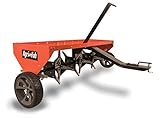
2. Agri-Fab 48 Inch Tow Behind Plug Aerator: Best for Large Lawns
Agri-Fab 48 In Tow Behind Lawn Plug Aerator with 32 Galvanized Knives and Universal Hitch
48 inch cutting width
32 galvanized knives
175 lb weight tray
Pulls plugs to 3 in
Pros
- 48 inch width needs far fewer passes
- Self-sharpening galvanized knives
- 175 lb tray adds ballast
- Cantilever handle raises from the seat
Cons
- Needs a riding mower or tractor to pull
- 94 lb build is awkward to store by hand
Model 45-0299 is the classic American tow-behind plug aerator, and for a property of an acre or more it removes the labor argument entirely. You attach it, drop the cantilever handle, and the machine coring plugs happens while you drive.
Thirty-two galvanized self-sharpening knives sit on the rotating tine assembly across a 48-inch working width. Plugs come up to three inches deep, and the weight tray accepts up to 175 pounds of ballast, which is what actually gets the knives into dry clay.
Reviewers rate the flat-free tires as a quiet hero. A flat tire on a plug aerator ends the job halfway across the lawn, and these roll reliably over uneven ground and driveway transitions without that risk.
The catches are structural rather than functional. It weighs 94 pounds, needs a tractor or riding mower with a working hitch, and it is useless on a lawn too small to turn a machine around in. Owners with large properties describe it as dependable and shed-friendly, with the tractor requirement as the only real reservation.
What you should know before buying
The weight tray is the feature that matters most on hard soil. An empty tray on compacted clay will skim the surface, while a loaded tray produces the two to three inch cores that signal a real aeration pass.
Measure your turns before you buy. A 48-inch unit needs a wide path, and users working around trees, beds and sprinklers report this as the hardest part of the job. Our tow-behind aerator picks for riding mowers cover narrower widths if space is tight.
Where it falls short
It is strictly a tow-behind. No handle lets you push it, and on a small lot you will spend more time repositioning than coring.
At 94 pounds, storing it means clearing a wall in the shed. Owners with tight storage report that as the deciding factor against an otherwise strong machine.
3. Brinly 40 Inch Tow Behind Plug Aerator: Best Tow-Behind Finish
Brinly Tow Behind Plug Aerator with Universal Hitch, 40″ – Flat Black
24 heat-treated spoons
3 inch plug depth
150 lb enclosed tray
63.9 lb with single-lever transport
Pros
- Narrow spoons penetrate with less added weight
- Rotating tine sections reduce turf damage
- Semi-pneumatic tires resist flats
- Single-lever transport from the seat
Cons
- Costs more than most tow-behinds
- Semi-pneumatic tires need pressure checks
The Brinly PA-403BH-A3 is the highest-rated tow-behind here at 4.4 stars, and the reason is tine geometry. Twenty-four heat-treated 16-gauge steel plugging spoons remove plugs to three inches and, being narrow, need noticeably less ballast to bite than broader knives.
Three independently rotating welded tine sections are the quiet engineering win. Because the sections turn at their own angle rather than scrubbing sideways, owners report less turf tearing on tight turns and uneven ground, which is where most plug aerators do visible damage.
The enclosed weight tray holds 150 pounds, a little less than the Agri-Fab maximum, but the narrower spoons compensate. A single transport lever engages the 10-inch semi-pneumatic tires, so crossing a driveway is one motion from the seat rather than a wrestling match.
At 63.9 pounds it is also about a third lighter than the Agri-Fab, which matters in a shed. The tradeoff is price: it sits above most tow-behind plug aerators, and semi-pneumatic tires ask for an occasional pressure check.
What you should know before buying
Its 40-inch width is narrower than the Agri-Fab, so expect a few more passes but a much easier time threading between beds and shrubs. For irregular lots with obstacles, that is usually the better trade.
The single-pin universal hitch attaches to lawn tractors, most zero-turn riders and ATVs. Check your machine has a hitch receiver before ordering, since retrofitting is the one thing none of these attachments accommodate.
Where it falls short
It is a coring machine with no spreading function. If you want seed and fertilizer in the same pass, the combination unit later in this list does both jobs.
The price gap against other tow-behinds is real, and buyers on a tight lawn-care budget can get adequate results from a cheaper machine. You are paying here for cleaner plugs and gentler turns.
4. Gardzen Hand Hollow Tine Plug Aeration Tool: Best Budget Core Aerator
Gardzen Plug Aeration, Hand Hollow Tine Lawn Aerator, Heavy Duty Aerator for Compacted Soils and Lawns, 35″ x 11″, Black
Hollow tine plug aeration
Powder-coated steel frame
35 x 11 in footprint
3.65 lb
Pros
- Lowest-cost entry into true coring
- Handy for spot treatments
- Powder-coated steel frame
- Light enough to carry one-handed
Cons
- Shallow cores versus premium hollow-tine tools
- Light frame gives little pressing force
- Only practical on small areas
The Gardzen GLA03 does something most cheap garden tools do not: it pulls actual plugs with hollow tines instead of punching solid spikes. That makes it the most affordable honest way into core aeration, which is why it earns a place on a list filtered strictly to hollow-tine tools.
The frame is powder-coated steel at 3.65 pounds, with a 35 by 11 inch working footprint. Light weight means easy handling, and for a dog path, a side yard or a patch in front of a gate, that convenience is worth more than capacity.
Owners describe it in exactly those terms: cost-effective for small lawns and problem spots where a bigger machine is overkill. The 54 percent five-star share matches a simple tool that does a narrow job predictably.
The reservations are consistent too. Cores come up shallow compared with premium hollow-tine models, and a light frame gives you less pressing force when the ground is hard. On a whole lawn, you would be walking it for hours.
What you should know before buying
Set expectations by yard size. Under roughly 2,000 square feet of spot work, this is a sensible purchase. Beyond that, the hours add up faster than the savings.
Gardzen sells plug and spike variants of the same frame. Confirm you are ordering the hollow-tine plug version, since the spike version will not satisfy the problem you are trying to solve.
Where it falls short
Core depth is the weak point. Shallow cores open the surface without relieving compaction deep in the profile, so the effect on a hard lawn is temporary.
Lightweight steel also flexes under pressure, which reduces the number of full cores you get per press in compacted clay. If your soil is heavy, spend a little more on a heavier frame.
5. Landzie 42 Inch Hollow Tine Core Aerator: Best Self-Cleaning Tine Design
Landzie – Lawn Aerator Tool 42″, Hollow Tine Core Aerator
Three stainless steel hollow tines
42 inch overall length
Beveled self-ejecting ends
5.6 lb, no assembly
Pros
- Beveled tines eject plugs on each stroke
- Replacement tines sold separately
- No assembly required
- Removable tines clean easily
Cons
- Real effort on hard or dry ground
- Not efficient on large lawns
- Three tines cover a narrow strip
Clogging is the loudest complaint in every lawn forum thread about hollow-tine tools, and the Landzie is designed around that problem. Its three solid stainless steel hollow tines have beveled ends that push old material out of the tube on each press, so the tool clears itself as you work.
At 42 inches overall and 5.6 pounds, it is taller and heavier than the Yard Butler but built from a powder-coated steel frame that owners expect to last. The tines arrive fitted, so there is no assembly, and each one unscrews for cleaning or replacement.
The rating distribution backs the design claim: 68 percent five-star, with the positive reviews naming the self-cleaning beveled tines specifically. Replacement tines sold separately also mean a bent tine is a five-minute fix rather than a replacement tool.
Reviewers do add a firm caveat. The tines work best on damp soil, and heavy clay or dry ground will bend them and tire you out. Owners of big yards report renting a machine instead.
What you should know before buying
Self-ejecting tines only help if the soil is not bone dry. Water the lawn the day before you work, then use the tool while the top few inches are soft and you will rarely stop to clear it.
Because the tines are removable, you can drop to two if the soil is harder than expected. That flexibility is something fixed-head competitors in this roundup do not offer.
Where it falls short
Three tines over a narrow base means slow coverage. Even with clean tines, a quarter-acre lawn is a multi-hour job and a genuine workout.
Bent tines on very hard clay are reported in reviews despite the stainless steel. Treat it as a garden tool for normal lawn conditions rather than a machine for subsoil.
6. Dolibest 4 Corer Stainless Steel Plug Aerator: Best Four-Tine Coverage
Dolibest Lawn Coring Aerator, Stainless Steel 4 Corer Plug Aerator Tool with Soft Rubber Grip, Manual Grass Aerating Tool, Garden Tool & Cleaning Hand Tool for Loosening Soil and Improving Lawn Health
Four 3.5 in stainless corers
0.5 in core diameter
Soft rubber grips
Foot bar clears shoes from cores
Pros
- Widest manual coverage per foot push
- Interchangeable replaceable tines
- Includes a 12 inch weeding tool
- Soft grips reduce blisters
Cons
- Tines clog in heavy wet clay
- Some owners report welded joints loosening
- Too slow for a whole large lawn
The Dolibest answers the slowest part of manual coring: how much lawn you cover per step. Four corer plugs, each 3.5 inches long and 0.5 inches in diameter, give it the widest working footprint of any hand tool in this roundup.
The stainless steel plugs and powder-coated body resist the rust and bending that end cheaper tools, and the tines are interchangeable, so a damaged plug is a swap rather than a purchase. A 12-inch weeding and cleaning hand tool is included for clearing plugs out of the tubes.
Reviewers describe the result honestly: on properly moist ground it pulls clean cores of roughly 1.5 to 3 inches, while in clay it clogs within a few dozen steps and needs clearing. Soil moisture, not tool quality, decides how this one performs.
The foot bar is a small but real improvement. It positions your shoe ahead of the ejection path so the plug drops clear instead of being kicked back at you, and the soft rubber grips take the sting out of a long session.
What you should know before buying
Four plugs in one foot press still covers a strip only about two inches wider than a single-tine tool. The gain is real but incremental, so set your time expectations from your lawn size rather than the plug count.
Check the listing variant before ordering, since several configurations exist with and without a storage tray and with three or four plugs. The core geometry is otherwise the same.
Where it falls short
Clay is where this tool struggles. Reviewers describe tines clogging every few dozen steps in heavy wet ground, which turns an hour of work into an hour of clearing.
A small number of owners also report welded joints loosening with limited use. Inspect the frame joints periodically if you store it under a shed in damp conditions.
7. LawnVigor Manual Core Aerator: Best for Compact Small Yards
Manual Lawn Core Aerator for Compacted Soil with Non-Clogging Hollow Tines
Three heat-treated hollow tines
About 4 in penetration depth
Bolted replaceable tines
37 in tall with tools included
Pros
- Insert rings guide plugs out cleanly
- Bolted tines are replaceable
- All assembly tools included
- Compact 37 in height stores easily
Cons
- Handle grips can spin loose
- Only three tines per press
- Grass and roots lodge between tines
LawnVigor takes the clogging problem seriously from a different angle. Rather than beveling the tube, it adds white plastic insert rings that guide the soil plug out of each hollow tine as it rises. Owners report plugs releasing without jamming, including in clay.
The tines are heat-treated, roughly 0.9 inches across, and reach about 4 inches of penetration depth, which is the deepest hand-tool figure in this roundup. They bolt into the frame rather than press-fit, so a worn tine can be unscrewed and swapped.
At roughly 37 inches tall with an 8.3-inch base, the whole tool is compact enough for a small shed wall. Wrenches and a hex key come in the box, so assembly takes minutes rather than a trip to the toolbox.
It also draws 75 percent of reviews at five stars, among the strongest rating shares on this list. The recurring caveats are handle covers loosening during use and physical effort in dry, hard soil.
What you should know before buying
Keep the white plastic inserts in place. They are the mechanism that releases plugs, and owners who removed them reported the anti-clog benefit disappearing. That single detail does more for you than any other feature here.
Budget a few minutes after each session to pull grass and small roots out of the gaps between tines. Reviews mention this cleanup specifically, and skipping it is what makes a tool feel like more work than it is.
Where it falls short
Three tines mean the narrowest strip of lawn per foot press. For a front yard under 2,000 square feet this is fine; beyond that the hours add up quickly.
Loose handle covers are the most common complaint and can cause blisters over a long session. A wrap of grip tape or a zip tie fixes it in a minute.
8. K.D STONEDGE Patented Rolling Lawn Aerator: Best Rolling Corer
Patented Rolling Lawn Aerator Manual Coring Tool Compacted Soil Loosening
Patented rotary coring
60 inch overall length
43.7 lb balanced frame
Wheeled push operation
Pros
- Rolls instead of stamping each core
- Balanced weight resists tip-over
- 43.7 lb frame drives tines deep
- Sized for small and medium lawns
Cons
- 43.7 lb is hard to lift and store
- 60 in length is awkward around beds
- A full session is physically taxing
Every other hand tool here asks you to lift, aim and stamp. The K.D STONEDGE rolls. Its patented rotary coring design pulls plugs continuously as you push it across the lawn, which removes the repeated bending that makes manual coring tiring.
The frame is heavy at 43.7 pounds, and that weight is the point. With balanced weight distribution, the machine resists tip-over and drives its tines deep enough to satisfy the visual check homeowners use: cores of two to three inches sitting on the surface afterward.
Reviewers who switch from a foot tool to this one describe the difference as trading bending for pushing. At 60 inches long, it fits small and medium lawns comfortably and covers ground far faster than any tine-count comparison suggests.
The manufacturer is candid that it is a workout, and owners agree. The recurring complaints are weight and size: hard to lift, awkward to store, and long enough to be troublesome turning near landscaping.
What you should know before buying
Measure your storage space and your turning radius. At 60 by 17 by 11 inches and 43.7 pounds, this is the least portable machine in the roundup, and it does not fit in a typical shed corner without a dedicated spot.
It also has no hitch, so it will not work behind a tractor. That keeps it below the tow-behind tier in coverage but above every hand tool in speed.
Where it falls short
A 43.7 pound machine has no convenient carry handle for stairs or a truck bed. Two people lifting it is the realistic assumption for most owners.
Effort is the trade. You avoid repeated bending but add sustained pushing weight over distance, which builds up in the shoulders and lower back over a long session.
9. Xuperace Alloy Steel Core Aerator: Best for Hard Clay
Xuperace Lawn Aerator Tool, Core Aerator Lawn Tool with Alloy Steel Material, Sturdy Grass Aerator for Lawn Health Soil Yard Aerator
Three hollow alloy steel tines
Side-ejecting plug release
Knee-clear frame
42 in long and 5.91 lb
Pros
- Side-eject ramp stopped clogging in owner use
- Knee stays clear of the frame
- Longer constant-diameter tines drive deeper
- Replacement tines and threadlocker included
Cons
- Costs about twice a budget manual aerator
- Sharp tines can puncture a dropped foot
- Firm soil still needs a rocking motion
The Xuperace rates highest in the entire roundup at 4.6 stars, with 80 percent of reviews at five. Buyers who shopped the whole manual category single out one thing: the side-ejecting ramp on the hollow tines, which pushes plugs out to the side so the tubes never fill.
Its second distinction is the open-center frame. Most coring tools have a cross brace where your knee lands, and owners report bruised knees across competing brands. This one leaves the center open so your leg moves freely while you step.
The tines are longer than typical with a constant diameter, which is why they drive deeper than shorter flared competitors. An Allen wrench, combination wrench, spare screw and blue threadlocker are included, and replacement hollow tines attach with screws, so a bent tine is not a dead tool.
There is a middle-tine removal option for harder ground. Take the center tine out and the frame becomes a two-tine tool that concentrates your weight where the soil resists most.
What you should know before buying
This is the pick for clay. Constant-diameter side-ejecting tines plus the ability to drop to two tines are the two features that matter when the ground fights back, and owners report clean cores in compacted clay where other tools jam.
If you are weighing it against cheaper hand tools, read our core aerator picks for compacted lawns for the deeper diagnosis of how compacted ground changes your choice.
Where it falls short
The price is roughly twice that of a budget manual aerator. You are paying for tine geometry and hardware, which is defensible on hard soil and hard to justify on soft loam.
Those tines are sharp. Owners warn that a dropped tool can puncture a foot, and stepping in firm soil still requires a rocking motion, so keep your knee clear of the tine path.
10. Brinly Combination Aerator and Spreader: Best 2-in-1, But Not a True Corer
Brinly Tow Behind Combination Aerator Spreader with Weight Tray, 40-Inch, Flat Black
Aerator and broadcast spreader
132 tine tips on 8 in stars
75 lb weight tray
100 lb all-steel hopper
Pros
- Seeds and fertilizes in the same pass
- 75 lb tray adds real penetration
- All-steel 100 lb hopper resists flexing
- Works on uneven ground
Cons
- Perforates about 2 in without pulling true plugs
- Chain and chain guard failures reported
- Flow control lever shifts in use
- Assembly takes 30 to 45 minutes
I am including this one with a clear caveat. The Brinly AS2-40BH-P is a two-in-one aerator and broadcast spreader, and its 132 galvanized 3-D tine tips perforate the soil about two inches deep. They perforate. They do not pull hollow cores, so on a compacted lawn it will not do the job a core aerator exists to do.
What it does well is convenience. You drop seed, fertilizer or lime in the 100-pound all-steel hopper and spread it in the same pass you aerate, which is genuinely useful when you are overseeding and want the seed down immediately.
The 75-pound rigid steel weight tray is more substantial than it looks on paper, and owners say it pushes the tines into hard ground effectively. Ten-inch pneumatic transport wheels engage with one lever, and the calibrated flow control gives a reasonably even pattern.
The 17 percent one-star share is about hardware, not results. Owners report drive chain and chain guard failures, a flow control lever that shifts position mid-pass, and assembly that ran well past the advertised thirty minutes for some owners.
What you should know before buying
Buy this only if seeding and fertilizing in one pass matters more to you than deep coring. On a lawn that is merely thatch-bound or slightly compacted, perforating at two inches may be all you need.
On a lawn with real compaction, standing water or thin grass in traffic zones, choose a hollow-tine machine instead. No amount of ballast turns solid tines into plugs.
Where it falls short
Perforation depth of about two inches is shallow compared with the three inches a hollow-tine corer reaches, and it leaves nothing on the surface to judge the pass by.
The chain and chain guard are reported as weak points, and a failing drive chain mid-job means a trip for parts on a machine you cannot push manually.
Core Aerator vs Spike Aerator: Which One Actually Relieves Compaction?
Core aerators remove soil. Spike aerators push soil. That single difference is why university extension services across the country recommend hollow-tine coring over spike aeration on compacted lawns, and why spike products crowd the shelves without earning their place on a list like this one.
A spike is a solid steel pin. It drives into the root zone, displaces soil sideways and downward, and leaves a narrow hole that closes quickly. On soft ground that is fine. On compacted ground it compacts the sides of the hole further, which can make the underlying problem worse.
A hollow tine removes a cylinder of soil and lifts it to the surface. That 0.5-inch-plus opening stays open, letting water and air reach roots while the core breaks down into the topsoil. Slicing aerators cut blades of turf sideways and deal with thatch better than compaction, and liquid aeration uses a soil surfactant with no mechanical effect at all.
The honest counterpoint is that spikes do less damage to the grass surface, so they are easier on a thin, stressed lawn. If your soil is loose and you only want to improve water movement, a spike tool is acceptable. If you have a hard pan, use hollow tines.
How to Aerate Your Lawn Without Damaging It?
Water first, then work. Dry soil gives you dust and bent tines; saturated soil tears the turf into strips. Aim for soil that holds together in your hand but breaks apart with a thumb, which usually means watering a day or two ahead.
Mow first, aerate second. Working over tall grass snags tines and pulls up weeds by the root. Leave the plugs on the lawn when you finish; they break down and feed the soil rather than smothering it.
Overlap passes by about one-third and stay off the same wheel track repeatedly. Walk the borders first so you do not box yourself into a corner, and slow down on turns rather than pivoting in place.
Do not aerate during a drought or a growing-season heat spike on cool-season grass. Fall is the recovery window, and the open holes let fall rain reach roots before the lawn goes dormant.
Why Tines Clog and How to Fix It
Clogging is a soil-moisture symptom, not a defect. Hollow tines pack with wet clay and organic matter, and in dry conditions the plug dries inside the tube and jams where it sits.
Check the soil by squeezing a handful. If it forms a slick ball, it is too wet and plugs will smear. If it crumbles to powder, it is too dry and tines will not penetrate or will break the cores loose in powder.
Stop every few dozen steps on hand tools and eject plugs from the tines by hand or with the included cleaning tool. On tow-behind units, check the collection area at the end of each pass. Dry tools off after use and tines stay free far longer.
Design matters too. Beveled ends, side-ejecting ramps and plastic insert rings all exist to solve this problem, and the Landzie, Xuperace and LawnVigor picks here each take a different route to the same result.
When to Aerate Your Lawn by Grass Type and Season
For cool-season lawns, which covers most of the Northeast and Upper Midwest, aerate in early fall while the grass is actively growing and temperatures are falling. Spring is the second window, but do it before heavy spring rains.
For warm-season lawns, Bermuda and Zoysia, aerate in late spring through early summer as the grass ramps up growth. Avoid fall aeration on warm-season grass, since it can push the lawn into winter with open holes and weakened roots.
Aim for once a year on a normal lawn and twice when traffic is heavy, pets run the same path, or the soil is clay. Judge by evidence rather than calendar: water that sits, thin grass or a fork that will not go past an inch all point the same direction.
How to Choose a Core Aerator: Buying Guide by Lawn Size and Soil
Match the machine to the lawn first. Under 2,000 square feet, a two-tine foot corer handles the job in an afternoon. Between 2,000 and 10,000 square feet, a four-tine hand tool or the rolling corer keeps you from walking the property ten times.
Above that, or if you own a riding mower with a hitch, a tow-behind plug aerator is the only realistic option. Match the working width to your turning room, not just your lawn size, and confirm the hitch type before ordering.
Then match tine design to soil. Beveled, side-ejecting or insert-guided hollow tines handle clay without constant stopping. Standard hollow tines are fine on loam. On very hard ground, longer constant-diameter tines penetrate deeper than short flared ones.
Look at the ballast tray next. A tow-behind that accepts 100 pounds or more can be pushed deeper into dry clay, and the weight tray is where you decide whether a machine will do real work or just skim the surface.
Finally, check the maintenance details that determine whether the tool still works in year three: are the tines replaceable, is the steel powder-coated or galvanized, and are the fasteners the kind that loosen? Check the pick’s parts list, because a tool with no spare tines is a tool with a shorter life.
Storage and effort deserve equal weight. A 94-pound tow-behind needs a clear wall in the shed, and a rolling corer at 43.7 pounds needs a corner it can live in permanently. Tools that are hard to store get stored away and never used.
Renting vs Buying a Core Aerator
The economics usually turn on lawn size and how often you will do it. Professional aeration services are quoted per visit, and one or two passes a year makes renting a machine a defensible choice for most homeowners under half an acre.
Buying starts to make more sense once you have a tow-behind setup, a lawn large enough that manual coring is punishing, or a multi-season plan that includes overseeding and topdressing in the same window. If you will use the same machine three years running, the purchase pays back quickly.
If you are considering a powered electric or gas unit instead, our electric lawn aerator picks cover the homeowner powered tier in more detail, including the gap between hand tools and commercial machines.
One caution about renting: walk the machine before you load it. Ask specifically whether the tines are hollow or solid, because plenty of rental counters hand over spike or perforating machines when you ask for a core aerator.
Frequently Asked Questions
What is the best garden aerator?
For most home lawns under a quarter acre, the Yard Butler ID-6C manual coring aerator is the best balance of hollow-tine coring, low storage footprint and cost. On larger lawns with a riding mower, a tow-behind plug aerator such as the Agri-Fab 48-inch model covers far more ground per pass. On hard clay, a self-ejecting design like the Landzie or Xuperace avoids constant stopping.
What is the difference between a core aerator and other lawn aerators?
A core aerator uses hollow steel tines to pull 2 to 3 inch plugs of soil out of the lawn, leaving open holes that admit air, water and nutrients. A spike aerator drives solid pins that push soil sideways and can worsen compaction. A slicing aerator cuts blades sideways to manage thatch, and liquid aeration applies a surfactant with no mechanical effect.
How much does it cost to buy a core aerator?
Prices span a wide range because lawn size, not build quality, sets the tier. Manual hollow-tine corers sit at the entry level, four-tine and self-ejecting designs sit above them, and tow-behind plug aerators with ballast trays land in the low hundreds. Rolling rotary corers sit between the two, and powered machines sit above hand tools.
What month is best to aerate a lawn?
For cool-season grasses, early fall is best, while the grass grows vigorously and temperatures drop, followed by a late spring window before heavy spring rains. For warm-season Bermuda and Zoysia, late spring to early summer is the right time. Avoid fall aeration on warm-season lawns, which can leave open holes and weakened roots going into winter.
Is it worth buying a core aerator?
Worth it when your soil shows real compaction: water puddles after rain, fertilizer greens nothing, grass thins in traffic zones, or a garden fork will not go past an inch or two. Under half an acre with no riding mower, renting once or twice a year is often the better financial decision than owning a machine you will use two days a year.
Should you leave the soil plugs on the lawn after aerating?
Leave them. The cores break down over a few weeks and return organic matter and nutrients to the topsoil, and the open holes they came from are the entire point of the pass. Raking them away removes that benefit and costs you an extra job. Lightly break them up instead if their appearance bothers you.
Final Verdict: Best Core Aerator by Yard Type
For a small lawn and one person doing the work, the Yard Butler ID-6C is the best core aerator for home lawns because it pulls real cores, stores in a corner and has the longest track record of any tool here. It earned our Editor’s Choice on review volume and consistent owner feedback, not on being the most capable machine.
Own a riding mower and have real acreage? The Agri-Fab 48-inch tow-behind handles the job in an afternoon. Want the cleanest plugs and the gentlest turns from a tow-behind? The Brinly PA-403BH-A3 is the better-finished machine.
Fighting clay? The Xuperace side-ejecting design keeps working where other hollow tines jam. Tired of bending? The K.D STONEDGE rolling corer trades stamping for pushing. And if your compaction is only moderate, take our advice and rent before you buy, then revisit once you know how many passes your lawn really needs.
Whichever you choose, water the day before, mow first, and leave the plugs on the lawn. The tool is the easy part.