
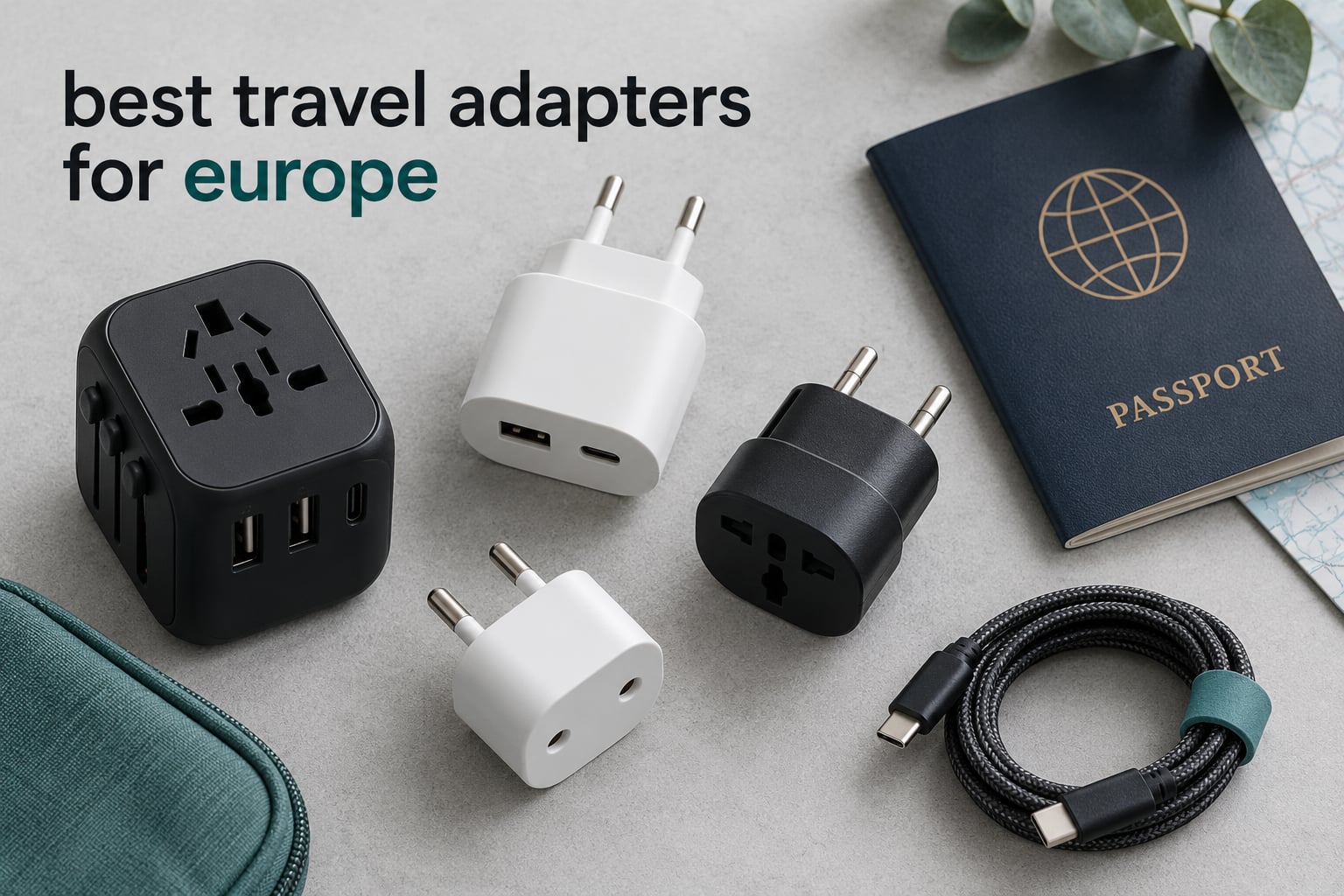
A trip to Europe fails faster than almost anything else when your phone dies at the gate and you have no way to charge it. The reason is physical: a US two-pin plug does not fit a German or French wall socket, and a UK socket is a completely different shape again. Pick the right travel adapter for Europe before you fly and the problem disappears for the whole trip.
We spent weeks comparing twelve of the most-reviewed travel adapters on the market, checking plug coverage, AC outlet counts, USB-C and USB-A output, fuse ratings and what real travelers say about them after a trip. Everything below uses published specifications and owner feedback rather than marketing copy, and every pick states plainly what it cannot do.
Short version: most of continental Europe runs on round-pin Type C or Type E/F sockets at 230V and 50Hz, while the UK, Ireland and Malta use three-rectangular-pin Type G sockets. A single universal adapter with Type A, C, G and I plug heads covers both, and none of the twelve below changes voltage.
Table of Contents
What Type of Adapter Do You Need in Europe?
You need a plug adapter that physically matches the sockets on your itinerary, and for most trips that means a universal model with Type A, C, G and I heads. Continental Europe uses round pins: Type C is the ungrounded two-round-pin plug, while Type E adds a grounding pin and Type F is the Schuko socket with side grounding clips. The UK, Ireland and Malta use Type G, and Switzerland uses Type J, whose pin spacing looks like Schuko but is not identical.
Here is the split that catches almost everyone. A Type C adapter bought in Paris works in France, Germany, Spain, Italy, Portugal, Greece, the Netherlands and most of the continent, and it fails completely in London. Forum advice on the Rick Steves board is the same: for dual-voltage phones and tablets, carry one simple Type C piece and one Type G piece rather than a heavy universal unit.
One more thing to check before you buy anything. Look at the input label on your devices. Nearly every modern phone, laptop, camera and e-reader reads 100-240V 50/60Hz, which means it works directly on European 230V with no conversion. Traditional hair dryers, curling irons and some kitchen appliances are single-voltage and need a real step-down converter, which is a different product entirely.
Top 3 Picks for Travel to Europe (October 2026)

EPICKA Universal Travel Adapter
- Type A C G and I plug heads
- 1 AC socket plus 3 USB-C and 2 USB-A
- Replaceable 10A fuse with spare
- 2-year warranty

Ceptics 45W Universal Travel Adapter
- Type A C G and I plug heads
- 45W total across 3 USB-A and 2 USB-C
- 8A fuse with spare
- Universal input socket

NEWVANGA All in One Travel Adapter
- Type A C G and I plug heads
- USB-C PD 3.0 up to 20W
- Double 8A fuse with shutters
- 3.2 ounces
The EPICKA takes the top slot because it is the only adapter in this group that carries four plug types, five USB ports, an AC socket and a replaceable 10A fuse in a 5.1 ounce body, with more than 19k reviews behind it. The Ceptics is the pick when you want real Power Delivery wattage rather than port count, and the NEWVANGA is the one to pack when grams matter more than features.
All 12 Travel Adapters Compared in 2026
| Product | Specifications | Action |
|---|---|---|
| EPICKA Universal Travel Adapter |
|
Check Latest Price |
| Ceptics 45W Universal Travel Adapter |
|
Check Latest Price |
| NEWVANGA All in One Travel Adapter |
|
Check Latest Price |
 VYLEE Universal International Adapter VYLEE Universal International Adapter |
|
Check Latest Price |
 TESSAN European Travel Adapter 2 Pack TESSAN European Travel Adapter 2 Pack |
|
Check Latest Price |
 One Beat European Travel Adapter 2 Pack One Beat European Travel Adapter 2 Pack |
|
Check Latest Price |
 Unidapt European Plug Adapter 4 Pack Unidapt European Plug Adapter 4 Pack |
|
Check Latest Price |
 VINTAR European Travel Adapter 2 Pack VINTAR European Travel Adapter 2 Pack |
|
Check Latest Price |
 TESSAN European Travel Adapter USB-C TESSAN European Travel Adapter USB-C |
|
Check Latest Price |
 GEONAV 90W European USB-C Charger GEONAV 90W European USB-C Charger |
|
Check Latest Price |
 Romeda 6 Pack Type C Adapter Romeda 6 Pack Type C Adapter |
|
Check Latest Price |
 Anker Nano Travel Adapter 20W Anker Nano Travel Adapter 20W |
|
Check Latest Price |
1. EPICKA Universal Travel Adapter – Best Overall
EPICKA Universal Travel Adapter with 1AC/3 USB-C/2 USB-A Ports
Type A, C, G and I heads
1 AC plus 3 USB-C and 2 USB-A
5.1 oz
2-year warranty
Pros
- Four plug types covering Europe and the UK plus US and Australia
- Five charging ports in a small body
- Replaceable 10A fuse with a spare included
- Safety shutters and plug lock system
- RoHS CE and FCC compliant
Cons
- No voltage conversion so 110V-only appliances will not run
- USB-C output capped at 3A per port
- Two-pin design will not take a grounded three-prong plug
This is the adapter we kept reaching for. EPICKA covers more than 200 countries with four plug heads, which means the same unit handles Paris, London, Lisbon and Sydney without a swap. The body measures 2.9 by 2.07 by 2.15 inches and weighs 5.1 ounces, small enough to sit in a front jacket pocket for the whole flight.
Owners consistently mention the port mix rather than the plug coverage. One AC socket, three USB-C and two USB-A gives you room to charge a phone, a watch, headphones and a battery pack overnight from a single wall outlet, which is often all a hotel room offers.
The safety hardware is the part that separates it from a cheap slider. It has a replaceable 10A fuse and includes a spare, plus safety shutters on the socket and a plug lock so a two-pin plug cannot creep out of a recessed European outlet. Maximum power is 1100W at 110V and 2400W at 240V, so a mid-wattage appliance such as a laptop brick is fine.
Backed by a 30-day money-back promise and a 2-year limited warranty, it is also the highest-rated product here with the largest review base, which makes it the safest default if you are packing one adapter and nothing else.
How the plug system handles a UK and Europe itinerary
The sliding head switches between Type A, C, G and I without tools, so moving from a French hotel to a London train does not mean unpacking anything. Round-pin European sockets are recessed, and the plug lock is what keeps the head seated in them rather than falling out overnight.
Where it falls short
It is a two-pin adapter with no ground path, so a grounded laptop charger or hair tool will not fit through it. USB-C ports output 3A each, which is fine for phones and watches but slow for a laptop, and it converts no voltage.
2. Ceptics 45W Universal Travel Adapter – Best for Real Power Delivery
Ceptics 45W Universal Travel Adapter w/ 3 USB-A, 2 USB-C & Universal Input
45W total output
Type A, C, G and I
8A fuse with spare
2 x 1.8 x 3 in
Pros
- 45W shared across ports supports laptops and tablets
- Universal input socket accepts almost any plug
- Compact enough for a carry-on front pocket
- 8A fuse with spare plus plug lock and shutters
Cons
- 45W total is below most laptop charger needs
- Secondary receptacle sits low on UK sockets so plugs can slip out
- Heavier at about 15 ounces than plug-only adapters
Ceptics is the pick when wattage matters more than port count. Its 45W total budget, shared across three USB-A and two USB-C ports with Power Delivery and Quick Charge 3.0, is high enough to charge a tablet or a smaller laptop and far above the 15W to 20W ceilings on most competitors here.
The universal input receptacle is the feature travelers notice most. You can plug a US cord, a UK plug or almost anything else straight into the face, which removes the guesswork of matching a head to a socket. Ceptics rates it at 8A with a spare fuse, FCC, CE and RoHS certified.
Owner feedback is warm on reliability across countries, from the US and UK to the UAE and India, and Ceptics support is repeatedly described as responsive when a port failed. The fit also holds up in recessed European wall outlets.
Two practical notes. It weighs 15.04 ounces, noticeably heavier than the 3 to 5 ounce plug-only adapters, so it takes real room in a one-bag setup. And when it is plugged into a UK socket, the secondary receptacle sits on the lower face, which means an unplugged device can slide out.
Whether 45W is enough for your trip
A phone, watch, e-reader and pair of earbuds will all charge comfortably within 45W. A 65W or 100W laptop charger will not, so business travelers running a full-size notebook should pair this with a dedicated GaN charger rather than rely on it alone.
Where it falls short
The weight is the first drawback, the low-mounted pass-through socket on UK outlets is the second, and the shared 45W ceiling means a laptop and two phones on one trip will slow each other down.
3. NEWVANGA All in One Worldwide Travel Adapter – Best Lightweight Pick
Universal Travel Adapter USB C, All in One Worldwide Plug Adapter, Black
Type A, C, G and I heads
PD 3.0 up to 20W
3.2 oz
Double 8A fuse
Pros
- Lightest multi-port option here at 3.2 ounces
- Secure fit in recessed European outlets
- USB-C PD 3.0 plus fast USB-A
- Two 8A fuses with surge and short-circuit protection
Cons
- Fewest output ports among multi-port models
- Charging speed depends on device protocol support
- Not a voltage converter
At 3.2 ounces and 3 by 1.5 by 1.9 inches, the NEWVANGA is the one to pack when every gram in your carry-on is contested. It still covers more than 200 countries with US, EU, UK and AU plug heads, so you are not trading coverage for size.
Charging runs through a USB-C PD 3.0 port up to 20W and 3A, with a fast-charge USB-A port alongside it. That is enough for a phone overnight and reasonable for a smaller tablet, but it is not laptop territory.
What reviewers like most is the fit. Recessed Schuko and Type E/F sockets reject round-pin adapters that are too bulky, and this one seats firmly without wobble. The dual 8A fuses, safety shutters and surge and short-circuit protection add confidence at a price that undercuts most of the multi-port options.
Its rating spread is the widest in this group, at 75 percent five-star and 5 percent one-star, which mostly reflects charging expectations. Owners who expected a laptop charger were disappointed; owners who wanted a small dependable plug adapter were not.
What 20W actually charges overnight
A phone, a smartwatch, earbuds and a small power bank will all refill overnight on this budget. Add a 13-inch laptop to the same night and you are at the edge of what 20W per port can deliver in eight hours.
Where it falls short
Three output ports is the fewest here among multi-port models, and fast charging depends entirely on whether your device speaks PD 3.0. It converts no voltage and carries no pass-through AC socket beyond its single outlet.
4. VYLEE Universal International Power Travel Adapter – Best as a Home and Hotel Charger
VYLEE Universal International Power Travel Plug Adapter (White Grey)
Type A, C, G and I heads
1 AC plus 2 USB-A and 2 USB-C
100 g
2-year warranty
Pros
- Smooth sliding plug mechanism feels solid
- Covers 200+ countries with four plug types
- Built-in 8A fuse with safety shutter
- FCC CE and RoHS certified with 2-year warranty
Cons
- Slow output despite fast-charge cables
- No Quick Charge 3.0 support
- Not for high-power appliances like hair dryers
The VYLEE is one of the few adapters in this roundup that reviewers also use as a permanent wall charger at home, which tells you something about the build. The sliding plug head moves smoothly between Type A, C, G and I positions and locks firmly, with no wobble in recessed European sockets.
It provides one AC socket with 2.4A USB-A ports and two USB-C ports at 3A, enough to run a small travel charging station without hunting for outlets. At 100 grams and 2.72 by 2.13 by 2.07 inches it is larger than the three-ounce options but still packs flat and easy.
The consistent complaint is charging speed. Multiple owners report slow output regardless of which cable they use, and the ports do not support Quick Charge 3.0. The 8A fuse, safety shutter and FCC, CE and RoHS certification are solid safety basics.
It handles up to 200-plus countries and works well as a nightstand charger in a hotel where you only need cables anyway. Just do not plan on fast top-ups between activities.
Whether the charging speed matters for you
If you charge overnight and rarely check progress, the VYLEE is fine. If you need a fast top-up during a layover, or you are topping up a tablet between meetings, the slow output will be noticeable and a better option exists.
Where it falls short
It does not support Quick Charge 3.0, the USB-C output is modest at 3A, and it is explicitly not for high-power appliances such as hair dryers or straighteners.
5. TESSAN European Travel Plug Adapter 2 Pack – Best for Families
TESSAN European Travel Plug Adapter 2 Pack, Type C Plug
Type C plug for continental Europe
4 AC plus 2 USB-A and 1 USB-C
3.48 oz each
18-month warranty
Pros
- Two adapters so partners each carry one
- Four AC outlets plus three USB ports
- Four-sided design does not block bulky neighbors
- Handles up to 2500W at 250V
Cons
- Type C plug will not work in the UK Ireland or Scotland
- USB-C PD capped at 20W
- No surge protection
Solving the problem adapters actually create, this is a two-pack. Forum threads about lost adapters come up constantly, and with one in each partner’s bag you are covered if a bag gets left behind or a bag gets stolen.
Each unit converts one Type C socket into four AC outlets plus two USB-A ports and one USB-C PD port at 20W. That is the most AC outlet expansion here, which matters when a family of four shares one cramped hotel room outlet.
The four-sided body is a smart design choice: bulky neighbors plugged into the same wall socket do not block access to yours. At 3.48 ounces each and 3.15 by 2.24 by 2.63 inches, both units fit easily in a personal item.
Power handling is rated for 100V to 250V at 10A, up to 2500W at 250V, so a laptop charger or small appliance is fine. The 18-month warranty is shorter than the two years on the top pick.
Whether a two-pack beats a single universal adapter
For two people traveling continental Europe, the TESSAN two-pack gives you more AC outlets and a spare, which is genuinely useful. For any itinerary touching London, you would still need a separate Type G solution.
Where it falls short
The Type C plug does not fit the UK, Ireland or Scotland, USB-C output stops at 20W, and there is no surge protection built in, which some cruise lines require.
6. One Beat European Travel Adapter 2 Pack – Most AC Outlets in a Small Body
2 Pack European Travel Plug Adapter, Type C Plug Adapter Travel Essentials
Type C plug
3 US outlets plus 2 USB-A and 2 USB-C
3.52 oz each
1-year warranty
Pros
- Three US outlets plus four USB ports in a small body
- Smart chip auto-detects devices up to 2.4A per port
- On and off power indicator
- Two-pack with a one-year warranty
Cons
- Not compatible with the UK Ireland or Scotland
- USB-C lacks Quick Charge 3.0 and 9-22V devices
- Not a voltage converter
The One Beat packs more conversion capacity into less space than almost anything else here. At 3 by 2.4 by 1.6 inches and 3.52 ounces, each unit turns a single Type C socket into three US outlets, two USB-A ports and two USB-C ports.
Those four USB ports share 5V at 3.1A total with smart device detection. That is fine for a night of charging and it will not fight you for space on a crowded socket, which is the real constraint in most European hotel rooms.
Reviewers consistently highlight the port count for the size and the value of the two-pack for a European trip. The compatibility list covers Austria, Belgium, Croatia, Denmark, Finland, France, Germany, Spain, Turkey, Iceland, Italy and Israel.
The limitation buyers cite most is the missing UK and Ireland coverage, followed by the USB-C ports not supporting Quick Charge 3.0 or anything needing 9V to 22V. Some buyers assumed fast charge was included and were disappointed.
When three US outlets beat one AC socket
If your devices are mostly USB, the four USB ports do the real work and the three US outlets handle the leftovers like a shaver or a battery pack. If you travel with several two-pin plug-in devices, this is the most efficient shape available.
Where it falls short
UK, Ireland and Scotland sockets are excluded, USB-C fast-charge protocols are missing, and single-voltage appliances will not run through it.
7. Unidapt European Travel Plug Adapter 4 Pack – Smallest and Lightest
Unidapt European Travel Plug Adapter, US to Europe Type C, 4 Pack, White
Passive Type C plug
17.87 g each
Rated 6A and 1380W
2-year warranty
Pros
- Four adapters at the lowest cost in this roundup
- Tiny at 17.87 g and 1.89 x 1.48 x 0.51 inches
- Solid copper pins in a flame-retardant PC shell
- Fits modern hexagonal Schuko plus Type J and L sockets
Cons
- No USB ports and no pass-through AC socket
- Rated 6A and 1380W which is lower than multi-port adapters
- Will not fit UK or Ireland Type G outlets
Sometimes a wall plug and nothing else is exactly right. This is four passive Type C adapters, each weighing 17.87 grams, which is less than a single AA battery apiece and effectively weightless in a carry-on.
Owners use them for phones, shavers, toothbrushes and small electronics, and the four-pack format gives you a spare for every bag. The solid copper pins sit in a flame-retardant PC shell with a 2-year warranty behind them.
The fit is better than it looks. It handles modern hexagonal Schuko sockets as well as Type C and E/F outlets, and the listing also notes it works with Swiss Type J and Italian Type L sockets, which is broader coverage than most simple plugs claim.
The 6A, 250V rating works out to a 1380W ceiling at 230V. That covers chargers and small electronics comfortably but rules out hair tools and anything else with a heating element.
When a passive plug is the right choice
If your packing list is mostly two-pin USB chargers, a shaver and a toothbrush, a passive adapter removes all the bulk and failure points of a multi-port unit. Reviewers on travel forums treat this style as the dependable backup piece to carry alongside a main adapter.
Where it falls short
There are no USB ports, no pass-through socket, and the 6A ceiling is the lowest class here. UK and Ireland are excluded entirely.
8. VINTAR European Travel Plug Adapter 2 Pack – Best Lightweight Two-Pack
VINTAR 2 Pack European Travel Plug Adapter, Type C Adapter with USB C
Type C plug
2 US outlets plus 3 USB-A and 1 USB-C
85 g each
CE and FCC certified
Pros
- Highest five-star share among the multi-port options
- 2 US outlets with 3 USB-A and 1 USB-C in 85 g
- LED power indicator shows it is live
- CE and FCC certified with metal interfaces
Cons
- Not compatible with the UK Ireland or Scotland
- Not a voltage converter
- USB-C output limited to 3A
The VINTAR two-pack is the one we would hand to a backpacker. At 2.72 ounces and 3.1 by 2.6 by 2.4 inches each, it delivers six-in-one functionality, including two US outlets, three USB-A ports and one USB-C, without pushing a single bag scale.
It holds up to 2500W at 250V and 10A, so a laptop charger is not out of the question. The LED indicator is a small touch, letting you confirm the adapter is seated and powered without unplugging anything.
Satisfaction centers on compact size, port count and a reliable fit in continental European outlets. Owners report a durable feel, helped by internal metal interfaces for conductivity and CE and FCC certification.
The most repeated caveat is the same one that appears across this category: no UK, Ireland or Scotland. Confusion about high-wattage appliances is also common, which is why the not-a-converter labeling matters here.
Whether 85 g each is light enough to double up
At under three ounces each, carrying both is realistic for anyone who splits travel gear, and one can stay in a day bag while the other lives in a suitcase. Compare that to the 15 ounce Ceptics, which is a single-unit design.
Where it falls short
UK, Ireland and Scotland sockets will not accept it, the USB-C port caps at 3A, and single-voltage hair tools and straighteners will not work through it.
9. TESSAN European Travel Plug Adapter USB-C – Best for Cruise Cabin Rules
TESSAN European Travel Plug Adapter USB C, International Plug Adaptor
Type C plug
4 AC plus 1 USB-C and 2 USB-A
3.42 oz
18-month warranty
Pros
- Charges seven devices from one European outlet
- Four-sided design avoids blocking adjacent plugs
- Light at 3.42 oz and compact
- No surge protection meets cruise cabin rules
Cons
- Not compatible with the UK Ireland Scotland or South Africa
- USB-C output limited to 15W
- No surge protection
Cruise lines and some ferry operators restrict personal power strips with surge protection, and this TESSAN is built with that in mind. It has no surge protection built in, which keeps it within common cabin rules while still delivering seven outputs.
Four AC outlets rated to 2500W max, one USB-C port at 3A and two USB-A ports at 2.4A each means a single European socket can charge a whole cabin’s worth of small devices. Travelers describe it as the most useful item in their carry-on.
The four-sided body is worth noting because it lets a bulky plug sit in one side without blocking access to the others, which matters in the tight socket arrays found in older European buildings and passenger ferries.
At 3.42 ounces and 3.07 by 2.2 by 2.64 inches it packs without thinking about it. The dominant caution in owner reviews is that it does not convert 240V to 120V, which beginners in particular should read before buying.
Whether surge protection absence is a feature here
On a cruise cabin, yes. It removes the single most common reason a personal power strip gets confiscated at security or flagged by crew. On a normal European trip, surge protection is a genuine loss, so pick your adapter around your itinerary.
Where it falls short
UK, Ireland, Scotland and South Africa sockets are excluded, USB-C output is limited to 15W, and the absence of surge protection is a real drawback outside a ship cabin.
10. GEONAV 90W European USB-C Charger 2-Pack – Best for USB-C Fast Charging
GEONAV European USB-C Charger, 2Pack 5Port 90W European Travel Plug Adapter
Type C/E/F 2-pin EU plug
3 USB-C and 2 USB-A at 90W
Two MFi cables included
8-year warranty
Pros
- 90W total output which is the highest in this roundout
- Dynamic power-tuning chip redistributes wattage across five devices
- Two MFi-certified 6FT USB-C cables in the box
- Fast charging for current iPhone Galaxy Pixel and tablet lines
Cons
- Two-pin Type C does not fit UK Ireland or Scotland sockets
- Charger only with no AC pass-through outlet for plug-in devices
- Not a voltage converter
This is the only pure charger in the group and the only one that can realistically fast-charge a laptop from a European socket. Three USB-C ports deliver up to 30W each and two USB-A ports up to 18W, for 90W total.
The dynamic power-tuning chip redistributes wattage when several devices draw at once, which is what stops a five-device night from collapsing into slow trickle. Temperature sensing covers surge, short-circuit, over-voltage and thermal events.
The package includes two chargers plus two MFi-certified 6FT USB-C cables, so you can set up two hotel rooms without buying anything else. Owners highlight the 90W output and the included cables as the reason the kit works out of the box.
One design decision to weigh carefully. There is no AC pass-through outlet, so plug-in devices like a shaver or a small appliance have nowhere to go. You need to travel with all-USB gear or pair it with a second adapter.
Whether 90W is enough for a working laptop
A single USB-C port at 30W will keep a thin laptop topped up while you work in a cafe, and a modern tablet will run near full speed. It will not replace a 100W desktop-class charger, but it comfortably beats every 20W option in this roundup.
Where it falls short
UK, Ireland and Scotland sockets are excluded, and the lack of an AC outlet rules out any two-pin plug-in device. It also converts no voltage.
11. Romeda 6 Pack Type C European Adapter – Best for Splitting Up a Group
6 Pack US to Europe Plug Adapter – Type C European Travel Adapter, Wall Plug Power Converter for Europe (White)
Passive Type C plug
Rated 6A and 600W
2.08 oz
Six adapters included
Pros
- Highest-rated product in this roundup at 4.8 stars
- Six adapters at the lowest cost per unit
- Pure copper conductors in flame-retardant ABS
- Tight fit in both the charger and the wall outlet
Cons
- Lowest power ceiling here at 6A and 600W
- No USB ports and no AC pass-through socket
- Passive plug only
- so no voltage conversion
Six adapters for a group trip is the cheapest insurance in this roundup, and the 4.8-star average with 86 percent five-star reviews is the highest here. Reviewers describe a tight fit on both sides, into the US charger and into the European wall outlet.
That fit addresses the fall-out problem reported for bulkier models. A loose adapter in a recessed socket that drops mid-night is the failure mode that strands travelers, and these do not shift.
Coverage is broad for a passive plug, including modern hexagonal Schuko outlets plus Italian and Swiss sockets. Named working countries include Germany, France, Spain, Portugal, Sweden, Norway, Belgium and the Netherlands.
The 6A, 125-250V rating works out to a 600W ceiling, the lowest in this group, which makes these appropriate for phones, razors and toothbrushes rather than anything with a heating element.
Whether a group should each carry one
For a family or a small group on a continental Europe trip, six adapters cost almost nothing and remove any argument about sharing an outlet. It also spreads risk: if one is lost or bent, five remain.
Where it falls short
The 600W ceiling is the real limit, and there are no USB ports or pass-through sockets, so this does nothing for a device that charges by cable into an outlet.
12. Anker Nano Travel Adapter 20W – Smallest Footprint
Anker Nano Travel Adapter (1-Pack), 2 USB-C Universal Charger, 20W
Type A, C, G and I heads
1 AC plus 2 USB-A and 2 USB-C
3.39 x 1.97 x 0.98 in
18-month warranty
Pros
- Credit-card footprint which is 43 percent smaller than similar models
- Five outputs including one AC outlet and two USB-C
- Retractable foldable pins that stay flat in a bag
- Two-pin design reduces shock risk
Cons
- AC outlet rejects all three-prong grounded plugs including Schuko and UK 3-pin
- 20W total drops to 15W when shared
- Highest one-star share in this group at 6%
- No voltage conversion
There is nothing else in this roundup that disappears into a wallet the way the Anker Nano does. It measures 3.39 by 1.97 by 0.98 inches, 43 percent smaller than similar models, and the retractable foldable pins mean it travels truly flat.
Coverage is wide, with Type A, C, G and I heads, and it powers five devices through one AC outlet, two USB-A and two USB-C ports. Anker claims the single USB-C port takes an iPhone 16 to 50 percent in 28 minutes.
Buyers who switched to it for size are generally happy. The 2-pin-to-2-pin construction is designed to reduce shock risk, and the 18-month warranty is respectable for the category.
But read the limitation carefully if you carry a laptop. The AC outlet does not accept three-prong grounded plugs, which includes a Schuko plug, a UK three-pin plug and most grounded laptop chargers. Those travelers need a separate adapter.
Who the 20W ceiling suits
A traveler on a phone-first packing list, charging a phone, earbuds, watch and small power bank, will find 20W ample. It drops to 15W shared across ports when several devices draw at once, which is worth knowing before a long travel day.
Where it falls short
The grounded-plug limitation is the significant one and it is not obvious from the photos. Combined with modest wattage and the highest one-star share in this group, it is the pick to buy only if you know you will not need a laptop charger.
Europe Plug Types by Country and Region
Here is the map that most roundups skip, and the one that decides whether your adapter works. Grouping countries by socket type tells you in seconds whether a single unit covers your itinerary.
Type C, E and F, plus L and J: France, Germany, Spain, Portugal, Italy, Greece, Austria, Belgium, the Netherlands, Switzerland, Poland, Czechia, Hungary, Croatia, Slovakia, Slovenia, Serbia, Romania, Bulgaria, Denmark, Sweden, Norway, Finland, Iceland, Estonia, Latvia, Lithuania, Luxembourg, Malta, Turkey, Cyprus, the Baltic states and most of Central and Western Europe.
Type G: The United Kingdom, Ireland, Cyprus, Malta and a handful of former British territories.
Type L: Italy in particular, plus Chile and Uruguay. A Type C round-pin plug fits an Italian socket, but the three-pin Type L arrangement is a different fit worth checking.
Type J: Switzerland and Liechtenstein. Pin spacing resembles Schuko but is not identical, and forum travelers report that forcing a grounded Schuko plug into a Swiss socket risks damage.
Type K: Denmark and Greenland, where the socket accepts a Type C plug alongside its own grounding pin arrangement.
The practical takeaway is short. If your trip includes the UK, Ireland or Malta, a Type C adapter alone is not enough. If you are staying on the continent, a Type C piece handles almost everything, with Switzerland and Italy as the two countries where the fit deserves a second look before you leave.
Do You Need a Voltage Converter for Europe?
No, for almost everything you carry. A travel adapter changes only the physical shape of the plug; it does not change voltage. If your device is labeled 100-240V 50/60Hz, which covers nearly every phone, laptop, camera, e-reader and modern hair tool sold in the last decade, it will run directly on European 230V with nothing more than an adapter.
You need a real converter only for single-voltage appliances, and that group is now narrow. Traditional hair dryers, some curling irons and a few older kitchen appliances are the usual exceptions. Forum advice is blunt on this point: cheap dual adapter-converter units have a long history of burning out hair tools, so a separate step-down converter is safer than an all-in-one box.
Note also that hair dryers are frequently the exception travelers forget. Most European hotels provide a wall-mounted converter in the bathroom for exactly this reason, so check the room before you spend money on one.
How to Choose: Grounding, Wattage, Fuses and Certification
Six questions decide whether an adapter serves your trip or merely fits the socket. Work through them in order and the choice narrows quickly.
1. Which plug types does the itinerary need? Continental Europe needs C, E or F. Add G if you touch the UK, Ireland or Malta. Check J for Switzerland and K for Denmark before committing to a model whose head does not reach.
2. Does any device have a third ground pin? Laptops, many hair tools, audio equipment and powered medical devices all use a ground pin. A two-pin adapter cannot accept them, and electrical engineers on forums stress that the third pin is a safety path, not decoration. This is the single most important question on the list.
3. How many watts do you need at once? A watch needs around 10W, a phone around 20W to 30W, and a laptop charger can draw 65W to 100W. Anything above 20W total should be checked against your biggest device, and nothing above 30W will touch a full-size notebook.
4. How many AC outlets does the room give you? European hotel bathrooms often include a low-current socket marked shavers only. Tripadvisor forum users note these are much weaker than a standard outlet and will not run a laptop or a hair tool, so plan on charging away from the bathroom.
5. What is the fuse rating, and is a spare included? A 10A fuse handles 2500W at 250V comfortably. An 8A fuse is adequate for chargers. A 6A rating, as on the cheapest passive plugs here, caps out around 600W and excludes heating appliances.
6. What certification is printed on it? Look for CE and RoHS, FCC or UL and Intertek marks. A 2-year warranty is a reasonable minimum signal that the manufacturer stands behind the unit.
On certification, travelers on r/travel repeatedly raise whether no-name Amazon adapters are safe, and the practical answer is that a listed mark plus a documented fuse and safety shutters are the cheapest insurance available. We covered the wider adapter landscape in our roundup of the best travel adapters, which covers short trips and non-European routes too.
Adapters to Avoid and Why
Two failure modes account for most of the bad experiences described online. The first is the unlatching slider plug, where a two-pin head sits loosely enough to slide apart under a cable pull, leaving a charger half in a socket and prone to arcing in a recessed European outlet.
The second is the unmarked budget box with no stated fuse, no certification and no warranty. Forum threads about cheap dual adapter-converter units burning out hair tools all point at the same absence of documentation. If a listing cannot tell you the fuse rating, the maximum wattage or the certification, treat that as the answer.
A third, quieter problem is buying a Type C adapter for a trip that includes London. It is not a safety issue, but it is the most common reason travelers end up buying a second adapter in a European airport at several times the original cost. Users on the Rick Steves board confirm the simple approach: one low-cost Type C piece and one Type G piece covers both.
A Five-Step Test Before You Leave
Testing an adapter at home takes about ten minutes and removes the most common airport-adapter regrets. Start by plugging it into a wall outlet and confirming every outlet and port delivers power with the adapters you will actually travel with.
Second, cycle the plug head through every type on your itinerary. Third, load it: plug in the heaviest device you plan to use and check the wattage headroom. Fourth, confirm the fit is tight in a recessed socket rather than a flat wall plate, since that is what European outlets usually are. Fifth, check the fuse rating printed on the body and note it, so you know its ceiling before you need it.
If you are traveling with a powered medical device, the question changes from convenience to safety. A traveler on r/travel running an IV pump asked specifically about the safest adapter, and the responsible answer is a grounded model with a documented fuse from a manufacturer that publishes certifications, plus a conversation with the device maker.
Frequently Asked Questions
What type of adapter should I use in Europe?
Use a universal travel adapter with Type A, C, G and I plug heads if your trip covers both the continent and the UK. Continental Europe runs on round-pin Type C and Type E/F sockets at 230V and 50Hz, while the UK, Ireland and Malta use three-rectangular-pin Type G sockets. Switzerland uses Type J and Denmark uses Type K, so check those before you buy.
Can I use my American phone charger in Europe?
Yes, almost certainly. Modern phone chargers are rated 100-240V 50/60Hz, which covers European 230V, so the only thing standing between you and a working charger is the physical plug shape. A Type C adapter handles France, Germany, Spain, Italy and most of the continent, and a Type G adapter handles the UK and Ireland.
Do you really need a voltage converter for Europe?
Only for single-voltage appliances such as traditional hair dryers and some curling irons. Adapters change plug shape, not voltage. Devices labeled 100-240V 50/60Hz, which includes nearly every modern phone, laptop, camera and e-reader, work directly on 230V. Most European hotels supply a wall converter in the bathroom for hair tools.
Which brand travel adapter is best?
It depends on the trip. The EPICKA covers the most ground with four plug types, five USB ports and a replaceable 10A fuse. Ceptics leads on real Power Delivery wattage at 45W. For pure US-C fast charging the GEONAV 90W kit includes cables. For continental Europe on a budget, the TESSAN and One Beat two-packs give you a spare.
What is the best high-quality travel adapter?
High quality here means a documented fuse rating, safety shutters, CE, RoHS or FCC certification and a warranty of a year or more. Every pick in our roundup meets at least some of those tests, and the EPICKA and VYLEE pair a replaceable or built-in 8A to 10A fuse with a two-year warranty.
Can travel adapters go in a suitcase?
Yes, in both carry-on and checked luggage. Adapters contain no batteries, so they clear airport security without the lithium restrictions that apply to power banks. Power banks above 100 watt-hours are restricted to hand luggage, which is a separate rule from the adapter itself.
Conclusion
The best travel adapters for Europe fall into two camps, and the right one depends on whether London is on your itinerary. Cross the Channel and the EPICKA wins on coverage, with four plug heads, five USB ports, a replaceable 10A fuse and the largest review base here. Stay on the continent and the TESSAN or One Beat two-packs give you four AC outlets and a spare for almost nothing.
Test whatever you choose at home, confirm your devices read 100-240V 50/60Hz, and remember that a two-pin adapter will not accept a grounded laptop charger. Get that right before you fly and the best travel adapter for Europe becomes the item you never think about again. For related reads, our guides to MoCA adapters and powerline adapters cover the other side of home connectivity.