
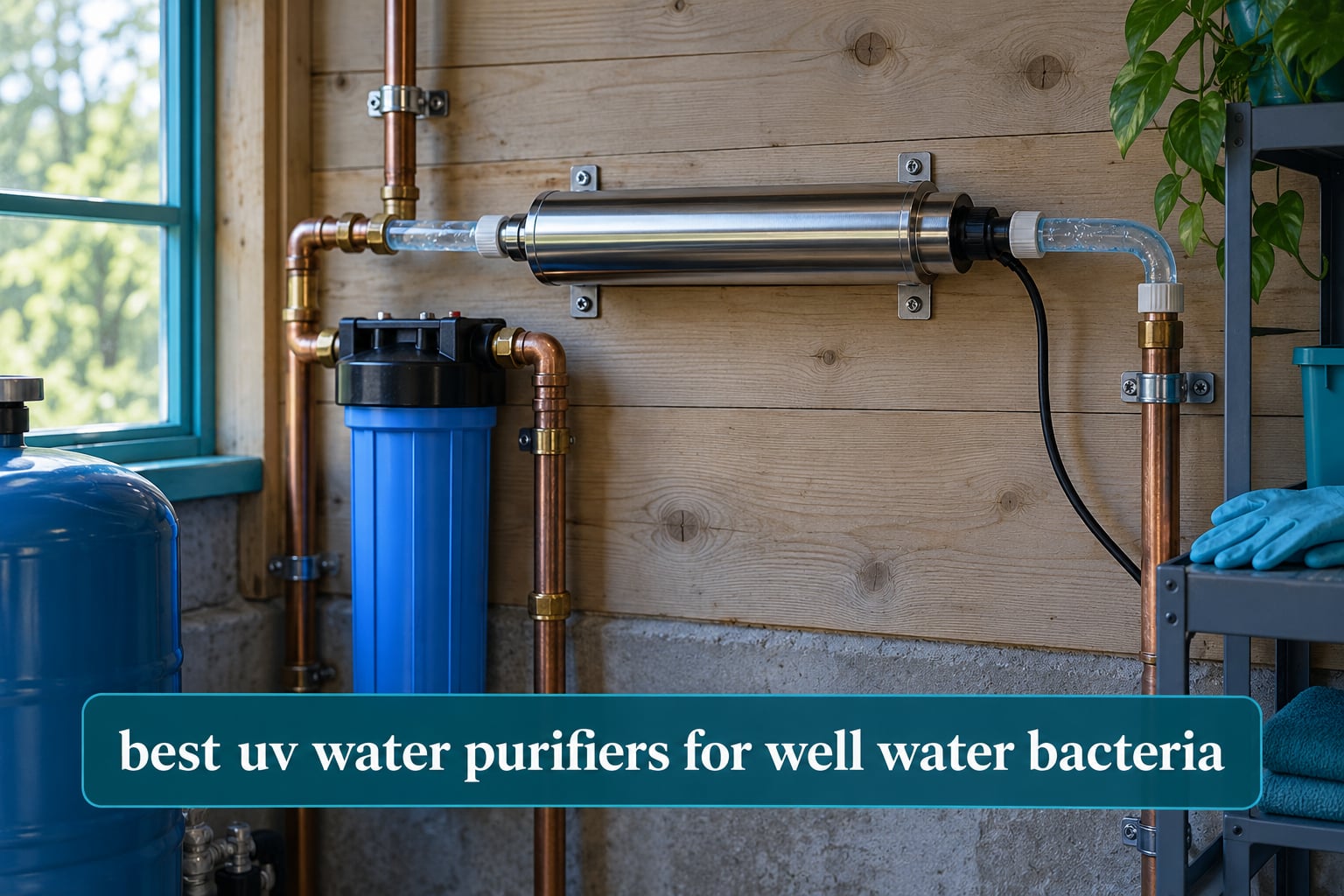
The best UV water purifier for well water bacteria is the HQUA-OWS-12 for most households, because it pairs a 12 GPM rated 40W lamp with a 304 stainless chamber and the largest review base of any unit in this group. UV systems use germicidal UV-C light at 254 nanometers to scramble the DNA of bacteria, viruses, and protozoa such as coliform, E. coli, Giardia, and Cryptosporidium, so they can no longer reproduce or cause illness. Nothing is added to the water, and there is no taste, odor, or pH change. If your household runs below 5 GPM of peak flow, an under-sink unit will serve you better than a whole-house chamber. If you want a compact system from a long-established brand name, the VIQUA VH200 is worth a look too.
Private wells are not covered by the municipal rules that protect city water, so bacteria can enter through a cracked casing, a shallow water table, a nearby septic field, livestock, or a flooded pump pit. A UV stage is the only practical way to disinfect continuously at the point of entry without shocking the well with chlorine every few months. It also fits cleanly into most existing whole-house filtration trains. If you are still assembling your treatment plan, start with our broader UV water purifier roundup for point-of-use coverage, and check well pump basics if your pump is part of the problem.
That is the honest framing of this roundup: UV is a disinfection step, not a purification system. It inactivates organisms. It does not pull iron out of the water, strip hardness, reduce dissolved solids, or trap sediment. Every unit here needs a sediment and carbon stage ahead of it, and any well with meaningful iron or sulfur needs that media upstream of the UV chamber. We read the review data closely on that point, because the most common complaint pattern in the forums is an owner installing UV, seeing clear tests, and then discovering the water still tastes metallic or the shower scale never went away.
We compared ten inline UV systems rated from 9 GPM to 24 GPM, covering single-family homes through larger properties, and organized them by the situation each one actually fits. Our methodology: we pulled the full specification sheet for every model, cross-checked it against the reported fit and finish feedback in customer reviews, and weighted rating alongside review volume so a five-star average from a handful of buyers does not outrank a well-documented install history. The picks below are ordered by how well they serve a typical well water household, not by price.
Table of Contents
- Top 3 Picks for Well Water Bacteria in 2026
- All 10 Best UV Water Purifiers at a Glance in 2026
- 1. HQUA-OWS-12 Review: Our Best Overall UV Purifier for Well Water Bacteria
- 2. iSpring UVF55FS Review: Best Value 12 GPM Whole House UV Filter
- 3. Bluonics 12 GPM Review: Best Pick for High-TDS Well Water
- 4. Geekpure GP-UV55 Review: Best Spare Lamps and Sleeves in the Box
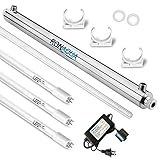
- 5. Ronaqua 55W Review: A Working Pick for Spring and Well Water
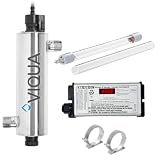
- 6. VIQUA VH200 Review: Best Compact System for Small Homes
- 7. Aquaboon 55W Review: Solid Performer for Well Water and Fish Rooms
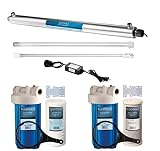
- 8. Bluonics UV and Carbon Combo Review: Best All-in-One Package
- 9. Bluonics 110W 24 GPM Review: Best for High-Flow Homes
- 10. VIQUA VH410 Review: Best Compact 18 GPM Whole-Home System
- How to Size a UV System for Your Household Flow?
- What UV Will Not Remove From Well Water
- Where to Install the UV: Before or After Your Softener
- Maintenance: Lamps, Quartz Sleeves and Annual Cost
- Shock the Well or Run UV: Which One Is Right
- How to Read Certification Labels on UV Systems
- Frequently Asked Questions
- Conclusion
Top 3 Picks for Well Water Bacteria in 2026

HQUA-OWS-12 40W 12 GPM Whole House UV
- 12 GPM rated 40W lamp
- 304 stainless chamber and quartz sleeve
- Extra bulb included
- Status lights on ballast

iSpring UVF55FS 55W 12 GPM UV Filter
- Smart flow sensor switch
- 9000 hour rated lamp
- 37.5 inch 304 stainless chamber
- 1 inch MNPT ports

Bluonics 12 GPM 55W UV System
- 2000 ppm TDS tolerance
- LED and audible alarm
- Two spare bulbs included
- 3/4 inch NPT ports
All 10 Best UV Water Purifiers at a Glance in 2026
| Product | Specifications | Action |
|---|---|---|
| HQUA-OWS-12 40W 12 GPM Whole House UV |
|
Check Latest Price |
| iSpring UVF55FS 55W 12 GPM UV Filter |
|
Check Latest Price |
| Bluonics 12 GPM 55W UV System |
|
Check Latest Price |
 Geekpure GP-UV55 12 GPM UV Filter Geekpure GP-UV55 12 GPM UV Filter |
|
Check Latest Price |
 Ronaqua 55W 12 GPM UV Purifier Ronaqua 55W 12 GPM UV Purifier |
|
Check Latest Price |
 VIQUA VH200 Compact 9 GPM UV System VIQUA VH200 Compact 9 GPM UV System |
|
Check Latest Price |
 Aquaboon 55W 12 GPM UV System Aquaboon 55W 12 GPM UV System |
|
Check Latest Price |
 Bluonics UV and Carbon Four-Stage Combo Bluonics UV and Carbon Four-Stage Combo |
|
Check Latest Price |
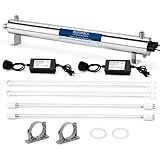 Bluonics 110W 24 GPM UV System Bluonics 110W 24 GPM UV System |
|
Check Latest Price |
 VIQUA VH410 18 GPM Whole-Home UV VIQUA VH410 18 GPM Whole-Home UV |
|
Check Latest Price |
1. HQUA-OWS-12 Review: Our Best Overall UV Purifier for Well Water Bacteria
HQUA-OWS-12 120V 40W 3/4″ MNPT Inlet/Outlet Whole House Ultraviolet Water Purifier Filter, + 1 Extra UV Bulb
40W lamp rated 12 GPM,37.2 in 304 stainless chamber,3/4 in MNPT ports,rated to 140 F
Pros
- Chemical-free treatment with no change to taste
- color
- odor or pH
- Straightforward DIY install on 3/4 inch MNPT inlet and outlet
- 304 stainless chamber and quartz sleeve rated to 140 F
- An extra UV bulb ships in the box
- Dual red and green status lights on the ballast
Cons
- Ballast failures reported after several years of use
- Chamber can corrode to pinhole leaks over a multi-year lifespan
- The extra bulb occasionally arrives broken in transit
We picked the HQUA-OWS-12 first because it is the unit we would put on our own well, and the decision comes down to documentation rather than marketing. Its 4.4 star average sits on more than a thousand ratings, which is roughly six times the review volume of anything else in this group. That volume matters when you are buying a component you cannot see working, since the failure patterns are simply better documented.
The hardware is unremarkable in the best way. You get a 304 stainless chamber measuring 37.2 inches long by 2.5 inches square, a quartz glass sleeve, an electronic ballast, an UV bulb, mounting holders, and a pair of gloves. Connections are 3/4 inch MNPT, and horizontal installation is what the manufacturer recommends, which is exactly how most well houses and mechanical rooms are laid out. Capacity is listed at 12 gallons per minute, and the whole assembly weighs 7.9 pounds.
What stands out in the feedback is the boring, repeatable result: well owners report failed coliform and bacteria tests coming back clean after the install. The ballast status lights are a small thing that turns out to matter, because a UV system gives you no visible confirmation that light is actually reaching the water, and a green or red indicator removes one whole category of doubt. Installation is reported as straightforward by people doing the work themselves, which is why we rated it as the pick for confident DIY installers.
Two things keep this from being flawless. Ballast or transformer failure is the top complaint among long-term owners, reported after several years of use rather than months, so this is a slow-life item rather than a disposable one. The second is physical durability: the chamber is reported to corrode and eventually develop pinhole leaks across a multi-year lifespan, which matters if your well water is aggressively corrosive and you are not already treating for it.
Two smaller notes. The spare bulb included in the box sometimes arrives cracked, so inspect it before you store it as your backup. The quartz sleeve seal needs a flat, even gasket seat every time you open the chamber, and rushing that step is the usual cause of weeping at the end cap. The unit is rated up to 140 F and tolerates water with up to 1000 ppm TDS, which covers the majority of residential wells without a separate mineral stage.
Who the HQUA-OWS-12 works best for
This is the unit to buy if your home runs somewhere under 10 GPM of peak demand, you have a sediment and carbon stage ahead of it, and you want the most proven record of clearing coliform in this group. It suits owners who are comfortable doing the plumbing themselves and who will set a yearly reminder to change the lamp rather than waiting for a failure alarm.
It is also the safer recommendation for a first-time UV buyer. The manual is straightforward, the fittings are a common size, and the fact that so many people have completed the install is itself a form of documentation you cannot buy elsewhere.
Who should skip the HQUA-OWS-12
Skip it if you have raw, unfiltered well water with visible sediment or iron staining, because the sleeve will scale quickly without pre-filtration. Owners who cannot commit to an annual lamp change should look elsewhere, since a UV chamber that quietly stops treating is worse than no chamber at all. It is also not the right pick for a home with very hard water and no softener, where scale on the quartz sleeve becomes a recurring service burden.
2. iSpring UVF55FS Review: Best Value 12 GPM Whole House UV Filter
iSpring UVF55FS Whole House UV Water Filter, 1″ MNPT Inlet/Outlet, 12 GPM
55W lamp rated 12 GPM,37.5 in 304 stainless reactor,1 in MNPT ports,flow sensor switch
Pros
- Smart flow sensor switch with Auto
- Move and Stop modes
- 9000 hour rated lamp in a durable quartz sleeve
- 37.5 inch 304 stainless chamber holds 12 GPM with little pressure loss
- Mounting clips included for a DIY install
- 30-day money-back guarantee with lifetime tech support
Cons
- Annual lamp change and quartz sleeve cleaning every 6 to 12 months
- Flow sensor only triggers at 0.66 GPM so trickle lines may not activate it
The iSpring UVF55FS is the pick for anyone who wants visible proof that water is actually being treated. Its ballast is the reason: instead of running continuously, it uses a smart flow sensor switch with three modes, Auto, Move, and Stop, and the Auto mode only energizes the lamp when the sensor sees flow. On a well with intermittent use, that alone extends lamp life and eliminates the stagnant-water heat build-up that bothers other units in this list.
Capacity is 12 GPM through a 37.5 inch 304 stainless reactor chamber, with 1 inch MNPT inlet and outlet. The lamp is rated for up to 9000 hours, and the box includes the stainless body, lamp, quartz sleeve, ballast, O-rings, and mounting clips. Dimensions are 40 inches long by 8 by 8, and it weighs 7.5 pounds. iSpring backs it with a 30-day money-back guarantee, a one-year manufacturer warranty with extension on registration, and lifetime technical support, which is a stronger service commitment than most of the alternatives here.
Reviewers single out the flow-sensor ballast as the feature that converts a skeptic, because it answers the question every UV owner asks, which is whether the light is on right now. The 4.4 star average across 615 ratings puts it second only to our top pick in volume, and the installation feedback is consistently described as straightforward with good build quality.
There is a catch with the flow sensor worth planning around. It activates at 0.66 GPM, so a fixture that dribbles rather than flows will not trigger the lamp. On a whole-house install serving a kitchen, a bathroom, and a laundry pair, that never becomes an issue. On a setup that mostly serves one slow tap, it might. The second catch is the ordinary one: the lamp needs annual replacement and the quartz sleeve needs cleaning every six to twelve months, and skipping the sleeve is how people end up with reduced dose and no obvious symptom.
Overall this is the configuration we would build a new well treatment train around, because the flow interlock removes the most common real-world failure mode, which is a lamp running dry against a fouled sleeve. The one-year warranty is shorter than the equipment deserves, so register the unit if you buy it.
Who the iSpring UVF55FS works best for
It fits a household that wants treatment on demand rather than around the clock, and that has a well where the water sits unused for long stretches. Anyone building a new whole-house train will appreciate the 1 inch MNPT ports, the included mounting clips, and the fact that a lamp change is a five-minute job with the chamber in place.
It is also a strong pick if you have hard water and already own a softener, because the flow interlock means the lamp is not cooking in heated water while nobody is drawing.
Who should skip the iSpring UVF55FS
Skip it if your only UV outlet is a single low-flow tap, since the 0.66 GPM trigger point means the lamp may never fire. Do not put it ahead of a softener on hard water without a sleeve plan in mind, and skip it entirely if you have no sediment pre-filter, because the manufacturer requires clear water entering the chamber.
3. Bluonics 12 GPM Review: Best Pick for High-TDS Well Water
Whole House UV Water Filter System 12 GPM – 55W Stainless Steel UV Light System – LED Indicator & Audible Alarm – for Well & City Water – Includes 2 Extra Bulbs – Bluonics
55W lamp rated 12 GPM,2000 ppm TDS ceiling,3/4 in NPT ports,125 psi rating
Pros
- Handles up to 2000 ppm TDS
- the highest rating in this group
- LED status indicator plus an audible alarm
- Two spare bulbs
- quartz sleeve
- ballast
- gloves and hardware included
- Standard 3/4 inch NPT ports with clear step-by-step instructions
Cons
- Quartz sleeve can sit short against the O-ring and leak at the end cap
- Ballast failures reported after roughly two years
- Support initially declined some ballast warranty claims
This Bluonics chamber is the one to look at if your well test came back with a high dissolved solids number. It is rated to 2000 ppm TDS, the highest ceiling among the 12 GPM units we looked at, and it also carries the highest upper temperature rating in that group at 104 F with a 125 psi operating pressure. For a well with mineral content above 1000 ppm, that headroom is the difference between a unit that is specified for your water and one that is not.
The physical package is generous. You receive a ballast, quartz sleeve, bulb, stainless cylinder, and O-rings, and the listing describes a kit that also includes cotton gloves and mounting hardware. Two spare bulbs ship with the chamber, which quietly solves the annual lamp change for the first couple of years. Dimensions are 44 inches long by 7 by 12, connections are standard 3/4 inch NPT, and the included instructions are described as clear and step by step.
Owners with E. coli-positive well water report post-install tests coming back clear, and the LED indicator with audible alarm is repeatedly praised for telling you the moment lamp status changes instead of leaving you to guess. At 4.3 stars across 197 ratings, the review volume is modest but the result reports are specific and consistent.
The recurring negative theme is mechanical rather than electrical, and it is worth planning for. Reviewers report that the quartz sleeve in this 12 GPM chamber can be too short to seat properly against the O-ring, which produces end-cap leaks that are easy to mistake for a plumbing problem. Check the sleeve seats fully and evenly before you pressurize the line, and re-check it every time you reopen the chamber. Ballast failures also show up around the two-year mark, and at least one owner reports support declining warranty claims on a failed ballast.
On the positive side of longevity, the spare bulb inclusion and the standard fitting size mean this chamber is easy to keep running. We would pair it with a plan to inspect the sleeve at every lamp change rather than annually on a separate schedule.
Who the Bluonics 12 GPM works best for
It suits owners whose well water tests high for total dissolved solids, or who have mineral-heavy water near the practical limits of a residential UV chamber. It is a good fit for anyone who wants the alarm and indicator lights as standard rather than as an add-on, and for households that would rather not order spare lamps separately.
The 3/4 inch NPT connections are common on existing filtration trains, which makes it an easy retrofit behind a sediment and carbon pair.
Who should skip the Bluonics 12 GPM
Skip it if you are not comfortable re-seating the quartz sleeve during service, because the end-cap leak is the single most reported problem and it recurs. It is a poor fit for very hard water without a softener upstream, and it is not a good choice if warranty support matters more to you than the higher TDS ceiling, since ballast claims are the sore point.
4. Geekpure GP-UV55 Review: Best Spare Lamps and Sleeves in the Box
Geekpure 12 GPM Whole House UV Water Filter-1“NPT-55 Watt
55W lamp rated 12 GPM,44 in 304 stainless chamber,1 in NPT ports,9000 hour lamp
Pros
- Ships with three lamps
- three quartz sleeves and three clamps
- Manufacturer requires it as a last stage after sediment pre-filtration
- Electronic ballast with audible and visual alarm
- 1 year warranty and ISO9001:2015 certified manufacturer
Cons
- Fragile lamps and sleeves often arrive cracked in transit
- Included mounting clips are weak and the chamber can drop off the wall
- Chamber and water run hot when the line sits unused
The Geekpure GP-UV55 is the value pick for anyone who plans to keep a UV running for years without wanting to hunt for parts. The box includes three UV lamps, three quartz sleeves, and three fixed clamps, which is more than anyone else in this roundup supplies, and it effectively covers the first two lamp changes and one sleeve service out of the box. Replacement parts are also listed separately under their own ASINs, so a single sleeve or lamp can be ordered later without replacing the chamber.
Capacity is 12 GPM through a 304 stainless steel chamber with 1 inch NPT inlet and outlet, measured at 44 inches long by 8 by 6. The lamp is rated for a minimum of 9000 hours, roughly a year of continuous duty, and the electronic ballast carries both an audible and a visual alarm. Operating conditions are specified at 50 to 60 psi, 40 to 110 F, and free chlorine tolerance under 0.1 ppm. The manufacturer is ISO9001:2015 certified and a WQA member, with a one-year warranty.
Users report total coliform-positive well tests turning negative after installation, and reviewers note performance comparable to name-brand equipment sold by well service companies at a much higher cost. The BPA-free, chemical-free design leaves taste, color, odor, pH, and conductivity untouched. At 4.4 stars across 168 ratings, the average is strong, and the company states plainly that UV cannot treat raw well water directly and must be used as a last stage after pre-filtration.
That last point is the most useful thing on this page, because the manufacturer will not let you skip it. The fragile glass is the top complaint: lamps and sleeves frequently arrive cracked from transit, and buyers report limited seller response when requesting replacements, so inspect the box the day it arrives. The included mounting clips are also described as weak, with the chamber reported to fall off the wall, and we would upgrade the mounting before trusting it over a finished wall.
Like several units here, the chamber and water can run hot when the line sits unused, especially overnight, which is normal physics in a sealed stainless tube with a lamp inside. It is not a defect, but it is why we would not put this unit in an unheated space in a freezing climate without protection.
Who the Geekpure GP-UV55 works best for
It suits a household that wants a decade of service from one purchase and would rather have the spare lamps and sleeves in hand than order them annually. The published pre-filtration requirement and the WQA membership make it a sensible first UV for owners who read manuals before they buy.
It is also a strong candidate for anyone replacing a unit sold by a well service company at a fraction of the cost, since the flow rating and lamp life are comparable.
Who should skip the Geekpure GP-UV55
Skip it if you cannot accept a last-stage-only design and were planning to hang it directly off the well pump. Buyers who have had broken glass arrive before should either request replacement parts up front or choose a chamber with better transit packaging. It is a poor fit for a location where overnight stagnation heat or freezing is a concern.
5. Ronaqua 55W Review: A Working Pick for Spring and Well Water
Ronaqua 55W Whole House UV Light Water Purifier, 12 GPM, 3/4” MNPT Ports – Includes 2 Free Replacement Bulbs, Long-Lasting Performance, Ideal for Well & City Water
55W lamp rated 12 GPM,36 in stainless chamber,3/4 in MNPT ports,300 ppm TDS ceiling
Pros
- Owners report coliform-failing well and spring water testing clean after install
- One owner logged 14 months of service with two bulb swaps and no leaks
- Three lamps
- quartz sleeve
- ballast and three mounting clips included
- Hand-tightened assembly with O-rings produced leak-free installs
Cons
- Ballast failures reported near the nine-month mark
- No warranty beyond the initial return window and returns shipping is paid by the buyer
- Lowest TDS ceiling in this group at 300 ppm
The Ronaqua 55W is a fair-value choice, and its strongest argument is durability evidence rather than spec sheet. Buyers with coliform-failing spring and well water report clean results after install, and one owner describes 14 months of continuous service with two bulb changes, no leaks, and no flickering. Hand-tightened assembly with properly seated O-rings produced leak-free installs for several users, which is a meaningful signal in a category where leaking end caps are the most common complaint.
The chamber is 36 inches long by 3 by 5, stainless steel, with 3/4 inch MNPT inlet and outlet ports and a rated capacity of 12 GPM. The box includes three UV lamps, a quartz sleeve, a ballast, and three mounting clips. Because UV treatment is purely physical, the water chemistry, taste, smell, and color all stay exactly as they were, which matters if you are treating a spring with a taste you have learned to live with.
This is the lowest-rated unit in the roundup at 4.0 stars, and the review base is 158 ratings. That rating reflects support and component durability rather than treatment results, and it is why this sits fifth rather than higher despite a working core design.
Ballast or transformer failure is the dominant negative theme, reported around the nine-month mark with several failures straight from the factory, and the warranty picture is the weakest here: coverage stops at the initial return window, and defective parts come back at the buyer’s expense. One unit arrived with missing pieces and another with a broken UV lamp, so inspect the box immediately. The listed TDS ceiling of 300 ppm is also the lowest in this group, which rules the unit out for mineral-heavy wells.
None of that changes the treatment outcome for a normal well, but it does change the ownership math. Budget for a possible ballast replacement in year one, or weigh that risk against a unit with a longer documented service record.
Who the Ronaqua 55W works best for
It fits owners with a straightforward well or spring that tests clear on minerals, who want a simple chamber and can live with a possible ballast replacement in the first year. The three included lamps and three mounting clips give you more than one year of parts, and the compact 36 inch body fits easily in a crowded well house.
It is also a reasonable choice for anyone treating water that has an established taste or smell they intend to keep, since UV will not alter it either way.
Who should skip the Ronaqua 55W
Skip it if warranty coverage matters, because the ballast and bulb sit outside the support window. Wells with elevated TDS or heavy mineral content are outside its envelope. Anyone who cannot absorb a surprise component replacement inside the first year should pick a unit with a longer documented electronics life.
6. VIQUA VH200 Review: Best Compact System for Small Homes
VIQUA VH200 Home Stainless Steel Ultraviolet Water System
35W lamp,9 GPM at 30 mJ per sq cm,15 in stainless chamber,3/4 to 1 in MNPT combo
Pros
- Highest average rating in this group
- Compact footprint for small homes and tight cabinets
- Three rated flow options for different dose levels
- Complete system with lamp
- quartz sleeve
- chamber and ballast
- 3/4 to 1 inch MNPT combo connection
Cons
- Small review base
- One unit arrived with a shattered quartz sleeve and a missing lamp
The VIQUA VH200 is the pick for small homes, and it earns its place on the strength of published dose ratings rather than a headline flow number. The manufacturer lists three flow and dose pairings: 16 GPM at 16 millijoules per square centimeter, 9 GPM at 30, and 7 GPM at 40. That is the honest way to size a UV system, because a chamber can hit a high GPM at a dose that would not protect you. The listed highlight rating is 9 GPM, designed for small homes.
The physical unit is compact at 3.5 by 3.5 by 17.5 inches and weighs 8 pounds, with a stainless steel chamber, 35W consumption at 120VAC, and a 3/4 to 1 inch MNPT combo connection that accepts either hose size without an adapter. It ships as a complete system, meaning lamp, quartz sleeve, chamber, and ballast controller in one box, with a manufacturer warranty behind it.
Owners report well water failing for coliform and E. coli retesting negative after installation, and the setup is described as uncomplicated. At 4.5 stars it carries the highest average rating in this roundup, though the 50-rating base is the second thinnest here, so treat it as encouraging rather than conclusive.
Who the VIQUA VH200 works best for
It suits a small household, a cottage, or a single well feeding one structure, where peak demand stays under the 9 GPM published rating. Anyone who wants to choose a dose level rather than accept a marketing number will find the three published flow options unusually clear. The compact body fits where a full-size chamber will not, such as a small cabinet or a tight utility bay.
It is also a good pick for a drinking water tap that needs a second line of defense, sitting behind an existing sediment and carbon pair.
Who should skip the VIQUA VH200
Skip it for a home with multiple full-flow fixtures open at once, since 9 GPM is the ceiling at the published dose. Owners with high mineral water should use a higher chamber size. The thin review base and one report of a shattered quartz sleeve arriving with a missing lamp mean we would confirm the parts are present before scheduling the install.
7. Aquaboon 55W Review: Solid Performer for Well Water and Fish Rooms
UV Water Purification System 55W, 12 GPM – UV Water Filter with Smart Flow Sensor Switch – Whole House UV Water Purifier Ensuring Water Purity – UV Light for Well & City Water + 1 Extra Lamp
55W lamp rated 12 GPM,SAE 304 stainless chamber,adapters for 3/4 and 1 in plumbing
Pros
- Ballast indicator lights plus audible alerts
- Adapters included for both 3/4 inch and 1 inch plumbing
- Stainless chamber reflects UV better than plastic housings
- Seller replaced a failed ballast and issued a full refund
- Easy warranty registration and solid packaging
Cons
- Flow sensor switch described as cheap and prone to breakage
- Several reports of leakage at the flow control valve
- Technical support number reported as unusable when the sensor broke
The Aquaboon 55W is a good option for a secondary application, because one owner used it commercially in a fish room to clear pink algae and bacteria at about 8 GPM. That is exactly the job UV does well, and the result is a useful data point for anyone treating pond, tank, or aquaculture water rather than a house. If you want a broader look at that category, our UV pond clarifier picks cover the same physics at pond scale.
For well water, the chamber is stainless steel SAE 304, 37 inches long by 2.5 inches square, rated to 12 GPM with a 500 ppm TDS ceiling. It ships with all components needed for a full install, and the two included stainless NPT adapters cover both 3/4 inch and 1 inch plumbing, which removes the most common fitting problem on a retrofit. The 55W ballast has clear indicator lights and audible alerts, and the unit is sold with an extra lamp in the box.
Owners report clean test results the day after installation on well water, and the seller’s response to a failed ballast, replacing it and issuing a full refund, is worth noting when support is otherwise a weak spot in this category. At 4.2 stars across 67 ratings, the volume is on the thin side.
The weak point is the same flow sensor that is a feature on the iSpring. Here it is described as feeling cheap and prone to breakage, and several owners report leakage at the flow control valve, including after a plumber over-tightened the fitting and cut the washer. That combination means the sensor and the valve are the two things to inspect at each service. One unit also shipped with a broken bulb, and technical support contact details are reported as unusable when the sensor failed.
The manufacturer also states the unit is not intended to run continuously without pre-filtration on raw well water, which is the correct instruction and worth respecting. With sediment and carbon ahead of it, the treatment results hold up.
Who the Aquaboon 55W works best for
It suits a household that also runs an aquarium, pond, or aquaculture system, since the same chamber handles both jobs. The included 3/4 inch and 1 inch adapters make it the least fussy retrofit in this roundup for existing plumbing, and the audible alerts are useful in a space where you cannot see the ballast.
Owners who value seller responsiveness on a failed ballast will find that support responsive when a component does go out.
Who should skip the Aquaboon 55W
Skip it if the flow sensor is the feature you most want to rely on, since breakage reports are common and support contact details are unreliable. It is a poor fit for raw well water without pre-filtration, and the 500 ppm TDS ceiling is below what mineral-heavy wells need. Anyone who has had a fitting chewed by an over-tightened valve should expect to check that washer early.
8. Bluonics UV and Carbon Combo Review: Best All-in-One Package
55W UV Ultraviolet Light Plus Sediment and Carbon Well Water Filter Purifier System for Rust, Iron, Sand, Dirt, Sediment Bad Taste/Odor.12 GPM UV System and 2 Heavy Duty Housings Size 4.5″x10″
Four stages: 20 micron sediment, 5 micron carbon, 1 micron sediment, 55W UV
Pros
- UV and pre-filtration bundled in a single package
- Carbon block stage handles chlorine
- taste
- odor and VOCs
- Heavy duty 4.5 by 10 inch housings with 1 inch brass NPT fittings
- Support replaced a cracked piece and helped resolve ballast issues
Cons
- Warranty covers the metal tube but not the ballast or bulb
- One owner had all four threaded housing fittings leak
- Not a reverse osmosis system and will not reduce dissolved solids
This Bluonics package is the only pick in the roundup that solves the pre-filtration problem for you. Instead of a bare chamber, you get a four-stage train: 20 micron string-wound sediment, 5 micron carbon block, 1 micron sediment, and a 55W UV stage as the last step. That is the correct order of operations, and having it pre-assembled removes the single most common installation mistake we see, which is hanging a UV chamber directly off a pump.
The UV unit is 304 stainless steel with 1 inch MNPT inlet and outlet and a 36 inch lamp, rated to 12 GPM. The housings are heavy duty 4.5 by 10 inch with 1 inch US Standard NPT brass fittings, and replacement cartridges are listed under a separate ASIN so you can reorder without rebuilding the system. Operating range is 40 to 125 psi and 35 to 100 F, with a 500 ppm TDS ceiling. The whole assembly is 42 by 12 by 20 inches and weighs 32 pounds.
Owners with positive well samples report clean results and improved water quality throughout the home, and the carbon block stage is credited with removing chlorine, bad taste, odor, and organic solvents including VOCs. At 4.0 stars across 44 ratings, this is the smallest review base here, so the treatment feedback is thinner than the packaging appeal suggests.
Who the Bluonics Combo works best for
It suits a homeowner starting from scratch who wants a complete, correctly ordered train and does not want to source a sediment and carbon pair separately. Anyone dealing with a taste or odor complaint alongside bacteria will get more from this box than from a bare chamber. The brass NPT fittings on heavy housings are also a good match for higher-pressure well systems.
The 32 pound weight and 20 inch height mean you need real vertical clearance, so measure your well house wall before you order.
Who should skip the Bluonics Combo
Skip it if you already have a well-proportioned sediment and carbon stage, since you would be duplicating hardware. The 4.0 rating and 16 percent two-star share reflect real problems, including one owner whose four threaded housing fittings all leaked and forced removal of both canisters, and a warranty that covers only the metal tube. It is not a reverse osmosis system and will not reduce total dissolved solids, so anyone with a TDS problem needs a different approach.
9. Bluonics 110W 24 GPM Review: Best for High-Flow Homes
Whole House UV Water Filter System 24 GPM – 110W Stainless Steel UV Light – 1″ NPT – LED Indicator & Audible Alarm – for Well & City Water – Includes 2 Ballasts – Bluonics
110W lamp rated 24 GPM,1000 ppm TDS ceiling,1 in NPT ports,40 to 125 psi
Pros
- Highest capacity in this group at 24 GPM
- Two electronic ballasts included as a spare
- LED status indication and audible alarm
- Full kit with two lamps
- two sleeves
- four O-rings and gloves
- 1000 ppm TDS tolerance
Cons
- Highest price point in this group
- Bulb and ballast reliability concerns shared across this brand
- 4.0 rating with 15 percent one-star reviews
If your home genuinely pushes more than 12 GPM at peak, the Bluonics 110W is the throughput option here. It is rated to 24 GPM through a stainless steel chamber with 1 inch NPT inlet and outlet, running 40 to 125 psi with a 1000 ppm TDS ceiling and a 100 F upper temperature rating. That makes it a fit for large homes, multi-unit properties, and light commercial work where two smaller chambers would otherwise be needed in parallel.
The kit is unusually complete for a high-capacity unit: two UV lamps, two quartz sleeves, two electronic ballasts, four O-rings, gloves, and a manual, all in a 44 by 8 by 8 inch chamber weighing 16 pounds. The included spare ballast is the detail that stands out, since ballast failure is the most common failure in this category and a spare means you are not waiting on a delivery to restore treatment.
Reviewers value the included spare ballast and dual lamp and sleeve kit for uninterrupted service. The 4.0 rating across 93 ratings is the lowest tier in the group, and it reflects the usual bulb and ballast durability concerns rather than any doubt about the treatment result.
We want to be direct about the tradeoffs. This is the highest price point among the 24 GPM capable units, and 15 percent of ratings are one star. The same ballast and bulb reliability theme shows up here as it does on the smaller Bluonics 12 GPM model, which is worth factoring in if you are choosing between the two. The 1000 ppm TDS ceiling is a real limit for mineral-heavy wells, and higher than 1000 ppm of TDS can also reduce UV transmittance, which cuts the effective dose regardless of the flow rating.
If your peak demand is under 12 GPM, do not buy this for headroom you will not use. You are paying for capacity, wattage, and duplicated components that serve you only if two fixtures are running hard at the same time.
Who the Bluonics 110W works best for
It suits larger homes, properties with multiple dwelling units, and light commercial applications where measured peak flow exceeds what a 12 GPM chamber can hold. The duplicated lamp, sleeve, and ballast kit means service downtime is measured in minutes rather than weeks for a unit that would be awkward to leave untreated.
Owners who want visible confirmation of lamp status will appreciate the LED indication and audible alarm on each ballast.
Who should skip the Bluonics 110W
Skip it for any home whose measured peak flow sits under 12 GPM, since the added capacity and cost buy nothing. Anyone sensitive to ballast reliability should factor in the one-star share before committing. It is also a poor choice for water with elevated TDS or low UV transmittance, where a smaller high-dose chamber serves better than a large low-dose one.
10. VIQUA VH410 Review: Best Compact 18 GPM Whole-Home System
VIQUA VH410 Whole-Home UV Water System, 18 GPM, 3/4-1 Inch NPT, 100-240V
18 GPM whole-home capacity,3/4 to 1 in NPT,100-240V,365-day lamp timer
Pros
- 18 GPM packed into a compact chamber
- Threads on both inside and outside of the inlet and outlet
- No leaks reported at the fittings
- 365-day countdown lamp replacement timer
- Easy lamp and quartz sleeve changes with clamps included
Cons
- Inlet and outlet sit on opposite sides
- One unit failed and beeped after about 12 hours
- Short burst of hot water after overnight stagnation
- Highest price point in this group
The VIQUA VH410 is our pick for anyone who wants large capacity without a wall-filling chamber. It delivers 18 GPM of whole-home treatment from a compact 4.5 by 11.8 by 14.3 inch body, built around high UV output lamp technology in a stainless steel chamber rated across varied temperatures, pressures, and pH levels. The published inactivation targets are specific and useful: Cryptosporidium, Giardia, E. coli, and fecal coliform.
It runs on 100-240V, which means it works without a voltage-specific circuit in a way some 120V-only units do not. The inlet and outlet are threaded both inside and outside, accommodating two hose sizes, and the ballast includes a 365-day countdown lamp replacement timer, which is the feature that keeps owners from missing a change and quietly losing dose. Replacement parts are itemized, including the BA-ICE-CL controller, the S410RL-HO lamp, the QL-410 lamp and sleeve, and the QSO-410 sleeve, so a single failed component never means a new system.
Users report no leaks at the fittings and like seeing the blue glow at the bottom cap as confirmation the lamp is on. One installer used the unit to treat lake water for safe bathing and drinking. At 4.4 stars across 81 ratings, the volume is modest but the feedback is specific and mechanical, which is a good sign for a component with moving service parts.
The drawbacks are physical and minor. Inlet and outlet on opposite sides complicates installation in a tight cabinet, so measure your run before ordering. One unit failed and began beeping after about twelve hours of use, which points to a controller issue rather than a design flaw, and remember the BA-ICE-CL controller is the replaceable part if that happens. Several users note a short burst of hot water after overnight stagnation, which is expected in a closed chamber. It is also the highest price point in this roundup, and the only system in the group with a listed annual filter life cycle and a fixed-installation format.
For our purposes the trade is straightforward. You pay more and get a smaller footprint, a real service timer, and documented spare parts, in exchange for 18 GPM that most homes will never reach.
Who the VIQUA VH410 works best for
It fits larger homes and any installation where space is tight but flow is not, such as a crowded mechanical room or a cabinet with a limited footprint. The 100-240V range and the itemized replacement parts list make it the pick for owners who plan to keep a system running for a decade rather than a few years.
The 365-day timer is the deciding factor for anyone who has never changed a UV lamp and is worried about forgetting, and the dual-side threading helps when your plumbing is mismatched.
Who should skip the VIQUA VH410
Skip it if your home’s peak flow is well under 18 GPM and you would rather spend on pre-filtration, since the capacity here goes unused. Avoid it where the run between inlet and outlet is short, because the opposite-side ports will not bend to fit. It is also the wrong tool for anyone unwilling to follow a lamp change schedule, since a missed change is silent.
How to Size a UV System for Your Household Flow?
Size a UV system by peak flow, not by average use. A system rated at 12 GPM delivers its full disinfection dose only when actual flow is at or below that rating, and a household that briefly exceeds it gets proportionally less UV exposure at that moment. Start by listing every fixture that could run at once: kitchen sink, dishwasher, washing machine, two bathrooms, a utility sink, and any hose bib or filling line.
A workable method is to assign a rough figure to each fixture running at the same time, total the worst realistic case, and then add a 25 to 30 percent margin. The margin is not caution for its own sake. It covers the fact that a softener or a sediment filter upstream adds pressure drop, that a pump cycling on a timer can send a short burst through the chamber, and that a slightly oversized chamber costs far less than undersized one that never achieves its rated dose.
Published flow numbers also hide a second variable, the dose. The VIQUA VH200 is the clearest example in this roundup, listing 16 GPM at 16 millijoules per square centimeter, 9 GPM at 30, and 7 GPM at 40. Same chamber, three different answers depending on the dose you need. When you compare models, compare the GPM at the dose that matches your water clarity, not the largest number on the box.
Two practical notes. First, run the UV after any pressure drop component so the flow sensor and lamp see realistic conditions. Second, if your well has livestock, a pond intake, or an irrigation tie-in on the same line, treat that as a separate demand and size accordingly, because barn and garden use is what pushes a marginal household into the 18 and 24 GPM class. If you are still working out your well’s basics, our well pump guide covers the pressure side of the same decision.
What UV Will Not Remove From Well Water
UV does exactly one thing: it inactivates organisms. It will not remove iron, manganese, sulfur, hardness, sediment, dissolved solids, nitrates, PFAS, lead, or any chemical. This is the single most repeated misconception in well forums, where owners install a chamber, watch a bacteria test clear, and assume the water is fixed. It is not, and a companion media stage is not optional.
Iron is the most common culprit. Ferric iron stains fixtures and appliances, and a UV chamber will not touch it. It needs an oxidation stage such as greensand or a catalytic media ahead of the filter, and if the iron is bacterial rather than mineral, that filter will grow bacteria downstream, which is a documented problem when a softener sits upstream of the UV. Sulfur odor is chemical, not biological, and needs catalytic carbon. Hardness needs ion exchange, and it will scale a quartz sleeve if the softener is not upstream.
The order that works in practice is: oxidation or iron removal, then sediment, then a softener if the water is hard, then carbon, then UV last. UV goes last because anything that clouds the water, or coats the sleeve, undoes the treatment. Carbon goes before UV rather than after for a specific reason, since chlorine residual damages UV lamp performance and the sleeve.
There is one more limit worth stating plainly. UV leaves no residual protection behind it, so a dead lamp means untreated water flowing through with no taste, odor, or color change to warn you. That is why the units with flow sensors, status lights, and countdown timers are worth the small premium over a bare chamber.
Where to Install the UV: Before or After Your Softener
Install the UV after the softener. Hard water passing through a chamber first will scale the quartz sleeve with mineral deposits, and a scaled sleeve reduces the UV dose reaching the water while doing nothing visible to signal it. The softer’s job is to remove hardness, and the UV’s job is to disinfect; running them in that order means each stage works on water the other has already conditioned.
The one documented exception is a system with a salt-free descaler, where hardness minerals are changed form rather than removed. Those systems leave the water at similar mineral content, so the sleeve can still scale, and the same after-the-softener rule applies. If you own a conventional ion exchange softener, the rule is simple.
Position also determines what the UV is actually treating. Installed at the point of entry, it disinfects everything downstream, including the softener resin bed and the drinking water lines, which is the whole point. Installed at a single tap, it protects that tap only, which is a legitimate choice for a rental or a short-term fix, but leaves every other fixture on raw well water. A bypass valve and a shutoff on both sides of the chamber turn cartridge changes and sleeve cleaning into a fifteen-minute job rather than a plumber’s visit, and we would insist on both before buying.
Maintenance: Lamps, Quartz Sleeves and Annual Cost
Plan for three recurring costs: the lamp, the sleeve cleaning, and the pre-filters. Lamps are the most predictable, with most of these units rated around 9000 hours of lamp life, which is roughly a year of continuous operation. Because a lamp dims gradually rather than burning out, the manufacturer replacement schedule matters more than waiting for a visible failure.
Sleeves are the cost people forget. A quartz sleeve needs cleaning at least every six to twelve months on a typical well, and on hard water that means mineral scale has to come off with either a mild acid soak or a commercial sleeve cleaner. Skipping it is how UV systems slowly stop working while the indicator light still shows green. Forum installers report roughly a year between sediment filter changes and carbon replacements on a standard whole-house setup, and homeowners who skipped prefilter changes reported bacterial growth in the tank and steep pressure drops.
The practical routine looks like this. Once a year, change the lamp, clean the sleeve, and check the O-ring seals at the end caps. Every month, glance at the status lights or timer. Once pre-filters start to show pressure differential, change them, and never let a filter housing run past its service interval to save a cartridge. If you are working through a full equipment upgrade, our well water dishwasher guide covers the downstream end that benefits most from clean water.
Shock the Well or Run UV: Which One Is Right
Shock chlorination and UV solve different problems, and the right answer is usually both. Shocking is a one-time or periodic chemical treatment that clears biofilm and bacteria from the casing, the pump, and the storage tank. UV is continuous disinfection of water as it passes through the chamber. A UV unit does nothing to the bacteria colonizing the inside of your well casing, which is exactly the reason some owners find coliform returning months after a successful UV install.
This is the failure mode that scares people. On farms and properties with livestock, the same water feeds the animals, so owners often want to avoid routine chlorine shocking entirely, and a UV chamber becomes the primary defense. That works, provided the well is in reasonable condition. If the casing is cracked, the water table is shallow, or flooding has introduced surface water, UV is treating a symptom, and the recurring positives will keep coming back until the source is fixed.
The decision rule is simple. If your well is properly cased, deep, and tested clean other than for an occasional bacteria hit, install UV and shock only when a test fails or after flooding, repairs, or a long power outage. If your well keeps failing tests, spend the money on casing repair or a proper well construction first, and treat the UV as the second layer, not the first.
How to Read Certification Labels on UV Systems
NSF/ANSI 55 is the standard for UV water disinfection units, and it is the one that matters for a whole-house chamber. It certifies the unit for microbial reduction, including bacteria, viruses, and cysts. NSF/ANSI 42 covers aesthetics, meaning taste, odor, and sediment, and NSF/ANSI 53 covers health effects for a filter that does both. If a listing does not name a standard, ask before you buy.
NSF/ANSI 58 and NSF/ANSI 372 belong to a different category entirely. Those cover reverse osmosis and point-of-use filtration systems, and 372 adds a material safety standard for lead and the reduction claim. They are meaningful certifications, but they apply to membrane and carbon systems rather than to a UV chamber, so a product touting 372 without a 55 rating may not be the disinfection device you think it is.
One more label worth recognizing is WQA, the Water Quality Association. It is a manufacturer membership mark rather than a product certification, and several units in this roundup come from WQA members, which tells you the company operates in the water treatment trade but not that this specific model has been independently tested. Certification claims of 99.9 or 99.99 percent reduction are meaningful only when paired with a standard and a rated flow at a stated dose.
Frequently Asked Questions
What is the best UV filter for well water?
For most households, the best UV filter for well water is a 304 stainless steel inline chamber rated 40W to 55W and 9 to 12 GPM, installed at the point of entry after a sediment and carbon stage. Our top pick, the HQUA-OWS-12, pairs a 12 GPM rating with the largest review base in the category. Size it to your peak household flow, not your average use.
Which water purifier kills bacteria?
UV water purifiers kill bacteria by exposing them to germicidal UV-C light at 254 nanometers inside a quartz sleeve, which scrambles their DNA so they can no longer reproduce or cause infection. A good activated carbon or sediment pre-filter removes the particles that would otherwise shield organisms from the light. Reverse osmosis and chlorine also inactivate bacteria, but UV needs no chemicals and leaves no taste.
Do UV filters work for well water?
Yes, UV filters work very well on well water as long as two conditions are met. The water must be clear enough for light to pass through, so sediment and carbon stages go first, and the flow must stay at or below the chamber’s rated GPM at your required dose. Several owners in this roundup report well tests that failed for coliform and E. coli coming back clean after installation.
What is the disadvantage of using UV to disinfect water?
The main disadvantages are that UV removes nothing but microorganisms, so iron, sulfur, hardness, sediment, nitrates, and metals still need dedicated media, and that it leaves no residual protection, meaning a failed lamp produces no taste or odor warning. UV also only works on clear water, so pre-filtration is mandatory, and the quartz sleeve needs cleaning every six to twelve months.
Does a UV filter remove coliform?
Yes, a properly sized UV filter inactivates total coliform and fecal coliform such as E. coli, along with Giardia and Cryptosporidium, which is why the VIQUA VH410 lists those four organisms as its targets. The catch is dose: the chamber must be sized so actual flow never exceeds the rated GPM at the dose your water requires, and it must follow a sediment filter so organisms are not hidden inside particles.
Conclusion
The best uv water purifiers for well water bacteria all share one design: a stainless steel chamber, a quartz sleeve, and a lamp that does nothing except disable organisms. Our top pick, the HQUA-OWS-12, wins on documentation and the deepest review history here. The iSpring UVF55FS is the smarter install for intermittent use because its flow sensor only fires the lamp when water is moving. The Bluonics 110W covers homes above 12 GPM, and the Bluonics four-stage package is the shortcut if you do not already own pre-filtration.
Before any of them, test your well. Know your coliform status, your iron level, and your peak household flow, because a UV chamber sized wrong or hung off an unfiltered pump is the most common reason these systems disappoint. Add the sediment and carbon stages, put the UV after the softener, and set a yearly lamp reminder. If you want a second set of eyes on the disinfection side of your treatment train, our aquarium UV sterilizer picks use the same lamp physics at a much smaller scale.