
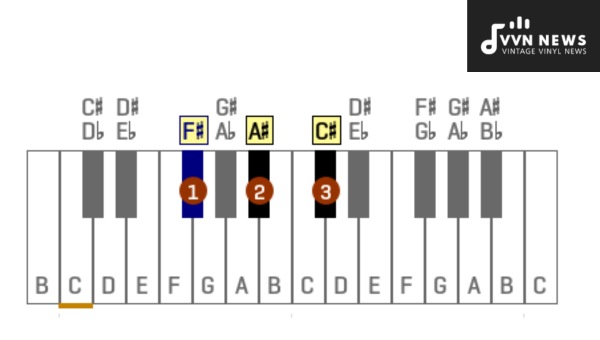
I am excited to delve into the topic of F Sharp Major Triad Music Theory. Today, I want to share with you some valuable insights into this important musical concept.
Whether you are a musician, music enthusiast, or just curious about how different chords and scales work together, understanding F Sharp Major Triads will open up new possibilities in your musical journey.
In this article, we will explore the fundamentals of F Sharp Major Triads, their composition, and their significance in music theory.
So what exactly is an F Sharp Major Triad? Well, in music theory, a triad is a chord that is made up of three notes played simultaneously.
The F Sharp Major Triad consists of three specific notes – F Sharp, A Sharp, and C Sharp. These notes determine the tonal characteristics and overall mood of the triad.
Understanding how these notes interact with each other is crucial in grasping the essence of this major chord. It is important to note that “F Sharp” refers to the note F sharp.
Table of Contents
What defines the F Sharp Major Triad?
The F Sharp Major Triad is a chord consisting of three notes – F#, A#, and C#. The triad is built upon the F# major scale, which consists of the notes F#, G#, A#, B, C#, D#, and E#.
In music theory, a major triad is formed by stacking a major third on top of a minor third.
The defining characteristic of the F Sharp Major Triad is its root note, F#. The root note gives the chord its name and serves as its foundation.
The second note in the triad is A#, followed by C# as the highest note. When played together, these three notes create a harmonious sound that is central to many musical compositions.
The F Sharp Major Triad can be represented using musical notation or on various instruments such as piano, guitar, or any other instrument that allows for chord playing.
Understanding and recognizing this triad can greatly enhance one’s understanding and ability to play music in the key of F# major.
How is the F Sharp Major Triad constructed?

To understand the construction of the F Sharp Major Triad, we need to dive into its musical intervals and the relationship between its notes.
- Starting with the F# Major Scale: The F Sharp Major scale consists of the notes F#, G#, A#, B, C#, D#, and E#. These notes serve as the foundation for constructing the triad.
- Stacking Thirds: The triad is built by stacking intervals of thirds on top of each other. In other words, starting from the root note (F#), we add a major third interval to get to the second note, A#. Then we add another major third interval from A# to reach the final note, C#.
- Root, Third, Fifth: The F Sharp Major Triad is composed of three notes: F#, A#, and C#. These three notes are referred to as the root, third, and fifth respectively. The root note establishes the tonal center, while the third and fifth contribute to its overall character.
- Sequencing: When played in succession or simultaneously, these three notes create a harmonious sound representative of the F Sharp Major Triad.
Understanding how these intervals come together is crucial for comprehending chord progressions and musical compositions revolving around F Sharp Major.
Also Read: C Sharp Major Pentatonic Scale [Crisp & Clear Tones For Your Music]
Why does the F Sharp Major Triad matter in music?
The F Sharp Major Triad holds significant importance in music theory and composition.
Understanding this triad and its role in music can greatly enhance one’s ability to compose, analyze, and appreciate various musical pieces.
Here are some reasons why the F Sharp Major Triad matters in music:
- Key Center: The F Sharp Major Triad serves as the tonic chord or the “home base” of the F# major scale. It establishes a sense of stability and resolution, making it a crucial component in chord progressions and harmonic structures.
- Harmony: The F Sharp Major Triad is often used to harmonize melodies or create chord progression within the key of F# major. It provides a rich, consonant sound that complements many genres of music, including classical, pop, jazz, and more.
- Scales and Modes: The construction of the F Sharp Major Triad is closely tied to the F# major scale and its modes. By understanding how this triad fits into different scales and modes, musicians can create unique melodies and explore various tonalities.
- Chord Substitutions: The F Sharp Major Triad can be substituted or modified to create different chord voicings and colors within a musical composition. This versatility allows for creative explorations, adding depth and interest to the overall sound.
- Voice Leading: Voice leading refers to the smooth movement of individual melodic lines within a chord progression or composition. The F Sharp Major Triad offers specific voice-leading possibilities when combined with other chords, creating seamless transitions between harmonies.
- Melody Accompaniment: Musicians often use the F Sharp Major Triad as an accompaniment to melodies in the key of F# major or relative minor keys such as D# minor or B minor. It provides harmony support that enhances the overall melodic structure and emotional impact.
The F Sharp Major Triad holds immense significance in music theory, composition, and performance.
Its role as a key center, harmonic foundation, and tool for chord substitution makes it a valuable asset for musicians looking to expand their musical vocabulary and create captivating pieces of music.
Also Read: A Sharp Minor Pentatonic Scale [Unique Harmonic Possibilities]
What triads make up the F Sharp Major scale?
The F Sharp Major scale consists of seven different notes, each serving as the foundation for a triad. These triads can be categorized into major, minor, and diminished chords. Let’s break down each triad in detail:
- F# Major Triad: The first triad in the F Sharp Major scale is built upon the root note F#. It consists of the notes F#, A#, and C#. This triad is formed by stacking a major third (F# to A#) on top of a minor third (A# to C#). It has an uplifting and bright sound commonly found in happy or energetic compositions.
- G# Minor Triad: The second triad in the scale is G# minor, which is formed by using the notes G#, B, and D#. It features a root note of G# combined with a minor third (G# to B) and a major third (B to D#). This triad has a more melancholic and introspective sound.
- A# Minor Triad: The third triad in the F Sharp Major scale is A# minor. It comprises the notes A#, C#, and E#. Similar to the previous one, it has a root note of A#, but it differs in the intervals used – there’s a minor third (A# to C#) followed by another minor third (C# to E). This chord offers a somber and mellow tone.
- B Major Triad: The fourth triad in the scale introduces us to B major, made up of B, D#, and F#. It features a root note of B, followed by two major thirds stacked on top of each other (B to D# to F#). This chord has a more grandiose and triumphant quality.
- C# Major Triad: The fifth triad is constructed using the notes C#, E#, and G#. It follows the same pattern as the previous triad, with a root note of C# and two major thirds (C# to E# to G#). This chord has a vibrant and bright sound that is often used to create tension or excitement.
- D# Minor Triad: The sixth triad in the scale is D# minor, consisting of D#, F#, and A#. It utilizes a root note of D# and two minor thirds (D# to F# to A#). This chord has a more pensive and introspective feel.
- E# Diminished Triad: The final triad in the F Sharp Major scale is E# diminished. It incorporates the notes E#, G#, and B. Unlike the previous triads, it consists of two minor thirds (E# to G# to B). This chord has a tense and unsettling quality.
These triads provide a solid foundation for composing or playing music in the key of F Sharp Major.
By recognizing their individual qualities, musicians can create harmonic progressions or melodic lines that capture specific emotions or moods.
How can you play this triad across different instruments?

Understanding how to play the F Sharp Major Triad across different instruments is essential for musicians looking to incorporate this chord into their repertoire. Here, I will provide instructions on how to play the F Sharp Major Triad on piano and guitar:
On Piano:
Playing the F Sharp Major Triad on the piano is relatively straightforward, thanks to its layout of black and white keys. Follow these steps to play the triad:
- Position your right hand on the piano with your thumb on F#, your middle finger on A#, and your pinky finger on C#.
- Press down all three keys simultaneously, applying a moderate amount of force.
- Ensure that your fingers are curved and relaxed as you play the chord.
- Experiment with playing the triad in different octaves to explore its full range of possibilities.
Also Read: G Sharp Minor Pentatonic Scale [Add Dimension To Your Music]
On Guitar:
Playing the F Sharp Major Triad on the guitar requires familiarity with common chord shapes and finger placements. Follow these steps to play the triad:
- Place your index finger barring all strings across the 2nd fret.
- Position your ring finger on the 4th string (D string) at the 4th fret.
- Place your middle finger on the 3rd string (G string) at the 3rd fret.
- Strum from the 4th string downward, avoiding strumming any open strings.
Remember to adjust your position based on whether you prefer playing chords using standard or alternate tunings.
In all cases, it is crucial to practice playing the F Sharp Major Triad repeatedly until you feel comfortable and confident with the finger positions and sound of the chord.
What inversions exist for the F Sharp Major Triad?
In music theory, an inversion is a reordering of the notes within a chord. For the F Sharp Major Triad, there are three inversions: the root position, the first inversion, and the second inversion.
Each inversion produces a unique tonal quality and can be used to add variety and interest to musical compositions.
Root Position
The root position is the original form of the triad, where the root note (F#) is at the bottom. In this position, the notes of the F Sharp Major Triad are stacked in thirds: F# at the bottom, followed by A#, and then C# at the top. The root position is often represented as F#m or simply F#.
First Inversion
The first inversion occurs when we move the root note (F#) an octave higher. This places A# as the lowest note, followed by C#, and then F#.
The first inversion is represented as A#m/F#, indicating that A# is now functioning as both the bass note and root note of this chord.
Second Inversion
In the second inversion, we move both F# and A# up one octave from their positions in the root position.
This results in C# becoming the lowest note, followed by F#, and then A#. The second inversion is represented as C#/F#, indicating that C# serves as both bass note and root note.
Also Read: F Sharp Minor Pentatonic Scale [How To Use In Your Compositions]
How to execute the 1st and 2nd inversions on piano and guitar?

Understanding how to play inversions of the F Sharp Major Triad is essential for expanding your musical repertoire and creating unique chord progressions. Inversions are alternate ways of playing a chord by changing the order of the notes. This allows for different voicings and adds variety to your sound.
Piano:
To execute the 1st inversion of the F Sharp Major Triad on the piano, follow these steps:
- Start with the root position chord, which is F# in the bass, A# in the middle, and C# on top.
- Raise F# (the root note) an octave higher. Now, A# becomes the bass note, C# moves to the middle, and F# becomes the highest note.
- The first inversion is now complete – A#, C#, and F#. This inversion has a brighter sound compared to the root position due to its rearrangement.
To execute the 2nd inversion of the F Sharp Major Triad on piano:
- Begin with the first inversion chord – A#, C#, and F#.
- Raise A# an octave higher. This positions C# as the bass note, F# in the middle, and A# as the highest note.
- The second inversion is now complete – C#, F#, and A#. This inversion provides a different tonal color compared to both the root position and the first inversion.
Guitar:
To execute these inversions on guitar, you need to know how to play barre chords:
- For playing 1st Inversion (F#/A#/C#):
Place your index finger across all six strings at fret two (barre chord). Your ring or pinky finger will press down on strings 4-5-6 at fret four while leaving strings 1-2-3 open.
- For playing 2nd Inversion (A#/C#/F#):
Place your index finger across all six strings at fret six (barre chord). Your pinky finger will press down on strings 2-3-4 at fret nine while leaving strings 1-5-6 open.
By mastering these inversions, you can explore new sounds and progressions, adding depth and complexity to your compositions.
Experiment with incorporating these inversions into your playing to create unique musical arrangements and inspire your creativity.
Iconic pieces featuring the F Sharp Major Triad
The F Sharp Major Triad has been used in countless compositions across various genres of music. Its unique tonality and rich sound make it a favorite among composers and musicians alike.
Here are some iconic pieces that prominently feature the F Sharp Major Triad:
- Ludwig van Beethoven – Symphony No. 9
Beethoven’s Symphony No. 9, also known as the “Choral Symphony,” contains a powerful and uplifting melody in F# major. The opening theme, played by the orchestra, incorporates the F Sharp Major Triad in various inversions, showcasing its versatility. - Johann Sebastian Bach – Prelude in F# Major, Well-Tempered Clavier Book 1
Bach’s Prelude in F# Major is a beautiful and introspective piece for solo keyboard. The F Sharp Major Triad appears throughout the composition, highlighting its significance in creating a sense of harmony and resolution. - Frédéric Chopin – Nocturne Op. 15 No. 2
Chopin’s Nocturne Op. 15 No. 2 is a captivating piano piece that showcases the lyrical qualities of the F Sharp Major Triad. Its delicate arpeggios and flowing melodies create an enchanting atmosphere that captivates listeners. - Antonín Dvořák – Symphony No. 9 “From the New World”
Dvořák’s Symphony No. 9 is a seminal work that blends elements of European classical music with American folk melodies. In movement IV, the famous Largo theme features a poignant progression centered around the F Sharp Major Triad. - Wolfgang Amadeus Mozart – Piano Concerto No. 23
Mozart’s Piano Concerto No. 23 is one of his most beloved works, featuring a striking opening that prominently features the F Sharp Major Triad. The majestic and virtuosic passages highlight the chord’s grandeur.
These pieces represent just a fraction of the many compositions that utilize the F Sharp Major Triad.
Its versatility allows it to be seamlessly integrated into various musical styles and genres, from classical to jazz, pop, and beyond.
Also Read: C Sharp Minor Pentatonic Scale [Add Color To Your Solos & Riffs]
FAQs about the F Sharp Major Triad
How is the F Sharp Major Triad constructed?
The F Sharp Major Triad is constructed using the notes F#, A#, and C#. It follows the pattern of a major third followed by a minor third.
What other triads are found in the F Sharp Major scale?
Within the F Sharp Major scale, you can find several triads, including F# major, G# minor, A# minor, B major, C# major, D# minor, and E# diminished.
Can I play the F Sharp Major Triad on different instruments?
Yes! The F Sharp Major Triad can be played on various instruments such as piano or guitar. On piano, you would play the notes F#, A#, and C# together to form the chord. On guitar, you could play these notes on different strings to create the desired sound.
Are there different ways to play the F Sharp Major Triad?
Yes, inversions of chords allow for different voicings of the same triad. The first inversion of the F Sharp Major Triad has A# as its lowest note, while the second inversion has C# as its lowest note.
What iconic pieces feature the sound of the F Sharp Major Triad?
The magnificent opening of Ludwig van Beethoven’s famous Symphony No. 5 features a prominent use of F#, creating a powerful and memorable impact. Additionally, Johann Pachelbel’s Canon in D showcases this triad in a beautiful and timeless composition.
Conclusion
The F Sharp Major Triad is an essential component of music theory. Understanding its construction, inversions, and applications across different instruments can greatly enhance your ability to play and compose music in F# major.
Whether you’re a pianist, guitarist, or any other musician, recognizing the F Sharp Major Triad and its role in music can open up a world of possibilities for creative expression.
So take some time to explore this triad and incorporate it into your musical repertoire.