
I believe that understanding the fundamentals of music theory is key to becoming a well-rounded player.
Today, I want to delve into the topic of the D Major Triad. While it may sound like a complex musical term, I assure you that by the end of this article, you will have a clear understanding of what it entails and how it can enhance your musical compositions.
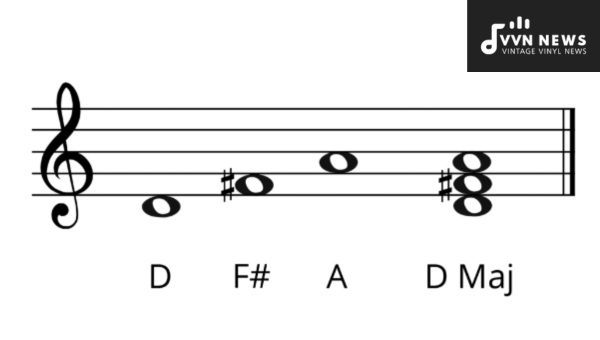
The D Major Triad is an essential building block in Western music. It consists of three notes: D, F#, and A, which form the root, third, and fifth intervals respectively.
The D Major Triad means grasping its significance as one of many possible chord progressions within a major key.
Whether you’re a budding guitarist or pianist, comprehending this triad will improve your ability to create harmonies effortlessly.
So let’s dive into the world of music theory and unravel the intricacies behind the D Major Triad.
Table of Contents
What Is a D Major Triad?
A D Major Triad is a combination of three notes: D, F#, and A, that are played simultaneously. It is one of the most commonly used chords in music and belongs to the key of D major. The D Major Triad consists of the root note (D), the major third (F#), and the perfect fifth (A). This particular combination of notes creates a bright and uplifting sound. In musical notation, it is represented as Dmaj or simply D. Understanding how this triad is constructed and its role within a major key will greatly enhance your ability to create beautiful melodies and harmonies in your compositions.
The Structure of the D Major Triad

The structure of the D Major Triad is based on the intervals between the three notes – D, F#, and A. Here’s a breakdown of each note and its role within the triad:
- Root Note (D): The D note serves as the foundation of the triad. It is the starting point from which the other two notes are built upon.
- Major Third (F#): The major third interval refers to a distance of four half steps or two whole steps above the root note. In the case of a D Major Triad, this is where F# comes into play.
- Perfect Fifth (A): The perfect fifth interval is a distance of seven half steps or three and a half whole steps above the root note. In our case, this brings us to A.
We have D as our root note, F# as our major third, and A as our perfect fifth. These three notes form the structure of the D Major Triad, creating harmony and giving a sense of stability to musical compositions.
Understanding these intervals allows musicians to know which notes to include when playing or composing music in the key of D major or using chords that contain a D Major Triad.
Also Read: G Flat Minor Triad [Mastering Complex Guitar Chords]
D Major Triad Inversions
Inversions are alternative ways of playing a chord, where the order of the notes is rearranged. They provide different voicings and create unique tonal textures. Understanding and practicing inversions of the D Major Triad can contribute to your versatility as a musician.
Here are the three inversions of the D Major Triad:
- Root Position – The root note (D) is the lowest note in this inversion, followed by the major third (F#) and then the perfect fifth (A). It creates a solid and stable foundation for your chord progressions.
- First Inversion – In this inversion, we take the third (F#) and move it up an octave, making it the highest note in the chord. The order now becomes A-F#-D. This inversion adds a sense of movement and lightness to your compositions.
- Second Inversion – Finally, we take the fifth (A) and move it up an octave, placing it above both the root note (D) and major third (F#). The second inversion is played with F#-D-A notes. It has a unique depth and richness while still maintaining its major tonality.
By practicing these inversions on both piano and guitar, you’ll not only improve your finger dexterity but also be able to explore different sonic possibilities within your chord progressions.
How to Build a D Major Triad?

Building a D Major Triad is relatively simple, and understanding its structure will greatly improve your musical compositions. Here’s a step-by-step guide on how to construct a D Major Triad:
- Start with the root note, which in this case is D. The root note represents the foundation upon which the triad is built.
- Next, we need to add the major third interval from the root note, which is F#. To find the major third, simply count two whole steps (or four half steps) up from the root note.
- Finally, we add the perfect fifth interval from the root note, which in this case is A. To find the perfect fifth, count seven half steps up from the root note.
By following these three simple steps, you have successfully built a D Major Triad: D-F#-A.
It’s important to note that triads can be built starting from any note within a scale. This means that by applying these steps to other root notes in the D major scale (E, F#, G, A, B, C#), you can create different triads within that key.
Also Read: G Minor Triad [Demystify This Common Guitar Chord]
D Major Triad on the Piano and Guitar
When it comes to playing the D Major Triad, both the piano and guitar offer unique approaches. Let’s explore how to play this triad on each instrument.
D Major Triad on the Piano
On the piano, the D Major Triad can be played in various inversions and positions across different octaves. Here’s a simple way to play it:
- Find the D key: Begin by identifying the white key labeled “D” on your piano keyboard. It is usually located just left of a group of two black keys.
- Skip two keys: From the D key, skip two consecutive keys (including white and black keys), which will result in landing on the F# key.
- Skip three keys: Moving from F#, continue to skip three consecutive keys to reach the A key.
- Play all three keys together: Now that you have found the D, F#, and A keys, play these three notes simultaneously to create a full-sounding D Major Triad.
Remember that you can explore different inversions by rearranging the order of these notes while maintaining their relative positions.
D Major Triad on the Guitar
On the guitar, you can play various shapes and fingerings for the D Major Triad across different frets and strings:
- Position your fingers: On your guitar fretboard, place your index finger (first finger) on the 2nd fret of the G string, your middle finger (second finger) on the 3rd fret of B string, and your ring finger (third finger) on the 3rd fret of high E string.
- Strum or pluck all strings simultaneously from A through high E strings using either your pick or fingers.
This particular fingering allows for easy switching between other chords in open position while maintaining a full-sounding D Major Triad.
By practicing these fingerings and exploring different positions on the piano or guitar, you will become familiar with the D Major Triad’s sound and be able to incorporate it into your playing effortlessly.
Also Read: A Flat Diminished Triad [Delve Into Rare Guitar Chords]
Common Uses of the D Major Triad

The D Major Triad is widely used in various genres of music due to its pleasant and uplifting sound. Here are some common uses of the D Major Triad:
- Melodies and Solos: The D Major Triad serves as a foundation for creating catchy melodies and solos. Its bright and optimistic sound makes it perfect for creating memorable hooks in a song.
- Chord Progressions: The D Major Triad is often used as part of chord progressions in many popular songs. It can be combined with other chords to create harmony and add dynamic changes to the music.
- Pop, Rock, and Folk Music: In pop, rock, and folk genres, the D Major Triad is frequently employed to create an uplifting atmosphere in songs. It is commonly heard in popular tunes like “Sweet Home Alabama” by Lynyrd Skynyrd.
- Key Changes: The D Major Triad can also be used as a transition chord between different keys. It provides a smooth modulation from one key to another by creating a sense of resolution.
- Accompaniment: When playing with other musicians or backing tracks, using the D Major Triad as an accompaniment chord provides a harmonic foundation for the other instruments or vocalists.
- Improvisation: Musicians often use the D Major Triad as a starting point for improvisation. By knowing the triad’s structure, players can expand upon it by adding additional notes to create unique and expressive solos.
- Songwriting: If you’re a songwriter, incorporating the D Major Triad into your compositions can help evoke positive emotions and add depth to your lyrics.
Understanding how to use the D Major Triad effectively opens up endless creative possibilities in your musical journey. Experiment with different melodies, chord progressions, and embellishments to make the most of this versatile musical tool.
D Major Triad in Chord Progressions
Chord progressions are a fundamental element of music composition, and the D Major Triad is commonly used within these progressions to create harmonic movement and emotional depth. Let’s explore how the D Major Triad fits into chord progressions and how it can be used effectively in your musical compositions.
1. Diatonic Chord Progressions:
In the key of D major, the D Major Triad naturally occurs as the I (one) chord. It is commonly followed by the IV (four) chord, which in this case would be G major, and the V (five) chord, which would be A major. This progression (D-G-A) is frequently used in popular music genres and provides a sense of resolution and stability.
2. Borrowed Chord Progressions:
The D Major Triad can also be utilized in borrowed chord progressions from other keys or modes. For example, it can be borrowed from the parallel minor of D major (D minor), resulting in a more melancholic or moody sound.
3. Secondary Dominant Chords:
Another way to incorporate the D Major Triad in chord progressions is through secondary dominant chords. By using an A major chord (which contains the triad notes of D major), you can create tension and anticipation leading to a resolution back to the I chord.
4. Modal Harmony:
In modal harmony, specifically in the Mixolydian mode, the D Major Triad serves as the I chord. This mode offers a slightly different tonality than traditional major scales, providing a unique flavor to your compositions.
Understanding how to incorporate the D Major Triad into your chord progressions will expand your musical palette, allowing you to create rich harmonies that evoke various emotions within your listeners.
Also Read: B Flat Major Scale [Exploring This Warm & Mellow Key]
D Major Triad in Popular Music

The D Major Triad is a versatile chord that has found its place in countless popular music pieces across various genres. Its bright and uplifting sound makes it a popular choice for musicians and songwriters looking to create catchy and memorable melodies. Let’s explore some of the ways the D Major Triad is used in popular music.
1. Pop Songs
In pop music, the D Major Triad often serves as a starting point for many chart-topping hits. Artists like Taylor Swift, Ed Sheeran, and Bruno Mars frequently use this chord to add a sense of positivity and energy to their songs. From the opening chords of “Shake It Off” to the infectious hooks of “Counting Stars,” the D Major Triad can be heard creating a joyful atmosphere that resonates with listeners.
2. Rock Anthems
Rock music relies heavily on powerful chords and riffs, and the D Major Triad is no exception. Bands like AC/DC, Led Zeppelin, and Guns N’ Roses have utilized this chord to create iconic rock anthems that are instantly recognizable. Songs like “Back in Black,” “Stairway to Heaven,” and “Sweet Child o’ Mine” all feature the driving force of the D Major Triad, adding intensity and depth to their timeless tunes.
3. Country Classics
In country music, chords play a vital role in creating that distinct twangy sound we all love. The D Major Triad is commonly used in country classics by artists such as Johnny Cash, Willie Nelson, and Shania Twain. From the heartfelt strums of “Ring of Fire” to the toe-tapping rhythms of “Man! I Feel Like A Woman,” these songs owe their charm in part to embracing the warmth and familiarity of the D Major Triad.
4. Hip-Hop Hooks
Even within hip-hop music, the D Major Triad has found its place. Producers and beatmakers often incorporate this chord within their melodies to add a catchy and melodic element to rap songs.
It brings a refreshing balance between the hard-hitting beats and soft, harmonic progressions.
Artists like Drake, Kendrick Lamar, and Kanye West have cleverly integrated the D Major Triad into their tracks, creating memorable hooks that stick in your head.
Whether it’s in pop, rock, country, or hip-hop, the D Major Triad continues to be a staple chord in popular music. Its vibrant sound adds depth and emotion to compositions, making it an excellent tool for songwriters looking to create catchy melodies and harmonies that resonate with listeners.
All aspiring musicians should familiarize themselves with this chord as they explore the endless possibilities of musical expression.
Also Read: E Flat Minor Pentatonic Scale [Master This Key With Our Guide]
FAQs About D Major Triad
How do you play a D Major Triad on the piano?
To play a D Major Triad on the piano, position your right-hand fingers on the keys D, F#, and A simultaneously. You can start with your thumb on D, your middle finger on F#, and your pinky finger on A.
Can I use different inversions of the D Major Triad?
Yes, you can use different inversions of the D Major Triad to create different chord voicings and add variety to your music. The inversions involve rearranging the positions of the notes in the triad.
How does a D Major Triad contribute to chord progressions?
The D Major Triad is often used as a tonic or home chord in chord progressions within the key of D major. It brings a sense of resolution and stability when transitioning between different chords in a song.
Can I use a D Major Triad in other keys or modes?
Yes, you can use a D Major Triad in other keys as well. However, it is important to consider how it fits within the specific musical context and whether it complements other chords and melodies in that key or mode.
Are there any famous songs that feature the D Major Triad prominently?
Yes, Many popular songs utilize the bright and uplifting sound of the D Major Triad. Some notable examples include “Sweet Child o’ Mine” by Guns N’ Roses and “Wonderwall” by Oasis, among others.
Conclusion
The D Major Triad is a fundamental chord in music theory that consists of three notes: D, F#, and A.
The structure and inversions of this triad will greatly enhance your compositions and allow you to create harmonies effortlessly.
Whether you’re a pianist or guitarist, incorporating the D Major Triad into your playing will undoubtedly elevate your musicality.
So go ahead, experiment with this versatile chord, and let its bright and uplifting sound add depth to your compositions.