
Mastering The E Major Triad is an essential skill for any guitarist looking to expand their musical repertoire.
Whether you’re a beginner just starting or an experienced player looking to fine-tune your skills, understanding and being able to play the E Major Triad is a fundamental building block in guitar playing.
In this article, I will guide you through the process of mastering this chord, providing you with practical tips and techniques that will help you become proficient in playing the E Major Triad.
Before we dive into the details of mastering the E Major Triad, let’s first understand what it is. A triad is a chord consisting of three notes – the root, third, and fifth – played simultaneously.
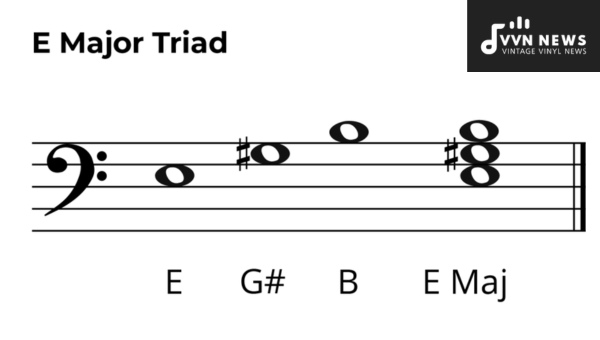
In the case of the E Major Triad, these three notes are E, G#, and B respectively. This particular triad has a bright and energetic sound that can add depth and richness to your overall guitar playing.
Now that we have an overview of what we’ll be exploring today, let’s delve into the different aspects of mastering the E Major Triad.
Table of Contents
What Is an E Major Triad?
An E Major Triad is a chord consisting of three notes: the root, third, and fifth. Specifically, for the E Major Triad, these notes are E, G#, and B.
This triad has a distinctive sound that is bright and energetic. It can add depth and richness to your guitar playing.
Here’s a breakdown of the structure of the E Major Triad:
- Root: The root note is the starting point of the chord. In this case, it’s E.
- Third: The third note determines whether the chord is major or minor. For the E Major Triad, it’s G# (the major third).
- Fifth: The fifth note adds stability to the chord. In this triad, it’s B.
Understanding the structure of the E Major Triad will help you construct and play it on various instruments like piano or guitar more confidently.
Also Read: F Major Triad [Music Theory Breakdown For Beginners]
Structure of the E Major Triad
The E Major Triad consists of three notes: the root, third, and fifth. Let’s break down the structure in more detail.
- Root: The root note is the foundation of the chord and sets its tonality. In the case of the E Major Triad, the root note is E.
- Third: The third determines whether a chord is major or minor. In this triad, the third note is G#, which is a half-step above G. This interval of a major third creates a bright and uplifting sound.
- Fifth: The fifth adds stability and strength to the chord. For the E Major Triad, it is B. This note complements the E and G# to form a harmonically rich sound.
It’s important to note that these three notes are played simultaneously to create the full triad sound.
When constructing chords or playing them on an instrument like a piano or guitar, knowing how to find, identify, and play these specific notes will help you master the E Major Triad more effectively.
Inversions of E Major Triad

An inversion of a chord refers to rearranging the order of its notes while still maintaining the original chord’s identity. In the case of the E Major Triad, there are three possible inversions:
- Root Position: In this inversion, the root note (E) is played as the lowest note in the chord. The G# is played above it, followed by the B. This is considered the standard version of the E Major Triad.
- First Inversion: In this inversion, we take the third note (G#) and move it up an octave, so it becomes the highest note in the chord. The B remains in its original position, and now E becomes the middle note.
- Second Inversion: For this inversion, we take the fifth note (B) and move it up an octave to become the highest note. The root note (E) moves to become a lower note than both G# and B.
Inversions provide different voicings and textures to a chord progression, allowing for more creative and interesting sounds in your playing. It’s important to practice each inversion separately and identify their unique sound qualities.
How to Construct an E Major Triad?
Constructing an E Major Triad involves understanding the relationship between its root, third, and fifth notes. Follow these steps to construct an E Major Triad on the guitar or piano:
- Find the Root Note: Locate the E note on your instrument. On the guitar, you can find it on the open sixth string or at the 12th fret of the 6th string. On the piano, it is three white keys to the right of middle C.
- Determine the Third: To find G#, which is also known as Ab, count up four half steps from E. On a guitar’s sixth string, this will be at the fourth fret (one-half step for each fret). On a piano, count four white keys up from E.
- Identify the Fifth: The fifth note in an E Major Triad is B. Count up seven half steps from E or move two strings up from G# on a guitar.
- Play and Listen: Once you have located all three notes (E, G#, and B), play them together simultaneously. Strum all three strings on a guitar or press all three keys simultaneously on a piano.
- Practice Different Positions: Experiment with playing the E Major Triad in different positions along your instrument’s neck or keyboard to expand your playing options and enhance your musicality.
Remember to strum or pluck only the strings required for each note when playing on a guitar and use fingers or multiple fingers for each note when playing on a piano.
By following these steps, you can confidently construct an E Major Triad and incorporate it into your musical compositions or improvisations with ease.
Also Read: E Minor Chords [Complete Guide With Tips & Tricks]
Playing E Major Triad on the Piano and Guitar

Playing the E Major Triad on both the piano and guitar is relatively straightforward, although the technique and hand/finger positioning differ between the two instruments.
Piano:
- Start with your right hand in a relaxed position, fingers curved and resting lightly on the keys.
- Place your thumb (1st finger) on E, which is two white keys to the right of middle C.
- Use your middle finger (3rd finger) to play G#, which is one black key to the right of E.
- Finally, use your pinky finger (5th finger) to play B, which is two white keys to the right of G#.
- Play all three keys simultaneously to hear the full E Major Triad chord sound.
Guitar:
- Find the sixth string (the thickest one) on your guitar, which is tuned to E.
- Place your index finger across all six strings at the 7th fret, creating an “E” shape barre chord.
- Use your ring finger (3rd finger) to press down on the 9th fret of the fifth string (A).
- Next, place your pinky finger (4th finger) on the 9th fret of the fourth string (D).
- Finally, use your middle finger (2nd finger) to press down on the 8th fret of the third string (G#).
- Strum all six strings from top to bottom to play a full-sounding E Major Triad.
Learning and mastering how to play an E Major Triad both on piano and guitar opens up numerous possibilities for implementing this chord in your musical compositions and improvisations.
Practice diligently, and soon you’ll be able to add the bright and energetic tones of the E Major Triad to your playing repertoire.
Also Read: D Flat Minor Triad [Advanced Music Theory Made Simple]
What are the Common Uses of the E Major Triad
The E Major Triad is a versatile chord that finds its way into many musical contexts. Its bright and energetic sound makes it perfect for various genres and styles. Here are some common uses of the E Major Triad:
- Key Center: The E Major Triad is often used as a foundation for songs in the key of E major. It establishes a strong tonal center and sets the overall mood of the piece.
- Strumming Chords: As a guitarist, you can incorporate the E Major Triad into strumming patterns to add texture and depth to your playing. It pairs well with other chords such as A major, B major, and C# minor.
- Melodic Riffs: The E Major Triad can be used to create melodic riffs and lines that catch the listener’s ear. By exploring different voicings and positions on the guitar fretboard, you can come up with interesting melodies that highlight the triad’s unique qualities.
- Soloing: In improvisation and soloing, incorporating the E Major Triad allows you to outline chord changes effectively and create harmonically rich solos. Experiment with arpeggios or sequences built around this triad within specific keys or chord progressions.
- Songwriting Tool: Songwriters often use basic triads like E major as a starting point for composing melodies and chord progressions. With its strong tonal center, you can build upon this triad to create memorable hooks and intricate harmonic progressions.
- Composing Harmonies: When writing harmonies for vocals or other instruments, using the E Major Triad in different inversions can create lush sounds that enhance your compositions.
- Transposition: Because it belongs to a standard set of triads used in most musical compositions, knowing how to master the E Major Triad will make it easier for you to transpose songs into different keys. It serves as a foundation for understanding chord relationships and harmony theory.
The E Major Triad is just one of many chord options available to guitarists and musicians. But mastering its sound and incorporating it into your playing will undoubtedly enhance your musical versatility and allow you to explore a wide range of genres and styles with confidence.
E Major Triad in Chord Progressions

The E Major Triad is widely used in chord progressions across various genres of music. Its bright and energetic sound makes it a popular choice for creating catchy melodies and harmonies. Let’s explore how the E Major Triad fits into chord progressions and how it can be used effectively.
Primary Chords
In the key of E major, the E Major Triad serves as the I (one) chord, also known as the tonic. It is considered a primary chord, providing a sense of stability and resolution.
This means that many songs in the key of E major will begin and end with this chord.
Secondary Chords
The other two primary chords in the key of E major are A major (IV) and B dominant 7th (V). These chords, when combined with the E Major Triad, create a strong foundation for chord progressions that can be used in songwriting or improvisation.
Modal Interchange
The E Major Triad can also be borrowed from its parallel minor key (E minor) to create interesting harmonic variations.
Modal interchange involves using chords from parallel keys to add depth and complexity to a composition or arrangement.
Common Progressions
Here are some common chord progressions where you might find the E Major Triad:
- I – IV – V: In the key of E major, this would be E – A – B.
- I – V – vi: This progression, using the chords E – B – C# minor, creates a melancholic feel often found in pop songs.
- ii – V – I: In this jazz-inspired progression, using F# minor 7th (ii), B dominant 7th (V), and E major (I), the E Major Triad provides resolution at the end.
Also Read: E Flat Major Triad [Music Theory Explained In Easy Steps]
Popular Music With E Major Triad
The E Major Triad is a versatile chord that has been used in countless popular songs across various genres.
Its bright and uplifting sound makes it a favorite among songwriters and musicians. In this section, we will explore some examples of popular music that feature the E Major Triad prominently.
“Sweet Child O’ Mine” by Guns N’ Roses:
- This iconic rock song begins with a powerful introduction that highlights the E Major Triad.
- The chord progression throughout the song includes the E Major Triad, adding energy and intensity to the music.
“Thinking Out Loud” by Ed Sheeran:
- In this romantic ballad, Ed Sheeran uses the E Major Triad during the chorus and bridge sections.
- The triad contributes to the warm and melodic feel of the song.
“I Will Always Love You” by Whitney Houston:
- This timeless classic features the E Major Triad in various parts of the song, including the intro and pre-chorus.
- The triad adds depth and emotion to Whitney Houston’s powerful vocals.
“Here Comes The Sun” by The Beatles:
- Written by George Harrison, this uplifting tune prominently features the E Major Triad.
- The triad’s bright sound captures the joyous and hopeful vibe of the song.
“Free Fallin'” by Tom Petty:
- Tom Petty uses an acoustic guitar to highlight the E Major Triad in this beloved rock anthem.
- Playing this triad helps create a catchy and memorable melody.
By studying these songs, you can gain a better understanding of how this chord can be used effectively in different musical contexts.
Also Read: C Major Triad [Master The Basics Of Music Theory]
FAQs about the E Major Triad
How do I play the E Major Triad on the guitar?
To play the E Major Triad on the guitar, place your index finger on the 1st fret of the G string, middle finger on the 2nd fret of the A string, and ring finger on the 2nd fret of the D string.
Can I use different inversions of the E Major Triad?
Yes, you can use different inversions of the E Major Triad to add variety to your playing. Some common inversions include G#-B-E, B-E-G#, and B-G#-E.
What are some practical uses for the E Major Triad?
The E Major Triad is used in a wide range of musical genres and can be incorporated into chord progressions, solos, and arpeggios to create melodic and harmonious sounds.
Can I use the E Major Triad in all keys?
Yes, you can transpose and play the E Major Triad in different keys by applying movable chord shapes and adjusting accordingly based on which key you’re playing.
Are there any popular songs that use the E Major Triad prominently?
Yes, many famous songs utilize the energetic sound of the E Major Triad. Examples include “Purple Haze” by Jimi Hendrix and “Livin’ On a Prayer” by Bon Jovi.
Conclusion
Mastering the E Major Triad is a crucial step in developing your guitar playing skills. By understanding the structure and components of this chord, you can confidently incorporate it into your music.
Whether you’re strumming on a guitar or playing on a piano, practicing the E Major Triad will allow you to add depth and richness to your sound.
Keep practicing and honing your skills, and soon, you’ll be able to effortlessly integrate the E Major Triad into your musical repertoire.