
Music, in its many forms, is a universal language that has the power to communicate emotions and stories without the need for words.
But there’s more to it than just melodies and harmonies; there’s a science behind how music works and one of those scientific concepts is minor 3rd intervals.
This principle plays an essential role in the structure of music and makes it pleasing to the ear. I may be the first to admit that discussing minor 3rd intervals may not exactly sound electrifying.
Its vital influence on your favorite songs or compositions, I promise it’ll add a new depth to your listening experience.
Table of Contents
Whis is Minor 3rd Interval?
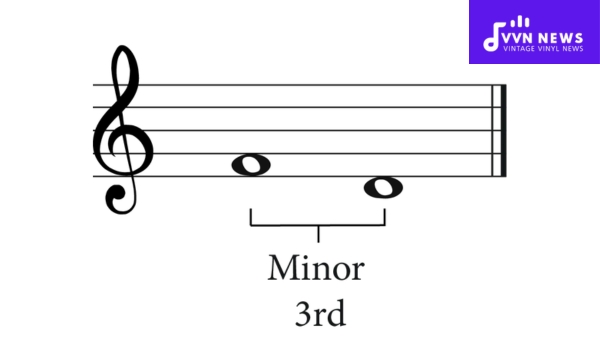
A minor 3rd interval refers to a specific distance between two notes in the musical language. To get technical, it involves two pitches with three semi-tone steps or one and a half full steps.
If you’re familiar with a piano keyboard, this would mean moving from one key to another, jumping over three keys (black or white depending on the key you started from) in between.
For instance, if we started on ‘C’, a minor third up would be ‘Eb’. Despite its name “minor,” this interval is no less important; it adds depth and variety to melodies and harmonies, making it fundamental in music.
Also Read: E Major: Scale And Chords [Exciting Sounds For Your Compositions]
some Minor 3rd Interval examples
When you’re delving into the world of minor 3rd intervals, it’s helpful to have concrete examples to hear and practice.

This interval is like a small step in the vast staircase of musical sequences. For ascending minor 3rd intervals, think of the notes C ascending to E♭, or G rising to B♭.
In descending order, imagine the note E♭ dropping down to C, or B♭ lowering to G. Let’s lay out these in a clear format:
Ascending Minor 3rd Intervals:
- C to E♭
- D to F
- E to G
- F to A♭
- G to B♭
- A to C
- B to D
Descending Minor 3rd Intervals:
- E♭ down to C
- F down to D
- G down to E
- A♭ down to F
- B♭ down to G
- C down to A
- D down to B
Through these patterns, you’ll notice how each interval maintains a distance of three half-steps or semitones between notes – signifying the essence of a minor 3rd.
These combinations form the backbone of countless melodies that resonate with listeners for their emotive quality.
Also Read: How To Transpose Into The Tenor Clef? [Mastering In Notation]
What characterizes Minor 3rd Intervals?
In the realm of music theory, a minor 3rd interval spans three half-steps, or semitones, on the chromatic scale. To appreciate its distinctiveness, you must first grasp its sonic qualities.
When played in succession or harmony, minor 3rds convey a sense of melancholy or wistfulness, which is why they’re often employed in genres that thrive on emotional depth like blues and somber classical compositions.
Pitch Relationship
A minor 3rd interval is always comprised of two notes: the root note and another note exactly three semitones above it.
For instance, if you start on C, a minor 3rd above would be E-flat. This pitch relationship is what gives the interval its ‘minor’ quality and differs from a major third, which extends for four semitones.
Frequency Ratio
From an acoustical perspective, minor 3rds have a frequency ratio of roughly 6:5.
This means that for every six vibrations of the lower pitch, the higher pitch vibrates five times. It’s this relationship that creates the distinctive sound we associate with minor intervals.
Harmonic and Melodic Usage
Harmonically, minor thirds contribute to the foundational structure of minor chords and minor scales.
Melodically, they create poignant leaps within tunes that can evoke introspective or reflective feelings.
Scale Construction
When building natural minor scales—the basic form of minor scales in Western music—a sequence beginning with two whole steps followed by one-half step will lead directly into a minor third. For example:
- A natural: A → B (whole step) → C (half step) forms an A minor third.
- E natural: E → F♯ (whole step) → G (half step) repeats this pattern starting at E.
Recognizing these characteristics enables musicians to harness the evocative power of minor 3rds seamlessly within creative works—adding depth where needed and invoking emotion through their inherently introspective sound.
Also Read: E Major: Scale And Chords [Exciting Sounds For Your Compositions]
How to Recognize Minor 3rd Intervals by Ear?
Listening for minor 3rd intervals requires a sharp ear and some practice, but it’s a skill that you can develop with time.

Here are steps to help you identify this distinctive musical spacing.
Tune Into the Emotional Tone
Firstly, notice the feel of the interval. Minor 3rds often carry a somber or melancholic sound. If the notes evoke a sense of sadness or pensiveness, you’re likely hearing a minor 3rd.
Familiar Songs as References
Use familiar tunes as reference points. The beginning of “Greensleeves” or “Hey Jude” by The Beatles contains recognizable minor 3rds.
Sing these songs in your head and compare them when trying to detect this interval.
Practice with an Instrument
If you play an instrument, repeatedly play minor 3rd intervals. For example, on a piano, start with any note and count three half-steps up to find its minor 3rd partner. Repeat this in different octaves and starting pitches.
Singing Exercises
Incorporate singing into your routine. Humming or singing both notes of various minor 3rds can reinforce your ability to discern them by ear.
Interval Training Apps
Consider using mobile apps designed for interval training. They provide structured exercises that progressively enhance your listening prowess.
Detecting minor 3rds becomes clearer when you boldly approach each step with curiosity and persistence.
With these tips at your disposal, recognizing this interval will soon become second nature as you immerse yourself in the world of music comprehension.
What’s the method to play Minor 3rd Intervals on piano?
Grasping the method to play minor 3rd intervals on a piano is a skill that can add depth and emotion to your playing.
A minor 3rd is comprised of three half-steps. Here’s how you can identify and play them:
- Start With a Reference Note: Choose any note as your starting point on the keyboard.
- Count Half-Steps: From this note, count up three half-steps (which are also known as semitones). To move a half-step up on a piano, you go to the very next key directly adjacent to your starting note—this could be either a black key or a white key.
- Identify the Interval: The key that sits three half-steps above your initial note forms a minor 3rd interval with the starting note. If you began with C, for instance, E♭ would be that minor third, since it is three semitones higher than C.
- Play Together or Separately: You can strike both keys simultaneously to hear them in harmony or play them sequentially for melodic practice.
Ensuring correct finger placement is critical. For optimal reach and comfort, pianists often use their thumb (finger 1) and middle finger (finger 3) when playing this interval in succession.
To cement this concept, visit online piano tools that can offer interactive guidance and support your practice regimen with visual aids and audio examples.
Also Read: E Major Triad [Master This Staple Of Music Composition]
What’s the connection between Minor 3rd Intervals and the Chromatic Scale?
Minor 3rd intervals and the chromatic scale are fundamental concepts in music theory, with intriguing relationships between them:

- Intervallic Structure: A minor 3rd interval spans three half-steps, or semitones, within the chromatic scale.
- Semitone Basis: The chromatic scale is comprised of 12 pitches, each a semitone apart. When you play any note and then jump three notes up or down the chromatic scale, you’ve played a minor 3rd.
- Enhancing Harmonies: Harmonically speaking, minor 3rds add color to chords. Since every note in the chromatic scale can be part of multiple minor 3rd intervals, this weaves a rich tapestry of potential harmonies.
- Versatility in Music: It’s classical compositions or modern pop songs, the connection between minor 3rds and the chromatic scale enables musicians to craft diverse sounds and evoke varied emotions.
- Modulation Potential: Transitioning from one key to another (modulation) often involves using intervals. Minor 3rds serve as smooth bridges between keys that are a semitone apart on the chromatic scale.
This vital relationship deepens comprehension of scales and intervals while enhancing musical creativity and analysis.
Also Read: How To Transpose Music? [Simplifying Key Changes In Songs]
FAQs
What defines an interval in music?
An interval refers to the distance in pitch between two notes, characterized by steps on a scale.
How do I identify a minor 3rd on sheet music?
Look for two notes that are three half-steps apart; this configuration signifies a minor 3rd.
Is the minor 3rd interval common in any particular genre?
Minor 3rds are prevalent in blues and rock, as they contribute to the melancholic and expressive sound common in these genres.
Can minor 3rds be found in major scales?
Yes, minor 3rds can be part of major scales, typically from the third to the fifth note (mediant to dominant).
What impact does a minor 3rd have on a chord’s quality?
Incorporating a minor 3rd turns a major chord into a minor chord, altering its emotional feel.
Also Read: How To Transpose Music? [Simplifying Key Changes In Songs]
Conclusion
The minor 3rd interval is a stepping stone to grasping musical theory. It’s essential for crafting emotive and expressive melodies that resonate deeply with listeners.
By practicing ear training and instrument play-throughs, you can develop an intuitive knowledge of these intervals. Remember, consistent practice will turn the recognition of minor 3rds into second nature.
So keep exploring, let your creativity flow through these intervals, and witness how they bring a rich layer of sophistication to your musical endeavors.