
Music carries us on a journey each time we listen, shaping our thoughts and emotions with each note played.
When it comes to the specifics of music theory, those nuances can get somewhat complex – and that’s where our comprehension can deepen our connection with each graceful melody or dynamic beat.
One such nuance is the minor 2nd intervals in music, a subject I hope to shed some clarity on.
To many, the term minor 2nd intervals might sound like an intimidating music jargon, but trust me, it is not as complicated as it seems.
Simple yet profound, mastering this interval has the potential to dramatically enhance your understanding of melodies and how they are structured. It truly brings out the symphony in every tune you hear or compose.
Table of Contents
What is a Minor 2nd Interval?
‘Minor 2nd Interval’ refers to the smallest possible distance between two different notes in music.
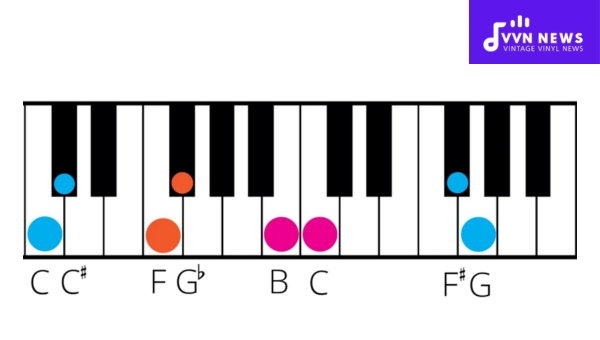
Think of these as adjacent keys on a piano, which might either be a white key to an adjacent black key or vice versa. In terms of semitones, the minor 2nd interval represents a one-semitone gap.
It produces a dissonant sound and is famous for its use in creating tension within music.
It’s the interval you hear in the iconic theme from “Jaws!” This sense of tension and unease it can create means it carries significant power in the realm of music composition.
Also Read: Phrygian Mode [Adding Exotic Flair To Your Musical Compositions]
How can one train their ears for intervals?
As with any new skill, learning begins by familiarizing yourself with the basic elements – in this case, understanding what intervals sound like.

Step 1: Learn the Sounds
Start by recognizing and distinguishing between major and minor intervals.
You can find samples online to hear the distinct difference. Believe it or not, some of the best online resources for this are YouTube tutorials.
It’s free and you get access to various interpretations of these intervals. All you need is a pair of good headphones.
Step 2: Interval Singing
It may sound unusual at first, but actively creating the intervals yourself is an excellent way to train your ear.
You don’t have to be a superstar vocalist; it’s about creating and connecting with sound on a different level.
Step 3: Practice with an Instrument
Try playing different intervals on your instrument – remember, practice makes perfect!
Step 4: Quiz and Test Yourself
Use online interval ear training tools/apps to test yourself regularly, sites like musictheory.net are top-notch for this.
Possessing trained ears will make you enormously more effective as a musician, expanding your capabilities exponentially compared to solely relying on muscle memory or visual patterns.
Also Read: F Sharp Minor Pentatonic Scale [How To Use In Your Compositions]
What are examples of Minor 2nd Intervals?
Within the realm of music theory, minor 2nd intervals play a significant role in crafting melodies and harmonies that resonate with our emotions.
Let’s dive into specific instances where you can discern this interval in both ascending and descending forms across various notes.
When exploring minor 2nd intervals, it’s helpful to recognize that they consist merely of two notes played in succession where the second note is one semitone higher (ascending) or lower (descending) than the first.
This can be demonstrated adequately on a piano keyboard, as each adjacent key represents a semitone step.
Ascending Minor 2nd Intervals:
To illustrate ascending minor 2nd intervals using all available notes, here are several examples:
- From C to C# or Db
- From D to D# or Eb
- From E to F
- From F to F# or Gb
- From G to G# or Ab
- From A to A# or Bb
- From B to C
Each pair represents a push forward by one semitone, hence creating the smallest possible interval between two pitches excluding unisons.
Descending Minor 2nd Intervals:
With descending sequences, the second note falls one semitone below its predecessor. Some descending minor 2nd examples encompass:
- From C down to B
- From D down to C# or Db
- From E down to D# or Eb
- From F down to E
- From G down to F# or Gb
- From A down to G# or Ab
- From B down to A# or Bb
Engaging your auditory senses with these patterns can enrich your musical perception as well as enhance composition skills.
What are the qualities of Minor 2nd Intervals?
The minor 2nd interval, often referred to as a half-step or semitone, is the smallest perceptible distance between two pitches in Western music.

Its distinctive sound is recognizable as the beginning of the ‘Jaws’ theme, inducing an instant sense of suspense and proximity.
This interval bristles with tension and is what creates its characteristic dissonance.
Dissonant Nature
One key attribute of the minor 2nd is its dissonance. While this quality can evoke unease or a desire for resolution in music, it’s also responsible for adding emotional complexity to a piece.
Due to its close frequency proximity, it clashes somewhat urgently when played simultaneously, creating what musicians refer to as a rub.
Resolution Tendency
Given its uneasy character, the minor 2nd often demands resolution into either unison or a major 2nd interval where the notes feel more harmonious together.
This push towards stability is seen frequently in classical compositions where tension and release are essential storytelling tools.
Expressiveness
Despite—or perhaps because of—its dissonance, this interval is rich with expressiveness.
Composers use it to convey a range of emotions from fear and sadness to longing and introspection.
It reminds us that beauty in music isn’t always about perfect harmony; sometimes it’s found in the raw edges of discord.
Use in Melodies and Harmonies
In melodies, the minor 2nd’s stepwise movement lends itself to intricate musical lines.
When utilized within harmonies, these intervals contribute to richer textures, providing depth even within their brevity.
These characteristics will not only help you recognize a minor 2nd when you hear one but appreciate how it functions intrinsically within the tapestry of music’s language.
Also Read: How To Transpose Bass Clef To Treble Clef [A How-To Guide]
How can you identify Minor 2nd Intervals by ear?
Identifying a minor 2nd interval by ear can be likened to recognizing the unique nuance of spice in your favorite dish—subtle, yet distinctive.
To accomplish this, start by familiarizing yourself with the sound of the interval.
Listen for the Dissonance
A minor 2nd is the smallest interval in Western music, often described as dissonant or tense. The clash between the two pitches is a trademark of its sound.
Reference Well-Known Melodies
One trick is to associate the minor 2nd with songs you already know. The initial notes of the “Jaws” theme or “Fur Elise” are classic examples where a minor 2nd stands out.
Sing it Out
Hum or sing the interval repeatedly. Begin with a note and follow it immediately with the adjacent higher or lower semitone to hear that tight, ‘rubbing’ sound characteristic of a minor 2nd.
Use A Piano Keyboard
If you have access to a piano or keyboard, visual aids can be useful. Play any note followed by its immediate neighbor (black or white key).
This pairing demonstrates how close these two notes are on the scale—essentially side by side.
Practice Regularly
Continuous practice is crucial for enhancing your skill set. Use online resources like interval training websites where you can listen to and test yourself on intervals repetitively.
Recognizing intervals comes down to consistent exposure and drills. Keep at it, and soon enough, picking out that elusive minor 2nd will be second nature!
Also Read: How To Transpose Music? [Simplifying Key Changes In Songs]
How do you play Minor 2nd Intervals on a piano?
To master the art of playing minor 2nd intervals on a piano, you’ll need to get comfortable with the keyboard’s layout.

Each key is a step into this world of harmonic subtlety, where even a slight change in pitch can alter the mood of music.
Step-by-Step Guide
- Locate Middle C: Start by finding middle C, which serves as a reference point. Middle C is typically near the middle of the keyboard and often under the brand name printed on your piano.
- Position Your Fingers: Position your thumb (finger 1) on middle C. Make yourself comfortable; maintaining good posture at your instrument supports better performance and learning.
- Identify The Next Key: A minor 2nd interval is the smallest distance between two different notes in Western music – just one half-step or semitone apart.
- Play The Adjacent Key: Press the key directly to the right of middle C (whether it’s a black or white key). The interval from C to C# (or Db—both names refer to this black key) demonstrates what a minor 2nd sounds like.
- Experiment: You can apply this principle to any note. Move up or down from your starting note by just one semi-step; this position-to-position transition always represents a minor 2nd.
- Explore Variations: Make it interesting by jumping around the keyboard, trying different minor 2nd pairs: E-F, G-G#, B-C – every pairing has its own distinct sonority yet shares that same tight spacing.
By practicing these small steps and incorporating them into scales and melodies, not only do you get acquainted with their tonal quality but you also bolster finger independence and dexterity on your piano keyboard.
Feel free to utilize digital tools like an online piano if an actual piano isn’t at hand, which allows for consistent practice opportunities no matter your location or time zone.
These tiny intervals may be minimalistic in terms of spacing, but they’re undeniable powerhouses when it comes to stirring emotion and color in music.
How do Minor 2nd Intervals Relate to the Chromatic Scale?
The Chromatic Scale serves as the complete set of twelve pitches that are at the foundation of Western music.
Each pitch is a half-step—or semitone—apart from its neighbors, which is exactly where the minor 2nd interval comes into play.
A minor 2nd is this half-step, the smallest interval used in Western music.
Imagine a piano: placing your finger on any key and then moving to the very next key—whether white to black, black to white, or white to white—produces a minor 2nd.
This interval is the backbone of chromatic motion in melodies and harmonies, imparting tension or resolution depending on its context within a piece.
Without minor 2nds, there would be no chromatic scale as we know it.
Each step you take along this one-octave path on a keyboard demonstrates successive minor 2nds strung together, forming a tapestry of pitches that composers and musicians utilize for richness and variation in their works.
Also Read: Transposition Chart [A Lifesaver For All Musicians]
FAQs
What is the sound difference between a minor 2nd and a major 2nd interval?
A minor 2nd is just one semitone apart — it sounds dissonant, tense, or “crunched,” while a major 2nd spans two semitones, producing a brighter and more harmonious sound.
When composing music, how important are minor 2nd intervals?
Minor 2nds add tension and dissonance that can be crucial for building emotion or suspense in music composition.
Can you find minor 2nd intervals in popular music?
Yes, minor 2nds are frequently found in various musical genres, often used to create edginess or tension within a piece.
Is it possible to play minor 2nd intervals on any instrument?
Yes, as long as the instrument is capable of producing semitone steps, like pianos or guitars, you can play minor 2nds.
What exercises can help me master recognizing minor 2nd intervals by ear?
Try practicing with ear-training apps or software that focuses on interval recognition or use a piano to play and memorize the sound of half-step movements.
Conclusion
The minor 2nd interval, though small, is mighty in its influence on a piece’s emotion and tension. It’s not just a technical component of music theory but the backbone of evocative melodies that resonate within us.
As you listen to some of your favorite songs or movie scores, try to identify those poignant minor 2nd moments. They are the subtle architects of a song’s depth and character.
And, if you’re a musician, embracing and practicing this interval will enrich your playing with nuances that can only be felt through sound.