
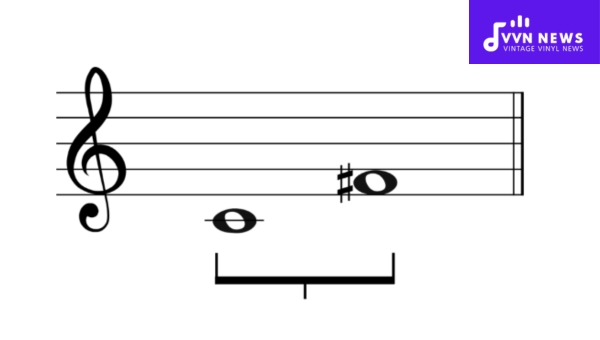
Music, in its vast complexity and beauty, offers a spectrum of tunes to explore. Among many intriguing elements, the unique charm of augmented 4th intervals is profoundly appealing to musicians and listeners alike.
As this note combination is the backbone of countless melodious phrases in our favorite music pieces, understanding its intricacies can significantly enhance one’s musical cognition.
Augmented 4th intervals are said to be the spice of a musical composition, adding a harmonic intensity that is hard to ignore. The more you dip your toes into their world, the more you’ll appreciate the depth they bring into compositions across different genres.
Table of Contents
What Is an Augmented 4th Interval?
An augmented 4th interval, often known as a tritone, is a distinct musical gap that spans five semitones (or half-steps).
To illustrate, imagine moving from C to F# on your piano, this is an example of the tritone interval. It’s a compelling tonal movement that captures listeners’ imaginations due to its dramatic quality.
In classical times, this ear-catching interval was regarded somewhat warily and was even colloquially referred to as diabolus in music or “the Devil in music” owing to its dissonant sound.
Despite this infamous reputation, modern musicians embrace the augmented 4th for the rich tension it brings to a piece.
Also Read: D Sharp Major Pentatonic Scale [A Bright And Positive Tone]
What Makes the Qualities of Augmented 4th Intervals Unique?
For centuries, musicians and composers alike have leveraged the powerful tool that is the augmented 4th interval to create iconic pieces.

A good starting point when it comes to tackling the uniqueness of augmented 4th intervals is how they deviate from their pure form.
A Deviation from Purity
An augmented 4th interval jumps up one half-step (or semitone) more than a perfect fourth.
From a purely mathematical perspective, you would measure this by counting five whole steps or ten half steps on your instrument.
This extends its reach, creating an unexpected twist – a ‘stretching’ of the sound compared to what our ears expect.
Balancing Tension and Resolution
Secondly, these intervals embody tension and resolution within them. The resolution is realized when this half-step’s tension resolves either up to the perfect fifth or down to a major third within a chordal context.
This very anticipation newbies in music theory often find disorienting and experienced musicians find it intriguing.
Enlivening Harmonic Complexity
As if standing out with its stretched sound and embodiment of tension resolution wasn’t enough, the augmented 4th jazzes up with increased harmonic complexity in virtually any piece of music.
Thanks to its tritone nature, it can be inverted without losing this level of discordance.
This makes it equivalent to its inversion: the diminished fifth (dim5), granting it duality in function.
Hence, if you are interpreting classical music or improvising jazz tunes on your piano at twilight, knowing how augmented 4ths function is beneficial in enhancing your performance.
How Can You Identify an Augmented 4th Interval in Music?
The recognition of this pivotal interval can heighten your musical sense.
Here are five hallmark characteristics that can assist you in identifying the presence of an augmented 4th interval in a composition.
- Counting Musical Steps: The most basic approach for pinpointing these intervals is counting the musical steps or semitones. Markedly, the augmented 4th consists of six half steps above the initial note.
- Recognizing its Unique Sound: The unique sound of an augmented 4th stands out due to its tension and dissonance. It has a distinctive tonal quality that feels unresolved or “hanging”.
- Use of Inversions: Another notable feature is their inversions, which create diminished 5th intervals – another name for these is tritones. Be attentive to these inversions, as they are frequent indicators.
- Identification in Chords: Besides standalone instances, you can also spot augmented 4ths inside chords, especially dominant seventh and diminished chords. Their presence lends a particular flavor to these harmonies.
- Familiar Themes/Phrases: Sometimes, familiar musical themes or phrases can provide clues about an augmented 4th interval’s existence – like the ‘Maria’ theme from Bernstein’s “West Side Story”, which employs this interval to great effect.
By acquainting yourself with these traits, you’ll gradually develop a keen ear for discerning augmented 4ths in various compositions and imbibe them into your creative process.
Also Read: How To Transpose Treble To Bass Clef [Music Guide]
What Are Some Well-Known Songs Featuring Augmented 4th Intervals?
Music enthusiasts often encounter the distinct sound of the augmented 4th interval, also known as the tritone.

Historically regarded with a bit of mystery and even superstition, this interval’s unique tonal quality has not gone unnoticed in popular music.
Here are five songs that famously employ the augmented 4th:
“Purple Haze” by Jimi Hendrix
In “Purple Haze,” Jimi Hendrix harnesses the tritone to craft a psychedelic atmosphere.
Right from the song’s opening riff, you’ll notice how the dissonance created by this interval echoes throughout, creating its memorable sound.
“Black Sabbath” by Black Sabbath
As one of heavy metal’s foundational bands, Black Sabbath effectively uses the augmented 4th to evoke a sense of foreboding in their eponymous track. The first few chords immediately introduce this tense sonic theme, making it an iconic part of metal music’s heritage.
“The Simpsons Theme” by Danny Elfman
A more playful usage can be heard in Danny Elfman’s theme for “The Simpsons.”
Within seconds after you hear Homer’s exasperated sigh, the augmented 4th sweeps in, echoing through television sets worldwide to signal the start of this beloved animated series.
“YYZ” by Rush
Instrumental prowess is showcased in Rush’s “YYZ,” where among intricate rhythms and melodies, Geddy Lee’s bass line employs augmented 4ths to create a distinctive sound that progressive rock fans have come to admire.
“Maria” from West Side Story (Leonard Bernstein)
Lastly, Leonard Bernstein elegantly weaves an augmented 4th into “Maria” from West Side Story.
This interval jumps right at Maria’s name during its signature motif — exemplifying how classical elements seamlessly meld into musical theatre compositions.
From rock ‘n’ roll anthems and TV show jingles to impactful moments on Broadway stages — these instances demonstrate just how versatile and impactful an augmented 4th can be when stitched into a musical tapestry.
Also Read: Mastering Chords In A Minor [Improve Your Composition Skills]
How Do Augmented 4th Intervals Function in Ear Training?
Mastering the art of identifying augmented 4th intervals can elevate your aural skills to new levels.
This interval’s distinctive sound makes it an essential component for any ear training exercise.
- Recognition and Differentiation:
The first step in ear training with augmented 4th intervals is to recognize them. The unique tonal character can be easily detected once familiarized. Practice by listening diligently to various music pieces and aim to distinguish these intervals among others. - Recall and Reproduce:
Being able to recall the sound of an augmented 4th interval and then reproduce it on your instrument of choice is another significant factor in ear training. Memorize its sound, so you dare not miss it! - Interval Singing:
Singing the interval out loud is a valuable training method. It allows you to physically connect with the sounds you are producing, which will make recognition easier as you become more adept at reproducing this specific interval. - Usage in Melodies and Chord Progressions:
Frequently used in melodies and chord progressions, being able to identify augmented 4ths is critical for dissecting the fabric of songs and compositions on an auditory level. - Improvement of Overall Musician Skills:
Notably, incorporating this distinctive interval into your practice routine doesn’t just improve your capacity to discern it; imparting broader benefits by enhancing overall musicianship and interpretative abilities through sharpened hearing skills.
By integrating these steps into ear training, you honor the power that comes from understanding the characteristics of varied sounds in music and developing a more nuanced musical ear – all thanks to the magic held within augmented 4th intervals!
How Can Augmented 4th Intervals Be Played and Utilized on the Piano?
Playing an augmented 4th on the piano involves finding a perfect fourth and then raising the upper note by a half step.

For example, starting with C to F, which is a perfect fourth, you elevate the F to an F#. This adjustment transforms it into an augmented 4th.
Utilizing Augmented 4ths:
- Familiarize with their sound by playing two keys that are six half steps apart.
- Incorporate them into your melodic compositions for a striking dissonance.
- Employ this interval as a pivot point in modulations between keys.
- Enhance harmonic depth by using it alongside standard chords.
When practiced regularly, this interval becomes a powerful asset in your improvisational toolbox.
With every press of those two keys, you’re not merely playing notes; you’re creating suspense, yearning, and anticipation within your listeners.
Also Read: How To Transpose Music? [Simplifying Key Changes In Songs]
FAQs
What is the difference between a perfect 4th and an augmented 4th interval?
A perfect 4th covers five semitones, whereas an augmented 4th spans six, creating a tension-filled sound.
Can an augmented 4th interval resolve in music?
Yes, augmented 4ths often resolve to a consonant interval, such as a perfect fifth or major third.
Is the augmented 4th the same as a diminished 5th?
Yes, they consist of the same notes and are enharmonic equivalents but are named differently depending on context.
Why is the augmented 4th called “the devil in music”?
Historically, its dissonance led to this moniker; it was often avoided in medieval ecclesiastical singing.
How do you practice listening for augmented 4ths?
You can use ear-training apps or listen for it in songs that feature this interval prominently.
Conclusion
The augmented 4th interval, often labeled as the “devil’s interval,” is undeniably a fascinating aspect of music theory.
Its enigmatic sound creates a sense of tension and release that is central to many musical compositions.
If you are a musician hoping to incorporate this interval into your work or simply a music enthusiast aiming to recognize its presence in your favorite songs, the augmented 4th remains an essential part of your auditory exploration.