
The world of music can often seem like an intricate maze, a complex world of beats, rhythms, and intervals. One such intriguing musical concept that fascinates many is the diminished 5th intervals.
This particular interval holds a unique identity in the world of music theory which we will explore in this blog post. The nature of diminished 5th intervals could significantly elevate your knowledge of music.
This fascinating concept can seem challenging to comprehend initially, but once you have grasped it, it may alter how you perceive and interpret musical compositions.
So, stay tuned if you’re a lover of all things musical or simply curious about the intricacies of melody and harmony.
Table of Contents
What Is a Diminished 5th Interval?
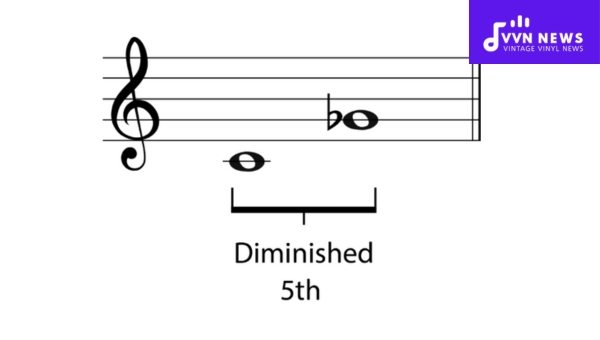
A Diminished 5th interval, often known in music theory as a tritone, is a unique span between two notes. You’ll find it six half-steps, or semitones, apart on your keyboard or fretboard.
This interval’s fascinating history has cloaked it with an air of mystery, even earning it the nickname “devil’s interval.”
In terms of notation, if you have two notes like B and F, this is recognized as a diminished 5th because it is one half-step smaller than a perfect fifth.
Historically, its dissonant sound wasn’t as appreciated as today. It still occupies an unparalleled position in conveying tension and resolution within compositions.
These dynamics are what make music so enthralling. Without intervals such as the diminished 5th, we wouldn’t have the expressive diversity that rules the music we appreciate day in and day out.
Also Read: How To Transpose Into The Tenor Clef? [Mastering In Notation]
What Are the Qualities of a Diminished 5th Intervals?
The qualities of a diminished 5th interval is key to recognizing it in music compositions and using it effectively.

Listed below are intriguing traits of diminished 5th intervals that may make your musical journey enthralling.
- Tritone Interval: A diminished fifth interval, often referred to as a tritone, forms when climbing five steps on the chromatic scale while lowering one half-step. This process gives this unique interval distinctive sound quality.
- Dissonant Sound: In terms of harmonic relations, a diminished 5th is considered dissonant, as its sound is tense and unstable. It typically needs resolution, which composers expertly use to create suspense or drama within their pieces.
- Symmetric Formation: This interval is symmetrically situated in the octave, meaning if you start from C and go up a tritone, you hit F#, and if you start from F# and go up a tritone, you hit C again.
- Enharmonic Equivalents: The diminished 5th has an enharmonic equivalent known as the augmented 4th (denoted as an A4). What’s interesting here is both intervals share the same pitch but hold different notations.
- Usage in Chords: The diminished 5th plays a crucial role within the fully-diminished seventh chord (dim7) and half-diminished seventh chords (m7♭5) within both classical and jazz harmony constructs.
These characteristics paint a useful portrait of how to identify those elusive diminished 5ths within music compositions, which may broaden your perspective on music theory comprehensively.
How Are Diminished 5th Intervals Used to Play Piano and Guitar?
When you learn about diminished 5th intervals, it may seem complex at first glance.
It’s just a matter of practice and knowing the basics. Let’s now learn how these intervals can be intertwined into playing two popular musical instruments: the piano and the guitar.
Piano
- Establish Your Root Note – To begin, select a root note. For instance, let it be ‘C’. It serves as your point of reference
- Counting From the Root – The next step is to count up five white keys starting from your root note ‘C’.
- Diminish Your Note – Your fifth note in this case should be ‘G’, simply drop it half a step down to F# or Gb. This dropped half step is where you achieve the diminished 5th interval known musically as a tritone.
- Play the Interval -Finally, play those notes together or independently to hear the diminished 5th interval.
Guitar
- Identify Your Primary Note – Choose your primary point of reference on any string of your guitar.
- String Skipping Technique – Use this technique and skip three frets forward.
- Add a String Skip with an Immediate Jump Of One Fret Downward To Achieve Decreased 5th Interval
- Produce tones revered in musical history: Strum both notes collectively or separately on your guitar to hear the tone so respected across years of musical history.
They offer unique sonic possibilities not found in more harmonious intervals. They are integral for any musician playing instruments ranging from keyboard to full orchestras because they allow for complex and unique harmonic structures.
Be the jazz mavericks, rock virtuosos, or Olympic-level classical musicians – every great artist harnesses the transformative power of the diminished 5th at some point during their professional journey.
Also Read: How To Transpose Treble To Bass Clef [Music Guide]
Why Are Diminished 5th Intervals Important in Ear Training?
Diminished 5th intervals hold a pivotal role in the realm of ear training. Here are five critical reasons for their significance:

Identification of Tonalities
Often referred to as the ‘devil’s interval’, a diminished 5th can help to identify tonalities within a piece of music.
It appears distinctively discordant compared to other intervals, thereby giving it an easily recognizable quality.
Dissonancy Recognition
You’re surely aware that not all musical arrangements are sonorous and pleasant to the ear.
Some are purposely dissonant, and this is where diminished 5th intervals come into play.
Utilizing this interval improves skills in recognizing dissonance and enhancing overall music appreciation.
Ear Training Exercises
Most importantly, these intervals have been an integral part of numerous ear-training exercises for generations.
Working on recognizing this specific interval significantly helps improve auditory perception skills – it’s like going through a musical gym session for your ears!
Improved Transposition Skills
By recognizing this unique interval’s characteristic sound, you can improve your transposition skills immensely.
Just think about it; once you’ve mastered how to recognize a diminished 5th in any key, you’ll find yourself navigating the complexities of key changes with increased ease.
Better Compositional Skills
The overwhelming intrigue of the diminished 5th makes it an exciting tool for composers trying to create tension or mystery in their pieces.
The essence of a diminished 5th interval can be highly beneficial for both professional musicians and those just starting on this learning journey alike!
Its unique sound can distinguish between various tones, enhance your compositional skills, and enrich your overall auditory experience during your musical journey.
What Are Examples of Diminished 5th Intervals?
Diminished 5th intervals, pulsating throughout musical history in various compositions and instruments, are captivating to examine.
In the world of music, you’re bound to come across them. Here’s an exhaustive list of these intervals:
Ascending Order
- C to G♭
- C# to G
- D to A♭
- D# to A
- E to B♭
- F to B
- F# to C
- G to D♭
- G#to D
- A# to E
Descending Order
- C to F♯ or G♭
- C# or D♭to G
- D to G# or A♭
- D# or E♭to A
- E to B♭ or A#
- F to B
- F#.or G♭to C
- G to C or D ♭
- G#.or A ♭to D#
Inherently, this examination shows that a diminished fifth can be described by narrowing the perfect fifth interval by a semi-tone if ascendant or descendant.
It’s important to remember that these intervals aren’t mere textbook stuff.
They have roles in some of the greatest, toe-tapping melodies ever composed, such as Steppenwolf’s “Born To Be Wild,” “Star Trek Theme,” Tchaikovsky’s “Symphony No. 4,” and more.
Also Read: How To Transpose Treble To Bass Clef [Music Guide]
Songs that Utilize Diminished 5th Intervals
The diminished 5th interval, often referred to as the “tritone,” carries a distinct sound that has seduced composers and songwriters across genres.

Its tension-filled character adds an edge to music that is unmistakable. Let’s delve into five iconic songs where the tritone plays a starring role:
- Led Zeppelin – “Black Dog”
This rock classic features a tritone in the guitar riff that is as iconic as the song itself. Jimmy Page crafts a sharp musical dialogue by interweaving standard and tritone intervals, giving “Black Dog” its memorable bite. - Mariah Carey – “Dreamlover”
In “Dreamlover,” Mariah uses the diminished 5th to add color to her pop melodies. The subtle use of this interval among primarily major and minor tones adds depth to the overall harmony, showcasing her sophisticated approach to melody writing. - Gustav Holst – “Mars, The Bringer of War”
Classical music is rife with examples of diminished 5ths, but Gustav Holst’s orchestral suite The Planets displays this dissonance with drama and power in “Mars.” Each powerful orchestral stab emphasizes the foreboding feel that only a tritone can provide. - Metallica – “Enter Sandman”
With an opening riff laced with diminished 5th intervals, Metallica’s “Enter Sandman” creates an atmosphere of unease fitting for its dark themes. The tension induced by each tritone carries listeners through riffs that are as haunting as they are catchy. - West Side Story (Musical) – “Maria”
Leonard Bernstein capitalized on the dramatic potential of diminished 5ths in his composition for “Maria.” This specific usage highlights emotional complexity within a melody line, dragging listeners into Tony’s profound mix of joy and desperation.
These examples cut across diverse musical landscapes, showing how versatile yet potent the application of the diminished 5th can be in crafting unforgettable musical moments.
FAQs
Why is a diminished 5th also known as a “tritone”?
A diminished 5th is called a tritone because it spans three whole tones or six semitones, creating a distinctly dissonant sound.
Is the diminished 5th interval only used in classical music?
No, the diminished 5th is used across various genres, including jazz, rock, and even some popular music forms for its tension and resolution effect.
Can playing diminished 5th intervals improve my musical skills?
Absolutely! Practicing diminished 5ths can enhance your theoretical knowledge and practical application in composition and improvisation.
What’s the difference between a diminished 5th and an augmented 4th?
While they share the same pitch in equal temperament tuning (enharmonic equivalents), theoretically, a diminished 5th descends from the fifth note of a scale, whereas an augmented 4th ascends from the fourth note.
How do I quickly find a diminished 5th on my instrument?
To find a diminished 5th, locate the perfect 5th from your starting note and then lower it by one semitone; this will give you the diminished interval.
Also Read: A Guide Transposing Into The Alto C [Navigate Music Transposition]
Conclusion
The diminished 5th interval, also known as the tritone, is a potent musical element with a dissonant sound that has been stirring emotions since its inception.
This interval has been essential in creating tension, signifying moments of unease, and resolving into more harmonious sounds.
If you’re a budding pianist or an experienced ear-training enthusiast, recognizing and this interval is crucial for music composition and analysis.
The next time you hear that unsettling clash in your favorite song, you’ll know the diminished 5th is at play!