
The soulful twangs of blues music have a way of speaking directly to the heart, and at the core of this emotional dialogue is the A Major Blues Scale.
This particular scale is a powerhouse tool for musicians, offering a palette rich with expressive possibilities.
Whether you’re picking up your guitar to while away a quiet evening or crafting a solo that will bring an audience to its feet, understanding this scale can elevate your musical expression to new heights.
Getting to grips with the A Major Blues Scale may seem daunting at first, but it’s an immensely rewarding endeavor for anyone looking to expand their musical vocabulary.
In this piece, we’ll unravel the secrets behind its versatility and why it’s considered an essential element for blues musicians and beyond.
As we delve into each note and interval, you’ll discover how this timeless scale can infuse life into your melodies and improvisations.
Table of Contents
What Notes are in the A Major Blues Scale?
The A Major Blues Scale, a variant of the traditional blues scale, holds a unique set of notes that give it its characteristic sound.
It includes the following: A, B, C#, D, D# (or Eb as a blue note), and E. This hexatonic scale—a six-note scale—revolves around these tonal pillars. Let’s break it down:
- The root note, A, establishes our tonal center.
- B represents the second or major second.
- C#, known as the major third, introduces that major feel.
- The fourth, D, maintains the scale’s bluesy backbone.
- The blue note, D# or Eb adds tension and an unmistakable blues edge.
- Lastly, we have our fifth, which is the note E.
By incorporating these notes into your playing, you’re tapping into the essence of blues with a major twist.
How do you construct the A Major Blues Scale?

The A Major Blues Scale is a musical ladder of sorts, consisting of six distinct notes.
its core, you’ll find the A Major Pentatonic Scale (A, B, C#, E, F#), but with a twist – the addition of a blues note.
This blue note is the flattened third (C natural) which injects that quintessential bluesy feel into the scale.
Here’s a step-by-step breakdown of its construction:
- Start with the root note, A.
- Move up two whole steps to B.
- Proceed half a step to the bluesy heartthrob, C (flat 3rd).
- Continue another half step to reach C# (major 3rd).
- Leap over one and a half steps to land on E (the 5th).
- Finally, another whole step takes you to F# (6th) before returning to our root note an octave higher.
Remembering this pattern makes it easy to replicate the scale on any instrument in any key—all it takes is knowing your starting point.
Also Read: A Sharp Minor Pentatonic Scale [Unique Harmonic Possibilities]
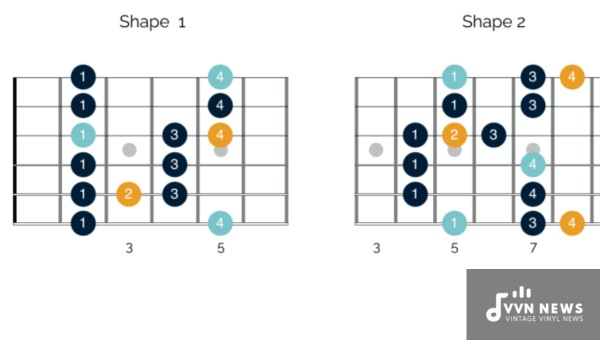
Guitar Fingerings for the A Major Blues Scale Shapes
As a guitarist, mastering the fingerings for the A Major Blues Scale is like finding the keys to a treasure trove of musical expression.
Each scale shape offers a different pathway through the same tonal landscape, providing you with multiple options for crafting your melodic lines.
The Classic Box Pattern
One of the fundamental shapes that every blues guitarist starts with is often referred to as the “box” pattern. For the A Major Blues Scale, this pattern is situated around the second fret:
- Start on the low E string at the fifth fret (A), using your second finger.
- Move to the eighth fret (C) with your pinky.
- On the A string, play from the fourth fret (C#) with your first finger, to the fifth (D) with your second finger, and finally, to the seventh (E) with your fourth finger.
This boxy shape continues across all six strings in a similar fashion and provides an accessible way for beginners to start navigating this scale.
Stretching Across Frets
Moving beyond basic patterns will involve larger stretches across more frets. Familiarize yourself with fingering that spans five or even six frets to give yourself full access to all notes in various octaves:
- Strike down on low E at the fifth fret (A) 2nd finger
- Approach the eighth fret (C) on the same string pinky.
- Step onto the next string at the fifth (D) and sixth (Eb) frets 1st & 2nd fingers
Here’s where stretches come in:
- Extend out over two more frets on the D string, playing fourth (F#) through seventh (A). Make sure you’re using fingers 1 and 4, respectively.
Visualizing Shapes Across The Neck
Each string contains its own road map to unlocking these shapes. Visualize these patterns as movable forms that can slide up or down depending on what key you wish to play. This isn’t just about A Major.
Also Read: B Flat Minor Pentatonic Scale [Create Emotive Music In Minutes]
Incorporating Practice Techniques
Remember, when practicing these scales:
- Start slowly with precision before speed.
- Use a metronome to ensure timing consistency.
- Repeat fingering sequences until they feel natural.
- Push yourself incrementally by increasing speed only as you maintain accuracy.
Using these techniques will engrain each note position and related fingering deeply into muscle memory.
Before long, you’ll find yourself improvising fluidly within these scales over any chord progression that comes your way!
Process of Deriving the A Major Blues Scale

When delving into the A Major Blues Scale, it’s important to start by understanding its foundation: the A Major pentatonic scale.
This five-note scale forms the basic structure on which we’ll build our blues scale. The A Major pentatonic consists of the following notes: A, B, C#, E, and F#.
To morph this into the blues scale, we introduce a blue note. So, what’s this blue note? It’s a chromatic passing tone that adds a distinct ‘bluesy’ flavor.
In our case, the blue note is D (the flattened third), which gets added between C# and E.
Consequently, an A Major Blues Scale is constructed from these six notes:
- A (Root)
- B (Major second)
- C# (Major third)
- D (Blue Note: Minor third)
- E (Perfect fifth)
- F# (Major sixth)
Each interval plays a crucial role in creating tension and resolution within your melodies.
The inclusion of both major third (C#) and minor third (D) intervals enables you to toe the line between classic blues sentiment and a more optimistic major tonality.
Also Read: B Minor Pentatonic Scale [Inject Your Music With Dramatic Flair]
How Major and Minor Scales Converge in A Major Blues Music
The A Major Blues Scale is a fascinating hybrid, a cross-pollination of the soul-stirring minor blues scale and the brighter, more optimistic A Major scale.
At its heart, this melding of scales is what gives the blues its signature bittersweet sound.
Here’s a quick glance at how they converge:
- Root Note: Both scales share the same root note, A.
- Major 3rd: This is where the magic happens. The major 3rd (C#) from the A Major scale introduces a hopeful color into the otherwise melancholic minor scale.
- Minor Pentatonic Core: The minor pentatonic scale serves as the foundation, made up of the notes A, C, D, E, and G.
- Added Blue Note: By injecting the blue note (Eb), we bridge major and minor tonalities to create that distinct blues flavor.
When you blend these elements together in your playing or composition within blues music, you craft lines that dance between joy and sorrow—perfect for conveying the rich tapestry of human emotion that blues music embodies so well.
Using Backing Tracks in A Major Blues Scale Practice

When it comes to refining your skills with the A Major Blues Scale, one of the most effective tools at your disposal is the use of backing tracks.
These tracks serve as a musical canvas, allowing you to paint with the notes of the scale and explore different rhythmic and melodic ideas.
Here’s how to make the most out of backing tracks:
- Choose the Right Track: Look for a track in the key of A Major that complements the blues scale. Backing tracks designed specifically for blues practice can be found across various online platforms.
- Start Slow: Begin by playing along slowly, ensuring that you hit each note clearly and confidently. Pay attention to how each note interacts with the underlying chords.
- Experiment: Use backing tracks as a playground for improvisation. Try different phrasings, bend notes, and see how far you can stretch your creativity within the confines of the scale.
- Play with Dynamics: Practice playing softly and then gradually increase your volume, or vice versa. This will help add expression to your playing.
- Record Your Sessions: Listening back to yourself can be a revelation. Record your practice sessions and critique your performance afterwards.
- Repetition is Key: Consistent practice with backing tracks will train your ear and improve muscle memory, making improvisation more intuitive over time.
By incorporating these strategies into your practice routine, backing tracks will not only help you master the A Major Blues Scale but also prepare you for real-life jam sessions and performances where dynamic and spontaneous play is essential.
Also Read: C Sharp Major Pentatonic Scale [Crisp & Clear Tones For Your Music]
Notable Songs Utilizing the A Major Blues Scale
The A Major Blues Scale, with its distinct sound, has been the foundation for countless memorable tracks across various genres, not just confined to the blues.
It’s a versatile scale that evokes emotion and adds depth to music.
In this section, we’ll highlight a few notable songs that brilliantly incorporate the A Major Blues Scale.
- “Sweet Home Chicago” by Robert Johnson
The legendary bluesman Robert Johnson masterfully laid down riffs in “Sweet Home Chicago” that are deep-rooted in the A Major Blues Scale. The tune showcases classic blues progressions and a lively use of the scale’s swing that has inspired generations of guitarists. - “Crossroads” covered by Eric Clapton
Clapton’s iconic rendition of “Crossroads,” originally also by Robert Johnson, features solos dripping with notes from the A Major Blues Scale that resonate with fiery passion. His interpretation serves as a testament to the scale’s adaptability and power. - “Pride and Joy” by Stevie Ray Vaughan
Stevie Ray Vaughan’s “Pride and Joy” stands out as a modern homage to traditional blues stylings. Vaughan’s electrifying licks capitalize on the sweet spots of the A Major Blues Scale, adding spice to his Texas-flavored groove.
When diving into these songs, take note of how each artist uses bends, vibratos, and slides within this framework—these techniques bring out the emotional potential locked within the scale.
By studying how these masters utilized the A Major Blues Scale, you can begin to find your voice within its notes.
The Effect of the A Major Blues Scale on Different Musical Styles

The A Major Blues Scale, a variant of the traditional minor blues scale with an added major third, wields a profound influence across various musical styles.
Its use stretches beyond the archetypal blues genre, permeating jazz, rock, pop, and even country music.
Jazz: A Canvas for Improvisation
In jazz, the distinctive sound of the A Major Blues Scale lends itself to both melody and improvisation.
Its incorporation allows musicians to add a touch of bluesy soul to their playing.
Jazz greats like Miles Davis and John Coltrane often infused blues scales into their solos, which gave rise to iconic improvisations—melding sophistication with heartfelt expression.
Rock: An Edge of Raw Emotion
When it arrives in rock music, this scale introduces a raw edge—an essential ingredient for genres like classic rock and roll.
Electric guitar legends such as Jimi Hendrix and Eric Clapton often leaned on the A Major Blues Scale to craft powerful riffs and lightning-fast solos that cut straight to the bone.
Pop Music: Subtlety Meets Versatility
Contrary to what you might think, the A Major Blues Scale can even find its way into pop music.
Here its effect is more subtle; the scale may underpin a catchy hook or serve as a foundation for melodic motifs that lend songs an element of soulfulness or groove that often captivates listeners.
Country: Twang with Warmth
In country music, guitarists frequently utilize this scale’s versatility. It adds warmth and twang while allowing them to step outside traditional country licks into more dynamic territory.
Think of artists like Brad Paisley using these tones to flavor their storytelling melodies.
By wielding the A Major Blues Scale thoughtfully within music compositions or performances, you unleash an array of tonal colors that can transform any piece from mundane to memorable.
Also Read: B Major: The Scale And Chords [Guide To This Bold & Beautiful Key]
FAQs about the A Major Blues Scale
What makes the A Major Blues Scale different from a regular major scale?
The A Major Blues Scale adds a bluesy flatted fifth note, creating a distinct sound that’s not found in the traditional major scale.
Can I use the A Major Blues Scale over any chord progression?
The scale works best over blues progressions in A or when you want to add a bluesy feel to an A major context, but it can add interesting color to other progressions with some creativity.
Are there any signature licks commonly used with this scale?
Yes, many guitarists incorporate signature licks that emphasize the swing feel, particularly focusing on bends and slides around the flatted third and fifth.
How do I practice improvisation with this scale effectively?
Practice improvising by using backing tracks in A and experiment by targeting different notes of the scale to understand their impact on your solos.
Is the A Major Blues Scale more suited for guitar or can it be played on other instruments?
While often associated with guitarists, the versatility of the A Major Blues Scale lends itself well to virtually any melodic instrument, like piano, saxophone, or harmonica.
Conclusion
In the grand tapestry of musical scales, the A Major Blues Scale stands out for its ability to inject a dose of soulfulness into various genres.
By mastering this scale, you unlock a new realm of emotional depth in your playing.
Embrace this melodic toolkit, and you’ll find that your musical narratives have never been more compelling or rich with feeling.
Armed with the A Major Blues Scale, you’re not just playing notes; you’re telling stories that resonate.