
Music is a universally enchanting language—an exquisite dance of melodies, harmonies, and rhythms that fill our lives with profound beauty and emotion.
At its heart lie unique patterns, one of which is the melodious charm of A melodic minor scale. This scale not only enriches your understanding of musical theory but can also step up your skills as a musician in an exceptionally captivating manner.
The journey through the realm of music theory can often be intimidating—there are countless scales, each with its distinct persona and complexity.
However, once you sink your teeth into the enchanting world of A melodic minor scale, you’re sure to appreciate its simplicity and uniqueness.
A gateway to poignant melodies and alluring tunes; this scale is truly worth exploring for music enthusiasts and trained musicians alike.
Table of Contents
Identifying the Intervals of the A Melodic Minor Scale
When discussing the A Melodic Minor scale, we delve into a world of unique intervals and patterns. These intervals produce a characteristic sound that distinctly marks this scale.

The A Melodic Minor scale happens to be an intriguing blend consisting of both minor and major scale qualities. In terms of exact intervals, it includes:
- Tone
- Semitone
- Tone
- Tone
- Tone
- Semitone
Notably, while ascending, we witness a raised 6th and 7th degree from the natural minor scale, yielding an exotic flavor and more melodious resolve to the tonic note of ‘A.’
During descent, however, these raised notes revert to their natural form in alignment with the traditional A natural minor scale.
This dual structure barrels us swiftly into an evolving sonic landscape—sharp and flat notes contributing dramatic tension to your music compositions!
Melodic Minor Scale Constructing Formula
Constructing a melodic minor scale is similar to constructing a major scale, save for a couple of slight alterations. Its captivating charm lies in its unique formula—a mixture of both major and natural minor scales.
The formula incorporates specific steps between notes, spelled out as Whole-Half-Whole-Whole-Whole-Whole-Half. Here’s how you can break it down:
- Start with the root note (for instance, A)
- Move up a whole step to the second note (B)
- Half step to the third note introduces the minor quality (C)
- Then move through three whole steps precisely, climbing to D, E, and F#
- Finally, refine with a half-step ending at G# before returning to A
The trick is in the shifts—the first four notes are consistent with a natural minor scale, while the last four resonate with a major scale. This intriguing blend is what forms the entrancing melodic minor scale.

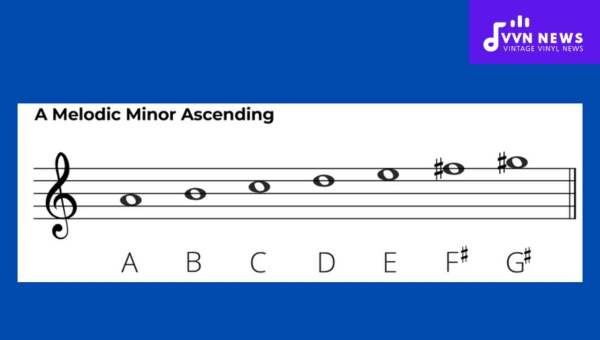
What are the ascending scale degrees of A melodic minor?
The ascending scale degrees of A melodic minor consists of seven distinct notes, starting from the root, or the tonic, progressing upwards to the leading note:

- 1st degree – Root (Tonic) – A: This degree serves as the foundation, it’s where our musical journey begins.
- 2nd degree – Supertonic – B: The supertonic is one step above the tonic. In this case, B is our supertonic.
- 3rd degree – Mediant – C: Aptly named—the mediant (C in our scenario) sits like a bridge between the root and the dominant.
- 4th degree – Subdominant – D: The name might hint that it’s below dominant. Yet, in reality, it’s just the midway point to our dominant.
- 5th degree – Dominant – E: Here we reach E—the most crucial stage after our root as it holds immense gravitational pull towards the tonic.
- 6th degree – Submediant – F#: It follows naturally after E and is often considered reminiscent due to its perfect fifth below the tonic.
- 7th Degree – Leading note (or subtonic) – G#: Lastly comes G#, a highly tensioned note because of its potent urge to resolve back to our home pitch.
Notice how every note seamlessly leads you from one point to another. Each succeeding level prepares you for what’s coming next.
These ascending steps are like buoys guiding your musical vessel through an intricate labyrinth of mesmerizing melodies swirled within A melodic minor scale.
What degrees comprise the descending A melodic minor?
In its pristine form, the A melodic minor scale descends differently from the way it ascends. Experts and learners find this attribute intriguing and fantastically unique.
On its downhill journey, the scale shifts gears, returning to the natural minor form, thus presenting an engaging challenge for musicians. Let’s delve into the degrees that mark this fascinating descent:
1st degree – Root/Tonic – A: Initiating point, it anchors your melody giving a sense of completion when returned. This is ‘homebase’.
7th degree – Leading note– G: This forms a compelling pull towards home (A) again.
6th degree – Submediant – F: Notably less tense, it adds depth with its darker color.
5th degree – Dominant – E: Pivot of harmonic motion, crucial for achieving balance in your melody.
4th degree – Subdominant – D: Its more neutral chordal quality allows for greater melodic flexibility.
3rd degree – Mediant – C: Adds a touch of complexity to your melody with its dark-sounding nature.
2nd degree – Supertonic– B: Fuels anticipation and tension as we progress closer toward resolution (home).
And then finally, we return to the 1st degree – Root/Tonic – A, which brings a sense of resolution after our musically rewarding journey down the scale.
By tapping into these degrees while descending, you can play out contrasting elements in your music composition—the upbeat rhythm against somberness or adding tension before sublime relief—all orchestrated through your unique interpretation of the sequence that is exclusively part and parcel of the enchanting A Melodic Minor Scale.
How to Play the Melodic Minor Scale on Different Instruments?
Executing the A melodic minor scale on musical instruments involves mastering its specific pattern of Whole and Half steps.

Here’s how you can play this scale on various instruments:
Guitar
The fretboard may seem intimidating due to its multiplicity of strings, but once you grasp the concept, playing the A melodic minor is smooth sailing. Below are steps to guide you:
- Beginning at the open fifth string (A), play the next note, a whole step higher, at the second fret (B).
- Move a half-step on the same string to C at the third fret.
- Progress a whole step onto an open D string.
- Move up a whole step to play E on the second fret of the fourth string.
- Push another whole step upwards towards F# on the fourth string’s fourth fret.
- Onto an impressive leap: A whole-and-a-half-step rise will land you on A at the seventh fret.
Ensure consistent practice so that your fingers get accustomed to flowing through this pattern.
Piano
For pianists with their black and white keys laid out linearly, follow these steps:
- Start by pressing down an A key.
- Go up in terms of white keys; logically, your next note would be B.
- Jump right over to blue-scale territory by hitting up the next two black keys, covering C# and D accordingly.
- Lastly, round off by linearly progressing through three white keys: E, F#, G#, concluding with another A.
Don’t forget constant repetition is key (no pun intended)!
Violin
Violinists navigate through 8 notes with Half-position shifts as follows:
- Open “A” string begins this melodious voyage.
- The next stop is “B” on A string with a 1st finger placement.
- Jump to 3rd position with a second finger placement for “C#”.
- Fingerings in order are Open-1-2-Open-1-3-4.
Notations and positions may modify according to instruments, but the underlying principle remains the same: mastering the pattern.
Fluency in playing the A melodic minor scale, as with any other scale, directly depends on constant practice. It’s all about familiarizing yourself with your instrument and these patterns.
Define the key signature for A melodic minor.
A key signature in music represents the collection of sharps or flats in a particular piece. When we examine A melodic minor, it’s fundamental to know that its key signature parallels its major counterpart – A Major.
This means, that the A melodic minor shares the same key signature as the A Major, which consists of three sharps – F#, C#, and G#. As you visualize bass clef or treble clef, remember that sharps or flats always anchor at specific lines or spaces.
Explore this intricate domain with curiosity and patience, and enjoy your journey through music’s magical landscape.
Representations of A Melodic Minor in Various Clefs
One crucial aspect of music is that it can be represented visually in different ways, depending on the range and instrument. This applies to the A melodic minor scale as well, which can be illustrated in numerous clefs like Treble, Bass, Alto, and Tenor.

Knowing how to read these visual tools will amplify your musical knowledge and capabilities.
Treble Clef
In the Treble Clef, the A melodic minor scale begins on an A note above Middle C. The ascending sequence is A – B – C – D – E – F# – G#, followed by another A at the top.
To play these notes descending, you will start from the high A, and then follow this series: G Natural – F Natural – E – D – C- B –A.
Bass Clef
Moving on to the Bass Clef, our scale begins on an A note that is beneath Middle C. Similar to our pattern in Treble clef, our ascending order is as follows: A – B – C – D – E – F# –G#.
Correspondingly, while playing it descending you should follow this line-up: G Natural – F Natural–E-D-C-B-A.
Alto Clef
Alto clef continues our adventure with slightly different placement for notes. It starts with an A situated beneath Middle C.
Moving up meticulously from there we have; B –C–D–E–F#–G#. Romance with this scale going down will involve G natural-F natural-E-D-C-B-A.
Tenor Clef
For Tenor clef, begin at a flat situated below Middle C for your ascension journey: Arriving at these points along your way; B –C–D–E –F# –G#.
Vertical descent through this scale will treat you with the following melody: G natural-F natural-E-D-C-B-A.
In each of these musical staffs, and for both ascending and descending scales, your journey will always start and end on an A note.
When written out, each note stands on its line or space, offering the player a clear roadmap of the fingerings or keys needed to recreate the crisp and sharp tones of the A melodic minor scale.
What are the chords in the A melodic minor scale?
Mastering the chords within the A melodic minor scale is a crucial part of delving into its melodious tendencies. This scale typically includes:
- A minor/major: A – C – E – G#
- B minor 7 flat 5: B – D – F – A
- C Augmented Major 7th: C – E#(F) – G# – B
- D7: D – F# – A – C
- E7: E – G# (Ab)– B – D
- F# minor 7th: F# – A– C# – E
- G# diminished 7th: G#, B, D, F#
These chord variations can open up an array of sonic possibilities for any musician, revolutionizing your playing style by enhancing your dexterity across various notes and modes inherent to this enchanting scale.
Jazz Adaptation of the A Melodic Minor Scale
The A melodic minor scale finds a special place in the realm of jazz music. Known for its vibrant tones and dynamic structure, jazz music has extensively adapted to this scale.

The melodic minor scale ascends with the raised 6th and 7th degrees, but descends exactly like a natural minor, making it highly versatile in jazz improvisation.
Let’s interpret its structure:
- A Melodic Minor Ascending: A – B – C – D – E – F# – G#
- A Melodic Minor Descending: G natural – F natural – E – D – C – B – A
The intriguing aspect of its usage in jazz is that the same notes are employed while ascending and descending.
This provides players with a sophisticated array of sounds achieved through variations in intervals between notes.
This distinct characteristic enriches jazz music with unprecedented creativity and adds to its vibrant melodies. For example, it’s often used over minor chords that have major 7ths (m/M7).
With an air of drama, intensity, mystery, and an enticing finish; the application of A melodic minor scale creates a bewitching sonic experience that captivates listeners. Thus adding an extra layer of intricacy to the captivating world of jazz music.
Also Read: How To Transpose Treble To Bass Clef [Music Guide]
FAQs
What is the A melodic minor scale?
A melodic minor scale is a type of minor scale with distinct ascending and descending sequences. It’s unique in its composition as it contains usual major scale notes when ascended and natural minor notes when descended.
Why is it called a ’melodic’ minor scale?
It’s been named ‘melodic’ because its structure changes whether you’re ascending or descending, which lends smoothness to melodies compared to other scales.
How does the A melodic minor scale differ from the basic natural minor scale?
In an ascending A melodic minor scale, the sixth and seventh notes are raised by a half-step compared to a natural minor, while the descending sequence reflects the natural minor.
Why do musicians study the A melodic minor?
The A Melodic Minor provides a different tonal flavor that can add variety and depth to compositions, improvisations, and solos.
Is understanding the A melodiс Minor Scale important for all musicians or specific instruments only?
No matter what instrument you play, understanding scales like the A melodiс Minor is pivotal. It contributes to sight-reading abilities, and improvisation skills, and deepens overall music understanding.
Also Read: E Major Triad [Master This Staple Of Music Composition]
Conclusion
The A melodic minor scale is not only a cornerstone of music theory, but it also reveals fascinating nuance and depth once we immerse ourselves in its charm.
With its unique structure and beautiful harmony, it’s a powerful tool in any musician’s toolkit. It creates an enthralling soundscape full of emotional depth, making it useful across different musical contexts.
Once you grasp this scale – its intervals, ascending and descending degrees, and associated chords among other things – you can beautify your musical compositions and understanding which will reward both you as a musician and your listeners.