
In the realm of musical harmony, there lies an emotive powerhouse seldom appreciated for its versatile charm – the A minor triad.
Musicians and listeners alike commonly relegate it as a chord, a mere component clumped together among others to form music.
Yet, in reality, this seemingly simple combination of notes, to me, is so much more than that. It’s an entire universe on its teeming with vibrancy and meaningful expression.
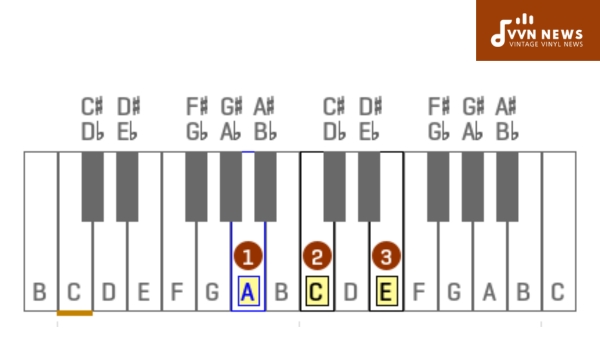
The A minor triad comprises three notes: the fundamental or root note ‘A,’ the minor third ‘C’, followed by the fifth ‘E.’
However, it’s not just the structure that makes it special; it’s the magical potency these three species unleash when interplayed.
This lyrical triad has wove its way into countless compositions spanning genres and ages, bringing with them a kaleidoscope of evocative sensations.
Each usage echoes stories that are at once sorrowful and tranquil, mysterious yet relatable.
Table of Contents
Explain the composition of A Minor Triad
A minor triad is a three-note chord that consists of the root note (A), a minor third interval, and a perfect fifth interval.
These three notes combine to create a distinct minor sound that produces a melancholic or somber mood.
In terms of musical intervals, the minor third is made up of three half steps (or frets on a guitar), while the perfect fifth consists of seven half steps. In the case of an A Minor Triad, the chord would include the notes A, C, and E.
When played together, these three notes create a harmonious relationship where they support and complement each other.
The root note (A) establishes the tonal center and gives the chord its name, while the minor third (C) adds emotional tension and contributes to its minor quality. Finally, the perfect fifth (E) adds stability and richness to the overall sound.
Understanding how these components come together allows musicians to construct and use A Minor Triads in their compositions effectively.
What are the main features of A Minor Triads?

The A Minor Triad is a chord that consists of three notes played together: A, C, and E. It is categorized as a minor chord due to the presence of a minor third interval between the root note (A) and the middle note (C). Here are some key features of the A Minor Triad:
- Structure: The A Minor Triad follows a specific pattern of intervals – a minor third followed by a major third. This pattern creates a distinct sound that can be described as somber, melancholic, or introspective.
- Emotional Character: The minor tonality of the A Minor Triad evokes feelings of sadness, longing, or mystery. It often contributes to creating a sense of tension and depth in musical compositions.
- Versatility: Despite its melancholic character, the A Minor Triad can be found in various musical genres ranging from classical to rock and pop. Its versatility lies in its ability to convey different emotions within a given context.
- Role in Harmonic Progressions: As a chord built on the first degree of the A minor scale, the A Minor Triad holds significant importance in harmony. It serves as both a tonic and subdominant chord within progressions and can create beautiful harmonic movements when combined with other chords.
- Easy Transposition: The A Minor Triad can easily be transposed to different keys by maintaining its structure and shifting all three notes accordingly.
The main features of an A Minor Triad will give you valuable insights into its unique sound and role within musical compositions, enriching your overall knowledge and appreciation for music theory.
Also Read: B Minor Pentatonic Scale [Inject Your Music With Dramatic Flair]
What are the triads from the A Minor scale?
The A Minor scale is fundamental in music theory and serves as the foundation for numerous musical compositions across various genres.
The triads that can be derived from the A Minor scale is essential for any aspiring musician or enthusiast looking to delve into the intricacies of chord progressions and harmonies.
Let’s explore in detail the triads that can be formed from the A Minor scale, their composition, and how they contribute to the overall tonality of a piece of music.
- A Minor (Am) Triad: The A Minor triad consists of three notes – A, C, and E. It is created by stacking two minor thirds on top of each other. The A Minor triad is known for its melancholic and introspective quality and often evokes feelings of sadness or yearning in a musical composition.
- B Diminished (Bdim) Triad: The B Diminished triad comprises three notes – B, D, and F. It is formed by stacking two minor thirds on top of each other. The B Diminished triad has a distinct tense and unstable sound due to its diminished nature, making it ideal for creating tension or suspenseful moments in a piece.
- C Major (C) Triad: The C Major triad consists of three notes – C, E, and G. It is formed by stacking a major third followed by a minor third on top of each other. The C Major triad has a bright and uplifting quality and is commonly used to convey happiness, joy, or optimism in music.
- D Minor (Dm) Triad: The D Minor triad comprises three notes – D, F, and A. Like the A Minor triad, it is formed by stacking two minor thirds on top of each other. The D Minor triad shares similar characteristics with the A Minor triad but possesses its unique flavor, adding depth and emotional resonance to a musical composition.
- E Minor (Em) Triad: The E Minor triad consists of three notes – E, G, and B. It is formed by stacking two minor thirds on top of each other. Like the A Minor triad, the E Minor triad carries a sense of melancholy but has a slightly brighter and warmer tone due to its different root notes.
- F Major (F) Triad: The F Major triad comprises three notes – F, A, and C. It is formed by stacking a major third followed by a minor third on top of each other. The F Major triad has a bold and resolute sound, often used to bring stability or resolution to a musical piece.
- G Major (G) Triad: The G Major triad consists of three notes – G, B, and D. Like the C Major triad, it is formed by stacking a major third followed by a minor third on top of each other. The G Major triad has a bright and uplifting quality, making it ideal for creating positive or energetic musical passages.
The composition and characteristics of these triads opens up endless possibilities in music composition and improvisation.
Whether you are playing an instrument or composing songs, experimenting with different combinations of these chords can help create varying moods and atmospheres in your music.
Also Read: B Flat Minor Pentatonic Scale [Create Emotive Music In Minutes]
How to Perform an A Minor Chord on Various Musical Instruments?
Learning how to perform an A Minor chord on different musical instruments is a fundamental skill for any aspiring musician.
Here’s a step-by-step guide on how to play an A Minor chord on the guitar, piano, and ukulele.
Guitar:
- Place your index finger on the first fret of the B string (second thinnest string).
- Press down firmly on the fret and make sure not to touch any adjacent strings.
- Keep your other fingers relaxed but ready to play other chords if needed.
- Strum all of the strings together using a downward motion with your strumming hand.
Piano:
- Find the A note on your keyboard, which is located between the two black keys in the group of three black keys.
- Place your thumb (or index finger) on this A note.
- Skip one key and place your middle finger on the white key next to it.
- Skip another key and place your ring finger on the next white key.
- Play these three keys simultaneously by pressing down firmly with all three fingers.
Ukulele:
- Position your index finger across all four strings at the second fret.
- Make sure that you are pressing down just behind the metal bar without touching any adjacent strings or muting them.
- Keep your other fingers relaxed, ready to form other chords if necessary.
- Strum all four strings together using either your thumb or index finger.
It’s crucial to practice these chord shapes regularly, paying attention to proper hand placement and posture while playing each instrument.
As you become more familiar with these basic chord shapes, you can explore various strumming patterns and progressions that incorporate the A Minor chord.
Inversions of A Minor Triad

In music theory, an inversion refers to rearranging the order of a chord’s notes. When it comes to the A Minor Triad, three different inversions can be created: root position, first inversion, and second inversion.
1. Root Position
The root position of the A Minor Triad is when the root note (A) is in the bass or lowest voice. The other two notes in this triad are the minor third (C) and the perfect fifth (E). This arrangement is denoted as A-C-E.
2. First Inversion
To create the first inversion of the A Minor Triad, you take the second note of the root position (C) and move it up one octave.
This means that C becomes the highest note in the chord, while A remains in the middle, and E shifts down to become the bass note. The first inversion of A Minor Triad is represented as C-E-A.
3. Second Inversion
The second inversion involves taking the third note from the root position (E) and moving it up one octave.
Now, E becomes the highest voice in the chord, while C takes its place as a middle voice, and A shifts down to become the bass note. The second inversion of A Minor Triad is notated as E-A-C.
These three inversions of an A Minor Triad, you can create interesting chord progressions and add depth to your musical compositions.
Also Read: A Flat Minor Pentatonic Scale [Unleash Subtle Tension In Your Music]
How to Play A Minor Triad Inversions on Guitar and Piano
Inversions are an essential aspect of music theory, allowing musicians to explore different voicings and arrangements of chords.
When playing the A minor triad inversions on the guitar and piano, it is important to know the finger placements and hand positions for each inversion.
In this guide, I will walk you through the steps for playing these inversions on both instruments.
A Minor Triad Inversions on Guitar
To play the A minor triad inversions on the guitar, you need to know the basic open position A minor chord shape
Root Position:
- Place your index finger on the first fret of the B string.
- The middle finger goes on the second fret of the D string.
- Place your ring finger on the second fret of the G string.
First Inversion:
- Barre your index finger across all strings at the 5th fret.
- Place your middle finger on the 7th fret of the D string.
- Let your ring finger rest on the 7th fret of the G string.
Second Inversion:
- Barre your index finger across all strings at the 12th fret.
- Use your ring and pinky fingers to press down on strings B, G, and D at positions 14 and 15.
A Minor Triad Inversions on Piano
Playing A minor triad inversion on piano provides a different set of challenges but offers more possibilities due to its wider range.
Root Position:
- Place your right hand in a relaxed position with the thumb (1) resting over middle C.
- Middle finger (3) goes over E.
- Use your pinky (5) to cover A in a spanned position.
First Inversion:
- Position your right-hand thumb (1) over C.
- Middle finger (3) rests on A.
- Extend your pinky (5) to E.
Second Inversion:
- Place your right-hand thumb (1) on E.
- Middle finger (3) goes over C.
- Pinky (5) should rest on A, forming the top note of the inversion.
Songs Comprising of A Minor Triad

The A Minor Triad is a versatile and widely used chord in many songs across various genres. It adds a unique melancholic and emotional quality to music, making it a favorite among composers and songwriters.
Here are some notable songs that prominently feature the A Minor Triad:
Pop/Rock Genre:
- “Someone Like You” by Adele: This soulful ballad showcases the power of the A Minor Triad as it forms the basis of the chord progression throughout the song.
- “Hallelujah” by Leonard Cohen: This iconic song utilizes the A Minor Triad in several sections, creating an emotional atmosphere that resonates with listeners.
- “Creep” by Radiohead: The haunting chords in this alternative rock anthem prominently include the A Minor Triad, contributing to its brooding and introspective nature.
Classical Genre:
- “Für Elise” by Ludwig van Beethoven: This timeless classical composition contains sections where the A Minor Triad is introduced, adding depth and complexity to its melodic structure.
- “Prelude in A Minor” by Frédéric Chopin: In this piano piece, Chopin masterfully employs various inversions of the A Minor Triad to evoke a sense of melancholy and longing.
Jazz Genre:
- “Autumn Leaves”: This jazz standard incorporates the A Minor Triad within its chord progressions, contributing to its soulful and introspective character.
- “All Blues” by Miles Davis: In this renowned jazz composition, Davis seamlessly incorporates variations of the A minor triads into his improvisations.
It’s worth noting that while these songs prominently use the A Minor Triad, they may also incorporate other chords and progressions to create harmonic complexity.
The versatility of this chord allows it to seamlessly blend within different musical contexts.
Also Read: G Minor Pentatonic Scale [Create Engaging Solos & Improvisations]
FAQs about the A Minor Triad
What notes make up an A Minor Triad?
A Minor Triad consists of three notes: A, C, and E. These notes are formed by taking the root note (A) and adding a minor third (C) and a perfect fifth (E) above it.
What are the main characteristics of an A Minor Triad?
A Minor Triad has a melancholic and somewhat mysterious sound due to its minor third interval. It is often associated with emotions such as sadness, introspection, and longing.
Which triads can be formed from the A Minor scale?
In the key of A Minor, the triads that can be formed are Am (A C E), Bdim (B D F), C Maj (C E G), Dm (D F A), Em (E G B), F Maj (F A C), G Maj (G B D). Each triad has its unique sound and function within a musical composition.
How can I play an A Minor Triad on different instruments?
To play an A Minor Triad on guitar, place your index finger on the first fret of the B string, your middle finger on the second fret of the D string, and your ring finger on the second fret of the G string. On the piano, simply press down on the keys corresponding to A, C, and E simultaneously.
What are the inversions of an A Minor Triad?
Inversions are alternate ways to arrange the notes of a chord. For example, in the first inversion, E is placed as the lowest note instead of A. In the second inversion, C becomes the lowest note while E is in between C and A. These inversions give different textures and voicings to a chord progression or melody.
Conclusion
The A Minor Triad is a fundamental chord that holds immense power in shaping the emotional landscape of music.
Its moody and melancholic nature creates a captivating ambiance in various genres and compositions.
Its composition and features, as well as exploring different permutations and inversions on various instruments, opens up a world of possibilities for musicians and songwriters alike.
Whether strumming it on a guitar or playing it on a piano, the A Minor Triad adds depth and complexity to any musical piece.
So go ahead, unlock the potential of this chord, and let your creativity soar.