
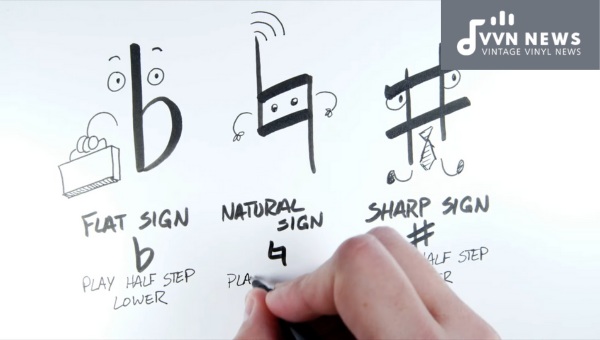
As a musician or music enthusiast, you’ve probably encountered symbols on sheet music that don’t represent the standard notes on the scale.
These symbols are called “accidentals in music,” and they play a vital role in expressing the full range of musical emotion and complexity.
Understanding accidentals is essential for anyone looking to read, write, or perform music with accuracy and expressiveness.
So, what exactly are these accidentals, and how do they affect the notes we play and hear? Accidentals are like the secret spices in a chef’s recipe. They can subtly or dramatically alter the flavor of a piece.
I’ll guide you through their significance and show you how they can change the tonality of a composition.
Whether you’re just starting out with your musical journey or seeking to refine your knowledge, you’ll find that grasping the concept of accidentals is key to unlocking a deeper understanding of music theory.
Table of Contents
What Are Accidentals in Music and the Key Types?
Imagine you’re reading a piece of music. You’re gliding along the staves when suddenly you spot symbols that seem to be giving you special instructions – these symbols are accidentals.
Accidentals are notational elements used to modify the pitch of a note. The alteration can raise, lower, or return it to its original state.
The key types of accidentals you’ll encounter are:
- Sharps (♯): A sharp raises a note by a half step. For instance, if you play an F♯, you’re playing a pitch that’s halfway between F and G.
- Flats (♭): Opposite to sharps, flats lower a note by a half step. B♭ would mean you play a sound that falls between A and B.
- Naturals (♮): A natural sign is your reset button. It cancels out any previous sharps or flats on that note within the same measure.
In addition to these primary signs, there are also:
- Double Sharps (????): These raise a note by two half steps or one whole step.
- Double Flats (????): They lower a note by two half steps or one whole step.
These accidentals ensure every piece of music has its unique color and mood.
They help musicians interpret works as intended by the composer, allowing them to convey the full emotional spectrum through their performance.
Also Read: A Flat Minor Pentatonic Scale [Unleash Subtle Tension In Your Music]
How Do Sharp and Flat Signs Affect Musical Notes?

Sharp (♯) and flat (♭) signs serve as musical directives, altering a note’s pitch to create nuanced soundscapes.
When you encounter a sharp sign, it signifies that a half-step should increase the given note.
In pianistic terms, if you’re instructed to play C♯, you’d press the black key immediately to the right of middle C.
Conversely, when a flat sign appears before a note, it instructs you to decrease the pitch by a half-step.
Applying this to the keyboard, playing B♭ involves striking the black key just to the left of B.
Let’s illustrate their impact on notes:
- Without Accidentals: C ➔ D (Whole Step)
- With Sharp: C ➔ C♯ (Half Step)
- With Flat: D ➔ D♭ (Half Step)
Notably, these modifications are not absolute. They depend on their contextual relationship with other notes.
Also, since music is cyclic with regards to pitches with A following G and then restarting from A, sharps, and flats can lead to enharmonic equivalents, such as C♯ being sonically identical to D♭.
Understanding how these signs affect musical notes is vital for any musician; they are like critical coordinates guiding through the melodic map of any composition.
What is the Function of Natural Signs in Music Notation?
The role of the natural sign (♮) in music notation is quite significant; think of it as a reset button.
When you see this symbol, it instructs you to disregard any previous sharps (♯) or flats (♭) applied to that note within the measure.
Essentially, a natural returns the altered pitch back to its original, unmodified state.
For better comprehension, let’s break down its function:
- Cancels Sharps/Flats: If a note has been altered accidentally earlier in the measure, a natural sign will ensure it’s played in its pure form from that point forward.
- Prevents Confusion: It provides clarity. Without naturals, musicians might be left uncertain about whether to play the modified or unmodified pitch.
- Retention of Modification: It’s worth noting that a natural effect only lasts for the measure it’s placed in. As soon as you cross into a new measure, accidentals must be re-stated if they continue.
Natural signs maintain the structural integrity and intended harmonics of the musical piece. They bring us back home to our musical foundation after flirting with change.
Also Read: B Flat Minor Pentatonic Scale [Create Emotive Music In Minutes]
What Are Double Sharps and Flats, and How Do They Work?

Encountering double sharps (????) and double flats (????) in sheet music can be daunting at first.
These symbols are the equivalent of telling a note to “step it up” or “take it down” by two notches instead of one.
Double Sharps:
A double sharp instructs you to raise the pitch of a note by a whole step. It’s like hitting the fast-forward button.
You bypass the immediate half-step neighbor and land on the next. For instance, if you see an F with a ???? beside it, don’t stop at F♯; push through to G.
Double Flats:
Conversely, a double flat tells you to lower the pitch by an entire step. Think of it as a full retreat. Where G???? is marked, you won’t just move back to G♭ – go further to F.
To use these accidentals:
- Identify the base note.
- Reference your key signature to check for pre-existing accidentals.
- Apply the double accidental accordingly.
Remember that double accidentals have their terms within specific keys or chromatic passages; they might seem excessive but are vital for maintaining consistency in notation.
Their presence keeps musical lines logically tied to their underlying scales, allowing for seamless translation from score to sound.
Also Read: B Minor Pentatonic Scale [Inject Your Music With Dramatic Flair]
How Are Key Signatures and Accidentals Related?
Key signatures and accidentals are intrinsically linked elements in the realm of music notation.
Think of a key signature as the home base. It sets the tonal foundation of a piece by indicating which notes are consistently sharp or flat throughout.
If a piece is in G major, its key signature will feature an F♯. These fixed alterations don’t need to be written as accidentals each time they appear; they’re implied by the key signature at the beginning of each staff.
Accidentals, on the other hand, can be seen as visitors who make temporary changes within a composition.
If a note within a measure requires a pitch alteration not indicated by the key signature, an accidental comes into play.
You might encounter an A♭ in our given G major piece; it’s accidental since A is naturally occurring without alterations according to the key signature.
While key signatures provide an overarching structure, accidentals offer moment-to-moment variation.
Their relationship allows for complex musical expression and serves as a reminder that while some rules are set in stone, there’s always room for immediate creativity.
What is the Structure of Accidentals in Key Signatures?

Key signatures are like roadmaps that dictate the presence of accidentals throughout a piece of music.
At the beginning of a staff, right after the clef symbol, you’ll find a cluster of sharps or flats.
These set the tonal foundation by indicating which notes are to be consistently altered from their natural state whenever they appear in the music.
Sharps and flats in key signatures follow a specific order. Sharps are added in the sequence of F-C-G-D-A-E-B, known as the Circle of Fifths.
Similarly, flats adhere to B-E-A-D-G-C-F, which is basically the Circle of Fifths backward.
Key signatures can have up to seven sharps or seven flats, and no key signature will mix both sharps and flats. It’s one or the other.
The arrangement represents keys: more sharps lean towards a brighter tonality, while more flats tend to suggest a softer, richer quality.
Also Read: C Sharp Major Pentatonic Scale [Crisp & Clear Tones For Your Music]
How Do Accidentals Impact Measures and Tied Notes in Music?
When you delve into the notational universe of music, you’ll notice that accidentals have a specific sphere of influence.
Let’s illuminate how these symbols impact measures and tied notes, ensuring you wield their power effectively in crafting musical narratives.
Influence on Measures
When an accidental is placed before a note, it remains in effect for the entire measure where it appears.
It’s tied to a specific line or space within that measure and impacts each occurrence of the note on that line or space, regardless of the octave.
- Example: If you encounter an F♯ early in a measure, every other F within that same measure is also played as F♯ unless otherwise canceled by another accidental.
Effect on Tied Notes
Tied notes connecting two identically pitched notes span beyond just one measure and can link adjoining measures. The magic of accidentals here is simple yet crucial:
- Rule: When a note with an accidental is tied to the same note in the following measure, the accidental continues to affect the tied note without needing to be restarted.
Accidentals are your musical modifiers, shaping sounds with precision across measures and ties.
Harnessing their role elevates both composition and performance, adding nuanced dynamics to every melodic story told.
Also Read: D Major: The Scales And Chords [Broaden Your Musical Vocabulary]
FAQ: Navigating the World of Accidentals in Music
What happens if I see a sharp and a flat for the same note in a measure?
If a sharp and flat cancel each other out within a measure, you should play the natural note unless further accidentals are indicated.
Do accidentals carry over to the next octave?
No, accidentals apply only to the notes in the specific octave where they appear.
Can an accidental be used without any key signature present?
Accidents can be placed in music with or without a key signature to indicate temporary changes in pitch.
What’s the difference between a double sharp and just writing the next note?
A double sharp raises the note by two half steps, which could lead to an enharmonic equivalent (e.g., Fx is enharmonically G), but it’s contextually important for musical analysis.
How do I know when an accidental no longer applies?
An accidental applies to the entire measure where it is written until it is canceled by another accidental or at the start of a new measure.
Conclusion
Accidentals are fundamental to giving music its vibrant character. Sharps and flats act as modifiers that alter the pitch, while naturals reset them.
With these small symbols, composers can weave complex auditory tapestries. Remembering their influence on the pitch will help you better understand and perform the music you love.
Whether you’re practicing scales or diving into a full composition, keep an eye out for these critical notational cues. They’re key to bringing your music to life.