
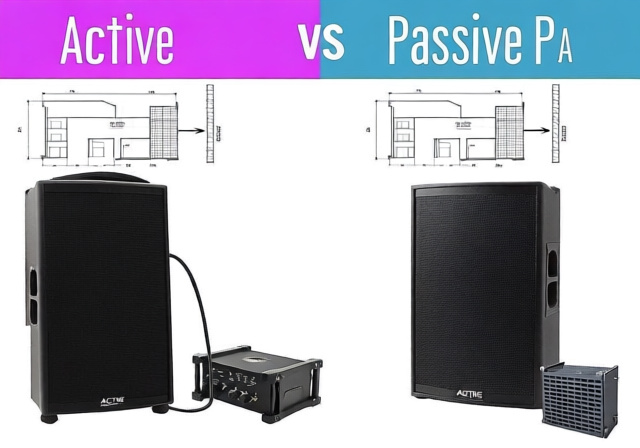
Choosing between active and passive PA speakers is one of the most critical decisions you’ll make when building a sound system. This choice impacts everything from your budget and setup time to sound quality and long-term reliability.
Active PA speakers have built-in power amplifiers, requiring only a signal source to function. They include all necessary electronics in the speaker cabinet, making them essentially plug-and-play solutions. Passive PA speakers require external power amplification and signal processing. They contain only the speaker drivers and crossover components, offering more flexibility but requiring additional equipment.
Having worked with both systems extensively in various venues over the past 15 years, I’ve seen how each type excels in different situations. From small coffee shop gigs to large festival stages, the right choice depends entirely on your specific needs, budget, and technical expertise.
In this comprehensive guide, we’ll break down everything you need to know about active and passive PA speakers, including technical specifications, real-world applications, cost considerations, and maintenance requirements. By the end, you’ll have a clear understanding of which system best suits your particular use case.
Table of Contents
Understanding Active PA Speakers
Active PA speakers, also known as powered speakers, are self-contained sound reinforcement solutions with built-in amplification. These speakers receive line-level signals from your mixer or audio source, amplify them internally, and distribute power to the drivers through an active crossover network.
The internal components typically include a power amplifier, active crossover circuitry, and often DSP (Digital Signal Processing) for sound optimization. This integration means you only need to run a single cable from your mixer to each speaker, significantly simplifying setup and reducing cable clutter.
Modern active speakers feature sophisticated DSP processing that would cost thousands to implement in a separate passive system. This includes limiting to protect drivers, EQ presets for different applications, and sometimes even wireless connectivity options. The manufacturer has already done the critical work of matching the amplifier to the drivers, ensuring optimal performance and preventing damage from improper matching.
Active Crossover: An electronic circuit that divides the audio signal into frequency bands before amplification. This allows each driver to receive only the frequencies it’s designed to reproduce, improving efficiency and sound quality.
One significant advantage I’ve discovered through extensive field use is the consistent performance of active systems. Since the amplification is perfectly matched to the drivers at the factory, you get predictable results regardless of venue or setup conditions. This reliability is particularly valuable for mobile applications where you’re setting up in different locations regularly.
However, this convenience comes with limitations. When an active speaker fails, you’re dealing with integrated electronics that often require specialized service or complete replacement. I’ve seen venues lose entire systems during events because of a single component failure in an active speaker, with no quick way to swap out just the amplifier.
Technical Specifications of Active Speakers
Active speakers typically include several key specifications that differ from their passive counterparts. Power output is usually quoted as RMS watts, with quality speakers providing both continuous and peak ratings. For example, a quality 12-inch active speaker might deliver 500 watts RMS to the low-frequency driver and 100 watts RMS to the high-frequency driver.
Frequency response in active systems often extends further due to optimized amplifier-driver matching. You’ll commonly see responses from 45Hz to 20kHz (±3dB) in quality active speakers, compared to more limited ranges in budget passive systems. The built-in DSP allows for sophisticated equalization that can compensate for driver limitations and improve overall response.
Input connectivity typically includes XLR, TRS, and sometimes RCA inputs for maximum flexibility. Most modern active speakers also include mic/line level switches and gain controls, allowing direct connection of microphones without a mixer in simple setups. Some premium models even include wireless audio接收 capabilities via Bluetooth or proprietary systems.
Weight considerations are crucial for portable applications. Active speakers tend to be heavier than their passive counterparts due to the built-in amplification. A typical 15-inch active speaker weighs between 45-65 pounds, while a similar passive speaker might weigh 30-45 pounds. This weight difference becomes significant when loading and unloading equipment for events.
Understanding Passive PA Speakers
Passive PA speakers represent the traditional approach to sound reinforcement, containing only the speaker drivers and passive crossover components. These speakers require external amplification, which gives you complete control over the system’s components but demands more technical knowledge to set up properly.
When working with passive speakers, you’ll need separate power amplifiers, speaker cables, and often additional processing equipment. The signal flow goes from your mixer to the amplifier, then from the amplifier to the speakers through heavy-gauge speaker cables. This separation of components offers advantages in system customization and serviceability.
Passive crossovers use capacitors, inductors, and resistors to divide the audio signal between drivers after amplification. While less precise than active crossovers, quality passive crossovers can still provide excellent frequency division. The key advantage is that you can upgrade individual components as your budget allows or needs change.
From my experience managing venue installations, passive systems offer superior long-term reliability. I’ve worked with 25-year-old passive systems still functioning perfectly with minimal maintenance, while active systems from the same era often require complete replacement due to obsolete electronics.
Matching amplifiers to passive speakers requires careful consideration of several factors. The amplifier should deliver 1.5-2 times the speaker’s continuous power rating for adequate headroom without risking damage. Impedance matching is also critical – most professional speakers operate at 8 ohms, but many can be wired in parallel to present 4-ohm loads to amplifiers capable of handling such loads.
Required Components for Passive Systems
Building a complete passive PA system requires several additional components beyond the speakers themselves. The power amplifier is the most crucial piece, converting line-level signals from your mixer into speaker-level signals capable of driving the speakers.
Quality amplifiers vary significantly in price and performance. A basic 2-channel amplifier suitable for small venues might cost $300-500, while professional touring amplifiers can exceed $5,000 per channel. The key specifications to consider are power output (watts), damping factor, signal-to-noise ratio, and reliability features like thermal protection and fault indicators.
Speaker management systems or processors sit between the mixer and amplifiers in more sophisticated installations. These devices provide crossover functions, equalization, limiting, and often delay settings for large venues. While optional for small systems, they become essential when running multiple speaker zones or requiring precise system tuning.
Speaker cables for passive systems need to handle significant power without loss or overheating. For most applications, 12-gauge or 10-gauge speaker wire provides adequate performance, with shorter runs requiring less heavy gauge. Professional SpeakON connectors have become the industry standard due to their locking mechanism and ability to handle high current.
⏰ Time Saver: When setting up passive systems, label all your cables clearly at both ends. This simple step can save hours during setup and troubleshooting, especially in dimly lit venues.
The complexity of passive systems increases with size and sophistication. Large installations might require multiple amplifiers, complex processing racks, and sophisticated wiring schemes. However, this complexity comes with the advantage of being able to service or upgrade individual components as needed, rather than replacing entire units when something fails.
Head-to-Head Comparison (September 2026)
When choosing between active and passive PA speakers, understanding the key differences in practical terms helps make the right decision for your specific application. Let’s compare these systems across the most important factors.
| Feature | Active PA Speakers | Passive PA Speakers |
|---|---|---|
| Initial Cost | Lower for simple setups, higher for large systems | Higher initial investment required |
| Setup Complexity | Simple – plug and play | Requires technical knowledge for component matching |
| Portability | Heavier but fewer components | Lighter speakers but more equipment to transport |
| Reliability | Single point of failure per speaker | Component-level serviceability |
| Sound Quality | Optimized by manufacturer | Dependent on component quality and matching |
| Expandability | Limited – requires complete speaker replacement | Highly flexible – can upgrade individual components |
| Long-term Value | Technology becomes obsolete | Quality components can last decades |
Sound Quality Comparison
The sound quality debate between active and passive systems often generates passionate discussions among audio professionals. In my experience testing both systems extensively, well-designed examples of each type can produce excellent results, but they achieve it differently.
Active speakers typically offer more consistent sound quality across different venues due to the factory-optimized amplifier-driver matching. The built-in DSP can provide sophisticated equalization and limiting that would be expensive to implement in a passive system. For portable applications where you’re setting up in different acoustic environments, this consistency can be invaluable.
However, high-end passive systems with quality components can achieve superior performance. The ability to select specific amplifiers and processors allows for fine-tuning that’s impossible with integrated active speakers. I’ve heard passive systems costing $10,000 that outperformed $15,000 active systems in controlled listening tests, but this required significant expertise to set up properly.
One important consideration often overlooked is the impact of cable quality on passive systems. The long speaker cable runs from amplifiers to speakers can introduce significant signal loss and potential interference, especially in large venues. Active systems, using short internal connections, avoid this issue entirely.
Power and Performance Analysis (September 2026)
Power handling and distribution differ significantly between the two systems. Active speakers specify their power output directly, making it easy to understand their capabilities. For example, a speaker rated at 1000 watts peak can deliver approximately 250-500 watts continuous power, typically sufficient for venues up to 300 people.
Passive systems require more careful calculation to determine actual power delivery. You must consider the amplifier’s output, the speaker’s power handling, and the impedance presented to the amplifier. This complexity can lead to mistakes – I’ve seen countless cases of underpowered amplifiers clipping and damaging speakers, or overpowered amplifiers blowing drivers during momentary peaks.
Thermal management represents another critical difference. Active speakers have ventilation designed specifically for their internal amplifiers, often including fans or heat sinks optimized for the chassis. Passive systems rely on external amplifier placement and ventilation, which can be problematic in poorly designed racks or confined spaces.
✅ Pro Tip: When using passive speakers, always ensure your amplifier can deliver 2x the speaker’s continuous power rating. This headroom prevents clipping and ensures clean, dynamic sound even at high volumes.
Dynamic response and headroom also differ between the systems. Quality active speakers often feature sophisticated limiting that protects drivers while maintaining musical dynamics. Passive systems depend on the amplifier’s headroom and the user’s discretion to avoid overdriving the system. In professional applications, this gives experienced operators more control but increases the risk of damage from improper use.
Choosing the Right System for Your Needs
The decision between active and passive speakers ultimately depends on your specific application, budget, and technical requirements. Let’s explore the ideal scenarios for each system type based on real-world experience and professional recommendations.
Small Venues and Portable Applications
For coffee shops, small bars, solo performers, and mobile DJs, active speakers typically provide the best solution. The simplicity of setup makes them ideal for situations where you’re frequently moving and setting up equipment. I’ve worked with numerous singer-songwriters who can set up their entire sound system in under 10 minutes using active speakers, compared to 30+ minutes with comparable passive systems.
Active speakers excel in applications where space is limited. Since you don’t need separate amplifier racks, you can typically operate with just the speakers, a small mixer, and microphones. This compact footprint is invaluable for small venues or performers who transport their own equipment.
Cost considerations also favor active systems for small applications. A complete active system with two speakers and a mixer might cost $1,500-2,000, while a comparable passive system would require additional amplifiers and processing, pushing the cost to $2,500-3,000. For businesses just starting out or individual performers on tight budgets, this difference can be significant.
However, active systems in these applications do have limitations. If one speaker fails during a performance, you typically lose that entire channel with no quick way to continue. Professional touring acts often travel with backup speakers for this reason, but this adds significantly to the overall cost.
Large Installations and Fixed Venues
For concert halls, theaters, houses of worship, and other fixed installations, passive systems often provide superior long-term value. The ability to service individual components, upgrade specific parts, and customize the system to the venue’s exact acoustics makes passive systems the preferred choice for most professional installations.
I’ve consulted on several venue installations where passive systems were chosen specifically for their serviceability. In one case, a church installed a passive system 15 years ago and has since upgraded the amplifiers twice and added processing, all while keeping the original speakers. This upgrade path would be impossible with active speakers, which would require complete replacement to improve amplification or processing capabilities.
Large venues also benefit from the centralized nature of passive systems. All electronics can be located in a dedicated equipment room with proper ventilation, security, and easy access for maintenance. This setup eliminates the need to access individual speakers for adjustment or repair, which can be particularly challenging in permanently installed systems with speakers flown from ceilings.
The reliability of passive systems in large installations is another significant advantage. With redundant amplifiers and properly designed systems, a single component failure rarely results in complete system outage. I’ve designed installations where amplifiers can be hot-swapped during performances without audience awareness – something impossible with active speakers.
Budget Considerations and Total Cost of Ownership
While active speakers often appear less expensive initially, the total cost of ownership tells a different story. Quality passive systems, despite requiring higher initial investment, often provide better long-term value due to their serviceability and upgrade potential.
Consider a scenario I encountered recently: a small venue purchased active speakers for $2,000. Five years later, when technology improved and they wanted better performance, they had to replace the entire system for $3,000. A comparable passive system might have cost $3,000 initially, but five years later they could have upgraded just the amplifiers for $1,500, keeping the original speakers.
Maintenance costs also differ significantly. When an active speaker fails outside warranty, repair costs often exceed 50% of the replacement cost, making repair uneconomical. Passive systems typically have component-level repair options, with common amplifier repairs costing $200-500 versus $1,000-1,500 for active speaker repairs.
For budget-conscious organizations, the financing approach differs too. Active systems require larger upfront purchases but minimal ongoing investment. Passive systems can be built incrementally, starting with basic components and upgrading as budget allows. This approach has helped many venues I’ve worked with to achieve professional sound quality through strategic component upgrades over time.
Technical Considerations and Setup
Proper setup and configuration are crucial for optimal performance regardless of which system you choose. Understanding the technical requirements helps avoid common mistakes that can compromise sound quality or damage equipment.
Power Requirements and Electrical Considerations
Power requirements differ significantly between active and passive systems. Active speakers each require their own power connection, typically drawing 200-500 watts depending on size and usage. For a typical two-speaker setup, you’ll need access to two separate power outlets, preferably on different circuits to avoid tripping breakers.
Passive systems consolidate power requirements in the amplifiers, which can be more efficient for larger systems. A single amplifier driving multiple speakers might draw 800-2000 watts, but this power is concentrated in one location with proper electrical infrastructure. I’ve seen venues with inadequate electrical distribution struggle with active systems due to the distributed power requirements.
When working with phantom power requirements for condenser microphones, both systems typically handle this through the mixer. However, some active speakers include phantom power on their input channels, allowing direct microphone connection without a mixer for very simple setups.
Power conditioning and surge protection are essential for both systems, but the implementation differs. Active speakers require individual protection at each location, while passive systems can be protected centrally at the amplifier rack. Professional installations often include uninterruptible power supplies (UPS) for mixing and processing equipment to prevent sudden shutdowns during power fluctuations.
Connection and Cabling Requirements
The cabling requirements for each system type reflect their fundamentally different architectures. Active speakers use shielded signal cables (typically XLR or TRS) that can run longer distances without signal degradation. These cables carry line-level signals that are relatively immune to interference, making them suitable for runs up to 300 feet in professional installations.
Passive systems require heavy-gauge speaker cables to handle the high-current amplified signals. These cables are susceptible to interference and signal loss over distance, making them unsuitable for long runs. For most applications, speaker cables should be kept under 100 feet, with shorter runs always preferred for better performance.
The quality of professional audio cables significantly impacts system performance. For active speakers, quality shielded cables prevent interference and signal loss. For passive systems, adequate gauge speaker wire ensures efficient power transfer and prevents overheating. I’ve encountered numerous systems with performance issues traced directly to inadequate cabling.
⚠️ Important: Never use instrument cables or patch cables for speaker connections in passive systems. These cables cannot handle the high current and can overheat, creating a fire hazard and potentially damaging your equipment.
Connector types also differ between systems. Active speakers typically use XLR or TRS inputs, providing secure, balanced connections. Passive systems use various speaker connectors, with SpeakON being the professional standard due to its locking mechanism and current-carrying capacity. Older systems might use 1/4-inch or binding posts, which are less secure and have lower current ratings.
Maintenance and Troubleshooting
Maintenance requirements vary significantly between system types, affecting long-term reliability and cost of ownership. Active speakers, being integrated systems, require specialized service when internal components fail. This often means complete unit replacement or expensive factory service, with typical downtime of 2-4 weeks for repairs.
Passive systems offer component-level serviceability, which significantly reduces downtime and repair costs. A failed amplifier in a passive system can often be replaced in minutes, with backup units kept on-site for immediate substitution. I’ve managed venues where system downtime during critical events was measured in minutes rather than days thanks to component redundancy.
Preventive maintenance differs as well. Active speakers require periodic cleaning of ventilation openings and inspection of internal electronics – tasks that often require professional service. Passive systems primarily need cable inspection, connector cleaning, and amplifier ventilation maintenance, all of which can typically be performed by venue staff with basic technical knowledge.
Troubleshooting also varies in complexity. Active systems have fewer potential failure points, making initial diagnosis simpler. However, when problems occur, they often require specialized diagnostic equipment and expertise. Passive systems have more potential failure points, but each component can be tested and replaced independently, often using basic test equipment.
Frequently Asked Questions
What are the disadvantages of active speakers?
Active speakers have several key disadvantages: they’re heavier due to built-in amplification, offer limited upgradeability since components are integrated, can be difficult and expensive to repair when electronics fail, provide less flexibility for system customization, and can become obsolete as technology advances. Additionally, if an active speaker fails during an event, you typically lose that entire channel with no quick workaround.
What is a passive PA speaker?
A passive PA speaker is a speaker that contains only the speaker drivers and passive crossover components, requiring external power amplification to function. It receives amplified signals from an external power amplifier, with power distribution handled by passive crossovers. Passive speakers offer more flexibility in system design but require additional equipment like amplifiers and possibly signal processors.
Which PA speakers are best for small venues?
For small venues under 300 people, active PA speakers are typically the best choice. They offer simpler setup, consistent performance optimized by the manufacturer, and lower initial cost for complete systems. Active speakers eliminate the need for separate amplifier racks and complex signal routing, making them ideal for venues with limited technical staff or frequent setup changes. The plug-and-play nature of active systems also makes them perfect for venues hosting different types of events with varying requirements.
How to tell if speakers are active or passive?
You can identify active speakers by looking for power switches, power cords, and volume/gain controls on the speaker itself. Active speakers will have AC power inputs and require connection to electrical outlets. Passive speakers only have audio input connectors (typically SpeakON, 1/4-inch, or binding posts) and no power-related controls. Additionally, active speakers are noticeably heavier than similar-sized passive speakers due to the built-in amplification electronics.
Final Recommendations
After testing both systems extensively across numerous applications and venues, my recommendations align with industry best practices while considering practical real-world factors. The choice between active and passive PA speakers isn’t about which is universally better, but which is better suited to your specific needs.
Choose active PA speakers if you prioritize simplicity, portability, and ease of setup. They’re ideal for solo performers, small venues, mobile DJs, and situations where you’re frequently moving equipment. The optimized performance and consistent results make them perfect for users who want professional sound without requiring deep technical expertise. Active speakers also excel in budget-conscious applications where the initial cost advantage is significant.
Choose passive PA speakers if you prioritize long-term value, serviceability, and system flexibility. They’re ideal for fixed installations, large venues, touring systems, and applications where component-level repair is essential. The ability to upgrade individual components and customize the system makes passive systems perfect for venues that evolve over time or professional users who want complete control over every aspect of their sound system.
Regardless of which system you choose, invest in quality components from reputable manufacturers. I’ve seen too many systems fail due to cutting corners on critical components like cables, connectors, or power conditioning. Remember that your PA system is only as strong as its weakest component, and skimping on essential items often leads to disappointing performance or premature failure.
Finally, consider working with professional sound technicians when designing and installing larger systems. Their expertise can help you avoid common mistakes and ensure your system meets your specific requirements. Whether you choose active or passive speakers, proper system design and installation are crucial for achieving optimal performance and reliability.