
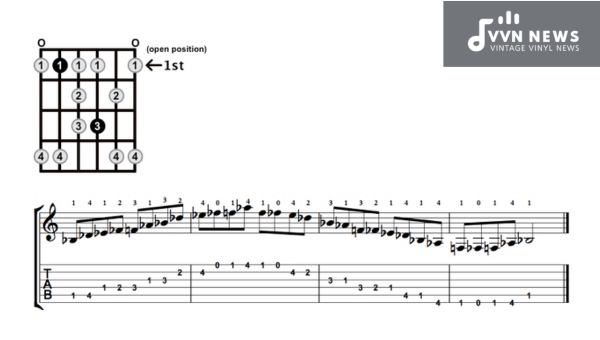
The soulful strains of the B flat minor blues scale have long been a staple for musicians seeking to express emotion through their instruments.
In its simplicity lies a profound depth, capable of conveying the blues’ classic melancholy or fiery passion, depending on how you wield its notes.
It’s a palette that colors your music with rich hues of sonic blues, allowing for deeply expressive playing that resonates with listeners.
As we unravel the nuances of this time-honored scale together, you’ll discover how it can transform your musical expression and breathe new life into your performances.
Table of Contents
Explain the B Flat Minor Blues Scale
The B flat minor blues scale is an evocative and deeply expressive tool used by musicians, particularly in genres like blues, jazz, and rock.
It’s constructed from a pentatonic minor base with an added blue note, which gives it that distinctive ‘bluesy’ sound. The notes in this scale are:
- B♭ (the root)
- D♭ (the minor third)
- E♭ (the fourth)
- A key characteristic of the B flat minor blues scale is the inclusion of the blue note, F♮, situated between the fourth (E♭) and fifth (F) notes. This chromaticism is what provides the tension and color that make blues music so emotionally compelling.
When you’re playing this scale on your instrument, think of it as weaving a story — each note contributes to expressing a feeling or mood.
The B flat minor blues scale allows for versatile interpretations and improvisations because it borders between sweet melancholy and intense passion.
It forms an essential vocabulary for any musician looking to add depth to their musical expression.
How do you construct the B Flat Minor Blues Scale?

To wield the introspective power of the B flat minor blues scale, one must first understand its construction.
This scale is built by adding a chromatic passing note, also known as the blue note, to the B flat natural minor (or Aeolian) scale. Here’s how to dissect it:
- Start with the Natural Minor: Begin by laying down the foundation with the B flat natural minor scale: B♭, C, D♭, E♭, F, G♭, and A♭.
- Identify the Blue Note: To transform this into a blues scale, you’ll inject an additional note – the quintessential blue note. In this case, it’s an E natural (E♮), slid right in between the fourth and fifth scale degrees (E♭ and F).
- Formulate the Blues Scale: With this addition, you get B♮- C – D♭ – E♮ – E♭ – F – G♭.
- Condense to Pentatonics: Remember that at its core, blues scales derive from pentatonic scales; hence they contain five primary notes before adding that crucial sixth blue note.
By understanding these steps and components within each octave on your instrument of choice be it six strings or keys you will quickly grasp and execute this emotive scale to elevate your musical storytelling.
Also Read: A Sharp Minor Pentatonic Scale [Unique Harmonic Possibilities]
What Distinguishes the B Flat Minor Blues Scale from Its Minor Counterpart?
The B flat minor blues scale stands apart from the standard B flat minor scale with its distinctive inclusion of a blue note – the sharpened fourth.
This single, seemingly small alteration, injects a dose of tonal flavor that’s both raw and complex.
While the B flat minor (natural) scale follows a sequence of whole and half steps traditionally (B♭-C-D♭-E♭-F-G♭-A♭), the blues variation intersperses an additional note—the F natural—which is not present in the standard minor framework.
This specific note is what we refer to as the blue note, and it resides in a precarious spot between the perfect fourth (E♭) and the perfect fifth (F), offering more expressive potential within those parameters.
Consider this:
- The natural minor scale provides a systematic approach: W-H-W-W-H-W-W (where W=whole step, H=half step).
- The blues scale disrupts this order, presenting an unconventional pattern: W-H-H(W+H)-H-W-W.
This inclusion creates a hexatonic structure with six notes instead of seven, fundamentally distinguishing it from its pure minor counterpart by its sonic complexity.
On musical reflection, these distinctions grant artists a broader emotional canvas—providing both tension through unexpected intervals and resolution with familiar patterns—a duality essential for blues’ expressive power.
In essence, while both scales share a common root in B flat minor tonality, it’s that extra dimension — that blue note — that sets apart your blues playing to be soulful and resonant with authentic character.
Also Read: B Flat Minor Pentatonic Scale [Create Emotive Music In Minutes]
Why It’s Essential to Develop a Good Ear when learning the B Flat Minor Blues Scale?

When delving into the intricate world of music theory and practice, developing a good ear is paramount, especially when learning scales like the B Flat Minor Blues Scale. Here’s why:
- Enhances Musical Intuition: Your ability to predict chord progressions and complementary notes sharpens. This intuitiveness is particularly helpful for improvisation.
- Improves Accuracy: With a refined ear, you can detect off-pitch notes instantly, ensuring your playing stays faithful to the desired scale and tonality.
- Facilitates Transcription: A well-trained ear enables you to transcribe solos and riffs by ear, an incredibly valuable skill for learning new pieces or writing your own music.
- Enriches Improvisation: Knowing how the scale should sound allows you to comfortably navigate between notes while improvising, making your solos more fluid and engaging.
- Strengthens Communication: In ensemble settings, it’s easier to understand and respond to the musical ideas of others if you have a developed ear.
With each practice session where you attentively listen and adjust your playing based on what you hear, you are not just learning a scale; you’re nurturing an aural skill set that will elevate your overall musicianship.
Which Songs Incorporate the B Flat Minor Blues Scale?
The B flat minor blues scale weaves its magic through numerous songs across various genres.
This scale is beloved for its emotive quality, evoking a sense of raw emotion and depth in music.
Here are some classic examples where you can hear the B flat minor blues scale come to life:
- “The Thrill Is Gone” by B.B. King
A seminal blues number, “The Thrill Is Gone,” showcases the emotive power of the B flat minor blues scale. King’s mastery of guitar licks within this scale conjures a feeling of sorrow and resignation that has made this song a timeless piece. - “While My Guitar Gently Weeps” by The Beatles
George Harrison’s iconic guitar solo uses elements from the B flat minor blues scale to add soulful richness, complementing the poignant lyrical content. - “Comfortably Numb” by Pink Floyd
Although not strictly in B flat minor throughout, David Gilmour’s guitar solos employ fragments from this blues scale, particularly in live versions, to amp up emotional intensity.
Listening to these tracks provides insight into how the B flat minor blues scale can be both subtle and impactful within a musical context.
It underpins riffs and solos that have moved generations of music fans.
When musicians delve into these tunes, they’re tapping into a rich tapestry of emotional storytelling underscored by this versatile scale.
Also Read: C Sharp Major Pentatonic Scale [Crisp & Clear Tones For Your Music]
FAQs on the B Flat Minor Blues Scale
What makes the blues scale different from a regular minor pentatonic scale?
The blues scale adds a blue note (a diminished fifth or augmented fourth) to the regular minor pentatonic, creating its characteristic sound.
Can I play the B flat minor blues scale over any chord progression?
It’s best played over bluesy and minor chord progressions; using it elsewhere requires careful attention to harmony.
Is the B flat minor blues scale only used in blues music?
Not at all; it’s also popular in jazz, rock, and even pop styles for its emotive potential.
How can I practice this scale effectively?
Practice with various backing tracks and focus on feeling each note, not just playing them. Include it in your improvisation and songwriting.
What are some iconic solos that use this scale?
Check out solos by greats like B.B. King and Eric Clapton, as they often employ this scale in their playing.
Conclusion
The B flat minor blues scale stands as a musical beacon; it’s your gateway to expressing heartfelt stories through your instrument.
Remember, integrating this scale into your repertoire is more than memorizing notes—it’s about feeling each tone.
Embrace the journey of learning and feel the blues in every note you play; that’s when you’ll truly connect with your audience and yourself.
Practice diligently, listen intently to blues masters, and most importantly, infuse your individuality into every bend, every run, every chord.