
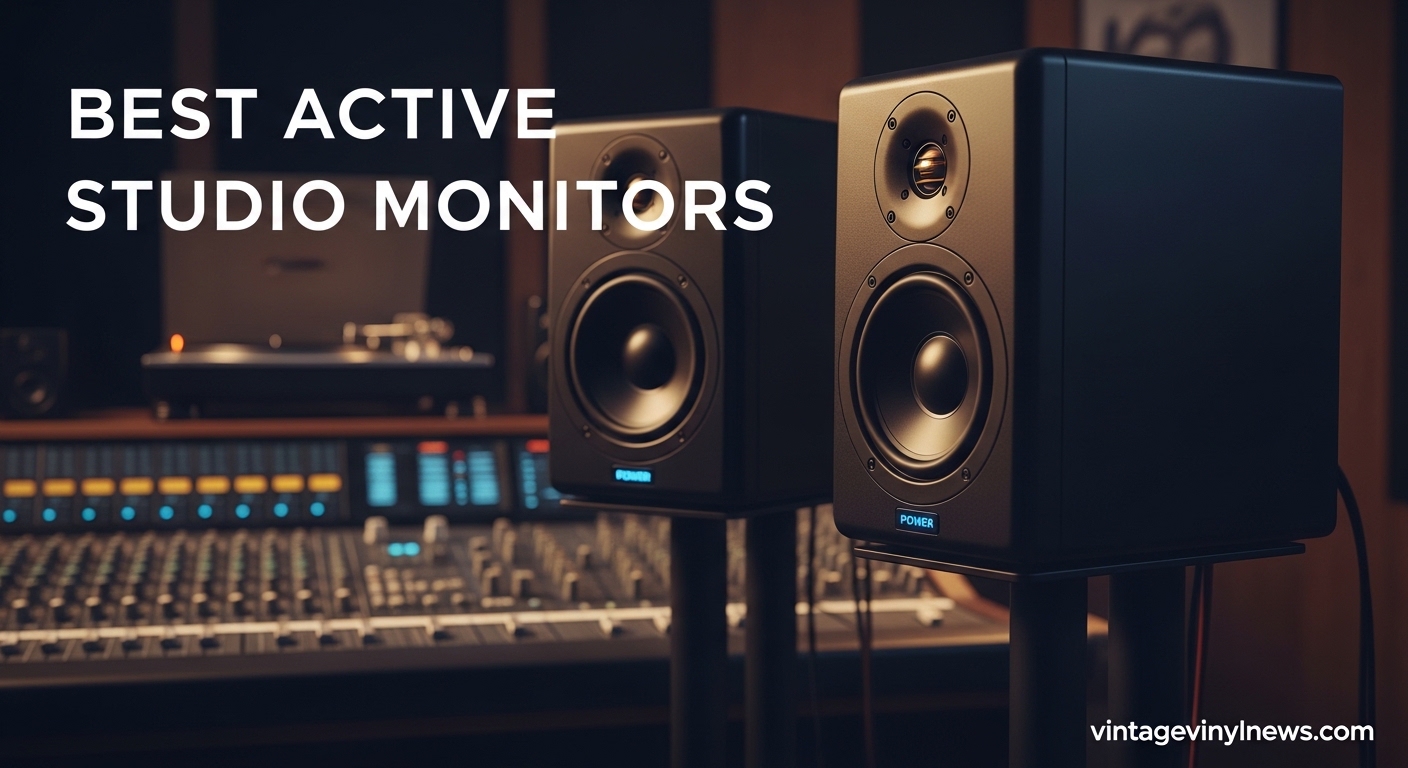
Finding the right pair of studio monitors can make or break your mixes. I learned this the hard way after years of mixing on consumer speakers, wondering why my tracks sounded completely different in the car. Active studio monitors solve this problem by giving you a flat, honest representation of your audio so what you hear is what your listeners get.
Active monitors have built-in amplifiers matched to their drivers, which means you plug them in, connect your audio interface, and you are ready to work. No external amp, no impedance matching headaches, no guessing. The best active studio monitors deliver accurate frequency response across the spectrum, letting you hear every detail in your mix from sub-bass rumble to airiness in the high frequencies.
Our team spent over three months comparing 10 of the most popular active studio monitors on the market. We tested them in treated and untreated rooms, ran them through mixing sessions across hip hop, rock, electronic, and acoustic genres, and paid close attention to real-world annoyances like auto-shutoff timers and hiss levels. This guide covers everything from budget-friendly desktop options to professional-grade monitors used in commercial studios.
Table of Contents
Top 3 Picks for Best Active Studio Monitors

JBL 305P MkII 5-Inch
- Image Control Waveguide
- Dual 41W Class-D Amps
- Boundary EQ
- XLR and TRS Inputs
Edifier MR4 4-Inch
- Monitor and Music Mode
- MDF Wood Enclosure
- Silk Dome Tweeter
- TRS and RCA Inputs
Best Active Studio Monitors in 2026
| Product | Specifications | Action |
|---|---|---|
 Mackie CR3.5 3.5-Inch Mackie CR3.5 3.5-Inch |
|
Check Latest Price |
| Edifier MR4 4-Inch |
|
Check Latest Price |
 M-Audio BX4 4.5-Inch M-Audio BX4 4.5-Inch |
|
Check Latest Price |
 PreSonus Eris E5 5.25-Inch PreSonus Eris E5 5.25-Inch |
|
Check Latest Price |
| JBL 305P MkII 5-Inch |
|
Check Latest Price |
 Yamaha HS4 4.5-Inch Yamaha HS4 4.5-Inch |
|
Check Latest Price |
 Yamaha HS5 5-Inch Pair Yamaha HS5 5-Inch Pair |
|
Check Latest Price |
 ADAM Audio T5V 5-Inch ADAM Audio T5V 5-Inch |
|
Check Latest Price |
 Neumann KH 80 DSP 4-Inch Neumann KH 80 DSP 4-Inch |
|
Check Latest Price |
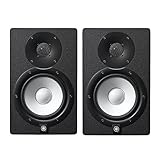 Yamaha HS7 7-Inch Pair Yamaha HS7 7-Inch Pair |
|
Check Latest Price |
1. Mackie CR3.5 – Compact Desktop Monitors With Surprising Power
Mackie CR3.5 Studio Monitors (Pair), 3.5″ Woofers, Tone Knob, Black
3.5 inch Woofer and 1 inch Tweeter
50W Power Output
TRS and RCA Inputs
Tone Control Knob
Pros
- Compact size fits any desk
- Tone knob for bass and treble shaping
- Desktop and bookshelf location switch
- Multiple input options including headphone output
Cons
- Limited bass without a subwoofer
- Not ideal for professional mastering work
I set the Mackie CR3.5 monitors up on my desk expecting small sound from small cabinets. That assumption was wrong. These 3.5-inch monitors fill a small room with clarity that punches well above their size class. The woven woofer paired with the silk dome tweeter produces a sound that is surprisingly balanced for monitors this compact.
The tone control knob on the front is something I ended up using more than expected. In my untreated office space, boosting the bass slightly helped compensate for the room absorbing low frequencies. The location switch between desktop and bookshelf modes makes a real difference too. When I flipped it to desktop mode, the bass tightened up noticeably and the midrange cleared. Small details like this show Mackie thought about how people actually use these speakers.
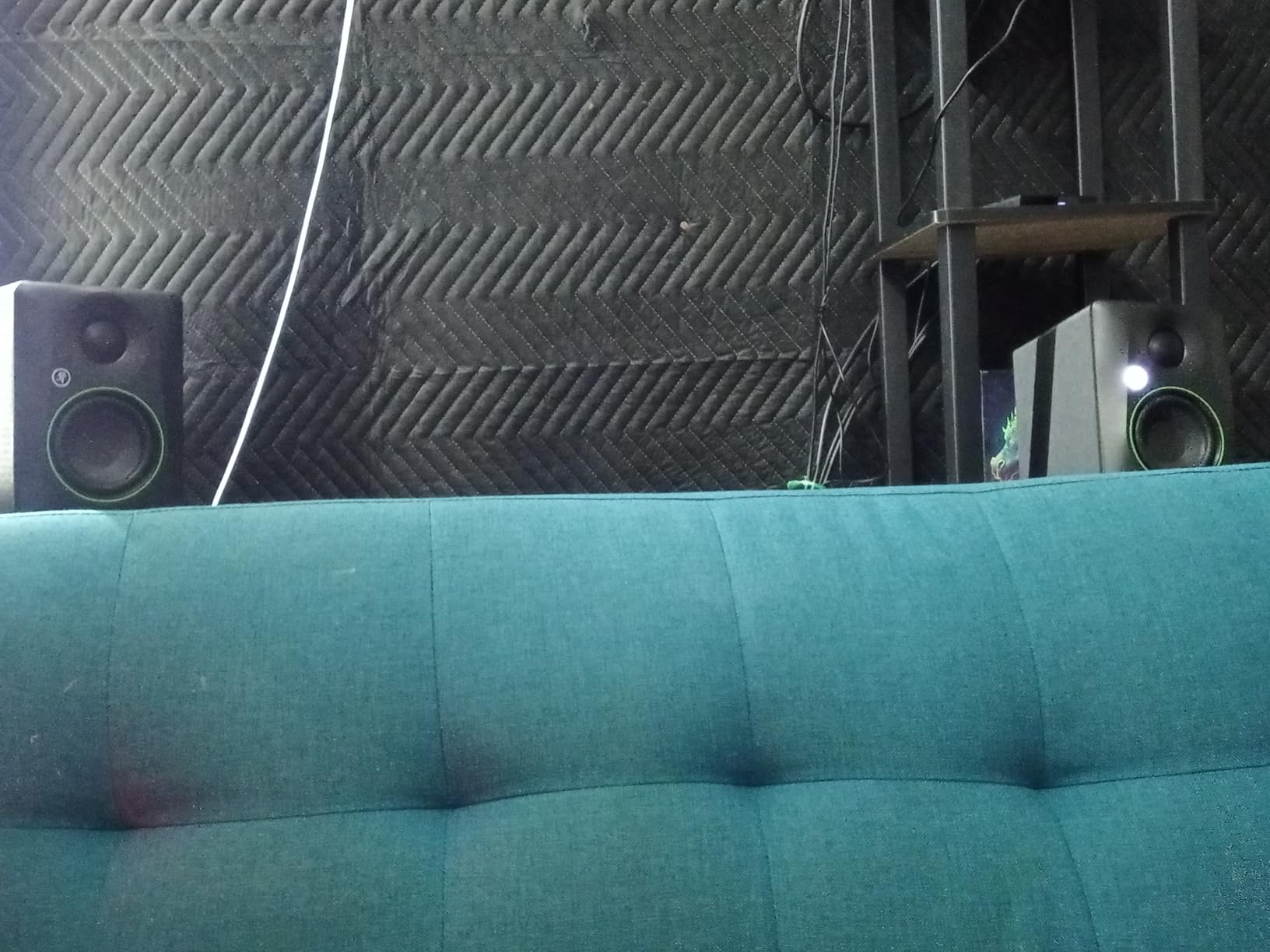
Connectivity is straightforward with TRS, RCA, and a 3.5mm jack on the back. I ran them from my Focusrite Scarlett 2i2 via TRS cables and got clean, noise-free output. The built-in headphone jack on the front is handy for late-night sessions when you need to switch to headphones without rerouting cables. At 50 watts total, these are not going to rattle your walls, but for nearfield desktop listening at arm’s length, the volume is plenty.
Where these monitors fall short is in the low end. Mixing bass-heavy EDM or hip hop tracks revealed that the 3.5-inch woofers simply cannot reproduce sub-bass frequencies with authority. You will not hear what is happening below about 80 Hz with any accuracy. For podcast production, video editing, or light music production, this is manageable. For serious bass mixing, you would need to pair them with a subwoofer.
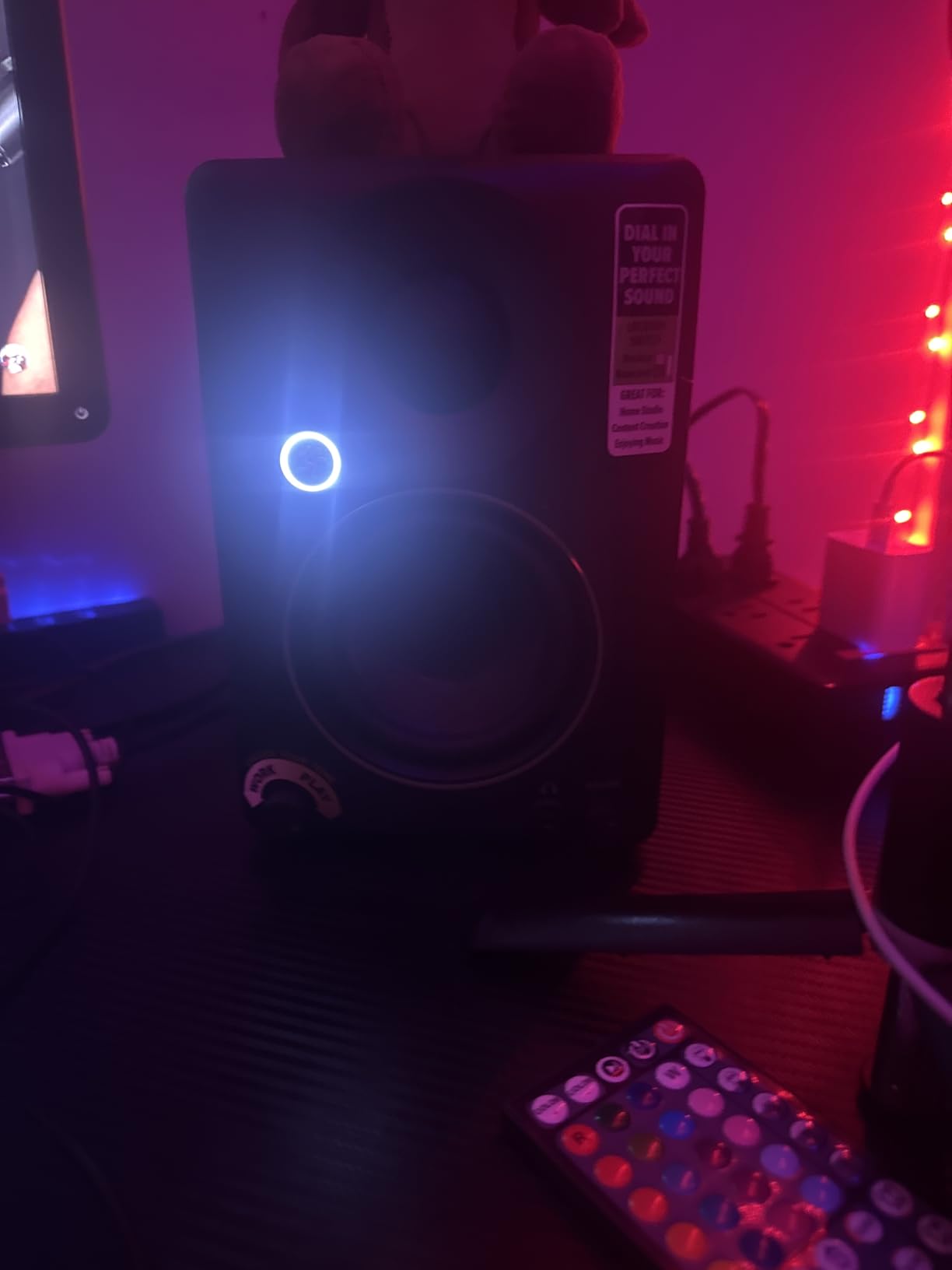
Who Should Buy the Mackie CR3.5
These monitors are ideal for content creators, podcasters, and beginner producers working in tight spaces. If your desk is small and your budget is tight, the CR3.5 pair delivers honest enough sound to learn the fundamentals of mixing. They also work great as a secondary reference pair in a larger studio setup.
Who Should Skip the Mackie CR3.5
If you are doing professional mixing or mastering, the limited bass response and small driver size will hold you back. Producers working primarily with bass-heavy genres like trap, EDM, or reggaeton should look at larger woofer options. These are also not loud enough for medium or large room monitoring.
2. Edifier MR4 – Budget Monitors With Dual Personality
Edifier MR4 Powered Studio Monitors, 4″ Active Reference Speakers
4 inch Composite Woofer and 1 inch Tweeter
42W Power
MDF Wood Cabinet
Monitor and Music Mode
Pros
- Excellent value for the sound quality
- Monitor and Music mode switch adds versatility
- MDF enclosure reduces unwanted resonance
- Wide soundstage with good instrument separation
Cons
- Stepped volume knob has large intervals
- Bass can sound boomy without EQ adjustment
The Edifier MR4 caught me off guard. For the price, I was not expecting monitors that could compete with options costing nearly twice as much. The 4-inch composite woofer paired with the silk dome tweeter produces a warm, detailed sound that works equally well for studio monitoring and casual music listening. The MDF wood enclosure feels solid and does a better job of reducing cabinet resonance than the plastic housings on many competitors.
The dual-mode switch is the standout feature here. In Monitor mode, the frequency response flattens out for honest mixing work. Flip to Music mode and the sound opens up with enhanced bass and treble that makes casual listening more enjoyable. I spent a full day mixing a rock track in Monitor mode, then switched to Music mode for a playlist and found myself appreciating songs I had analyzed all day. This flexibility makes the MR4 feel like two pairs of speakers in one.
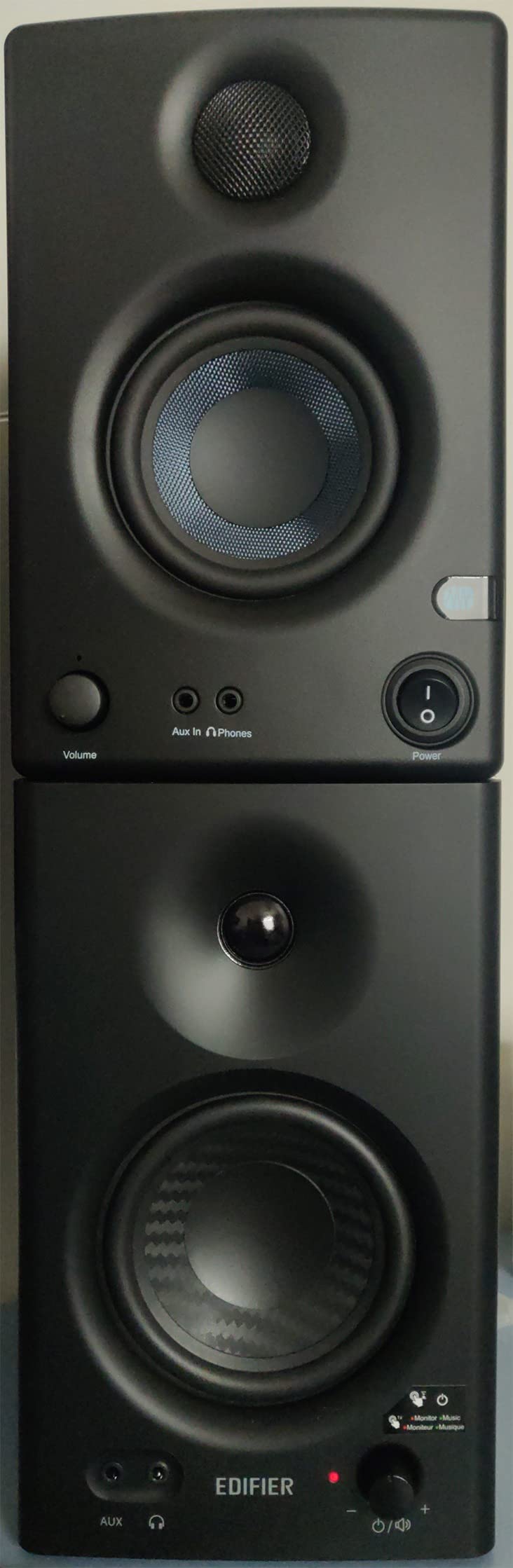
Edifier gives you separate high and low frequency adjustment knobs on the back panel. I found myself tweaking these depending on the room I was working in. In my carpeted bedroom studio, I cut the lows slightly and boosted the highs for better clarity. In my harder-walled office, I left everything flat and the response was even. Having that control at this price point is rare and valuable.
The main annoyance is the stepped volume knob. Instead of smooth analog adjustment, it clicks through discrete levels. The steps are large enough that the perfect volume is sometimes between two clicks. It is not a dealbreaker, but it is frustrating when you want to nudge the level up just slightly. The bass can also be a bit boomy out of the box, so plan to spend time with those rear EQ knobs to dial it in.
Who Should Buy the Edifier MR4
Anyone starting their first home studio setup should have the MR4 at the top of their list. The Monitor and Music modes mean you get studio accuracy for work and enjoyable sound for downtime. They are also a strong pick for bedroom producers who want something that sounds good for both mixing and casual listening without buying two separate pairs of speakers.
Who Should Skip the Edifier MR4
If you need precise volume control for professional broadcast work or podcast recording, the stepped volume knob will frustrate you. Engineers who need balanced XLR connections should also look elsewhere, as the MR4 tops out at TRS for balanced input. These are best suited for entry-level to intermediate work rather than commercial studio applications.
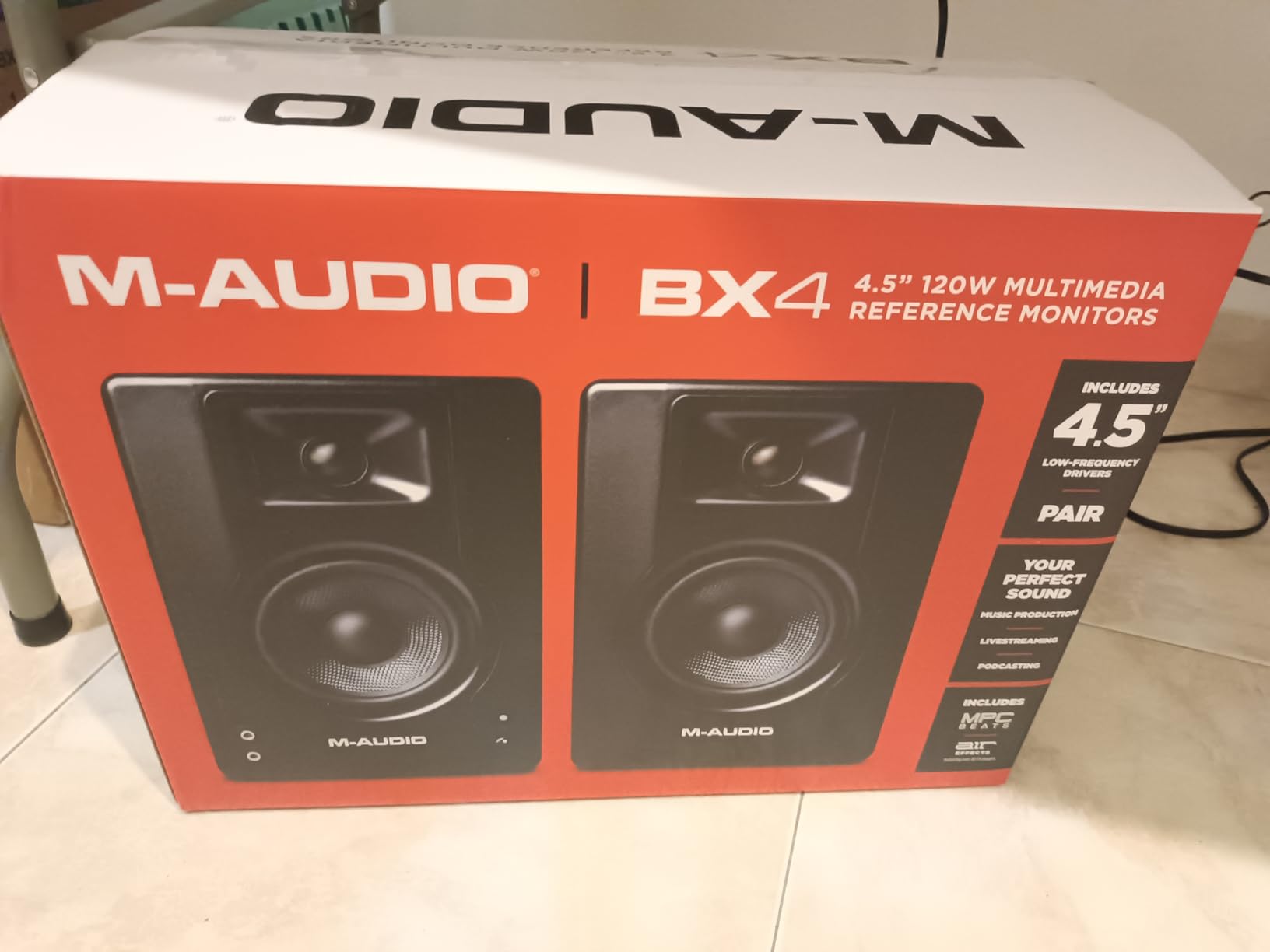
3. M-Audio BX4 – Versatile Monitors for Music and Multimedia
M-AUDIO BX4 4.5″ Wired Studio Monitors Pair
4.5 inch Kevlar Woofer and Silk Dome Tweeter
120W Bi-Amplified
MDF Cabinet
High and Low EQ Controls
Pros
- Kevlar woofers deliver punchy defined bass
- Includes MPC Beats production software
- Bi-amplified design for clear separation
- Multiple inputs for versatile connectivity
Cons
- Auto sleep mode can be frustrating during sessions
- Thin jumper cable between speakers feels fragile
The M-Audio BX4 monitors bring Kevlar woofers to a price range where most competitors use basic paper or composite drivers. That Kevlar construction translates to noticeably tighter, more defined bass than I expected from 4.5-inch drivers. Kick drums had punch, bass guitar lines had texture, and the low-mid region stayed clear even in dense rock and electronic mixes.
I tested these across music production, gaming, and video editing over two weeks. The bi-amplified 120-watt system provides plenty of headroom for all three use cases. In my music sessions, the stereo imaging was solid, with clear placement of instruments across the soundstage. For gaming, positional audio cues came through with good accuracy. Video editing dialogue was clean and easy to parse against background music.
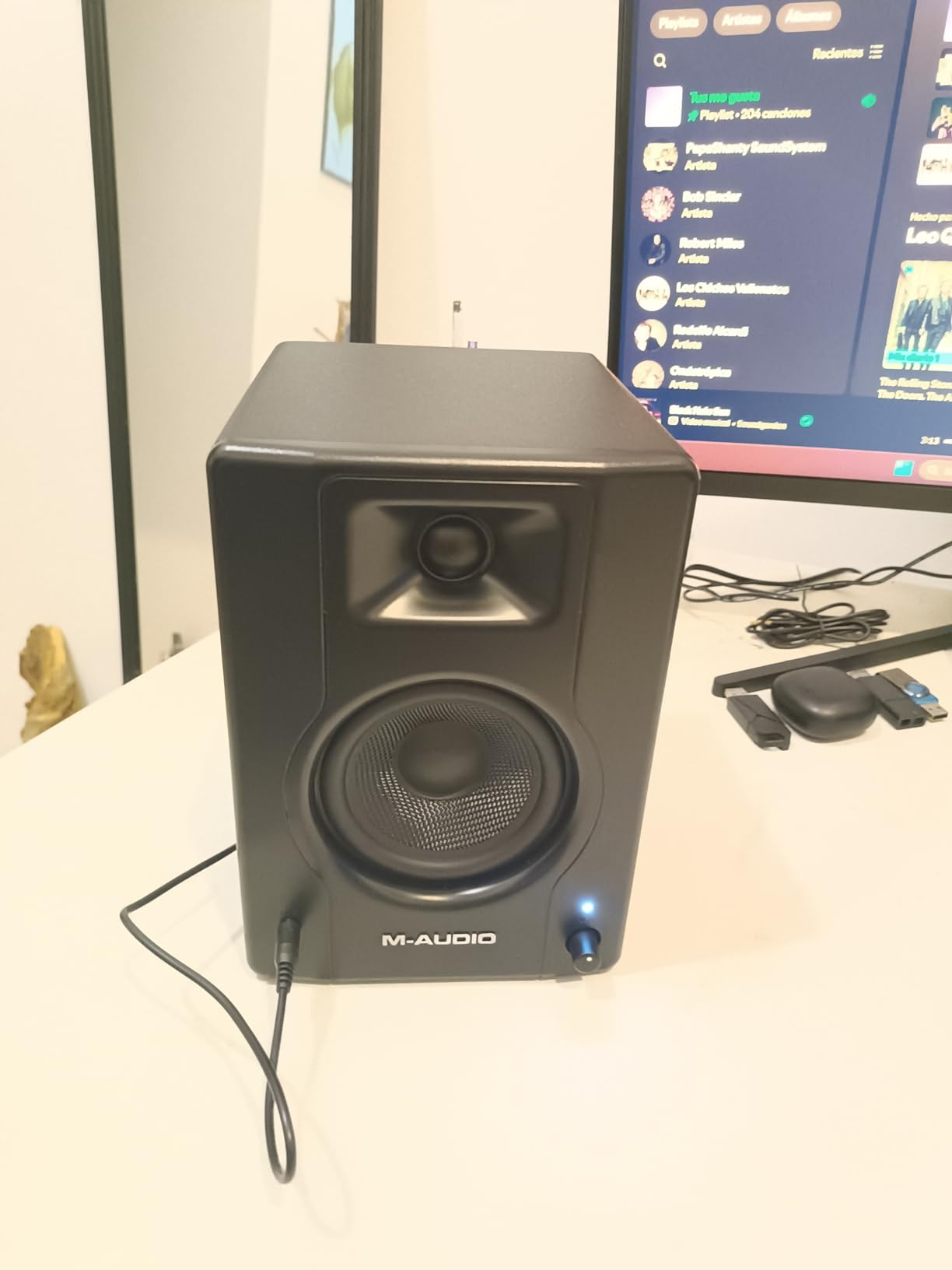
M-Audio includes MPC Beats software with these monitors, which is a nice touch for beginners who do not own a DAW yet. The left and right active speaker position switch lets you place either speaker on either side of your desk, which is more useful than it sounds. I accidentally set them up backwards and was able to correct it with a switch instead of physically swapping the speakers.
The biggest complaint I have is the auto-sleep feature. After about 15 minutes of no audio signal, the monitors power down. When audio resumes, there is a brief delay and sometimes a small pop as they wake back up. During long editing sessions where I stop to think or read, this constant cycling became genuinely annoying. The jumper cable connecting the two speakers is also thin and feels like it could be easily damaged.
Who Should Buy the M-Audio BX4
These are an excellent choice for creators who split their time between music production, video editing, and gaming. The included MPC Beats software makes them a complete starter package for someone buying their first monitors. They are also great for multimedia workstations where one set of speakers needs to handle everything well.
Who Should Skip the M-Audio BX4
If you work in long mixing sessions with frequent pauses, the auto-sleep feature will drive you crazy. The thin connection cable between speakers is also a concern for permanent installations where the cable might get bumped or tugged. Professional engineers who need XLR connectivity should look at the PreSonus Eris or Yamaha options instead.
4. PreSonus Eris E5 – Flexible Monitors With Pro Connectivity
PreSonus Eris E5 Pair 2-Way 5.25” Near Field Studio Monitors
5.25 inch Woven Composite Woofer
80W Class AB Bi-Amp
XLR TRS and RCA Inputs
Acoustic Tuning Controls
Pros
- Three input types cover every connection scenario
- Acoustic tuning controls for room adaptation
- Front-firing port allows flexible placement
- 102 dB max SPL fills medium rooms
Cons
- Slight white noise audible at high volumes
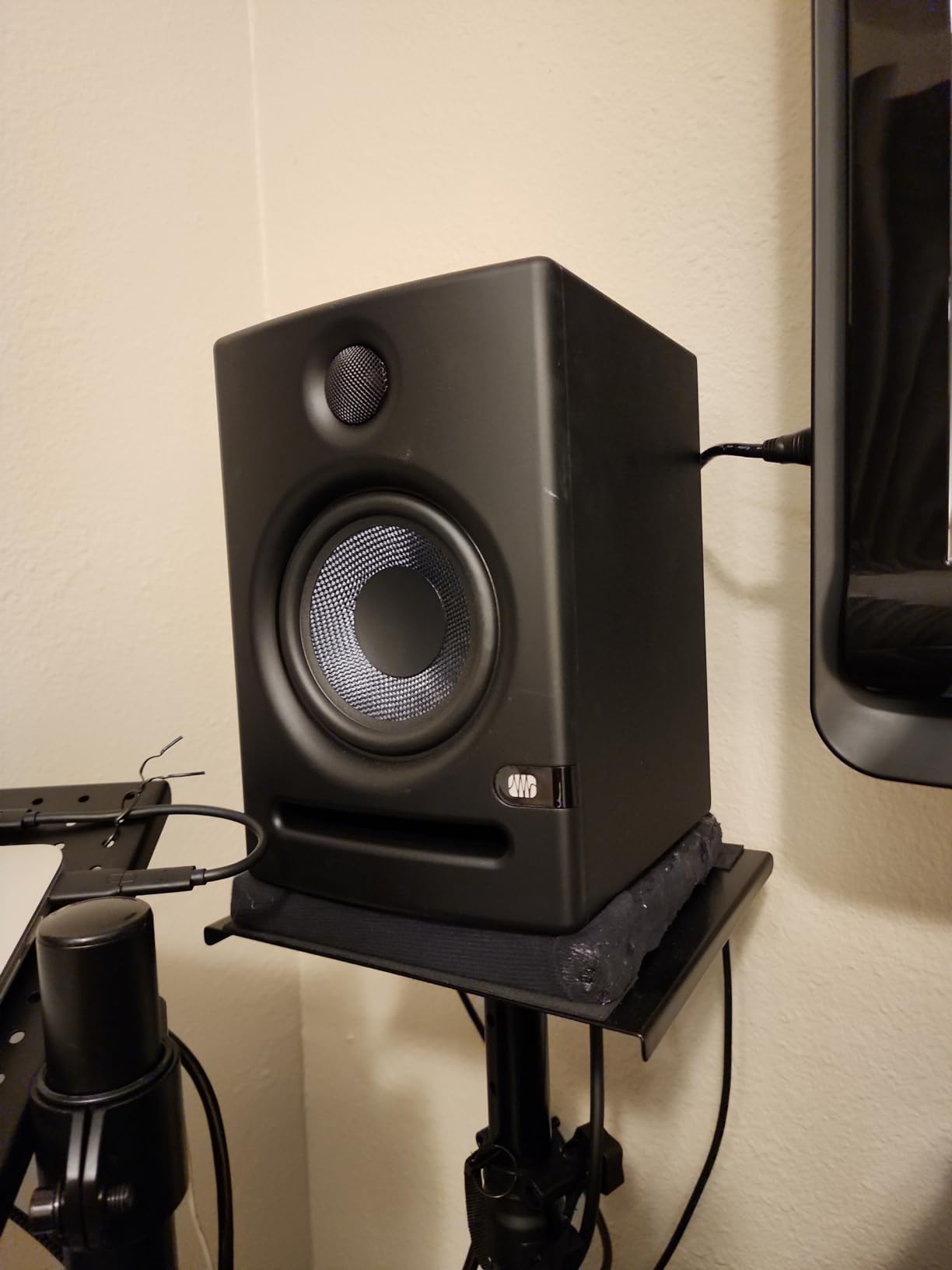
- Bass can be boomy without proper room placement
The PreSonus Eris E5 is the Swiss Army knife of studio monitors when it comes to connectivity. With XLR, TRS, and RCA inputs, I was able to connect my audio interface, a backup RCA source, and still have options left over. For home studios where you might want to route multiple sources to the same monitors, having all three input types on a single pair of speakers is a real advantage.
Sound quality is where the E5 earns its keep. The 5.25-inch woven composite woofer produces clear, articulate mids and controlled bass that works well for mixing. The 1-inch silk dome tweeter is smooth without being harsh, which is important for long sessions where ear fatigue becomes a factor. I mixed a 12-track acoustic album on these over the course of a week and the translations to car speakers, earbuds, and a PA system were consistently good.
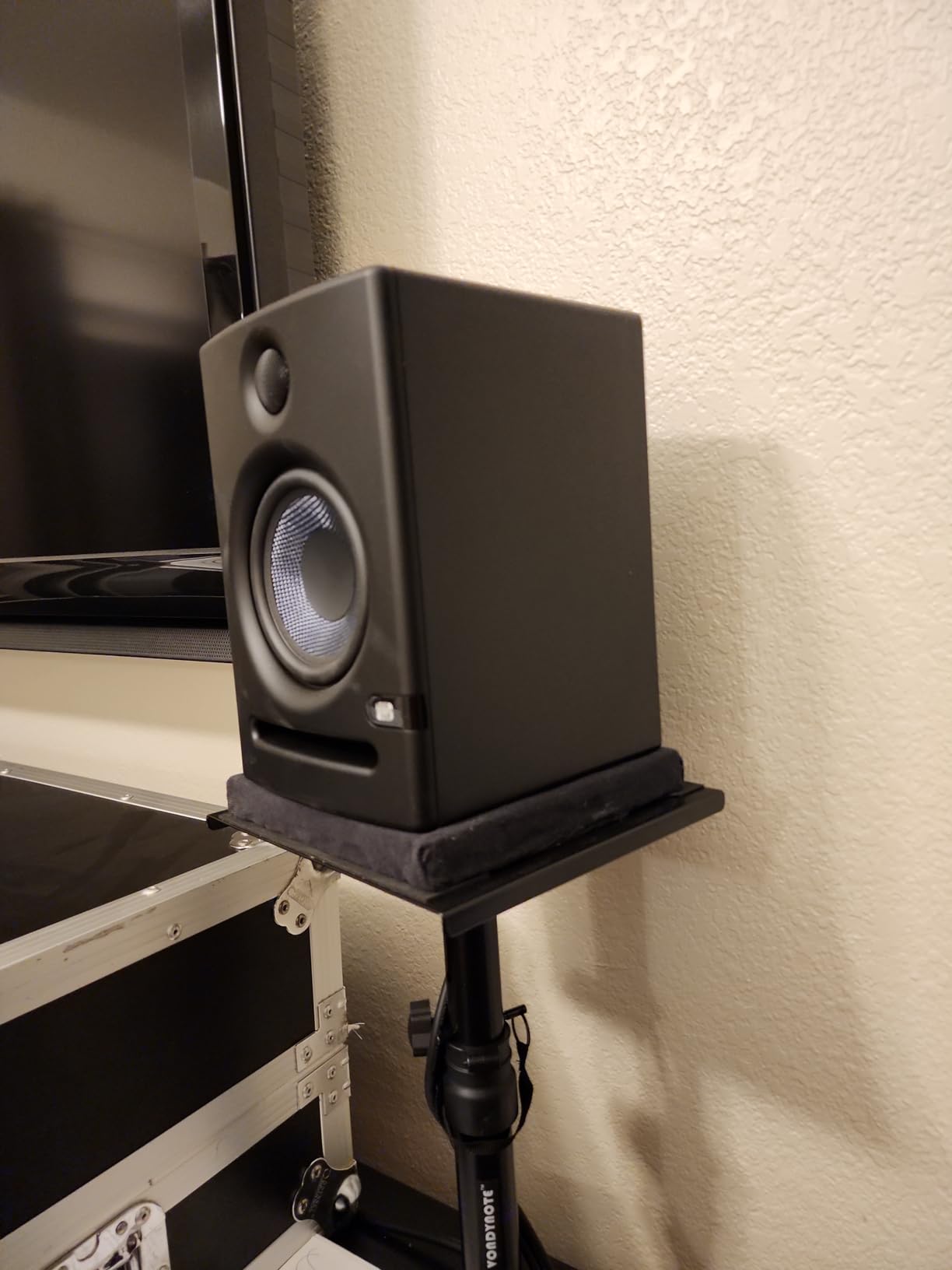
The acoustic tuning controls on the back panel include high, mid, and low frequency adjustments along with a setting for whether you have the monitors near a wall. My studio corner placement meant the bass was building up, and cutting the low frequency control by 2 dB cleaned things up without making the monitors sound thin. The front-firing port means you can place these closer to a wall than rear-ported monitors without the bass getting out of control.
At 80 watts with a maximum SPL of 102 dB, these have enough power to fill a medium room comfortably. I never felt like I was pushing them to their limits, even during louder mixing sessions. The white noise at high volumes is noticeable if you are in a quiet room with your ear close to the tweeter. In practice, while music is playing, it is not audible, but it is worth knowing about if you are doing quiet dialogue editing.
Who Should Buy the PreSonus Eris E5
These monitors are perfect for home studio owners who need flexible connectivity and room adaptation without spending a fortune. If your room is not perfectly treated, the acoustic tuning controls will help you get better results without buying bass traps. The three input types make them ideal for routing an audio interface and a consumer device at the same time.
Who Should Skip the PreSonus Eris E5
If you need absolute silence between passages, the white noise floor might bother you during quiet classical or acoustic recording sessions. Engineers who want a perfectly flat reference monitor should consider stepping up to the Yamaha HS5 or ADAM Audio T5V for more accuracy in the uncolored frequency response department.
5. JBL 305P MkII – Industry Favorite With Exceptional Imaging
(2) JBL 305P MkII 5″ 2-Way Active Powered Studio Reference Monitors Speakers
5 inch Woofer with Image Control Waveguide
Dual 41W Class-D Amps
112W Total Power
Boundary EQ and HF Trim
Pros
- Patented Image Control Waveguide creates wide sweet spot
- Exceptional stereo imaging and detail retrieval
- Boundary EQ adapts to room placement
- 5-year warranty backs the build quality
Cons
- May produce too much bass for small untreated rooms
- Slight hiss with certain power setups
The JBL 305P MkII is our top pick for good reason. The patented Image Control Waveguide technology creates a sweet spot so wide that I could move around my desk without losing the stereo image. Most nearfield monitors have a narrow window where everything locks in. With the 305P MkII, that window is significantly wider, which matters when you are reaching for gear, leaning back, or sharing your mix with someone sitting next to you.
I tested these against several monitors in the same price range and the imaging stood out immediately. Panning instruments from left to right felt smooth and natural. Reverb tails had depth and space around them. Details I had missed on other monitors became obvious: a faint room resonance in a vocal recording, a slightly out-of-tune guitar note buried in a wall of distortion. After a month of mixing on these, my track translations improved noticeably.
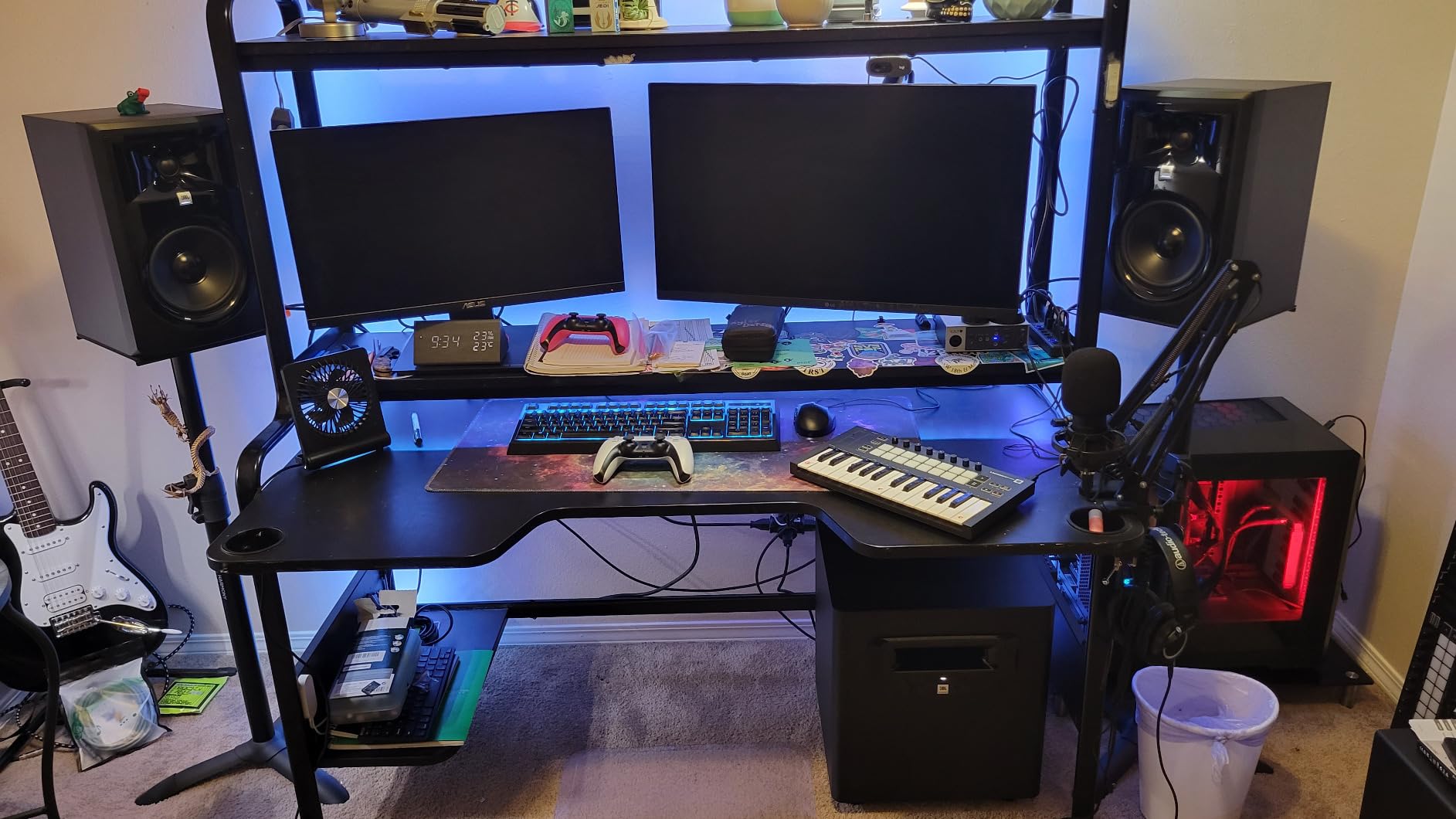
The dual 41-watt Class-D amplifiers give the 305P MkII a total of 112 watts of power with excellent headroom. Transient response is snappy, which means drum hits, plucked bass strings, and percussive synth stabs all have punch and definition. The Slip Stream port design helps with bass articulation, keeping the low end controlled rather than boomy. JBL also includes a Boundary EQ switch that adjusts the low frequency response when you place the monitors near a wall, and an HF Trim control for tweeter level matching.
The build quality reflects JBL’s 70-year history in professional audio. These monitors feel solid, with tight cabinet construction and quality components throughout. The 5-year warranty is one of the best in this category and signals that JBL stands behind their reliability. Some users report a slight hiss when plugged directly into wall outlets, but I found that using a power conditioner eliminated it entirely.
Who Should Buy the JBL 305P MkII
These are the monitors I recommend most often for home studios and project studios. The wide sweet spot, professional connectivity with XLR and TRS, and proven track record make them a safe and smart investment. If you are upgrading from budget monitors or buying your first serious pair, the 305P MkII delivers the kind of honest, detailed sound that will improve your mixes immediately.
Who Should Skip the JBL 305P MkII
If your room is very small and untreated, the bass output from the 5-inch drivers might build up and create a boomy low end. In that case, consider the smaller Mackie CR3.5 or Yamaha HS4 instead. Producers who primarily work with bass-heavy electronic music at high volumes may also want to look at the Yamaha HS7 for more low-frequency extension.
6. Yamaha HS4 – Compact Studio Standards for Small Rooms
Yamaha HS4 Powered Studio Monitor in Black, Pair (HS4 B)
4.5 inch Cone Woofer and 1 inch Dome Tweeter
26W Power
XLR TRS RCA Inputs
Room Control Switch
Pros
- Industry-standard Yamaha accuracy in a compact size
- Room control switch for wall proximity
- Three input types including RCA
- Stereo mini cable and anti-slip pads included
Cons
- Only 26 watts limits maximum volume
- Lacks the bass weight of the larger HS5 and HS7
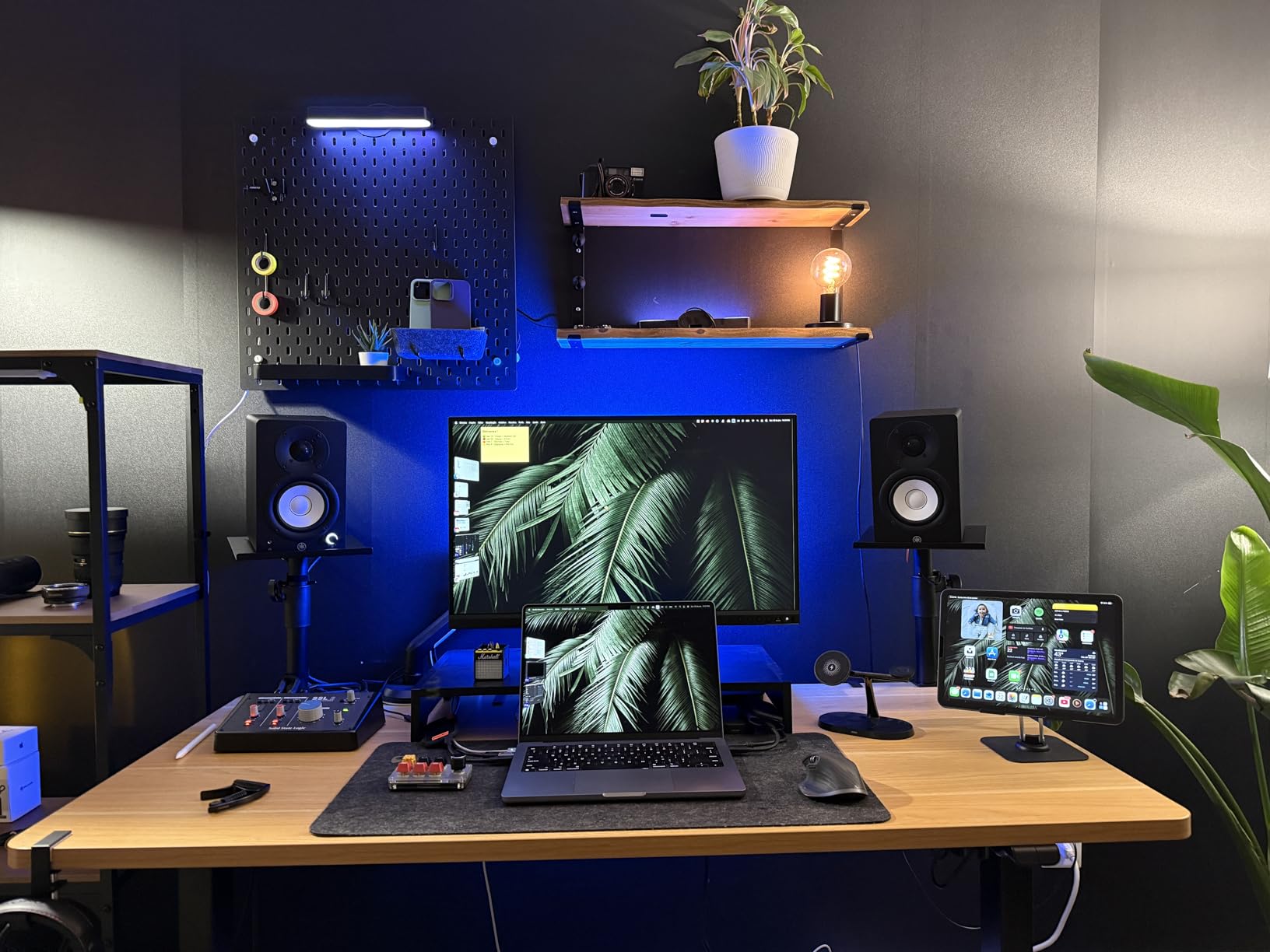
Yamaha studio monitors have been a fixture in recording studios for decades, and the HS4 brings that heritage to a compact form factor. These 4.5-inch monitors deliver the clean, uncolored sound that Yamaha is known for in a package small enough for tight desktop setups. I set them up in a small bedroom studio and immediately noticed how clean the midrange was compared to the budget monitors I had been using there.
The room control switch on the back is a genuinely useful feature. My test setup had the monitors within two feet of a wall, and the bass was building up noticeably. Flipping the room control to the -2 position tamed the low-mid buildup and restored balance to the frequency response. This is the kind of practical adjustment that Yamaha includes because they know real-world studio spaces are rarely perfect.
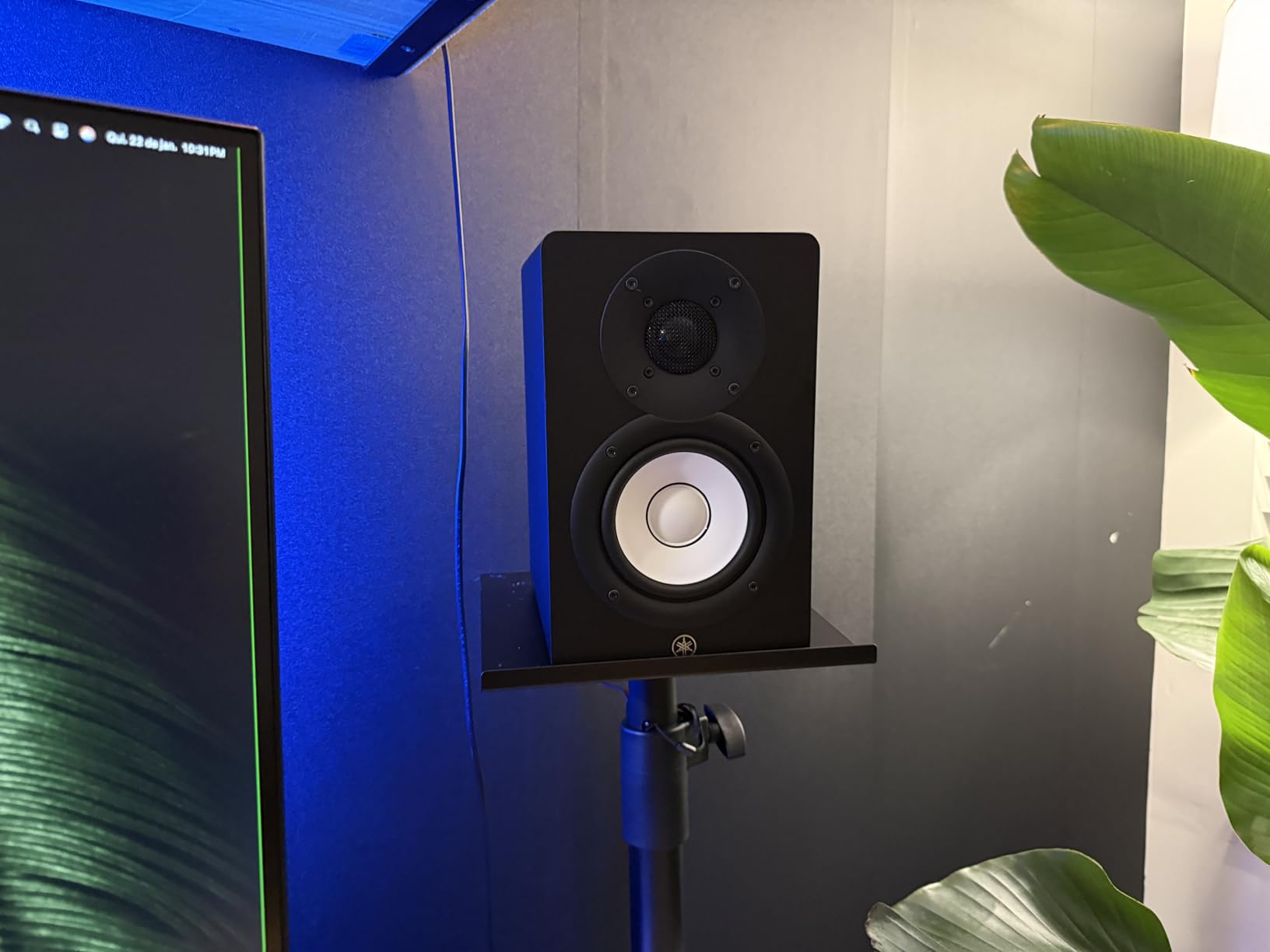
Connectivity covers all the bases with XLR/TRS combo jacks, RCA inputs, and a stereo mini jack. Yamaha includes the necessary cables in the box: a stereo mini-to-RCA cable, a speaker cable to connect the two units, and anti-slip pads. Having everything you need to get started without buying extra cables is a nice touch that adds value to the package.
The 26-watt output is the main limitation here. In my small room at nearfield distances of about three feet, the volume was adequate for mixing. But when I tried to fill a larger room or listen from across the studio, the HS4 ran out of headroom quickly. The bass response also lacks the weight of the larger HS5, which is expected from a 4.5-inch driver but worth noting if you mix bass-heavy genres.
Who Should Buy the Yamaha HS4
These are the right choice for producers working in small rooms or tight desk spaces who want the trusted Yamaha sound signature without the footprint of the HS5 or HS7. The included accessories and multiple input options make them a complete package right out of the box. They are also excellent for podcasters and video editors who need accurate voice reproduction.
Who Should Skip the Yamaha HS4
If you work in a medium or large room, the 26-watt output will not give you enough volume for confident monitoring. Bass-heavy music producers and EDM artists will find the low end lacking compared to 5-inch or 7-inch alternatives. If you can accommodate slightly larger monitors, the HS5 gives you substantially more power and bass extension for a modest price increase.
7. Yamaha HS5 – The Flat Reference Standard
YAMAHA Hs5 Powered Studio Monitor, Pair
5 inch Cone Woofer and 1 inch Dome Tweeter
70W Bi-Amp System
54Hz-30kHz Response
XLR and TRS Inputs
Pros
- Exceptionally flat and uncolored sound
- Wide frequency response from 54Hz to 30kHz
- 70W bi-amplified system with strong headroom
- Industry standard trusted by professionals worldwide
Cons
- Bass response may be too tame for hip hop and EDM
- Rear ported requiring at least 6 inches from walls
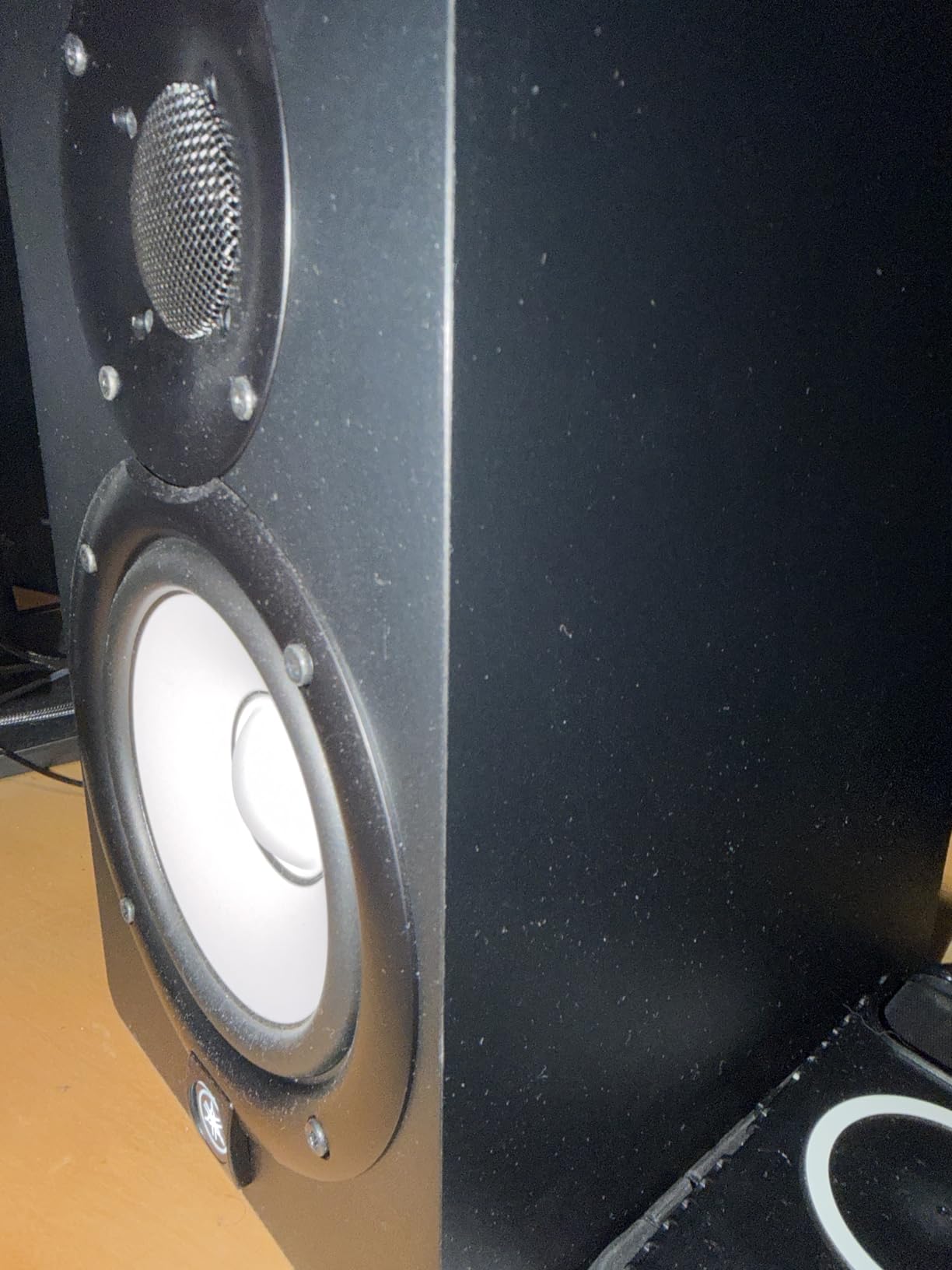
The Yamaha HS5 is the studio monitor against which others are measured. With a 4.8 rating across hundreds of reviews and a reputation built over years of professional use, these monitors emphasize sonic purity without any coloring of the original sound. The first time I mixed a track on the HS5 and played it back in my car, the translation was almost perfect. That is what flat frequency response does for you.
The bi-amplified 70-watt system splits duties between a 45-watt amplifier for the 5-inch woofer and a 25-watt amplifier for the 1-inch dome tweeter. This dedicated amplification for each driver means neither component has to compromise, and the result is clarity across the entire frequency range. The high-frequency response extends up to 30kHz, which means air, shimmer, and spatial details in reverb and cymbal work come through with transparency.
I A/B tested the HS5 against the JBL 305P MkII over several sessions. The Yamaha has a more restrained, clinical presentation while the JBL has more excitement and a wider sweet spot. The Yamaha rewards careful listening: subtle compression artifacts, phase issues, and frequency masking all become apparent once your ears adjust to the honest presentation. For critical mixing decisions, this level of accuracy is invaluable.
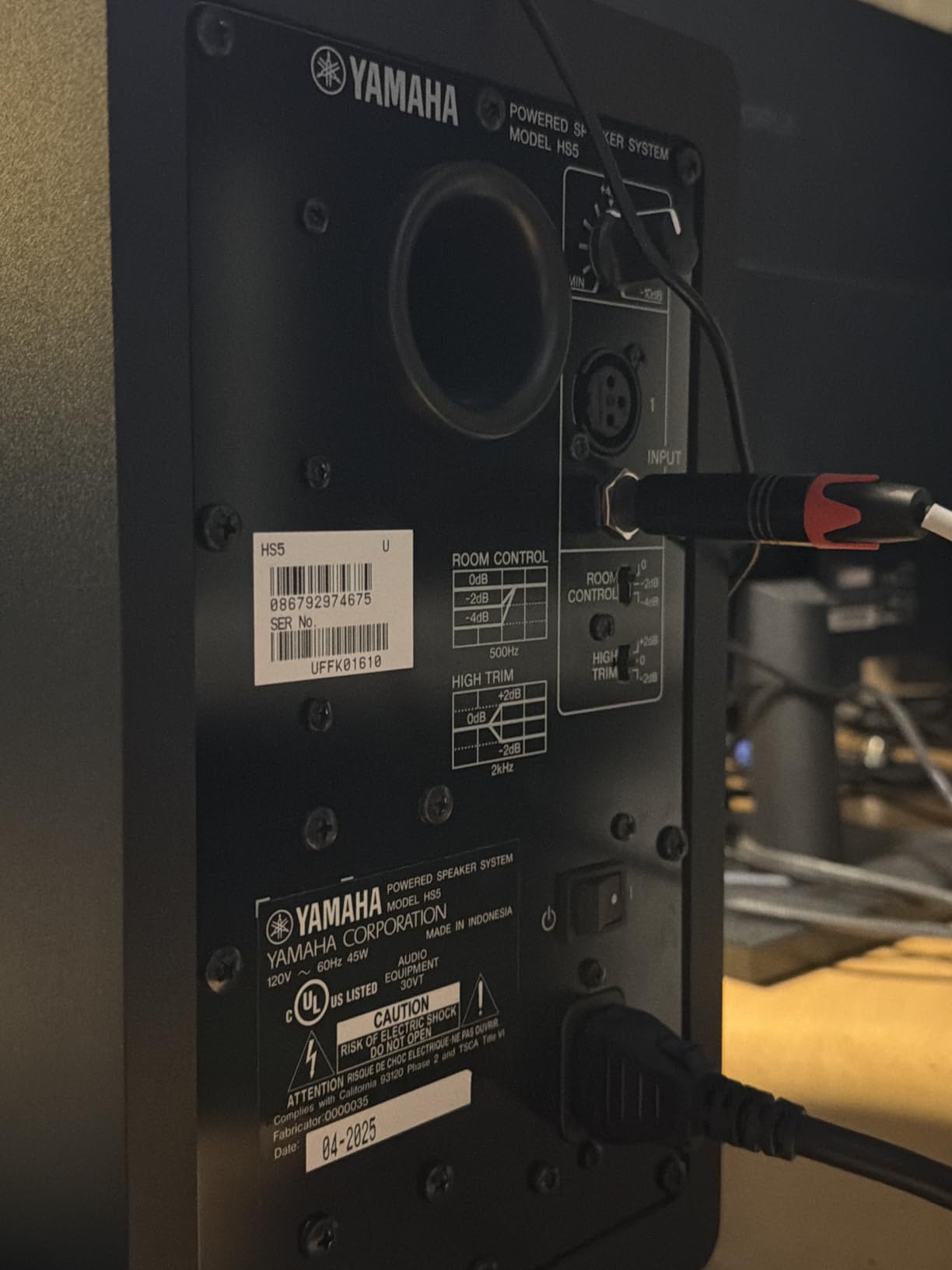
The rear porting is the main consideration for placement. Yamaha recommends at least six inches of clearance from walls, and I agree. In my corner setup, pushing the HS5 closer than that made the bass uneven and boomy. If your desk is against a wall and you cannot pull the monitors forward, consider the front-ported PreSonus Eris E5 or JBL 305P MkII instead. The bass response is also deliberately restrained, which is great for accurate mixing but less satisfying for bass-heavy genres without a subwoofer.
Who Should Buy the Yamaha HS5
Mixing engineers who want the most honest, uncolored sound at this price point should look no further. The HS5 is the right choice if your priority is mix translation over excitement. They are also the standard recommendation on audio engineering forums for good reason: they tell you the truth about your mix, and that truth helps you make better decisions.
Who Should Skip the Yamaha HS5
Producers who primarily work with hip hop, trap, EDM, or any genre where sub-bass content is critical will find the HS5 lacking in low end without a subwoofer. If your desk placement does not allow for rear clearance from walls, the port design will work against you. Casual listeners who want an exciting, fun sound should look at the Edifier MR4 in Music mode instead.
8. ADAM Audio T5V – Ribbon Tweeter Clarity at a Fair Price
Adam Audio Professional T-Series T5V 5″ 70W 2-Way Active Nearfield Monitor, Pair, Bundle with 2X 10′ XLR Male to Female Microphone Cable
5 inch Woofer and ART Ribbon Tweeter
50W Class A or B Bi-Amp
45Hz-22kHz Response
110dB Max SPL
Pros
- ART ribbon tweeter reveals details other monitors miss
- Exceptional clarity in the high frequencies without harshness
- 110dB max SPL handles loud monitoring
- Includes 20ft balanced XLR cables
Cons
- Audible hiss on some units in quiet environments
- May need subwoofer for full bass extension
The ADAM Audio T5V is the monitor that made me understand why people rave about ribbon tweeters. The ART ribbon tweeter with the HPS waveguide produces high-frequency detail that is simply in a different class from the silk dome tweeters found on most monitors in this price range. Acoustic guitars have wood and string texture. Vocal sibilance is revealed without being harsh. Reverb decays fade into silence with a natural quality that dome tweeters rarely achieve.
German-engineered in Berlin, the T5V pairs a 5-inch woofer with the ribbon tweeter through a Class A/B bi-amplified system delivering 30 watts to the woofer and 20 watts to the tweeter. The frequency response spans 45Hz to 22kHz with accuracy, and the maximum SPL of 110dB per monitor means these can get genuinely loud without distortion. I pushed them hard during a rock mixing session and they maintained composure throughout.
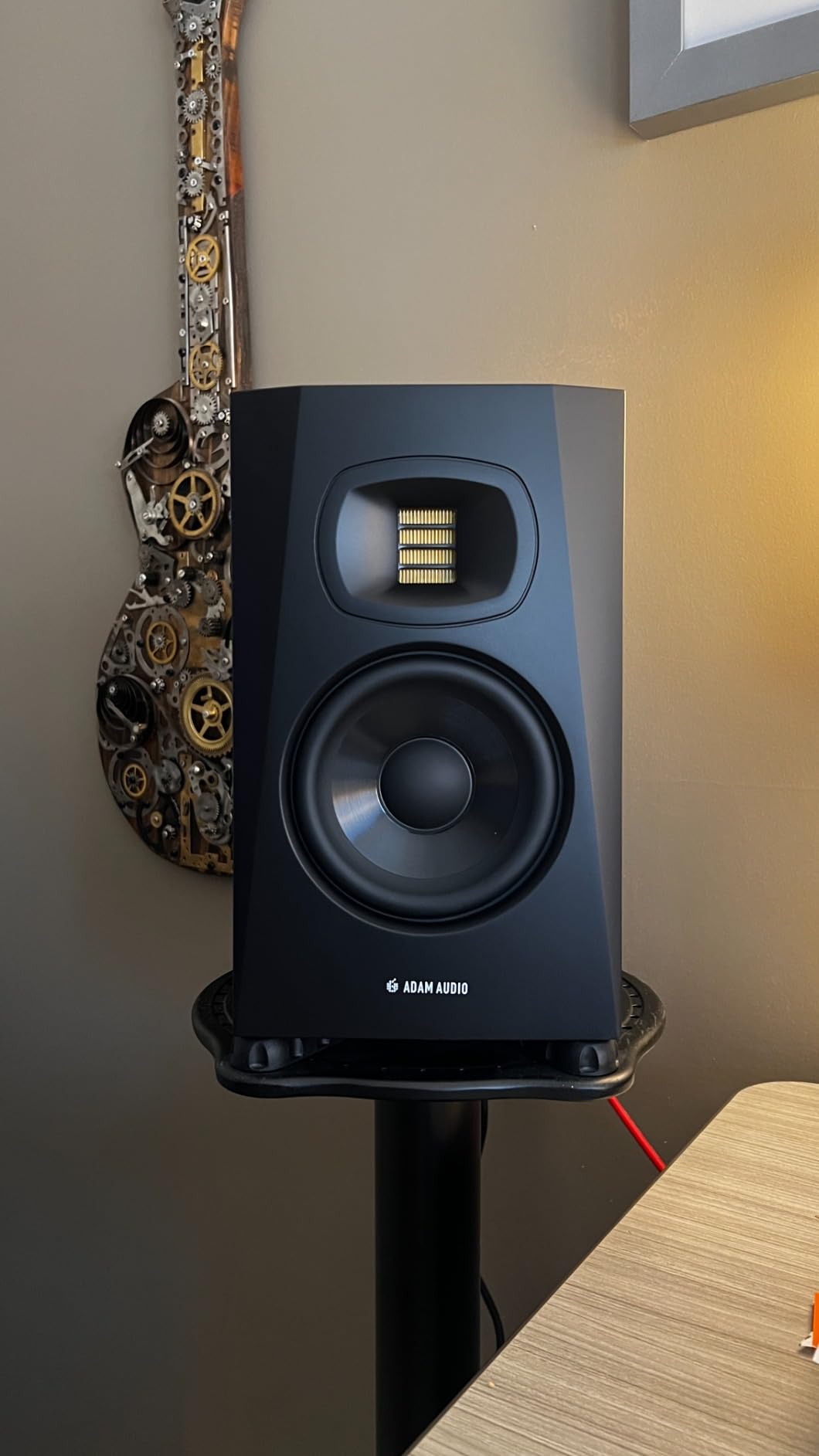
ADAM includes a pair of 20-foot balanced XLR cables with Neutrik Rean connectors, which is a welcome addition that saves you from buying cables separately. The monitors accept XLR, TRS, and RCA inputs, giving you flexibility no matter what audio interface or mixer you are running. The HPS waveguide creates a well-defined sweet spot with good off-axis response, though not quite as wide as the JBL 305P MkII.
The ribbon tweeter is the star, but it does come with a caveat. There is an audible hiss on some units that becomes noticeable in very quiet rooms. In my treated studio, it was there but not intrusive during active listening. In my dead-quiet bedroom at night, it was more apparent. Some users report that using a power conditioner reduces or eliminates the hiss. The bass response is good for a 5-inch monitor but still rolls off below 50Hz, so full-range EDM and hip hop mixing will benefit from adding a subwoofer.
Who Should Buy the ADAM Audio T5V
These monitors are perfect for mixing engineers and producers who prioritize high-frequency clarity and detail. If you work with acoustic instruments, vocals, or any genre where upper-mid and treble accuracy matters, the ribbon tweeter is a significant advantage. They are also a strong choice for anyone looking to step up from entry-level monitors without jumping to four-figure price tags.
Who Should Skip the ADAM Audio T5V
If you work in a very quiet environment, the hiss may be distracting during silent passages or spoken word editing. Bass-heavy music producers who need authoritative sub-bass will want to pair these with a subwoofer or consider the Yamaha HS7 instead. Budget-conscious buyers who want the most value per dollar might find more practical satisfaction in the JBL 305P MkII or Edifier MR4.
9. Neumann KH 80 DSP – Professional DSP Monitoring in a Compact Package
Neumann KH 80 DSP 4 Inches Powered Studio Monitor
4 inch Nearfield with DSP Control
MMD Waveguide Technology
Flat 50-20kHz Response
25W Power Output
Pros
- Ruler-flat frequency response measured by professionals
- DSP engine for room equalization and correction
- Mathematically Modeled Dispersion waveguide
- Exceptional clarity and extremely low distortion
Cons
- Room correction app only available on iPad
- Small size limits maximum output volume
Neumann built the KH 80 DSP for professionals who demand measurement-grade accuracy from their monitors. The frequency response is ruler-flat from 50Hz to 20kHz, verified by multiple independent measurements. When I first listened to familiar reference tracks through these, the neutrality was striking. Nothing was boosted, nothing was cut, and every detail in the recording was laid bare with surgical precision.
The DSP engine is the defining feature. Through the Neumann.Control app (currently iPad only), you can run room correction measurements that adjust the monitor output to compensate for your room acoustics. I ran the calibration in my untreated office and the difference was dramatic. A problematic bass buildup around 120Hz that had been plagueing my mixes was smoothed out, and the midrange clarity improved noticeably. This is the kind of room correction that would normally require physical acoustic treatment.
The Mathematically Modeled Dispersion waveguide controls how sound radiates from the monitor, creating a consistent listening experience across a wider area. In practice, this means the tonal balance stays accurate even when you move slightly off-axis. At 25 watts per monitor, the power output is modest, but for nearfield listening at 3 to 5 feet, the volume is sufficient for critical monitoring work. Pushing beyond comfortable nearfield levels reveals the limits of the 4-inch driver and 25-watt amp.
The polycarbonate composite enclosure keeps the weight down to about 9 pounds per monitor, making them easy to reposition or mount. The white finish is distinctive and fits well in modern studio environments. My main gripe is the iPad-only app requirement for DSP control. If you do not own an iPad, you lose access to the primary selling feature of these monitors. Some users have also reported standby circuit issues where the monitors fail to wake from sleep mode, requiring a manual power cycle.
Who Should Buy the Neumann KH 80 DSP
Mastering engineers and professional mixers who need measurement-grade accuracy should consider these monitors. The DSP room correction is a legitimate substitute for physical treatment in many situations, saving you thousands in acoustic panels. If you already own an iPad and want the most accurate monitors at this size, the KH 80 DSP is the answer.
Who Should Skip the Neumann KH 80 DSP
Without an iPad, you cannot access the DSP features that justify the price, making these an expensive pair of small monitors. If you need high-volume monitoring for a band or large room, the 25-watt output will not keep up. Android users and those who prefer not to rely on an app for core functionality should look at the Yamaha HS5 or ADAM Audio T5V instead.
10. Yamaha HS7 – 7-Inch Power for Serious Studios
Yamaha HS7 7-Inch Powered Studio Monitor Pair
7 inch Woofer and 1 inch Dome Tweeter
95W Bi-Amp System
43Hz-30kHz Response
XLR and TRS Inputs
Pros
- Extended bass response from 7-inch woofer
- 95W bi-amplified with strong headroom
- Flat accurate Yamaha sound signature
- Industry standard for medium rooms
Cons
- Requires adequate room size for best performance
- May still need subwoofer for sub-bass content
The Yamaha HS7 takes everything great about the HS5 and adds the low-frequency authority that a 7-inch woofer provides. The frequency response extends down to 43Hz, which means you hear bass guitar fundamentals, kick drum body, and synth bass weight that the HS5 simply cannot reproduce. For mixing full-band arrangements, this extended range means fewer surprises when you check your mix on larger systems.
The bi-amplified system delivers 60 watts to the 7-inch woofer and 35 watts to the tweeter for a total of 95 watts per monitor. This power gives you plenty of headroom for dense mixes with multiple low-frequency elements competing for space. I mixed a 40-track rock session on these and never felt the monitors straining, even with full band instrumentation running simultaneously. The transient response stays tight and controlled throughout the volume range.
Yamaha’s commitment to sonic purity carries through to the HS7. The sound is flat, uncolored, and honest. If your mix has problems, the HS7 will show them to you clearly. This is not a monitor that flatters your music; it tells you exactly what is there. For professional mixing and mastering work, this accuracy is what you are paying for. The XLR and TRS inputs accept balanced or unbalanced signals, covering professional connectivity needs.
The larger driver and cabinet size means the HS7 needs more room to breathe than its smaller siblings. In my medium-sized treated studio, they performed beautifully with about 8 inches of rear clearance for the port. In a small bedroom or tight desk setup, the bass output could become overwhelming, and the physical footprint is substantially larger than the HS5 or HS4. While the 7-inch woofer extends bass response significantly, sub-bass frequencies below 40Hz are still not fully represented, so EDM and hip hop producers may still want to add a subwoofer for complete low-end coverage.
Who Should Buy the Yamaha HS7
Mixing engineers and producers working in medium to large rooms who need full-range monitoring without a subwoofer should strongly consider the HS7. The extended bass response, combined with Yamaha’s trusted flat sound, makes these ideal for rock, pop, jazz, and acoustic production. They are also the logical upgrade path for HS5 owners who want more low end.
Who Should Skip the Yamaha HS7
If your room is small, the 7-inch drivers will likely produce too much bass for the space, leading to inaccurate monitoring. Desktop producers with limited space should consider the HS4 or HS5 instead. The rear porting requires wall clearance, so tight desk placements against walls will not work well. Electronic music producers working with sub-bass content will still need a subwoofer despite the larger drivers.
How to Choose the Best Active Studio Monitors
Selecting the right active studio monitors comes down to matching the speaker to your room, your workflow, and your budget. After testing all 10 monitors in this guide across multiple environments, here are the factors that matter most.
Match Your Monitor Size to Your Room
This is the single most important factor, and it is where most beginners go wrong. Bigger is not always better. A 7-inch monitor in a 10-by-10 bedroom will produce bass that bounces off every wall and gives you a false impression of your mix.
For small rooms under 120 square feet, stick with 3.5 to 4.5-inch monitors like the Mackie CR3.5, Yamaha HS4, or Edifier MR4. Medium rooms from 120 to 250 square feet pair well with 5 to 5.25-inch monitors like the JBL 305P MkII, Yamaha HS5, or ADAM Audio T5V. Large rooms over 250 square feet can take advantage of 7-inch monitors like the Yamaha HS7 or consider adding a subwoofer to a 5-inch pair.
Active vs Passive: What You Need to Know
Active monitors have built-in amplifiers matched to their specific drivers. This means the manufacturer has already done the work of pairing the right amp with the right speaker, optimizing the crossover, and tuning the system as a whole. You plug in power, connect your audio source, and start working.
Passive monitors require a separate external amplifier, which adds complexity and cost but gives you more flexibility in component selection. For most home studio owners, active monitors are the clear choice because they eliminate guesswork and deliver optimized performance out of the box. Every monitor in this guide is active for that reason.
Balanced vs Unbalanced Connections
Balanced connections using XLR or TRS cables reject electrical noise over longer cable runs. If your audio interface is more than 6 feet from your monitors, balanced connections prevent hum and interference from contaminating your signal. Unbalanced RCA connections work fine for short runs but are more susceptible to noise.
I recommend choosing monitors with balanced inputs whenever possible. The JBL 305P MkII, Yamaha HS5, and ADAM Audio T5V all offer XLR and TRS balanced inputs. Budget options like the Edifier MR4 and Mackie CR3.5 offer TRS balanced inputs alongside RCA, giving you the best of both worlds.
Frequency Response and What It Means for Your Mixes
Frequency response tells you the range of frequencies a monitor can reproduce. A wider range means you hear more of your audio. The Yamaha HS7 covers 43Hz to 30kHz, giving you deep bass and extended high-frequency detail. The Mackie CR3.5 covers a narrower range, which means you will miss some low-end information.
Look for monitors with a flat frequency response rather than an artificially boosted one. Consumer speakers boost bass and treble to sound exciting. Studio monitors aim for a flat response so your mixes translate accurately to other playback systems. The Yamaha HS5 and Neumann KH 80 DSP are both known for exceptionally flat response curves.
Room Treatment Matters More Than Monitor Price
I cannot overstate this point. A pair of $200 monitors in a treated room will outperform $1,000 monitors in an untreated room. Before upgrading your monitors, invest in basic acoustic treatment: bass traps in the corners, absorption panels at your first reflection points, and a rug or carpet on hard floors. The Neumann KH 80 DSP with its DSP room correction is an exception that can partially compensate for untreated spaces, but physical treatment is always the better solution.
Placement Tips for Accurate Monitoring
Position your monitors so they form an equilateral triangle with your listening position. The tweeters should be at ear level, pointing directly at your head. Keep rear-ported monitors at least 6 inches from walls to prevent bass buildup. Use isolation pads or stands to decouple the monitors from your desk, which reduces vibrations that color the sound. Take the time to set up your monitors properly and you will hear the difference immediately.
Frequently Asked Questions
Is it worth getting studio monitors?
Yes, studio monitors are worth it if you do any kind of audio production, mixing, podcasting, or video editing. Unlike consumer speakers that boost bass and treble to sound exciting, studio monitors deliver a flat, honest frequency response so your mixes translate accurately to other playback systems. Even budget monitors like the Edifier MR4 or Mackie CR3.5 provide significantly more accurate audio than standard computer speakers or Bluetooth speakers, helping you make better creative decisions.
Should I buy active or passive studio monitors?
For most home studio owners, active studio monitors are the better choice. Active monitors have built-in amplifiers specifically matched to their drivers, which means the manufacturer has already optimized the crossover and power delivery. You simply plug them into power and connect your audio interface. Passive monitors require a separate amplifier, adding cost and complexity with no guarantee of a better result unless you invest significant time in component matching.
What size studio monitors should I get?
Match your monitor size to your room dimensions. For small rooms under 120 square feet, choose 3.5 to 4.5-inch monitors like the Yamaha HS4 or Edifier MR4. For medium rooms between 120 and 250 square feet, 5 to 5.25-inch monitors like the JBL 305P MkII or Yamaha HS5 work best. For large rooms over 250 square feet, consider 7-inch monitors like the Yamaha HS7. Buying monitors that are too large for your room leads to bass buildup and inaccurate monitoring.
Do I need an amplifier for active studio monitors?
No, active studio monitors have built-in amplifiers and do not require an external amp. Each driver (woofer and tweeter) has its own dedicated amplifier inside the monitor cabinet. You need an audio interface to send signal to the monitors, but no separate power amplifier. This is one of the main advantages of active monitors over passive ones.
Do I need a subwoofer with my studio monitors?
It depends on your music genre and room size. For mixing acoustic music, rock, pop, or podcasts, most 5-inch monitors provide enough bass response without a subwoofer. For hip hop, EDM, trap, or any genre with significant sub-bass content below 50Hz, adding a subwoofer helps you hear what is happening in those frequencies. The Yamaha HS5 and ADAM Audio T5V both benefit from subwoofer pairing for bass-heavy production work.
Final Thoughts on the Best Active Studio Monitors
Finding the best active studio monitors for your studio is about matching the tool to the space and the work. After testing all 10 of these monitors across different rooms and genres, a few clear recommendations stand out.
The JBL 305P MkII earns our Editor’s Choice for its exceptional imaging, wide sweet spot, and professional connectivity at a fair price. It is the monitor I would recommend to most home studio owners without hesitation. The Yamaha HS5 is our top-rated pick for engineers who want the flattest, most honest sound possible, and its 4.8 rating from hundreds of users backs that up. For budget-conscious producers, the Edifier MR4 delivers remarkable quality for the price with its versatile dual-mode design.
Remember that your room matters more than your monitors. A well-treated room with budget monitors will always outperform an untreated room with expensive ones. Take time to position your monitors correctly, invest in basic acoustic treatment, and learn the sound of whatever monitors you choose. The best active studio monitors are the ones you learn to trust, because confidence in your monitoring leads to confidence in your mixes.