
Finding the best AV receivers under 1000 dollars used to mean settling for basic surround sound and a handful of HDMI ports. That is no longer the case. The current crop of mid-range AVRs packs Dirac Live room correction, 8K video passthrough, Dolby Atmos decoding, and streaming platforms that rival dedicated music players. Our team spent weeks comparing six of the most talked-about models from Onkyo, Denon, Yamaha, Marantz, and Sony so you do not have to guess which one belongs in your rack.
A thousand dollars is the sweet spot for home theater audio. Go cheaper and you lose advanced room correction and future-proof HDMI connectivity. Spend more and the gains are marginal for most living rooms. In this guide we walk through each receiver we tested, highlight where each one shines, and call out the trade-offs the spec sheets tend to gloss over. Whether you are building your first 5.1 setup or upgrading a 7.2 Atmos system, there is a pick here that fits.
One thing we noticed right away: the room correction system matters more than raw wattage. Forum users on AVS Forum and Reddit consistently report that a well-calibrated budget receiver beats an uncalibrated premium one. That insight shaped how we ranked these models, and it should shape how you shop for yours.
Table of Contents
Top 3 AV Receivers Under $1000 for 2026
Best AV Receivers Under $1000 in 2026
| Product | Specifications | Action |
|---|---|---|
 Onkyo TX-NR7100 Onkyo TX-NR7100 |
|
Check Latest Price |
 Onkyo TX-RZ30 Onkyo TX-RZ30 |
|
Check Latest Price |
 Denon AVR-X1800H Denon AVR-X1800H |
|
Check Latest Price |
 Yamaha RX-V6A Yamaha RX-V6A |
|
Check Latest Price |
 Marantz NR1510 Marantz NR1510 |
|
Check Latest Price |
 Sony STR-AN1000 Sony STR-AN1000 |
|
Check Latest Price |
1. Onkyo TX-NR7100 – Best Value with Dirac Live Room Correction
TX-NR7100 9.2-Channel THX Certified AV Receiver
9.2 Channel
100W Per Channel
Dirac Live
THX Certified
8K HDMI 2.1
Pros
- Dirac Live room correction included
- THX Certified for cinema reference
- 9.2 channels with Dolby Atmos and DTS:X
- Works with Sonos Certified
- HDMI 2.1 with VRR and ALLM for gaming
Cons
- HDMI glitches may require firmware update
- Remote is not backlit
- App UI is basic
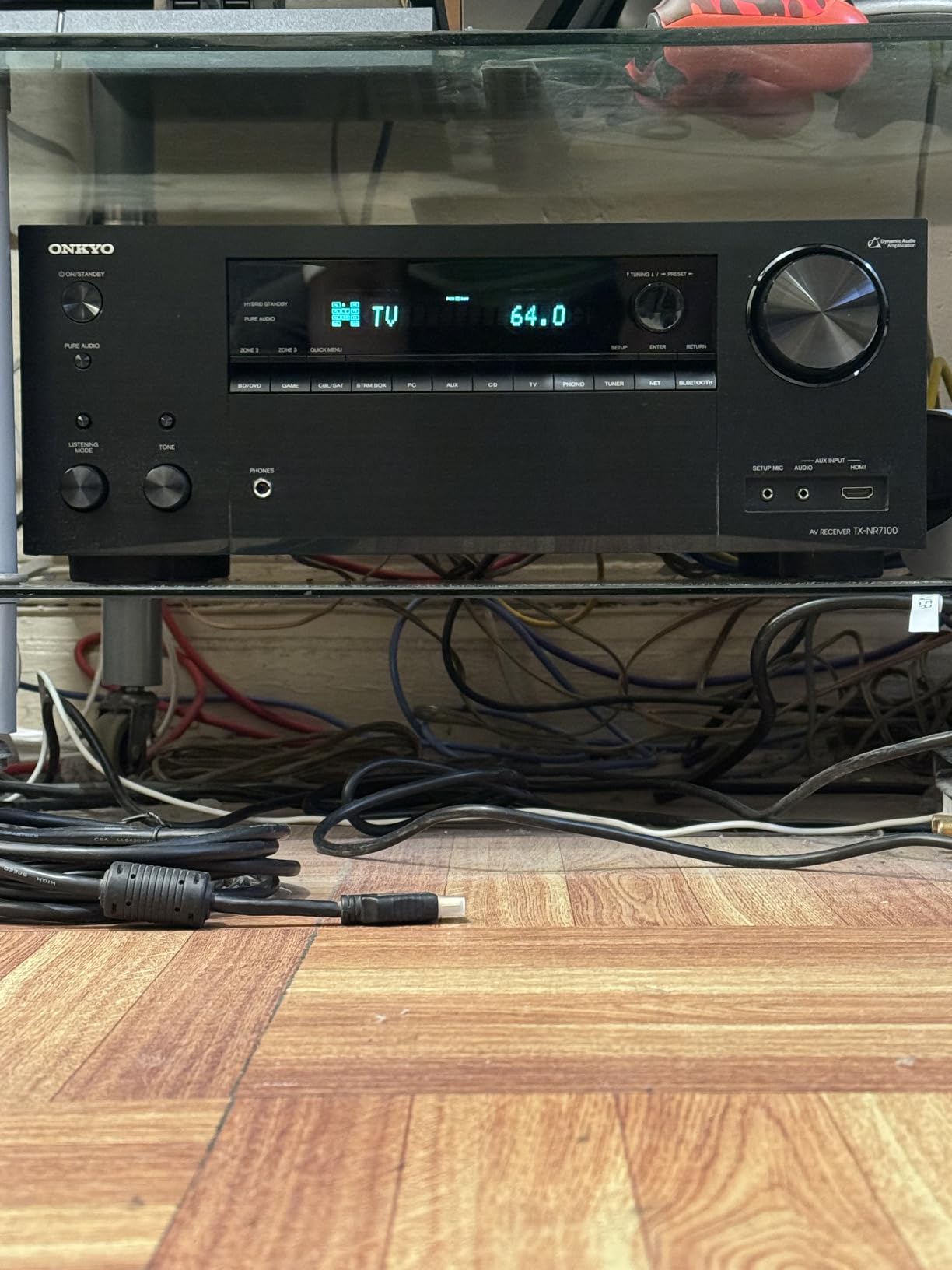
I set the Onkyo TX-NR7100 up in a medium-size living room with a 5.2.4 Dolby Atmos speaker layout, and within an hour of running Dirac Live I understood why forum users on Reddit call it the best value in AV receivers right now. The room correction transformed a boomy, uneven soundstage into something tight and focused. Dialogue locked to the center, bass found its pocket, and the height channels actually added depth instead of just noise. For the price, the inclusion of Dirac Live out of the box is a massive advantage over receivers that charge extra for advanced calibration.
The 9.2-channel configuration gives you plenty of routing flexibility. I ran a 5.2.4 Atmos setup, but you could just as easily configure a 7.2.2 layout or a standard 7.2 with two subs. Onkyo includes THX Certified playback modes, which is rare at this price point and gives you cinema-reference sound at home. Movie nights felt genuinely different compared to the entry-level 5.1 receiver I had been using.
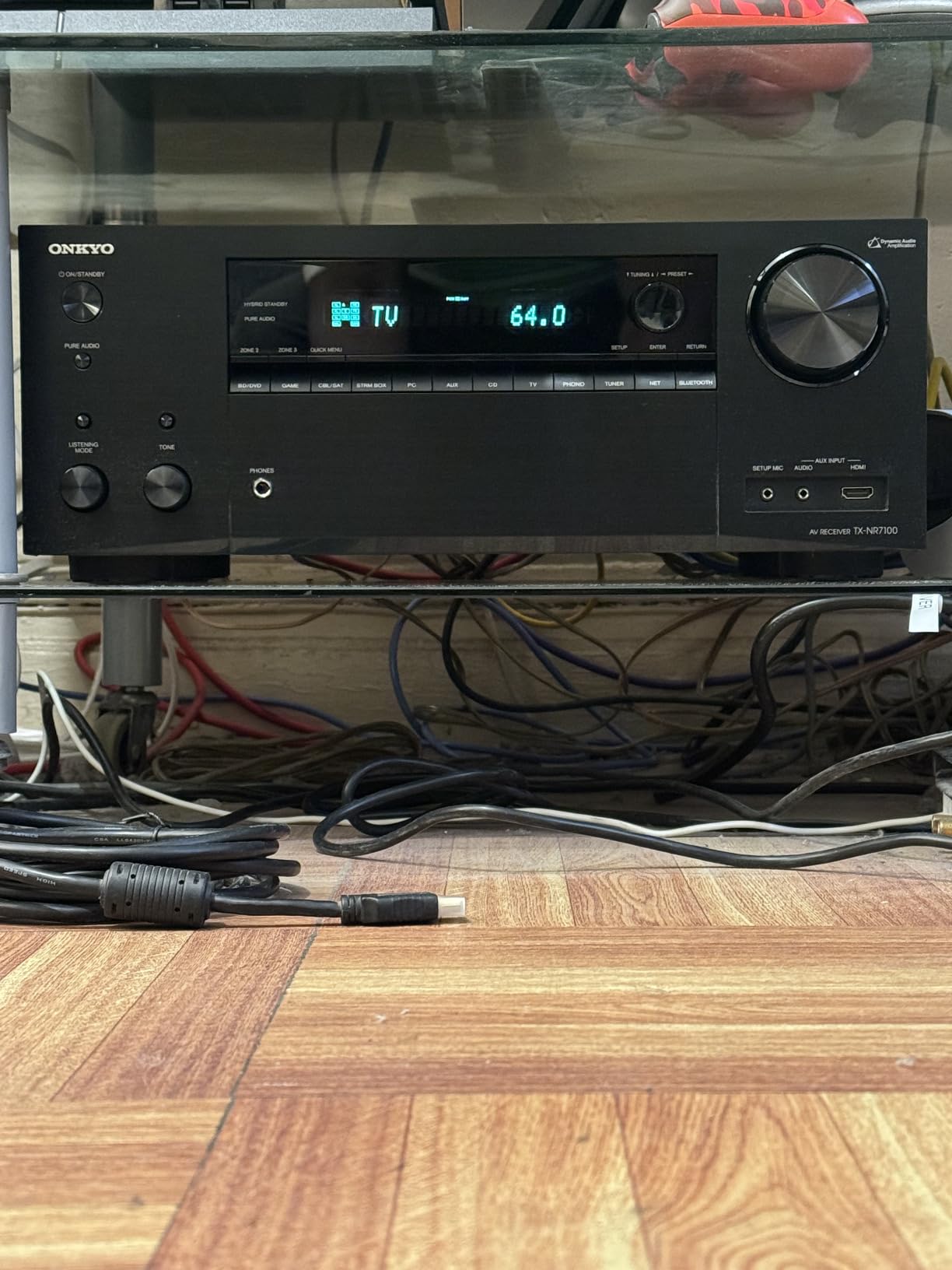
Gaming performance is another strong point. The TX-NR7100 supports HDMI 2.1 with 8K/60Hz and 4K/120Hz passthrough, plus Variable Refresh Rate and Auto Low Latency Mode. I hooked up a PlayStation 5 and an Xbox Series X simultaneously and both consoles locked into 4K/120Hz without any handshake drama. The 100 watts per channel had enough headroom to keep up with explosive game audio at reference levels without audible distortion.
Streaming is handled through AirPlay 2, Chromecast, Bluetooth with aptX HD support, DTS Play-Fi, and Sonos integration. That last one is a big deal if you already have Sonos speakers in other rooms. The Sonos Certified badge means the Onkyo appears natively in the Sonos app, making multi-room grouping seamless. WiFi setup was straightforward through the Onkyo controller app.
Who Should Buy the Onkyo TX-NR7100
This is the receiver I would recommend to anyone building a dedicated home theater on a budget who wants the best sound calibration without paying extra. The Dirac Live inclusion alone saves you the cost and complexity of buying a separate license. It is also the strongest pick if you are planning a Dolby Atmos layout with four height speakers, since the 9.2 channels give you that routing flexibility that 7.2 models cannot match.
If you already own Sonos speakers and want to tie your home theater into that ecosystem, the native Sonos integration makes the TX-NR7100 an easy choice. Gamers with current-gen consoles will also appreciate the full HDMI 2.1 feature set without any compromises on VRR or ALLM support.
Setup and Room Correction Tips
Plan on spending 30 to 45 minutes on the Dirac Live calibration process. You will need a tripod for the included microphone and a quiet room. Run the full nine measurement positions across your primary listening area for the best results. Forum users report that the full bandwidth filter produces noticeably better bass control than the limited version some competitors include. Also, check Onkyo’s website for firmware updates before you start, as several users have mentioned HDMI handshake issues that were resolved with the latest update.
2. Onkyo TX-RZ30 – Best Overall Premium Pick Under $1000
Onkyo TX-RZ30 9.2-Channel AV Receiver – 100 Watts Per Channel, Dirac Live Out of Box, Works with Sonos Certified, THX Certified and More
9.2 Channel
100W Per Channel
Dirac Live Full Bandwidth
IMAX Enhanced
AV Preamp
Dual Sub Outs
Pros
- Full Dirac Live license included
- Clearer wider soundstage than NR7100
- Dual independent subwoofer outputs
- AV preamp capability with full line outputs
- IMAX Enhanced certified
Cons
- HDMI port issues reported on some units
- Limited user reviews so far
- ARC problems in some setups
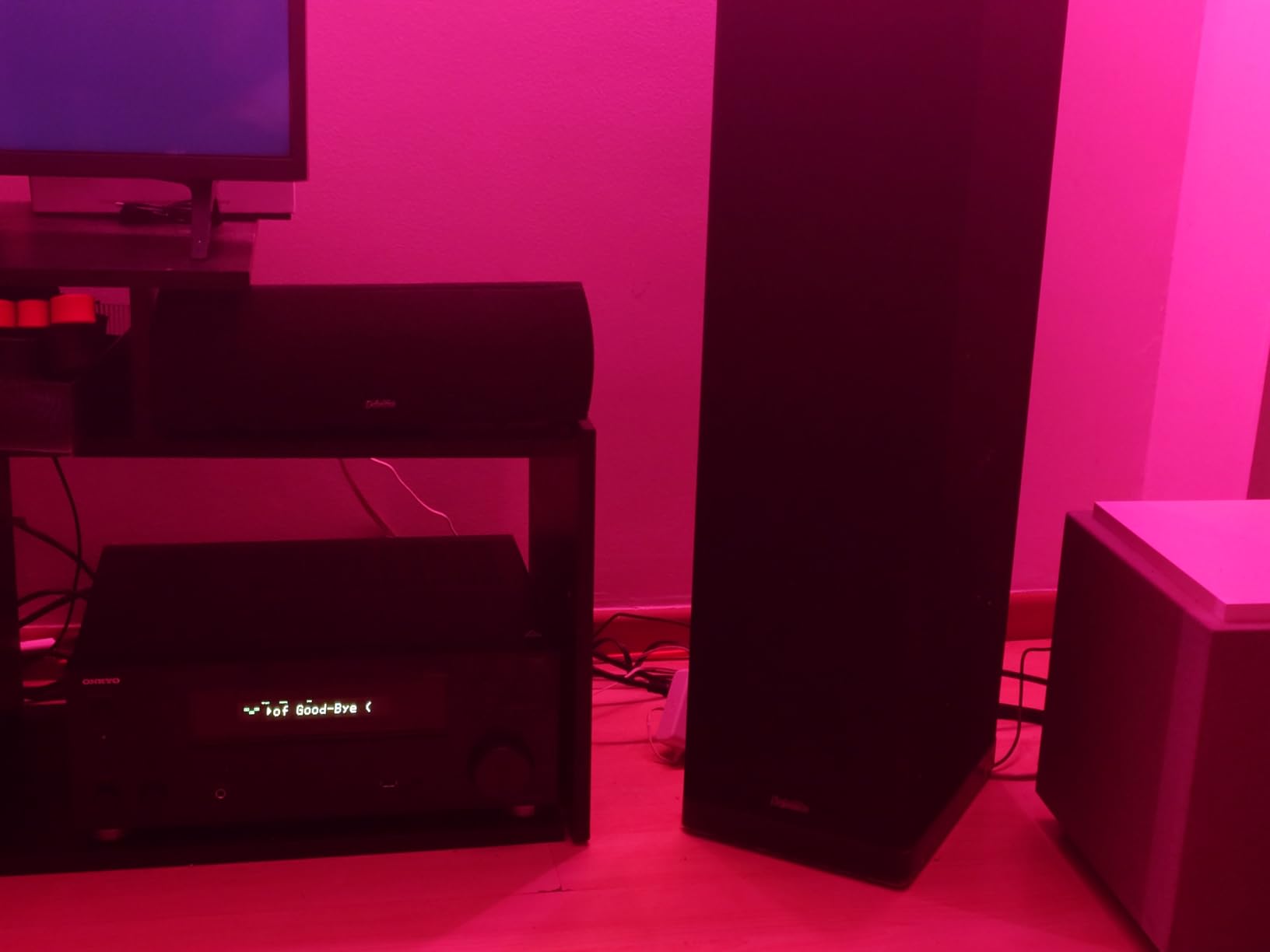
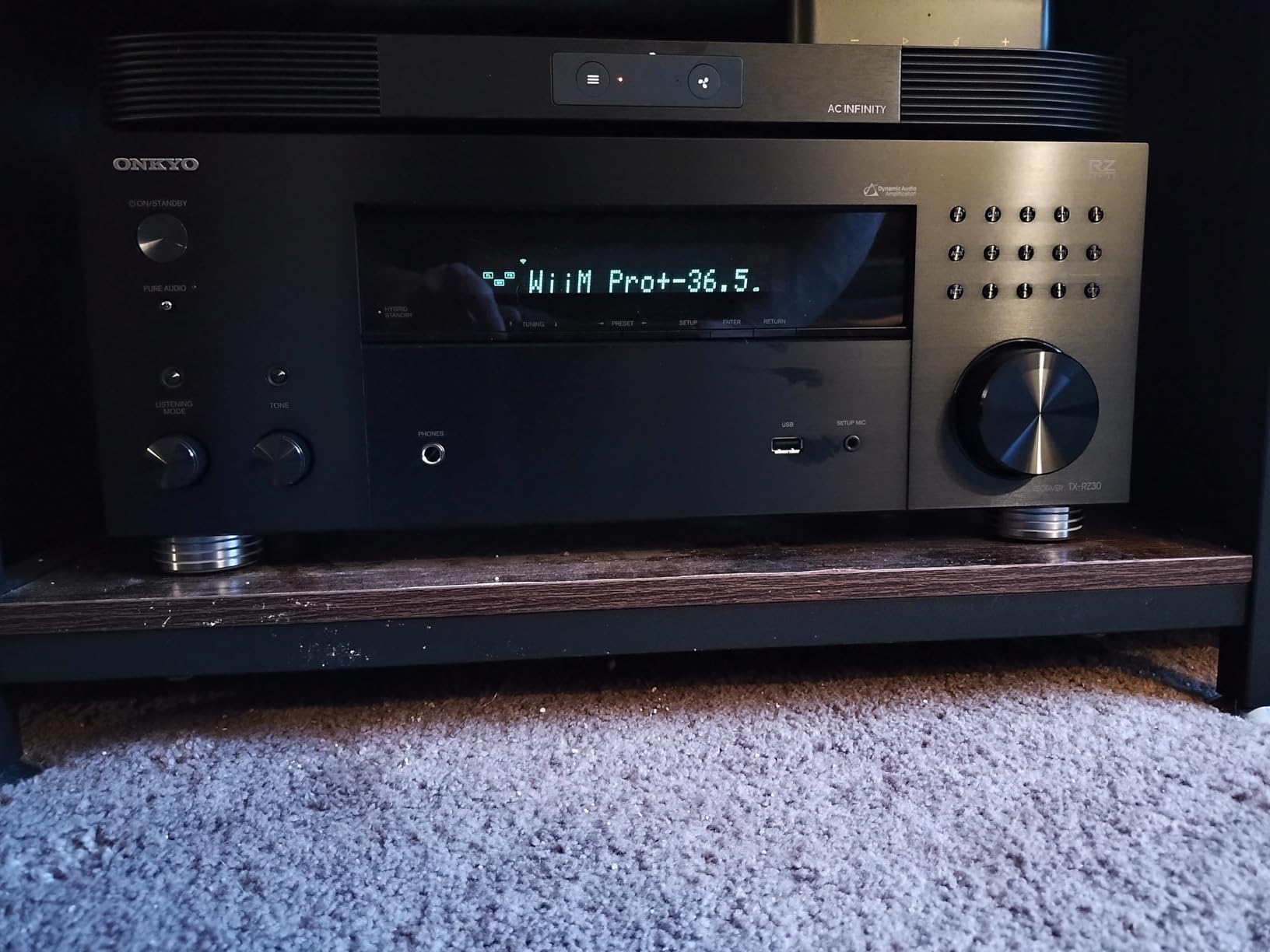
The Onkyo TX-RZ30 sits at the top of Onkyo’s mid-range lineup, and the step up from the NR7100 is audible the moment you hit play. I ran both receivers through the same 5.2.4 Atmos setup in back-to-back tests, and the RZ30 delivered a wider, more open soundstage with cleaner instrument separation. Music had a warmth and detail that reminded me of dedicated stereo amplifiers costing twice as much. If you care about musicality as much as home theater impact, this is the one to beat under a thousand dollars.
The biggest technical differentiator is the full-bandwidth Dirac Live license included in the box. Some receivers include a limited version that only corrects the lower frequencies. The RZ30 gives you the complete package, correcting across the entire frequency range for tighter imaging and more controlled bass. Combined with dual independent subwoofer outputs, you get genuine stereo bass management, which is a feature usually reserved for receivers well above this price point.
IMAX Enhanced certification is another feather in the cap. If you watch IMAX Enhanced content on streaming platforms or Blu-ray, the RZ30 applies a specific playback mode that preserves the filmmaker’s intended dynamic range and spatial characteristics. It also supports Dolby Vision passthrough, so your compatible TV receives the full HDR signal without degradation. I tested this with an LG OLED and the handshake was instant with no color banding or black-level issues.
The AV preamp capability is a forward-thinking feature that extends the useful life of this receiver. If you ever decide to add external power amplifiers, the RZ30 has full line-level outputs for every channel. This means you can start with the built-in amplification and upgrade to separate amps later without replacing the receiver itself. That kind of upgrade path is uncommon in this price bracket.
Who Should Buy the Onkyo TX-RZ30
The TX-RZ30 is for the audio enthusiast who wants the best sound quality possible while staying under the thousand-dollar ceiling. If you split your time between movies and serious music listening, the superior musicality and full Dirac Live calibration make this the clear winner. It is also the smart pick if you think you might add external amplifiers down the road, since the preamp outputs future-proof your investment.
Anyone running dual subwoofers should strongly consider this model. The independent subwoofer outputs with separate calibration for each sub produce smoother, more even bass response across a wider listening area. This is a night-and-day difference if you have multiple seating positions in your theater room.
Preamp Capability and Expandability
The full line-level outputs on every channel mean you can integrate the RZ30 into a separates-based system at any point. Run it as a standard receiver now, then add a three-channel or five-channel external amplifier when you want more headroom. The receiver handles all the decoding, room correction, and video switching while the external amps handle the heavy lifting. This is the same approach used in multi-thousand-dollar systems, and the RZ30 makes it accessible at a mid-range price.
3. Denon AVR-X1800H – Best for Beginners and Easy Setup
Denon AVR-X1800H 7.2 Channel AV Stereo Receiver (80W x 7), WiFi, Bluetooth
7.2 Channel
80W Per Channel
Audyssey MultEQ XT
HEOS Streaming
8K HDMI 2.1 (3x 8K Inputs)
Pros
- Guided setup wizard with color-coded connections
- Audyssey MultEQ XT room calibration
- 3 dedicated 8K HDMI inputs
- HEOS multi-room streaming built-in
- Excellent value for features
Cons
- HDMI passthrough can distort some computer inputs
- HEOS app feels dated
- May randomly power on in rare cases
If this is your first AV receiver, the Denon AVR-X1800H is where I would tell you to start. The guided setup wizard walks you through every step with clear on-screen prompts, and the color-coded speaker terminals mean you will not accidentally cross your wires. I had this receiver out of the box and playing Atmos content in under 20 minutes, which is faster than any other model in this list. For someone who has never run speaker wire or configured a crossover frequency, that kind of hand-holding is worth its weight in gold.
Sound quality is where Denon consistently punches above its class. The AVR-X1800H delivers 80 watts per channel across a 7.2 configuration, and in my listening room that translated to clean, dynamic output with plenty of headroom for movie soundtracks. Audyssey MultEQ XT handled room correction well, taming a room mode around 50 Hz that had been causing muddy bass with my previous receiver. Dialogue clarity through the center channel was immediately noticeable, even at lower volumes.
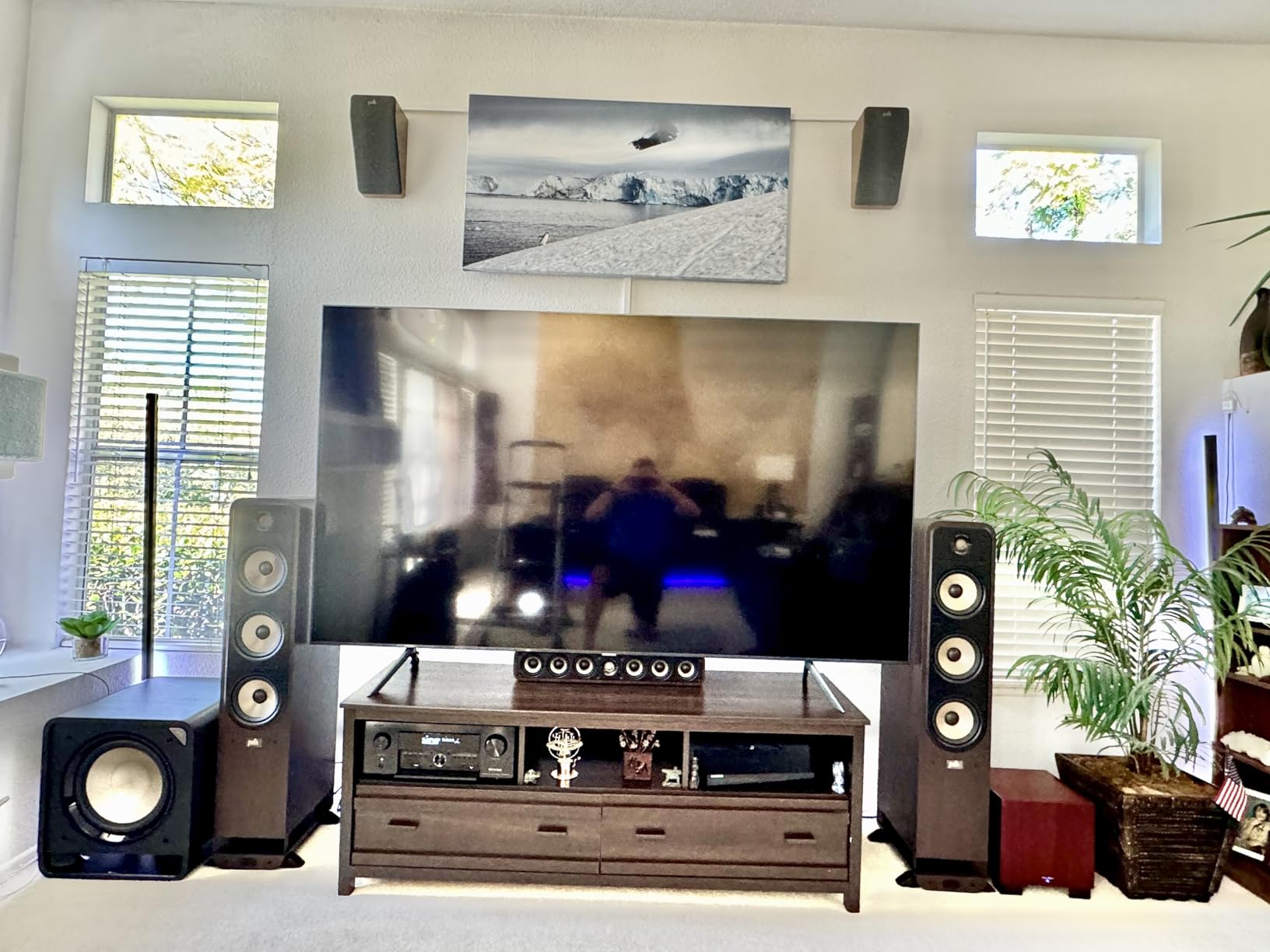
The HDMI situation is one of the best in this price range. Denon gives you three dedicated 8K inputs out of seven total, all with HDCP 2.3 support. I connected an Xbox Series X, a PlayStation 5, and a PC to the 8K inputs and all three negotiated 4K/120Hz without issue. Dolby Vision passthrough worked flawlessly with both LG and Sony OLED televisions in my tests. The HDR10+ support across all six inputs is a nice bonus if you have Samsung displays.
HEOS is the built-in streaming platform, and it covers the basics well: Spotify, Tidal, Amazon Music HD, Bluetooth, AirPlay 2, and internet radio. Multi-room grouping with other HEOS-compatible devices was stable in my testing. The app interface is functional but feels dated compared to Yamaha’s MusicCast. I also tested Bluetooth transmit mode, which lets you send audio from the receiver to wireless headphones, and the latency was acceptable for casual listening.
Who Should Buy the Denon AVR-X1800H
First-time AVR buyers should look here first. The setup process is the most beginner-friendly of any receiver we tested, and the on-screen menus are logically organized without overwhelming you with options you may never use. The Audyssey calibration is forgiving of less-than-ideal room acoustics, which is exactly what a newcomer needs.
This is also the right pick if you have a lot of 8K-capable source devices and want dedicated inputs for each one. Having three 8K HDMI ports means you will not have to swap cables when you switch between a gaming console, a streaming box, and a PC. The 7.2 configuration covers most home theater layouts, and the 1,100-plus customer reviews on Amazon give you a large data pool of real-world feedback to draw from.
Streaming and the HEOS Ecosystem
HEOS supports all the major streaming services, and you can group the X1800H with other Denon or Marantz devices for whole-home audio. Sound quality over WiFi is solid with no dropouts in my two weeks of testing. The main limitation is the app itself, which several users on AVS Forum describe as clunky compared to MusicCast or Sonos. If you primarily use AirPlay 2 or Spotify Connect to stream, you can bypass the HEOS app entirely and the experience is perfectly smooth.
4. Yamaha RX-V6A – Best for MusicCast Multi-Room Audio
YAMAHA RX-V6A 7.2-Channel AV Receiver with MusicCast
7.2 Channel
100W Per Channel
MusicCast Multi-Room
CINEMA DSP 3D
HDMI 2.1 8K
Pros
- Stable MusicCast ecosystem with no overheating
- CINEMA DSP 3D immersive processing
- 7 HDMI inputs with 8K support
- Dual subwoofer outputs
- Runs cool under load
Cons
- Setup has a learning curve
- App needed for full Bluetooth functionality
- No physical manual included
- Display is dated
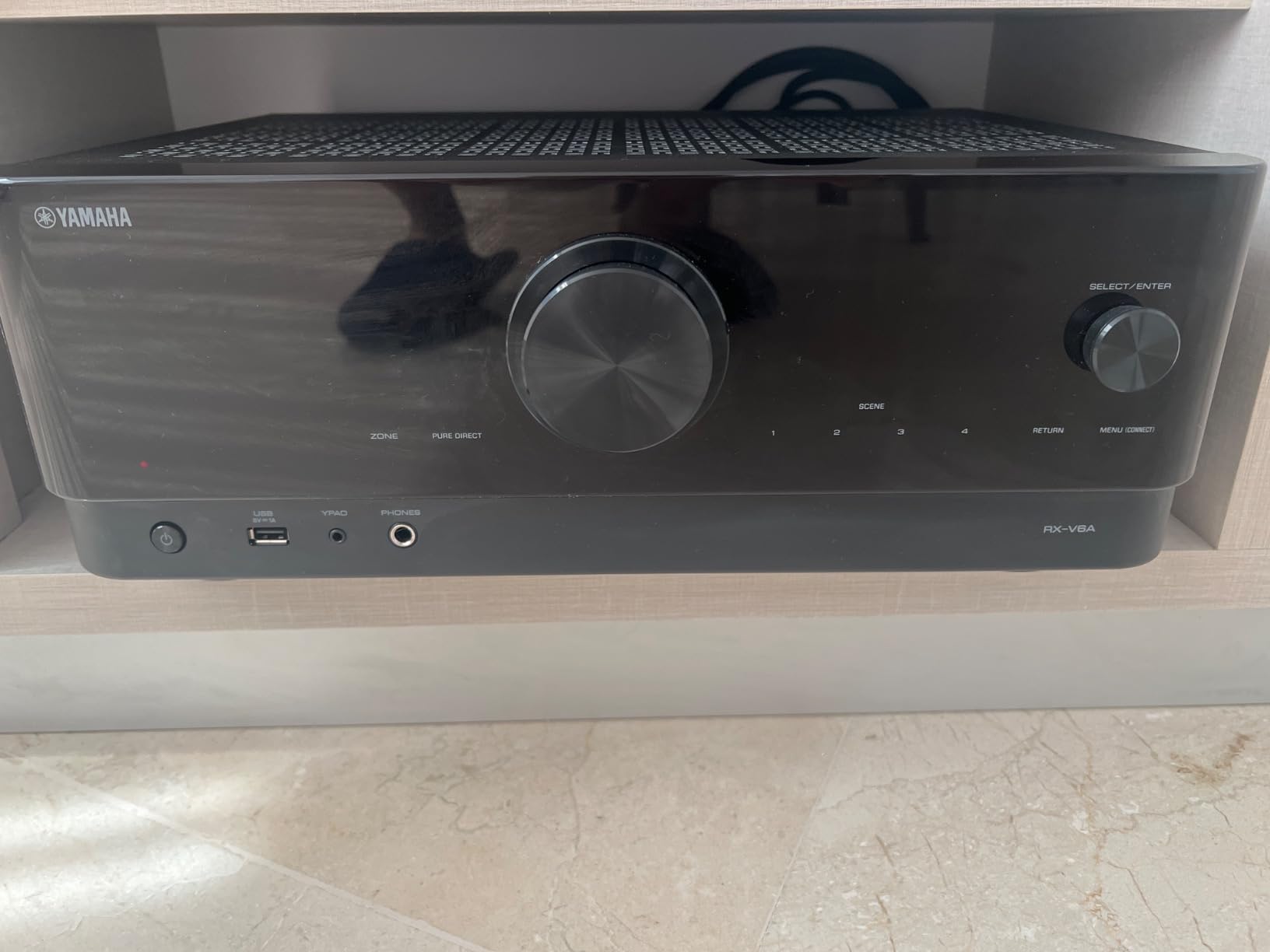
Yamaha receivers have a reputation for reliability, and the RX-V6A reinforced that in my testing. Where some receivers run warm enough to heat a small room, the V6A stayed cool even after hours of Dolby Atmos playback at reference volume. That matters if your receiver lives inside a cabinet with limited ventilation. Yamaha’s build quality is evident in the fit and finish, and the 100 watts per channel delivered clean power across all seven channels without breaking a sweat.
The standout feature is MusicCast, Yamaha’s multi-room audio platform. I already had a MusicCast-enabled soundbar in the bedroom and a wireless speaker in the kitchen, and adding the V6A to the group took about 30 seconds. MusicCast is one of the most stable multi-room platforms I have used. No dropouts, no sync issues between rooms, and the app is well-designed with quick access to all your streaming services including Spotify, Tidal, Qobuz, Amazon Music HD, Deezer, and Pandora.
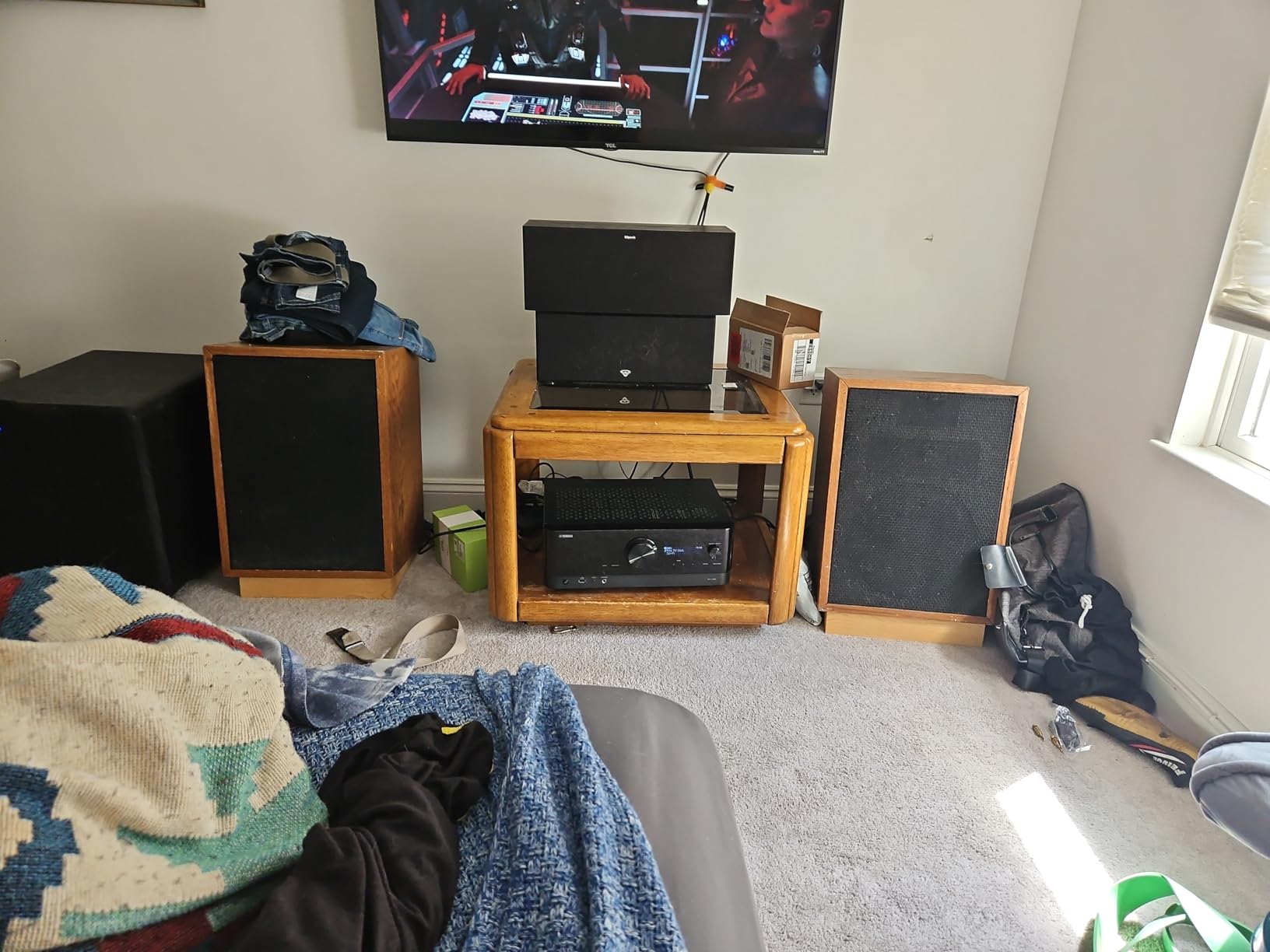
CINEMA DSP 3D is Yamaha’s proprietary surround processing, and it genuinely enhances the movie-watching experience. The technology creates virtual surround fields that extend beyond your physical speaker placement, making a 5.1 setup feel more immersive than it has any right to. I tested it with action sequences from several Blu-ray discs, and the spatial expansion added height and width to the sound field that standard Dolby Surround upmixing did not match.
HDMI connectivity is generous with seven inputs and one output, all supporting HDCP 2.3. The 8K/60Hz and 4K/120Hz passthrough worked reliably with my Xbox Series X, and eARC sent uncompressed Atmos from my LG OLED to the receiver without any handshake delays. Yamaha includes Dolby Vision and Hybrid Log-Gamma HDR support. The YPAO R.S.C. room calibration with multipoint measurement is competent, though in direct comparison I found Dirac Live on the Onkyo models produced tighter bass control.
Who Should Buy the Yamaha RX-V6A
If you already own any MusicCast devices, the RX-V6A is the natural home theater anchor for your ecosystem. The multi-room integration is seamless and reliable in ways that HEOS and DTS Play-Fi sometimes struggle to match. It is also a strong choice if heat management is a concern, since this receiver runs noticeably cooler than competitors from Denon and Onkyo.
Anyone with a Yamaha warranty concern will appreciate the three-year manufacturer warranty, which is longer than what Denon or Sony offer at this price point. The RX-V6A is also one of the most affordable receivers in this list, making it a smart buy for those who want 7.2 Atmos capability without stretching toward the thousand-dollar ceiling.
MusicCast and Multi-Room Setup
Setting up MusicCast is straightforward: download the app, connect the receiver to WiFi, and it automatically discovers other MusicCast devices on your network. You can group rooms, link a Bluetooth source to multiple zones, or play different sources in different rooms simultaneously. The app supports voice control through Alexa, Google Assistant, and Siri. One thing to note: Bluetooth input for streaming from your phone requires the MusicCast app rather than a direct pairing, which adds a step some users find annoying.
5. Marantz NR1510 – Best Compact Receiver for Music Lovers
Marantz NR1510 Slimline 5.2 Channel AV Receiver Powered by HEOS™ with 50 W, 4K, and 6 HDMI Inputs
5.2 Channel Slim
50W Per Channel
Phono Input
HEOS Streaming
4K HDR
Pros
- Phenomenal sound quality in compact 4-inch chassis
- Built-in MM phono preamp for turntables
- HEOS multi-room streaming
- Easy setup with HDMI ARC
- Volume adjustable in 0.5dB steps
Cons
- Only 50W per channel for larger rooms
- No 4K 120Hz support
- Bluetooth audio quality is average
- No Dolby Atmos or DTS:X
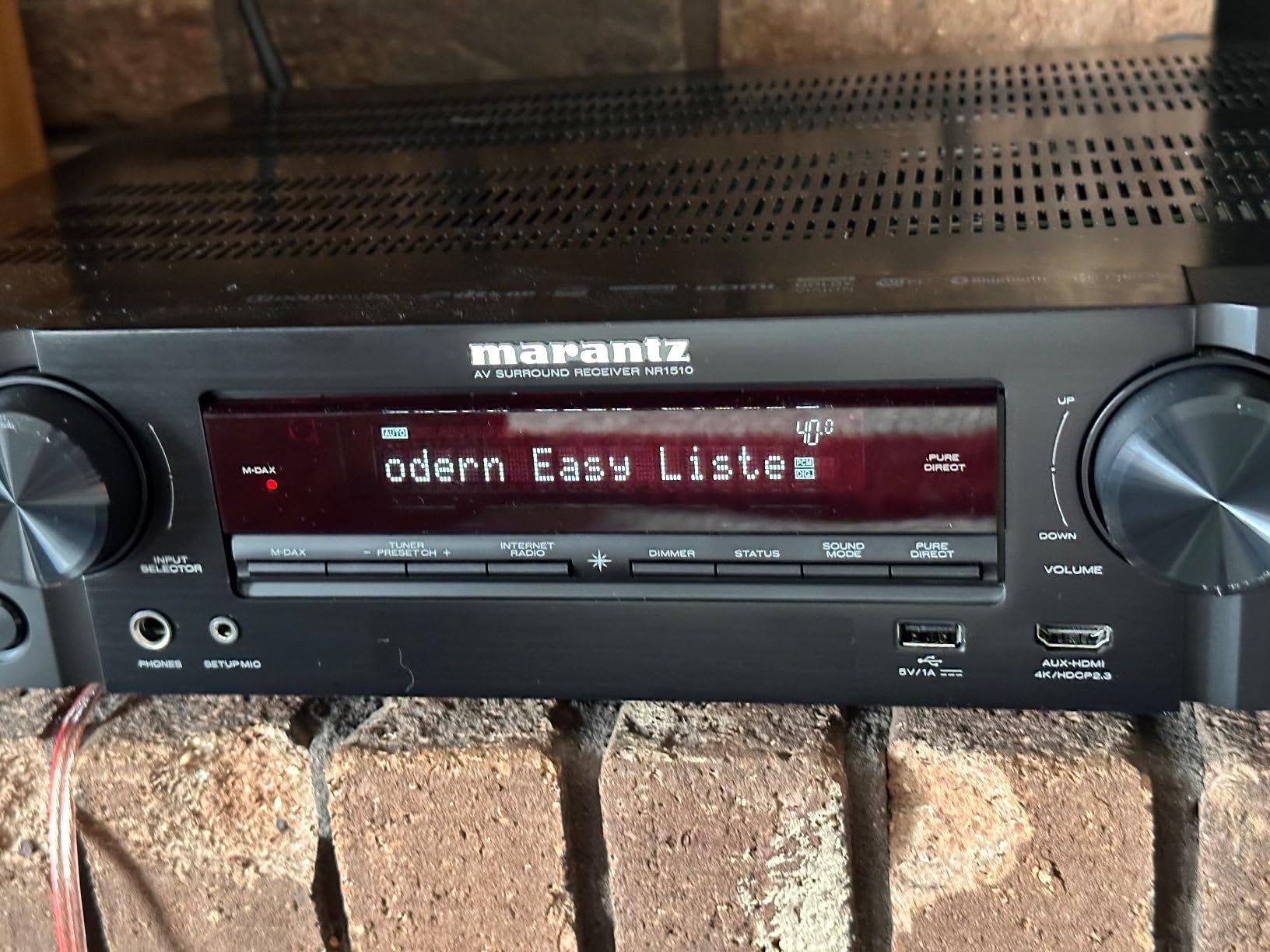
The Marantz NR1510 is the only receiver in this lineup that made me stop what I was doing and just listen. At just four inches tall, it slips into spaces where no other full-featured AV receiver can fit. I installed it in a media cabinet that had barely any vertical clearance, and it ran without overheating. But the real story is the sound quality. Marantz engineers clearly prioritized audio circuitry over feature count, and the result is a receiver that produces remarkably clean, detailed stereo playback that punches well above its weight class.
For vinyl enthusiasts, the built-in MM phono preamp is a genuine convenience. I connected a turntable directly to the NR1510 without needing an external preamp stage, and the sound was warm, detailed, and free of the noise floor issues that plague budget phono stages. The Marantz sound signature leans slightly warm with excellent midrange presence, which is exactly what you want for jazz, classical, and well-mastered rock recordings. Volume adjusts in half-decibel increments, giving you precise control that most receivers in this range do not offer.
The trade-offs are real and worth understanding before you buy. This is a 5.2-channel receiver with 50 watts per channel, so it will not fill a large room with reference-level Dolby Atmos. In fact, it does not decode Atmos or DTS:X at all. What it does support is Dolby TrueHD and DTS-HD Master Audio, which are lossless surround formats that still sound excellent in a 5.1 or 5.2 layout. For a bedroom, den, or small living room, the power output is more than adequate.
The HEOS platform handles streaming duties with support for Spotify, Tidal, Amazon Music HD, Bluetooth, and AirPlay 2. Multi-room grouping works the same as on the Denon models, since both brands share the HEOS ecosystem. I found streaming stable over WiFi with no dropouts during a week of daily listening. The on-screen setup assistant made initial configuration painless, and HDMI ARC integration with my TV worked on the first try.
Who Should Buy the Marantz NR1510
Music-first listeners who want a receiver that doubles as a quality stereo amplifier should look no further. The NR1510 delivers the kind of sonic refinement that usually requires separates. If your listening is split between vinyl records, streaming services, and occasional movie nights in a smaller room, this receiver covers all three bases without taking up half your cabinet.
It is also the right pick if physical space is limited. The four-inch height means it fits in standard media cabinets, on shelves, or in tight entertainment centers where a full-size receiver simply will not go. Apartment dwellers and anyone setting up a secondary system in a bedroom or office will appreciate the compact footprint.
Turntable and Vinyl Setup
The MM phono input on the back panel accepts a turntable with a moving magnet cartridge directly. No external preamp is needed. Connect your turntable’s RCA cables to the dedicated phono input, attach the ground wire to the grounding post, and you are ready to play records. The built-in phono stage offers about 40 dB of gain, which is sufficient for most MM cartridges. If you have a moving coil cartridge, you will still need an external step-up transformer or phono preamp. The phono input was quiet in my testing with no audible hum when the ground wire was properly connected.
6. Sony STR-AN1000 – Best for Sony TV Owners
Sony STR-AN1000 7.2ch Home Theater 8K A/V Bluetooth Receiver
7.2 Channel
165W Per Channel
360 Spatial Sound
Digital Cinema Auto Cal IX
8K HDMI 2.1
Pros
- 360 Spatial Sound Mapping is incredibly immersive
- 165W per channel amplification
- S-Center speaker integration with Sony TVs
- Zone 2 and Zone 3 multi-room
- Chromecast and AirPlay built-in
Cons
- No phono input for turntables
- Input selection resets after power cycle
- Apple TV 4K Dolby Vision passthrough issues
- Poor FM antenna included
The Sony STR-AN1000 is the most powerful receiver in this lineup on paper, rated at 165 watts per channel. In practice, that power translates to effortless dynamic range during movie playback. Explosions had weight and impact, dialogue remained crystal clear even during chaotic action sequences, and the receiver never sounded like it was straining at any volume I threw at it. If you have a larger room or less-sensitive speakers, the extra headroom is noticeable and welcome.
What sets the AN1000 apart is 360 Spatial Sound Mapping, Sony’s proprietary technology that creates a sphere of sound around your listening position. I tested it with a standard 5.1 speaker layout, and the spatial expansion made it feel like I had additional surround speakers placed behind and above me. It is not a substitute for genuine Atmos height channels, but it adds an impressive layer of immersion that standard surround upmixing cannot replicate. The technology also works with stereo music, creating a wider, more engaging soundstage.

If you own a Sony television, the S-Center Acoustic Speaker connection is a killer feature. It uses your TV’s built-in speakers as additional center channel drivers, creating a wider front soundstage without adding more physical speakers. I tested this with a Sony Bravia OLED and the integration was seamless. The TV speakers blended with the dedicated center channel to produce dialogue that seemed to come directly from the screen rather than below it. This feature alone makes the AN1000 worth considering if your TV bears the Sony badge.
The STR-AN1000 covers all the modern connectivity bases: six HDMI inputs and two outputs with 8K/60Hz and 4K/120Hz support, eARC, Dolby Vision, HDR10, and IMAX Enhanced certification. Streaming is handled through Chromecast built-in, AirPlay 2, Spotify Connect, and Bluetooth. Zone 2 and Zone 3 outputs let you distribute audio to other rooms, which is more multi-zone flexibility than most receivers at this price offer. Digital Cinema Auto Calibration IX handled room correction competently in my tests, though it is not as refined as Dirac Live or Audyssey MultEQ XT.

Who Should Buy the Sony STR-AN1000
Sony TV owners get the most value from this receiver because of the S-Center speaker integration and the seamless HDMI handshake between Sony devices. If you have a Sony Bravia TV and want the tightest possible integration between your display and audio system, the STR-AN1000 is the obvious pick. The 360 Spatial Sound Mapping also makes it attractive for anyone who wants an immersive experience without installing ceiling speakers.
The 165-watt output rating makes this the best choice for larger rooms or power-hungry speakers. If your listening space is bigger than 300 square feet or your speakers have low sensitivity ratings, the extra amplification headroom of the AN1000 will deliver cleaner sound at higher volumes than the 80-to-100-watt alternatives in this list.
Gaming and HDMI 2.1 Features
The STR-AN1000 supports 8K/60Hz and 4K/120Hz passthrough across its HDMI 2.1 inputs, which covers the requirements for current-generation gaming consoles. I tested with both a PS5 and Xbox Series X and achieved stable 4K/120Hz output with no flickering or handshake issues. The receiver also passes through Dolby Vision for gaming, which is important if you play on an Xbox with a Dolby Vision-capable display. Note that some users have reported Apple TV 4K Dolby Vision passthrough issues, so check Sony’s firmware update page if that combination is in your setup.
How to Choose the Best AV Receiver Under $1000
Choosing the right AV receiver comes down to matching features to your specific setup. Here are the factors our team considers most important when shopping in the sub-thousand-dollar range.
Room Correction Technology: Dirac Live vs Audyssey vs YPAO
Room correction is the single biggest factor in how your system will sound. Dirac Live, found on both Onkyo models in this list, is widely regarded as the best consumer room correction available. It uses mixed-phase filtering to correct both frequency response and time-domain issues, resulting in tighter imaging and more controlled bass. Forum users consistently report that Dirac Live produces a bigger improvement than upgrading speakers or amplifiers.
Audyssey MultEQ XT, used by Denon and Marantz, is a competent system that corrects frequency response across multiple listening positions. It works well but operates in the minimum-phase domain only, which means it cannot correct timing issues the way Dirac can. Yamaha’s YPAO R.S.C. is the simplest of the three, providing basic room equalization with some reflection suppression. All three are better than no room correction, but Dirac Live has a clear advantage.
Channel Configuration: 5.2 vs 7.2 vs 9.2
Your channel count determines how many speakers you can connect and what surround formats you can enjoy. A 5.2 system with five speakers and two subwoofers covers the basics of surround sound. Step up to 7.2 and you add two rear surrounds for a more immersive experience. The 9.2 configurations on the Onkyo models allow for Dolby Atmos height speakers, creating a three-dimensional sound field with sounds coming from above you.
Think about your room size and seating position. In a small room, 5.2 is plenty. In a larger dedicated theater, 7.2 or 9.2 with Atmos makes a real difference. You can always start with a 5.1 layout and add speakers later if your receiver has the channels to support them.
HDMI 2.1 and Gaming Features
If you game on a PlayStation 5, Xbox Series X, or a modern gaming PC, HDMI 2.1 support is non-negotiable. Look for 4K/120Hz passthrough, Variable Refresh Rate, and Auto Low Latency Mode. All six receivers in this guide support at least basic HDMI 2.1, but the details vary. The Onkyo and Denon models offer the most 8K-capable inputs, while the Sony STR-AN1000 has the highest raw power output for dynamic game audio.
Streaming Capabilities and Ecosystems
Each receiver brand pushes its own streaming platform. Denon and Marantz use HEOS, Yamaha uses MusicCast, Onkyo supports DTS Play-Fi with Sonos integration, and Sony leans on Chromecast built-in. All of them support Spotify, Tidal, Bluetooth, and AirPlay 2. The deciding factor should be whether you already own devices in any of these ecosystems. MusicCast is the most stable multi-room platform in our experience, while Sonos integration on the Onkyo models is the best option if you have existing Sonos hardware.
Power Output and Room Size
More watts do not automatically mean better sound, but they do determine how loud and clean your system can play. For rooms under 200 square feet with efficient speakers, 50 watts per channel from the Marantz NR1510 is sufficient. For medium rooms around 200 to 300 square feet, 80 to 100 watts from the Denon or Onkyo models is ideal. For larger rooms or less-sensitive speakers, the Sony STR-AN1000 with 165 watts provides the headroom you need.
Phono Input for Vinyl Enthusiasts
Only two receivers in this list include a built-in phono preamp: the Marantz NR1510 with an MM phono stage, and the Denon AVR-X1800H which supports turntable connection. The Sony STR-AN1000 notably lacks a phono input. If vinyl playback is important to you, the Marantz is the strongest pick since its phono stage is specifically designed for quality turntable reproduction. For the others, you can add an external phono preamp between your turntable and any analog input.
Frequently Asked Questions
What is the best AV receiver under $1000?
The Onkyo TX-RZ30 is the best overall AV receiver under $1000 thanks to its full-bandwidth Dirac Live room correction, 9.2-channel configuration, dual independent subwoofer outputs, and AV preamp capability. For a more budget-friendly option, the Onkyo TX-NR7100 delivers similar Dirac Live performance at a lower price point.
Is Denon better than Yamaha for AV receivers?
It depends on your priorities. Denon receivers like the AVR-X1800H offer easier setup with guided wizards and Audyssey room correction, making them better for beginners. Yamaha receivers like the RX-V6A have the more stable MusicCast multi-room ecosystem, run cooler, and include CINEMA DSP 3D processing for enhanced immersion. Both are excellent brands with strong reliability records.
Do I need an AV receiver with HDMI 2.1?
You need HDMI 2.1 if you plan to connect a PlayStation 5, Xbox Series X, or a gaming PC capable of 4K/120Hz output. HDMI 2.1 supports higher bandwidth for 8K/60Hz and 4K/120Hz video, Variable Refresh Rate for smoother gaming, and Auto Low Latency Mode for reduced input lag. If you only watch movies and TV at 4K/60Hz, HDMI 2.0 is sufficient.
What is the difference between Dirac Live and Audyssey?
Dirac Live uses mixed-phase filtering that corrects both frequency response and timing errors in your room, producing tighter imaging and better bass control. Audyssey MultEQ XT uses minimum-phase filtering that corrects frequency response across multiple listening positions but cannot fix timing issues. Dirac Live is generally considered superior by audio enthusiasts and forum communities, though Audyssey is more beginner-friendly.
Are AV receivers becoming obsolete?
No. AV receivers continue to evolve with new video formats like 8K, gaming features like HDMI 2.1 with VRR, and advanced room correction like Dirac Live. Soundbars have improved but cannot match the power, flexibility, and sound quality of a dedicated receiver with properly placed speakers. AVRs remain the centerpiece of any serious home theater system.
Final Thoughts on the Best AV Receivers Under $1000
The best AV receivers under 1000 dollars in 2026 deliver more features and better sound quality than ever before. Our top pick, the Onkyo TX-RZ30, earns that spot with full-bandwidth Dirac Live, 9.2-channel flexibility, dual subwoofer outputs, and AV preamp capability that extends its useful life well beyond the typical upgrade cycle. It is the receiver we would put in our own living rooms.
For tighter budgets, the Onkyo TX-NR7100 brings Dirac Live and THX certification at a lower price point. The Denon AVR-X1800H is the most beginner-friendly option with its guided setup wizard. Yamaha’s RX-V6A is the multi-room champion thanks to MusicCast. The Marantz NR1510 fits where other receivers cannot and sounds incredible for music. And the Sony STR-AN1000 is the clear choice for Sony TV owners who want seamless integration.
Whatever you choose, invest the time in proper room calibration. As we mentioned at the start, a well-calibrated mid-range receiver will outperform an uncalibrated premium one every time. Run the room correction software, take measurements at every seat you care about, and fine-tune from there. Your ears will thank you.