
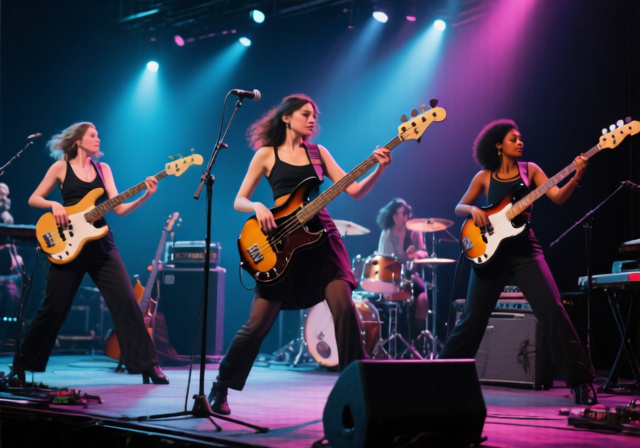
For decades, the world of bass guitar has been dominated by men, but women have been quietly revolutionizing this essential instrument since the earliest days of rock and roll. These incredible musicians have not only mastered their craft but have also broken barriers, pioneered new techniques, and inspired generations of players who followed.
Carol Kaye stands as the undisputed queen of bass guitar, having played on an estimated 10,000 recordings including hits for The Beach Boys, Simon & Garfunkel, and countless others as a member of the legendary Wrecking Crew.
In this comprehensive guide, we’ll explore 40 remarkable female bass players who have shaped music history across genres from rock and punk to jazz and funk. From pioneering session musicians to contemporary virtuosos, these artists demonstrate extraordinary technical skill, creative innovation, and enduring influence on the music world.
Whether you’re a bass player seeking inspiration, a music educator looking to diversify your curriculum, or simply a fan wanting to discover incredible musicians, this article will introduce you to the unsung heroes of the bass guitar world.
The Pioneering Legends: Foundation (1950s-1970s)
The 1950s through 1970s saw the first wave of female bass players breaking into the male-dominated music industry. These pioneers faced significant barriers but laid the groundwork for future generations through their exceptional talent and perseverance.
1. Carol Kaye – The Session Legend
Carol Kaye is arguably the most recorded bassist in history, male or female. As a key member of Los Angeles’ legendary Wrecking Crew, she played on thousands of hit recordings from the 1950s through the 1970s. Her distinctive basslines can be heard on classics like “Good Vibrations” by The Beach Boys, “La Bamba” by Ritchie Valens, “River Deep – Mountain High” by Ike & Tina Turner, and Simon & Garfunkel’s “Mrs. Robinson.”
Born in 1935, Kaye began as a professional guitarist at age 14 but switched to bass when a session musician failed to show up. Her intuitive understanding of song structure and flawless technique made her the go-to bassist for producers like Phil Spector and Brian Wilson. Kaye’s ability to craft memorable basslines that perfectly served each song while maintaining musical innovation has influenced countless bassists who followed.
Throughout her career, Kaye has played on everything from surf rock and pop to jazz and film scores. Her work spans an estimated 10,000+ recordings, making her one of the most prolific session musicians ever. Beyond her studio work, Kaye has also been dedicated to music education, creating instructional materials and teaching aspiring musicians about the art of bass playing.
Reasons to Love
Most recorded female bassist in history with an estimated 10,000+ recordings; Created iconic basslines for The Beach Boys, Simon & Garfunkel, and countless others; Pioneered the role of female session musicians in the recording industry
Reasons to Know
Her work was often uncredited on early recordings; Many people don’t realize she played on hits they’ve known their entire lives; Continues to teach and mentor new generations of musicians
2. Suzi Quatro – The Rock Pioneer
Suzi Quatro shattered gender barriers in the early 1970s as one of the first female rock stars to play bass guitar and sing lead vocals. Born in Detroit in 1950, Quatro began performing with her sisters in The Pleasure Seekers before launching her solo career in 1973.
Her breakthrough came with “Can the Can” which reached number one in the UK and Australia, followed by hits like “48 Crash,” “Devil Gate Drive,” and “Your Mamma Won’t Like Me.” Quatro’s aggressive bass playing style, powerful vocals, and leather-clad image challenged perceptions of what women could achieve in rock music.
Quatro’s influence extends beyond her own music—she inspired countless female rock musicians who followed. Her success paved the way for later artists like The Runaways and Girlschool. She has continued recording and performing for over five decades, maintaining relevance across multiple generations of music fans.
Reasons to Love
First female rock star to play bass and sing lead; Achieved international chart success with multiple hits; Influential figure in glam rock and early punk movements
Reasons to Know
Often overlooked in discussions of rock pioneers; Her image sometimes overshadowed her musical abilities; Still actively touring and recording after 50+ years
3. Bette Magnus – The Pleasure Seekers Co-founder
Bette Magnus (later Bette Sussman) co-founded The Pleasure Seekers with her sisters Suzi and Patti in 1964, making them one of the first all-female rock bands. As the band’s bassist, Magnus helped create a sound that blended rock, pop, and garage band energy that was revolutionary for its time.
The Pleasure Seekers gained regional fame in the Detroit area and even toured with famous acts like The Yardbirds and The Kinks. Magnus’s solid bass playing provided the foundation for the band’s energetic live performances, demonstrating early on that women could rock just as hard as their male counterparts.
After The Pleasure Seekers disbanded, Magnus continued her music career, later becoming an accomplished session musician and composer. Her early work helped establish a precedent for all-female bands that would inspire later groups like The Runaways, The Go-Go’s, and Girlschool.
Reasons to Love
Pioneered all-female rock band format; Provided solid bass foundation for one of the first female rock bands; Helped launch Suzi Quatro’s career
Reasons to Know
Largely unknown outside of music historian circles; The Pleasure Seekers didn’t achieve commercial success comparable to later female bands; Magnus’s session work later in career overshadowed early rock contributions
4. Ellen McIlwaine – Blues-Rock Bass Innovator
Ellen McIlwaine brought a unique approach to bass guitar in the late 1960s, blending blues, rock, and world music influences. Though primarily known as a slide guitarist, her bass playing demonstrated exceptional musicality and innovative techniques that influenced later players.
Born in 1945, McIlwaine began performing in folk clubs in the 1960s before signing with Atco Records. Her 1970 album “Honest I Do” showcased her versatility across multiple instruments, including distinctive bass work that combined melodic sensibility with rhythmic drive.
McIlwaine’s approach to bass emphasized melodic lines rather than traditional rhythmic patterns, helping expand the instrument’s role in blues-rock. Her incorporation of Eastern musical influences and unusual tunings demonstrated the creative possibilities available to bassists willing to experiment beyond conventional approaches.
Reasons to Love
Innovative approach combining blues, rock, and world music; Melodic bass playing style influenced later players; Versatile multi-instrumentalist
Reasons to Know
Better known for guitar work than bass; Limited commercial success; Often overlooked in histories of women in rock
5. Janice Fingel – Early Session Professional
Janice Fingel was among the first women to establish herself as a professional session bassist in the 1960s and 1970s. Her work spanned numerous recordings for various artists, though like many session musicians of the era, she often went uncredited on album liner notes.
Fingel’s versatility allowed her to work across multiple genres, from pop and rock to jazz and R&B. Her ability to adapt her playing style to serve different artists’ needs made her a valuable commodity in recording studios during this era when female session musicians were extremely rare.
While specific details about Fingel’s career remain scarce due to the undocumented nature of much session work from this period, her existence and professional success helped demonstrate that women could compete at the highest levels of studio musicianship despite the barriers of the era.
Reasons to Love
Early female session professional in male-dominated field; Versatile across multiple genres; Helped pave way for future female session musicians
Reasons to Know
Limited documentation of specific recordings; Like many session musicians, often went uncredited; Career details remain obscure
6. Ruth Underwood – Frank Zappa Collaborator
Ruth Underwood made significant contributions to Frank Zappa’s music in the 1970s, primarily as a percussionist but occasionally on bass. Her exceptional musicianship and ability to execute complex rhythmic patterns made her an essential member of Zappa’s band during his most creative period.
Though known primarily for mallet percussion, Underwood’s understanding of rhythm and harmony informed her approach when she did play bass. Her work with Zappa demonstrated exceptional technical proficiency and musical creativity, helping realize some of Zappa’s most challenging compositions.
Underwood’s success in Zappa’s notoriously demanding musical environment was remarkable for any musician, let alone a woman in the 1970s progressive rock scene. Her contributions helped expand perceptions of what women could achieve in technically demanding musical contexts.
Reasons to Love
Key collaborator with Frank Zappa during his peak creative period; Exceptional rhythmic understanding and technical proficiency; Broke barriers in progressive rock
Reasons to Know
Primarily known as percussionist rather than bassist; Limited bass recordings; Work often overshadowed by Zappa’s larger persona
7. Katherine Thomas – Early Jazz Bassist
Katherine Thomas was among the pioneering female jazz bassists who emerged in the 1950s and 1960s. In an era when jazz remained male-dominated, Thomas’s upright bass playing demonstrated exceptional skill and musicality that earned her respect in the jazz community.
Thomas’s approach combined traditional jazz bass techniques with innovative harmonic sensibilities. Her ability to walk basslines with sophisticated chord knowledge and melodic improvisation made her a valuable contributor to various jazz ensembles throughout her career.
Like many women in early jazz, Thomas faced significant barriers to recognition and opportunities. Despite these challenges, her persistence and talent helped open doors for future generations of female jazz musicians, particularly in the traditionally male domain of the rhythm section.
Reasons to Love
Pioneering female jazz bassist in male-dominated field; Sophisticated harmonic knowledge and technique; Helped open doors for future female jazz musicians
Reasons to Know
Limited documentation of specific recordings and performances; Often overlooked in jazz histories; Faced significant barriers to recognition
8. Mona Lisa Young – R&B and Soul Bass Pioneer
Mona Lisa Young contributed to the development of R&B and soul bass playing in the 1960s and 1970s. Her work with various soul and R&B artists helped define the sound of the era while demonstrating that women could excel in this genre.
Young’s bass playing emphasized the groove and pocket essential to R&B and soul music. Her ability to lock in with drummers while creating melodic basslines that enhanced vocal performances made her a valuable contributor to numerous recordings, though like many session musicians of the era, she often went uncredited.
Young’s success in the R&B and soul scene helped demonstrate that women could contribute meaningfully to traditionally male-dominated genres. Her playing influenced later female bassists who worked in funk, soul, and related styles.
Reasons to Love
Pioneered female bass in R&B and soul; Strong groove and pocket playing; Influenced later funk and soul bassists
Reasons to Know
Often uncredited on recordings; Limited documentation of specific contributions; Career details remain somewhat obscure
Alternative & Punk Revolutionaries (1980s-1990s)
The alternative and punk movements of the 1980s and 1990s provided new opportunities for female bass players to emerge. These genres’ DIY ethos and rejection of traditional gender roles created space for women to take prominent roles in bands, with many choosing bass guitar as their instrument of choice.
9. Tina Weymouth – New Wave Pioneer
Tina Weymouth revolutionized bass playing in new wave and post-punk music as a founding member of Talking Heads. Her distinctive style combined minimalist approach with rhythmic innovation, creating basslines that were both foundational and forward-thinking.
Born in 1950, Weymouth was largely self-taught when she co-founded Talking Heads in 1975. Her playing on tracks like “Psycho Killer,” “Once in a Lifetime,” and “Burning Down the House” demonstrated how bass could drive songs while exploring unconventional rhythmic territory.
Weymouth’s approach often emphasized space and groove over technical complexity, proving that simple, well-placed basslines could be incredibly effective. She and drummer Chris Frantz formed one of rock’s most innovative rhythm sections, creating a foundation that allowed Talking Heads to explore diverse musical territories from art rock to world music influences.
Beyond Talking Heads, Weymouth found even greater commercial success with Tom Tom Club, whose hit “Genius of Love” became one of the most sampled songs in hip hop history. Her influence extends across multiple genres, from alternative rock to electronic music.
Reasons to Love
Innovative new wave bass style influenced countless players; Part of one of rock’s most creative rhythm sections; Created enduring basslines with minimal, memorable approach
Reasons to Know
Often described herself as “not a real musician” despite immense talent; Self-taught approach sometimes overshadowed technical aspects; Tom Tom Club success sometimes eclipses Talking Heads contributions
10. Kim Gordon – Alternative Rock Icon
Kim Gordon defined the sound of alternative rock as the bassist for Sonic Youth, one of the most influential bands of the 1980s and 1990s. Her unconventional approach to bass playing matched the band’s experimental ethos, helping create a distinctive sound that influenced generations of alternative musicians.
Born in 1953, Gordon co-founded Sonic Youth in 1981, bringing an artistic sensibility to bass playing that prioritized texture and mood over traditional technique. Her work on albums like “Daydream Nation,” “Goo,” and “Dirty” demonstrated how bass could contribute to noise rock and experimental music without sacrificing musicality.
Gordon’s playing often employed prepared bass techniques, alternate tunings, and effects to create unique sounds. Her approach influenced the entire alternative rock genre, particularly bands exploring the boundaries between melody and noise. Beyond her bass playing, Gordon’s visual art background and artistic perspective shaped Sonic Youth’s overall aesthetic.
Gordon’s influence extends beyond music—she’s also a respected visual artist, writer, and fashion designer. Her multifaceted creativity has inspired countless artists to pursue interdisciplinary approaches to their work.
Reasons to Love
Pioneered alternative rock bass approach; Experimental techniques influenced noise rock and beyond; Multifaceted artist bringing visual art sensibility to music
Reasons to Know
Unconventional techniques sometimes overshadow traditional playing; Sonic Youth’s experimental nature isn’t universally accessible; Visual art career sometimes distracts from musical contributions
11. Kim Deal – Indie Rock Pioneer
Kim Deal helped define indie rock bass playing as a member of The Pixies and later The Breeders. Her distinctive style combined melodic sensibility with raw energy, creating basslines that were both catchy and powerful.
Born in 1961, Deal joined The Pixies in 1986 despite having limited experience on bass guitar. Her playing on songs like “Debaser,” “Gigantic,” and “Here Comes Your Man” demonstrated how bass could drive indie rock songs while providing melodic hooks that rivaled the vocals.
Deal’s approach emphasized simple, effective lines that perfectly complemented Black Francis’s songwriting. Her distinctive bass sound—often achieved with minimal effects—became an essential element of The Pixies’ influential sound that inspired bands from Nirvana to Radiohead.
After leaving The Pixies, Deal formed The Breeders with her sister Kelley, achieving mainstream success with the album “Last Splash” and hit single “Cannonball.” Her continued musical output across multiple decades has demonstrated remarkable consistency and creativity.
Reasons to Love
Created iconic indie rock basslines in The Pixies; Melodic approach influenced countless indie bands; Successful with multiple bands across decades
Reasons to Know
Relatively simple playing style sometimes undervalued technically; Limited solo work outside band contexts; The Pixies’ initial success came after breakup
12. Sean Yseult – Metal Pioneer
Sean Yseult broke gender barriers in heavy metal as the bassist for White Zombie, one of the most influential metal bands of the late 1980s and early 1990s. Her powerful playing and distinctive visual style helped define the band’s sound and aesthetic.
Born in 1966, Yseult co-founded White Zombie in 1985, developing a bass approach that combined metal’s aggressive energy with groove elements from funk and industrial music. Her playing on albums like “La Sexorcisto: Devil Music, Vol. 1” and “Astro-Creep: 2000” provided the heavy foundation for Rob Zombie’s theatrical vocals and horror-themed lyrics.
Yseult’s success in the male-dominated metal scene was remarkable, proving that women could excel in even the most aggressive musical genres. Her visual style—combining alternative fashion with metal aesthetics—created a distinctive look that influenced many musicians who followed.
After White Zombie disbanded, Yseult continued making music with various projects and also pursued visual art, showing photography and creating multimedia installations. Her diverse artistic output has demonstrated creative versatility beyond her metal roots.
Reasons to Love
Pioneered female presence in heavy metal; Combined metal aggression with groove elements; Distinctive visual style influenced alternative fashion
Reasons to Know
Sometimes overshadowed by Rob Zombie’s theatrical persona; White Zombie’s success came relatively late in their career; Limited mainstream recognition of individual contributions
13. Melissa Auf der Maur – Alternative Rock Virtuoso
Melissa Auf der Maur brought exceptional musicianship to alternative rock as a member of Hole and later The Smashing Pumpkins. Her melodic bass playing and solid technique made her one of the most respected bassists of the 1990s alternative scene.
Born in 1972, Auf der Maur joined Hole in 1994, replacing Kristen Pfaff. Her playing on the album “Celebrity Skin” demonstrated sophisticated harmonic knowledge and melodic sensibility that elevated the band’s sound. After leaving Hole, she joined The Smashing Pumpkins during their final tour before initial breakup in 2000.
Auf der Maur’s approach emphasized melodic basslines that worked both as foundation and counterpoint to vocals. Her solid technique and musical versatility allowed her to adapt to different band contexts while maintaining her distinctive voice on the instrument.
As a solo artist, Auf der Maur has released two albums showcasing her songwriting and multi-instrumentalist abilities. She has also directed documentaries and pursued photography, demonstrating creative versatility beyond her bass playing.
Reasons to Love
Exceptional melodic bass playing; Versatile across different alternative rock contexts; Multi-talented artist with photography and film work
Reasons to Know
Often overshadowed by more famous bandmates; Solo career hasn’t achieved mainstream success; Visual arts work sometimes distracts from musical contributions
14. D’arcy Wretzky – The Smashing Pumpkins Co-founder
D’arcy Wretzky co-founded The Smashing Pumpkins and provided the distinctive bass foundation for one of alternative rock’s most successful bands of the 1990s. Her playing helped define the band’s sound through their most creative period.
Born in 1968, Wretzky met Billy Corgan in 1988 and co-founded The Smashing Pumpkins the same year. Her playing on albums like “Gish,” “Siamese Dream,” and “Mellon Collie and the Infinite Sadness” demonstrated how bass could drive alternative rock songs while providing melodic interest beneath Corgan’s distinctive guitar work.
Wretzky’s approach often employed simple, effective lines that perfectly served the songs while leaving space for the band’s layered guitar arrangements. Her solid foundation allowed The Smashing Pumpkins to explore diverse sonic territories from hard rock to dream pop within the same album.
Wretzky left The Smashing Pumpkins in 1999 and has largely stayed out of the public eye since. Despite her limited recent output, her contributions to alternative rock during the 1990s remain significant and influential.
Reasons to Love
Co-founded one of alternative rock’s most successful bands; Solid, song-serving basslines; Essential element of The Smashing Pumpkins’ distinctive sound
Reasons to Know
Limited public appearances since leaving band; Sometimes overshadowed by Billy Corgan’s leadership; Personal struggles have sometimes overshadowed musical contributions
15. Jill Emery – Hole’s Original Bassist
Jill Emery played bass on Hole’s debut album “Pretty on the Inside,” establishing the bass foundation for one of alternative rock’s most influential and controversial bands. Her playing helped create the raw, aggressive sound that defined Hole’s early work.
Emery’s approach combined punk energy with alternative rock sensibilities, creating basslines that were both powerful and melodic. Her work on tracks like “Teenage Whore” and “Garbadge Man” demonstrated how bass could drive songs while providing harmonic interest beneath Courtney Love’s distinctive vocals.
Though she left Hole after their first album, Emery’s contributions established the band’s early sound. Her playing influenced later alternative and punk bassists who sought to combine aggression with musicality.
After leaving Hole, Emery continued making music with various projects and also pursued visual art. Her relatively brief but impactful time with Hole demonstrated how important foundational work can be in establishing a band’s sound.
Reasons to Love
Established Hole’s early bass sound; Combined punk aggression with melodic sensibility; Influential despite brief tenure with band
Reasons to Know
Left band before mainstream success; Often overlooked in discussions of Hole’s history; Limited documentation of specific contributions
Contemporary Virtuosos & Genre-Benders (2000s-Present)
The 21st century has seen an explosion of female bass talent across all genres, with contemporary virtuosos pushing technical boundaries while defying genre conventions. These players represent some of the most impressive musicianship on the instrument today.
16. Meshell Ndegeocello – Neo-Soul Pioneer
Meshell Ndegeocello has defied genre boundaries throughout her career, creating a unique space between neo-soul, funk, jazz, and alternative music. Her innovative bass playing combines exceptional technical skill with deep musicality and emotional expression.
Born in 1968, Ndegeocello emerged in the 1990s with a series of albums that showcased her virtuosic bass playing and genre-defying songwriting. Her work on albums like “Plantation Lullabies,” “Peace Beyond Passion,” and “Bitter” demonstrated how bass could serve as both foundation and lead instrument.
Ndegeocello’s approach incorporates elements from funk, jazz, hip hop, and world music, creating a distinctive voice on the instrument. Her ability to switch between slap bass, fingerstyle, and fretless techniques within the same song demonstrates remarkable versatility and musical sophistication.
Throughout her career, Ndegeocello has collaborated with artists from across the musical spectrum, including The Rolling Stones, John Mellencamp, and Herbie Hancock. Her influence extends beyond bass playing to songwriting and production, making her one of the most important musical innovators of her generation.
Reasons to Love
Genre-defying approach combines funk, jazz, and soul; Exceptional technical mastery across multiple techniques; Influential songwriter and producer beyond bass playing
Reasons to Know
Experimental approach sometimes challenging for mainstream audiences; Genre-spanning career can be difficult to categorize; Sometimes more recognized for collaborations than solo work
17. Gail Ann Dorsey – Session Virtuoso
Gail Ann Dorsey has established herself as one of the most accomplished session and touring bassists in contemporary music. Her collaborations with David Bowie, Tears for Fears, and numerous other artists demonstrate exceptional versatility and musicality.
Born in 1962, Dorsey began her career as a recording artist before finding her calling as a session musician. Her long tenure as David Bowie’s bassist from 1995 until his death in 2016 included multiple world tours and recordings on albums like “Heathen,” “Reality,” and “The Next Day.”
Dorsey’s approach combines flawless technique with deep musical understanding, allowing her to adapt her playing to serve diverse artists while maintaining her distinctive voice. Her ability to sing lead vocals while playing complex basslines has made her particularly valuable as a touring musician.
Beyond Bowie, Dorsey has worked with an impressive roster of artists including The The, Gwen Stefani, and Boy George. Her career demonstrates how female bassists can achieve the highest levels of success in the competitive world of professional session work.
Reasons to Love
Exceptional session musician with impressive roster of collaborators; Can sing lead vocals while playing complex basslines; Long-term collaboration with David Bowie
Reasons to Know
Session work sometimes overshadows solo identity; Often supporting role rather than spotlight position; Limited recognition outside music industry circles
18. Tal Wilkenfeld – Jazz Fusion Prodigy
Tal Wilkenfeld emerged as a jazz fusion phenomenon in her teens, displaying technical abilities and musical maturity far beyond her years. Her virtuosic playing and impressive collaborations have established her as one of the most exciting young bassists today.
Born in Australia in 1986, Wilkenfeld moved to the United States at age 16 to pursue music. She quickly gained attention through her work with jazz fusion legends like Chick Corea, Herbie Hancock, and Wayne Shorter. Her collaboration with Jeff Beck, particularly their 2007 Crossroads Guitar Festival performance, brought her international recognition.
Wilkenfeld’s technique combines elements from jazz, rock, and classical music, creating a distinctive voice on the instrument. Her ability to execute complex improvisations with flawless technique while maintaining emotional expression has drawn comparisons to jazz bass legends like Jaco Pastorius.
As a leader, Wilkenfeld has released albums showcasing her compositional abilities and diverse musical interests. Her continued development as an artist suggests she will remain an important figure in contemporary jazz and fusion music for years to come.
Reasons to Love
Extraordinary technical abilities at young age; Impressive collaborations with jazz legends; Compositional depth beyond technical virtuosity
Reasons to Know
Sometimes compared to male legends rather than recognized individually; Jazz fusion remains niche genre; Limited mainstream recognition outside jazz community
19. Esperanza Spalding – Jazz Innovator
Esperanza Spalding has revolutionized contemporary jazz with her innovative approach to bass playing and her ability to bridge jazz with pop, classical, and world music influences. Her Grammy win for Best New Artist in 2011 marked a historic moment for jazz and female musicians.
Born in 1983, Spalding began playing violin professionally as a child before discovering bass at age 15. Her rapid development led to studies at Berklee College of Music and early career opportunities with jazz legends like Pat Metheny and Joe Lovano.
Spalding’s approach combines virtuosic technique with singer-songwriter sensibilities, often singing while playing intricate basslines. Her albums like “Esperanza,” “Chamber Music Society,” and “Emily’s D+Evolution” demonstrate remarkable versatility and musical sophistication.
Beyond her performance career, Spalding has taught at Harvard University and composed for symphony orchestras, showing her commitment to musical education and expanding the boundaries of jazz. Her influence extends to inspiring a new generation of musicians, particularly young women interested in jazz.
Reasons to Love
Historic Grammy win brought attention to jazz and female musicians; Innovative approach combining jazz with diverse influences; Multi-talented performer, composer, and educator
Reasons to Know
Sometimes perceived more as vocalist than bassist; Experimental approach not always accessible; Academic career sometimes distracts from performance work
20. Rhonda Smith – Funk Specialist
Rhonda Smith has made significant contributions to funk and contemporary jazz through her work with Prince and other artists. Her powerful groove and sophisticated technique have made her one of the most respected bassists in contemporary funk.
Smith’s long collaboration with Prince included multiple tours and recordings, where she held down the bass chair in one of funk’s most legendary backing bands. Her ability to execute complex funk patterns while maintaining infectious grooves demonstrated exceptional musicality and technical skill.
Beyond Prince, Smith has worked with artists like Jeff Beck, Chaka Khan, and Sheila E., showcasing her versatility across funk, jazz, and rock contexts. Her playing emphasizes pocket and groove while incorporating sophisticated harmonic knowledge.
As a solo artist, Smith has released albums that showcase her compositional abilities and diverse musical interests. Her career demonstrates how female bassists can excel in funk and related genres that require deep rhythmic understanding and technical proficiency.
Reasons to Love
Powerful funk groove and pocket playing; Long-term collaboration with Prince; Versatile across funk, jazz, and rock
Reasons to Know
Sometimes overshadowed by more famous collaborators; Funk bass playing often background rather than spotlight; Limited mainstream recognition of individual contributions
21. Divinity Roxx – Beyoncé Collaborator and Solo Artist
Divinity Roxx has brought exceptional musicianship to pop, funk, and jazz through her work with Beyoncé and her solo projects. Her powerful playing and charismatic stage presence have made her one of the most visible contemporary female bassists.
Roxx’s five-year tenure as Beyoncé’s musical director and bassist included multiple world tours and high-profile performances. Her ability to lead bands while playing complex parts demonstrated exceptional musical leadership and technical proficiency.
As a solo artist, Roxx has released albums that blend funk, rock, and hip-hop influences. Her charismatic performances and engaging personality have helped bring bass playing to wider audiences, particularly young people who might not otherwise notice the instrument.
Beyond performance, Roxx has become an advocate for music education and inspiring young musicians. Her career demonstrates how contemporary bassists can build audiences through social media and engaging performances while maintaining musical integrity.
Reasons to Love
High-profile work with Beyoncé brought bass to mainstream audiences; Charismatic performer engaging new audiences; Advocate for music education and inspiration
Reasons to Know
Sometimes more recognized for personality than technical ability; Pop collaborations sometimes overshadow solo work; Limited documentation of specific technical innovations
22. Jennifer Leitham – Jazz Upright Bass Virtuoso
Jennifer Leitham has established herself as one of the most accomplished jazz upright bassists of her generation. Her remarkable technique and deep musicality have earned her respect in the jazz community and led to collaborations with numerous jazz legends.
Leitham’s career includes performances and recordings with artists like Mel Tormé, Peggy Lee, and Doc Severinsen. Her ability to walk basslines with sophisticated harmonic knowledge while maintaining perfect time has made her a valuable contributor to countless jazz recordings and performances.
As a transgender woman, Leitham’s journey has included significant personal challenges alongside her musical achievements. Her success in the competitive world of jazz bass, particularly on the technically demanding upright instrument, has inspired many musicians facing their own obstacles.
Leitham’s technical mastery extends beyond performance to include educational work and instrument design. Her career demonstrates how dedication to craft can lead to exceptional achievement on one of jazz’s most challenging instruments.
Reasons to Love
Exceptional upright bass technique in jazz; Impressive collaborations with jazz legends; Inspirational journey overcoming personal challenges
Reasons to Know
Upright bass less visible than electric bass in popular music; Jazz remains niche genre; Personal story sometimes overshadows musical contributions
International Stars Breaking Boundaries
Female bass players from around the world have made significant contributions to the instrument’s evolution, bringing diverse cultural perspectives and musical traditions to their playing. These international artists demonstrate that great bass playing transcends geographic boundaries.
23. Mohini Dey – Indian Bass Prodigy
Mohini Dey has emerged as one of the most impressive young bass players in the world, combining Indian classical influences with jazz fusion and progressive rock. Her extraordinary technical abilities and musical maturity at a young age have drawn international attention.
Born in India in 1996, Dey began playing bass at age 3 and was performing professionally by age 11. Her YouTube videos showcasing virtuosic covers of complex pieces have garnered millions of views, introducing her playing to global audiences.
Dey’s technique incorporates elements from Indian classical music, including konnakol (vocal percussion), blended with jazz fusion and progressive rock sensibilities. Her ability to execute complex rhythmic patterns and sophisticated improvisations has drawn comparisons to bass legends decades her senior.
As a performer and recording artist, Dey has worked with musicians from around the world, demonstrating how diverse musical traditions can create innovative new approaches to the bass guitar. Her continued development suggests she will remain an important figure in contemporary bass playing for years to come.
Reasons to Love
Extraordinary technical abilities at young age; Innovative blend of Indian classical with jazz fusion; Global recognition through YouTube and social media
Reasons to Know
Sometimes perceived more as YouTube sensation than recording artist; Fusion approach can be technically demanding for general audiences; Limited mainstream recognition outside bass community
24. Hadrien Feraud – French Jazz Fusion Virtuoso
Hadrien Feraud has established himself as one of the most impressive jazz fusion bassists to emerge from Europe. His virtuosic technique and sophisticated musicality have earned him collaborations with jazz legends and a growing international reputation.
Feraud’s playing combines elements from jazz fusion, contemporary jazz, and world music, creating a distinctive voice on the instrument. His ability to execute complex improvisations with flawless technique while maintaining deep groove has drawn attention from musicians and fans worldwide.
Throughout his career, Feraud has worked with artists like Chick Corea, John McLaughlin, and Bireli Lagrene, demonstrating his ability to hold his own with the most accomplished musicians in jazz fusion. His compositions showcase his understanding of harmony and rhythm across multiple musical traditions.
As an educator, Feraud has shared his approach through instructional materials and masterclasses, helping develop the next generation of bass players. His career demonstrates how international artists can achieve recognition in the competitive world of jazz fusion.
Reasons to Love
Exceptional jazz fusion technique and musicality; Impressive collaborations with jazz legends; Compositional depth beyond virtuosic playing
Reasons to Know
Jazz fusion remains niche genre; Sometimes more recognized for technique than compositional voice; Limited mainstream recognition outside jazz community
25. Liza Carlin – Australian Multi-Genre Bassist
Liza Carlin has demonstrated remarkable versatility across multiple genres as a bassist from Australia. Her ability to adapt her playing to serve different musical contexts while maintaining her distinctive voice has made her a valuable contributor to numerous projects.
Carlin’s career spans rock, pop, jazz, and experimental music, showcasing her ability to navigate diverse musical territories. Her playing emphasizes solid groove and musicality, always serving the song while adding sophisticated harmonic interest.
Throughout her career, Carlin has worked with various Australian artists and international musicians, demonstrating how geographic location doesn’t limit musical achievement in the digital age. Her collaborations have helped bridge different musical communities and create innovative cross-genre projects.
As an educator and advocate for music education, Carlin has worked to inspire the next generation of musicians, particularly young women interested in pursuing careers in music. Her career demonstrates how dedication to craft and versatility can lead to success across multiple musical contexts.
Reasons to Love
Versatile across multiple genres; Strong emphasis on groove and musicality; Advocacy for music education and young musicians
Reasons to Know
Multi-genre approach sometimes lacks specialization; Geographic distance can limit international recognition; Session work sometimes overshadows individual identity
26. Nona Hendryx – Labelle and Funk/Soul Pioneer
Nona Hendryx has made significant contributions to funk, soul, and rock music as a member of Labelle and as a solo artist. While primarily known as a vocalist, her bass playing has been an important element of her musical expression throughout her career.
As a member of Labelle, Hendryx contributed to the group’s distinctive sound that blended funk, soul, and rock elements. Her bass playing on tracks like “Lady Marmalade” provided the solid foundation for the group’s innovative vocal arrangements and theatrical performances.
Beyond Labelle, Hendryx’s solo career has incorporated bass playing alongside her distinctive vocals and songwriting. Her ability to write and perform across multiple genres has demonstrated remarkable musical versatility and creativity.
Hendryx’s influence extends beyond her own performances to inspiring future generations of musicians, particularly women interested in pursuing careers in funk and soul music. Her career demonstrates how bass playing can be one element of a multifaceted musical identity.
Reasons to Love
Pioneered female presence in funk and soul; Multi-talented performer combining vocals, bass, and songwriting; Influential figure in Labelle and solo career
Reasons to Know
Better known as vocalist than bassist; Labelle success sometimes overshadows individual contributions; Experimental approach not always commercially accessible
27. Ariane ‘Cap’ Caplan – German Educator and Performer
Ariane Cap has established herself as one of Europe’s leading bass educators while maintaining an active performance career. Her systematic approach to bass instruction and impressive musical knowledge have made her a valuable resource for bassists worldwide.
Cap’s educational materials, including her book “Music Theory for the Bass Player,” have helped countless musicians develop their understanding of harmony and theory as applied to bass guitar. Her ability to explain complex concepts clearly has made her particularly valuable for self-taught musicians seeking to fill gaps in their knowledge.
As a performer, Cap has worked across jazz, pop, and world music contexts, demonstrating practical application of theoretical concepts. Her playing emphasizes musicality and groove while incorporating sophisticated harmonic knowledge.
Cap’s career demonstrates how educational work can complement performance, creating a sustainable career in music while helping develop the next generation of bass players. Her systematic approach to bass pedagogy has influenced how the instrument is taught internationally.
Reasons to Love
Leading bass educator with systematic teaching approach; Clear explanations of complex theoretical concepts; Versatile performer across multiple genres
Reasons to Know
Educational work sometimes overshadows performance career; Theoretical emphasis less visible than virtuosic playing; Limited mainstream recognition outside bass education community
Honorable Mentions: More Talents to Discover
The world of female bass players extends far beyond those featured in detail above. These additional musicians deserve recognition for their contributions to music and bass playing:
- Lynn Davis: Jazz and session bassist with impressive technique and musicality
- Pino Palladino collaborators: Female bassists who have worked with the legendary session bassist
- Carolyn Wonderland: Multi-instrumentalist bringing blues and Americana sensibilities to bass
- Amy X. Neuburg: Avant-garde performer combining vocals, electronics, and bass
- Mia Theodoratus: Harpist and bassist creating innovative cross-instrument work
- Emily Roysdon: Artist and musician incorporating bass into multimedia performances
- Shannon Powell: Jazz bassist bringing New Orleans influences to contemporary playing
- Julia Kent: Cellist and bassist creating experimental chamber music
- Diana Dorsel: Rock and alternative bassist with distinctive melodic approach
- Sarah Manning: Jazz saxophonist who occasionally doubles on bass
- Martha Bassett: Americana and folk bassist with warm, supportive playing
- Emily Remler: Jazz guitarist who occasionally played bass on recordings
- Judy Collins: Folk icon who has played bass on her own recordings
- Carla Bley: Jazz composer and pianist who understands bass fundamentals
- Miriam Makeba: South African singer who incorporated bass into her performances
- Nina Simone: Jazz and soul icon who occasionally played bass on recordings
- Shirley Brown: Soul singer with deep understanding of bass fundamentals
Rising Stars: The Next Generation (September 2026)
The future of female bass playing looks bright with a new generation of talented players emerging through social media and digital platforms. These young artists are building followings and pushing the boundaries of what’s possible on the instrument.
28. Tess Nakaishi – Social Media Bass Star
Tess Nakaishi has built an impressive following through social media platforms like Instagram and TikTok, where she showcases virtuosic bass playing and engaging musical content. Her ability to connect with younger audiences has helped introduce bass playing to new generations.
Nakaishi’s playing combines technical proficiency with contemporary sensibilities, often covering current pop songs with impressive bass arrangements. Her engaging personality and educational content have made her particularly effective at inspiring young musicians.
Reasons to Watch
Strong social media presence reaching new audiences; Technical abilities continue to develop; Educational content inspiring young players
29. Davina Lo – YouTube Educator and Performer
Davina Lo has established herself as a respected bass educator through her YouTube channel, where she shares tutorials, gear reviews, and performance videos. Her systematic approach to instruction has helped countless players improve their skills.
Lo’s playing demonstrates solid technique and musicality across various genres, from jazz to contemporary pop. Her ability to explain concepts clearly while demonstrating them on the instrument has made her particularly valuable for visual learners.
Reasons to Watch
Educational content helping develop next generation; Clear explanations of technical concepts; Growing online community of followers
30. Hannah Brown – Emerging Jazz Bassist
Hannah Brown represents the next generation of jazz bassists, bringing fresh energy and perspective to the tradition. Her playing demonstrates deep understanding of jazz language while incorporating contemporary influences.
Brown’s performances at jazz festivals and club dates have drawn attention for their maturity and musicality beyond her years. Her ability to walk basslines with sophisticated harmonic knowledge suggests a promising future in jazz.
Reasons to Watch
Strong foundation in jazz tradition; Contemporary perspective on classic language; Growing reputation in jazz community
31. Sofia Hoffmann – Brazilian Bass Virtuoso
Sofia Hoffmann brings Brazilian musical influences to contemporary bass playing, creating a distinctive voice that combines traditional rhythms with modern techniques. Her virtuosic performances have begun drawing international attention.
Hoffmann’s playing incorporates elements from Brazilian music like bossa nova and samba, blended with jazz and contemporary influences. Her ability to execute complex rhythmic patterns while maintaining melodic interest demonstrates exceptional musicality.
Reasons to Watch
Unique blend of Brazilian and contemporary influences; Exceptional rhythmic understanding; Growing international recognition
Frequently Asked Questions
Who is the queen of bass guitar?
Carol Kaye is widely considered the queen of bass guitar, having played on an estimated 10,000 recordings including hits for The Beach Boys, Simon & Garfunkel, and countless others as a member of the legendary Wrecking Crew.
Who is the best female bassist?
While ‘best’ is subjective, top contenders include Carol Kaye for her prolific session work, Tina Weymouth for her innovative new wave playing, and Meshell Ndegeocello for her genre-defying virtuosity and creativity.
Why are there so few famous female bass players?
Historical barriers in the music industry, lack of representation in media, and gender stereotypes have contributed to fewer visible female bassists. However, many exceptional women have played important roles in music history, often in session capacities that went uncredited.
What bands have the best female bassists?
Notable bands with exceptional female bassists include Talking Heads (Tina Weymouth), Sonic Youth (Kim Gordon), The Pixies (Kim Deal), Hole (various), and White Zombie (Sean Yseult), among many others.
Are there any famous female bass players in heavy metal?
Yes, Sean Yseult of White Zombie is the most prominent example, but other notable female metal bassists include Jo Bench of Bolt Thrower, and members of bands like Girlschool and Phantom Blue.
How can I encourage more women to play bass?
Supporting female musicians, sharing their work, providing representation in music education, creating inclusive environments, and challenging gender stereotypes can all help encourage more women to take up bass guitar.
The Continuing Legacy of Female Bass Players
The female bass players featured in this article represent just a fraction of the talented women who have contributed to music history through their work on the bass guitar. From pioneering session musicians who shaped the sound of popular music to contemporary virtuosos pushing technical boundaries, these artists have demonstrated exceptional creativity, perseverance, and musical innovation.
As we’ve seen, female bass players have made significant contributions across all genres of music, often overcoming significant barriers to achieve recognition. Their legacy continues to inspire new generations of musicians, both female and male, who see in their example the possibilities of musical expression without gender limitations.
The future of female bass playing looks bright with rising stars leveraging social media and digital platforms to reach global audiences. As the music industry continues to evolve toward greater inclusivity and representation, we can expect to see even more talented women taking their place among the bass guitar’s great innovators.
Whether you’re a bass player seeking inspiration, a music educator working to diversify your curriculum, or simply a fan of great music, exploring the work of these exceptional musicians will enrich your understanding of both bass playing and music history more broadly.