
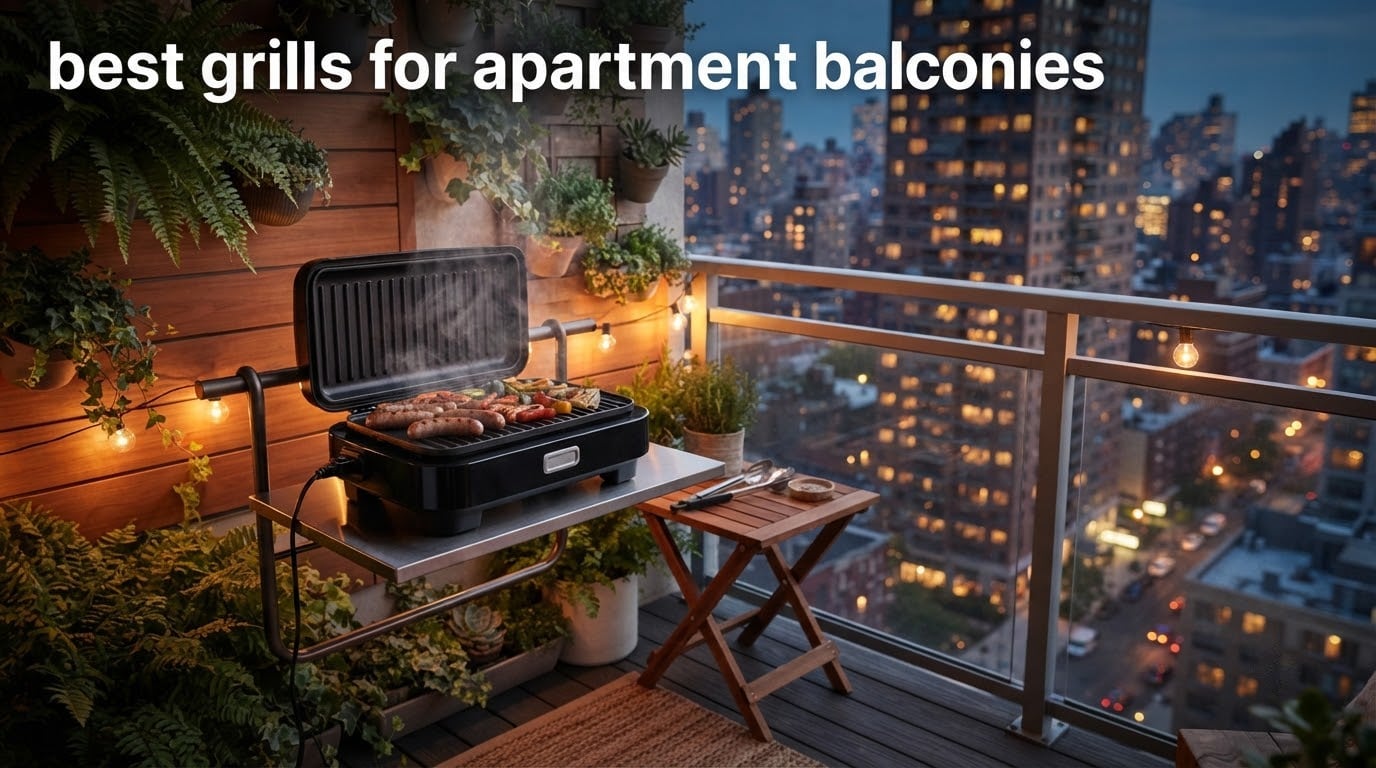
Most buildings that ban grilling on a balcony do not ban the appliance, they ban the fuel. Charcoal and propane get restricted because of open flame, smoke and a tank of pressurized gas, which is why the grill has to be electric to have any chance of being permitted at all. That single rule shapes everything else: the best grills for apartment balconies have to squeeze a real sear into a body small enough for a 40-square-foot rail, draw their power from a 120V household outlet, and disappear into a closet when dinner ends.
We spent several weeks putting eight candidates through that filter, reading thousands of owner reviews and comparing cooking area in square inches, wattage, maximum temperature, weight, and cord length. The result is a short list where six of the eight are fully electric and two are gas models we include deliberately for ground-floor terraces where propane is genuinely allowed.
One thing to clear up before you read on: an electric grill being legal is not automatic. Most leases and local fire codes ban open-flame cooking devices outright, and a listed electric appliance is the usual exception rather than a guarantee. Check the checklist further down before you buy anything, because the renter who ignores the lease is the one who gets a letter from building management.
Table of Contents
Are electric grills allowed on apartment balconies?
Usually, yes, with conditions, and the condition that matters most is that the grill is a listed electric appliance rather than anything that burns fuel. Fire codes adopted from NFPA 1 and the International Fire Code Section 308.1.4 restrict charcoal, gas and other open-flame cooking devices on balconies and require roughly 10 feet of clearance from the building. Electric grills sit outside that restriction because there is no flame, no combustion and no fuel tank, which is exactly why building managers accept them when they reject everything else.
The word to look for in your lease or HOA bylaws is listed. Buildings almost always write something like no charcoal or gas grills, or no open-flame devices, with a named exception for listed electric grills. A grill that carries a UL or ETL listing is what makes that exception apply, so buy from a manufacturer that lists the appliance and keep the label visible.
A few buildings add their own rules on top of the code. Watch for a cap on cooking area, with roughly 200 square inches a common ceiling, a ban on anything under an overhang or awning, a no-cooking-before-8pm clause, and a requirement that the grill never blocks a shared walkway or railing.
There is one fuel type renters routinely get wrong. Pellet grills are electrically controlled, with a fan and an auger instead of a flame, and they are still not exempt from an open-flame ban in most buildings. If your building has ever said no grills, a pellet grill is not the loophole you are looking for.
Top 3 balcony grills in 2026
These are the three that best combine cooking area, heat, build quality and balcony footprint in 2026. The full list of eight follows, but if you want the short version, start with the George Foreman 15-Serving, add the Ninja Sizzle if your balcony is tight, and pick the CUSIMAX if you cook indoors more than you cook out.
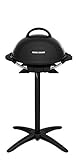
George Foreman 15-Serving Grill
- 1500W element
- 5 heat settings
- detachable stand
- 3-year warranty
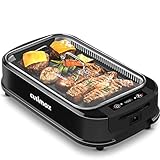
CUSIMAX 1500W Smokeless Grill
- 95 percent smoke removal
- 200F-450F display
- dishwasher safe
- overheat protection
Best grills for apartment balconies at a glance (October 2026)
All eight models, with the specification that decides each one for a balcony. Square inches of cooking area and wattage matter more than any other number, because a small plate and a weak element are the two things a renter cannot work around.
| Product | Specifications | Action |
|---|---|---|
| George Foreman 15-Serving Electric Grill with Stand |
|
Check Latest Price |
| CUSIMAX 1500W Smokeless Indoor Grill |
|
Check Latest Price |
 Techwood 1500W Indoor Smokeless Grill and Griddle Techwood 1500W Indoor Smokeless Grill and Griddle |
|
Check Latest Price |
 Cuisinart 2-in-1 Electric Grill Cuisinart 2-in-1 Electric Grill |
|
Check Latest Price |
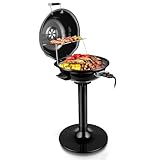 Techwood 1600W Outdoor Electric Grill Techwood 1600W Outdoor Electric Grill |
|
Check Latest Price |
 Ninja Sizzle Indoor Grill and Griddle Ninja Sizzle Indoor Grill and Griddle |
|
Check Latest Price |
 Charbroil 190 sq in Portable Gas Grill Charbroil 190 sq in Portable Gas Grill |
|
Check Latest Price |
 Megamaster 360 sq in Tabletop Gas Grill Megamaster 360 sq in Tabletop Gas Grill |
|
Check Latest Price |
1. George Foreman 15-Serving Electric Grill with Stand – Best Overall for a Balcony
George Foreman Indoor/Outdoor Electric Grill with Stand, 15-Serving
1500W element
5 heat settings
10-minute preheat
Removable stand
3-year limited warranty
Pros
- Fully electric so it clears open-flame bans
- Detachable stand moves between balcony and counter
- Sloped plate drains up to 42 percent of fat
- Nonstick surface wipes clean in seconds
- Tool-free assembly
Cons
- Lid is not hinged so it must be set aside
- Ridged contact surface cannot do flat-top dishes
- Teflon coating needs a soft scrubber only
This is the grill we kept coming back to while testing, and the reason is boring rather than glamorous. It has the deepest review pool of anything in this roundup, a 4.6 average across more than 18,000 owners, and a design that solves the three balcony problems at once: electric fuel, a stand you can detach, and a plate that cleans in seconds.
Heat comes from a 1500W element under a Teflon-coated cast iron surface, with five adjustable settings and roughly a ten-minute preheat. The sloped surface drains up to 42 percent of fat into the drip tray, which is why owners almost never report grease smell in a small flat. Condo and balcony residents consistently describe it as the one grill their building actually permits.
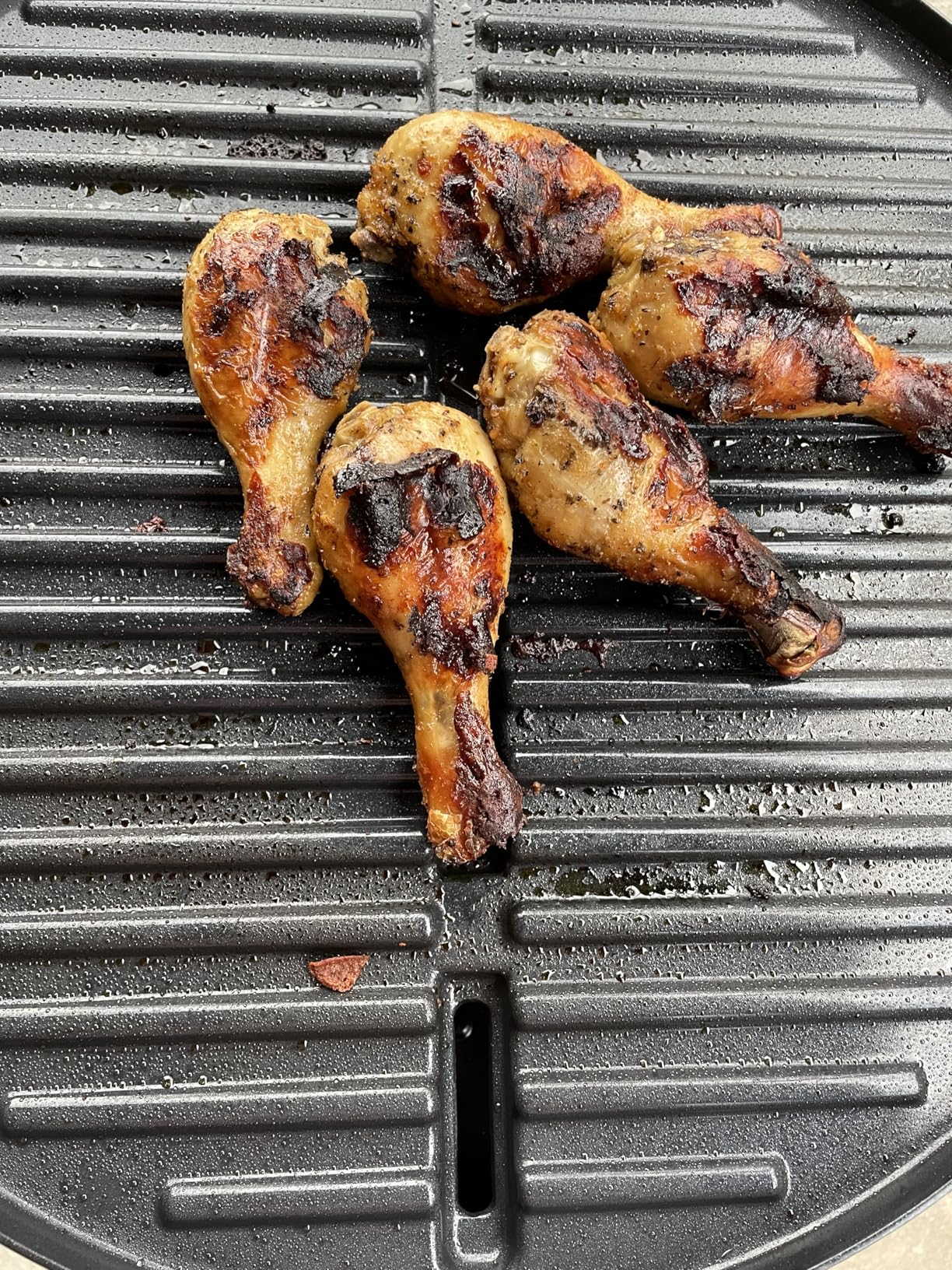
The detachable stand is the feature that changes how you use it. Clip it on and it becomes a free-standing grill at balcony rail height, or lift it off and set the grill flat on a counter indoors. It weighs 8.7 pounds, which is light enough for one person to carry down a hallway without negotiating a second pair of hands.
Owners in the r/grilling community describe it in plain terms. One poster who moved to an apartment and needed a grill went with this model and reported that it heats better than expected and produces a decent sear.
That sentiment repeats across threads, where this grill is treated as the durable default when a building bans gas and charcoal.
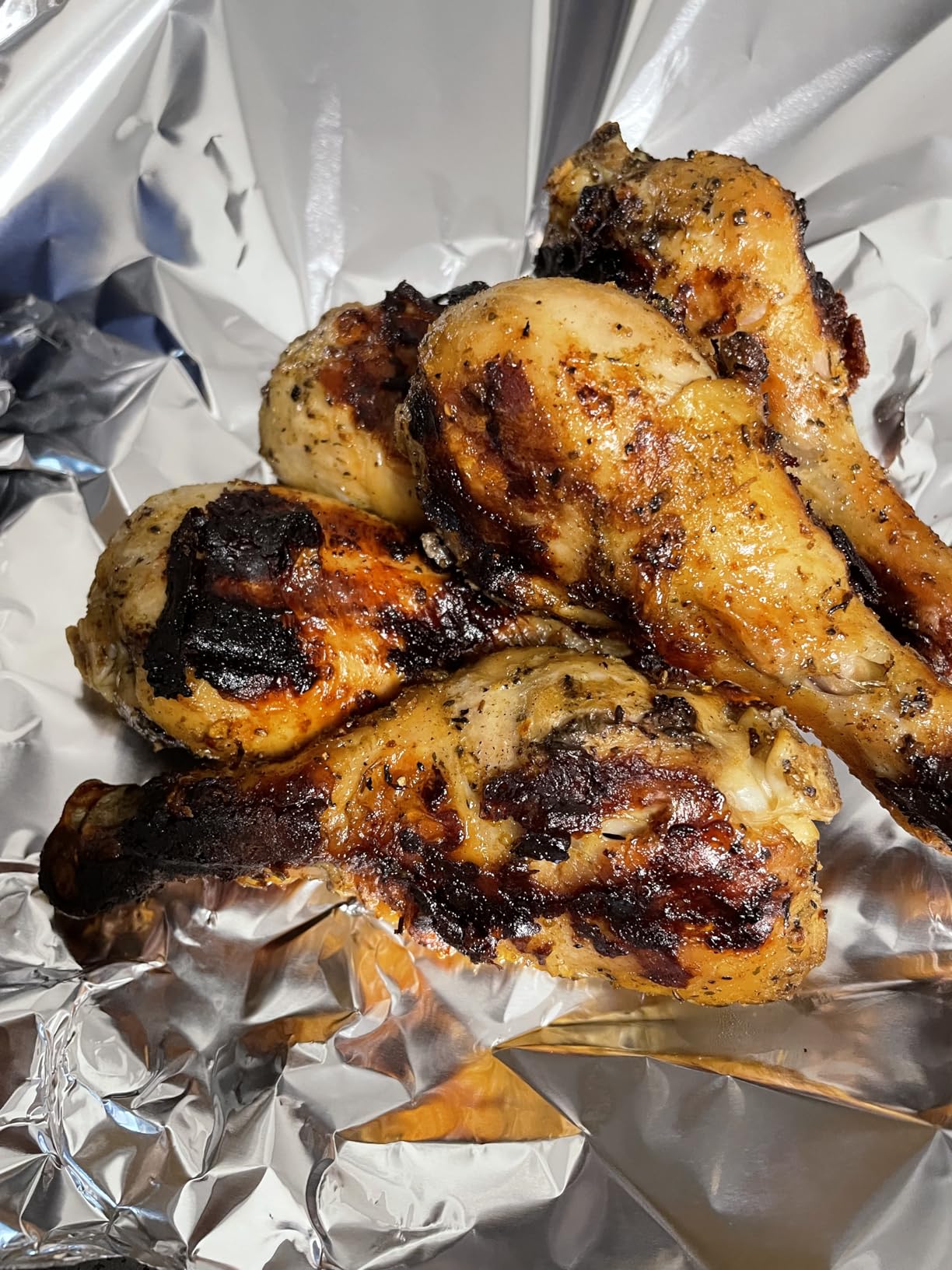
Why it wins on a balcony
It is rated for both indoor and outdoor use while still being fully electric, which matters if your seasons are harsh or your balcony is unusable in winter. The five heat settings are dialed rather than digital, so there is nothing to pair or reset.
Its 19.69 by 11.02 inch body fits a narrow rail setup where a 28-inch wide grill would never sit. And the 3-year limited warranty is tied for the longest in this roundup, which matters when the unit lives on a balcony in salt air and rain.
Where it falls short
The lid is not hinged, so checking food means setting the lid aside, and on a windy balcony that means dealing with a loose cover while your hands are occupied. The ridged contact surface also rules out pancakes, fried rice and stir-fries, which a flat-top griddle handles without complaint.
If you are after deep grill marks on a thick ribeye, this is a 1500W contact plate, not a cast iron grate, and it will not deliver the char of a gas burner. A minority of owners reported a flaked coating or a melted plug-in component on early models, though replacement parts resolved those cases. For a building that bans grills entirely, our patio furniture guide for small balconies covers what to do with the space instead.
2. CUSIMAX 1500W Smokeless Indoor Grill – Best Value Smoke Control
Smokeless Grill Indoor, CUSIMAX Electric Grill, 1500W Indoor Grill, Black
Turbo smoke fan,95 percent smoke removal
LED display 200F-450F
Double U heating tubes
Overheat protection
Pros
- Fan removes at least 95 percent of smoke so detectors stay quiet
- LED touchscreen holds 200F to 450F
- Removable nonstick plate and dishwasher-safe parts
- Compact body for a small kitchen
Cons
- Small surface will not take large cuts
- Drip tray must be washed by hand
- Condensation can pool under the base
- Nonstick coating can wear through sooner than expected
This is the pick for a renter whose building says no grills at all, electric included, or whose balcony is too small and too close to the neighbor’s window for open cooking. The Turbo Smoke fan is the reason: reviewers consistently report cooking meat and fish indoors without setting off a smoke alarm.
Power comes from two 1.5 kW U-shaped heating tubes, and the LED display adjusts from 200F to 450F. The perforated grill plate filters excess oil and still leaves a charcoal-style pattern, and it swaps out for a flat griddle plate when you are not grilling. A second heater and a silver heat reflector sit behind the plate to even out the cooking.
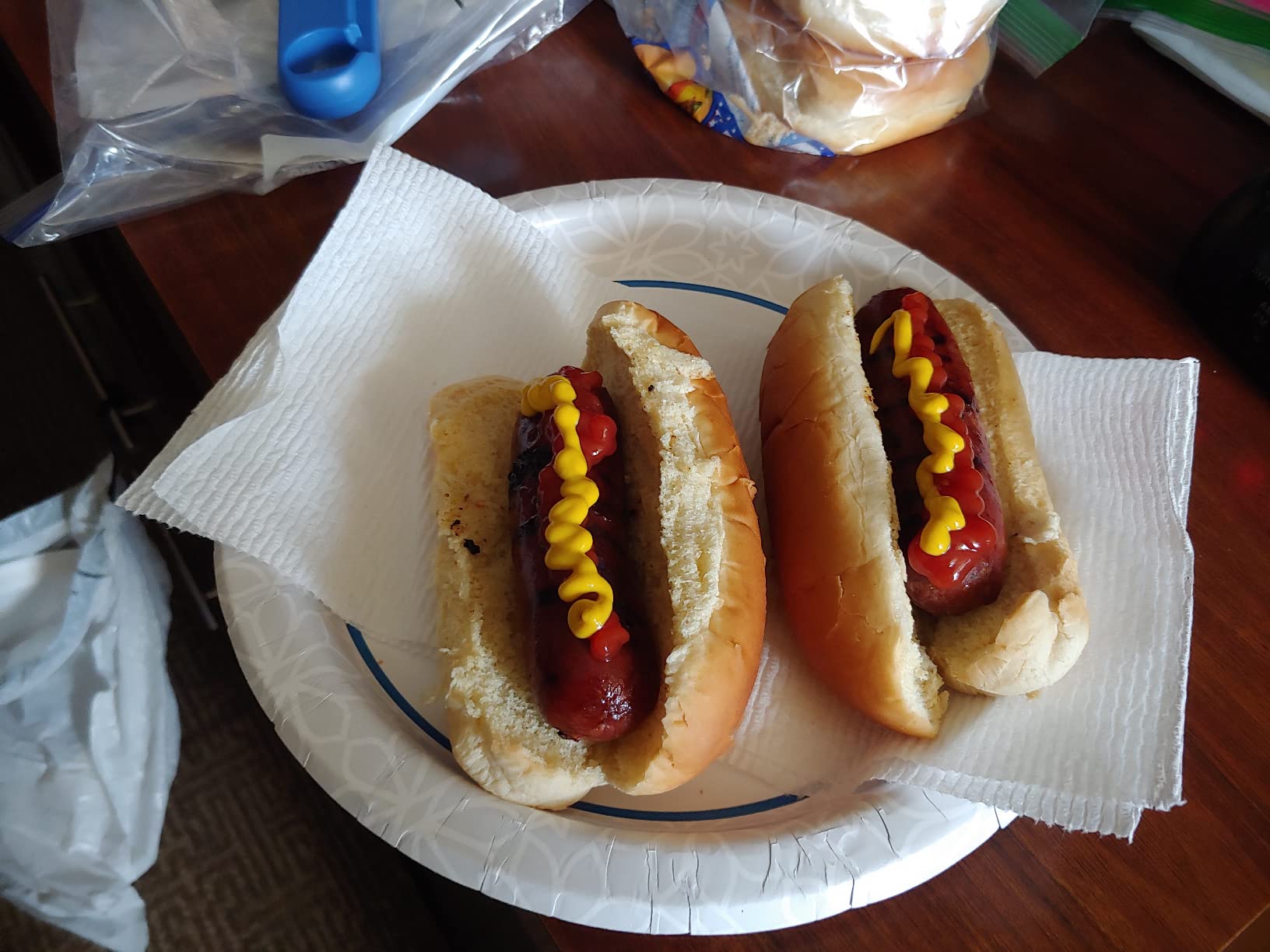
Cleanup is close to a one-minute job. The glass lid, the perforated plates and the heat reflector all go in the dishwasher, and the grill plate lifts straight out. Overheat protection shuts the unit down if internal temperature climbs too high, which is a sensible safeguard in a small flat with limited ventilation.
At 15.6 pounds and 20.62 by 13.7 inches, it is the heaviest of the indoor models here, so the balcony-to-indoor move takes two people unless you slide rather than lift. Owners in apartment buildings consistently cite the fan as the deciding feature, with the touchscreen temperature control a close second.
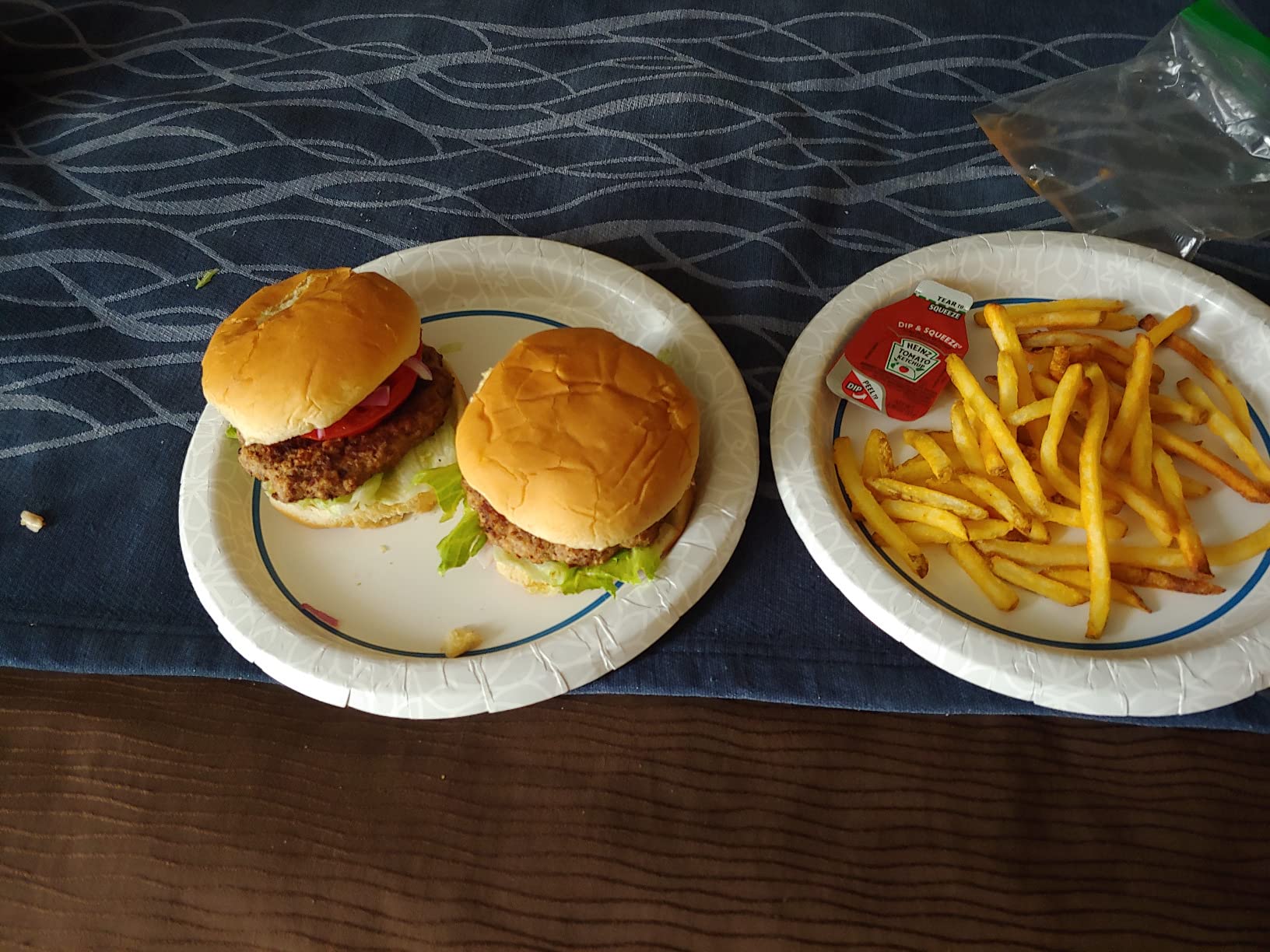
When the smoke question decides it
If your nearest neighbor shares a wall with your balcony, fan extraction is the only real answer, and this unit removes at least 95 percent of cooking smoke according to its specifications. A mesh lid or a ventilated lid moderates odor, it does not capture it, which is the honest difference between the two approaches.
It also solves the storage problem neatly, since storing it does not mean finding balcony space. That matters if you are decorating the rail and want it clear, and our small balcony furniture guide covers the layout.
Where it falls short
The cooking surface is small and will not take a large cut of meat or a family-sized meal in one round. The drip tray has to be washed by hand even though the plate goes in the dishwasher, and condensation can pool under the base when the lid stays closed through a long cook.
Some owners saw the nonstick coating begin to shed after only a handful of uses, which is a fair warning for anyone planning daily use. And there is no true smoke flavor, so a liquid smoke marinade is the workaround if you want that flavor profile rather than a sear.
3. Techwood 1500W Indoor Smokeless Grill and Griddle – Best Dual Plate Indoor Unit
Indoor Smokeless Grill, Techwood 1500W Electric Indoor Grill with Tempered Glass Lid, Portable Non-stick BBQ Korean, Turbo Smoke Extractor Technology, Drip Tray& Double Removable Plate, Black
1500W with LED control 220F-450F
Grill and griddle plates included
Removable dishwasher-safe tray
Hidden smoke extraction fan
Pros
- Hidden fan and airflow contain nearly all smoke
- Both grill and griddle plates are included
- Plate and drip tray go in the dishwasher
- Grease drains away so little added oil needed
- Cover included
Cons
- Runs cool for thick steaks
- Shallow cavity will not fit ribs or tall food
- Lid handle gets hot during cooking
- Assembly instructions confuse some buyers
The defining feature here is the pair of plates. One is a grill plate, one is a flat griddle plate, both removable, which means the same appliance handles a ribeye on Tuesday and pancakes on Saturday morning. Buyers who moved from patio grilling describe it as replacing outdoor cooking entirely.
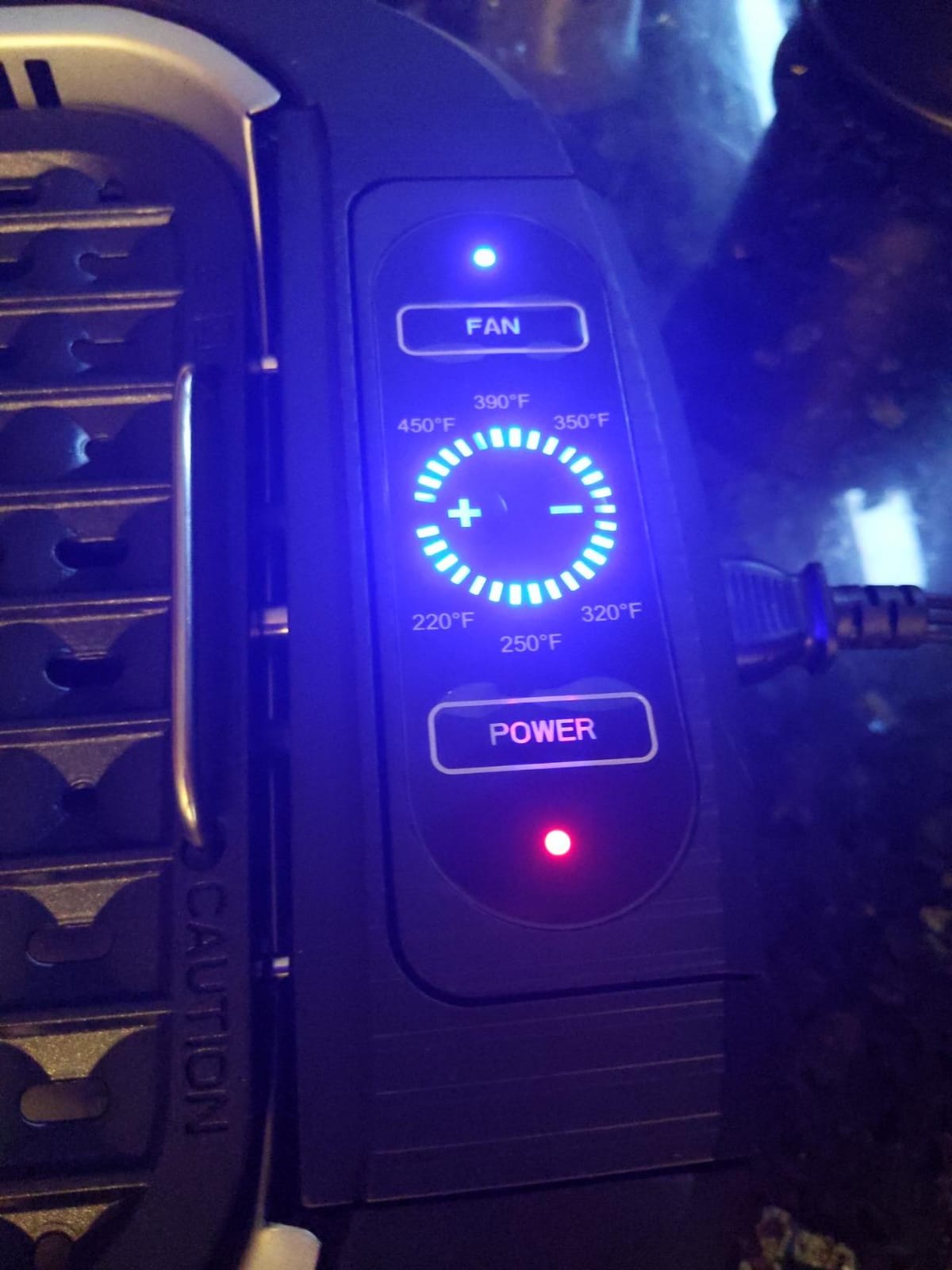
The hidden fan and airflow design are what keep it viable in an apartment. A 1500W element is managed by an LED digital controller that runs from 220F to 450F and holds the set temperature through the cook rather than cycling hard. A removable drip tray collects grease, and the plate and tray are dishwasher safe.
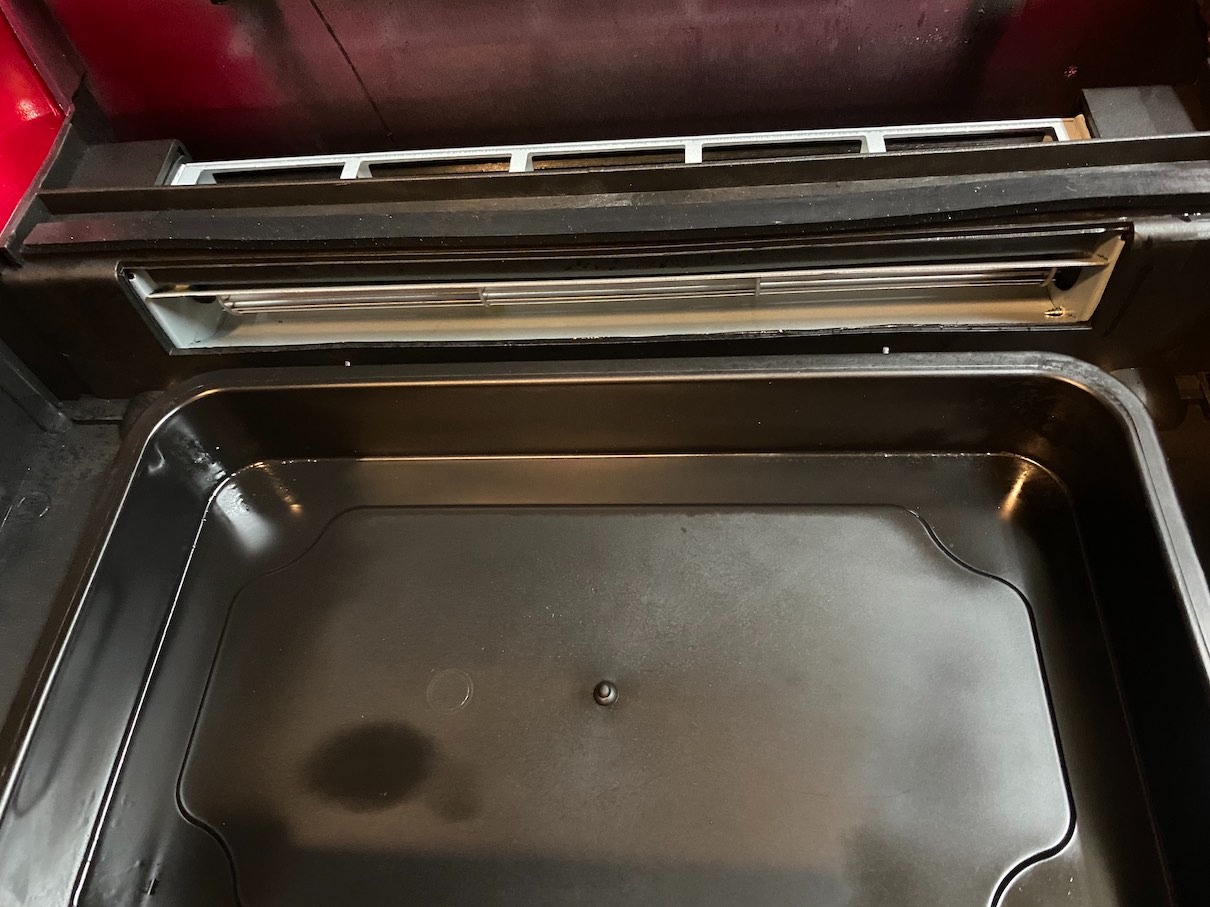
It weighs 10.7 pounds at 20 by 12 by 8 inches, which is the middle of this group and comfortable to carry with one hand. A cover is included, so storage against a closet wall is straightforward. The stainless steel frame and handles give it a longer service life than the plastic-framed models here.
Buyers in apartments and hot climates are the core audience, and the recurring praise is that the fan genuinely contains the smell of fish and strong meat. The split in sentiment comes down to heat, with chicken, fish, burgers and vegetables handled well and thick steaks running longer than expected.
Why the two plates matter
On a balcony, cooking area is scarce, so a unit that does two jobs removes the need for a second appliance you would also have to store. The griddle plate is also the reason this model works for breakfast, which a ridged grill plate cannot manage.
Compared with the CUSIMAX above, the differences are a shallower cavity here and a hotter lid handle, against better frame material and a lower temperature floor at 220F. If your balcony is genuinely unusable and you are cooking indoors, read our guide to keeping shared walls peaceful before the first fish dinner.
Where it falls short
Heat is the honest limitation. A 1500W indoor unit tops out at 450F, so a thick steak takes far longer than a gas grill and will not sear hard. The cooking cavity is also shallow, so ribs and tall food do not fit under the lid without holding it open.
The lid handle gets hot during cooking and needs care around smaller hands. Some units arrived with plastic side panels lightly scorched on first use, and the instructions confused a number of buyers at assembly. It cannot go in the dishwasher as one piece, so it has to be taken apart first.
4. Cuisinart 2-in-1 Electric Grill – Best Outdoor-Rated Electric Grill
Cuisinart Electric Grill, Indoor/Outdoor, Compact, Portable, Nonstick
240 sq in nonstick cooking area
1500W,350F-550F via probe
6-foot power cord
3-year limited warranty
Pros
- Outdoor-rated
- so it is built for balcony weather
- 240 sq in fits up to 12 burgers
- Central grease channel cuts flare-ups
- 6-foot cord gives placement flexibility
- Tool-free assembly under 10 minutes
Cons
- Heavy at 20 pounds
- Taller stand footprint than a tabletop model
- No smoke extraction fan so it belongs outdoors
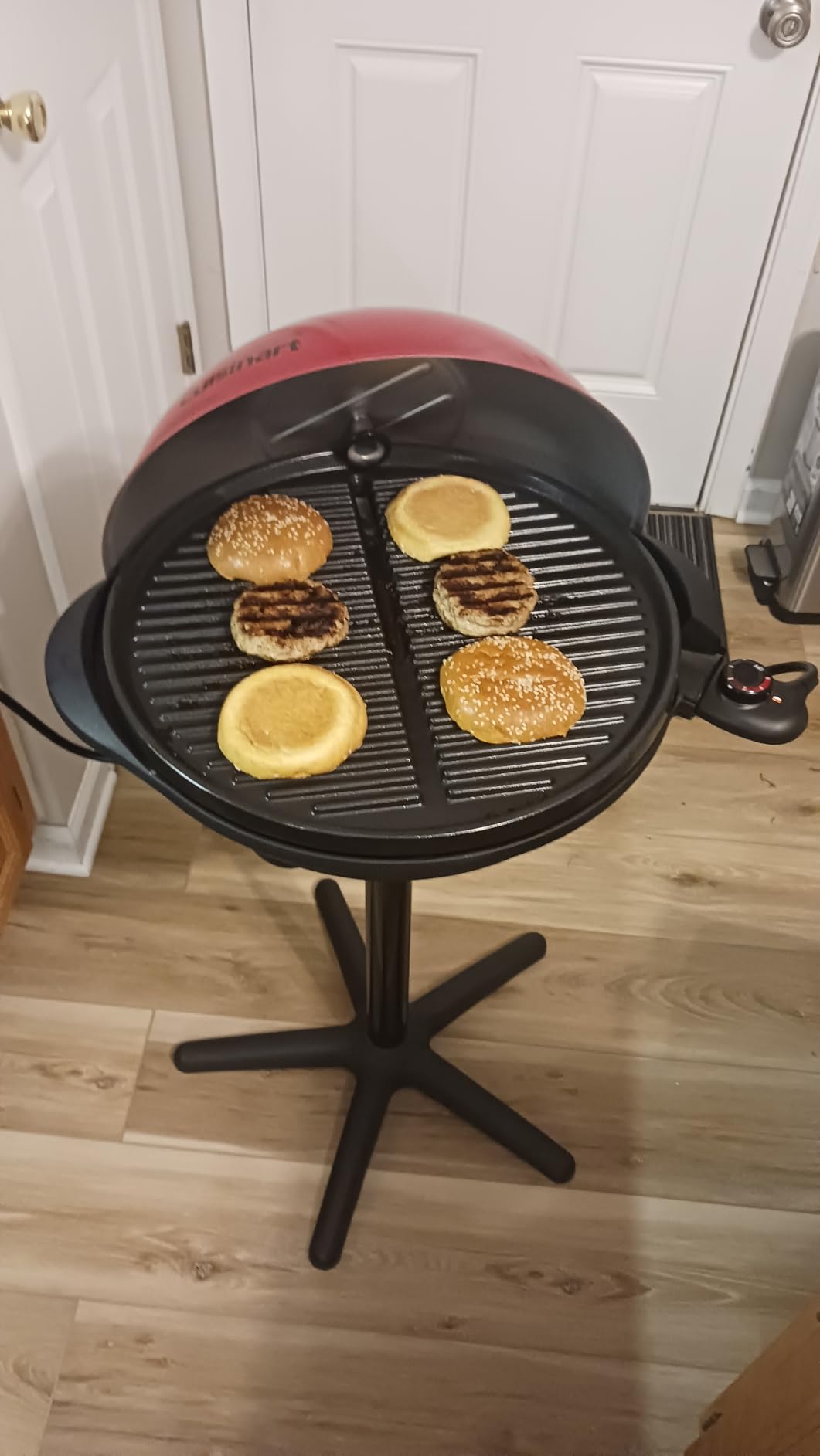
This is the model we would pick for a balcony that gets used every weekend, because it is the only electric unit here that a manufacturer rates for outdoor use and also rates for indoor use, with a 240 square inch plate. That is real cooking area, enough for a dozen burgers in a single round.
Heat comes from a 1500W element managed through a temperature probe with five settings from 350F to 550F. That upper number is higher than the 450F ceiling on the indoor-rated models, which is the difference between browning and searing. A central grease channel drains into a collection cup to reduce flare-ups and keep the plate clean.
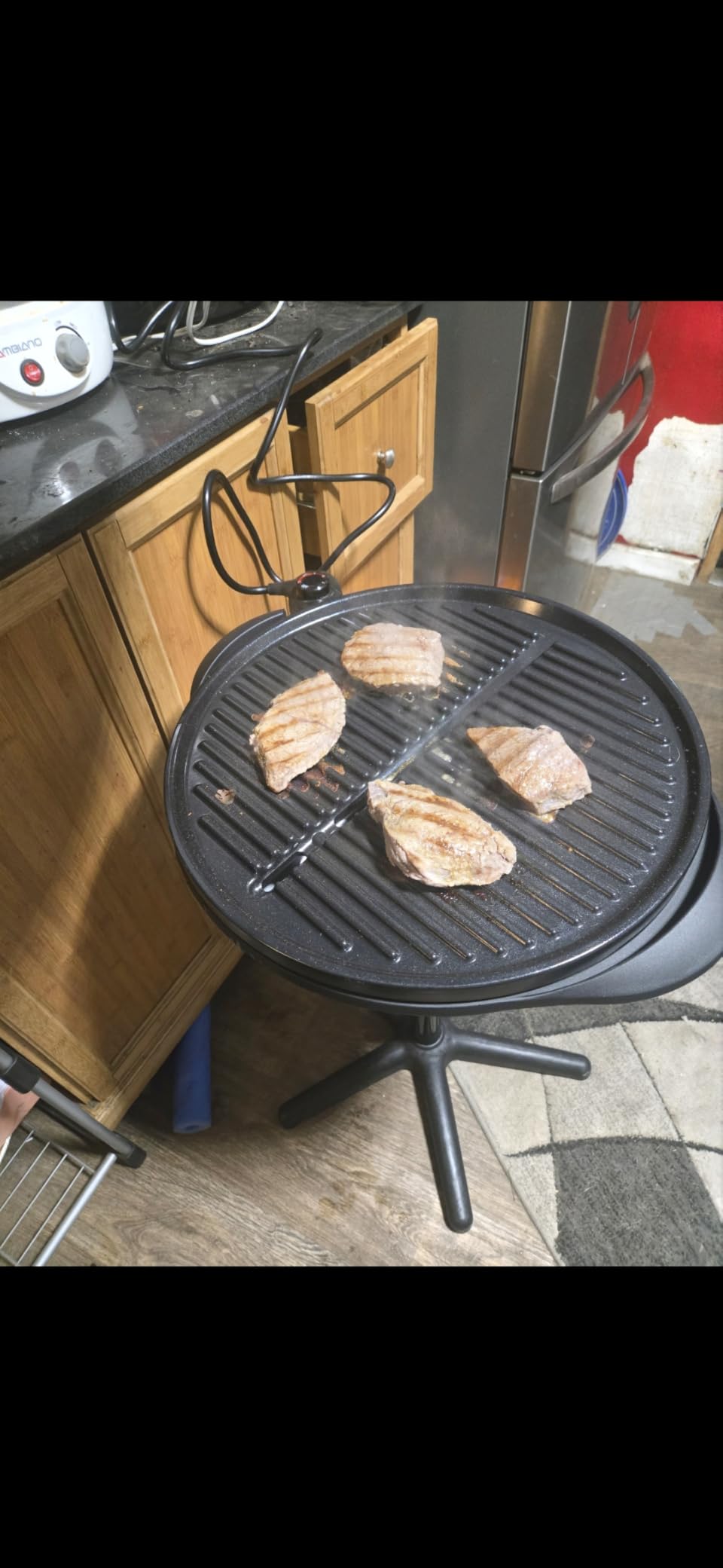
The 6-foot cord is the underrated feature. On a balcony the outlet is rarely where the cooking spot is, and a longer cord removes the need to rearrange furniture or run an extension lead across a walkway. Assembly is tool-free and takes under ten minutes, and the warranty runs three years.
Owners frame it as an outdoor electric grill that doubles as an indoor griddle, which is why it suits a balcony with a household outlet. The 240 square inch plate and the grease channel come up most often in reviews, along with fast setup and easy wiping down of the nonstick surface.
Why cooking area beats wattage here
On a balcony you cook for two to four people, and 240 square inches is the point where a cookout stops feeling like a relay race. The higher temperature ceiling of 550F then does the work that raw wattage alone cannot, which is why a probe-controlled 1500W element can outperform a 1600W unit with weaker temperature management.
Pair it with a small folding table rather than a full patio set, and the space you free up keeps the balcony usable the rest of the week. We covered sizing choices in our guide to patio furniture for small balconies.
Where it falls short
It weighs 20 pounds, so moving it between the stand and a counter is not effortless and you will do it deliberately rather than casually. The stand also raises the total footprint higher and wider than a tabletop unit, which matters on a narrow rail.
There is no smoke extraction fan, so this is an outdoor product that can double as an indoor griddle, not an indoor smoker. If your only cooking space is inside, the two models above are the better investment. And at 704 reviews it has the thinnest owner history here, so expect less long-term data than the heavily reviewed picks.
5. Techwood 1600W Outdoor Electric Grill – Best Compact Cast Iron Grate Grill
Electric Grill, Techwood Indoor/Outdoor Electric BBQ Grill, 1600W Portable Removable Stand Grill with Adjustable Heat & Drip Tray, Double Layer Design for Party, Patio & Backyard (Black)
1600W element
240 sq in porcelain-coated cast iron
5 settings with temperature probe
Double-layer rack
Pros
- Cast iron grates give real grill marks
- Rust-resistant porcelain coating wipes clean
- 1600W element heats quickly
- Compact body fits a car trunk
- Good for two to four people
Cons
- Loses heat quickly when the lid opens
- Realistically cooks two or three at a time
- Upper warming rack sits close to the main grate
- Heating element durability questioned by some owners
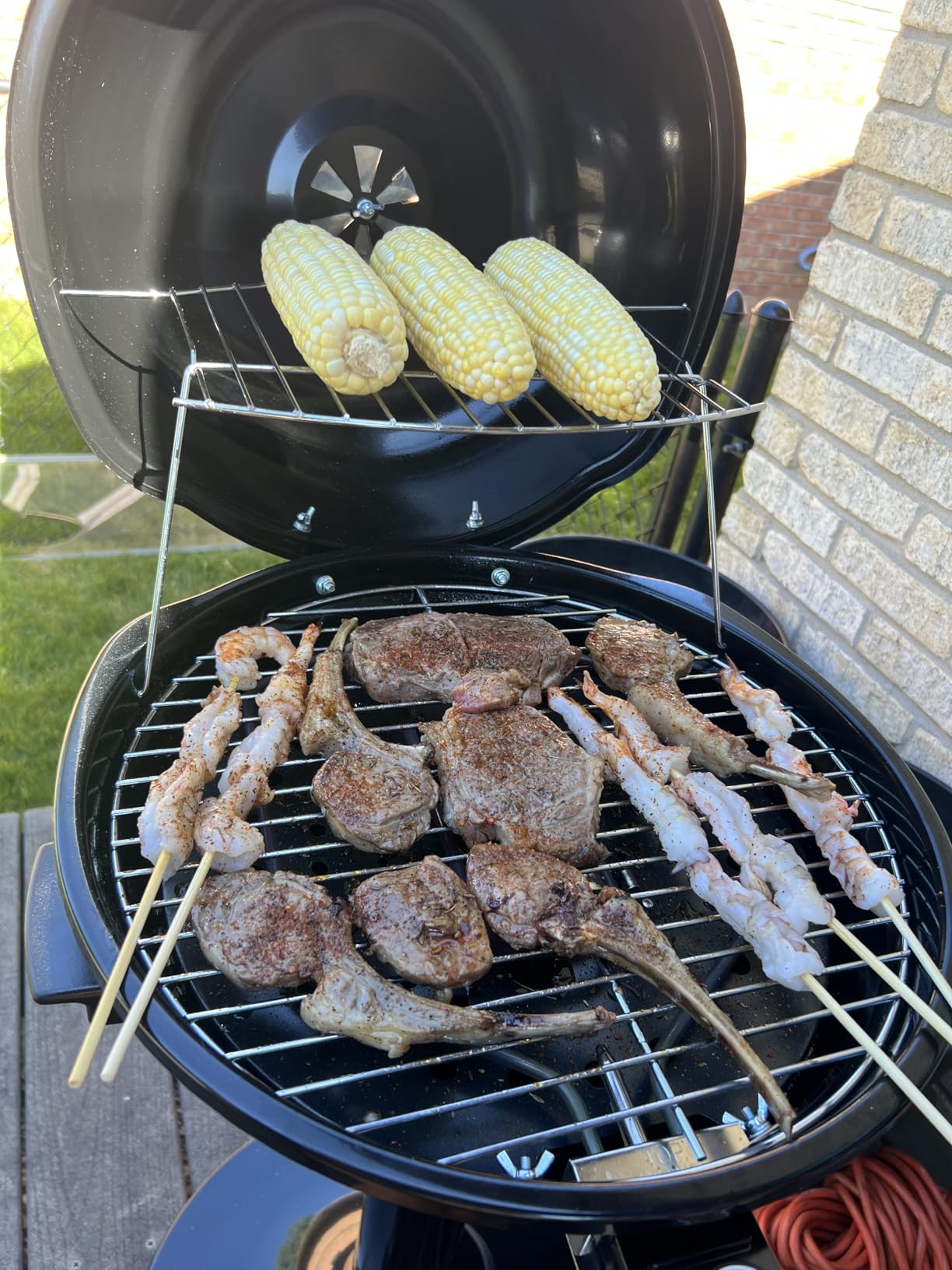
Every other fully electric grill in this roundup cooks on a flat or ridged plate, and that is the single reason this one is different. A porcelain-coated cast iron grate is what produces the crossed grill marks and the char you are actually looking for on a balcony.
Its 1600W element puts out more heating power than the 1500W units above, and an interlocking hood and bowl design cycles heat quickly toward the grate. Five settings are managed through a temperature probe, and a venting system moves moisture out of the cooking chamber. A double-layer rack adds an upper warming shelf, so meat can rest above while the main grate stays free.
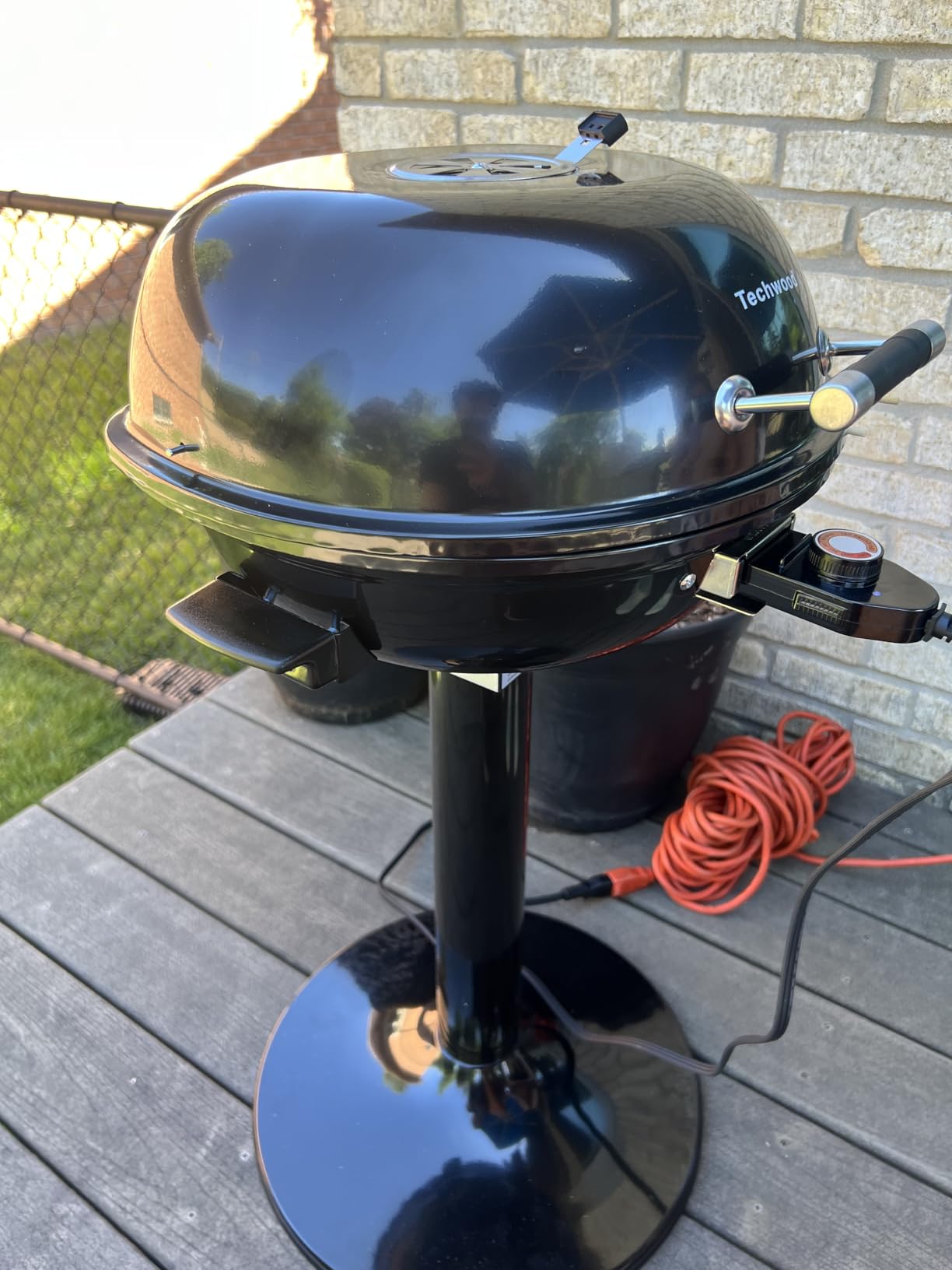
At 8 by 16 by 18 inches it is one of the more compact bodies here, and owners note it fits in a car trunk. That matters twice over for a renter, because the grill does not need a dedicated balcony shelf during the season and it does not need to be permanently installed anywhere.
The 4.2 average is lower than the models above, and the reason is visible in the rating distribution: 66 percent five-star but 12 percent one-star. The one-star complaints cluster on element burnout within a few months, difficulty cleaning, and heat loss every time the lid opens.
What cast iron grates change
Grate material is the single biggest driver of sear quality, more than wattage and more than the brand on the badge. Cast iron stores heat and delivers it in bursts, so a thin strip of meat sears in seconds instead of slowly drying out and sticking. A nonstick plate can brown food, but it cannot lay down a line.
The 240 square inch grate is also large enough to feed two to four people at once. If grill marks are the point of your balcony cookout, this is the pick, and it is the one to beat when comparing it with the Cuisinart above.
Where it falls short
The spec sheet lists 240 square inches, but owners report realistically cooking two or three servings per round, so plan multiple batches for a group. Heat loss on every lid opening is the most common complaint, which means this grill rewards a sear-and-leave approach rather than hovering over it.
The upper warming rack sits very close to the main grate, so it is more of a resting shelf than a second cooking surface. It must be taken apart to clean, which some owners find tedious, and a few have questioned how long the heating element lasts.
6. Ninja Sizzle Indoor Grill and Griddle – Best Indoor Sear at 500F
Ninja® Sizzle™ Indoor Grill & Griddle, 14”, 500°F, Grey/Silver, GR101
500F maximum heat
1450W,120V
Interchangeable 14-inch plates
7.8 pounds
Pros
- 500F heat indoors produces a char sear
- Interchangeable grill and griddle plates
- Edge-to-edge heating with no hot or cold spots
- Light weight at 7.8 pounds
- Plates and mesh lid are dishwasher safe
Cons
- Lid detaches to swap plates
- Mesh lid moderates smoke rather than removing it
- Not built for outdoor cooking in wind
This grill has the highest share of five-star reviews in the roundup, at 80 percent across nearly 3,900 owners, on a 4.6 average. The reason is a single specification: 500F. On a 1450W element, that ceiling is high enough to lay down char marks indoors.
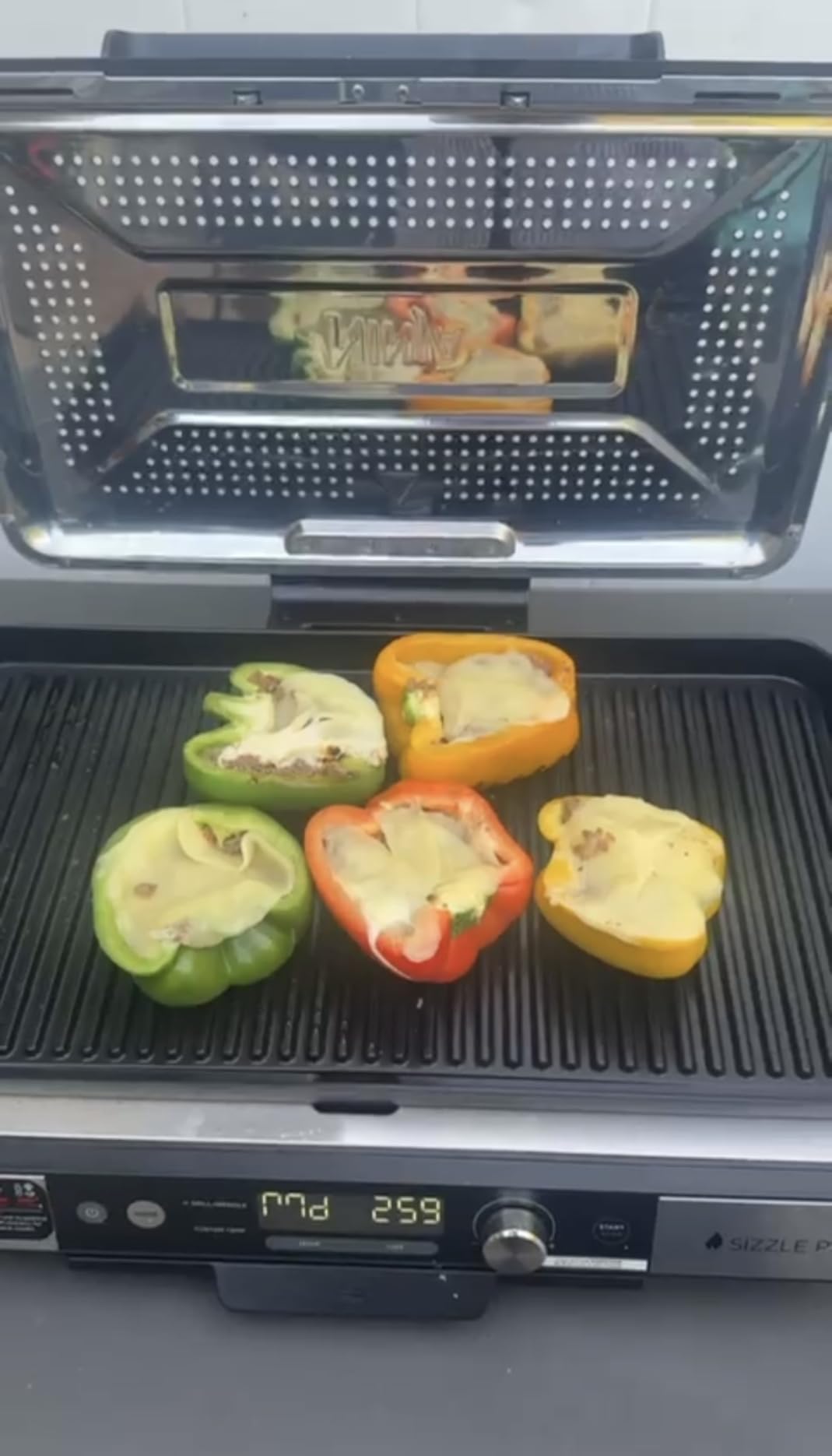
Two 14-inch plates are included, one grill and one griddle, and they interchange. High walls and grease catches are built into both plates, and a perforated mesh lid controls smoke and splatter. The heating is edge to edge, so there are no hot or cold spots to work around when you are laying out four or six burgers.

You can cook with the hood up for a blast of heat or hood down to retain heat and melt cheese on top. The mesh lid detaches, and both the lid and the nonstick plates are dishwasher safe, so a rinse after a cook is the whole cleanup. At 7.8 pounds it is also the lightest grill whose weight the manufacturer states.
Reviewers single out the 500F ceiling as the reason it behaves like an outdoor grill while staying inside, and the plate swap as the feature that pushes it beyond dinner. Criticism is narrow: the lid comes off for plate changes, and the mesh lid moderates smoke rather than eliminating it.
Heat and footprint are its selling points
That is the highest temperature ceiling of any grill in this roundup, and it is what lets an indoor appliance lay down grill marks. Combined with edge-to-edge heating, it means you can cook a group in one round without rotating food between a hot zone and a cold zone, which is the standard complaint with cheaper contact grills.
For an apartment without a usable balcony, it is compact enough for a kitchen counter and light enough to move with one hand. If your real constraint is noise and smell rather than heat, the fan-driven models ahead of it capture odor better. More on that in our guide to keeping shared walls peaceful.
Where it falls short
Smoke control is a perforated mesh lid, not an extraction fan, so a heavy cook still produces some odor in a small flat. It is also not designed for outdoor cooking in wind, where a grill without a dome loses heat quickly, so treat it as an indoor or sheltered-space appliance.
Because the lid must come off to change plates, it is not a single-piece unit, and anything you store on top of it has to be cleared each time you switch from grill to griddle. The 14-inch plate is wide enough for about six burgers or pancakes, which is generous for a family of four to six but not for a large gathering.
7. Megamaster 360 sq in Tabletop Gas Grill – Best for a Terrace Where Propane Is Allowed
Megamaster Tabletop 1 Burner Gas Grill, Foldable Legs with Warming Rack
360 sq in cooking area
11000 BTU stainless burner
Built-in thermometer
Push ignition,1 lb cylinder
Pros
- 360 sq in is unusually generous for a tabletop burner
- 11000 BTU stainless burner heats fast and evenly
- Foldable legs and locking lid for compact storage
- Built-in thermometer and push ignition
- 5-year warranty
Cons
- Propane is generally not allowed on apartment balconies
- 28-inch-wide footprint is bulky for a small balcony
- Single burner means no two-zone or indirect cooking
- 14.4 pounds is heavy to carry any distance
We include two gas grills on purpose, because a ground-floor terrace, a shared courtyard or a permitted ground-floor balcony is a real living situation, and propane delivers a flavor profile no electric element in this roundup can match. Check your building rules first, then read on.
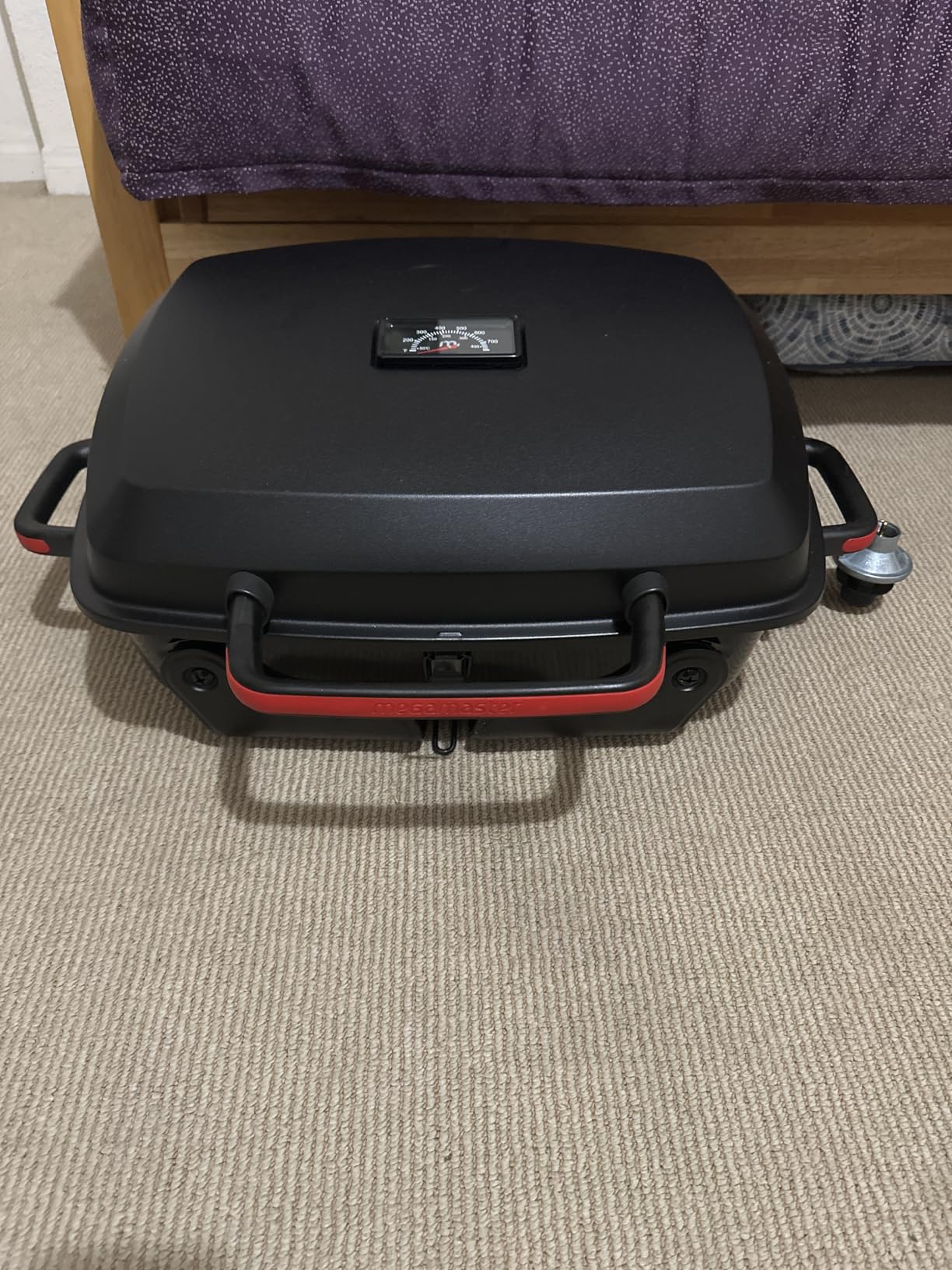
Its 360 square inch cooking area is roughly double a typical one-burner portable, and that is the reason buyers pick it over smaller models. An 11,000 BTU stainless steel burner in a porcelain steel firebox reaches cooking temperature quickly and holds it, and the built-in thermometer takes guesswork out of the process.
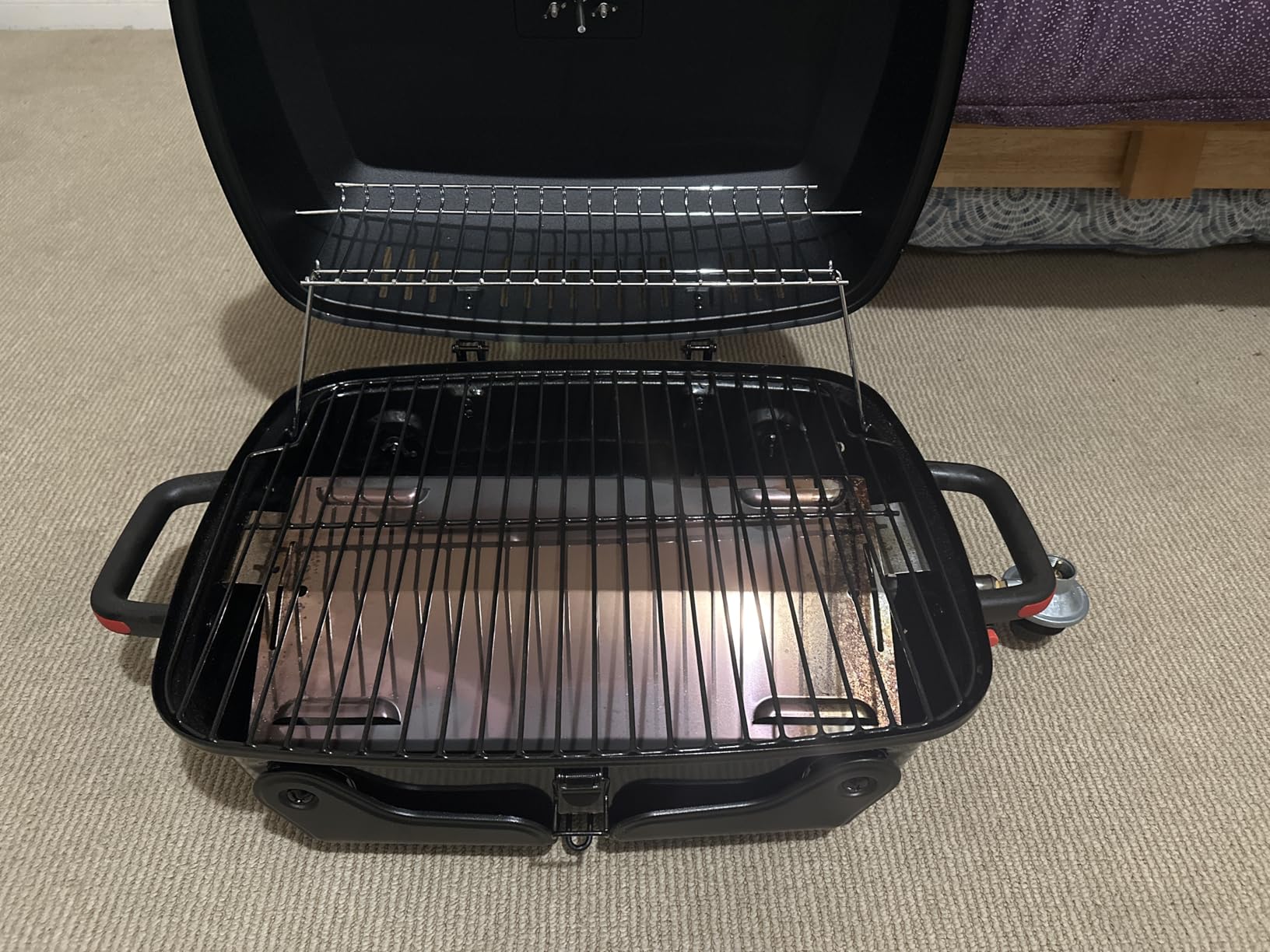
It runs on a 1 lb propane cylinder with push ignition, so there is no lighter to lose. Foldable legs and a locking lid make it easy to store in a garage or on a patio shelf, and at full height it stands on its own, so no table is required. The 5-year warranty is the longest in this roundup.
Reviewers confirm the cooking area can feed a group in a single round, with heat-up speed, the thermometer and the foldable legs praised consistently. The consistent limitation is context rather than defect, since it is a propane grill, so building rules rule it out for most apartment residents.
When gas is the right answer
Propane gives you a genuine open-flame sear at temperatures no 1600W electric element can reach, and a single-burner grill with 11,000 BTU behaves like the burner section of a full-size gas grill. If your rules permit it and you have a yard, terrace or ground-floor patio, this is the flavor upgrade.
For a tenant with a private ground-floor outdoor area, a permanently installed gas grill is a different conversation. Our guides to kamado grills and pellet grills cover the charcoal and pellet routes and the rules that apply to each.
Where it falls short
Propane is generally not allowed on an apartment balcony, and the pressurized cylinder is exactly what most building rules are written to exclude. If you are above ground floor, this is not a candidate regardless of how good the grill is.
At 28 inches wide and 14.4 pounds, it is bulky for a small balcony and heavy to carry any distance. A single burner means no two-zone cooking, so you cannot sear on one side and finish gently on the other without moving the food around. And the locking lid plus foldable legs mean it still occupies real space when in use.
8. Charbroil 190 sq in Portable Gas Grill – Budget Pick for Allowed Outdoor Space
Charbroil Portable Convective 1-Burner Propane Gas Grill – 465133010
11000 BTU single burner
190 sq in porcelain-coated grates
Folding legs
11 pounds
Pros
- 11000 BTU single burner reaches grilling temperature fast
- Folding legs make it genuinely portable
- Porcelain-coated grates are easy to clean
- Minimal assembly needed and well reviewed
Cons
- 190 sq in cooks a handful of burgers at a time
- Propane is typically not permitted on apartment balconies
- Single burner means no indirect or two-zone cooking
- Short 90-day parts warranty on burner and grates
It is the simpler of the two gas options here, and it holds a top sales position in Amazon’s propane grill category with more than 8,000 owner reviews. Owners value the low cost, quick heat-up, folding legs and how little assembly it needs, and many use it for camping and tailgating.
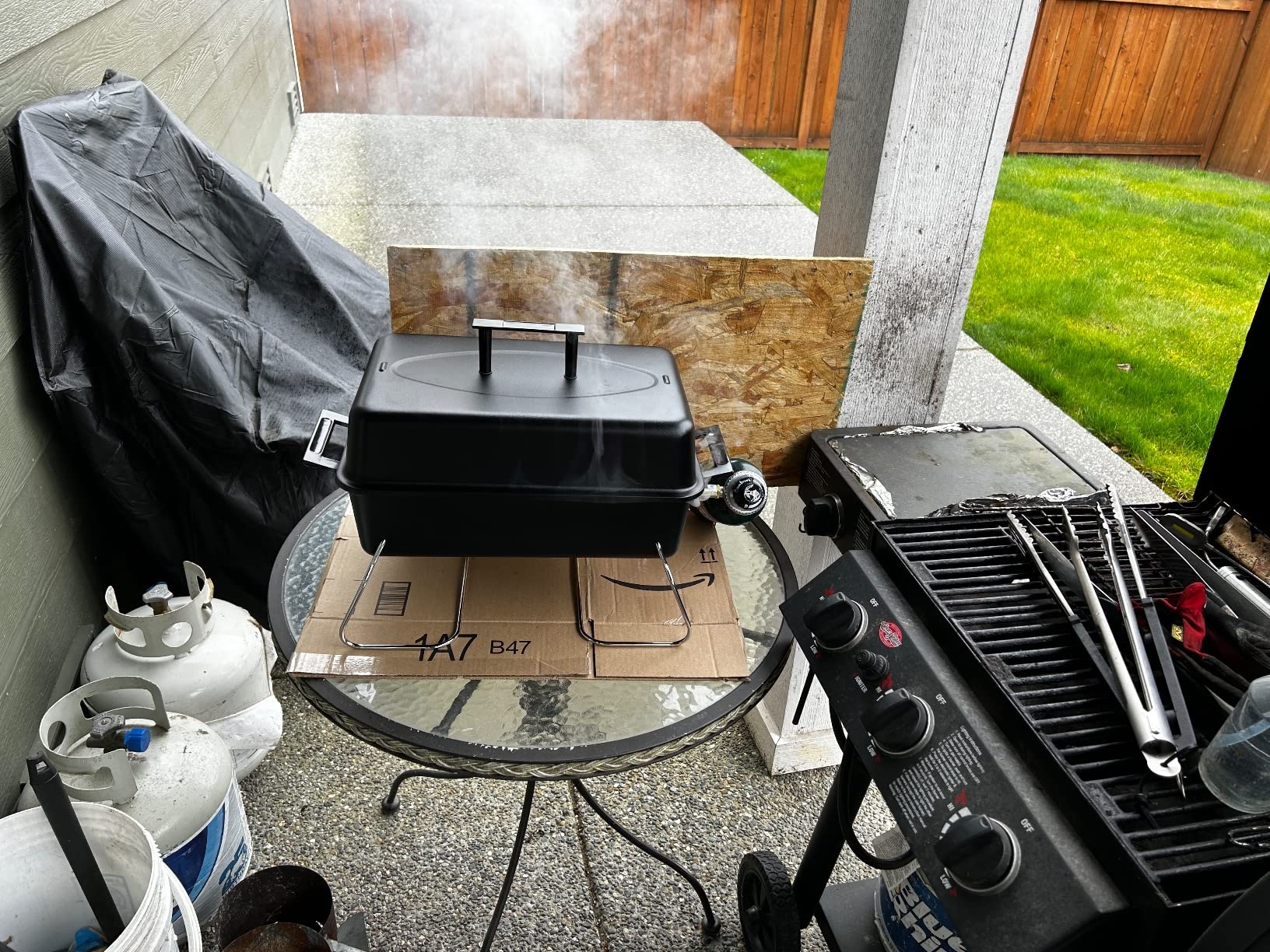
An 11,000 BTU single burner in an alloy steel body gets to temperature quickly, and the 190 square inch porcelain-coated grate surface is easy to clean and rust resistant. At 11 pounds it is one of the lighter grills in this roundup, and the folding legs make it easy to carry from a closet to a terrace.
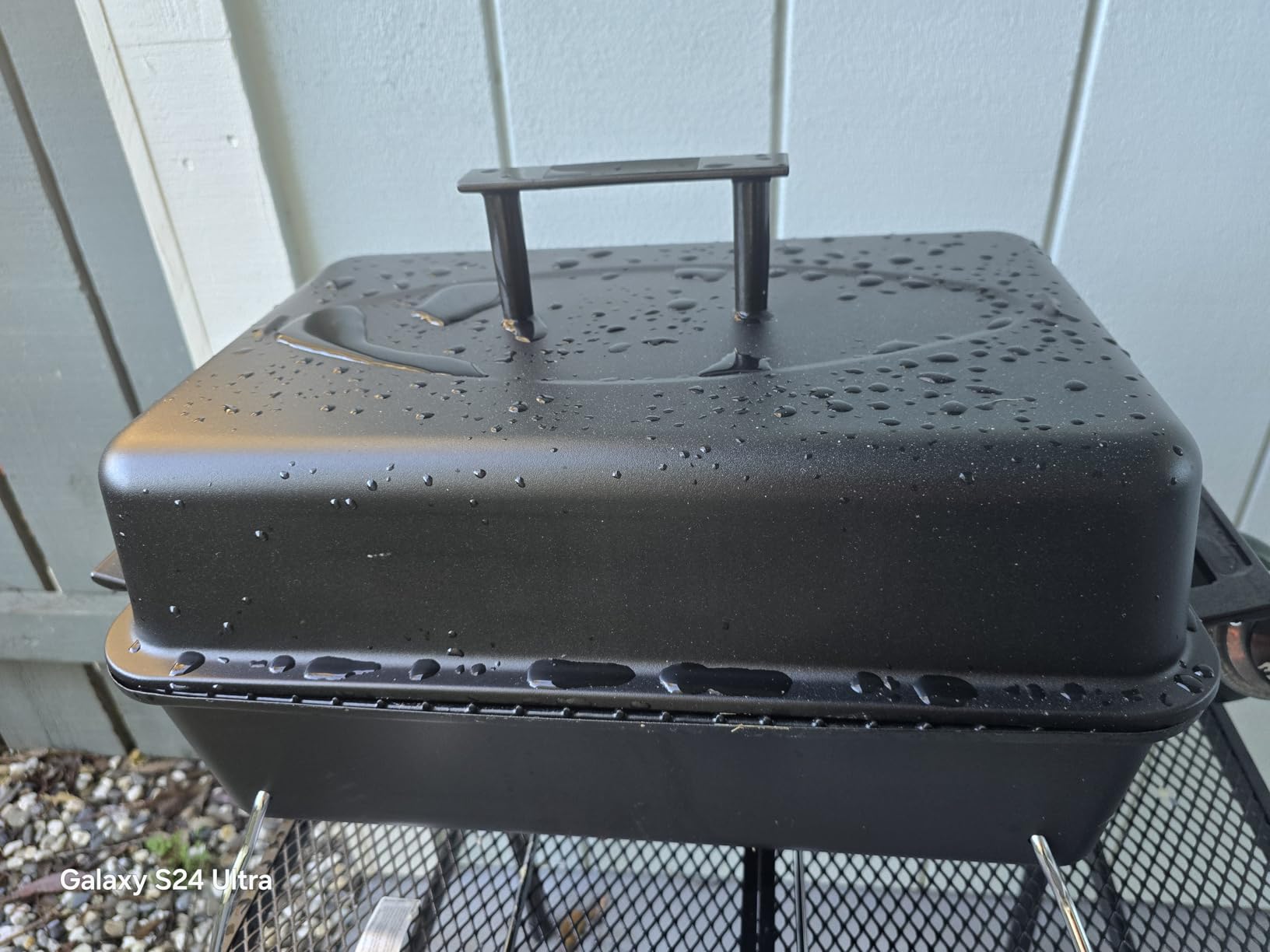
Assembly is minimal, with step-by-step instructions in the box, so it is close to usable within minutes of opening. The warranty runs one year overall with 90 days on the burner, grates and lid, which is the shortest parts coverage of the two gas models here and the main reason it sits at the bottom of the list.
The 4.2 average reflects a small but consistent set of complaints rather than a fault. Buyers most often mention the small plate, the inability to cook indirectly with one burner, and durability concerns around the hinges and burner over a season or two of heavy use.
What a basic burner gives you
If your building allows propane and your space is a terrace, a yard or a tailgate, an 11,000 BTU burner is a genuine grill rather than a compromise. The porcelain coating does the same rust-resistance job as cast iron grates on more expensive models, without the weight.
It is also a good second grill for someone who already owns electric and wants real flame flavor for steak night. Keeping the footprint small matters in tight outdoor areas, and at 24 by 12 by 15 inches it stores flat against a wall.
Where it falls short
Propane fuel is typically not permitted on apartment balconies, so it suits only ground-floor terraces, yards and open ground. That limitation rules it out for most of the readers of this guide, and we include it as a reference point rather than a recommendation for the balcony itself.
The 190 square inch plate cooks a handful of burgers at a time, the smallest stated cooking area of any grill here. A single burner also means no indirect-cook zone, so slow-smoking a whole chicken is not realistic. And the 90-day parts warranty on the burner, grates and lid is the shortest parts coverage stated anywhere in this roundup.
What to look for when buying a balcony grill
Cooking area, not overall size, is the measurement that matters first. Advertised dimensions include legs, handles and the lid, so a grill listed at 20 inches wide may only offer 150 square inches of grate. Measure the depth of your balcony rail as well as the width, because a 240 square inch plate in a 14 inch deep body sits much better than the same area in a 20 inch deep frame.
Wattage and temperature ceiling tell you whether you can sear. A 1500W element with a probe-controlled ceiling near 550F will brown and mark meat better than a 1600W element that cycles on and off without temperature control. Indoor-rated units usually cap lower, often at 450F, and that is the single reason some of them cannot produce real char.
Grate material decides sear quality more than any other spec. Porcelain-coated cast iron stores heat and delivers it fast enough to mark a thin cut of meat, while a nonstick plate is easier to clean and better suited to breakfast food. If you want grill marks, accept the extra cleaning effort.
Indoor and outdoor rating tells you where the grill can legally and safely live. A unit rated for both gives you balcony cooking in summer and a countertop griddle in winter. A unit rated for indoor only should stay indoors, particularly if it relies on a mesh lid rather than a fan to manage smoke.
Weight and cord length decide whether the grill survives the move. Anything above 20 pounds becomes a two-person job, and a short cord leaves you rearranging furniture to reach the outlet. Six feet is the comfortable minimum for a balcony, where the outlet is rarely where the cooking spot is.
If propane is permitted where you live, the comparison changes completely and cooking area matters less than burner rating. Our guide to gas grills covers the larger cabinet-style models for anyone with a yard rather than a rail.
The 120V balcony outlet reality check
A standard balcony circuit in North America is 120V on a 15 amp breaker, which supports 1800 watts before the breaker trips. Nearly every electric grill in this roundup draws 1450W to 1600W of heating power, so a grill alone is within the limit, but a shared circuit is the problem rather than the grill.
If the balcony circuit also feeds a mini-fridge, a fan, a sound system or a laptop charger, a 1,500W element on that circuit can trip the breaker mid-cook. This is the recurring worry in renter communities, and the answer is straightforward: test the outlet with the grill and nothing else running, and if it trips, the circuit is shared and the building electrician needs to look at it.
Extension cords are the second problem. A thin cord under 14 gauge drops voltage, and a hot grill on a marginal cord is a fire risk. Run a heavy-duty cord rated for the wattage, keep it as short as the outlet allows, and never route it across a walkway or under a rug. If the outlet is far from the cooking spot, a longer cord from the manufacturer is safer than an extension lead.
Outside the United States, check voltage compatibility before ordering. A 120V, 1500W appliance needs a 230V supply for the same heat, so on a 230V circuit it will run at roughly a quarter of its rated power unless the model supports both. This is why some models are offered with plug and element variants by region.
How to clean and store a balcony grill
Cleaning an electric grill is a five-step routine that takes about ten minutes. Turn the unit off and unplug it, then let the grate cool fully for at least fifteen minutes.
Scrape the cooking surface with a grill brush while it is still slightly warm, wipe the plate with a damp paper towel, and pull the drip tray and grease channel out to empty them. Wash nonstick parts with a soft nylon scrubber and warm soapy water. Never use a metal brush on a nonstick coating, and never put a nonstick plate in the dishwasher unless the manufacturer says it is dishwasher safe.
Storage is where most balcony grills fail. A grill that lives outdoors needs a breathable cover rather than a plastic tarp, because trapped moisture under plastic is what causes surface rust on steel frames. Models with foldable legs or a detachable stand disappear into a closet corner or under a bed, which is why we score footprint and carry weight separately in the reviews above.
For a typical 40 to 80 square foot apartment, plan on a dedicated storage square rather than hoping the grill lives outside. A balcony grill that has to be carried down four flights every time you want to cook will stop being used within a season, so the most important feature after heat is how quickly it moves indoors.
Frequently Asked Questions
Are electric grills allowed on apartment balconies?
Usually yes, provided the grill is a listed electric appliance with a UL or ETL listing. Fire codes adopted from NFPA 1 and the International Fire Code Section 308.1.4 restrict charcoal, gas and other open-flame cooking devices on balconies and call for roughly 10 feet of clearance from the building, so electric grills fall outside that restriction. Your lease or HOA bylaws can add stricter rules such as a cooking-area cap, a ban under an overhang or a time limit, so confirm with building management before you buy.
What is the best grill for a balcony?
A compact electric grill with at least 1500W of power, roughly 200 square inches of cooking area and a temperature ceiling near 500F or higher. The George Foreman 15-Serving is our top pick for most balconies because it is fully electric, has a detachable stand, five heat settings and the deepest owner review history. If you need grill marks specifically, look for porcelain-coated cast iron grates rather than a nonstick plate, and if you have no usable outdoor space at all, choose a fan-driven smokeless indoor model instead.
Can you grill on an apartment balcony at all?
Check in this order. Read your lease and HOA bylaws for the exact wording, since the exception is usually written as a listed electric grill rather than a general permission. Ask building management in writing and ask whether a cooking-area cap applies, with roughly 200 square inches a common ceiling. Confirm the required clearance from the building and any rule about cooking under an overhang or awning. Ask about hours, such as no cooking before 8pm. Finally, confirm your balcony has a 120V outlet and that your grill wattage fits the circuit.
How many square inches of cooking area do I need for a balcony grill?
About 150 to 200 square inches is enough for one to three people, 200 to 300 square inches covers a family of four, and 300 square inches or more suits a group cookout in a single round. Measure the usable grate rather than the overall dimensions, and check the depth of your balcony rail as well as the width, because a large plate in a deep frame may not fit a narrow balcony at all.
Are pellet grills allowed on balconies?
Usually not. A pellet grill has no flame and is electrically controlled, but most building rules and fire codes treat it as a grill rather than an ordinary appliance, so it does not qualify for the listed-electric exception. Treat any claim that pellet grills are balcony-safe because they are electric as a misunderstanding, and check with your fire marshal or building management before buying one for a balcony.
Do electric grills work in the wind on a balcony?
They work, but wind pulls heat off the grates faster than a gas burner loses it, so expect longer preheat and a lower effective temperature on a gusty day. To compensate, give a full ten-minute preheat, keep the lid closed, and avoid opening it repeatedly, since every opening costs heat that takes minutes to recover. A dome-style grill with a cast iron grate holds temperature better than an open flat plate, and moving the grill against a balcony wall rather than into the open helps.
What cord do I need for an electric grill on a balcony?
A heavy-duty cord rated for at least 1,600W, ideally 14 gauge or heavier, and at least 6 feet long so you can place the grill where the cooking happens rather than where the outlet is. Avoid thin extension leads, since they drop voltage and create heat. Keep the cord clear of walkways and never run it under a rug, and if the outlet is on a shared circuit with other appliances, expect the breaker to trip on a 1,500W element and ask the building to look at it.
Final verdict
The best grills for apartment balconies come down to one honest answer: the George Foreman 15-Serving Electric Grill with Stand earns the top spot because it is fully electric, detachable, light at 8.7 pounds, and backed by the deepest owner record of anything we tested. Add the Ninja Sizzle if you have no usable balcony at all and you want a 500F indoor sear, or the Techwood 1600W outdoor grill if grill marks on cast iron are the whole point.
Whichever you pick, confirm the listed-electric exception in your lease before it arrives, give it a full ten-minute preheat, and plan where it lives between cooks so it does not end up on the balcony rail all season.