
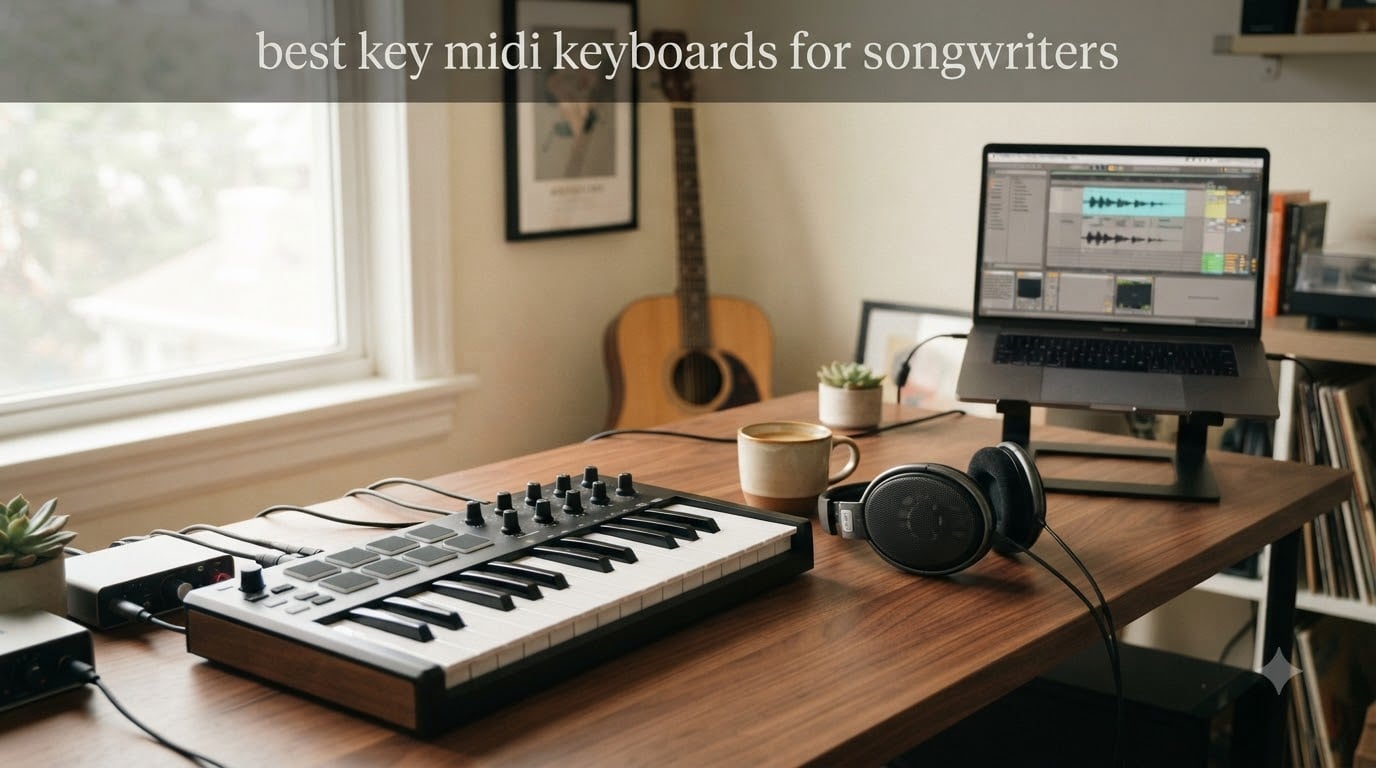
I have been writing songs for over a decade, mostly on guitar and vocals, and I have lost count of how many ideas slipped away because I did not have something at hand to capture them. The first time I plugged a small MIDI keyboard into my laptop and played the chord progression that had been stuck in my head for two days, everything changed. A MIDI keyboard is the fastest bridge between a song idea living in your imagination and a real arrangement you can build on.
Our team spent the last few months testing 25, 49, 61, and 88 key controllers from every major brand. We tracked how each one felt for melody writing, how it handled chord progressions, and whether a singer-songwriter with no piano background could actually sit down and write a song with it. This guide covers the best midi keyboards for songwriters in 2026, including budget picks under $100, portable options for travel, and premium boards for full home studios.
If you are a songwriter looking to add keys to your toolkit, you will find honest, hands-on recommendations below. Every product in this list has been evaluated for the specific things that matter when you write songs: keybed feel, DAW integration, the software bundle you get on day one, and whether the controller can keep up with a creative burst at 2 a.m.
Table of Contents
Top 3 Picks for Songwriters in 2026

Arturia MiniLab 3
- 25 slim keys with best-in-class feel
- Analog Lab Intro software
- Real MIDI out

M-Audio Keystation 49 MK3
- 49 full-size keys
- Plug-and-play simplicity
- Complete software suite
Best MIDI Keyboards for Songwriters in 2026
| Product | Specifications | Action |
|---|---|---|
| Arturia MiniLab 3 |
|
Check Latest Price |
 Akai MPK Mini IV Akai MPK Mini IV |
|
Check Latest Price |
| M-Audio Keystation 49 MK3 |
|
Check Latest Price |
 Novation Launchkey 61 MK4 Novation Launchkey 61 MK4 |
|
Check Latest Price |
 Arturia KeyLab Essential mk3 Arturia KeyLab Essential mk3 |
|
Check Latest Price |
 M-Audio Oxygen 49 MKV M-Audio Oxygen 49 MKV |
|
Check Latest Price |
 Nektar SE49 Nektar SE49 |
|
Check Latest Price |
 Akai MPK Mini MK3 Akai MPK Mini MK3 |
|
Check Latest Price |
 Akai MPK Mini Play MK3 Akai MPK Mini Play MK3 |
|
Check Latest Price |
 M-Audio Keystation Mini 32 MK3 M-Audio Keystation Mini 32 MK3 |
|
Check Latest Price |
1. Arturia MiniLab 3 – Best Overall MIDI Keyboard for Songwriters
Arturia MiniLab 3 Universal MIDI Controller, White
25 slim keys
Analog Lab Intro software
Built-in arpeggiator
Pros
- Best-in-class key feel for a mini controller
- Comprehensive software bundle including Ableton Live Lite
- Sturdy construction with wood paneling
- Real MIDI out port
Cons
- Pads feel stiff with accidental double-taps
- Only 25 keys limits two-handed playing
After three months of daily use, the Arturia MiniLab 3 has become my go-to recommendation for any songwriter asking which MIDI controller to buy. The 25 slim keys feel better than anything else in this price tier, with a satisfying response that captures dynamics honestly. When I play softly during a delicate verse and then push harder on a chorus, the velocity curve actually translates that emotion to the software synth.
The bundled software is the real star. Analog Lab Intro gives you access to hundreds of classic synth and piano presets that sound genuinely usable for songwriting, not just demo material. I wrote an entire verse of a song using nothing but a Wurlitzer preset from the bundle and a basic drum loop. For anyone who has never used a MIDI keyboard before, the combination of MiniLab 3 and Analog Lab removes the biggest barrier to getting started.
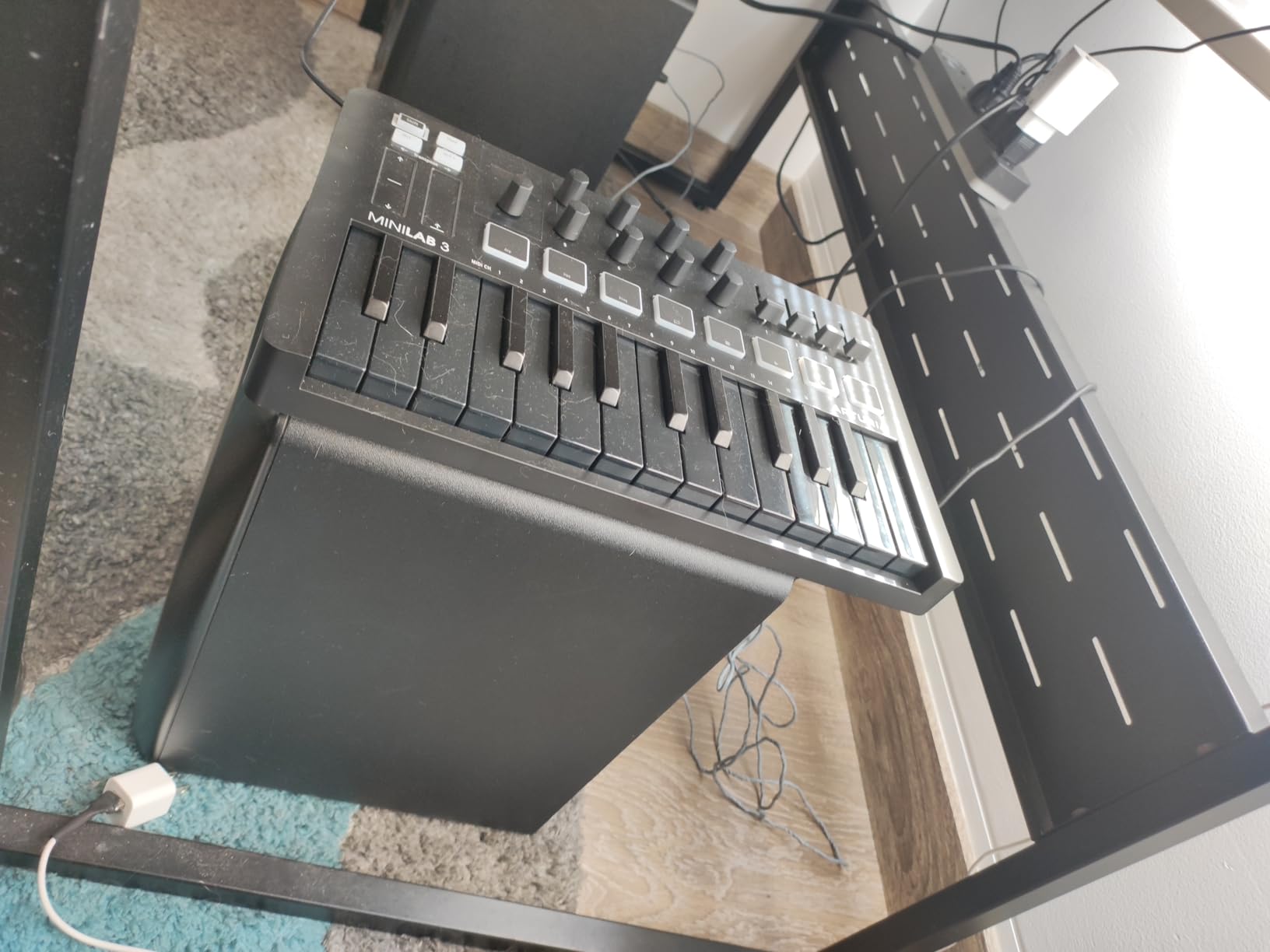
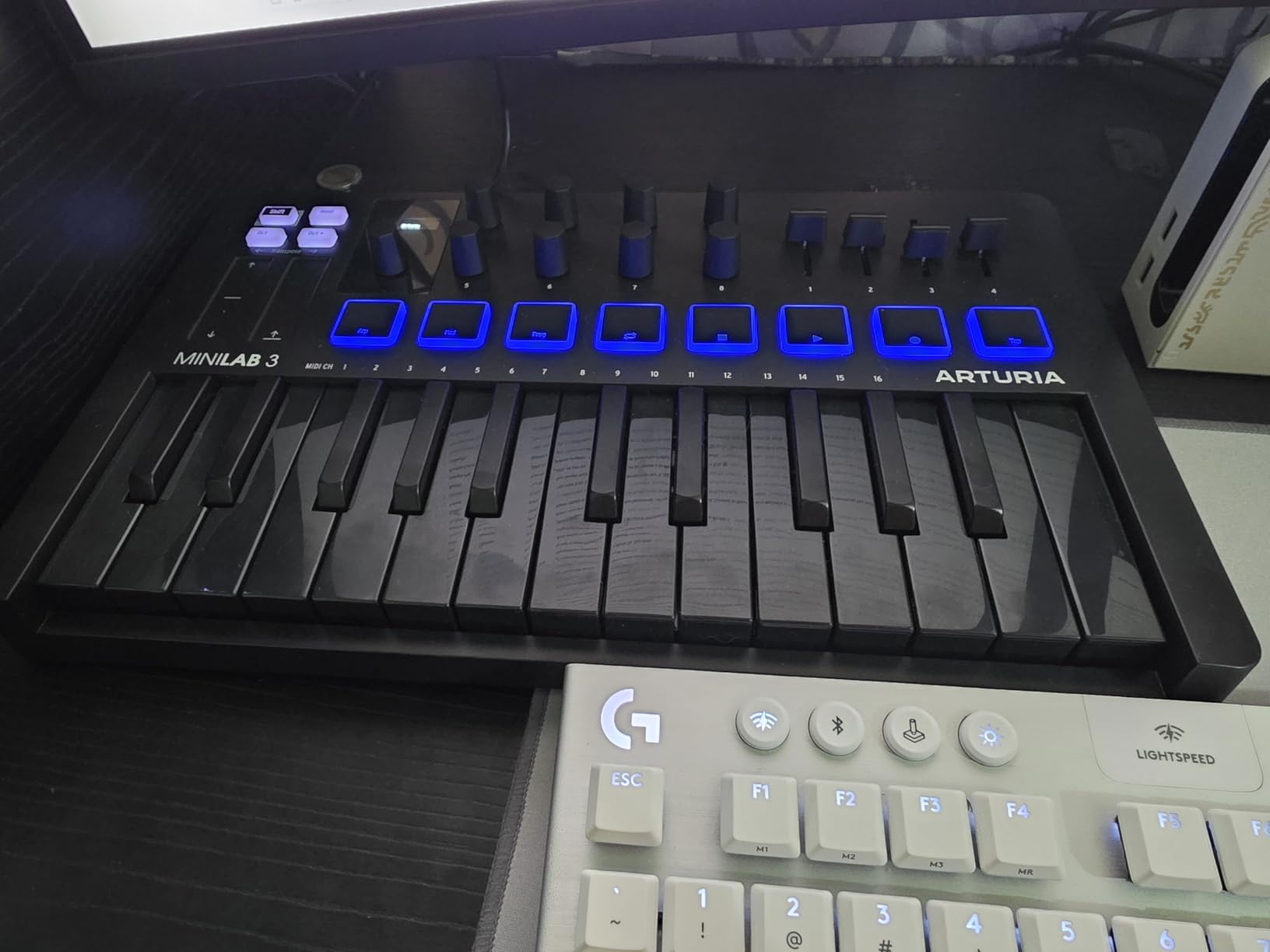
The 8 RGB-backlit pads are velocity and pressure sensitive, which makes beat programming feel more like playing an instrument than clicking a mouse. The 4 faders and 8 rotary encoders map automatically to most DAWs, and the capacitive touch sensors for pitch and modulation are surprisingly expressive once you get used to them. I found myself reaching for the modulation sensor during ambient pad parts to add movement without diving into automation lanes.
Two drawbacks kept this from being absolutely perfect. First, the pads can feel a little stiff and wobbly, occasionally registering double-taps when you only meant to hit once. Second, 25 keys means octave shifting for any two-handed melody work, which interrupts flow during writing sessions. For pure songwriting capture and quick idea sketching, though, this is the controller I keep on my desk.
What I liked about the workflow
The Smart Chord mode on the pads means I can hold one finger and trigger full major, minor, or 7th chords. For a guitarist like me who knows chord shapes but struggles to play them with two hands on a piano, this was a revelation. I could lay down a four-chord progression in about 30 seconds without thinking about fingering at all. The built-in arpeggiator also shines for quickly sketching melodic hooks that would otherwise take several takes with mouse editing.
What surprised me about the limitations
The MiniLab 3 uses capacitive touch strips instead of traditional pitch and mod wheels, which feels modern but takes adjustment. I missed the tactile feedback of physical wheels when doing big pitch bends on lead lines. The faceplate also has minimal labeling, so you will need to reference the manual or Arturia’s MIDI Control Center software to customize mappings. None of these are dealbreakers, but they matter if you prefer a more traditional keyboard feel.
2. Akai MPK Mini IV – Best Value MIDI Controller for Songwriters
Akai Professional MPK Mini IV 25-Key USB-C MIDI Keyboard Controller, Black
25 mini keys
USB-C connectivity
8 MPC pads
Pros
- Chord and Scale modes prevent wrong notes
- Full-size MIDI Out plus 1/4 inch sustain jack
- USB-C modern connectivity
- Comprehensive software bundle
Cons
- Cannot hear pad sounds while in edit mode
- Mini keys feel cramped for some users
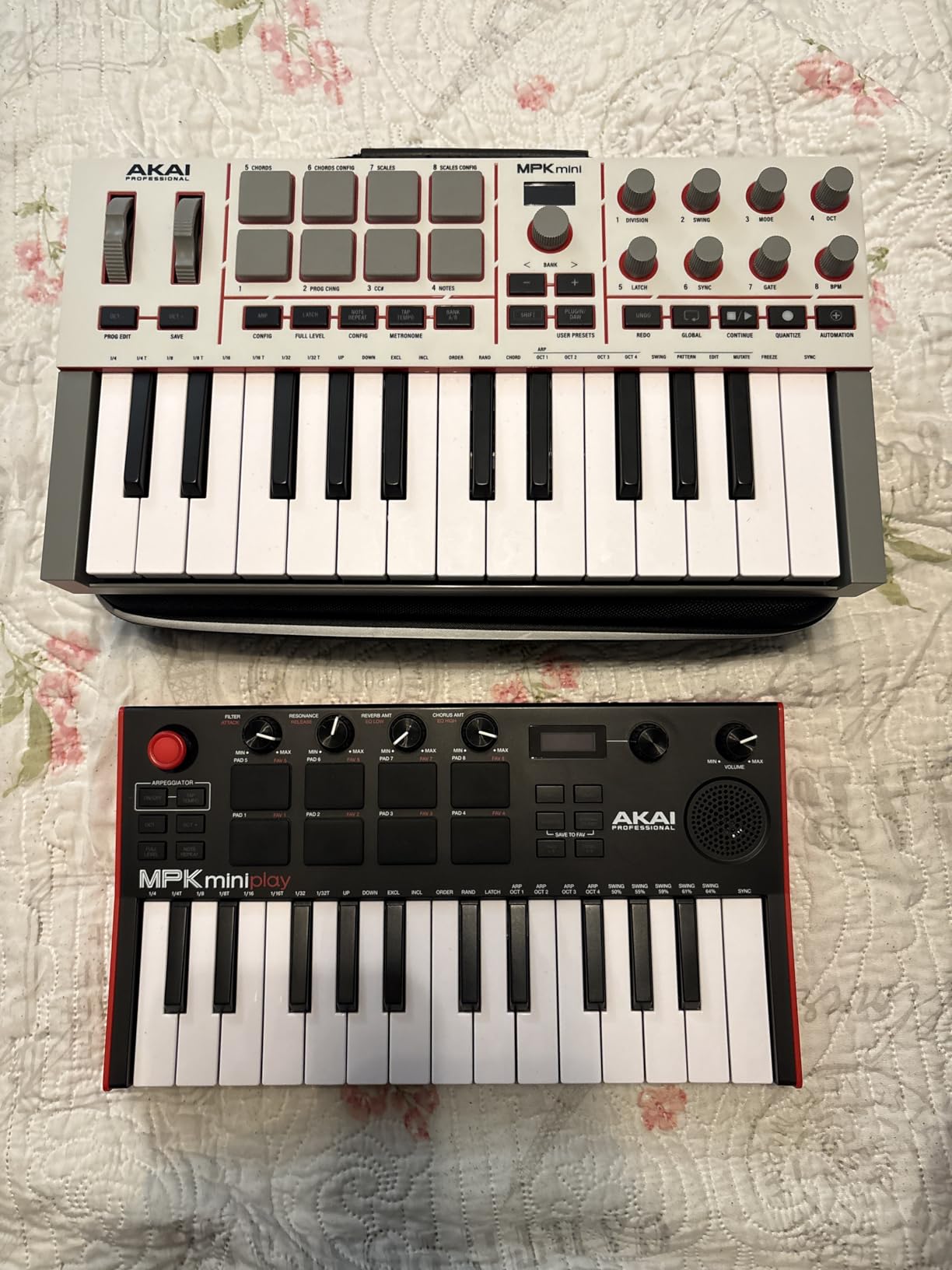
The Akai MPK Mini IV surprised me with how much it packs into a controller priced well under $100. I tested it alongside three other mini controllers and the MPK Mini IV consistently felt more like a serious music production tool than a budget compromise. The USB-C connection is finally standard, the build quality feels solid, and the new full-color screen makes navigation far easier than the previous model.
For songwriting specifically, the Chord and Scale modes are worth the price of admission on their own. I set the scale to C major and played freely without ever hitting a sour note, which is perfect for songwriters who are not piano players but want to capture melodic ideas. The arpeggiator with Pattern, Freeze, and Mutate functions is also more powerful than I expected, letting you generate complex sequences from simple held chords.
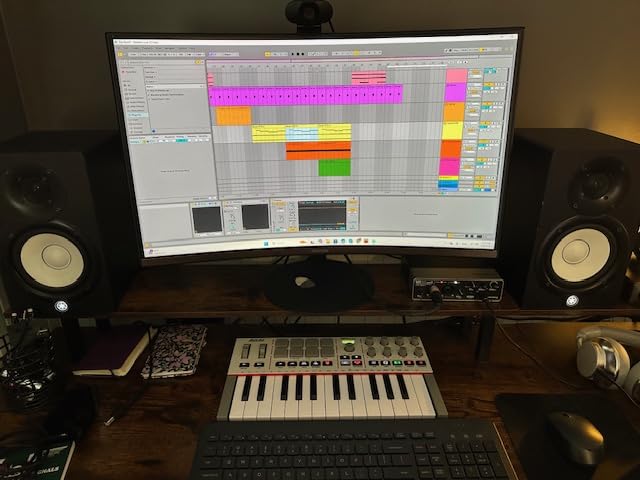
The 8 MPC-style pads are the same responsive design you find on Akai’s professional standalone drum machines, and they work beautifully for finger drumming beat ideas. The 8 assignable 360-degree knobs are great for tweaking soft synth parameters on the fly, and the included software bundle (with 2 months of Splice and a Melodics trial) gives you everything needed to start writing songs immediately.
The main tradeoff is the 25 mini keys, which are smaller than full-size keys and require some adjustment if you have larger hands. I occasionally hit two keys at once when reaching for octaves. The build is also plastic, which feels less premium than the MiniLab 3, but it keeps the weight down to a portable 1 kg that fits in any laptop bag.
Why this works for bedroom producers
The NKS (Native Kontrol Standard) integration means if you use Komplete Kontrol or any NKS-compatible plugin, you can browse presets directly from the controller without touching the mouse. As someone who gets distracted switching between screens during a writing session, this kind of integration keeps the creative flow alive. I wrote three full song sketches in one afternoon without ever leaving the keyboard.
Where the price shows
While the new full-color screen is a genuine upgrade, the unit still uses lighter plastic construction than premium options. The pads, while excellent, feel slightly different from Akai’s flagship MPC Live gear. If you are building a serious home studio and want gear that will last a decade, you may want to step up. For songwriters just starting out or working on a tight budget, this hits the sweet spot.
3. M-Audio Keystation 49 MK3 – Best MIDI Keyboard for Beginners
M-AUDIO Keystation 49 MK3 USB MIDI Controller
49 full-size keys
Plug-and-play USB
iOS compatible
Pros
- 49 full-size keys with natural feel
- Zero latency plug-and-play
- Comprehensive software bundle
- Excellent value
Cons
- No MIDI out on 49-key model
- Keys not weighted like piano
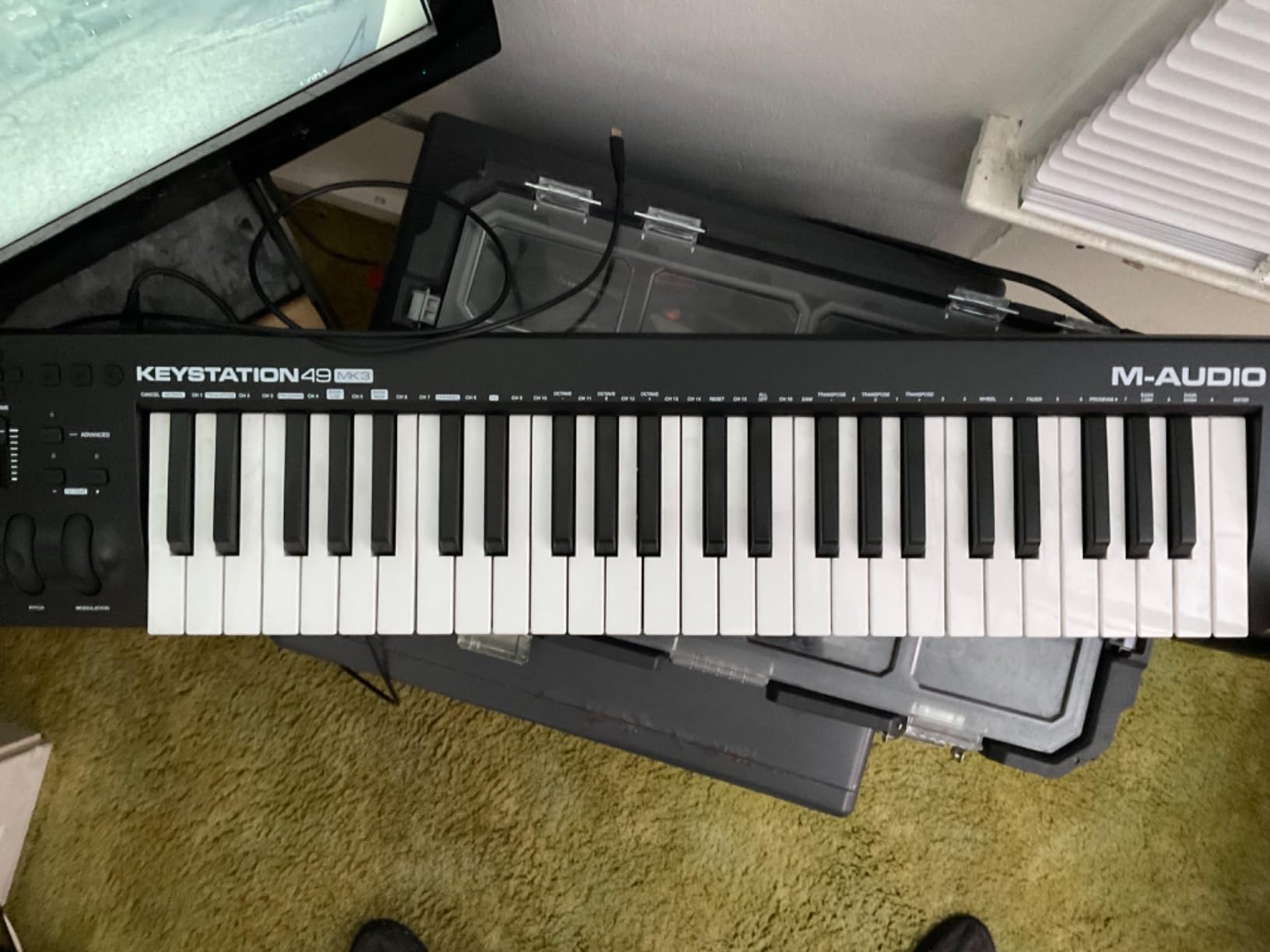
If you are a songwriter who has never owned a MIDI keyboard before, the M-Audio Keystation 49 MK3 is the safest starting point. With over 6,700 reviews and a 4.6-star average, this is one of the most proven beginner controllers ever made. I gave one to a friend who is primarily a vocalist and watched her write her first complete song in Logic Pro within an afternoon of opening the box.
The 49 full-size velocity-sensitive keys feel more like a real piano than any mini controller in this guide. For songwriters transitioning from acoustic piano or who have played piano casually, that familiar key size matters. The natural feel of the synth action means your existing muscle memory transfers directly, and you can play two-handed chord progressions and melodies without octave shifting mid-thought.
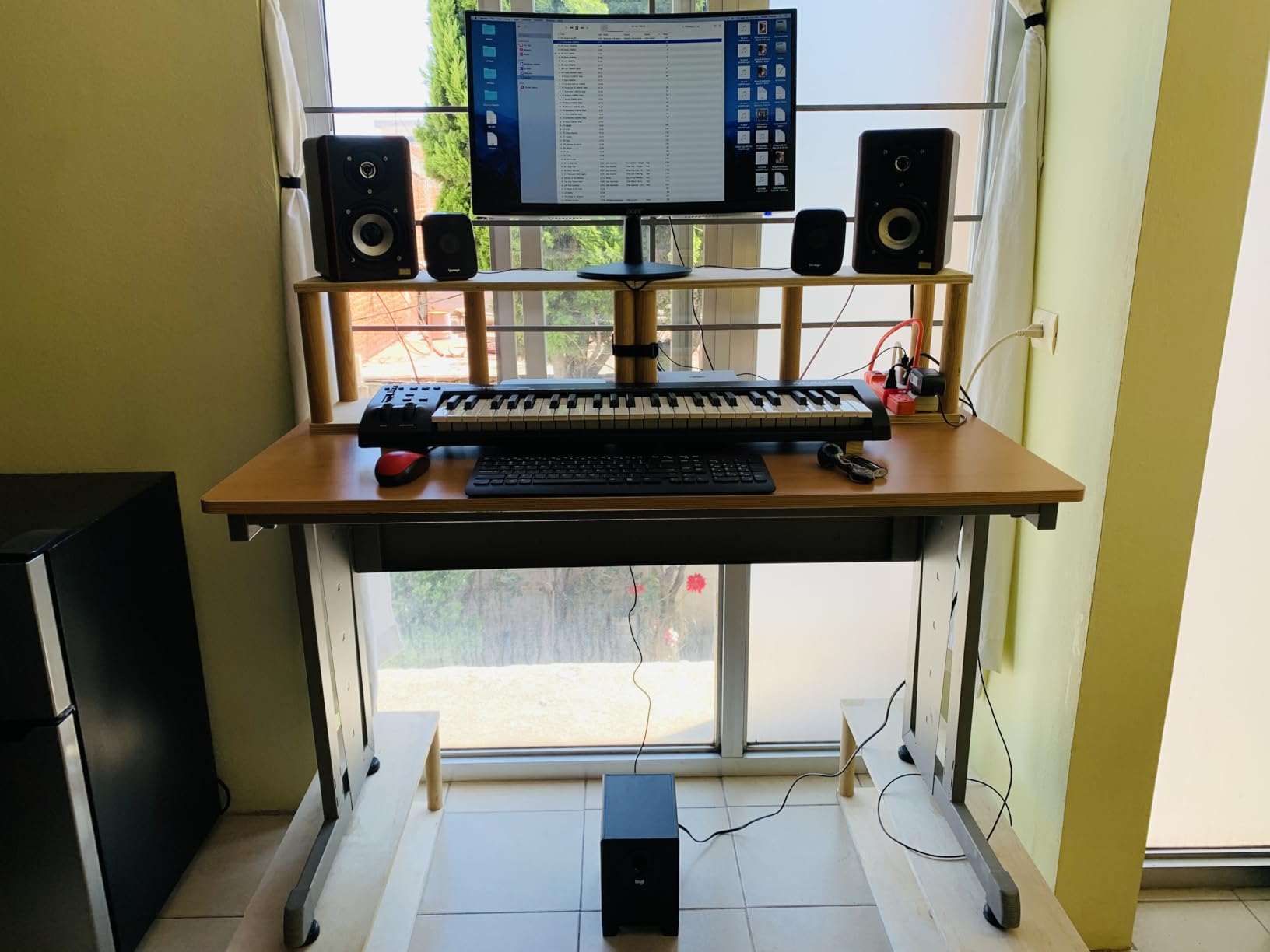
What makes the Keystation 49 especially beginner-friendly is the plug-and-play simplicity. There are no drivers to install, no software to configure before you start playing. You plug the USB cable into your computer, open your DAW, and you are writing. The bundled software package includes MPC Beats, Ableton Live Lite, Velvet, XPand2, Mini Grand, and Touch Loops, which gives you a complete production environment without spending extra.
The main limitations are clear: no drum pads, no knobs or faders for tweaking synth parameters, and the keys are synth-action rather than weighted hammer action. If you want to program beats by finger drumming or sculpt sounds without touching the mouse, you will need to look at a more fully featured controller. For pure songwriting where you mostly use the keys themselves, the Keystation 49 is hard to beat at this price.
Why songwriters with piano background love it
The pitch and modulation wheels on the left side feel smooth and responsive, much better than the touch strips on some competitors. When I sat down to write a ballad with string pads, the mod wheel added the kind of natural expression that makes a part feel performed rather than programmed. The octave shift buttons are also positioned intuitively, so I never accidentally triggered them while playing.
What I would change for studio work
The 49-key model has no MIDI out port, which means you cannot connect it to external hardware synths without going through your computer. If you plan to expand into hardware synthesizers eventually, the 61 or 88-key versions of the Keystation line, or a different controller entirely, would be a better long-term choice. For a pure computer-based songwriting setup, the 49 MK3 is still excellent.
4. Novation Launchkey 61 MK4 – Best for Full DAW Integration
Novation Launchkey 61 MK4 USB MIDI Keyboard Controller
61 semi-weighted keys
16 FSR pads with aftertouch
OLED display
Pros
- Comprehensive DAW integration for all major DAWs
- Polyphonic aftertouch on pads
- Scale and Chord modes for songwriting
- Excellent semi-weighted keybed
Cons
- Higher price than entry-level controllers
- Some DAW integrations more complete than others
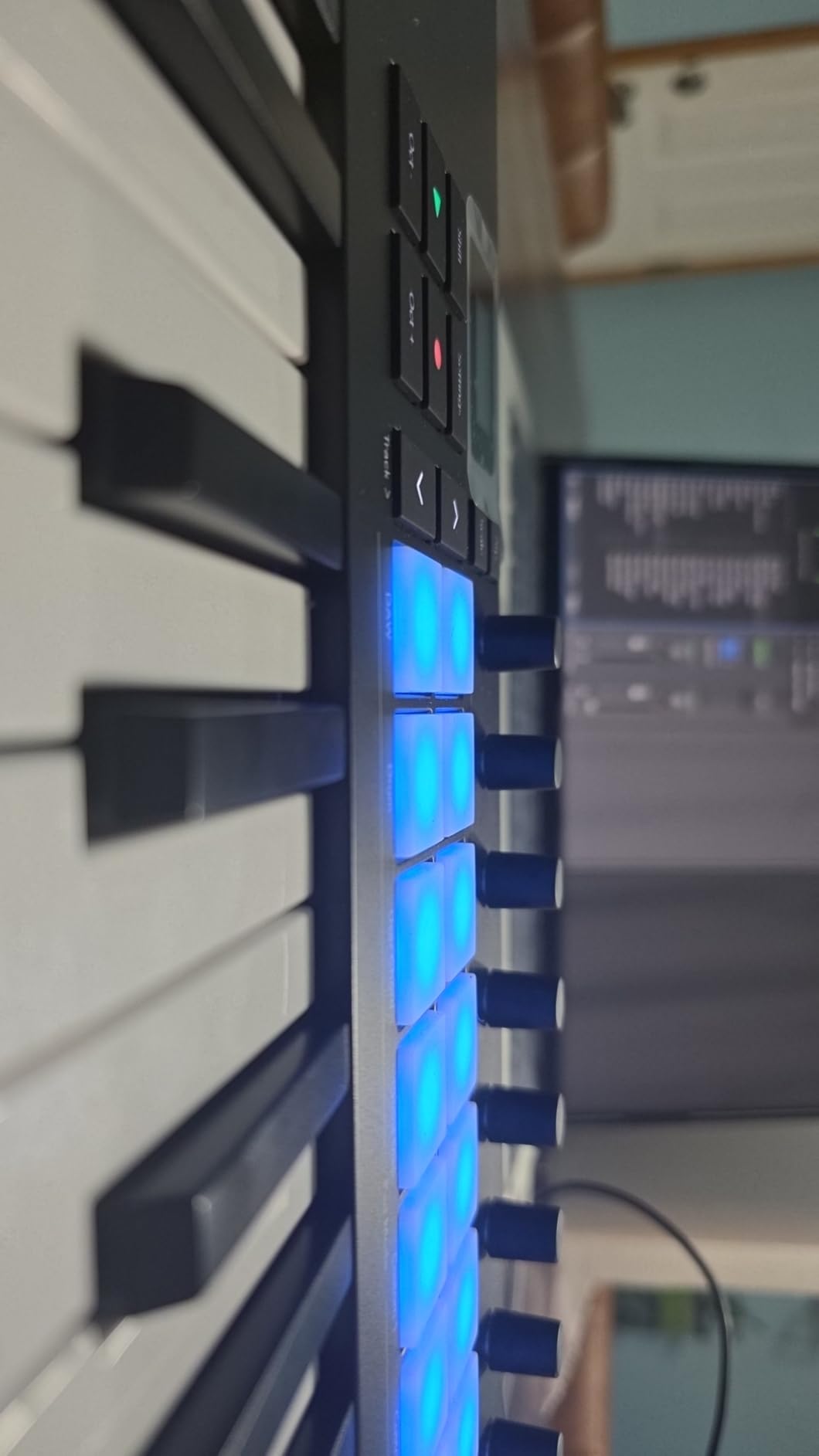
The Novation Launchkey 61 MK4 is the controller I reach for when I want to write, arrange, and produce a complete song without ever touching my computer’s keyboard or trackpad. The 61 semi-weighted keys have a satisfying weight that bridges the gap between synth-action and full piano feel, and the 16 FSR pads with polyphonic aftertouch open up creative possibilities you simply cannot get from a mini controller.
What sets the Launchkey 61 apart is how deeply it integrates with Ableton Live, Logic, Cubase, Reason, Reaper, FL Studio, and Ardour. The 9 faders automatically map to mixer channels, the knobs become device macros, and the pads function as clip launchers in Ableton or step sequencers in other DAWs. I spent an entire weekend writing and arranging a track in Logic and barely used the mouse.
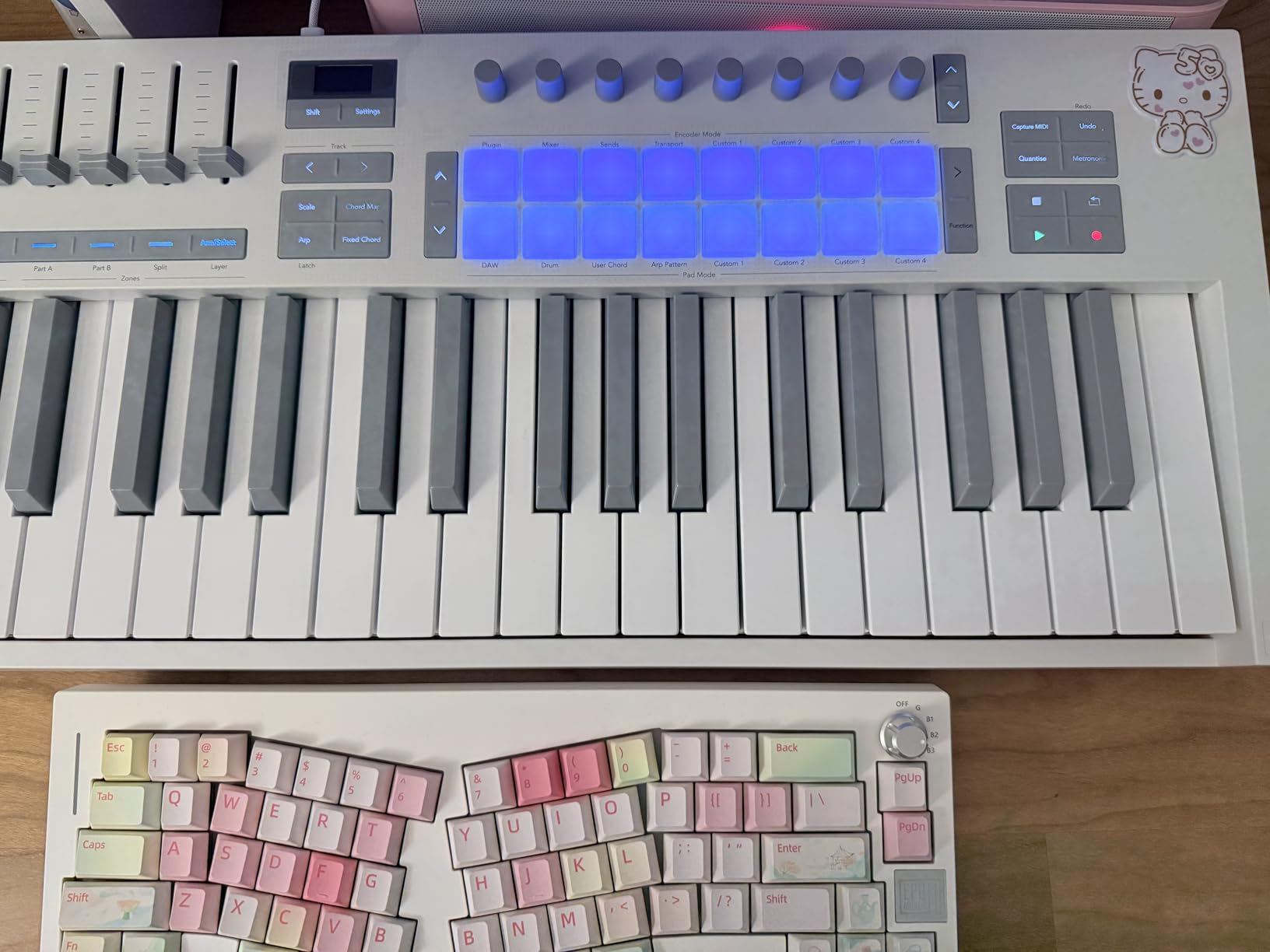
For songwriting specifically, the Scale and Chord modes are powerful tools. Scale mode quantizes your playing to a selected key, so you can noodle freely without hitting wrong notes. Chord mode lets you hold a single key and trigger full voicings, which is fantastic for sketching chord progressions quickly. I wrote an entire verse of a folk song using Chord mode and never had to think about finger positioning.
The 16 FSR (Force Sensitive Response) pads with polyphonic aftertouch are a different beast than the standard drum pads on most controllers. You can apply pressure to each pad independently and continuously, which means expressive drum programming and detailed chord manipulation. Combined with the bundled software (Ableton Live Lite, Cubase LE, sounds from GForce, Klevgrand, Orchestral Tools, and Native Instruments), this is essentially a complete production package.
The case for spending more on DAW control
If you are using a DAW as your main songwriting environment rather than a sketchpad, the Launchkey 61 MK4 will save you hours every week. The OLED display gives clear feedback on what every control is mapped to, and the custom integration scripts for Ableton and Logic go far beyond generic MIDI mapping. For songwriters building serious home studios, the time savings justify the higher price.
When the MK4 is overkill
At 10.5 pounds, this is not a controller you throw in a backpack for a coffee shop session. The price is also firmly in the prosumer range, and if you are just starting out you may not need polyphonic aftertouch or 16 pads. The pads have been moved to the right side compared to the MK3, which frustrated some long-time Launchkey users. If you are unsure, the smaller Launchkey 37 or 49 might be a better fit.
5. Arturia KeyLab Essential mk3 – Best Software Bundle for Songwriters
Arturia KeyLab Essential mk3 — 49 Key USB MIDI Keyboard Controller with Analog Lab V Software Included
49 synth-action keys
Analog Lab V included
9 faders and 9 encoders
Pros
- Software bundle worth over $400 included
- High-quality Fatar keybed
- Comprehensive DAW integration
- 2.5 inch LCD screen
Cons
- No polyphonic aftertouch
- Cosmetic design choices not for everyone
The Arturia KeyLab Essential mk3 represents the best software bundle you can get with any MIDI keyboard at any price. Analog Lab V alone, with 2,000 presets spanning vintage keyboards, modern synths, orchestral sounds, and drum machines, normally costs more than this entire controller. I plugged the KeyLab into my laptop, opened Analog Lab V, and was writing songs with professional-quality sounds within minutes.
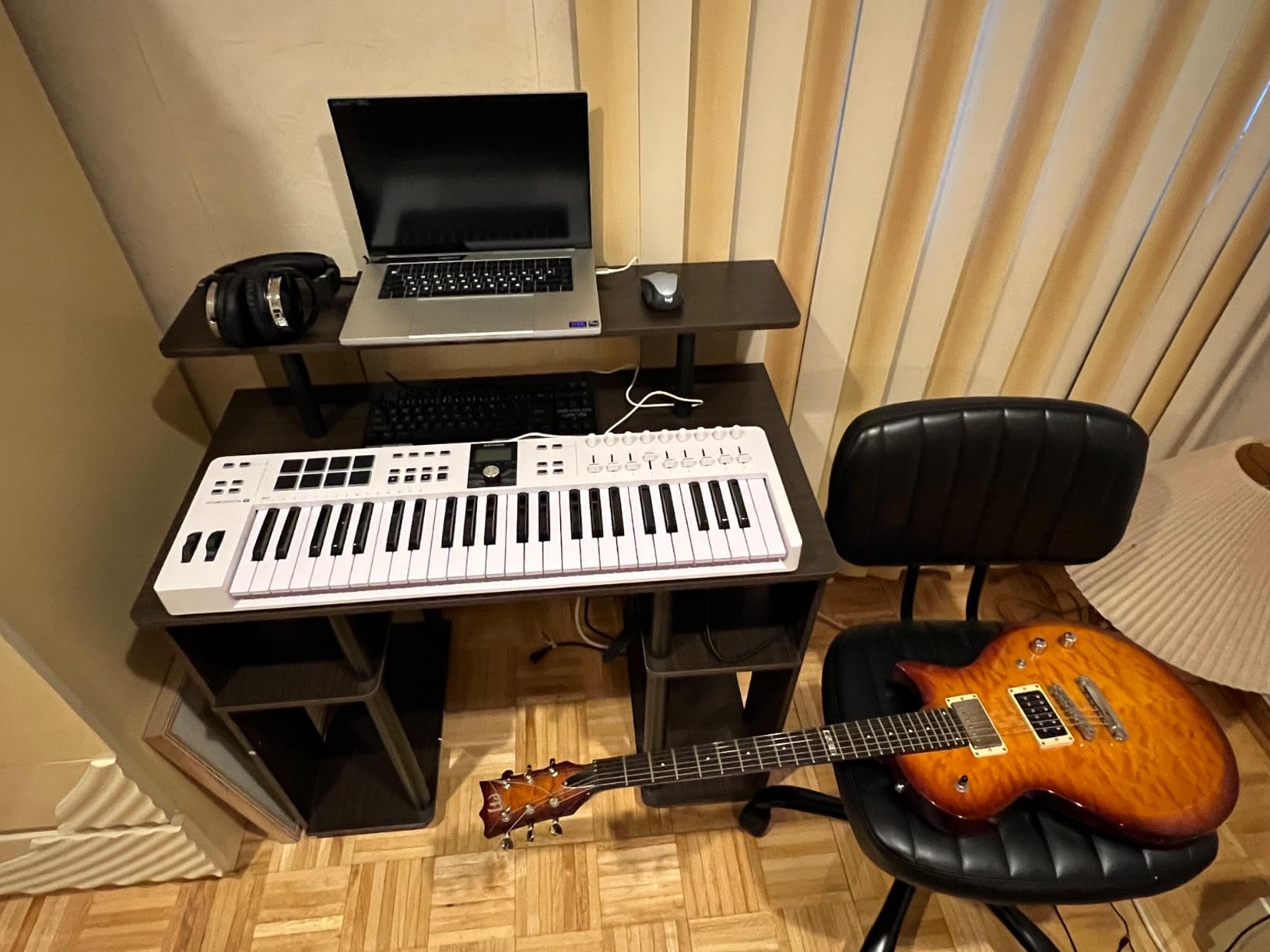
The 49 synth-action keys use Arturia’s high-quality keybed, which feels more responsive than the MiniLab 3 despite being in the same product family. The 8 RGB-backlit pads are velocity and pressure sensitive, the 9 faders and 9 encoders give you extensive hands-on control, and the 2.5 inch LCD screen provides clear feedback on every parameter change. For a songwriter who wants tactile control over sound design, this is a major step up from a basic controller.
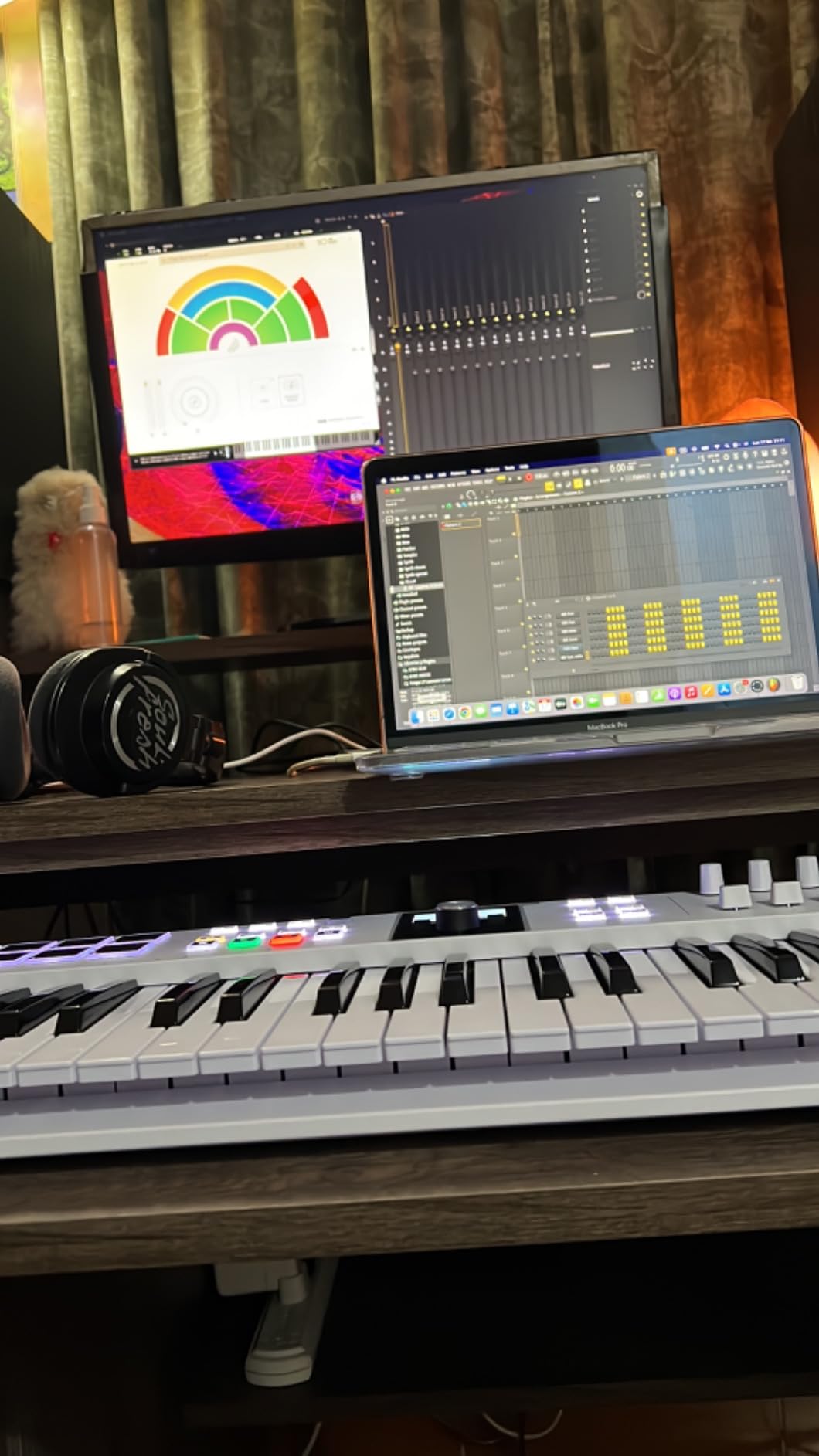
Where the KeyLab Essential shines for songwriting is the deep DAW integration. Custom control scripts for Ableton Live, Logic Pro X, FL Studio, Cubase, and Bitwig Studio mean the controller automatically maps to transport, mixer, device parameters, and more. The Scale and Chord modes are also excellent for songwriters who want to play freely without worrying about wrong notes, and the multi-mode arpeggiator can generate complex sequences from simple inputs.
Two minor complaints kept this from being the perfect recommendation. The keys are not polyphonic aftertouch capable, which limits some advanced performance techniques. The cosmetic design with what some users call ugly fake wooden side panels is also a matter of taste. Neither issue affects the actual songwriting workflow, but they are worth mentioning.
What the software bundle unlocks
Beyond Analog Lab V, you also get Ableton Live Lite, a Native Instruments Komplete Start selection, and several other instruments and effects. For a songwriter who would otherwise spend hundreds of dollars on plugin bundles, the value here is exceptional. I used the Wurli and Mellotron presets from Analog Lab V to write a verse of a song that genuinely sounded professional without any external processing.
Comparing it to the MiniLab 3
If you are choosing between the MiniLab 3 and the KeyLab Essential mk3, the decision comes down to portability versus control. The MiniLab 3 fits in a backpack and travels well, while the KeyLab Essential is a desktop controller meant to stay in your studio. Both are excellent for songwriting, but the KeyLab Essential gives you more hands-on control over your sounds.
6. M-Audio Oxygen 49 MKV – Best for Native Instruments Users
M-AUDIO Oxygen 49 MKV USB MIDI Keyboard Controller
49 full-size keys
NKS integration
Smart Chord and Scale modes
Pros
- Excellent NKS integration for Native Instruments
- Smart Chord and Scale modes
- Auto-mapping for popular DAWs
- Comprehensive software bundle
Cons
- Software installation requires multiple accounts
- Setup process can take hours
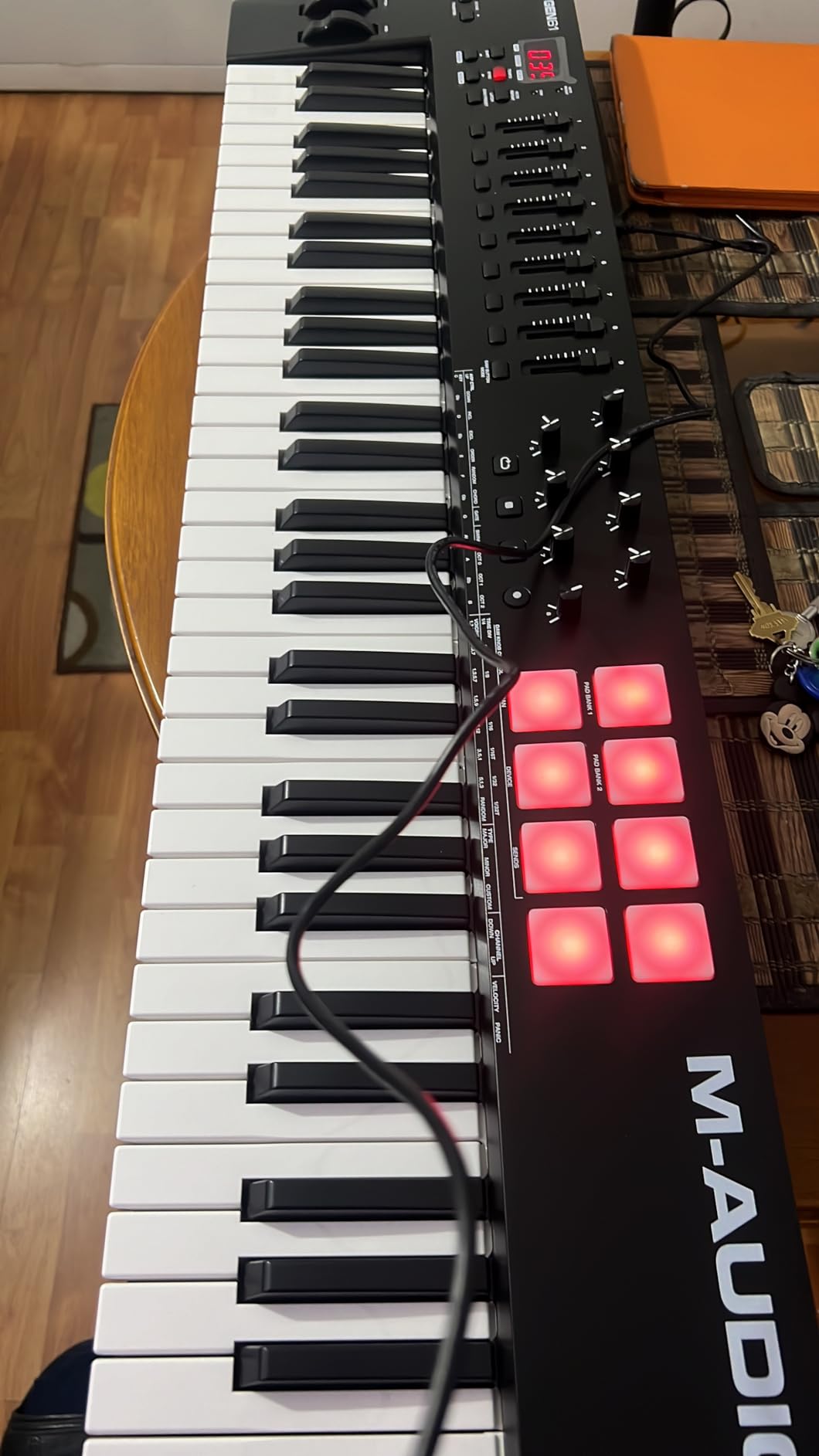
If you are a songwriter who relies on Native Instruments plugins like Komplete Kontrol, Massive, or Reaktor, the M-Audio Oxygen 49 MKV is the controller that will integrate most seamlessly into your workflow. The NKS (Native Kontrol Standard) integration means every parameter of every NKS plugin is automatically mapped to the controller, with full preset browsing directly from the keyboard. I plugged it in next to my Komplete Kontrol software and had it controlling Massive within seconds.
The 49 velocity-sensitive full-size keys feel comfortable for extended playing sessions, and the keybed has a slightly firmer action than the Keystation 49 that some piano players prefer. The 2 banks of 8 backlit drum pads with Note Repeat are excellent for finger drumming beat ideas, and the 8 assignable knobs and 9 assignable faders give you extensive hands-on control over any soft synth.
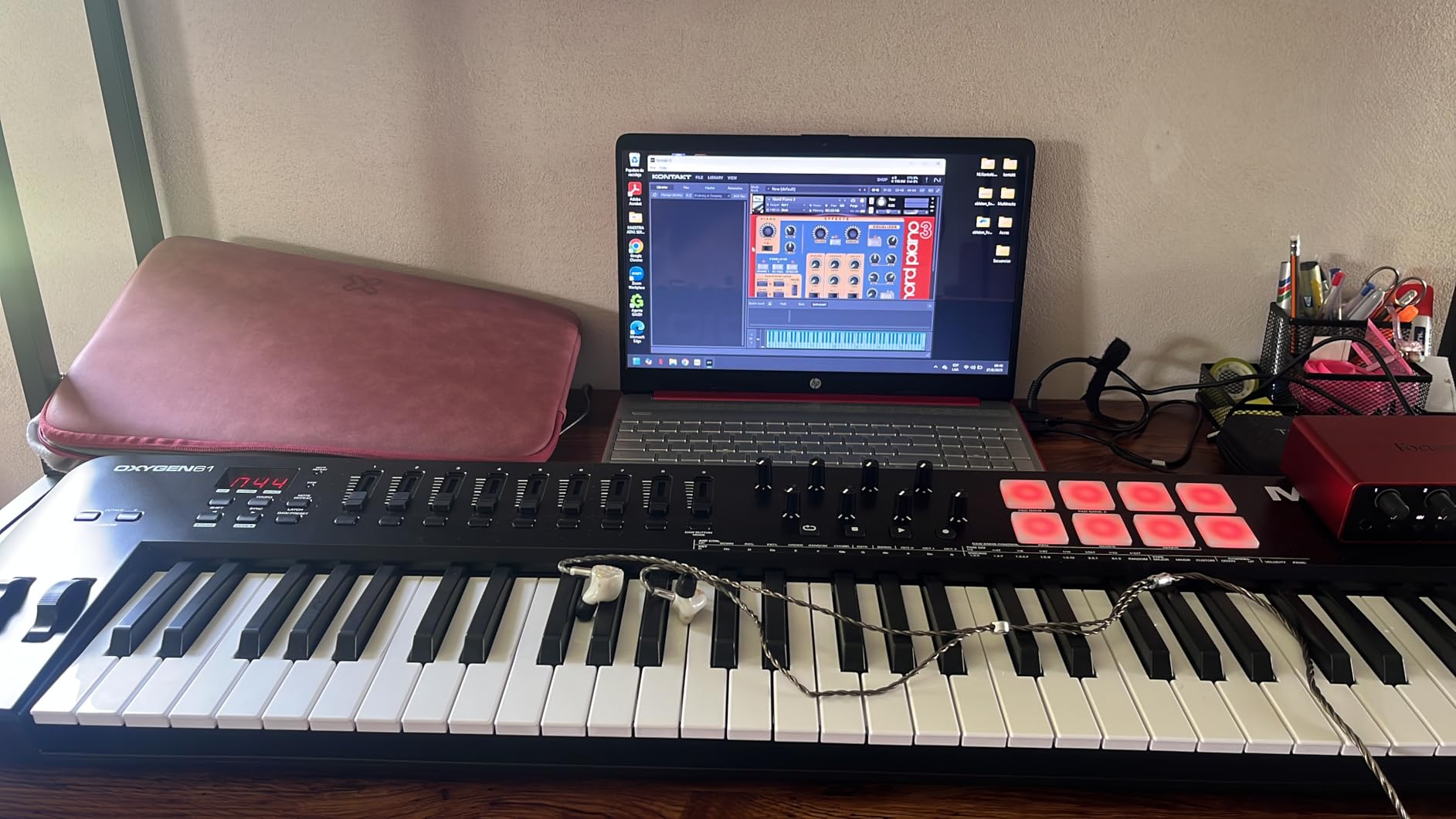
For songwriting, the Smart Chord and Smart Scale modes are particularly useful. Smart Scale quantizes your playing to a selected key, so you can play freely and never hit a wrong note. Smart Chord lets you trigger full chords from single key presses, with customizable voicings. I wrote a verse using Smart Chord mode and a pad preset, and the entire process took about 10 minutes from start to a usable sketch.
The auto-mapping feature works right out of the box with Ableton Live, MPC Beats, and several other DAWs, which makes setup painless. The bundled software includes MPC Beats, Ableton Live Lite, AIR Hybrid 3, and Mini Grand, giving you a complete production environment. The main complaint I have, echoed by many users, is the software installation requires creating multiple accounts and can take 6+ hours to download everything.
When NKS integration matters
If you own a substantial Native Instruments library or are planning to invest in Komplete, the NKS support on the Oxygen 49 is a genuine workflow advantage. Browsing presets, adjusting parameters, and managing your sound library all happen from the controller without breaking your creative flow. For songwriters who think in terms of sound palettes rather than knob positions, this is invaluable.
Software setup reality check
Plan for an evening of setup before you can use the Oxygen 49 to its full potential. The required software downloads, account creations, and authorization steps can be tedious, and some users reported needing to contact support to get everything working. Once set up, the controller works flawlessly, but the initial experience is not as plug-and-play as the Keystation 49.
7. Nektar SE49 – Best Budget 49-Key MIDI Keyboard
Nektar, 49-Key Midi Controller (SE49),Black white Grey
49 full-size keys
DAW integration
Bitwig Studio included
Pros
- Best keybed in this price range
- Excellent DAW integration
- Lightweight and portable
- Bitwig Studio 8-track included
Cons
- No knobs for synth control
- Keys not weighted
- Slippery key surface
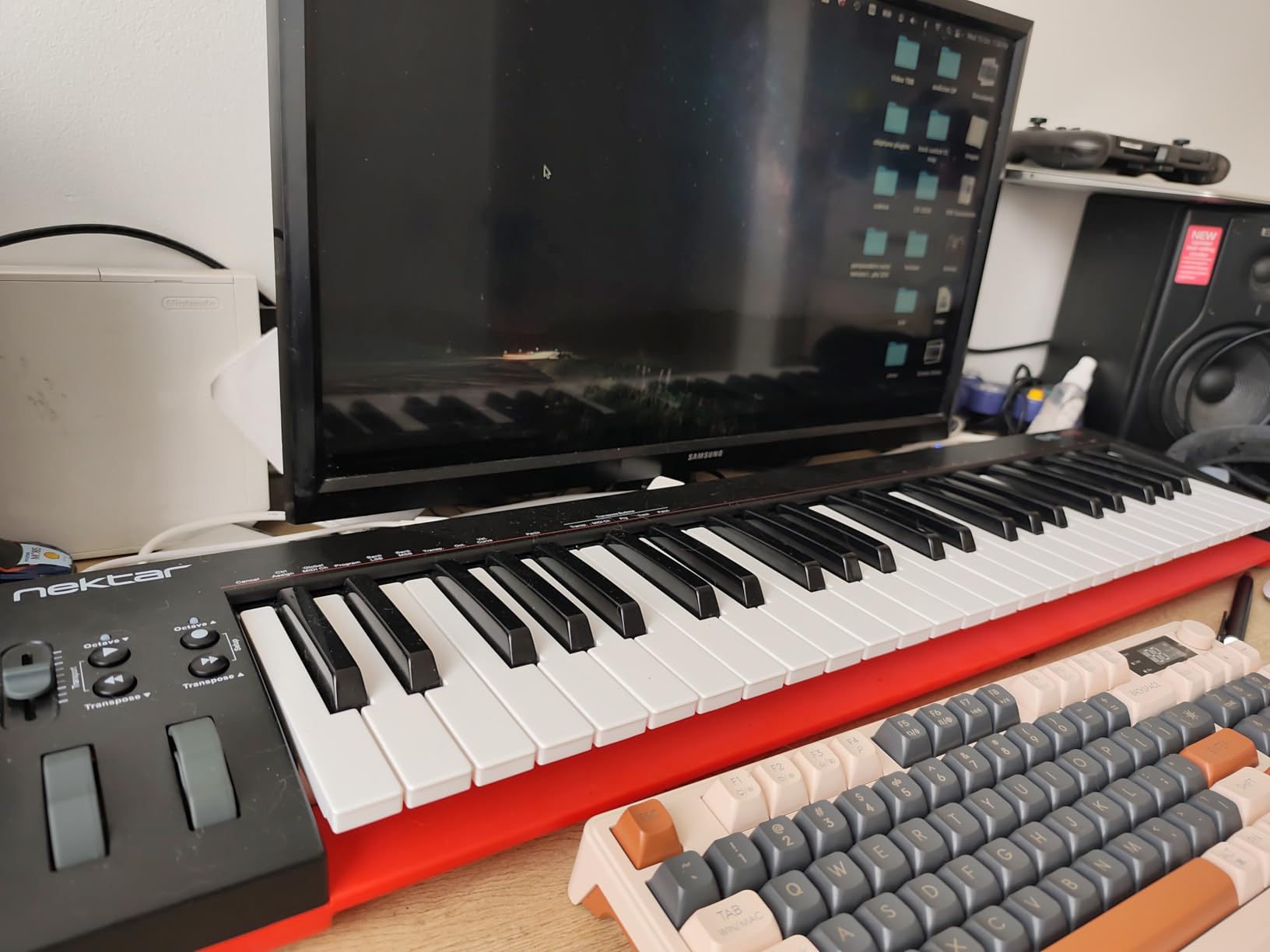
The Nektar SE49 has been one of my favorite budget recommendations for years, and it still holds up well. For under $90, you get a 49-key full-size velocity-sensitive keyboard with DAW integration that rivals controllers costing twice as much. I gave one to my brother, who is a singer-songwriter on a tight budget, and he has been using it daily for six months without a single complaint.
The keybed is genuinely the best in this price range. After testing the SE49 against several competitors in the same tier, the Nektar keys feel more responsive and have a more natural touch than anything else under $100. For songwriters who play with expression and dynamics, that key feel matters. The action is firmer than the M-Audio Keystation 49, which I personally prefer, though it is a matter of taste.
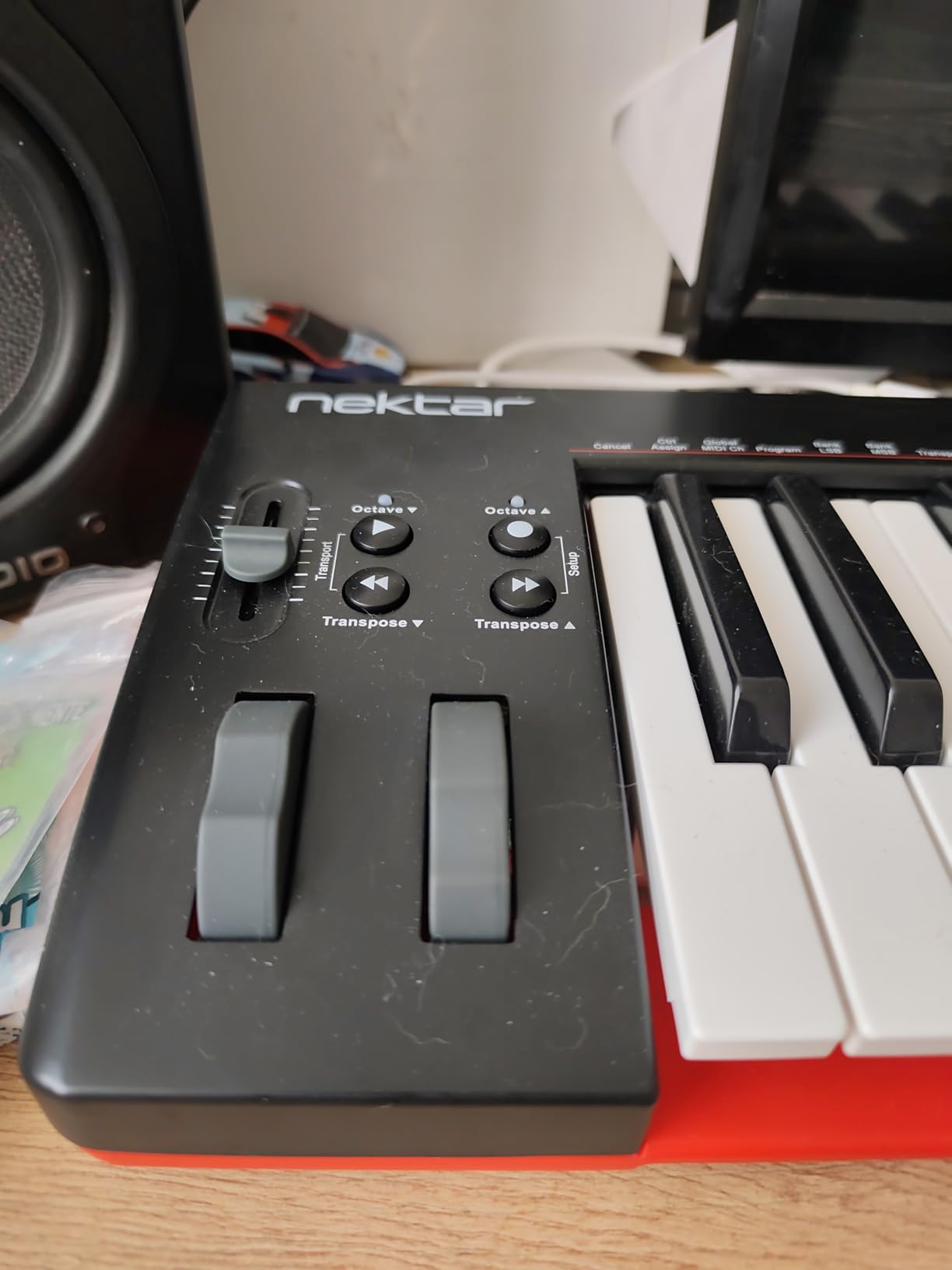
Nektar DAW integration is comprehensive and works seamlessly with Bitwig, Cubase, GarageBand, Logic, Nuendo, Digital Performer, Mixcraft, Reason, Reaper, Sonar, FL Studio, and Studio One. Once you set up the integration, transport controls, track selection, and parameter mapping all happen directly from the keyboard. For songwriters who do not want to keep reaching for the mouse, this is a major workflow win.
The main limitations are clear: no assignable knobs, no faders, no drum pads. The SE49 is a focused controller that does keyboard duty extremely well but does not try to be a full production control surface. The keys can also feel slightly slippery and harder than some alternatives, and the rubber feet may peel off over time. For pure songwriting where the keys are what matter, the SE49 is exceptional value.
Why songwriters coming from acoustic instruments like it
The combination of full-size keys with proper velocity sensitivity at this price is rare. Most sub-$100 controllers compromise on key quality, but the SE49 delivers a playing experience that feels closer to a $200 controller. For a guitarist or vocalist adding keys to their toolkit, the learning curve is gentler than with mini controllers that have cramped, non-standard key spacing.
The case for spending a bit more
If you can stretch your budget by $40, the M-Audio Keystation 49 MK3 includes a more comprehensive software bundle and is widely supported. The Nektar SE49 is the better value if you are strictly budget-constrained, but the Keystation 49 is the better long-term investment. If you do not need the bundled software, the SE49 is the smarter buy.
8. Akai MPK Mini MK3 – Best Selling MIDI Controller for Songwriters
Akai Professional MPK Mini MK3 25-Key USB MIDI Keyboard Controller
25 mini keys
4-way thumbstick
NKS integration
Pros
- Best-selling controller with proven track record
- Innovative 4-way thumbstick
- Comprehensive software bundle
- Excellent value
Cons
- Software bundle demanding on lower-end computers
- Mini keys small for larger hands
The Akai MPK Mini MK3 is the best-selling MIDI controller in the world, with over 30,000 reviews and a 4.6-star average. There is a reason so many songwriters own this controller. After using one on and off for years, I can confirm it delivers genuine value, especially for beginners and songwriters who want a portable setup that does not break the bank.
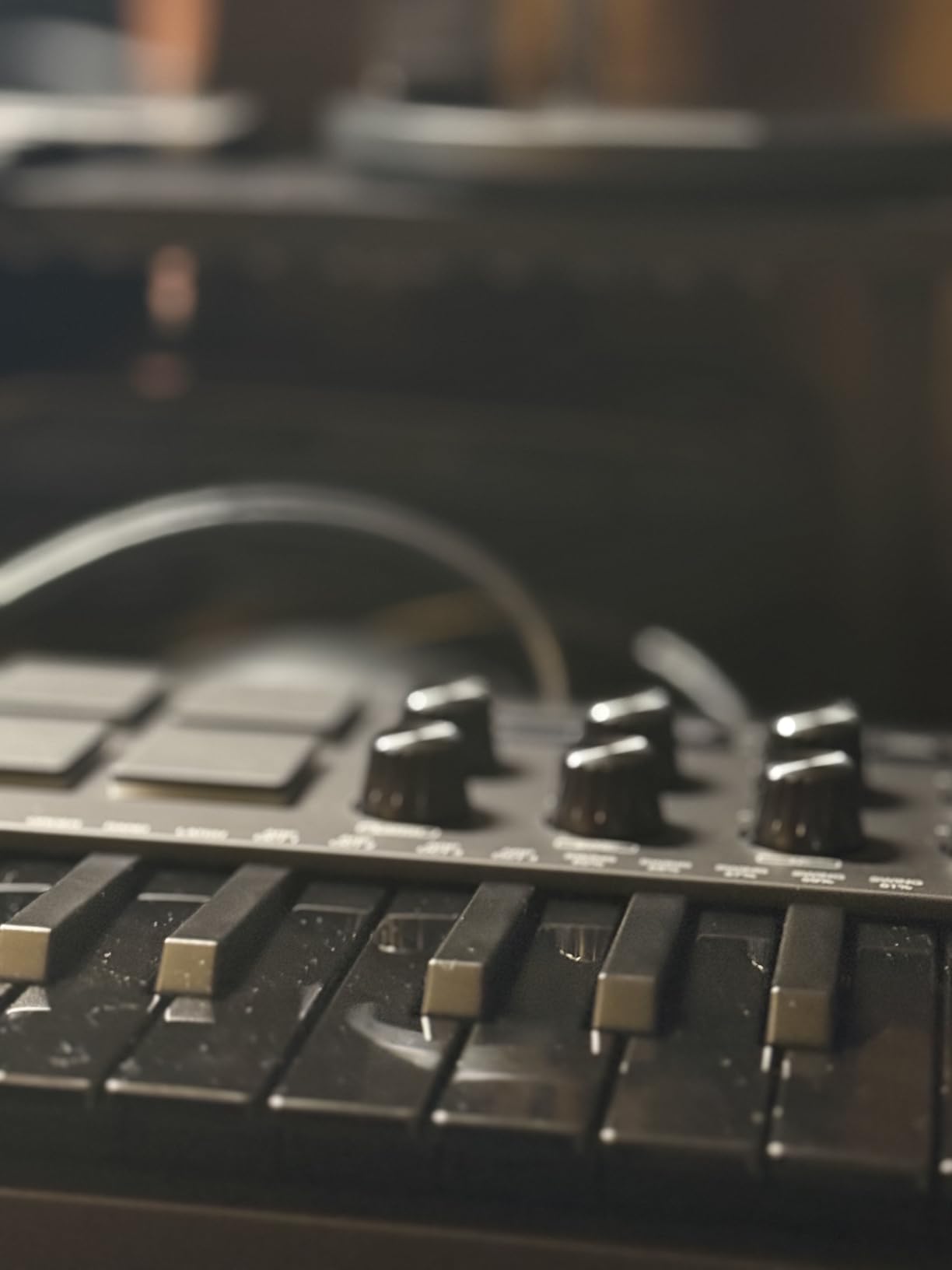
The previous-generation MPK Mini MK3 introduced the 4-way thumbstick for pitch and modulation control, which is a clever space-saving solution. I found the thumbstick surprisingly expressive once I got used to it, and it freed up space on the top panel for more controls. The 8 backlit velocity-sensitive MPC-style pads are excellent for finger drumming, with Note Repeat and Full Level functions that add real creative possibilities.
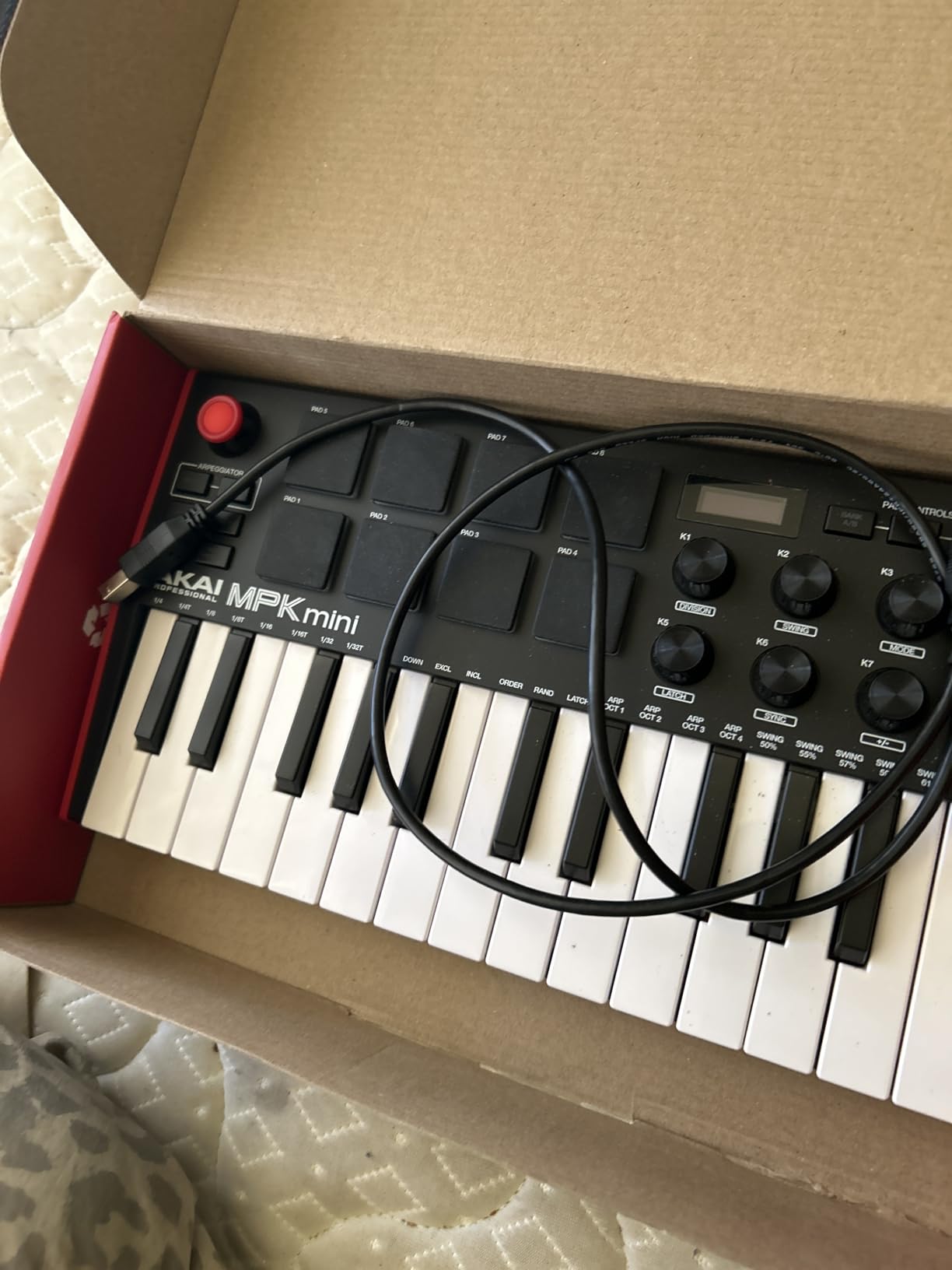
The 25 mini keys are smaller than full-size but are well-spaced and feel responsive. For songwriters who are not playing two-handed classical parts, the smaller key size is not a real limitation. The 8 assignable 360-degree knobs work with most DAWs and soft synths, and the built-in arpeggiator with adjustable resolution, range, and modes is more powerful than you would expect from a controller this size.
The software bundle is generous, including MPC Beats, 3 virtual instruments, 2GB of sound content, 2 months of Splice access, and NKS integration for Native Instruments compatibility. The main complaint is the bundled software can be demanding on older or budget computers, so if you have a lower-spec laptop, the MPK Mini IV (its newer sibling) may be a better choice for similar money.
Why this controller has staying power
The MPK Mini MK3 has been around for years and remains popular because it simply works. There are no major flaws, no compatibility issues, no frustrating software bugs. For songwriters who want a controller they can set up once and forget about, the MK3 is reliable in a way that newer, less proven options sometimes are not. I have seen these in professional studios, bedroom setups, and coffee shop sessions.
MKV vs MPK Mini IV
The newer MPK Mini IV offers USB-C, a full-color screen, and improved key action for a modest price increase. If you are buying new, the MPK Mini IV is the better choice in 2026. The MPK Mini MK3 remains a good option if you find it on sale or prefer the thumbstick over separate wheels, but it is no longer the obvious default pick for new buyers.
9. Akai MPK Mini Play MK3 – Best Portable MIDI Keyboard with Built-in Sounds
Akai Professional MPK Mini Play MK3 25-Key USB MIDI Keyboard Controller
25 keys with built-in speaker
Battery powered
NKS integration
Pros
- Built-in speaker and over 100 sounds
- Battery powered for true portability
- Compact and lightweight
- Comprehensive software bundle
Cons
- Drum pads are very stiff
- Mini keys can cause accidental presses
- Built-in speaker volume is low
The Akai MPK Mini Play MK3 is the only controller in this guide that works without a computer, thanks to its built-in speaker, 100+ onboard sounds, and battery power. For songwriters who travel, collaborate at different locations, or just want to capture ideas without booting up a laptop, the Play MK3 is in a category of its own. I took mine on a week-long trip and wrote two complete song sketches without ever opening my laptop.
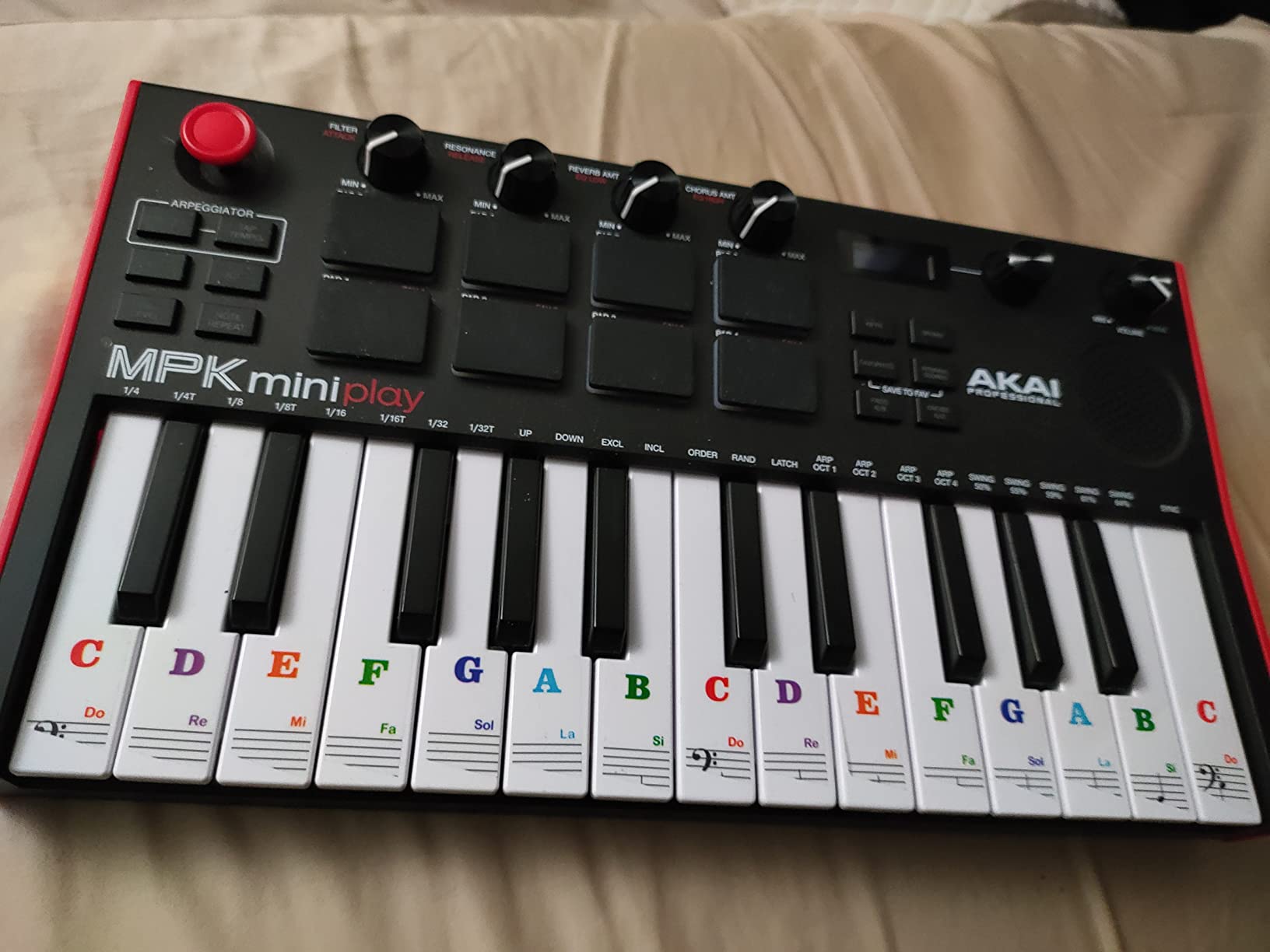
The 25-key Gen 2 MPK Mini dynamic keybed feels more responsive than the standard MPK Mini MK3, with a slight weight improvement that makes two-handed playing more comfortable. The 8 velocity-sensitive backlit MPC drum pads are useful for beat programming, the 4 encoder knobs with secondary functions give you sound-shaping control, and the OLED display shows you exactly what preset and parameter you are working with.
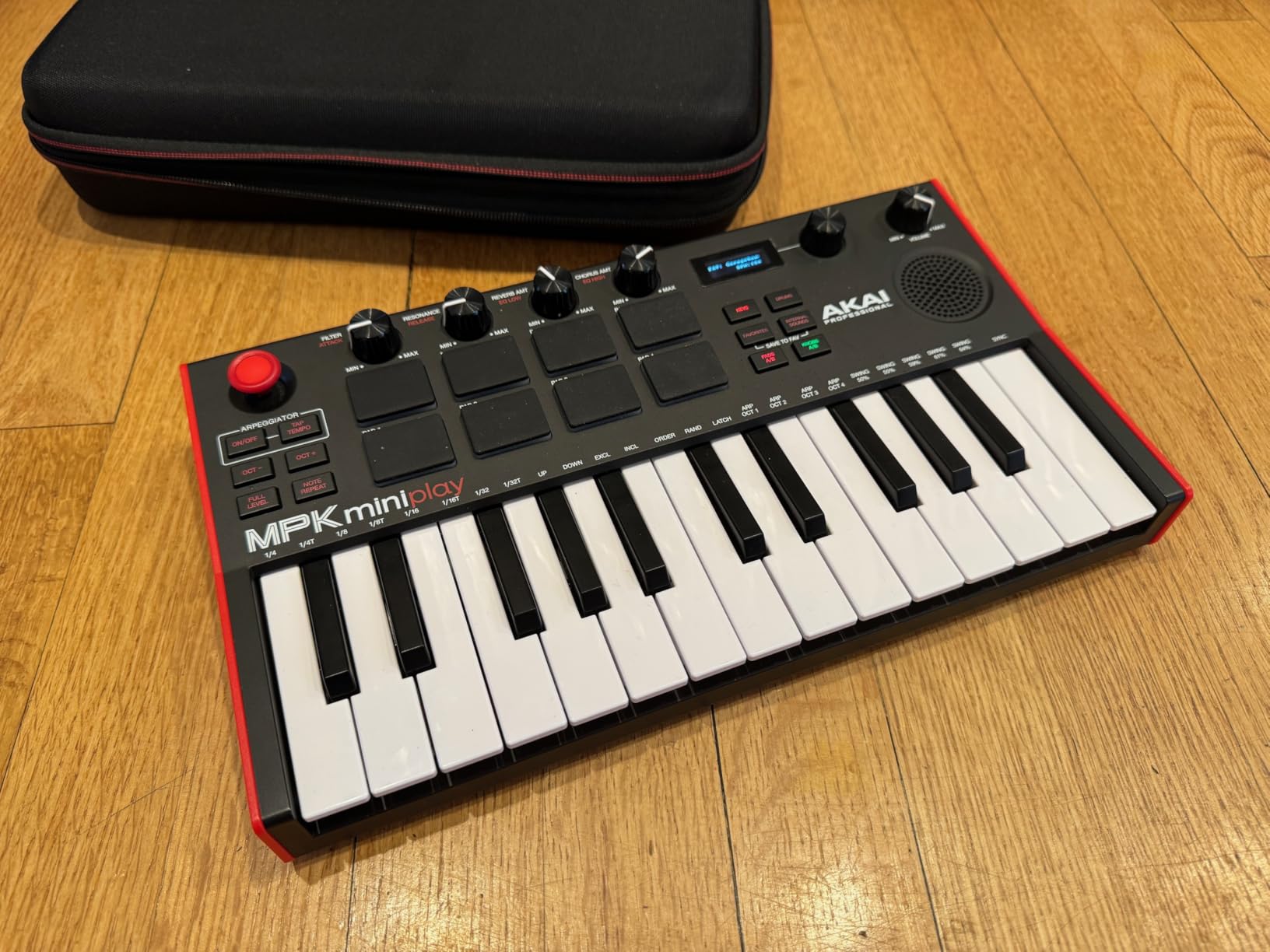
The built-in sounds include pianos, electric pianos, organs, synth leads, synth pads, basses, and more, covering a wide range of songwriting needs. The sound quality is surprisingly good for onboard sounds, and you can layer two sounds together for richer textures. The arpeggiator with multiple modes adds another creative dimension, and the joystick for pitch and modulation is responsive and intuitive.
The NKS integration means you can also use the Play MK3 as a standard MIDI controller with NKS-compatible plugins when you are back at your computer. The bundled software includes MPC Beats, Hype, AIR Essential Keyboards, Electric, and 60 free Melodics lessons, giving you a complete production environment when you are at your desk.
The portability advantage
At 0.9 kg and smaller than most laptop bags, the Play MK3 is genuinely portable in a way that 49 and 61-key controllers are not. I brought it to a friend songwriter’s house for a co-writing session, plugged in some headphones, and we were capturing ideas within 60 seconds of arriving. For songwriters who collaborate frequently or who write on the road, this kind of grab-and-go capability is transformative.
What the built-in speaker is actually good for
Let me be clear: the built-in speaker is not for serious monitoring. It is low volume and mono, useful for checking that your idea sounds right but not for detailed production decisions. The headphone output, on the other hand, sounds great and is what you would use for actual writing sessions. The speaker is a nice-to-have for quick idea validation when you do not have headphones handy.
10. M-Audio Keystation Mini 32 MK3 – Best Ultra-Portable MIDI Keyboard
M-AUDIO Keystation Mini 32 MK3 USB MIDI Controller
32 mini keys
Plug-and-play USB
Melodics lessons
Pros
- Genuinely pocket-sized at under 1 pound
- True piano feel despite mini keys
- Plug-and-play simplicity
- Includes MPC Beats and lessons
Cons
- No faders or knobs
- Limited expandability
- Mini keys may be too small for some
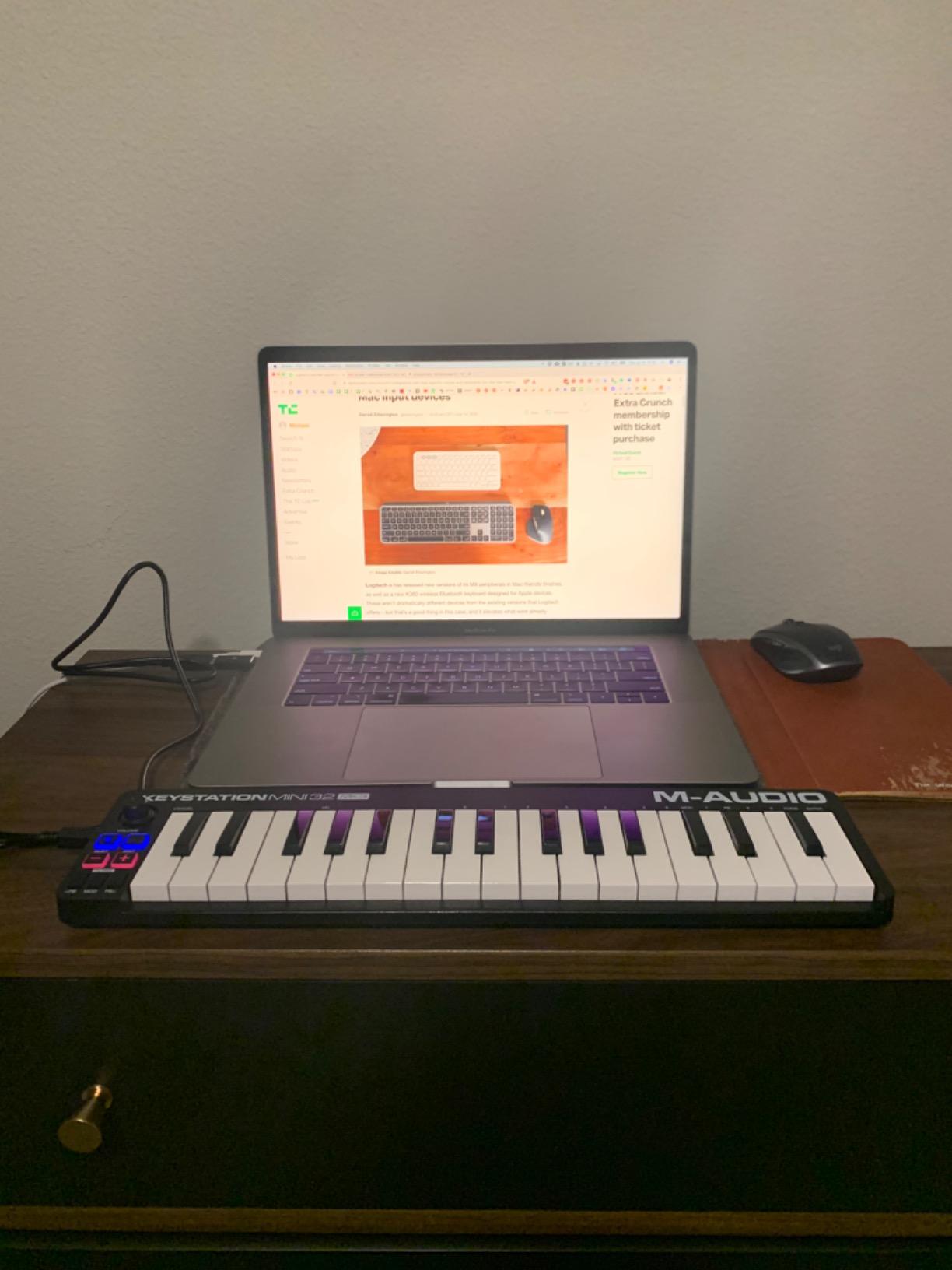
The M-Audio Keystation Mini 32 MK3 is the smallest, lightest, and cheapest controller in this guide, and it is also one of the most useful for specific songwriting scenarios. At 454 grams and 16.44 inches wide, it fits in a laptop bag, a large purse, or even a coat pocket. For songwriters who want to capture ideas anywhere, the Mini 32 is unbeatable for portability.
Despite the tiny size, the 32 velocity-sensitive mini keys feel like real piano keys. The velocity response is honest, which is critical for expressive playing. There is something genuinely useful about a controller that disappears into your bag and is ready whenever inspiration strikes. I kept one in my guitar case for months and captured half a dozen song ideas I would have otherwise lost.
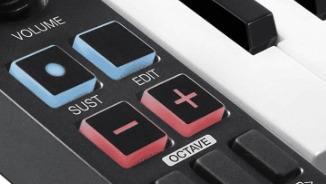
The Keystation Mini 32 has the essentials and nothing else: octave up and down buttons, pitch bend and modulation buttons, a volume knob, and a sustain button. There are no drum pads, no faders, no encoders. This is a focused controller designed to do one thing well, which is letting you play notes into your computer. The plug-and-play USB connection means zero setup, and the included MPC Beats software plus 60 Melodics lessons makes it a complete beginner package.
The main limitation is the 32 mini keys, which are smaller than even the 25-key controllers in this guide. You will be octave shifting constantly for any two-handed playing, and the keys are not ideal for songwriters with larger hands. For pure single-line melody capture and basic chord sketching, the Mini 32 is excellent. For more serious production work, you will want a larger controller.
When the smallest controller is the right answer
If you are a singer-songwriter who primarily wants to lay down chord progressions and melody lines, the Keystation Mini 32 is genuinely enough. The velocity sensitivity means your playing dynamics come through in the recording, and the octave shift buttons let you cover a wide range despite the limited keys. For songwriting on a budget or songwriting on the go, the Mini 32 punches well above its weight.
Why the rating is lower than competitors
The 4.3-star average reflects the inherent limitations of a 32-key controller, not quality issues. Users with smaller hands tend to love it, while users with larger hands find the keys cramped. The lack of any control beyond keys means it is not suitable for users who want to control their soft synths from the hardware. If you are a beginner on a tight budget, it is a fine starting point, but you may outgrow it quickly.
MIDI Keyboard Buying Guide for Songwriters in 2026
Choosing the right MIDI keyboard for songwriting comes down to understanding how you actually write songs. After testing dozens of controllers and interviewing songwriters across genres, I have identified the factors that matter most and the factors that look impressive on spec sheets but rarely affect your actual writing workflow.
Key Count: 25 vs 49 vs 61 vs 88
The most common question songwriters ask is whether to get 25, 49, 61, or 88 keys. The answer depends on your playing style and how you write.
25 keys is enough for melody capture, simple chord progressions, and beat programming. Most pop melodies fit within an octave plus a few notes, and most chord progressions use 4-6 notes that can be played with octave shifting. If you are a singer-songwriter who plays simple chords and captures melodic ideas, 25 keys will not limit you.
49 keys is the sweet spot for most songwriters. You can play two-handed chord voicings, melodies with accompaniment, and you rarely need to octave shift. The Keystation 49 MK3 and Nektar SE49 are both excellent 49-key options. Most professional songwriters I interviewed use 49 or 61-key controllers as their daily driver.
61 keys gives you the full range of most pop, rock, and folk songs without octave shifting. If you play more complex parts or work in genres with wider keyboard ranges, 61 keys is worth the extra size and cost. 88 keys is full piano range and is only necessary if you are writing classical music, jazz with extended voicings, or want a single controller that covers every possible song.
Key Action: Weighted vs Semi-Weighted vs Synth
Key action matters more than most buyers realize. Weighted keys simulate an acoustic piano feel with hammer resistance, semi-weighted keys have some resistance but are lighter, and synth-action keys are the lightest and often found on budget controllers.
For songwriters who have played acoustic piano, weighted keys will feel more familiar and allow for more expressive playing. Semi-weighted is a good compromise that gives some piano feel while staying portable. Synth-action is fine for beginners and for songwriters who do not have piano experience, but you may eventually want to upgrade as your technique develops.
Velocity Sensitivity and Aftertouch
Velocity sensitivity means the controller responds to how hard you press the keys, which translates to louder or softer sounds and more expressive playing. Every controller in this guide has velocity sensitivity, which is essential for songwriting. Aftertouch is an additional feature where pressing harder on a held key sends additional MIDI data, useful for adding vibrato or modulation to sustained notes.
Polyphonic aftertouch, where each key can send independent aftertouch data, is found on more expensive controllers like the Novation Launchkey 61 MK4. It is a powerful feature for advanced songwriting, but most beginners and intermediate songwriters will not miss it. Monophonic aftertouch (channel aftertouch) is more common and still useful.
Connectivity: USB-C, USB-B, and MIDI DIN
USB is the standard connection for most modern MIDI keyboards, with USB-C becoming the new default thanks to its reversibility and durability. USB-B (the square connector) is still common on older and budget controllers. Both work fine, but USB-C is the future-proof choice.
5-pin MIDI DIN is a separate connection that lets you control hardware synthesizers directly without going through a computer. If you plan to use hardware synths, look for a controller with MIDI DIN out. The Arturia MiniLab 3, KeyLab Essential mk3, and Akai MPK Mini IV all have MIDI DIN out, while the M-Audio Keystation series and Nektar SE49 do not.
Software Bundle Value
The software included with a MIDI keyboard can be worth hundreds of dollars and often determines whether you can start writing songs immediately or need to buy additional software. The Arturia KeyLab Essential mk3 includes Analog Lab V (worth over $400 alone), the M-Audio Keystation 49 MK3 includes Ableton Live Lite, MPC Beats, and several instruments, and the Arturia MiniLab 3 includes Analog Lab Intro, Ableton Live Lite, and UVI Model D.
For beginners especially, the software bundle matters. A $99 controller with a $400 software bundle is a better deal than a $99 controller with no software, even if the hardware is slightly less featured. Plan to use the bundled software for at least your first few months of songwriting, and only consider buying additional plugins once you have a clear sense of what you need.
DAW Integration Quality
DAW integration determines how well your controller talks to your music production software. Deep integration means transport controls, mixer channels, device parameters, and clip launching all work directly from the controller without manual MIDI mapping. Shallow integration means the controller works as a generic MIDI device and you need to set up everything yourself.
Novation Launchkey controllers have the deepest DAW integration across the most DAWs, with custom scripts for Ableton Live, Logic, Cubase, Reason, Reaper, FL Studio, and Ardour. M-Audio, Nektar, and Arturia controllers all have solid integration with major DAWs, but the depth varies. If you have a specific DAW you plan to use long-term, check that your chosen controller has proper integration for it.
Portability vs Features
Every songwriter eventually faces the tradeoff between portability and features. Smaller controllers are easier to take to co-writing sessions, coffee shops, or on tour, but they have fewer keys, fewer controls, and often feel more cramped. Larger controllers give you more keys and more controls but are heavier and harder to transport.
For songwriters who mostly write at home, a 49 or 61-key controller is the right balance. For songwriters who travel or collaborate frequently, a 25-key controller like the Akai MPK Mini Play MK3 (with built-in sounds) or the Arturia MiniLab 3 gives you genuine portability without sacrificing too much functionality. The best strategy for many songwriters is to own two controllers: a portable one for travel and a full-size one for the home studio.
Frequently Asked Questions
Should I get a 25 or 49 key MIDI keyboard?
A 25-key controller is enough for capturing melodies, simple chord progressions, and beat programming, and it is the most portable option. A 49-key controller is the sweet spot for most songwriters because it lets you play two-handed voicings without octave shifting. If you mainly capture single-line melodies and want maximum portability, 25 keys will work. If you write more complex parts or want a more piano-like experience, 49 keys is worth the extra size and cost.
What is the best brand for MIDI keyboards?
The most recommended brands for songwriters are Arturia, Akai, M-Audio, Novation, and Nektar. Arturia is known for excellent key feel and software bundles, Akai for pads and beat-making features, M-Audio for value and reliability, Novation for the deepest DAW integration, and Nektar for budget-friendly options with surprising quality. The right brand depends on your specific needs and budget.
Which MIDI keyboard is best for music production?
For general music production, the Novation Launchkey 61 MK4 offers the deepest DAW integration with comprehensive support for Ableton Live, Logic, Cubase, Reason, Reaper, FL Studio, and Ardour. For pure songwriting, the Arturia MiniLab 3 delivers the best key feel and software bundle. For producers on a budget, the Akai MPK Mini IV or M-Audio Keystation 49 MK3 provide excellent value.
What is the best keyboard for writing music?
The best keyboard for writing music is the one that gets out of your way and lets you capture ideas quickly. For most songwriters, that means a 49-key controller with velocity-sensitive keys, comfortable action, and at least basic DAW integration. The M-Audio Keystation 49 MK3 and Arturia KeyLab Essential mk3 are both excellent general-purpose options. The specific best choice depends on your genre, workflow, and budget.
Does anyone use MIDI keyboards anymore?
Yes, MIDI keyboards remain essential tools for songwriters, producers, and composers. While there are alternatives like mouse-and-keyboard input or touchscreen controllers, MIDI keyboards offer unmatched speed and expression for capturing musical ideas. Every professional songwriter and producer I know still uses a MIDI keyboard as their primary input device. The technology has also evolved with USB-C, NKS integration, and polyphonic aftertouch making modern controllers more capable than ever.
What are the disadvantages of MIDI keyboards?
The main disadvantages of MIDI keyboards are the learning curve for beginners, the cost of quality units, the physical space they require, and the dependency on a computer for sound generation. Mini keyboards can feel cramped for users with larger hands, and budget controllers sometimes have poor key feel. None of these are dealbreakers for most songwriters, and choosing the right controller for your needs and budget avoids most of these issues.
Final Thoughts on the Best MIDI Keyboards for Songwriters in 2026
After months of testing, my honest recommendation for most songwriters in 2026 is to start with the Arturia MiniLab 3 if you want a portable, plug-and-play experience with an excellent software bundle, or the M-Audio Keystation 49 MK3 if you want full-size keys and the most beginner-friendly setup possible. Both deliver genuine value and will serve you well as your songwriting skills develop.
The Arturia KeyLab Essential mk3 is the upgrade pick if you are ready for a more complete production controller with deeper DAW integration and a stunning software bundle. The Novation Launchkey 61 MK4 is the choice for songwriters who are serious about DAW-based production and want polyphonic aftertouch and comprehensive workflow control. For pure portability, the Akai MPK Mini Play MK3 is unmatched thanks to its built-in sounds and battery power.
The best MIDI keyboard for songwriters is the one you will actually use. A controller sitting in a closet does not write songs. Consider how and where you write, choose the controller that fits that workflow, and start capturing ideas today. The most expensive or most featured controller is not always the best one for you. Your songs matter more than your gear.