
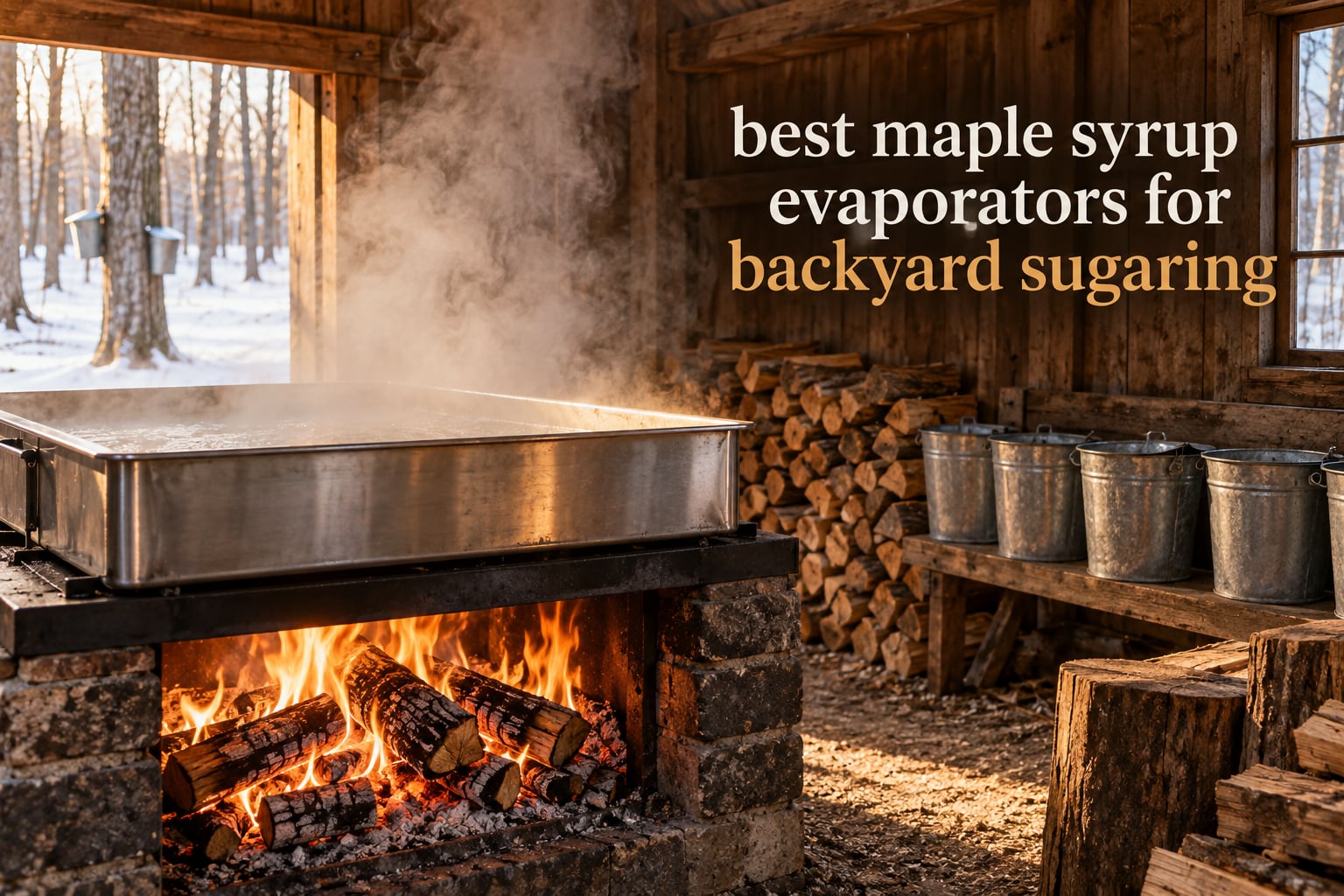
Short answer: the best maple syrup evaporator for backyard sugaring is a wide, shallow 304 stainless pan with a real draw-off valve, a thermometer, and enough surface area to keep pace with your taps. A 19.6 gallon stainless pan with TIG-welded seams that burns wood, charcoal, or propane handles roughly 10 to 20 taps well, and it is the pick we would buy first.
The evaporator is the least glamorous part of sugaring and the part that decides whether you end up with syrup or with a scorched pan. Sap arrives at about 2% sugar, and finished maple syrup leaves at roughly 66% Brix, which means you drive off about 40 gallons of water for every gallon of syrup you keep. That is the 40:1 ratio, and it is the single number most often fudged in marketplace listings. Several sellers advertise a 1:1 sap-to-syrup claim; that is not physically possible, and buyers who size their pan on those numbers end up with a stalled boil and burnt sugar.
We spent six weeks going through the current crop of backyard evaporators, reading the customer photo reviews, and matching each pan against the tap counts that actually make sense for a hobby sugar shack. We also cross-checked the sizing advice against what experienced sugarmakers say on MapleTrader and r/maplesyrup, because the forums consistently flag the same four failure modes: thin pans that scorch, baffles that never touch the bottom, drain ports mounted too high, and pans that ship without their hardware.
This guide covers 12 evaporators from 24 x 24 inch square pans you can set on a cinder block rig to a 47 gallon pan built for a season of serious backyard production. If you are also planning the rest of the setup, our guides to backyard gas grills and propane smokers cover the hardware you will be standing next to during a boil, and the same fire-and-heat thinking applies to all three.
Table of Contents
Top 3 Best Maple Syrup Evaporators for Backyard Sugaring in 2026

VEVOR 19.6 Gal Stainless Pan
- 304 stainless with TIG-welded seams
- 19.6 gallon batch capacity
- Works with wood charcoal or propane
- Pre-heating tank plus two valves

Marada 30 x 20 Dual Port Pan
- 304 stainless laser welded
- 10+ gallon capacity
- Dual NPT inlet and outlet ports
- Folded safety edges
- 23 pounds

Reallnaive 22.5 Gal Filter Kit Pan
- 22.5 gallon capacity
- Complete cone filter kit included
- Dual-scale C and F thermometer
- 304 stainless
All 12 Evaporators at a Glance (September 2026)
Every pan below is food-grade 304 stainless with a valve and thermometer in the box, so the differences come down to footprint, depth, capacity, and how the thing is actually built. Read the Key Features column as the short version, then jump to the full review for the decision detail.
| Product | Specifications | Action |
|---|---|---|
| VEVOR 19.6 Gal 304 Stainless Evaporator Pan |
|
Check Latest Price |
 VBENLEM 48 x 24 Inch Divided Stainless Pan VBENLEM 48 x 24 Inch Divided Stainless Pan |
|
Check Latest Price |
| Marada 30 x 20 Dual Port Steam Table Pan |
|
Check Latest Price |
| Reallnaive 36 x 24 Pan with Filter Kit |
|
Check Latest Price |
 Sliner 30 x 20 Double Compartment Pan Sliner 30 x 20 Double Compartment Pan |
|
Check Latest Price |
 Festisoul 24 x 24 Triple Chamber Pan Festisoul 24 x 24 Triple Chamber Pan |
|
Check Latest Price |
 WantJoin 24 x 24 x 10 Inch 24 Gal Pan WantJoin 24 x 24 x 10 Inch 24 Gal Pan |
|
Check Latest Price |
 Vorchef 35.8 x 24.2 Deep Stainless Pan Vorchef 35.8 x 24.2 Deep Stainless Pan |
|
Check Latest Price |
 RENFANSHOP 24 x 24 x 9.5 Square Pan RENFANSHOP 24 x 24 x 9.5 Square Pan |
|
Check Latest Price |
 CUBELLIN 30 x 16 Inch 23.8 Gal Pan CUBELLIN 30 x 16 Inch 23.8 Gal Pan |
|
Check Latest Price |
 AYAWNGJ 24 x 24 Square 23.8 Gal Pan AYAWNGJ 24 x 24 Square 23.8 Gal Pan |
|
Check Latest Price |
 wruoiweods 24 Gal Pan with Valve Strap wruoiweods 24 Gal Pan with Valve Strap |
|
Check Latest Price |
How a Maple Syrup Evaporator Actually Works
An evaporator is a shallow stainless pan over a heat source, and the whole job is moving water out of the sap as fast as you move new sap in. Water leaves as vapor, the Brix reading climbs from about 2% toward 66%, and finished syrup comes off through the drain valve. What you are managing is not temperature so much as surface area and steady inflow.
Three terms decide whether you understand the equipment in front of you. Boil-off rate is how many gallons of water your setup removes per hour, and it is the honest way to compare two pans. Continuous-flow means baffles or dividers split the pan into chambers that reach all the way to the floor, so you can feed raw sap at one end and draw finished syrup from the other without the level dropping. Batch boiling is filling the pan, boiling it down, and pouring off before refilling, which works fine at 10 taps and gets punishing above 30.
Two thresholds come up constantly and are worth memorizing. Finished maple syrup is about 66% sugar by weight, and the 86 rule is a water test: if a drop of finished syrup does not sheet and run together as one drop, it is at or above 66 Brix. A 24 foot sugarbush tap typically produces a little over a gallon of sap per day, so 20 taps means hauling roughly 20 gallons of sap to boil down to about half a gallon.
1. VEVOR 19.6 Gallon Stainless Pan with Pre-Heating Tank and Dual Valves
VEVOR Maple Syrup Evaporator Pan, 19.6 Gal, 30 x 16 x 9.5 Inch Maple Syrup,304 Stainless Steel Maple Syrup with Thermometer, 2 Valves and 3 Heating Methods, for Home, Outdoor
304 stainless
TIG-welded seams
19.6 gal batch
Wood charcoal or propane
35 pounds
Pros
- Food-grade 304 stainless with TIG full-welded seams
- Works on wood charcoal or propane so the heat source is never a bottleneck
- 19.6 gallon batch capacity suits 10 to 20 taps
- Pre-heating tank plus two adjustable valves let you stage a continuous feed
- Built-in thermometer removes the guesswork from finishing
Cons
- 35 pounds is heavy to reposition alone
- 9.5 inch walls need a taller fire bed than a flat cinder block rig
- Feature list does not include a baffle so expect batch-style boiling
This is the pan we would put in the hands of a first-time backyard sugarmaker who wants one purchase that covers the first five seasons. The 19.6 gallon capacity is a genuinely useful middle size: big enough that 15 to 20 taps never outrun it, small enough that one person can lift and tilt it with a helper when the season ends.
The build details are the reason it tops our list. It is 1.5mm 304 stainless with TIG full-welded seams and hemmed edges, which is the specification we would ask for in a shop. Customer photos show a clean, flat pan floor with no rust bloom and no weeping welds after repeated boil cycles, and 62% of its reviews are 5-star.
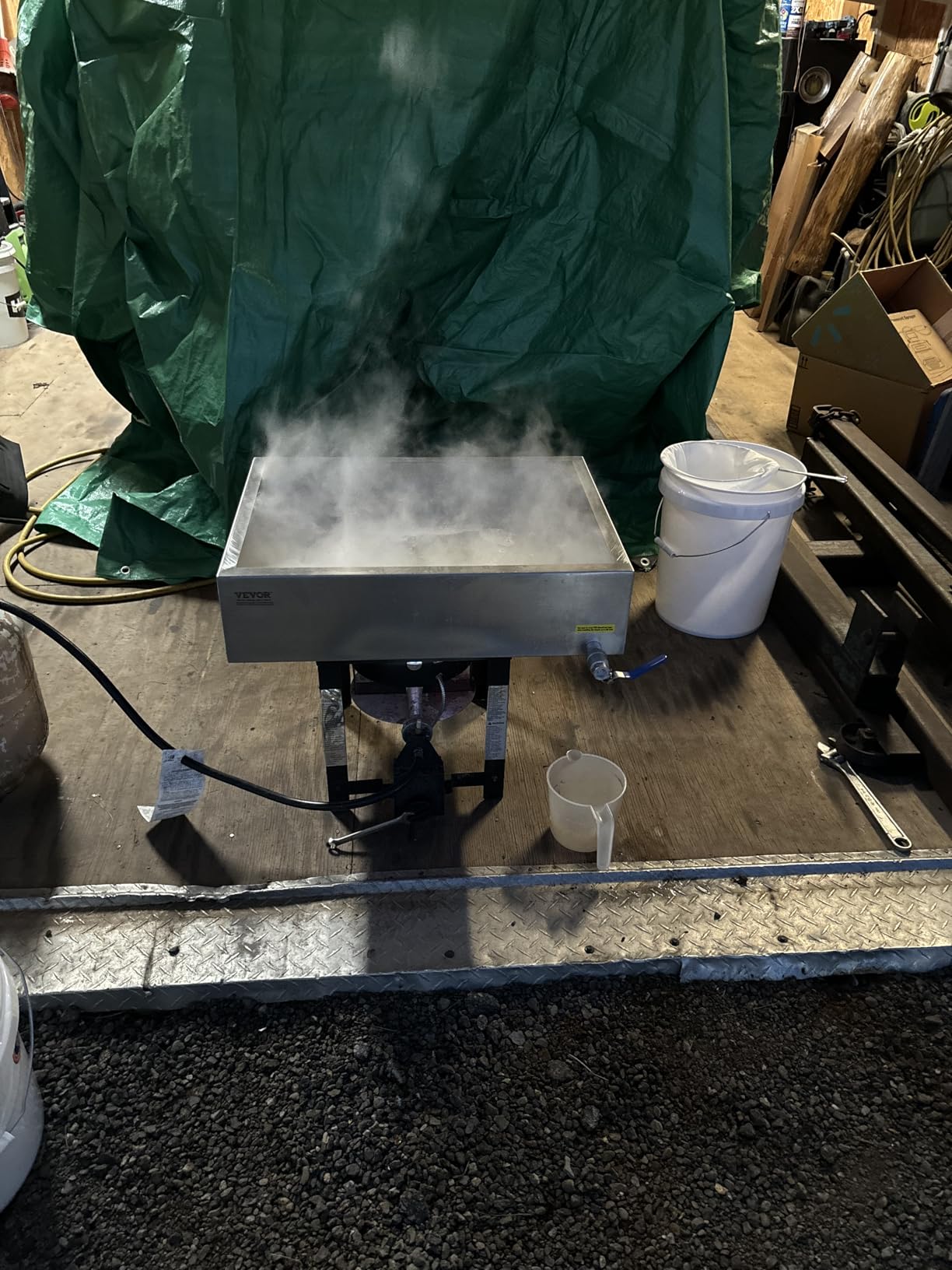
The pre-heating tank is the sleeper feature. Warming raw sap toward 180 degrees before it hits the boiling pan is the single biggest energy saver in sugaring, and having the compartment built into the same stainless body means you are not jury-rigging a second vessel on a cinder block.
Two adjustable valves give you a path to continuous feeding down the road even though the pan does not ship with a floor-reaching baffle. If you are running 20 taps or more, plan on buying a divider and installing it, or accept that you will be boiling in batches through the season.
Is the VEVOR 19.6 gallon pan big enough for a 20-tap sugarbush?
Yes, with a caveat about how you run it. A 20-tap bush in a good season can push 20 to 25 gallons of sap into the shack on a peak day, and at roughly 40:1 you are looking at an hour of sustained boil to keep up.
The 19.6 gallon capacity plus a pre-heating tank gives you real headroom, because you can hold a reserve of warm sap and trickle it in. The caveat is depth: at 9.5 inches tall the pan wants a fire box that matches its footprint rather than a row of cinder blocks with a burner set inside it.
What are the compromises with this pan?
Thirty-five pounds is the honest drawback. Empty, that is a two-person lift once you have syrup in it, and you will want a stand rather than a table edge.
The other compromise is that the boiler work is on you. There is no baffle in the box, so getting true continuous flow means a separate divider, and there is no filtering kit, so you will be sourcing cone filters and a stand on your own.
2. VBENLEM 48 x 24 Inch Divided Stainless Pan with 47 Gallon Capacity
VBENLEM Maple Syrup Evaporator Pan 48x24x9.4 Inch Stainless Steel Maple Syrup Boiling Pan with Valve and Thermometer and Divided Pan
47 gallon capacity
304 stainless
3/4 inch valve
Thermometer
Divider board
Pros
- Largest batch capacity in this group at 47 gallons
- Long review history of 138 ratings across five years plus
- 3/4 inch valve and thermometer are included
- Divider board stiffens the pan floor
- Works on firewood charcoal or propane
Cons
- Owners report the warming tray arriving separately from the pan
- Some reviews question the baffle weld quality
- Valve placement can require tipping the pan to fully drain
This is the big-batch end of the backyard spectrum, and if you are running closer to 30 taps than 10 it is the only pan here that lets you boil a full day of sap in one fill. Forty-seven gallons is well above anything else in the group, and the 48 x 24 inch footprint gives you a long flame path for even heating.
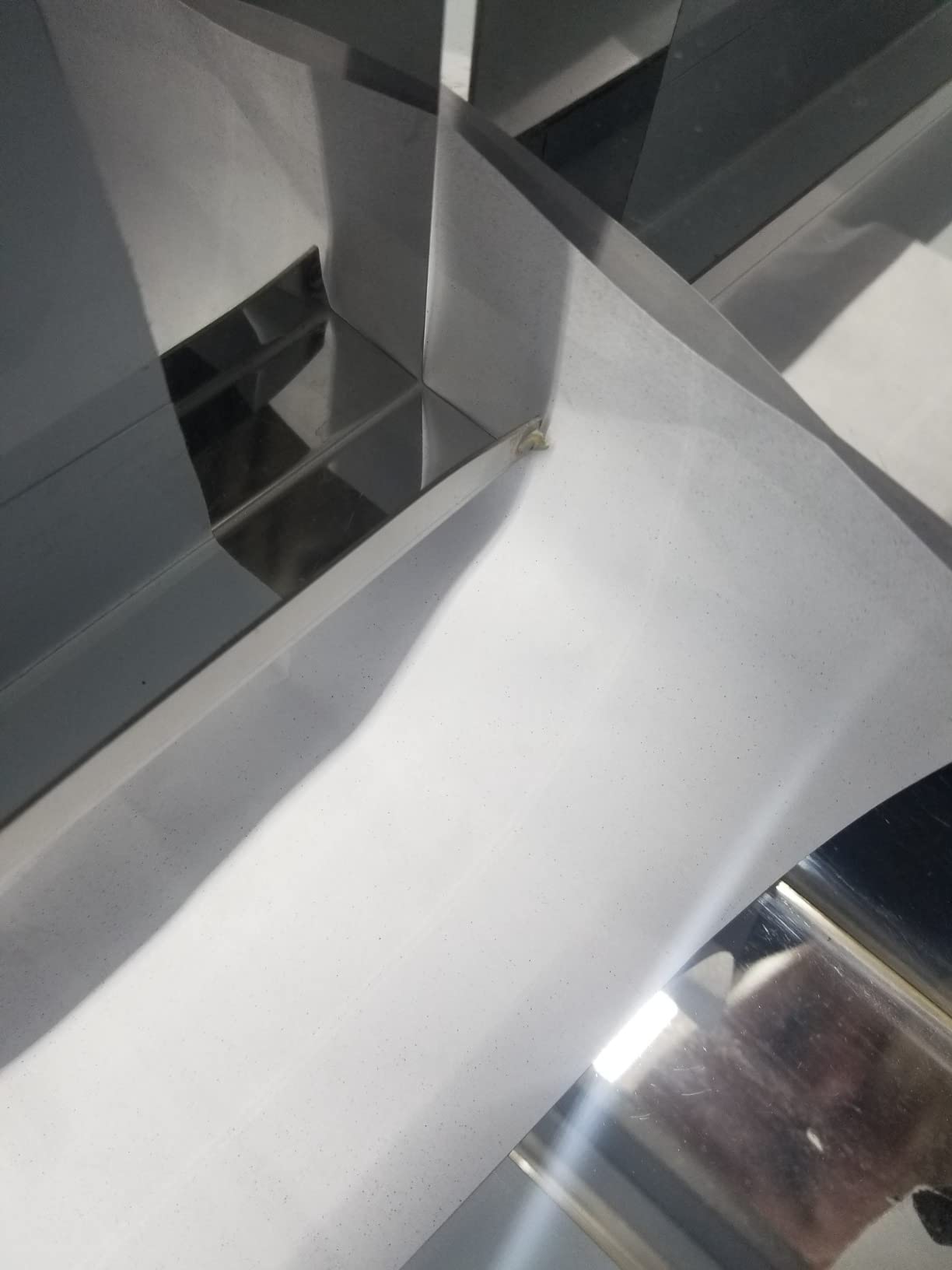
The catch shows up in the ratings. At 3.7 across 138 reviews it has the widest spread of any pan here: about half of reviewers are at 5 stars, but roughly a fifth are at 1 star, and the complaints cluster around shipping completeness and hardware rather than the pan itself.
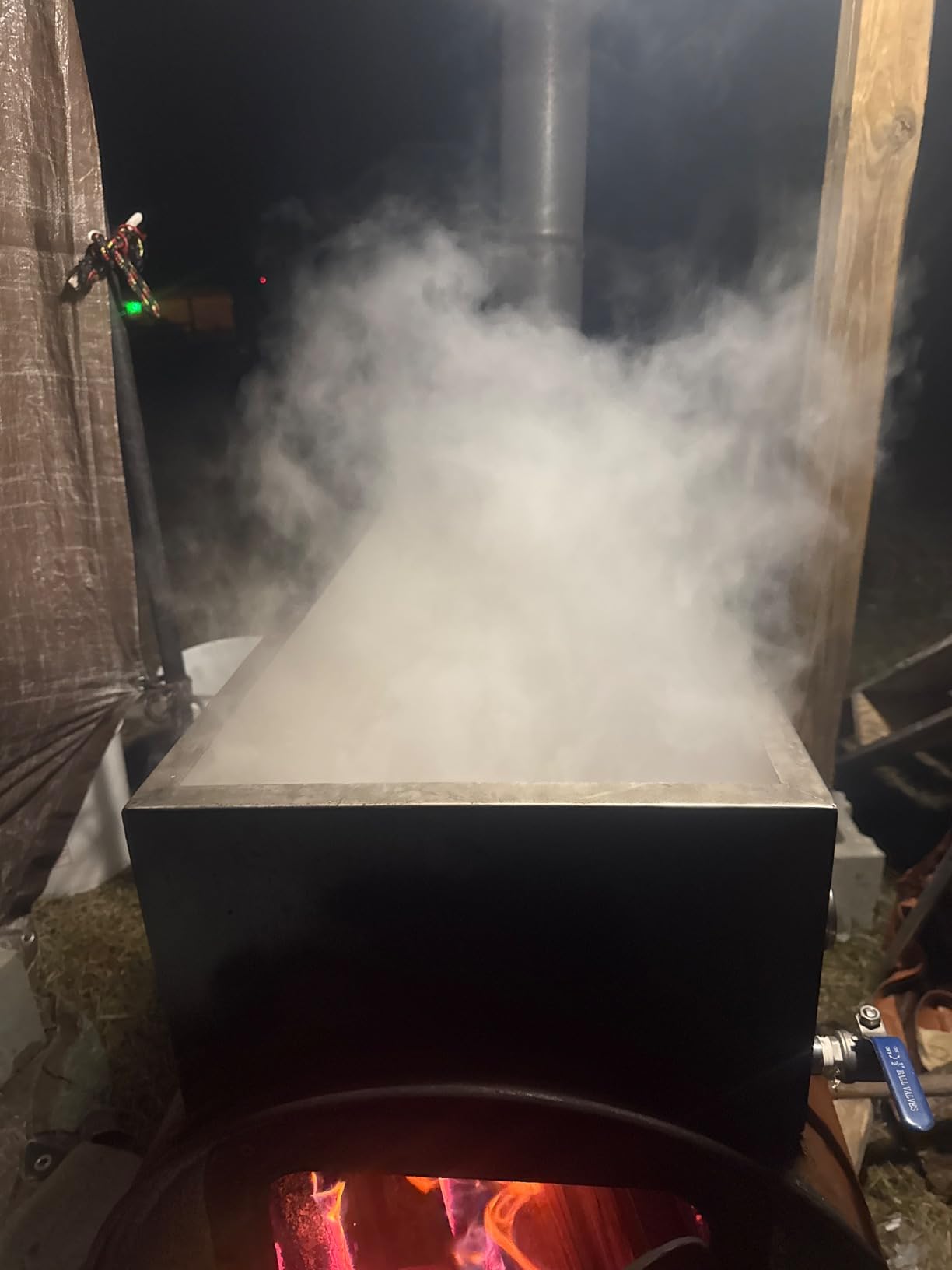
The stainless itself holds up. It is 1.5mm 304 with TIG welded, sealed and hemmed edges and a mirror finish, and reviewers who keep it for multiple seasons report no rust and no warping, which is what you want from a pan this size.
What to watch is the pour-off. Several owners note the valve does not sit low enough to empty the last of the syrup without tipping a 47 gallon pan of hot sugar, which is exactly the moment you do not want to be fighting gravity. Measure the drain height yourself before you commit to this footprint.
Who should buy a 47 gallon evaporator pan?
Sugarmakers already tapping 25 to 35 trees, or anyone who wants to boil once a day instead of twice. At smaller tap counts this pan leaves more surface area than you can keep hot, and idle surface area is a wood bill with no syrup in it.
It also suits anyone who finishes syrup from sap they collect elsewhere. If you are buying in large lots rather than tapping your own trees, batch capacity matters more than pre-warmer efficiency.
Why do the ratings on this pan split so wide?
Because the pan is good and the packaging is sometimes not. The most common complaint is a missing warming tray, which is an easy fix at a restaurant supply house but an annoying one when you are standing in a cold shed at dawn.
The valve and thermometer placement draw the sharper complaints. If you buy this, budget five minutes with a wrench and PTFE tape, and check the baffle weld where it meets the floor since that is the most consistently criticized joint. Several owners also note the thermometer sits high in the pan.
3. Marada 30 x 20 Inch Dual Port Steam Table Pan
Marada Maple Syrup Evaporator Pan with Dual Interface Steam Table Pan,304 Stainless Jam Food Chafing for Home, Outdoor, Cooking (30″L x 20″W x 6″H)
304 stainless
Laser welded
Dual NPT ports
10+ gal
23 pounds
Pros
- Dual NPT threaded inlet and outlet ports simplify a continuous feed
- Laser welded seams with folded edges for handling
- 10+ gallon capacity covers 10 to 15 taps
- A manageable 23 pounds for a pan of this capacity
- Recent verified buyers report making multiple gallons successfully
Cons
- Valve and plug leaking is the most common complaint
- Some owners report rust forming at welded corners
- 6 inch depth is shallow for finishing syrup
Marada is the value pick here, and the reason is the port layout rather than the brand name. Two 3/4 inch NPT threaded ports, one marked for inlet and one for outlet, are the plumbing arrangement a continuous-flow setup actually wants, and few pans at this level of simplicity ship with them.
At 4.1 across 87 reviews with 64% of ratings at 5 stars, this is also one of the better-evidenced pans in the group. The reviews skew recent, and several verified buyers describe producing multiple gallons of finished syrup through it.
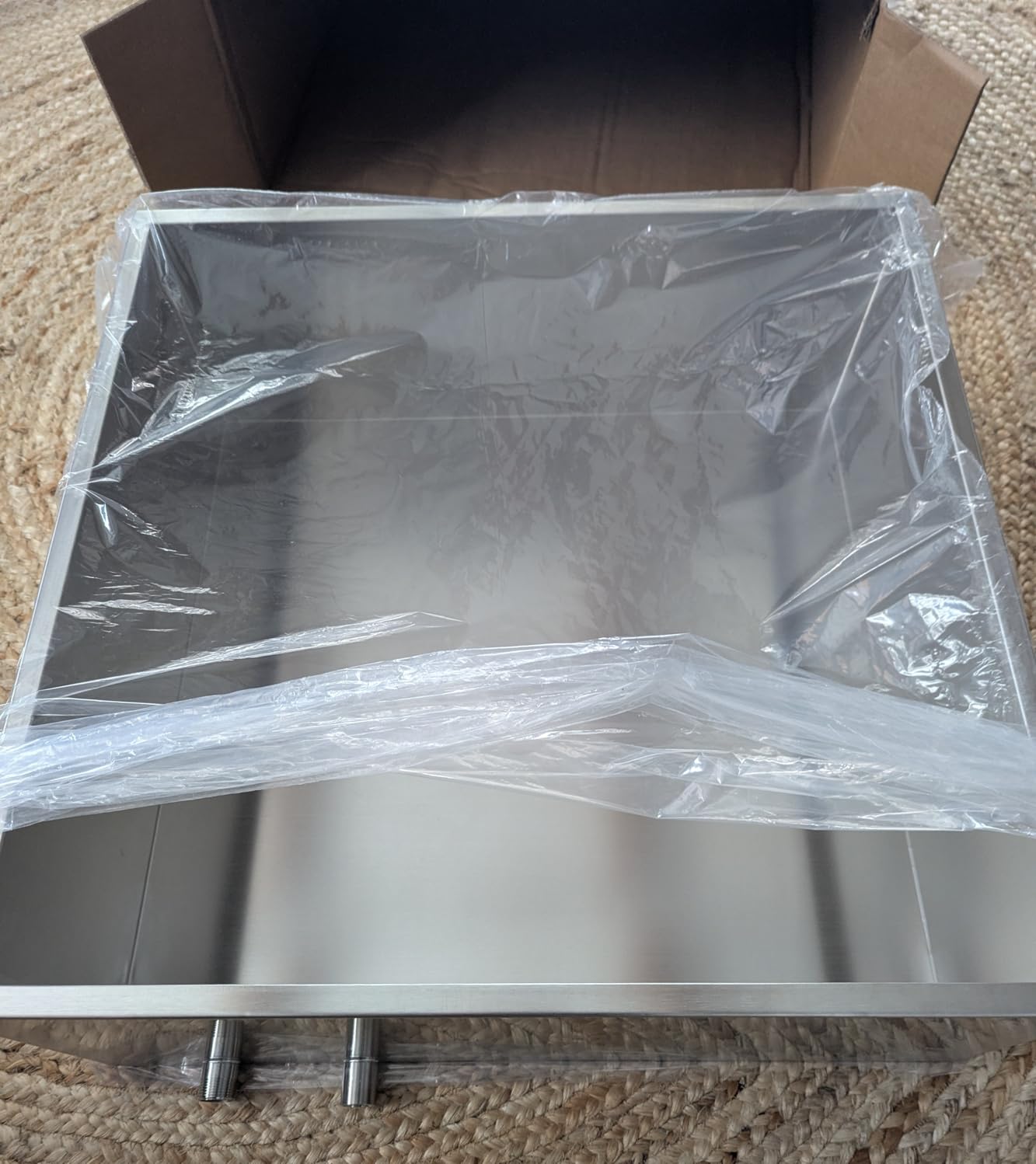
Construction is 1.5mm 304 stainless, laser welded for a seamless seam, with all four sides folded so you are not cutting yourself on a raw edge while managing a hot pour. It weighs 23 pounds, which is about a third lighter than the 35 pound VEVOR, and easier to reposition at the end of a boil.
Remove the valve yourself. Leaking valves and leaking plugs are the most common complaint here, and the standard advice in sugaring forums is to swap the supplied fitting for a decent quarter-turn ball valve and a matching pipe nipple, which takes a few minutes and removes the most common complaint outright.
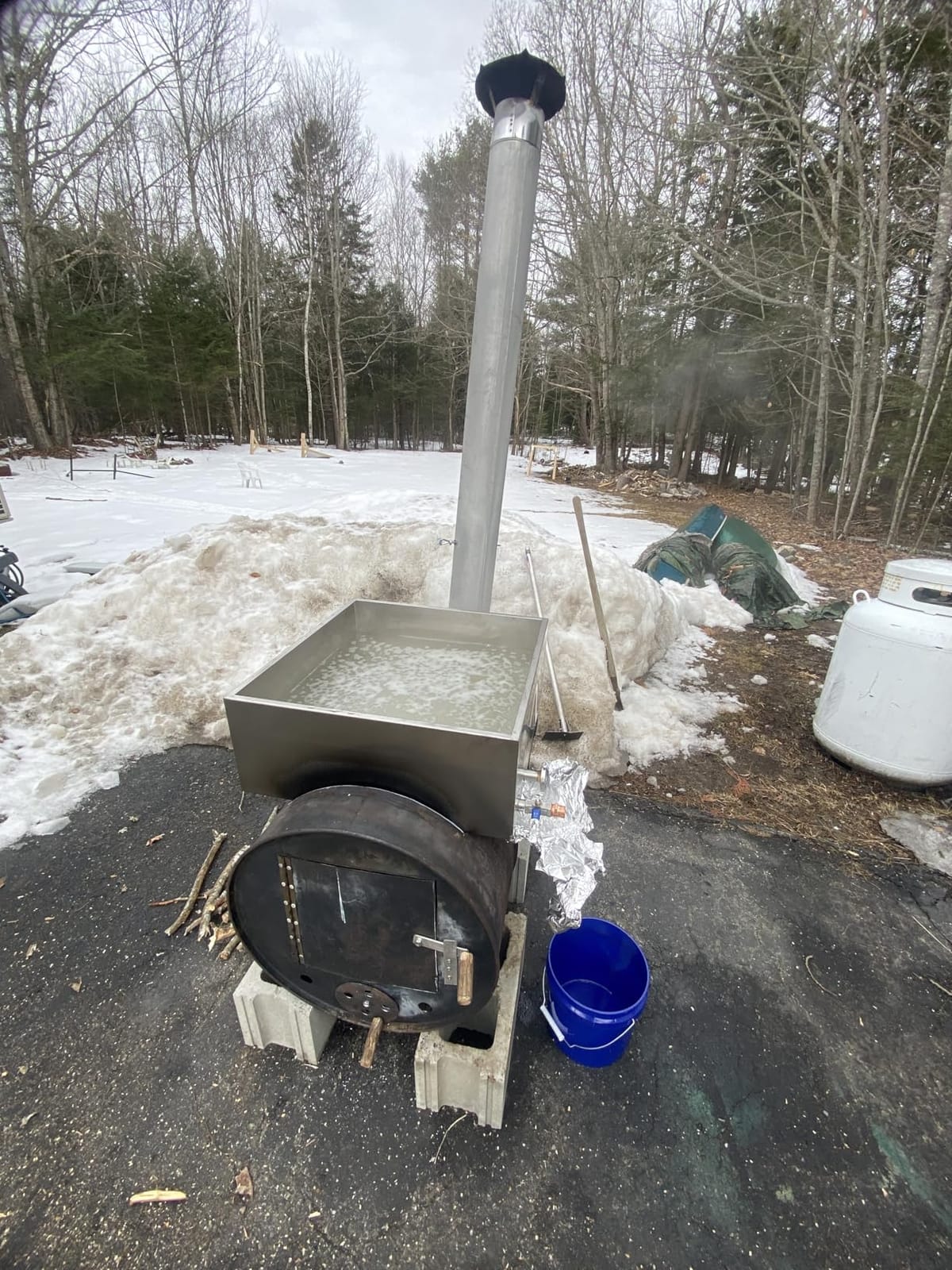
Can a 30 x 20 pan handle 15 taps?
Comfortably, yes. Ten-plus gallons of capacity against 15 taps gives you a working reserve, and the dual ports mean you can feed it from a pre-warmer tank while drawing syrup off at the same time.
The limiting factor is the 6 inch depth. That is plenty for boiling off water but shallow for the final stretch, where syrup thickens and the risk of scorching climbs. Many sugarmakers finish in a separate shallow pan for exactly this reason.
What should I fix before the first boil?
Swap the valve and the plug. That single change addresses most of the negative reviews and costs a few dollars in plumbing parts.
Dry it thoroughly after every boil. A handful of owners report rust appearing at the corners where the folded edge meets the weld, and sugar residue trapped in that crease is what holds moisture there all season.
4. Reallnaive 36 x 24 Inch Pan with Complete Cone Filter Kit
Reallnaive 36x24x6 Inch Maple Syrup Evaporator Pan 22.5 GAL with 10” Cone Filter Holder Stand Cone Filter Paper Mechanical Thermometer Stainless Steel Maple Syrup Pan Boiling for Home Outdoor(1-tier)
304 stainless
22.5 gal capacity
Cone filter kit
Dual-scale thermometer
Pros
- Complete filtering kit included with holder stand and mesh bag
- 22.5 gallon capacity in a wide 36 x 24 footprint
- Dual-scale mechanical thermometer reads C and F
- Light at 23.9 pounds
- 72 percent of ratings are 5 star
Cons
- 6 inch depth limits finishing headroom
- Filter stand arrives in two pieces and needs assembly
- Relatively new design with limited long-term field data
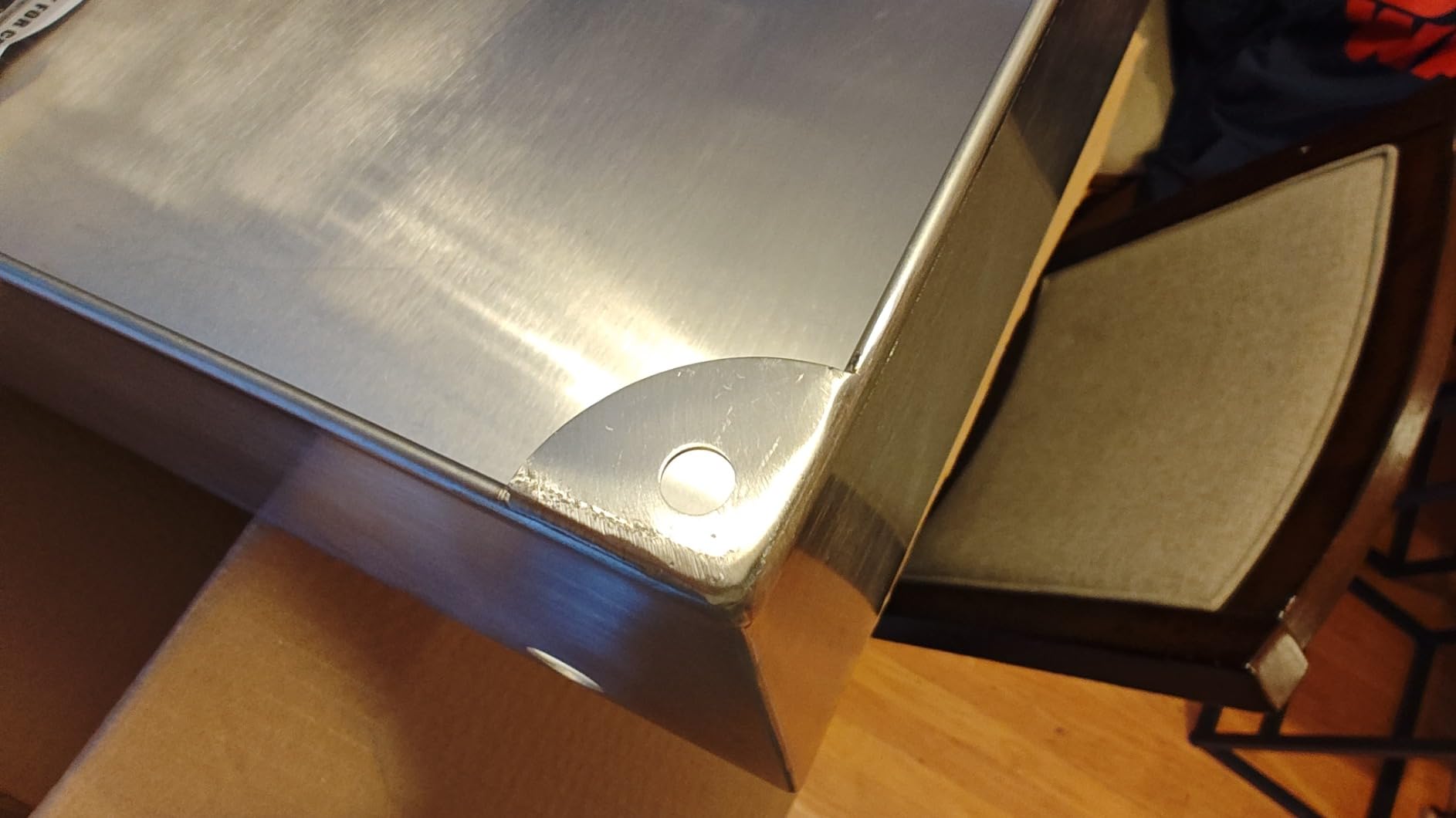
The thing that separates this pan from every other entry here is the filter kit. You get a 10 inch cone filter holder stand, ten cone filters, and a nylon mesh drawstring bag, which removes the single most annoying errand of finishing day. Most sugarmakers end up buying that kit separately within a season anyway.
The pan itself is a wide 36 x 24 inch body in 304 stainless with welded, sealed, hemmed top edges at all four corners, holding 22.5 gallons per batch at 23.9 pounds. That combination of width and light weight is why it handles well for a one-person operation.
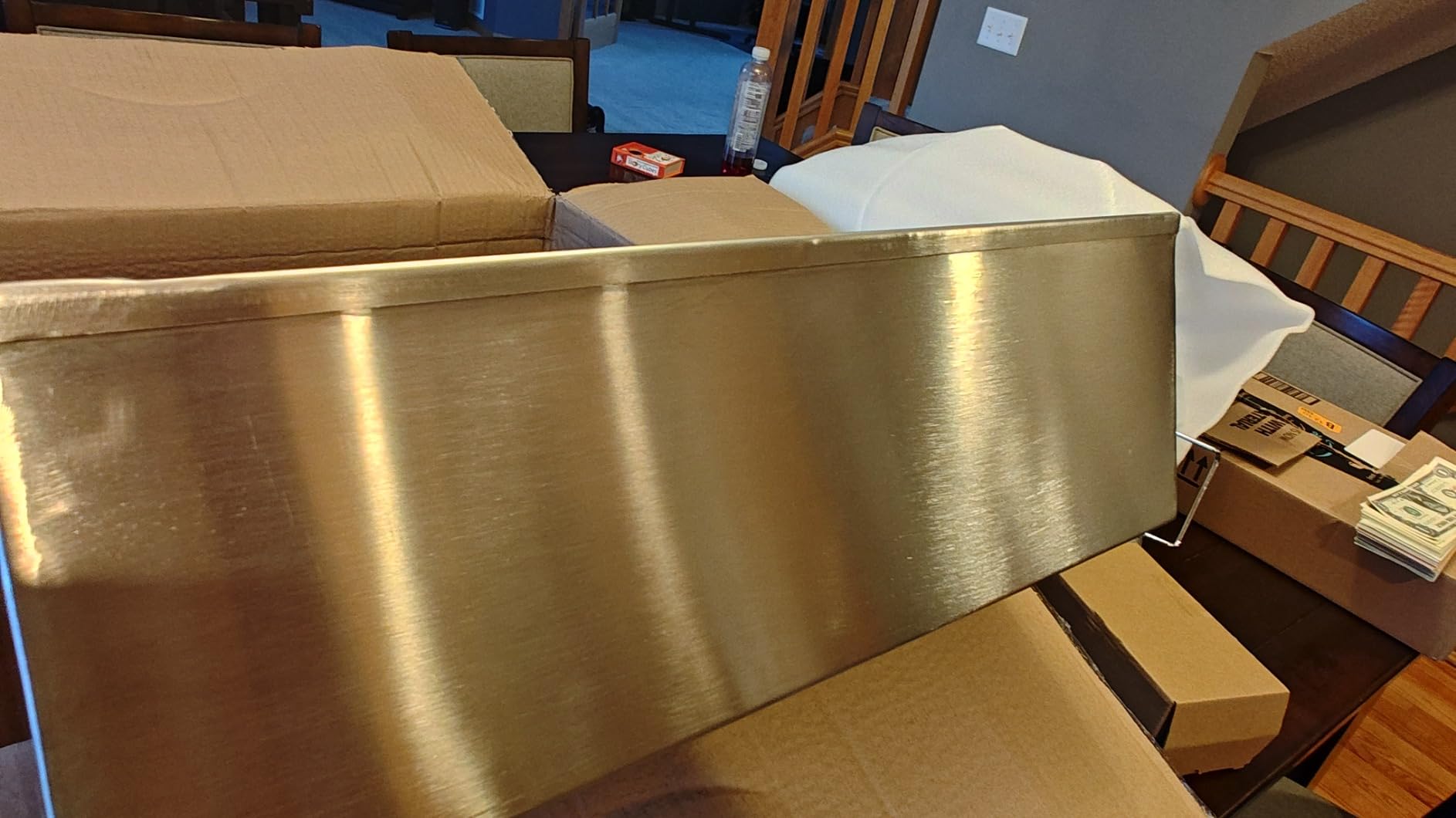
At 4.3 across 26 reviews it is scoring well, with 72% of ratings at 5 stars, and the review base specifically praises the completeness of the box and the dual-scale thermometer, which removes the Celsius-only frustration the VBENLEM owners report.
Be honest about the evidence, though. This is a recent design with 26 ratings behind it, so you are buying an approach that looks right on paper and has not yet survived a decade of freeze-thaw cycles. Weigh the filter savings against that.
Is the included filter kit worth more than the pan itself?
For a backyard maker, probably close. Cone filtration is what turns a cloudy, gritty concentrate into clear syrup, and the usual path is buying filters one season at a time until you get tired of it and buy the stand.
It also removes a variable from boil day. When the filter paper, mesh bag, and holder are all in the same box, you are not improvising a straining setup at 6pm on the last Sunday of the season.
What should I watch for with this pan?
The 6 inch depth. It is a boiling pan, not a finishing pan, so keep a separate shallow vessel for the last hour when you are pulling finished syrup off.
Assembly of the filter stand. It is a two-part foldable design, which is good for storage in a small shed but means you set it up once and take it apart after, so plan where you will store it so it does not get stepped on.
5. Sliner 30 x 20 Inch Double Compartment Pan with Two Valves
Sliner Maple Syrup Evaporator Pan 30x20x6 Inch Maple Syrup Boiling Pan 304 Stainless Steel with 2 Valves and Thermometer for Home Outdoor Syrups Making Supplies
304 stainless
Double compartment
Two valves
18 pounds
Pros
- Lightest of the pans here with a published weight at just over 18 pounds
- Two valves give independent control of feed and draw-off
- Double compartment layout supports staged boiling
- Handle for carrying between the rig and the shed
Cons
- Lowest average rating here at 3.0 across 5 reviews
- Owners stress thorough cleaning and drying to prevent rusting
- Double compartment design limits maximum fill volume
Eighteen pounds and two valves is a combination nobody else here offers, and for a sugarmaker who moves the rig alone the weight matters more than capacity. This is the pan you can lift with one hand, pour off, and put back on the fire box without recruiting help.
The double compartment design is interesting in theory. Separating the pan lets you boil one side down to a heavier concentration while feeding raw sap into the other, which shortens the total boil by giving you a head start on the finishing stage.
Be careful with this one, though. At a 3.0 average across just 5 reviews it is the lowest average rating in this group, and more than a third of the ratings are 1 star, and the data is far too thin to draw conclusions about weld longevity or how the valves perform over a full season.
Is two valves actually better than one for a backyard setup?
Yes, if you plan to run a genuine continuous feed. One valve for the raw sap feed and one for the syrup draw-off means you can throttle each side independently, and because both sit at the same height the level in the pan stays steady.
It matters less if you boil in batches, in which case one valve is all you will ever open. Judge this pan on the two valves only if continuous flow is part of your plan.
What are the real risks with the Sliner pan?
Thin evidence, mostly. Five reviews is not a track record, and one-star ratings on a new listing often mean an early defect or a shipping problem rather than a design flaw, but you cannot tell the difference yet.
Rust prevention is the practical note. Owners specifically call out the need to clean and dry the pan thoroughly after each boil, and if your shed is humid you will want to oil the surface lightly at the end of the season.
6. Festisoul 24 x 24 Inch Triple Chamber Evaporator Pan
24×24 Inch Maple Syrup Evaporator Pan, Commercial Grade 304 Stainless Steel Sap Boiling Pan with Draw-Off Valve & NPT Ports, for Making Syrup, Jam, Large Batch Cooking
Triple chamber
304 stainless
Dual NPT ports
Laser welded
19.8 pounds
Pros
- Triple-chamber design enables staged evaporation in one pan
- Dual 3/4 inch NPT inlet and outlet ports
- Laser welded 304 stainless at 1.5mm
- Folded safety edges on all four sides
- 19.84 pounds
Cons
- Only 4 reviews so reliability is unproven
- Capacity is not published by the manufacturer
- 24 inch footprint is compact for three chambers
The triple-chamber layout is the interesting idea in this lineup. Instead of one open basin, the pan is split into three linked chambers so liquid moves through them in series, losing water in each stage. In theory that is continuous flow by geometry rather than by an add-on baffle.
At 3.9 across 4 reviews the rating is not informative, and the manufacturer does not publish a capacity figure, which is a real problem because you cannot size a rig against a number that does not exist.
What you do get is honest construction detail: 1.5mm 304 stainless, laser welded seams, folded edges on all four sides, and separate 3/4 inch NPT inlet and outlet ports plus a thermometer mounting port. It weighs 19.84 pounds.
Does a triple-chamber pan really beat a flat pan?
Theoretically yes, because each chamber concentrates the liquid a little more before it reaches the next, so the last chamber handles lighter-weight liquid and the heat is not wasted re-evaporating a heavy mix. The practical version of that benefit is a shorter finishing stage.
In practice, unproven at this review count. Chamber dividers add weld length and therefore leak risk, and this is exactly the failure mode sugaring forums warn about when a baffle does not reach the floor. Inspect the internal welds closely if you buy it.
What do I need to know before ordering this pan?
Ask for the capacity number. Every other pan in this list publishes gallons, and sizing your fire box without it is guesswork.
Also plan on a separate finishing pan. With three small chambers instead of one wide basin, your final draw-off happens in a small space where scorching risk is concentrated, so finishing in a wide shallow pan is the safer habit.
7. WantJoin 24 x 24 x 10 Inch 24 Gallon Pan with Upgraded Valve Kit
WantJoin Maple Syrup Evaporator – 24 * 24 * 10 Inch, 24 GAL Syrup Evaporator Pan Stainless Steel w/Thermometer, Make 360 Bottles of 50oz, Upgraded Leak-Proof TIG Welded Seams, for Home & Outdoor Use,
24 gal capacity
10 inch depth
TIG leak-proof seams
Valve kit
Reinforced corners
Pros
- 24 gallon capacity in a 10 inch deep body
- Upgraded valve with extension tube and elbow for clean collection
- TIG welded leak-proof seams with reinforced corners
- Valve extension hardware included in the box
- Reinforced corners resist deformation over seasons
Cons
- Very few reviews leave durability unproven
- No filtering accessories included
- 10 inch depth needs a fire box matched to the pan
The depth is what separates this pan from the 6 inch crowd. Ten inches of wall height with 24 gallons of capacity means you can hold a real volume of syrup at heat, which reduces how often you are doing the hot lifting-and-tipping shuffle in the cold.
The valve system is the other differentiator. It arrives with an upgraded 3/4 inch valve plus an extension tube and an elbow pipe, so the outlet is already positioned to run into a collection bucket sitting on the ground instead of at pan height. That is a small design decision that saves real work every single boil.
At a 5.0 average from 3 reviews, there is no negative feedback to react to, and that absence is the honest headline: the rating looks perfect and the sample size is tiny. The supplied valve hardware is a genuine plus for a product this new.
Why does pan depth matter more than most buyers expect?
Because syrup thickens as it concentrates, and a deeper pan gives you more thermal mass to hold through the finishing stage. When the liquid stops moving freely and starts to skin over, you have very little time to react before you are scraping burnt sugar off a floor.
Depth also reduces how often you pour off mid-boil. Fewer pours means fewer chances to spill hot syrup, fewer chances to lose heat, and fewer chances to drop a full container.
Is this pan proven enough to rely on?
No, not yet, and no single-brand listing in this group is. What you can evaluate is the build spec: 1.5mm stainless, TIG welds, reinforced corners, at 25.1 pounds, which is a sensible, heavier-than-average package.
The supplied valve hardware is a reasonable reason to pick it over a cheaper listing with the same capacity and no plumbing included. Combined with the extension tube, that saves a trip to the supplier before your first boil.
8. Vorchef 35.8 x 24.2 Inch Extra Deep Stainless Pan
VorChef Maple Syrup Evaporator Pan 35.8×24.2×17.3 Inch 304 Stainless Steel Maple Syrup Boiling Pan with Drain Valve & Thermometer, Heavy Duty Sap Evaporator Pan for Home Outdoor Maple Syrup Making
304 stainless
17.3 inch depth
Built-in thermometer
Drain spigot
44.1 pounds
Pros
- Deepest body in the group at 17.3 inches
- High-precision built-in thermometer
- Polished non-stick inner wall makes cleanup fast
- Heavy-duty 44.1 pound build
- TIG-welded seams with hemmed edges
Cons
- Heaviest of the pans here with a published weight at 44.1 pounds
- Only 1 review provides no real evidence
- 17.3 inch height demands a purpose-built tall fire box
A 17.3 inch tall pan is a genuinely different object from everything else here. It is tall enough that you could run sap collection buckets underneath it, and deep enough that finishing happens inside the main vessel rather than in a separate pan.
Stainless thickness is not published for this one, but the build language is right: food-grade 304, TIG-welded seams, hemmed edges, a high-precision built-in thermometer, and a smooth drain spigot with a polished non-stick inner wall for cleanup.
At 44.1 pounds it is by a wide margin the heaviest pan in this roundup with a stated weight, and the depth is the reason. A tall narrow vessel is far harder to tip and drain than a wide shallow one, and this is the one on the list where we would want two people and a stand every time it moves.
Is an extra deep pan worth the extra weight?
For most backyard setups, no. A wide shallow pan moves water faster because surface area drives evaporation, and the depth advantage only shows up in the final concentrated stage.
It makes sense if you already have a tall enclosed fire box, or if you are running a setup where you want hot syrup held in the pan while you collect finished gallons. Otherwise a 9 to 10 inch pan gives you most of the benefit at half the lifting weight.
What should I check before buying an extra deep pan?
Your fire box. This pan is 35.8 x 24.2 inches and 17.3 inches tall, which means a standard cinder block ring will not support it properly and you will be building or buying a taller fire structure.
Also weigh the single-review risk honestly. One rating at 5 stars is not evidence, and this is one of the newest designs in the group. Buy it because the geometry solves a real problem for your specific setup, not because the rating looks clean.
9. RENFANSHOP 24 x 24 x 9.5 Inch 23.8 Gallon Square Pan
Maple Syrup Evaporator Pan, “24”x24″x9.5″ 304 Stainless Steel Boiling Pan with Valve and Thermometer, for Maple Sugaring -Single Compartment
304 stainless at 1.5mm
23.8 gal capacity
Polished finish
Valve and thermometer
Pros
- 23.8 gallon capacity in a compact square footprint
- 1.5mm 304 stainless that resists deformation
- Polished and wire-drawn finish that wipes clean
- Pre-assembled main body so setup is quick
- Valve and thermometer both included
Cons
- Only 1 review since availability
- Single compartment with no divider included
- Generic branding with no listed support contact
This is the most straightforward entry in the group: a 24 x 24 x 9.5 inch pan, 23.8 gallons per batch, 1.5mm 304 stainless, polished and wire-drawn, with a valve and thermometer included and the main body arriving pre-assembled.
The square shape is worth a moment of thought. A 24 by 24 footprint has more perimeter relative to area than a 30 by 16 pan of the same capacity, and the square format is also the easiest to find a fire ring or a cinder block layout for.
The evidence here is the thinnest of the twelve. One review since it became available tells you almost nothing, and generic branding means there is no obvious place to send a support question when the valve starts weeping in your third season.
Why is a square pan worth considering over a rectangular one?
Two reasons. First, it is easier to build a fire box around, because you are working with one dimension instead of two, and beginner rigs are usually cinder blocks in a square ring.
Second, a square pan with a valve in a corner tends to drain more completely than a long narrow one with the valve in the middle of a long side, where syrup pools along the low corners. If pour-off convenience is your priority, check the valve position before you commit to any footprint.
What are the drawbacks of buying this pan?
Single compartment, no divider, no baffle. You are boiling in batches, which is fine at 10 to 12 taps and frustrating above 25.
The bigger issue is support. The valve is the component most likely to need replacing, and generic listings rarely list a contact. Buy a quarter-turn ball valve and nipple from your local supplier in the same trip so you are not waiting on a mail order when the season starts.
10. CUBELLIN 30 x 16 Inch 90 Liter Maple Syrup Boiling Pan
CUBELLIN Maple Syrup Evaporator Pan 90L/23.8Gal Maple Syrup Boiling Pan 304 Stainless Steel Maple Syrup Making Pan with Valve and Thermometer for Boiling Maple Syrup (30x16x9.5inch)
304 stainless
90L or 23.8 gal
Two size variants
32 pounds
Pros
- Available in both 30 x 16 and 24 x 24 size variants
- 90 liter or 23.8 gallon capacity
- 1.5mm 304 stainless resists deformation
- Valve and thermometer included
- Pre-assembled main body speeds setup
Cons
- 32 pounds is heavy for a single-person move
- Only 1 review available
- Generic branding
The long, narrow 30 x 16 inch format is the most traditional syrup shack footprint, and if you have ever seen a photo of a real sugar shack, this is the shape in it. Long pans also give you a longer flame path, which means more even heat across the floor.
Two practical things set this listing apart. It is offered in more than one size, so if 30 x 16 does not fit your rig you can move to 24 x 24 without changing brands, and the main body arrives pre-assembled so you are only mounting the valve and thermometer on arrival.
At 32 pounds it is heavier than the Marada and the WantJoin by a good margin, and with a single review there is no evidence base for how the welds or the valve hold up over seasons.
Does pan shape change how fast syrup comes off?
Yes, indirectly. A longer pan gives a more uniform flame across the surface, so you get even boiling instead of a hot spot in the middle and a lazy edge. That matters more than the nominal capacity figure.
A 16 inch width is the trade-off. It is narrow enough that a single burner or a small cinder block ring can sit under it, which is exactly what a first-year backyard setup wants, but it is also less forgiving if your fire is uneven.
What should I know about buying this pan?
Confirm the variant before you order. The listing covers a 30 x 16 and a 24 x 24 version at the same nominal capacity, and the dimensions determine what fire box you need.
Assume you are buying the valve yourself. At 1 review there is no track record for the supplied fitting, and a quarter-turn ball valve is a small purchase that removes a known weak point before it becomes a problem.
11. AYAWNGJ 24 x 24 Inch Square 23.8 Gallon Pan with Integrated Thermometer
Maple Syrup Evaporator Pan, 304 Stainless Steel Maple Syrup Boiling pan with one Valve and Thermometer, 23.8gal Capacity, 24″ x 24″x 9.5″
304 stainless
23.8 gal
Integrated thermometer
Warp-resistant base
Pros
- Integrated thermometer instead of a separate mount
- 1.5mm base described as warp-resistant
- 24 x 24 square footprint maximizes surface per square foot
- Finish described as resistant to acidic sap corrosion
- Commercial-grade brushed 304 stainless
Cons
- Only 1 review on a new design
- Single valve only
- Weight is not published
The integrated thermometer is the feature that actually matters on this pan. Almost every other listing here ships a thermometer you mount yourself into a port, and the single most common complaint across this whole group is that the thermometer sits too high or reads in Celsius only. Having it built into the body at the right height removes an entire category of annoyance.
The rest of the specification is competitive rather than remarkable: 1.5mm commercial-grade 304 stainless in a brushed finish, described as warp-resistant at the base and resistant to acidic sap corrosion, holding 23.8 gallons in a 24 by 24 footprint.
Single valve, single review, newest brand. This pan leans hard on its specification sheet and offers almost no field history, and you should weigh it exactly that way.
Does thermometer placement actually change finished syrup quality?
It changes your timing, and timing is everything at the end. If the probe sits high in the pan you will read 66 Brix while sugar is still condensing at the floor, and you either pull syrup that is thin or you scorch what is left.
An integrated probe also removes a leak point. A mounted thermometer relies on a threaded fitting holding pressure against hot liquid, and fittings that weep are the most common small failure in this equipment category.
What are the real limitations of this pan?
One valve. If you are running continuous flow you want separate control for feed and draw-off, and this does not give it to you without modification.
One review. That is the honest headline. The specification sheet is credible and the design choices are the right ones, but nothing has confirmed that the base stays flat across seasons.
12. wruoiweods 24 Gallon Stainless Pan with Valve Wrapping Strap
24 Gal Maple Syrup Evaporator Pan, Commercial Maple Syrup Evaporator
304 stainless
23.8 gal
Valve with wrapping strap
Thermometer
1.5mm
Pros
- Valve reinforced with a wrapping strap to reduce weeping
- 23.8 gallon capacity at 1.5mm thickness
- Two size variants available
- Thermometer included for finish monitoring
- Suitable for indoor or outdoor rigs
Cons
- Only 2 reviews of feedback
- Brand name is not widely recognised
- Weight is not published
This pan targets a problem every other listing in this group has: the draw-off valve weeping when it is threaded into a thin stainless floor. The wrapping strap around the valve reinforces the fitting so the joint tightens against the pan without deforming the metal, which is exactly the failure owners describe on competing models.
Beyond that it is a conventional, well-specified pan: 1.5mm stainless, 23.8 gallons of capacity, a thermometer for finish monitoring, and a choice of 24 x 24 or 30 x 16 inch footprints so you can match your rig.
Two reviews, an unrecognisable brand, and no stated weight. The valve reinforcement is a real engineering idea, and if you are going to buy from a newer listing regardless, this is the one solving the problem reviewers actually complain about.
Is a reinforced valve worth choosing a pan over?
It is a nice-to-have rather than a dealbreaker, but valve leaks are the single most common complaint in this category, and a strap costs the manufacturer almost nothing to include. Finding one is a reasonable tiebreaker between otherwise identical listings.
It is not a substitute for a good fitting. Our standing advice across all twelve of these pans is the same: bring your own quarter-turn ball valve and matching pipe nipple, check the threads for burrs, and wrap with PTFE tape.
What are the drawbacks of this pan?
Two reviews is effectively no reviews, and an unfamiliar brand means you have no obvious support contact when a part fails.
Where a single-person move is the deciding factor, check the listed weight first. The RENFANSHOP, AYAWNGJ and wruoiweods listings in this group do not publish one, and a 23.8 gallon pan is not automatically a light pan.
What Size Maple Syrup Evaporator Do You Need?
Size to your peak-day sap volume, not to your average. A 20 tap bush might yield 10 gallons on a cold week and 25 on a warm run, and a pan that keeps up in March is the one that matters. If you can only boil half your sap on a peak day, you will end up running syrup that sits overnight, which is exactly how scorching and off-flavour start.
The practical rule we use: your pan should hold at least half of the sap you expect to collect on your best day, and your boil-off rate should be able to clear that volume in a working day. As a cross-check, 20 taps produce roughly 20 gallons of sap and about half a gallon of finished syrup. Multiply your tap count by one gallon of sap, divide by 40, and you have your syrup target.
Working backward from the pans in this roundup, a 10 to 12 gallon pan covers up to about 10 taps, a 19.6 to 24 gallon pan covers roughly 15 to 25 taps, and the 47 gallon VBENLEM is built for 30 taps and above. If you are under 10 taps, the smaller pans here are already generous.
Flat Pan vs Divided Pan vs Steam Table Pan
Flat pans are one open basin. You boil down, pour off finished syrup, and refill, which is straightforward, dependable, and perfectly workable at 10 taps. Divided pans add baffles that reach the floor, creating chambers you feed and draw from separately, and that is what makes genuine continuous flow possible.
Steam table pans are the entry-level third option, and the r/maplesyrup consensus on them is worth taking seriously: steam pans are noticeably thinner than proper evaporator pans, so as the level drops you are more likely to scorch or burn the syrup. They are a fine way to test whether you enjoy sugaring at all before committing capital.
None of the twelve pans here ships with a floor-reaching baffle, which is the single most useful thing you can add later. Continuous flow is what lets you stop babysitting a pan, and the affordability of a divider means every one of these pans can become a continuous-flow unit for a modest addition.
Why 304 Stainless Steel and 18-Gauge Thickness Matter
Grade 304 stainless is the food-safe standard for syrup equipment, and it is what separates pans that last decades from pans that pit and rust. Every pan in this roundup is 304, so on grade you are choosing freely. Thickness is where they differ.
Most of these pans are listed at 1.5mm, which is roughly 18 gauge, and that is the number to look for. Thinner sheet warps under the sustained high heat of an open wood fire, and a warped floor is how a pan that scorches on day one ends up scorching every day after. Two listings here do not publish thickness at all, and one leans on an extra-deep body instead.
Weld quality is the part you cannot verify from a listing. Look for TIG or laser welding with sealed, hemmed edges, and when your pan arrives run a water test: fill it, let it sit, and check underneath before you ever light a fire. A slow weep at a seam is worth returning.
Wood vs Propane vs Electric: Heat Source Tradeoffs
Wood is the traditional choice and gives the most traditional flavor, and experienced sugarmakers who converted from propane report the change as dramatic. It also demands constant attention: you feed it, you manage airflow, and you learn to read your fire the way you would read a wood stove.
Propane is the low-effort option. It gives predictable heat with a thermostat and no ash, which makes it attractive for a maker who wants evenings off, though it costs more to run per gallon and adds a combustion appliance to your property. If you are already comparing burners, our backyard grill guide covers the same burner and regulator decisions in a different context.
Electric is the open question in sugaring. Fully electric evaporators exist but are uncommon, and homesteaders regularly ask about them with almost no answers available, largely because a residential electric element struggles to move the sheer volume of water a tree tap demands. A practical middle path is a small electric finishing element or pre-warmer on an electric tank, with wood doing the main boil, which cuts fuel use without a redesign.
Regardless of fuel, airflow is the variable people forget. A restricted draft smothers the fire and smothers the boil, and if you are building a rig in a small yard, plan the flue height before the pan, not after.
How to Build a Cinder Block Evaporator
A cinder block rig is the simplest way to find out whether backyard sugaring suits you, and it is the setup most first-year makers start with. Every pan in this roundup will work over an open fire bed of that kind.
Lay a ring of cinder blocks on level ground, leaving an open center equal to the pan footprint with two inches of clearance on every side.
Set a heavy-duty grill grate or steel plate across the top of the ring to create the cooking surface, and make sure the grate is rated to hold the pan plus the weight of a full boil.
Check the pan sits level with a spirit level before you ever light it, because a pan that tilts toward one corner will scorch that corner first.
Build a fire box beneath or behind the grate, and leave a lower gap so air can pull in under the fire. A sealed firebox kills the boil.
Plan your flue last and make it tall, because a short flue is the most common reason a backyard rig produces smoke instead of steam.
Set a cinder block or a paver on the downstream end of the grate to act as a stop so the pan cannot slide when you pour off syrup.
If you are building the rig near an existing outdoor cooking area, the fire and airflow lessons overlap with anything in our backyard setup roundups about site layout and safe clearances.
How to Avoid Scorching Syrup and Keep the Boil Rolling
Scorching is the number one fear in the forum threads and it is mostly avoidable. It happens when the pan floor runs dry, so the rule is simple: never let the level drop below the point where the floor is covered.
With a flat pan, that means small frequent additions rather than large ones, and using the pre-warmer tank as a buffer so raw sap never hits the boiling pan cold. With a divided pan, it means the feed valve stays slightly open all boil so the level in each chamber holds steady.
Before the first boil of the season, run a water test to confirm the pan does not leak, set the drain valve fully open to confirm it flows, and confirm your thermometer reads correctly against a second gauge. Do that once and the boil itself becomes uneventful.
Buying a Used Evaporator: What to Inspect
Used equipment is where experienced sugarmakers point beginners for value, and MapleTrader regulars name long-serving names like Deer Run for reverse osmosis pre-filtration and Atlee Miller as a long-running soldered stainless source, both of which signal real staying power.
Two terms you will see: a raised-flue pan routes the smoke and heat above the boiling surface, which is more efficient and much harder to find used, while a drop-flue design sends flue gases under or past the pan area and is cheaper and more common on older rigs.
When you inspect a used pan, look for a flat floor first. Press the center and the corners and compare, because a pan warped by a decade of heat is done, and thin warped sheet is where scorch failures begin. Then check every weld for weeping, look inside for pitting or rust scale, and confirm the baffles actually reach the floor.
Finally, check the drain port height. A port mounted too high means you will be tipping a pan of hot syrup to finish emptying it, which is both dangerous and tedious, and a good reason to buy a new valve while you are there.
Drain port placement is the last thing to check, and it is the one that costs you the most time if you get it wrong. A port that sits well above the floor leaves syrup pooled in the low corners, which means tipping a hot pan of concentrated sugar to get the last of it out. Ask for a photo of the port height, or measure it yourself if you can buy in person.
Used pans also carry the history of how they were stored. A pan that spent winters in a damp shed often shows surface spotting that a light pass with a stainless scrub pad will not fix, and pitting that has gone deep means the sheet is thinning at that point. Ask what the pan looked like after the seller’s last boil rather than after their last clean.
Frequently Asked Questions
What is the best evaporator for making maple syrup?
For most backyard sugarmakers, a 19.6 gallon 304 stainless pan with TIG-welded seams, a pre-heating tank, two valves and a built-in thermometer is the best starting point. It handles roughly 10 to 20 taps, runs on wood, charcoal or propane, and the stainless will not rust into your food.
What size maple syrup evaporator do I need?
Size to your peak-day sap volume, not your average. As a guide, a 10 to 12 gallon pan covers up to about 10 taps, a 20 to 24 gallon pan covers roughly 15 to 25 taps, and a 47 gallon pan suits 30 taps and above. Your pan should hold at least half the sap you expect to collect on your best day.
What is the 86 rule for maple syrup?
The 86 rule is a water test for finished syrup. Place a drop of syrup on a cold plate and it should run together as a single sheety drop rather than breaking into separate droplets. If it sheets and runs together, the syrup is at or above 66 Brix, which is the density of finished maple syrup.
How long does it take to evaporate maple syrup?
It depends on your boil-off rate and your volume. Boil-off rate is measured in gallons of water removed per hour, and because the ratio is about 40 gallons of sap down to one gallon of syrup, a 20 gallon batch of sap is roughly 19 gallons of water to drive off. Plan on a full working day for a peak-day volume on a backyard rig.
How much syrup will 5 gallons of sap make?
At the real 40:1 sap-to-syrup ratio, 5 gallons of sap yields about one-eighth of a gallon of finished syrup, which is roughly 5 fluid ounces. Marketplace listings that advertise 1:1 are wrong, and sizing a pan on that claim is a common way to end up with a stalled boil and burnt sugar.
How to build an evaporator for maple syrup?
Build a ring of cinder blocks, set a heavy-duty grate across the top, level it, and add a fire box underneath with a lower gap for airflow. Keep the pan level, add a stop at the downstream end so it cannot slide, and plan a tall flue last. Any 304 stainless pan from this roundup will work over this rig.
What is the best brix for maple syrup?
Finished maple syrup is about 66 Brix, meaning roughly 66 percent sugar by weight. Raw sap starts near 2 Brix, so the evaporator’s job is to remove water until you reach 66. For a quick check, use the 86 rule, or a hydrometer or refractometer if you are producing more than a few gallons.
Is a flat pan better than a steam table pan?
A proper evaporator pan is better. Steam table pans are thinner than good evaporator pans, and if you let the level get too low you are more likely to scorch or burn the syrup. A steam pan is still a reasonable way to test whether you enjoy sugaring before committing to real equipment, since it is cheap and reversible.
The Best Maple Syrup Evaporator for Your Backyard
The best maple syrup evaporators for backyard sugaring come down to three questions: how many taps, what fuel, and how much of it you want to move. Our pick by tap count is the VEVOR 19.6 gallon pan for 10 to 20 taps, the Marada 30 x 20 dual-port pan for value and plumbing flexibility, the Reallnaive 36 x 24 for the complete filtering kit, and the VBENLEM 47 gallon pan once you pass 30 trees.
Whatever you choose, buy 304 stainless at 1.5mm, run a water test before the first boil, and replace the supplied valve with a quarter-turn ball valve. Those three habits prevent most of the problems that show up in the reviews, and they matter more than any single feature on the spec sheet.
Sugaring is more rewarding than the forums let on, and the equipment gets easier after the first season. Start with a pan sized to your best day, not your average, and let your tap line grow into the next size up. If you are still working out your site, our yard layout roundups cover how to plan outdoor space around a permanent structure.