

Setting up sound for a live gig without a rack full of gear used to mean either renting a full PA rig or hauling separate amps, mixers, and processors across town. A good powered mixer solves all of that — it puts the amplifier, mixing console, and effects into one box you can carry with one hand. I’ve spent time testing and researching the best powered mixers for live sound across every budget, and I put together this guide to help you skip the research rabbit hole and get straight to the right pick for your situation.
Whether you’re running a solo acoustic set at a coffee shop, mixing a five-piece band at a bar, or handling sound for a weekly church service, there’s a powered mixer here that fits. Our team looked at everything from wattage and channel count to Bluetooth connectivity, built-in DSP effects, and real-world gig feedback from the live sound community. Understanding your mixing approaches before you buy will help you get the most out of whichever unit you choose.
The ten mixers below cover the full range from an entry-level 4-channel unit all the way to Yamaha’s professional-grade 12-input system. Every pick has been selected based on actual user reviews, specs, and how well it performs in real live scenarios — not just on paper.
Table of Contents
Top 3 Best Powered Mixers for Live Sound Picks (September 2026)

Yamaha EMX5 12-Input Powered Mixer
- 2x 630W at 4 Ohm
- Built-in SPX DSP Effects
- Feedback Suppression
- Lightweight 22.4 lbs

Behringer PMP4000 16-Channel 1600W Mixer
- 16 channels with 1600W
- Class-D amplifier tech
- 100 FX presets
- FBQ Feedback Detection

Rockville RPM870 8-Channel 6000W Mixer
- 8 XDR2 mic preamps
- Bluetooth streaming
- Dual 7-band EQ
- USB recording
10 Best Powered Mixers for Live Sound in 2026
1. Yamaha EMX5 – Professional 12-Input Mixer with SPX Effects
Yamaha EMX5 12-input Stereo Powered Mixer w/ DSP Effects , Black
2x 630W at 4 Ohm
12 mic/line inputs
SPX DSP effects
Feedback suppressor
22.4 lbs
Pros
- Legendary Yamaha reliability
- SPX effects are broadcast quality
- Feedback suppression actually works
- Dummy-proof setup for first-timers
- Great for church and small venues
Cons
- Some users report limited headroom
- Aux label layout is confusing at first
- Higher price than budget options
The Yamaha EMX5 is the mixer I recommend when someone needs a powered console they can trust night after night without second-guessing it. Yamaha’s reputation in the live sound community is earned through decades of consistent quality, and the EMX5 continues that tradition. At 22.4 pounds, it’s genuinely portable, and the 2x 630W output at 4 ohms gives you real headroom for small to medium venues.
What sets this apart from cheaper options is the SPX effects engine. These aren’t generic reverb presets — SPX processing is the same tech found in Yamaha’s studio gear, and it shows when you run vocals through it. The feedback suppressor also does a surprisingly good job in challenging rooms, which matters when you’re setting up in a reverberant church hall or a small bar with parallel walls.
Real users describe it as “dummy proof” for a reason: the signal flow is intuitive, the gain staging is forgiving, and the monitor send routing (though the Aux 1/Aux 2 labeling trips some people up initially) works cleanly once you understand it. I’ve seen this unit running trivia nights, wedding ceremonies, karaoke setups, and outdoor acoustic stages — it handles all of it without drama.
Who Should Buy the Yamaha EMX5
This mixer is the right choice for sound reinforcement operators who want to set it and forget it. Church AV teams, small venue house sound rigs, and touring solo performers who need a reliable all-in-one head will find the EMX5 earns its price over time. If you’re running condenser microphones, the phantom power implementation here is clean and stable.
It’s also a strong pick for anyone who gigs consistently and can’t afford a failure mid-show. The EMX5 has a track record of surviving years of regular use. Forum users on r/livesound consistently point to Yamaha as the brand they trust when reliability matters more than raw features — and the EMX5 is the accessible entry point into that ecosystem.
Limitations to Know Before Buying
Some users report that the volume headroom feels limited compared to the wattage spec — this is partly a function of how the power amp section is voiced. If you’re driving large passive cabinets in a 400+ capacity room, this mixer will run out of steam before a dedicated amp rack setup. It’s optimized for small to medium venues, not large PA applications.
The Aux 1/Aux 2 labeling for monitor sends confuses first-time users who expect dedicated “Main” and “Monitor” labels. Once you understand the routing, it’s not a problem — but budget time for that learning curve when you first set it up.
2. Behringer PMP4000 – 16-Channel Workhorse with 1600W Output
Behringer Europower PMP4000 Powered Mixer – 16 Channels, 1600 Watts with Multi-FX Processor and FBQ Feedback Detection System
1600W bridged mode
16 channels (8 mono + 4 stereo)
Class-D amp
24-bit FX 100 presets
22.9 lbs
Pros
- 16 channels is a serious input count
- Class-D amp keeps weight down
- 100 FX presets for every situation
- FBQ feedback detection
- Excellent value for channel count
Cons
- Reliability concerns on some units
- Can feel underpowered for large passive speakers
- No USB streaming to computer
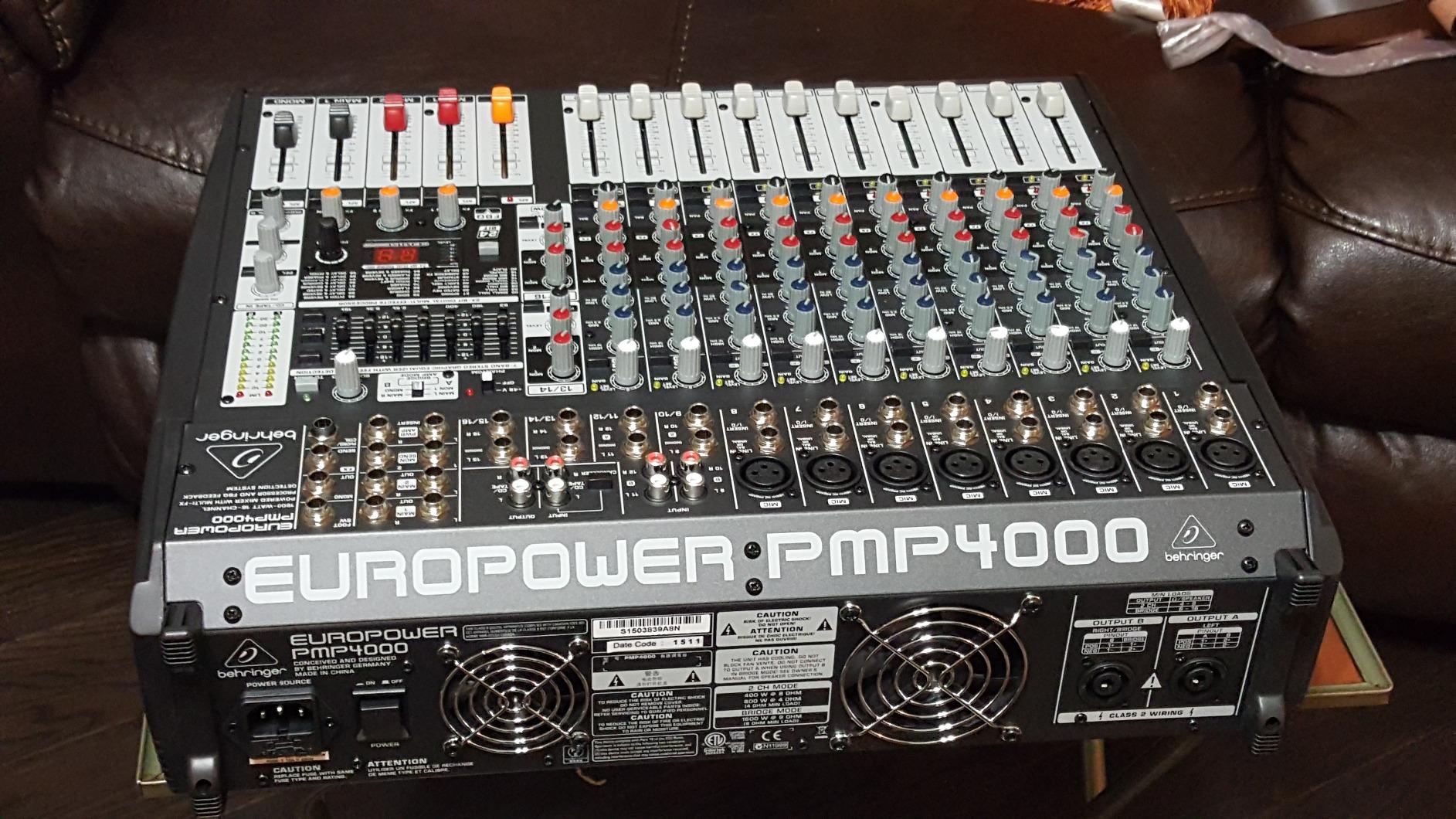
The Behringer PMP4000 is the mixer I point people to when they need to cover a full band and don’t want to spend Yamaha money. Sixteen channels in a powered console at this price is genuinely impressive — you get 8 mono channels with XLR inputs, 4 stereo channels, and a separate CD/tape input for playback sources, all running through Behringer’s Class-D amplifier technology.
That Class-D design is worth noting because it keeps the unit at 22.9 pounds despite the 1600W output capacity. Traditional Class-AB power amps at this wattage would push the weight considerably higher. The practical result is a mixer you can actually carry to gigs without needing a roadie or a heavy-duty cart.
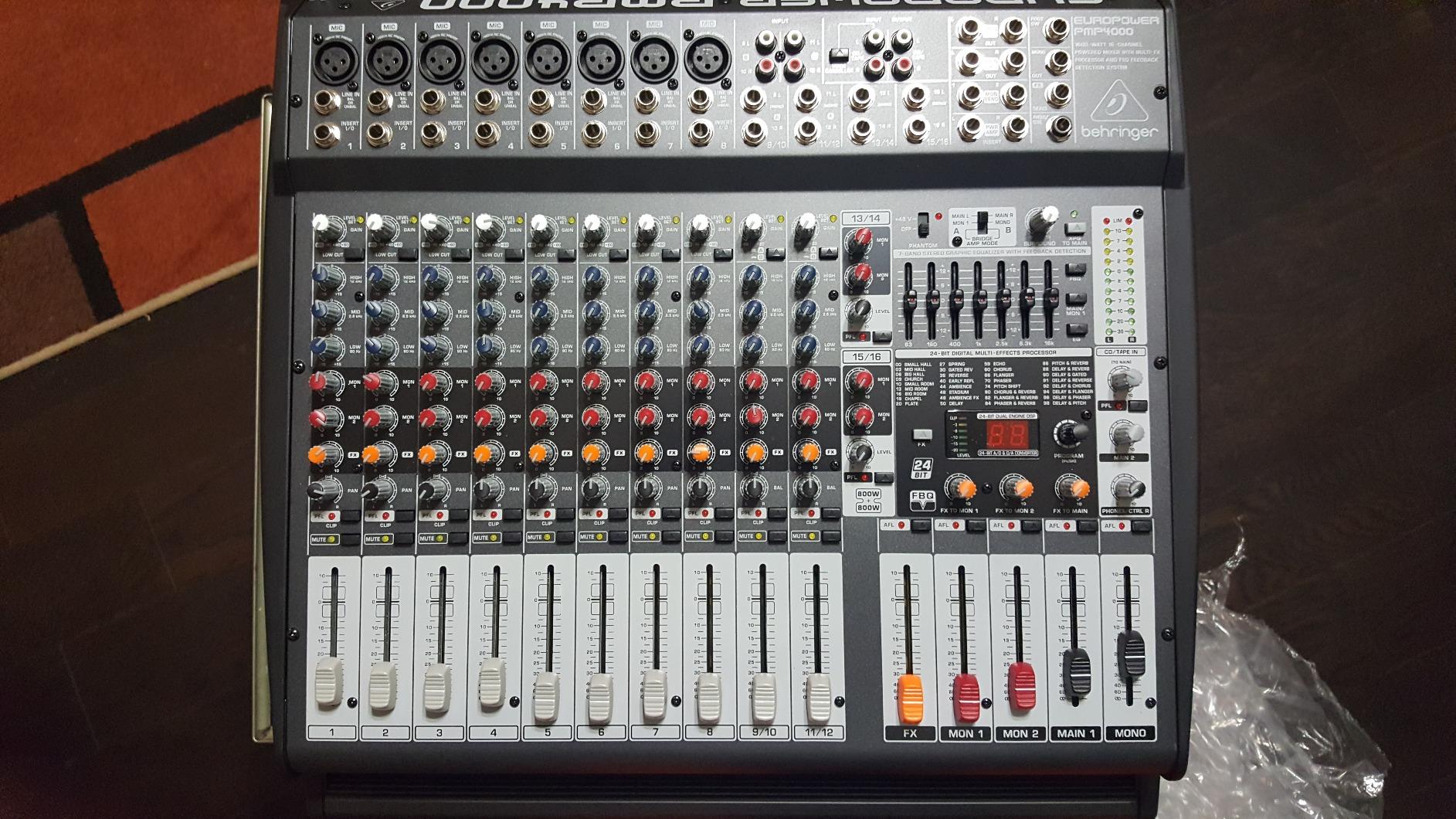
The 24-bit stereo FX processor with 100 presets handles reverb, delay, chorus, and pitch-based effects. Users specifically call out that the effects can be sent to both the main outputs and monitor sends independently — a feature some competing units lock down. The FBQ Feedback Detection system also provides visual indicators showing which frequencies are feeding back, which is useful when you’re racing against time during a sound check.
With 211 reviews averaging 4.4 stars, the PMP4000 has a proven track record across small DJ operations, karaoke setups, and live band applications. Users consistently praise the layout, the clean sound output, and the value proposition — features that compete with units costing significantly more.
Best Applications for the PMP4000
If you’re running a small DJ business or handling karaoke nights consistently, the PMP4000’s 16-channel count and feature set give you far more flexibility than an 8-channel unit at a similar price. The separate CD/tape input means you can run a music source alongside your microphone channels without burning a mix channel on it.
Church installations and school assemblies benefit from the channel count as well. When you’re running multiple wireless mic receivers, a keyboard, a backing track player, and a feed from a laptop, 16 channels fills up faster than you’d expect. The PMP4000 gives you room to grow.
What to Watch Out For
Behringer’s quality control has historically been inconsistent, and the PMP4000 is not immune to that. Some forum users report unit failures after moderate use. The reliability ceiling here is lower than Yamaha, and if you depend on this for regular paid gigs, having a backup plan matters.
The 1600W bridged output sounds impressive, but in stereo mode you’re working with 800W per side. For driving large passive speaker cabinets in bigger rooms, that can feel limiting. This unit is most effective paired with efficient speakers in venues up to 200-250 capacity.
3. Behringer PMP1680S – Rack-Mountable 10-Channel with Dual FX

Behringer EUROPWER PMP1680S 1600-Watt 10-Channel Powered Mixer
1600W bridged mode
10 channels (6 mono + 2 stereo)
Dual 24-bit FX processors
Rack mountable
21.8 lbs
Pros
- Rack-mountable design for permanent installs
- Dual independent FX processors
- Class-D stays lightweight
- Phantom power on all channels
- Excellent signal-to-noise ratio
Cons
- No traditional input gain knobs per channel
- Requires Speakon cables (not standard speaker cables)
- RC jack inputs lack individual EQ
The Behringer PMP1680S occupies an interesting position in the lineup — it’s rack-mountable, which immediately opens it up to permanent installation scenarios that the standard desk-format mixers can’t serve. If you’re installing a PA head in a venue rack or a church equipment closet, being able to mount it in a standard 19-inch rack is a genuine advantage.
The 10-channel layout (6 mono, 2 stereo, plus a CD/tape return) is tight but manageable for small ensemble work. Where this unit differentiates itself is the dual independent FX processors — you get two separate 24-bit processors, each with 100 presets, which means you can run different reverb settings on vocals versus instruments simultaneously without sharing a single effects bus.
Users consistently note that phantom power works cleanly across all channels, which is essential when running condenser mics. The signal-to-noise ratio is well-regarded in reviews — one user running it with Behringer B215XL speakers described the sound as having “incredible power and quality.” The Class-D amp keeps the unit under 22 pounds despite the 1600W capacity.
One practical note: this unit ships without standard speaker cables and requires Speakon connectors. If you’re coming from a setup that uses regular 1/4-inch speaker cables, budget for Speakon cables before your first gig. It’s caught several buyers off guard when unboxing for the first time.
Who This Mixer Is Right For
The rack-mount format makes the PMP1680S ideal for installed sound applications — small theaters, conference rooms, houses of worship, and anywhere the mixer lives in a permanent rack rather than on a table. The dual FX processors are a genuine advantage for scenarios where multiple performers need different reverb or effects settings simultaneously.
Smaller bands (trio or quartet) who want professional features without overpaying will also find this a strong value. The dual processors mean the keyboardist and the vocalist can each have their own effect chain without fighting over a single effects bus.
Where It Falls Short
The lack of traditional per-channel input gain knobs takes some adjustment if you’re used to conventional mixer layouts. You get EQ control but less granular gain staging than more expensive boards. The RC jack stereo inputs also don’t have their own EQ controls, which limits how much tonal shaping you can do on those inputs.
The reliability question applies here as it does with most Behringer gear — solid for many users, but forum discussions document occasional failures on some units. For a permanent installation where you can’t easily swap gear mid-event, this is worth considering before committing.
4. Rockville RPM1470 – 14-Channel Feature-Rich Mixer with Bluetooth

Rockville RPM1470 14 Channel 6000w Powered Mixer with USB and Bluetooth
6000W peak / 750W RMS x2
14 channels with 14 XDR2 preamps
Bluetooth and USB/SD recording
Dual 7-band graphic EQ
28.9 lbs
Pros
- 14 XDR2 preamps are genuinely low-noise
- 4-band EQ per channel beats 3-band on competitors
- Dual 7-band graphic EQ is practical for feedback control
- Bluetooth plus USB recording
- Warm and clear analog sound
Cons
- Heavier than competitors at 28.9 lbs
- Optimized for passive mains with powered monitors
- Limited effects preset count
The Rockville RPM1470 is the kind of mixer that makes you double-check the price because it simply has more features than you’d expect at this range. Fourteen channels, 14 XDR2 low-noise microphone preamps, 4-band EQ per channel (most competitors give you 3-band), dual 7-band graphic EQs, Bluetooth, USB, SD card recording, and 6000W peak power — this is a serious feature list for a mid-range powered mixer.
The XDR2 preamps deserve a mention because mic preamp quality is often where budget mixers cut corners. Multiple users describe the RPM1470’s sound as “warm and clear,” and one reviewer specifically compared the effects favorably to a higher-priced Mackie mixer. The dual graphic EQs are practical for live sound — you can dedicate one to the main outputs and one to monitor sends, which gives you independent room correction for each output path.
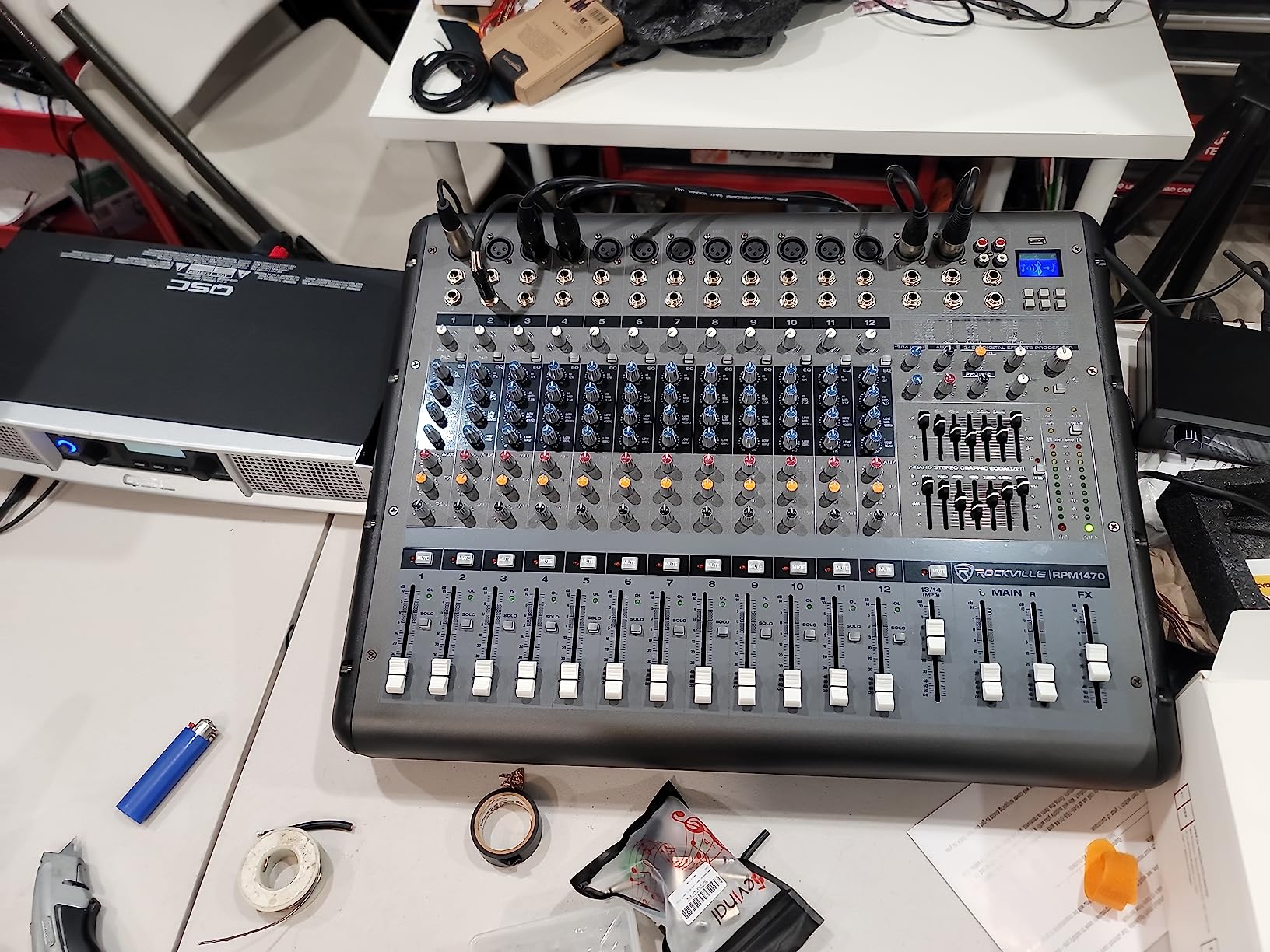
The Bluetooth and USB recording combination is genuinely useful for live situations. You can stream audio from a phone or tablet wirelessly for between-set music, record the full mix to a USB drive for reference listening, and connect instruments or media players through the multiple analog inputs — all simultaneously. Church bands and live event operators have found this particularly valuable as a simple recording solution.
With 232 reviews at 4.5 stars — the highest rating in this roundup — user satisfaction with the RPM1470 is notably strong. The 79% five-star rate is the highest in this comparison, which reflects genuine satisfaction rather than just feature quantity.
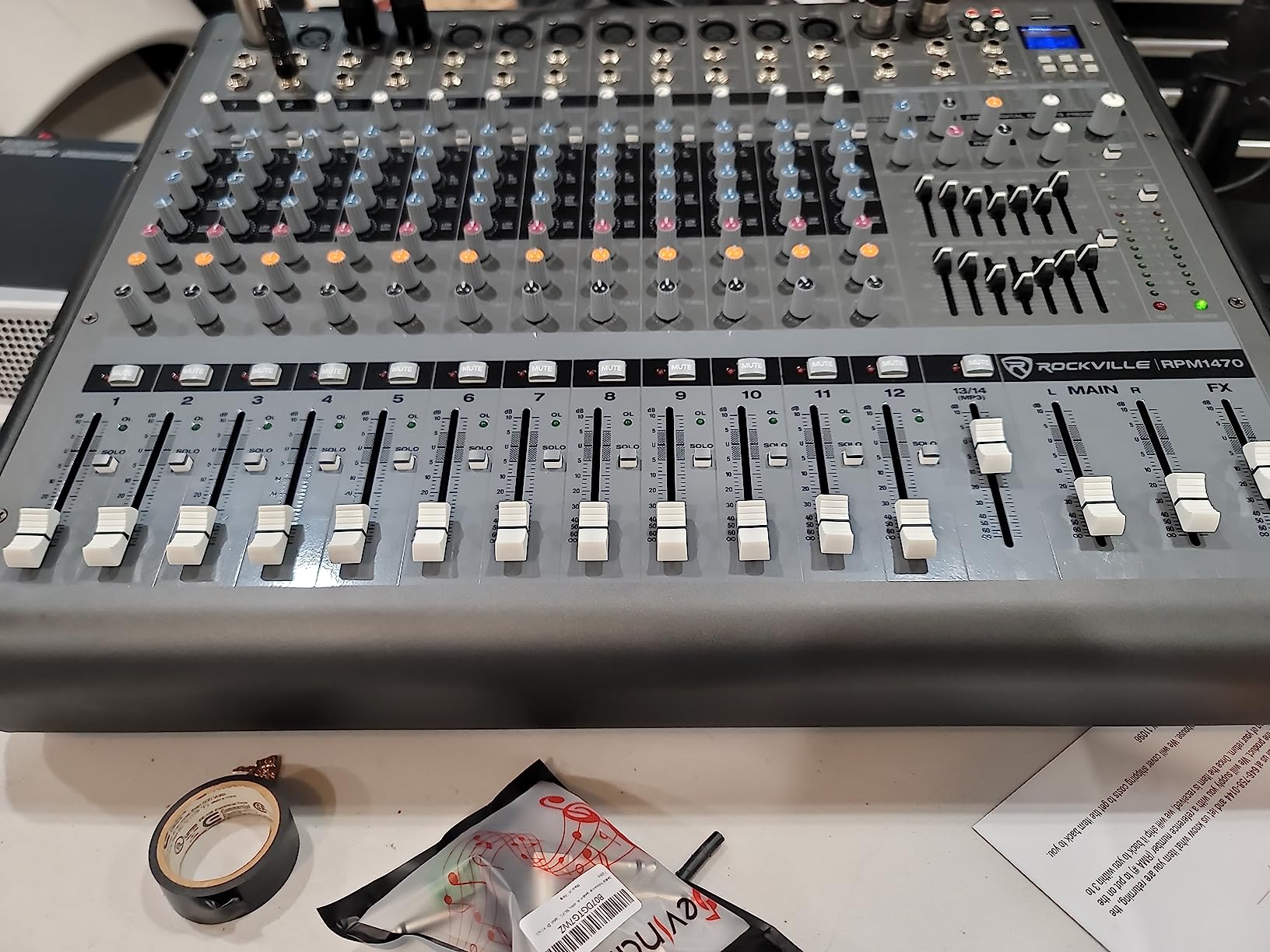
Ideal Use Cases for the RPM1470
Church bands are one of the best applications for this mixer. The channel count handles a full worship ensemble (vocals, keys, guitar, bass, drums overhead), the dual graphic EQs manage room acoustics independently, and the USB recording makes it easy to archive services. The analog warmth noted by users makes vocals and acoustic instruments sound natural without heavy processing.
Live event operators and bands running regular gigs in venues up to 300 capacity will find the 750W RMS per side provides adequate clean headroom for most applications. Pairing this with efficient passive speakers in that range is the setup it’s designed for.
Important Considerations Before Buying
The RPM1470 is heavier than many competitors at 28.9 pounds. If you’re carrying gear solo and doing multiple gigs per week, that extra weight compared to lighter Class-D units is worth factoring into your decision. This is a more traditional amplifier design, not the ultra-light Class-D topology found in the Behringer units.
The mixer is designed with the assumption that you’re running passive main speakers and powered monitors — not passive mains and passive monitors from a single amplifier output. Users who tried to run both mains and monitors from a single passive configuration found the routing options limited. Check your speaker configuration against this setup before ordering.
5. Rockville RPM109 V2 – 12-Channel Modern Mixer with DAW Integration

Rockville RPM109 V2 12 Channel Powered Mixer, 7 Band EQ, USB, 48V
4800W peak / 600W RMS x2
12 channels (6 mono + 3 stereo)
DAW interface via USB
24 digital effects
Rugged wood enclosure
Pros
- DAW interface for recording directly to computer
- 24 digital effects included
- Bluetooth plus USB and SD playback
- 8 mic preamps with proper phantom power
- Prime eligible for fast delivery
Cons
- Power switch failure reported by some users
- Effects less suited for lead vocals
- Heavier at 33 lbs
The Rockville RPM109 V2 is the updated version of a mixer that already had a solid reputation, and the version 2 refinements make it one of the most complete options in the mid-price range. What separates this from similar 12-channel offerings is the USB DAW interface functionality — you can connect this directly to a laptop and use it as both a live mixer and a recording interface simultaneously, which opens up possibilities for hybrid live/recording scenarios that older analog mixers simply can’t handle.
The 600W RMS per side output (450W at 8 ohms) is realistic power for small to medium venues, and the rugged wood enclosure with dual fan cooling makes it feel more solidly built than plastic-bodied alternatives at this price. Users consistently describe setup as fast and intuitive, with “everything at fingertip control” being a recurring phrase in reviews from users who gig regularly.
The 24 digital effects cover the standard palette — reverb, chorus, delay, and combinations — across 8 mic preamps that include proper +48V phantom power. The dual 7-band stereo master EQ gives you meaningful room control, and the combination of Bluetooth, USB, and SD playback options means you can handle any media source a gig throws at you without adapters or workarounds.
With only 33 reviews at time of writing (Prime eligible, which helps with availability), this is a newer listing — but the satisfaction numbers are strong, with 74% five-star ratings from buyers who describe it as “the best PA I’ve ever owned” and “amazing machine for the price.”
Who Benefits Most from the RPM109 V2
Musicians who want to record their live sets or practice sessions without buying a separate audio interface get genuine value from the DAW integration here. Connect a laptop, open your recording software, and capture a stereo mix of your entire performance. For solo performers, small ensembles, and practice room setups, this workflow is extremely practical.
Mobile DJs who need Bluetooth audio input alongside traditional XLR sources will find the feature combination particularly flexible. Running a DJ laptop through the DAW interface while streaming backup music via Bluetooth is a workflow this mixer handles natively.
Reliability Questions to Consider
One reported failure mode is the power switch dying after about a year of use. It’s not a universal complaint, but it appears in enough reviews to be worth noting. If you’re running this for regular paid gigs, keep an eye on the power switch and order from a seller with a solid return/warranty policy.
Some users also found the effects less effective for lead vocal processing compared to a dedicated vocal reverb unit. The effects are functional and cover the basics, but if pristine vocal processing is a priority, a dedicated effects processor in the signal chain will outperform the built-in options.
6. Rockville RPM870 – 8-Channel Best Seller with Pro Features
Rockville RPM870 8-Channel 6000W Powered Mixer with USB Bluetooth FX
750W RMS x2 at 4 Ohm
8 XDR2 low-noise mic preamps
Bluetooth plus USB recording
Dual 7-band EQ plus 4-band per channel
110V/220V switchable
Pros
- 8 XDR2 preamps deliver genuinely clean audio
- Dual 7-band EQ plus per-channel 4-band EQ
- Bluetooth works reliably for wireless audio
- USB recording built in
- 110V/220V switchable for international use
Cons
- Fan noise audible at low volumes
- Some early quality control reports
- Not for large venues or stadiums
The Rockville RPM870 is the best-selling powered mixer on Amazon in the Stage Powered Mixers category, and the sales numbers reflect real-world satisfaction rather than marketing. With 429 reviews averaging 4.4 stars, this is the mixer that a huge portion of the live sound community has already voted for with their wallets. It ranks #11 in Stage Powered Mixers, which is significant in a competitive category.
The combination that makes the RPM870 stand out at its price is the EQ stack: you get a dual 7-band graphic EQ on the master outputs plus an independent 4-band EQ on each individual channel. Most mixers in this range give you a 3-band channel EQ. Having a 4-band per channel lets you notch out problem frequencies more precisely than a simpler bass/mid/treble control allows, which makes a real difference when you’re fighting feedback or shaping guitar tone in a live room.
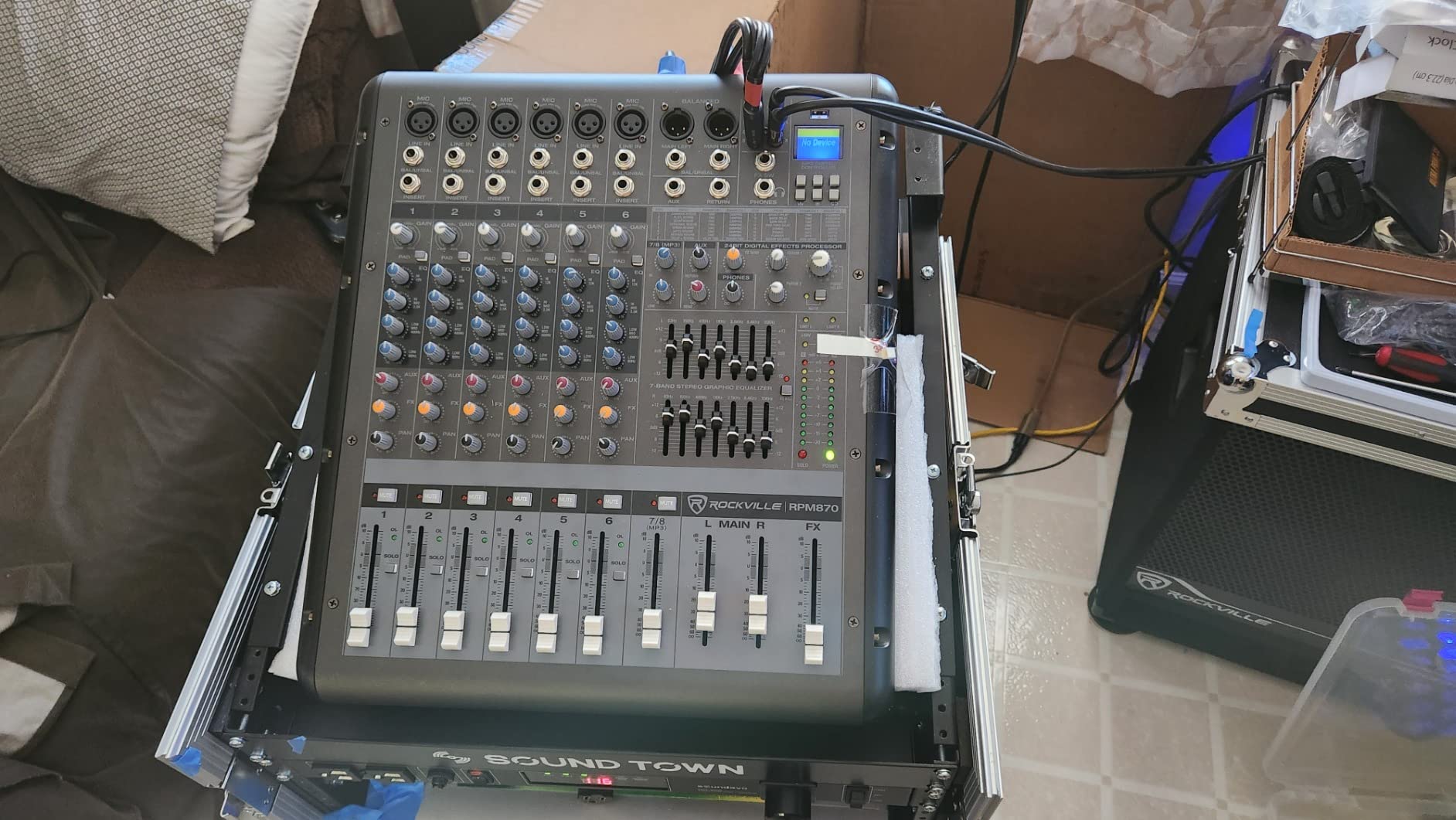
The XDR2 microphone preamps are the same design used in Rockville’s larger units — low-noise, low-distortion circuitry that delivers clean audio without the hiss that plagues very cheap preamps. Users who’ve compared this to older Behringer units specifically note the cleaner sound. The 750W RMS per side output at 4 ohms provides genuine clean headroom for venues up to 200-250 capacity with efficient speakers.
The 110V/220V switchable power supply is a feature that matters more than it gets credit for — it makes this mixer genuinely useful for international touring or in facilities with inconsistent power supplies. Combined with the USB recording and Bluetooth streaming, the RPM870 covers the modern connectivity needs that older mixer designs ignore.
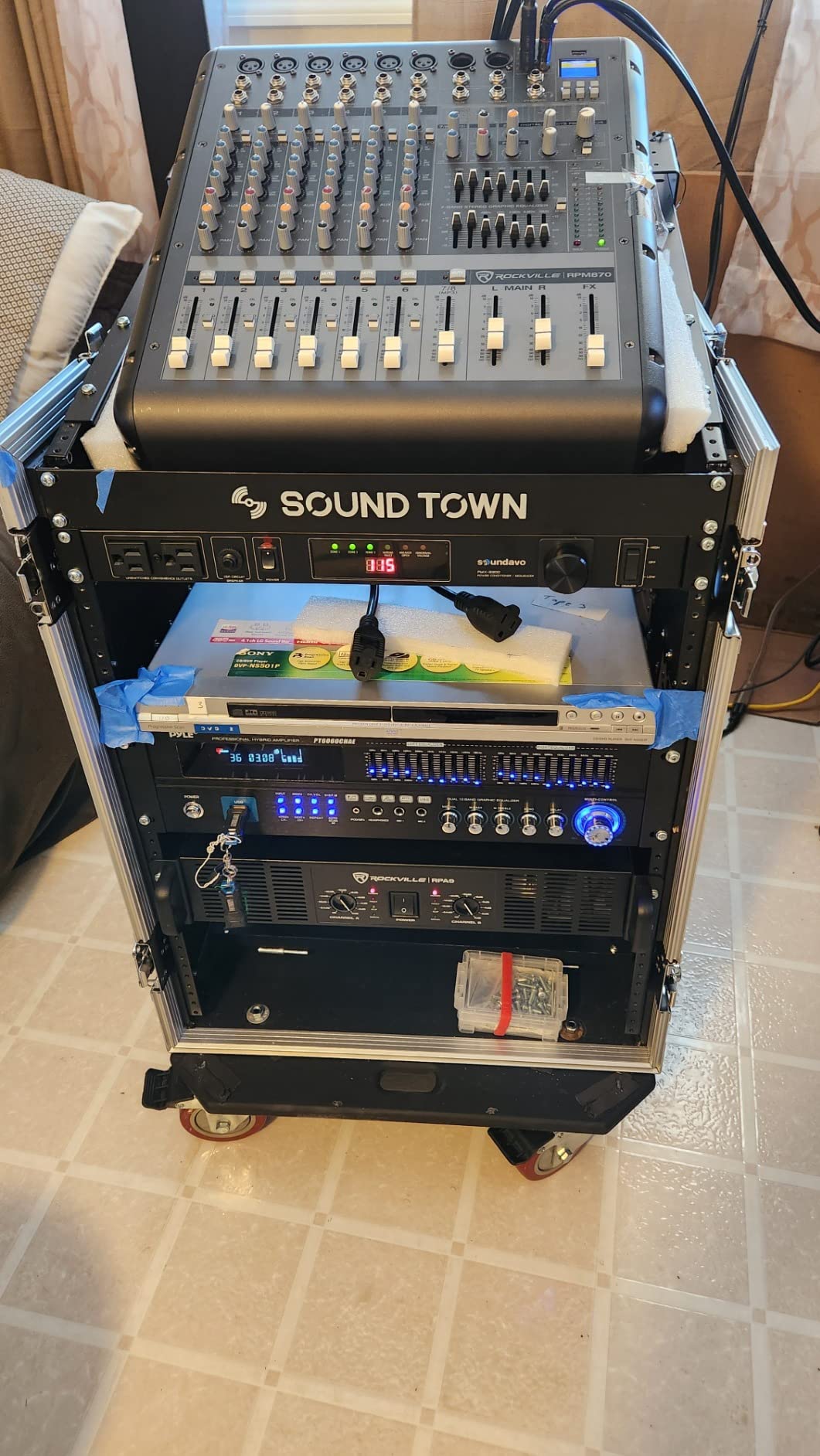
Ideal Setups for the RPM870
Live bands with up to 6-7 inputs (lead vocal, backing vocal, acoustic guitar, keys, and a stereo playback source) fit comfortably within 8 channels. Small venue house sound rigs, rehearsal studios, and DJ setups that need clean mic input alongside Bluetooth streaming find the RPM870 handles the mix without any compromises.
For DJs specifically, the combination of Bluetooth streaming, USB recording, RCA inputs, and multiple XLR channels means you can run controller outputs, wireless mics for the MC, a phone for emergency backup music, and still record the entire set — all from one box. Check out our guide to the best mobile DJ speakers to complete your setup.
What to Know Before You Buy
The internal cooling fan is audible when no music is playing. In a quiet room during setup or after a set, you’ll hear it. Most users describe it as a minor inconvenience rather than a deal-breaker, but if you’re using this for unamplified acoustic performances with very low stage volume, the fan noise is noticeable.
A small number of reviews describe early quality control issues — units arriving with problems. The majority of buyers have no issues, but ordering from a retailer with easy returns protects you if you’re one of the unlucky ones.
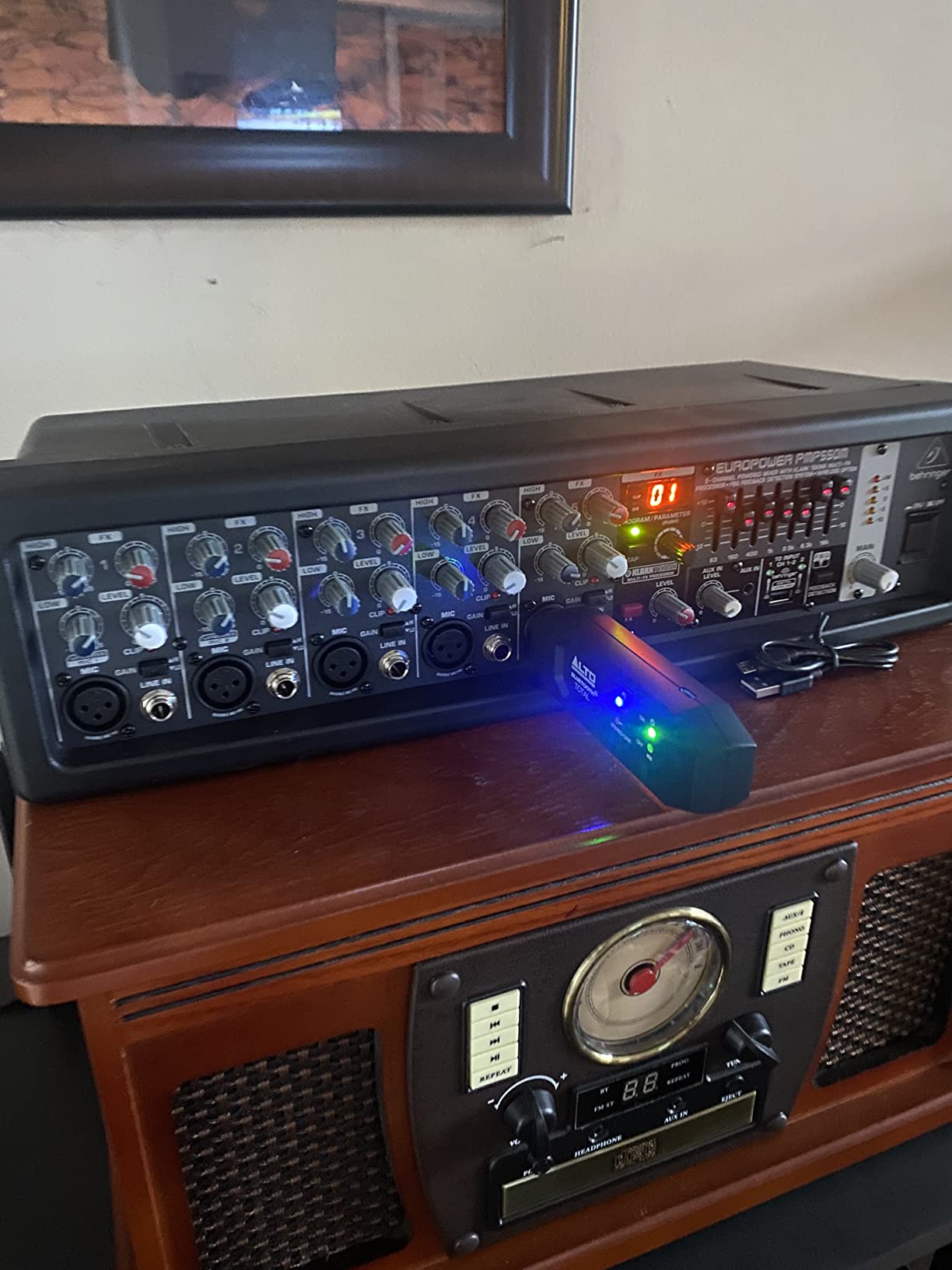
7. Behringer PMP550M – Ultra-Compact 5-Channel for Small Venues

Behringer EUROPOWER PMP550M 500 Watt 5 Channel Powered Mixer with Klark Teknik Multi-FX Processor, FBQ Feedback Detection System and Wireless Option
500W Class-D amplifier
5 channels XLR inputs
KLARK TEKNIK FX 25 presets
FBQ Feedback Detection
Ultra-light at 9.92 lbs
Pros
- Weighs under 10 lbs - easiest to transport
- KLARK TEKNIK effects are genuinely quality
- FBQ feedback detection system
- Wireless-ready capability
- Clean crisp sound with no hiss or hum
Cons
- No line out for powered speakers
- No monitor send jack
- No 48V phantom power
- Only 2-band EQ per channel
- Power rating is peak not RMS (125W actual)
The Behringer PMP550M is the smallest and lightest mixer in this roundup at just 9.92 pounds, and that weight number is the most important thing to understand about it. If portability is your primary concern — open mic nights, acoustic duo gigs at coffee shops, small corporate presentations — nothing here matches the PMP550M for ease of transport.
Despite the compact size, Behringer packed in their KLARK TEKNIK FX processor, which is a genuine premium effects engine. KLARK TEKNIK is a respected professional audio brand that Behringer acquired, and the 25 presets in this unit cover reverb, chorus, flanger, delay, and pitch shifting with notably better quality than generic budget effects processors. The FBQ Feedback Detection system also shows you visually which frequencies are feeding back, making sound check faster even in challenging rooms.
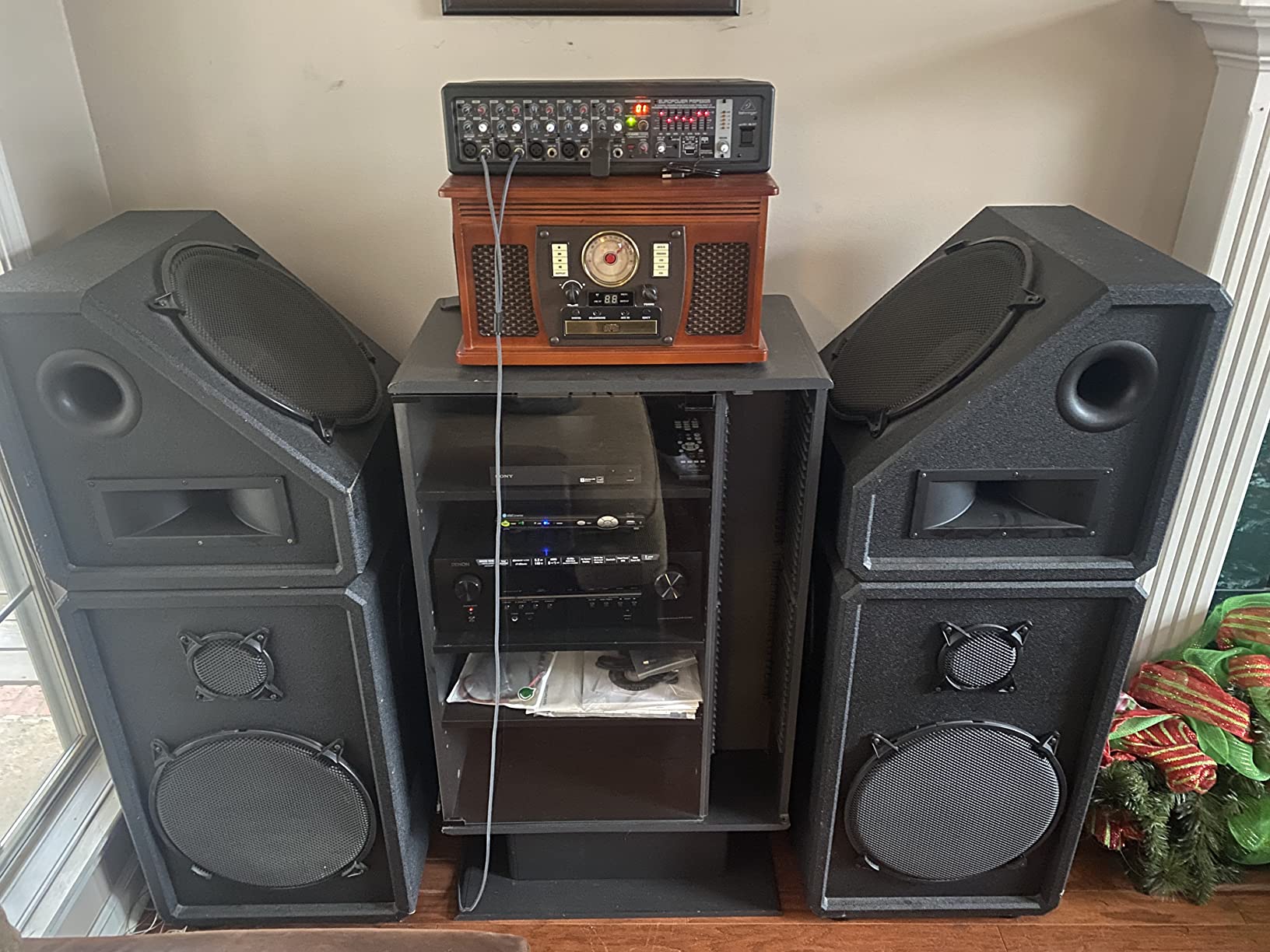
Users consistently describe the sound as crisp and clean with no hiss or hum — the Class-D amplifier delivers clean output without the noise floor issues that plagued older small mixer designs. The wireless-ready capability (compatible with Behringer’s digital wireless system) is a thoughtful inclusion for solo performers who want to go cable-free.
There’s also a critical limitation to understand before ordering: this mixer has no line out or unpowered output. That means you cannot use it with powered/active speakers — it can only drive passive speaker cabinets directly. If you already own powered speakers or are planning to buy active speakers, the PMP550M is the wrong choice. See our powered speakers guide to understand speaker compatibility before purchasing.
The Right Situations for This Mixer
Solo acoustic performers, duos, and small presentation setups with passive speakers are the natural home for the PMP550M. Five channels is enough for two vocals, an acoustic guitar, and a stereo playback source — the typical solo or duo setup for coffee shop and small venue gigs. The weight makes it genuinely no-hassle to throw in a bag alongside your microphone cables and call it a portable PA.
Open mic hosts, acoustic jam sessions, and small-scale event presentations where you need voice reinforcement without setting up a full PA system are ideal use cases. The FBQ feedback system helps manage feedback in unfamiliar acoustic environments, which is common when you’re setting up in a different room every week.
Critical Limitations to Understand
The 500W rating is peak, not RMS. The actual continuous output is approximately 125W per side — completely adequate for small venues, but dramatically different from what the headline number suggests. Don’t buy this expecting 500 watts of sustained power.
The 2-band EQ (bass and treble only, no midrange control) is limiting for shaping problematic room acoustics. No phantom power means you’re limited to dynamic microphones. And the absence of a monitor send means you can’t run stage monitors independently from your main speakers without additional external gear.
8. Rockville RPM85 – 8-Channel Budget Mixer with Full Feature Set

Rockville RPM85 8-Channel Powered Mixer with Bluetooth and USB/SD
2400W peak / 300W RMS x2 at 4 Ohm
8 mic/line inputs
Bluetooth plus USB/SD
5-band graphic EQ
Sturdy wood cabinet
Pros
- 8 channels at an entry price is strong value
- Sturdy wood cabinet is durable
- 5-band graphic EQ included
- Bluetooth plus USB/SD playback
- Individual channel reverb controls
Cons
- Fan noise is significant
- Bluetooth range limited to about 15 feet
- Phantom power is 15V not standard 48V
- Quality control issues on some units
The Rockville RPM85 is the most budget-friendly 8-channel powered mixer in this roundup, and it still offers Bluetooth streaming, USB/SD playback, a 5-band graphic EQ, and individual channel controls for reverb, bass, and treble. For a band or venue operating on a tight budget, the feature-to-dollar ratio here is hard to argue with.
The wood cabinet construction is worth mentioning because many budget mixers use plastic enclosures that flex and crack under regular transport. The RPM85’s solid wood build gives it a more durable physical structure than you might expect at this price point, and users consistently note it holds up well over time. With 307 reviews and a 4.2-star average, this has enough user data to provide a realistic picture of performance.
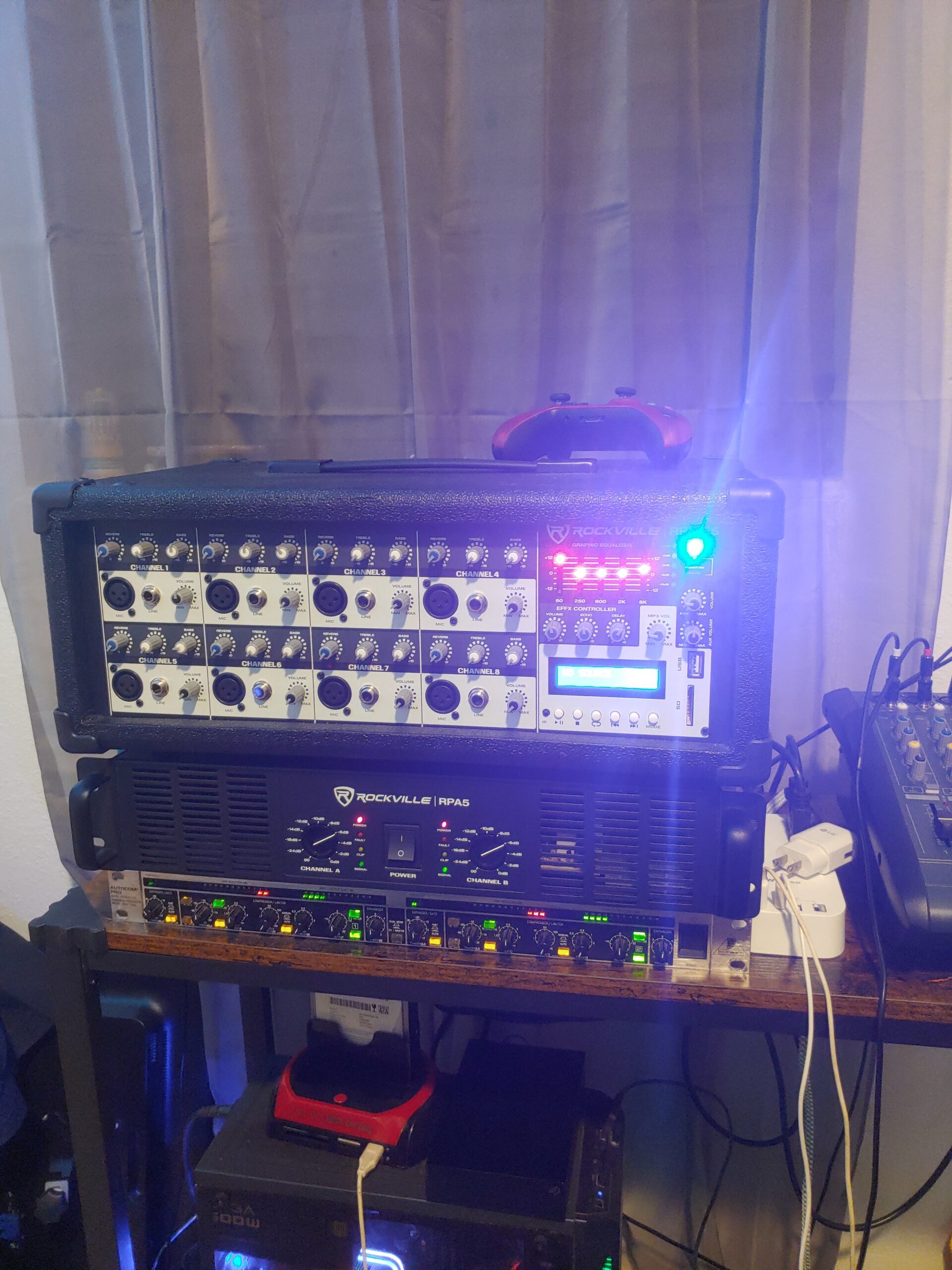
The 5-band graphic EQ provides meaningful room tuning capability, and having individual reverb, bass, and treble controls per channel lets each performer dial in their own basic tone without affecting everyone else’s channel. This is more granular control than some higher-priced mixers offer at the channel level.
The sound quality for the price is genuinely clear and loud — users describe it as adequate for practice rooms and small to medium gigs. Multiple reviewers with years of use report no reliability issues, which builds confidence in the value proposition even at the lower price tier.
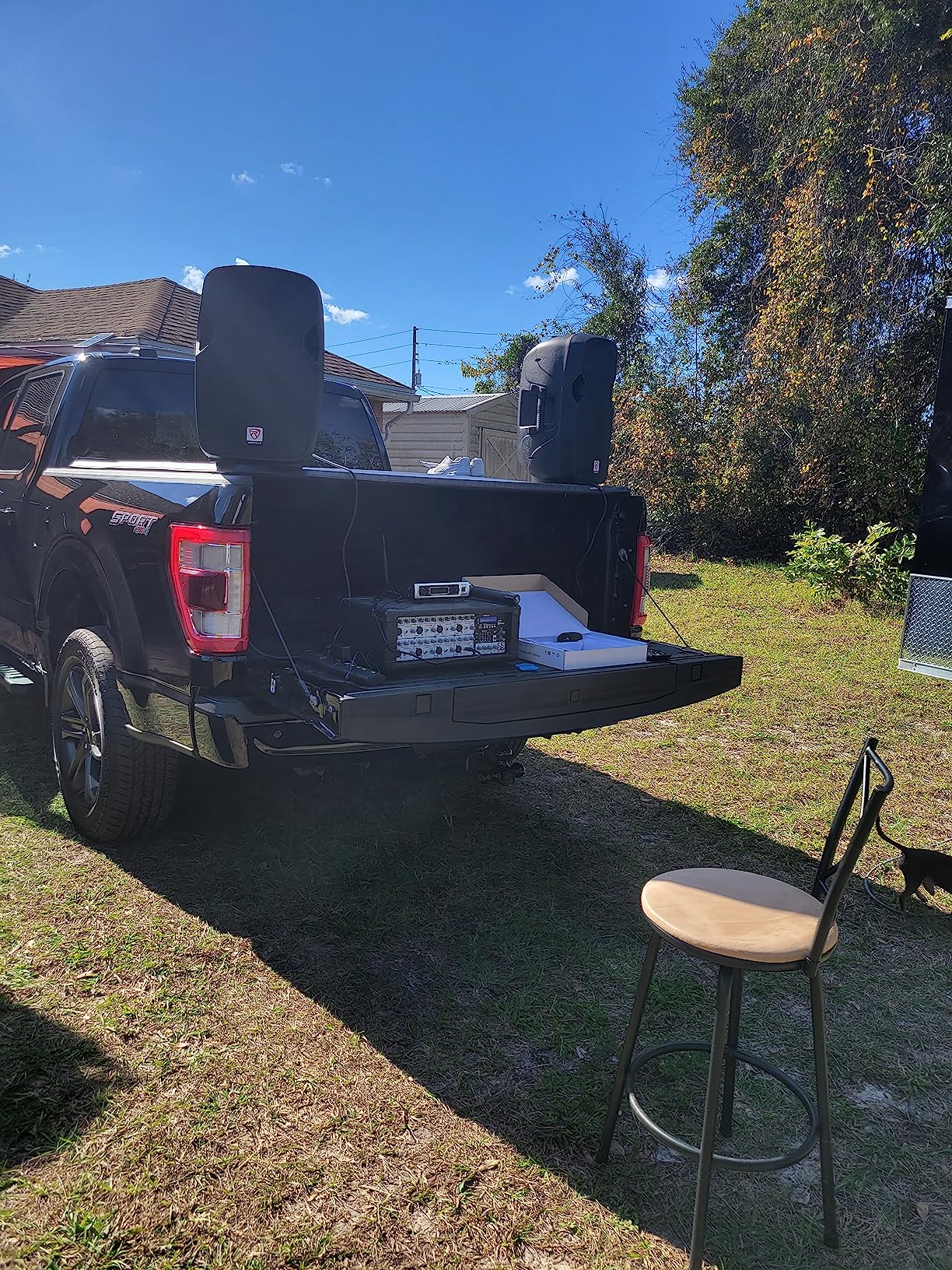
Where the RPM85 Shines
Practice rooms and rehearsal studios are the natural home for this mixer. Bands that need 8 channels for regular practice but don’t want to risk an expensive unit on weekly rehearsals find the RPM85 gives them full features without the investment risk. It’s also a strong pick for small venue installs where budget is the primary constraint.
Karaoke hosts, school AV setups, and occasional-use scenarios benefit from the Bluetooth connectivity that lets phones and tablets connect wirelessly alongside traditional XLR inputs. The USB/SD playback covers backing tracks and music sources without requiring a separate media player.
Real Limitations at This Price
The phantom power here is +15V, not the standard +48V that condenser microphones expect. Many condenser mics will partially function at +15V, but performance and reliability will be compromised. If you need to run condenser mics, the RPM870 with proper +48V phantom power is the better choice.
The Bluetooth range is genuinely limited to about 15 feet, which is restrictive if you’re trying to stream from across a room. Fan noise is also consistently mentioned as significant — audible in quiet moments and potentially disruptive for acoustic performances or quiet speech settings.
9. Rockville RPM80BT – 8-Channel Compact Mixer with Warm Sound
Rockville RPM80BT Powered 8-Channel Mixer/Amplifier with Bluetooth, EQ
500W RMS (250W x2 at 8 Ohm)
8 XLR plus 8 TRS inputs
5-band master EQ
Bluetooth plus USB
Phantom power included
Pros
- Warm mellow sound quality praised by users
- 8 XLR AND 8 TRS inputs for maximum flexibility
- Clear organized layout with well-labeled controls
- Good value at the price point
- Reliable for rehearsals and small gigs
Cons
- Knobs feel less solid than premium mixers
- Some static noise when inputs empty
- Fan noise at low volumes
- Power output may not match specs for some users
The Rockville RPM80BT occupies the sweet spot between the entry RPM85 and the more feature-rich RPM870. What distinguishes it from the competition at this price is the dual input format: you get 8 XLR inputs AND 8 independent 1/4-inch TRS inputs — meaning every channel has both connector types available simultaneously. This is more flexible than most mixers in this range and eliminates the need for adapter cables when connecting instruments with standard 1/4-inch jacks alongside XLR microphones.
The sound character is described by users as “warm and mellow” — a noticeable contrast to the more clinical output of some budget digital units. For acoustic music, vocals, and anything where warmth and natural tone matter, this quality is genuinely useful. The clear, organized panel layout with well-identified controls also reduces setup time, which matters when you’re doing a quick turnaround between acts.

At 408 reviews with a 4.4-star average, the RPM80BT has more user data behind it than most mixers in the budget category. The 72% five-star rate from a large review base indicates consistent performance across a wide range of users and use cases — from senior group rehearsals to small venue gigs to karaoke nights.
The individual channel controls for bass, treble, and reverb give each performer meaningful tone shaping capability. Combined with the 5-band master EQ, you have a workable toolkit for managing room acoustics and individual channel tone without needing an external graphic EQ unit.
Best Fit for the RPM80BT
Senior groups and community organizations doing regular small-scale events often cite the RPM80BT’s clear layout and warm sound as exactly what they needed. The low learning curve and intuitive panel design mean less setup stress, and the 500W RMS output is sufficient for rooms up to about 100-150 capacity with reasonably efficient speakers.
Home studio setups doubling as small live rigs, practice bands that occasionally gig locally, and venues running consistent low-volume events find the RPM80BT gives them professional connectivity options without professional-tier complexity or cost.
Known Shortcomings
The control knobs receive consistent feedback about feeling less sturdy than premium mixers — not loose or broken, but with a plastic quality that signals budget construction. Over years of heavy gigging use, this may become a maintenance issue. The fan noise at low volumes is also noted by multiple reviewers, same as the RPM85 and RPM870.
Some users report a strong chemical smell when first unpackaged — this dissipates over time but is worth knowing if you’re sensitive to that. A small number also note that static noise appears when no sources are plugged into inputs, which is not unusual for budget analog gear but should be managed with proper gain staging.
10. Rockville RPM45BT – 4-Channel Entry-Level with Bluetooth

Rockville RPM45BT 1800W 4-Channel Powered Mixer/Amplifier, Bluetooth, EQ
1800W peak / 225W RMS x2 at 8 Ohm
4 XLR/combo inputs
Bluetooth streaming
+48V phantom power
Compact 18 lbs
Pros
- Proper 48V phantom power for condensers
- Compact and light at 18 pounds
- Solid wooden enclosure
- Bluetooth works great for parties and karaoke
- Excellent value at entry-level price
Cons
- Only 4 channels limits expandability
- Bluetooth volume lower than analog inputs
- Fan noise at low volumes
- Power output less than spec per some users
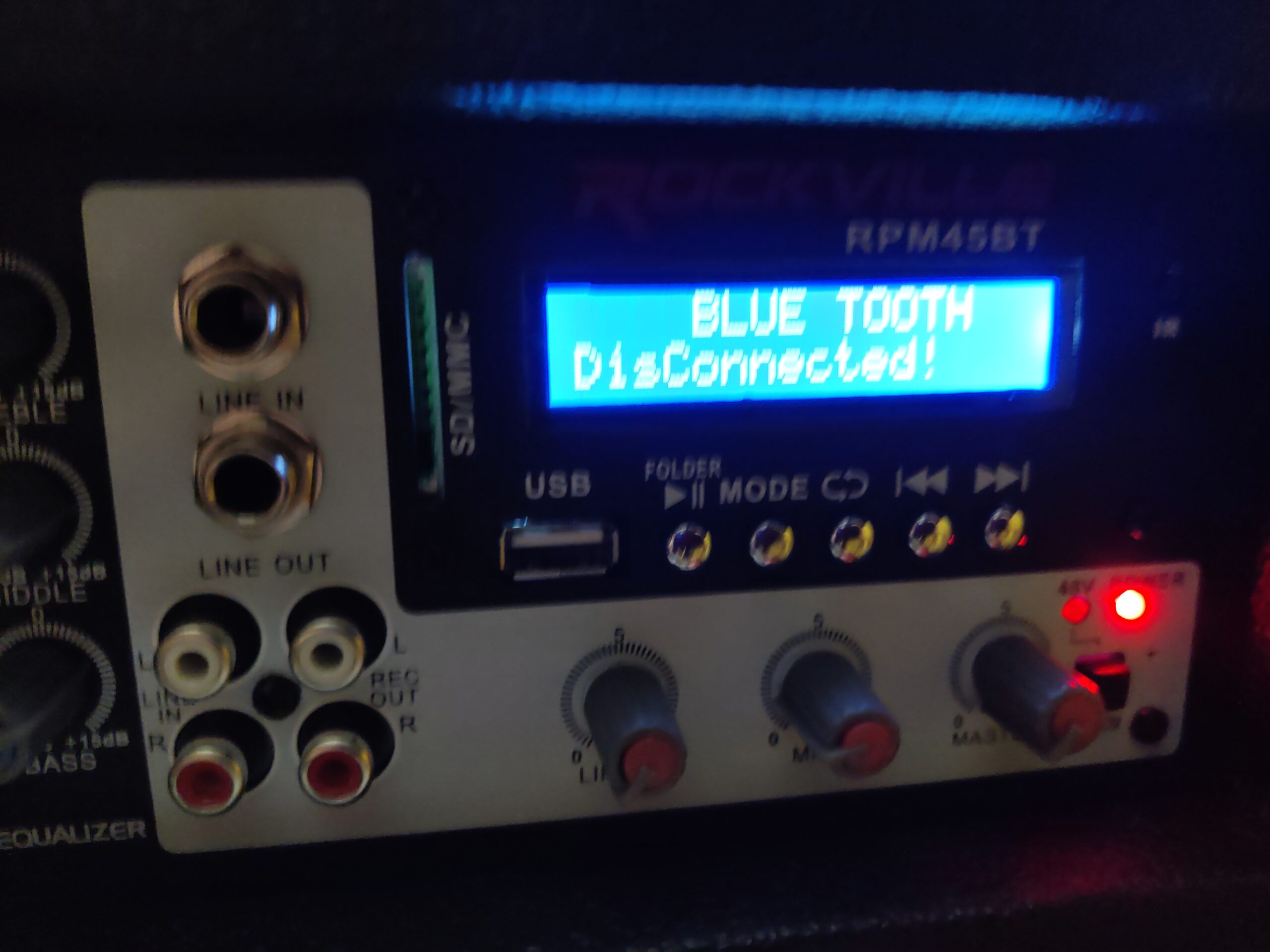
The Rockville RPM45BT is the entry point of this roundup — a compact 4-channel powered mixer that includes features you’d expect to pay significantly more for. The inclusion of proper +48V phantom power is notable at this tier, since many similarly-priced units either skip phantom power entirely or implement the lower +15V version. If you’re running a condenser microphone for vocal recording or speech amplification, having the full +48V is the difference between the mic working correctly and barely functioning.
The compact wooden enclosure weighs just 18 pounds and fits comfortably in a standard gear bag alongside cables and a microphone. For solo performers, small acoustic duos, and anyone running a 2-mic-plus-music-source setup, 4 channels is exactly what you need and the RPM45BT delivers it without unnecessary bulk or cost.
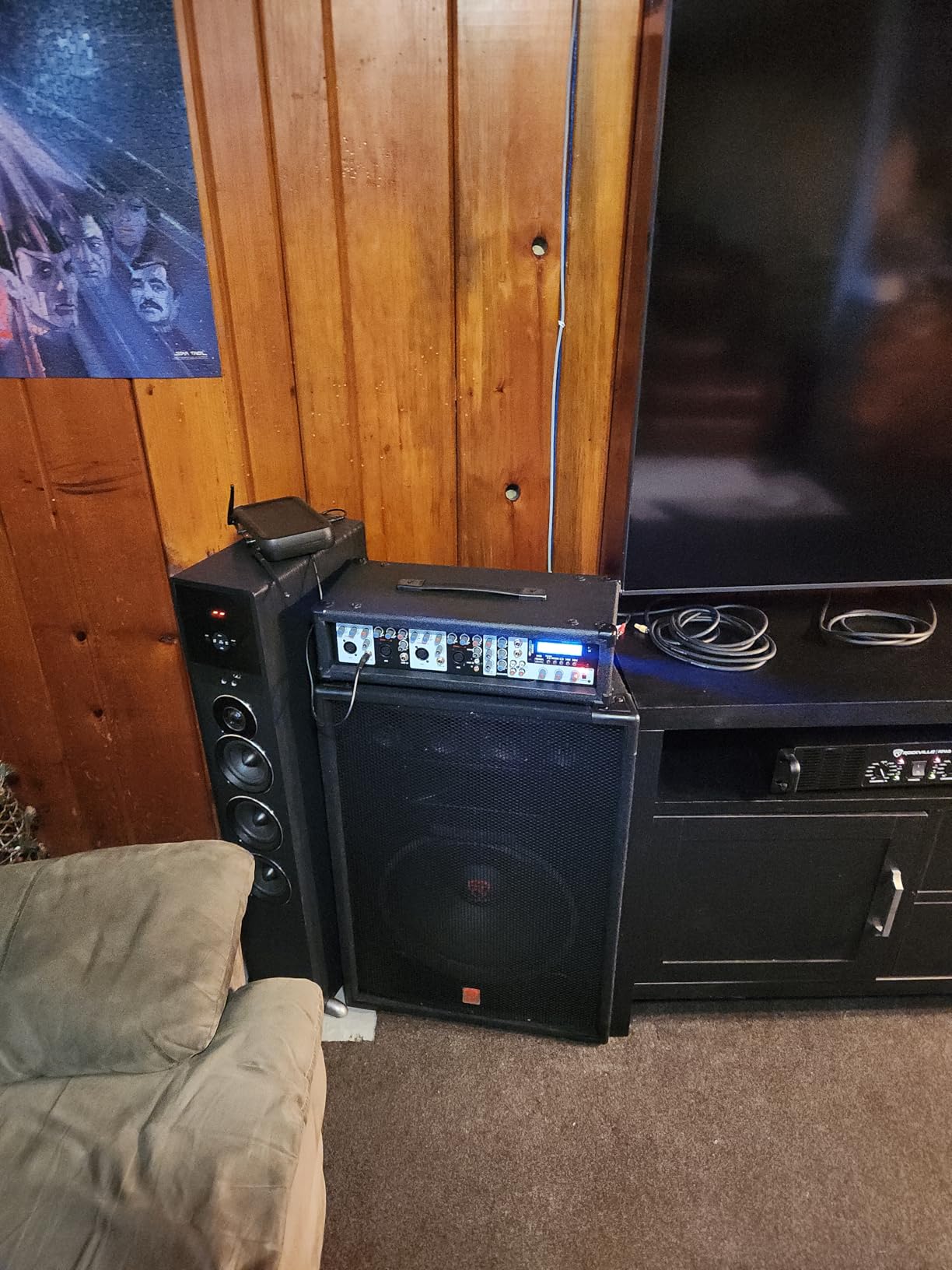
Bluetooth works reliably and is well-received by users running parties and karaoke setups — streaming phone audio to the mixer is seamless for background music and track playback. The individual channel controls (volume, bass, treble, reverb) give each input its own basic tone shaping, and the echo/delay effects on board provide enough processing for vocal and karaoke applications without needing external gear.
With 367 reviews averaging 4.4 stars, this is one of the most-reviewed options in the entry-level tier, and the user satisfaction level is genuinely high. Users describe it as a legitimate upgrade from low-quality alternatives in this range, with “excellent value” and “good sound quality” appearing consistently across reviews.
Who the RPM45BT Is Right For
Solo performers — acoustic singer/songwriters, spoken word artists, solo DJs — who need voice amplification, music playback, and a straightforward all-in-one setup will find the RPM45BT covers every base without unnecessary complexity. The 4-channel limit is not a constraint for this use case; it’s a feature that simplifies setup and reduces the decision overhead of running a larger board.
Small parties, backyard events, karaoke nights at home or in small bars, and church cell group meetings are all scenarios where a 4-channel mixer with Bluetooth and clean 225W RMS output per side gets the job done without overspending. This is also a solid first mixer for someone learning live sound basics before graduating to a larger board. Pairing it with quality dynamic microphones for live vocals completes an excellent beginner setup.
Limitations of Going Entry-Level
Four channels is a hard ceiling. If your setup grows — add a second vocalist, a keyboard player, a monitor mix — you’ll outgrow this mixer quickly. Buying this with growth plans means you’re buying twice. If there’s any chance you’ll need 6-8 channels within the next year, step up to the RPM80BT or RPM870 now.
The Bluetooth audio volume arrives notably lower than analog input signals, which requires a volume compensation adjustment in the Bluetooth channel. Users report this is manageable once you’re aware of it, but it can be confusing during first setup.
How to Choose the Best Powered Mixer for Live Sound
Buying a powered mixer is not complicated if you answer three questions first: How many channels do you need? How large is your venue? And what kind of speakers are you driving? Everything else is secondary to getting those three factors right.
Channel Count: Match Your Inputs, Not Your Ambitions
Count your actual inputs — microphones, instrument direct boxes, playback sources, wireless receivers — and add 20% buffer for future needs. A solo performer typically needs 4-6 channels. A three-piece band (vocals, guitar, keyboard plus playback) needs 8-10. A full five-piece band with multiple vocals needs 12-16. Buying more channels than you need costs money without adding value; buying fewer creates permanent limitations.
Adding a second vocalist to a 4-channel mixer requires buying a new mixer entirely. This is the most common regret in the live sound community. Our mic preamp guide can help you understand how preamp quality affects channel count decisions as well.
Power Output: Match Your Venue Size
Speaker efficiency and room size matter as much as raw wattage. As a general guide: 200-500W RMS handles rooms up to 100 people; 500-1000W RMS handles 100-300 person venues; 1000W+ RMS is needed for larger applications. The peak wattage numbers quoted by budget brands are marketing figures — focus on RMS (continuous) wattage for realistic performance expectations.
Efficient speakers (97-100dB sensitivity) need significantly less amplifier power than inefficient speakers (90-93dB). Pairing a modest powered mixer with high-efficiency speakers can outperform a high-wattage mixer driving inefficient cabinets. Speaker choice matters as much as mixer power.
Speaker Compatibility: This is Critical
A powered mixer is designed to drive passive (unpowered) speakers. If you connect a powered mixer to active (powered) speakers, you create a double-amplification problem that can damage your speakers and produces terrible sound. This is the single most common mistake new buyers make.
If you already own powered speakers or are planning to buy them, you need an unpowered mixer (passive mixer) — not a powered mixer. Read our powered speakers guide to understand the compatibility question before making any purchasing decisions. The Behringer PMP550M actually compounds this issue by lacking a line output entirely.
Features That Actually Matter at Each Price Level
At the entry tier, prioritize: enough channels, proper phantom power (+48V not +15V), basic EQ, and a reputable return policy. At mid-range, add: Bluetooth connectivity, USB recording, 7-band graphic EQ, and higher-quality preamps. At the upper end, expect: reliable brand pedigree (Yamaha, Behringer PMP4000 range), dual effects processors, rack-mountable options, and better long-term reliability records.
DSP effects are useful for small rigs where a separate outboard effects unit isn’t practical. Good built-in effects in the Yamaha EMX5 (SPX engine) and the Behringer KLARK TEKNIK implementation are genuinely quality; budget effects on very cheap mixers are often better ignored. Check out our best battle mixers guide if you’re also looking for DJ-specific mixing options.
Brand Reliability: What the Community Actually Says
Yamaha consistently tops reliability discussions in the r/livesound community. Their build quality and long-term track record justify the premium. Behringer offers more features per dollar but with a wider spread in quality control outcomes — some units run perfectly for years, others fail early. Rockville provides the best feature-to-dollar ratio in the budget space, with a track record that’s better than the brand’s reputation suggests but still below Yamaha’s reliability standard.
For regular paid gigs or permanent venue installations where failure means canceling an event, spend more on reliability. For practice rooms, occasional gigs, and budget-constrained installations, Rockville and Behringer provide genuine value with appropriate expectations.
Frequently Asked Questions
Can I use a powered mixer with active (powered) speakers?
No — this is a critical compatibility issue. A powered mixer already contains a built-in amplifier, and active speakers also contain their own amplifiers. Connecting the two creates double amplification that produces distorted sound and can damage your speakers. Powered mixers are designed to drive passive (unpowered) speaker cabinets only. If you own powered speakers, you need a standard passive mixer without a built-in amplifier.
Is a powered mixer good for live sound?
Yes, powered mixers are excellent for live sound in small to medium venues. They combine a mixing console and power amplifier in one portable unit, which simplifies setup significantly — one power cable instead of multiple rack components. They’re ideal for solo performers, small bands, mobile DJs, churches, and anyone needing a portable all-in-one PA solution. For larger venues or more complex setups, a separate mixer and amplifier rack provides more flexibility and upgrade options.
How many channels do I need for my band or event?
Solo performers need 4-6 channels. Trios and small bands (3-4 pieces) typically need 8-10 channels. Full bands with 5+ members and multiple vocalists need 12-16 channels. Count your actual inputs — each microphone, direct-box instrument, and playback source uses one channel — and add 2-3 extra for flexibility. Buying too few channels means replacing your mixer when you grow; buying too many wastes money.
What is the difference between peak and RMS power in powered mixers?
RMS (Root Mean Square) power is the continuous, sustained output a mixer can deliver — the number that reflects real-world performance. Peak power is a momentary maximum that can only be maintained for a fraction of a second. Budget mixer manufacturers often advertise peak power because it sounds more impressive. When comparing mixers, focus on RMS wattage for accurate comparisons. A mixer rated at 300W RMS is more powerful in practice than one rated at 2400W peak but only 300W RMS.
How do I set up a powered mixer for live sound?
Start by connecting your passive speakers to the speaker outputs using Speakon or 1/4-inch speaker cables (not instrument cables). Connect microphones and instruments to the channel inputs. Set all channel faders to the unity position and master fader to zero. Turn on the mixer last, after all connections are made. Gradually raise the master fader, then bring up individual channel faders while setting gain levels. Use the EQ to shape tone and manage feedback. Always turn the system off in reverse order — master fader down first, then power off.
Final Thoughts
Finding the best powered mixers for live sound means matching the unit to your actual use case rather than chasing the most impressive specs sheet. For professional reliability and sound quality, the Yamaha EMX5 is the standout choice — it costs more but earns it over years of consistent performance. For maximum features on a mid-range budget, the Rockville RPM1470 delivers the most impressive spec list including dual graphic EQs, 14 channels, and USB recording. The Rockville RPM870 remains the best seller in the category for good reason — it’s the sweet spot of features, quality, and value that the majority of live sound situations actually need.
If you’re just getting started or need an ultra-portable solution, the Rockville RPM45BT covers the basics with Bluetooth, proper phantom power, and a solid build in a compact form factor. And if you need a rack-mountable option for a permanent installation, the Behringer PMP1680S covers that need specifically.
Whatever you choose from this list, make sure your speaker cabinets are passive — not powered — before plugging anything in. That single compatibility check will save you a bad day and potentially a blown speaker. Get that right, match your channel count to your actual inputs, and you’ll have a powered mixing setup that handles live sound reliably for years.