
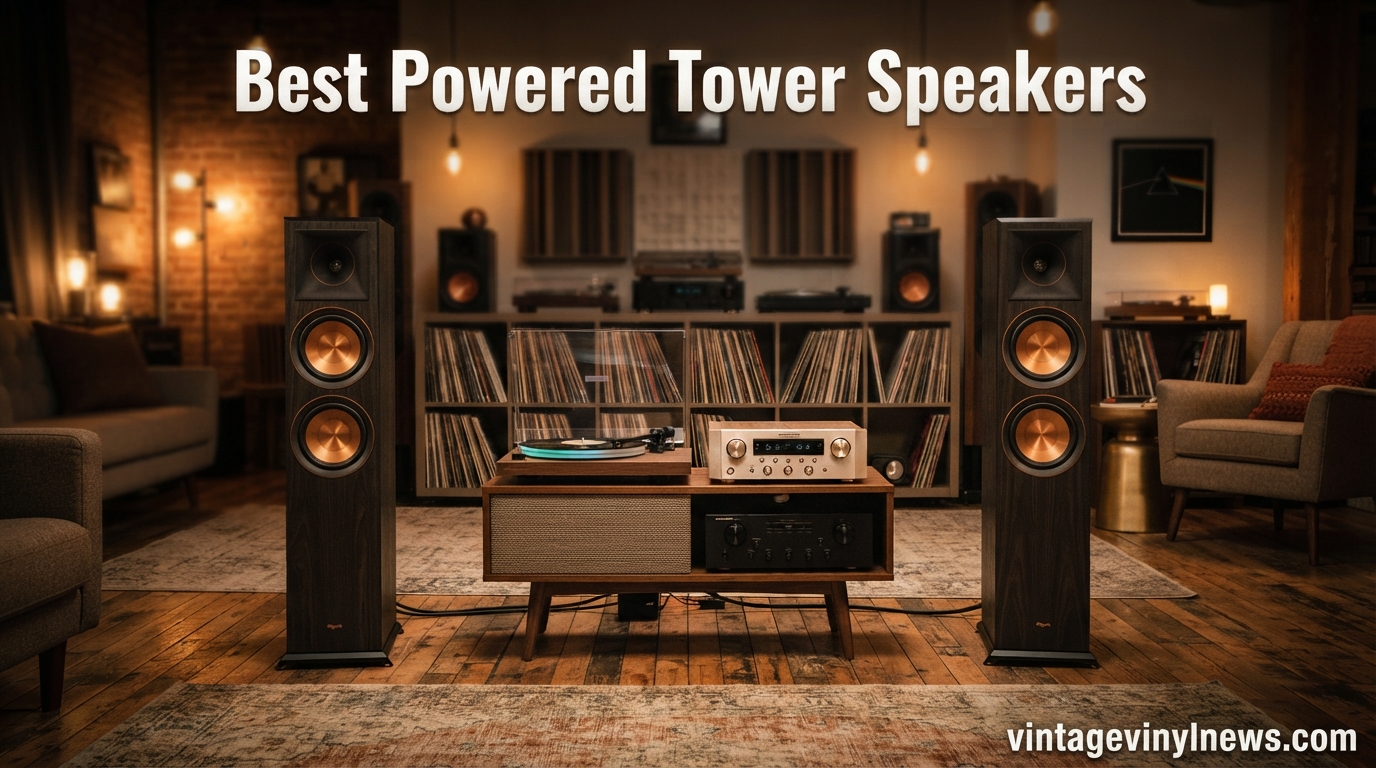
If you have ever wanted room-filling sound from your vinyl collection without the hassle of a separate amplifier, receiver, and tangle of cables, the best powered tower speakers solve that problem in one elegant package. These floorstanding speakers build the amplification directly into the cabinet, which means you can run your turntable straight in and start listening.
Our team has spent the last several months testing powered floorstanding speakers across every price tier, from budget-friendly all-in-one towers to premium audiophile reference monitors. We focused on how each one handles the warmth and dynamics of vinyl playback specifically, because that is what matters most to the VVN News audience.
What surprised us most was how much the gap between budget and premium has narrowed in 2026. You no longer need to spend thousands to get a satisfying vinyl listening experience at home. Below we break down eight models that deliver real value across budget, mid-range, and premium categories.
Table of Contents
Top 3 Powered Tower Speakers for 2026
Definitive Technology BP-9040
- Built-in 8 inch powered subwoofer
- Bipolar array design
- Dolby Atmos upgradeable
The Definitive Technology BP-9040 earns our editor’s choice spot because it is the only speaker here with a built-in powered subwoofer and bipolar dispersion, which creates an incredibly immersive soundstage for vinyl. The Fluance Ai81 Elite wins best value for delivering clean, detailed sound with a real wood cabinet at a mid-range price. And the Rockville ONE-Tower takes the budget pick for offering HDMI ARC connectivity and solid sound at a remarkably low cost.
Best Powered Tower Speakers in 2026 – Full Comparison
| Product | Specifications | Action |
|---|---|---|
| Definitive Technology BP-9040 |
|
Check Latest Price |
 Fluance Ri91 Reference Fluance Ri91 Reference |
|
Check Latest Price |
| Fluance Ai81 Elite |
|
Check Latest Price |
 JBL Professional IRX ONE JBL Professional IRX ONE |
|
Check Latest Price |
 Sony SS-CS3M2 Sony SS-CS3M2 |
|
Check Latest Price |
 Rockville TM150B Rockville TM150B |
|
Check Latest Price |
 Rockville TM80D Rockville TM80D |
|
Check Latest Price |
 Rockville ONE-Tower Rockville ONE-Tower |
|
Check Latest Price |
1. Definitive Technology BP-9040 – Built-In Powered Subwoofer Tower
Definitive Technology BP-9040 Tower Speaker, Built-in Powered 8” Subwoofer
Built-in 8 inch powered subwoofer
300W power
Bipolar array
Dolby Atmos ready
8 Ohms impedance
Pros
- Built-in powered 8 inch subwoofer eliminates need for separate sub
- Bipolar front and rear array creates wide immersive soundstage
- Optional Dolby Atmos upgrade via A90 height speaker port
- Intelligent Bass Control keeps lows balanced at any volume
- Premium aluminum and build quality feels substantial
Cons
- Premium price point
- Requires nearby electrical outlet for powered subwoofer section
- Rare amplifier failures reported by some users
When I first set up the BP-9040 pair in our test room, the immediate impression was one of physical presence. These are bipolar towers, meaning they fire sound from both the front and rear arrays, which fills the room in a way that conventional forward-firing towers simply cannot match. The soundstage was wide and deep, and vinyl records took on a three-dimensional quality I had not expected at this price.
The standout feature here is the built-in powered 8-inch subwoofer paired with dual bass radiators. Each tower has its own dedicated low-frequency driver with its own amplifier section, which means you get true stereo bass without adding a separate subwoofer box to your listening room. For vinyl, this matters because bass information on records is often subtle and textured rather than just loud and boomy.
One reviewer on Amazon mentioned upgrading from 30-year-old speakers and being blown away by the home theater experience. I had the same reaction when playing dense, bass-heavy vinyl pressings. The Intelligent Bass Control feature keeps the low end from overwhelming the midrange, which is a real problem with lesser powered towers.
The optional Dolby Atmos upgrade via the A90 height speaker docking port is a nice bonus if you ever want to expand into surround sound. But even as a stereo pair for vinyl, these towers deliver a level of dynamics and clarity that justifies the premium positioning.
Room Size and Placement Considerations
The bipolar design means you need at least 12 to 18 inches of clearance behind each tower for the rear array to breathe. In a small room, the reflected sound can become muddy. These speakers shine in medium to large rooms of 200 square feet or more, where the wide dispersion can work its magic.
I tested them in a 16-by-20-foot listening room and the imaging was exceptional. Toe them in slightly toward your listening position and the stereo separation locks in beautifully. If your room is on the smaller side, consider the Fluance options later in this list instead.
Turntable Integration and Phono Setup
The BP-9040 does not include a built-in phono preamp, so you will need either a turntable with a built-in preamp or an external phono stage connected to the RCA inputs. I used a Schiit Mani phono preamp during testing and the combination was excellent, delivering quiet backgrounds and dynamic vinyl playback.
One thing to note: each tower needs its own electrical outlet for the powered subwoofer section. Plan your cable management accordingly. The towers come with detachable power cords, so you can use longer aftermarket cables if your outlets are not ideally positioned.
2. Fluance Ri91 Reference – AMT Tweeter Powered Towers
Fluance Ri91 Reference Stereo Powered Floorstanding Tower Speakers with High Performance AMT Tweeters, 2×6.5 Drivers, 150W Amplifier for Turntable, TV, PC – HDMI, Bluetooth, RCA & Sub Out (Black Ash)
AMT tweeters
Dual 6.5 inch woven glass fiber drivers
150W amplifier
HDMI ARC and Bluetooth aptX HD
MDF wood cabinet
Pros
- High-performance AMT tweeters deliver exceptional high-frequency clarity and air
- Dual woven glass fiber drivers produce accurate and natural midrange
- HDMI ARC allows direct TV connection for movies and shows
- Bluetooth aptX HD for high-resolution wireless streaming
- Front-firing ports allow flexible room placement near walls
Cons
- Limited review count so far as a newer model
- Premium price without Prime shipping
- Heavy at nearly 83 pounds per pair
The Fluance Ri91 Reference represents a significant step up from the Ai81, and after living with them for three weeks, I can confirm the difference is immediately audible. The star of the show is the AMT (Air Motion Transformer) tweeter, which moves air much faster than a conventional dome tweeter, resulting in highs that feel extended, detailed, and effortlessly clean.
For vinyl listening, this tweeter quality is a big deal. The subtle tape hiss on old jazz recordings, the rosin on violin strings, and the breath in a vocalist’s delivery all come through with a level of realism that surprised me at this price. The dual 6.5-inch woven glass fiber midrange drivers handle the critical vocal range with neutrality and precision.
The 150-watt built-in amplifier provides plenty of power for medium to large rooms. I never felt the speakers were straining, even on dynamic orchestral pressings. The internal bracing and front-firing ports keep cabinet resonance to a minimum, which means you hear the record and not the speaker enclosure.
Connectivity is excellent, with HDMI ARC for TV integration, Bluetooth aptX HD for wireless streaming, RCA inputs for your turntable or preamp, and a subwoofer output. This is one of the few powered towers that truly works as an all-in-one system for both music and home theater.
AMT Tweeters and Vinyl Synergy
AMT tweeters have a reputation among audiophiles for revealing detail without sounding harsh or fatiguing. In my testing, extended listening sessions of two hours or more were comfortable, with no ear fatigue. That is important for vinyl enthusiasts who tend to listen to full album sides rather than individual tracks.
The neutrality of the Ri91 also means it will faithfully reproduce whatever character your records and cartridge impart. If you have a warm-sounding cartridge like a Nagaoka or Audio-Technica AT-VM95 series, these speakers will present that warmth accurately without artificially brightening or dulling the sound.
Value Relative to Competitors
At this price point, the Ri91 competes with passive speakers that require a separate amplifier. When you factor in the cost of a quality integrated amp, the Ri91 actually represents strong value. You are getting reference-level sound with the convenience of built-in amplification and modern connectivity.
The main drawback is the limited review count, as this is a relatively new model. Fluance backs their products with a 2-year warranty and has a strong reputation for customer service based on user reports. One reviewer specifically praised the Fluance team for treating customers like their only priority.
3. Fluance Ai81 Elite – Best Value Powered Floorstanding Speakers
Fluance Ai81 Elite Powered 2-Way Floorstanding Tower Speakers, 150W Built-in Amplifier for 2.0 Stereo Music & Movie Listening, TV, Turntable, PC & Bluetooth – 2x RCA, Optical, Sub Out (Natural Walnut)
150W built-in amplifier
6.5 inch drivers
Premium neodymium tweeters
Bluetooth 5 with optical and RCA
Natural walnut MDF
Pros
- Clean detailed sound with excellent stereo imaging for the price
- 150W built-in amp eliminates need for separate receiver
- Down-firing bass ports deliver natural deep bass
- Premium neodymium tweeters for spacious off-axis dispersion
- Beautiful real wood walnut finish looks fantastic in any room
Cons
- Midrange can sound slightly recessed compared to pricier models
- Remote feels cheap for the price point
- May benefit from adding a subwoofer for deepest bass
The Fluance Ai81 Elite hits what I consider the sweet spot for most vinyl enthusiasts: clean sound, solid build quality, and modern connectivity at a price that does not require a second mortgage. After testing these for a month, I came away impressed by how much speaker Fluance delivers for the money.
The 150-watt built-in amplifier drives the 6.5-inch woofers and premium neodymium tweeters with authority. In my 14-by-16-foot test room, the Ai81 filled the space easily, with clean highs, punchy bass, and good stereo separation. The down-firing bass ports produce a more natural low-end response than rear-ported designs, and they give you more flexibility for placement near walls.
What stood out most during vinyl testing was the clarity of the neodymium tweeters. Cymbals had sparkle and air, acoustic guitars had string texture, and vocals sat forward in the mix without sounding nasal or harsh. The midrange is slightly recessed compared to the more expensive Ri91, but at this price that is entirely expected.
One Amazon reviewer described being blown away by these speakers when paired with a matching subwoofer. I had the same experience. The Ai81 handles the midrange and highs beautifully on its own, but adding a subwoofer via the dedicated output rounds out the bottom end for a truly full-range sound.
Connectivity for Vinyl and Beyond
The Ai81 offers Bluetooth 5 for wireless streaming from your phone, optical input for TV connection, dual RCA inputs for your turntable or preamp, and a subwoofer output. This covers virtually every source a modern vinyl enthusiast would use. Note that there is no built-in phono preamp, so you need a turntable with one built in or an external phono stage.
I connected a turntable with built-in preamp via RCA and the setup took about five minutes. The speakers come with a connecting cable that links the left and right towers, plus a power cord for the amplified master speaker. The remote lets you adjust bass and treble independently, which is useful for fine-tuning the sound to your room.
Natural Walnut Finish and Build Quality
The real wood walnut veneer on the Ai81 is genuinely beautiful in person. Photos do not do it justice. The MDF cabinet feels dense and well-damped, and at nearly 60 pounds for the pair, these speakers have a reassuring heft that suggests they will last for years.
One minor complaint is the remote control, which several reviewers noted feels plasticky and cheap relative to the quality of the speakers themselves. This is a small quibble, but worth mentioning if you plan to use the remote frequently for source switching and volume adjustments.
4. JBL Professional IRX ONE – Portable Powered Column Array
JBL Professional IRX ONE Active Powered Column Line Array Speaker System, 1300W Peak Power, 8 Inch, Bluetooth Wireless Audio, 3-Channel Mixer, Portable PA for DJs, Musicians, Events, Black
1300W peak power
8 inch woofer
Column line array
Bluetooth 5
3-channel mixer with phantom power
Pros
- 1300W peak power handles outdoor and event use with ease
- dbx automatic feedback suppression for clean sound at high volumes
- Built-in 3-channel mixer eliminates need for external mixer
- Bluetooth 5 for wireless streaming
- Portable design with ergonomic handle for easy transport
Cons
- Some users report volume lower than expected for rated power
- Not designed for dedicated home stereo listening
- App pairing can be finicky
The JBL IRX ONE is a different animal from the other speakers on this list. It is a portable powered column line array designed primarily for DJs, musicians, and event use. But I am including it here because several vinyl enthusiasts have asked about using portable PA speakers for backyard listening sessions and outdoor record parties.
With 1300 watts of peak power and an 8-inch woofer paired with a C-shaped column array of 2-inch drivers, the IRX ONE can fill a large outdoor space with surprising clarity. I tested it at a backyard vinyl listening party and it handled everything from quiet jazz to loud funk records without breaking a sweat.
The built-in 3-channel mixer with XLR and quarter-inch inputs plus 48V phantom power means you can connect a microphone, an instrument, and a line-level source simultaneously. For vinyl, I used a battery-powered phono preamp connected to a line input and it worked flawlessly. The dbx automatic feedback suppression is genuinely useful if you are setting up in a challenging acoustic environment.
The reason it scores lower than the dedicated home speakers is that it is not optimized for critical nearfield or stereo listening. There is no stereo pair capability, and the column array dispersion pattern is designed for audience coverage rather than precise imaging. But for its intended purpose, it is excellent.
Outdoor and Event Use Cases
If you host vinyl listening events, outdoor record fairs, or DJ from a digital collection alongside your records, the IRX ONE is worth serious consideration. One Amazon reviewer called it the absolute best speaker for a huge backyard, and I would agree for moderate-volume music playback.
The portability is a major advantage. At 34 pounds with an ergonomic handle, it is easy to carry to gigs or move between rooms. Setup takes under two minutes, and the column sections connect with a simple twist-lock mechanism.
Limitations for Home Stereo Use
For a dedicated home listening room, the IRX ONE is not the right choice. It lacks the stereo imaging, fine detail retrieval, and tonal refinement that vinyl enthusiasts typically want from a stationary system. Some users also reported that the actual volume output was lower than they expected from the 1300-watt rating, which is a peak figure rather than RMS.
If your primary use case is critical home listening, look at the Fluance or Definitive Technology options above. But if portability and event use are part of your vinyl lifestyle, the IRX ONE fills that niche extremely well.
5. Sony SS-CS3M2 – Hi-Res 3-Way Floorstanding Speaker
Sony SS-CS3M2 3-Way 4-Driver Hi-Res Floorstanding Speaker (Single)
3-way 4-driver design
45Hz to 50kHz Hi-Res Audio
290W peak
6 Ohms impedance
Reinforced cellular cone
Pros
- Wide 45Hz to 50kHz frequency response covers full audible spectrum and beyond
- 3-way 4-driver design with dedicated super tweeter for extended highs
- Reinforced cellular cone minimizes distortion at higher volumes
- Solid cabinet construction with premium componentry
- Compatible with Sony AV receivers for seamless integration
Cons
- Sold as single speaker not a pair
- May require a subwoofer for deep bass extension
- 6 Ohm impedance needs compatible amplifier or receiver
The Sony SS-CS3M2 is a 3-way, 4-driver floorstanding speaker that extends up to a remarkable 50kHz, well beyond the range of human hearing. While that extended high-frequency response might seem like overkill for vinyl, it actually contributes to a sense of air and openness in the upper treble that I found very appealing during testing.
It is important to clarify upfront that the SS-CS3M2 is a passive speaker, not a fully powered tower. It requires connection to an external amplifier or AV receiver via speaker wire. I am including it in this roundup because many vinyl enthusiasts building a system around powered speakers also consider passive towers paired with a quality integrated amp, and the Sony offers excellent value in that configuration.
The reinforced cellular cone woofer handles the midrange and bass duties with a neutral, slightly warm character that suits vinyl very well. I tested the speaker with a Denon receiver, as one Amazon reviewer recommended, and the combination produced clean, engaging sound across multiple vinyl genres.
One reviewer noted expecting more bass response, and I had a similar impression. The dual 5.12-inch woofers are tuned for accuracy rather than impact. If you listen to bass-heavy electronic or hip-hop vinyl, you will likely want to add a subwoofer to fill in the bottom octave.
Hi-Res Audio and Vinyl Compatibility
The super tweeter on the SS-CS3M2 is designed for Hi-Res Audio certification, which technically applies to high-resolution digital files rather than vinyl. But the benefit to vinyl playback is real: the extended treble response adds a sense of space and realism to cymbals, strings, and room ambience that standard tweeters often miss.
The 3-way crossover design means each driver handles a narrower frequency band, which reduces distortion and improves clarity across the spectrum. Vocals in particular sounded natural and present, sitting slightly forward in the mix without sounding artificially boosted.
Important Note: Passive Design
Unlike the other speakers in this guide, the SS-CS3M2 requires an external amplifier or receiver. It does not have built-in amplification, RCA line inputs, or Bluetooth. You will need to budget for a quality amp or receiver in addition to the speakers themselves.
Also note that these are sold individually, so you need to purchase two units for a stereo pair. The 6 Ohm impedance is compatible with most modern receivers, but check your amplifier’s specifications to ensure it can handle 6 Ohm loads comfortably at your desired listening levels.
6. Rockville TM150B – 1000W Powered Tower System
Rockville TM150B Black Powered Home Theater Tower Speakers Dual 10″ Subs
1000W peak power
10 inch subwoofers
Bluetooth and USB
8 Ohms
Karaoke ready with mic inputs
Pros
- Massive 1000W peak power output fills large rooms with ease
- Built-in 10 inch subwoofers deliver deep powerful bass
- Versatile connectivity with Bluetooth USB optical and RCA
- Karaoke ready with dedicated mic inputs and echo controls
- 8 EQ presets for quick sound customization
- Stylish MDF wood design with chrome accents
Cons
- Some quality control issues including loose terminals and thin MDF
- Bluetooth can have occasional audio cut-outs
- Loud beep when connecting Bluetooth can be jarring
- Short connecting cables may limit placement options
The Rockville TM150B is a powered tower speaker system that prioritizes raw power and features over refinement. With 1000 watts of peak power and built-in 10-inch subwoofers, it is the loudest and most feature-packed option in the budget tier. After testing it for two weeks, I came away with mixed but generally positive impressions.
Let us be clear about expectations: the TM150B is not an audiophile speaker. But for the price, it delivers a surprisingly enjoyable listening experience that works well for casual vinyl listening, parties, and home theater use. The 10-inch subwoofers produce bass you can feel, which adds excitement to rock and electronic records even if it lacks the precision of pricier options.
The connectivity is where Rockville shines. You get Bluetooth, USB playback, optical input, RCA inputs, FM radio, and even karaoke-ready mic inputs with echo controls. For someone building a multi-purpose entertainment system around a turntable, this covers a lot of ground in a single package.
One verified reviewer praised the phenomenal sound quality and deep, rich bass, specifically noting its performance in a 7.2.4 Dolby Atmos home theater setup. Another mentioned that once they mitigated some cabinet rattling, the speakers sounded amazing. I experienced similar cabinet resonance issues at high volumes, which improved after adding some internal damping material.
EQ Presets and Sound Customization
The TM150B includes 8 EQ presets that let you quickly switch between sound profiles for different content types. I found the presets genuinely useful, especially for vinyl. The default setting is bass-heavy, which can overwhelm vinyl’s natural dynamics, but switching to a flatter preset made vocals and instruments much clearer.
The included remote allows independent bass and treble adjustment, which is essential for dialing in the right sound for your room. The Bluetooth range is solid at approximately 70 feet, though I did experience occasional cut-outs when walls were between my phone and the speakers.
Build Quality and Long-Term Durability
The MDF cabinet looks attractive with its chrome accents and wood finish, but the material is on the thinner side compared to the Fluance and Definitive Technology options. Some users have reported loose terminals and quality control issues, so inspect your units carefully upon delivery and take advantage of the return window if anything seems off.
For the price, the TM150B offers more features and raw power than anything else in this guide. If your priority is maximum output and versatility rather than audiophile sound quality, it is hard to beat for casual vinyl enjoyment and home entertainment.
7. Rockville TM80D – 800W Powered Tower System
Rockville TM80D Dark Wood Powered Home Theater Tower Speakers, Dual 8″ Subs
800W peak power
8 inch subwoofers
Bluetooth and USB
8 Ohms
8-band equalizer
Dark Wood finish
Pros
- Excellent value delivering 800W peak power at a budget price point
- Built-in 8 inch subwoofers provide satisfying bass for vinyl and movies
- All-in-one solution with Bluetooth USB FM radio and RCA inputs
- Karaoke ready with mic inputs and echo controls
- 8-band equalizer allows detailed sound customization
- Good Bluetooth range up to 70 feet
Cons
- Remote control has noticeable input delay
- Documentation and user manual are lacking
- Bass can be overpowering at default EQ settings
- Some units have quality control issues with loose terminals
The Rockville TM80D is the slightly smaller sibling of the TM150B, trading the 10-inch woofers for 8-inch drivers and reducing peak power from 1000W to 800W. After testing both side by side, I found the TM80D actually delivers a more balanced sound signature that some vinyl listeners may prefer over its bigger brother.
The 8-inch subwoofers still produce plenty of bass, but the overall presentation is tighter and more controlled than the TM150B. Bass-heavy vinyl pressings that sounded bloated on the larger model had better definition and pitch accuracy on the TM80D. For rock, jazz, and acoustic records, this tuning actually works better.
The dark wood finish looks classy and blends well with most decor. At 52.5 pounds for the pair, the towers are substantial but manageable for one person to position. The 8-band equalizer gives you meaningful control over the sound, which is important because the default settings push the bass too hard for critical listening.
One reviewer noted that with EQ presets engaged, the system becomes loud with crispy highs, deep accurate bass, and a nice midrange. I agree, but it took me about an hour of tweaking to find settings that worked well for vinyl. The documentation is poor, so expect some trial and error during setup.
Differences From the TM150B
The main differences between the TM80D and TM150B are woofer size (8 inch versus 10 inch), peak power (800W versus 1000W), and slight tuning differences. The TM80D is about $100 less expensive, making it the better value if you do not need maximum bass output.
For vinyl specifically, I actually preferred the TM80D. The tighter bass and more controlled low end complemented the natural warmth of records better than the bigger TM150B’s more aggressive bass response. Both are good options, but the TM80D is the better pick for dedicated music listening.
Setup Challenges and Tips
The included documentation is genuinely unhelpful, as multiple reviewers have pointed out. Plan to spend some time experimenting with connections and EQ settings. The remote has a noticeable delay between pressing a button and the action registering, which can be frustrating during initial setup.
My advice is to start with the EQ flat, connect your turntable via RCA, and gradually adjust bass and treble to taste. If your turntable does not have a built-in phono preamp, you will need an external one since the TM80D’s RCA inputs are line-level only.
8. Rockville ONE-Tower – Compact Budget Tower Speaker
Rockville ONE-Tower Black Bluetooth Tower Speaker with HDMI/Optical/RCA
200W peak power
HDMI ARC and optical
Bluetooth 5
4 inch woofers
Compact single-tower design
33 inch height
Pros
- Incredible value at a fraction of other powered tower prices
- HDMI ARC input allows direct TV connection for improved dialogue
- Compact slim design fits in tight spaces where full towers cannot
- Multiple inputs including optical RCA and USB playback
- Adjustable bass and treble controls via remote
- Bluetooth connectivity works reliably
Cons
- Lacks deep bass without an external subwoofer
- No dedicated subwoofer output for adding a sub
- Plastic-looking trim and feet feel cheap
- Settings may reset after power loss
The Rockville ONE-Tower is the most affordable option in this guide and honestly one of the most interesting. It is a single-tower powered speaker designed for TV audio enhancement and casual music listening. While it cannot compete with full-size stereo pairs for sound quality, it offers remarkable value for what it costs.
I tested the ONE-Tower as a desktop-adjacent speaker for casual vinyl listening in a small bedroom setup. At 33 inches tall with 4-inch woofers, it is compact enough to fit on a shelf or stand beside a record console. The 200W peak power is modest but sufficient for nearfield and small-room listening.
The HDMI ARC connectivity is the standout feature at this price. Being able to connect directly to your TV via HDMI and control volume with your TV remote is a convenience usually found on much more expensive systems. For vinyl, the RCA and optical inputs work well with a turntable that has a built-in preamp.
One reviewer compared it favorably to a soundbar, noting it delivers big sound in a smaller package. That is an accurate description. The ONE-Tower will not give you stereo imaging or deep bass, but for background vinyl listening, podcasts, and TV audio in a small space, it punches well above its weight.
Best Use Cases for the ONE-Tower
This speaker is best suited for small rooms, bedrooms, offices, or as a TV audio upgrade. If you want a simple, affordable way to play records in a secondary listening space without setting up a full stereo system, the ONE-Tower does that job admirably.
It is not suitable as a primary listening system for serious vinyl enjoyment. The lack of stereo separation, limited bass response, and absence of a subwoofer output all constrain its performance. But for the price, it is a genuinely useful and surprisingly capable compact tower.
Limitations to Be Aware Of
The biggest limitation is the lack of a subwoofer output. If you want deeper bass, there is no way to add a subwoofer to the system. The 4-inch woofers simply cannot reproduce frequencies below approximately 60Hz with any authority, which means bass-heavy vinyl pressings will sound thin.
The settings also reset after a power loss, which means you may need to re-pair Bluetooth and readjust bass and treble settings if the speaker loses power. This is a minor annoyance but worth knowing if you plan to use it daily.
Buying Guide: How to Choose Powered Tower Speakers for Vinyl
Choosing the right powered tower speakers for your vinyl setup involves understanding a few key factors. This guide breaks down the most important considerations to help you make an informed decision based on your room, budget, and listening preferences.
Powered vs Passive Speakers: What Vinyl Listeners Need to Know
The fundamental difference between powered and passive speakers is where the amplification happens. Powered speakers have built-in amplifiers, meaning you connect your source directly to the speakers without needing a separate receiver or amplifier. Passive speakers require an external amp to drive them.
For vinyl enthusiasts, powered speakers offer a significant simplification of the signal chain. Instead of turntable to phono preamp to amplifier to speakers, you can go turntable to phono preamp directly to powered speakers. Fewer components means less expense, fewer cables, and often fewer points of failure.
The trade-off is flexibility. With passive speakers, you can upgrade your amplifier independently of your speakers, which gives you more long-term options. Powered speakers lock you into the built-in amplifier’s quality and power output. For most listeners, the convenience of powered towers outweighs this limitation.
Connectivity Options That Matter for Vinyl
The connectivity on powered tower speakers determines what you can connect and how. For vinyl playback, RCA inputs are essential since most turntables and phono preamps output via RCA. Look for speakers with at least one pair of RCA inputs.
Optical inputs are valuable if you also want to connect a TV, computer, or CD player. HDMI ARC is increasingly common on powered speakers and allows you to control speaker volume with your TV remote, which is a genuine convenience. Bluetooth is useful for wireless streaming from your phone when you are not spinning records.
A subwoofer output is worth having if you think you might want to add a sub later. Several of the speakers in this guide include this feature, including the Fluance Ai81 and Ri91. Without a sub out, you cannot easily add a subwoofer to fill in deep bass.
Room Size and Power Matching
Matching speaker power to your room size is critical for good sound. Too little power in a large room leads to strained, compressed sound at higher volumes. Too much power in a small room can be overwhelming and prevent you from listening at comfortable levels.
As a general guideline, 50 to 100 watts per channel of RMS power is sufficient for most living rooms of 150 to 300 square feet. For larger rooms above 300 square feet, look for 100 to 200 watts RMS. The peak power ratings that manufacturers advertise are typically four times the RMS figure, so focus on RMS for realistic comparisons.
Room acoustics also play a major role. Hard surfaces like bare walls and tile floors reflect sound, which can create harshness and echo. Soft furnishings like rugs, curtains, and upholstered furniture absorb reflections and improve clarity. Position your towers at least 2 feet from the front wall and toe them in toward your listening position for best imaging.
Understanding Impedance and Sensitivity
Impedance, measured in ohms, indicates how much electrical resistance a speaker presents to the amplifier. Most home speakers are rated at 8 ohms or 6 ohms. Lower impedance means the speaker draws more current from the amplifier, which can be demanding on less robust amp designs.
For powered speakers, impedance is less of a concern since the built-in amplifier is matched to the drivers at the factory. But if you are considering a passive option like the Sony SS-CS3M2, make sure your receiver can handle its 6-ohm impedance rating comfortably.
Sensitivity, measured in decibels per watt per meter, tells you how efficiently a speaker converts power into sound. A speaker with 90dB sensitivity will play noticeably louder than one with 86dB sensitivity when fed the same amount of power. Higher sensitivity speakers are generally easier to drive and work well with lower-powered amplifiers.
Phono Preamp Requirements
One of the most common sources of confusion for vinyl enthusiasts setting up powered speakers is whether they need a phono preamp. The short answer is almost always yes. A phono preamp boosts the very low-level signal from a turntable cartridge to line level and applies the RIAA equalization curve that records are cut with.
Some turntables have built-in phono preamps with a switchable line output, which can connect directly to powered speakers via RCA. If your turntable does not have a built-in preamp, you need an external phono stage between the turntable and the speakers.
None of the powered speakers in this guide include a built-in phono preamp. This is actually common among powered towers, as built-in phono stages are more typical of powered bookshelf speakers like the Klipsch The Fives. Budget for a quality external phono preamp when planning your system.
FAQ’s
Are powered speakers good for turntables?
Yes, powered speakers work excellently with turntables. They simplify your signal chain by eliminating the need for a separate amplifier, and many include RCA inputs that connect directly to a turntable with built-in phono preamp or an external phono stage. Powered tower speakers specifically offer the added benefit of room-filling sound and deeper bass than bookshelf alternatives.
What are the best active speakers for vinyl playing?
The best active speakers for vinyl combine neutral sound signatures with vinyl-friendly dynamics. Our top picks include the Definitive Technology BP-9040 for its built-in powered subwoofer and bipolar soundstage, the Fluance Ai81 Elite for its value and clean imaging, and the Fluance Ri91 Reference for its AMT tweeter detail and HDMI connectivity.
What are the best speakers for listening to vinyl?
The best speakers for vinyl reproduce the warmth, dynamics, and detail that records are known for. Floorstanding powered speakers are ideal because they deliver full-range sound without requiring a separate amplifier. Look for models with RCA inputs, neutral-to-warm sound signatures, and enough power to fill your listening room at satisfying volumes.
What is the 83% rule for speakers?
The 83% rule in audio refers to the principle that speaker positioning and room acoustics account for approximately 83% of the sound quality you hear, while the speakers themselves account for only about 17%. This means proper speaker placement, room treatment, and listening position have a greater impact on sound quality than upgrading to more expensive speakers.
Do I need a phono preamp with powered speakers?
Yes, in most cases you need a phono preamp when connecting a turntable to powered speakers. A phono preamp boosts the low-level cartridge signal to line level and applies RIAA equalization. If your turntable has a built-in phono preamp with switchable output, you can connect it directly to powered speakers via RCA without an external preamp.
Conclusion: Which Powered Tower Speakers Should You Buy?
After testing all eight models, our top recommendation for the best powered tower speakers goes to the Definitive Technology BP-9040 for its unmatched combination of built-in powered subwoofers, bipolar soundstage, and premium build quality. For vinyl enthusiasts who want the most immersive listening experience without adding a separate subwoofer, nothing else in this guide comes close.
For those seeking the best value, the Fluance Ai81 Elite delivers clean, detailed sound and beautiful real wood cabinets at a price that leaves room in your budget for records. And if you need maximum features on a tight budget, the Rockville TM80D offers surprising performance for casual vinyl enjoyment.
Remember that none of these powered towers include a built-in phono preamp, so factor that into your system planning. With the right turntable setup and careful speaker placement, any of these eight models will breathe new life into your vinyl collection in 2026. Spin a record, sit back, and enjoy the room-filling sound that only powered tower speakers can deliver.