

If you have ever listened to a Hammond organ swirl through a mix and wondered how that buttery, three-dimensional movement happens, you are already hearing a rotary speaker effect in action. The best rotary pedals bring that same Leslie cabinet magic to your pedalboard without the 150-pound hernia-inducing cabinet. These effects recreate the Doppler shift, phase cancellation, and acoustic churn of spinning treble horns and bass rotors in a stompbox you can carry to any gig.
Our team spent weeks comparing rotary speaker emulator pedals across every price tier and use case. We looked at how each pedal handles the transition between slow and fast speeds, how convincing the acceleration ramp feels, and whether stereo output actually delivers the wide swirling image that makes rotary effects worth using. From budget-friendly options under $100 to professional-grade simulators pushing $550, we tested them all through clean amps, driven tube setups, and full stereo wet-dry rigs.
This guide covers 12 of the best rotary pedals available in 2026. Whether you play gospel organ lines, psychedelic rock, ambient swells, or just want that classic David Gilmour-style movement in your solos, we break down exactly which pedal fits your sound, your pedalboard footprint, and your budget.
Table of Contents
Top 3 Rotary Pedals Picks for 2026

BOSS RT-2 Compact Rotary Ensemble
- 3 versatile rotary modes
- Virtual rotor LED display
- Drive knob for tube saturation

JHS Pedals 3 Series Rotary Chorus
- Simplified classic rotary tone
- Intensity and speed controls
- Room switch for ambience

Strymon Lex V2 Rotary Speaker Simulator
- 6-knob interface
- Mic position switch
- Ramp speed control
The BOSS RT-2 takes our Editor’s Choice spot for packing authentic rotary speaker behavior into a standard compact BOSS enclosure with three switchable modes and a brilliant virtual rotor display. The JHS 3 Series Rotary Chorus wins Best Value with over 1,400 reviews and a sub-$100 price tag that makes it the most accessible entry point. For players who want the gold standard, the Strymon Lex V2 delivers the most detailed rotary simulation available with mic positioning and ramp speed controls that feel indistinguishable from a real Leslie.
Best Rotary Pedals in 2026
| Product | Specifications | Action |
|---|---|---|
| BOSS RT-2 Compact Rotary Ensemble |
|
Check Latest Price |
| Strymon Lex V2 Rotary Speaker Simulator |
|
Check Latest Price |
 Electro-Harmonix Lester-K Stereo Electro-Harmonix Lester-K Stereo |
|
Check Latest Price |
 Electro-Harmonix Lester-G Deluxe Electro-Harmonix Lester-G Deluxe |
|
Check Latest Price |
 Keeley Dyno My Roto Keeley Dyno My Roto |
|
Check Latest Price |
 Keeley Rotary Simulator Keeley Rotary Simulator |
|
Check Latest Price |
 Neo Instruments Ventilator II Neo Instruments Ventilator II |
|
Check Latest Price |
 Neo Instruments Mini Vent II Neo Instruments Mini Vent II |
|
Check Latest Price |
 Neo Instruments micro Vent 16 Neo Instruments micro Vent 16 |
|
Check Latest Price |
| JHS 3 Series Rotary Chorus |
|
Check Latest Price |
 Whorl Rotary by Klowra Whorl Rotary by Klowra |
|
Check Latest Price |
 ALABS NOVADRIFT Multi-Mod ALABS NOVADRIFT Multi-Mod |
|
Check Latest Price |
1. BOSS RT-2 Compact Rotary Ensemble Pedal
BOSS RT-2 | Compact Rotary Ensemble Pedal | Authentic Rotary Speaker Sounds | Tailored for Guitars & Keyboards | 3 Versatile Modes | Multiple Mod FX in One | Expanded I/O Features
Compact rotary pedal
3 versatile modes
Virtual rotor LED display
Drive knob for tube saturation
9V battery powered
Pros
- Authentic rotary speaker sounds and behaviors
- Three versatile modes including vintage and modified tones
- Virtual rotor display with LED indicators for treble and bass speeds
- Compact standard BOSS pedal format
- Drive knob adds convincing vintage tube saturation
Cons
- Volume changes when engaged requiring adjustment
- Never fully clean - always retains some dirt and distortion
The BOSS RT-2 surprised me from the first chord. BOSS managed to pack authentic rotary speaker behavior into their standard compact pedal housing, which means it fits on any pedalboard without requiring special real estate. The virtual rotor display uses LED lights to show you exactly what the treble and bass rotors are doing in real time, and that visual feedback makes a huge difference when you are dialing in sounds live.
I ran the RT-2 through three modes during testing. The vintage mode nails the classic Leslie 122 character with that warm, syrupy swirl. The two modified modes push the spatial effects wider, creating a more dramatic sense of movement that works beautifully for ambient passages and psychedelic lead lines. The drive knob adds just enough tube-style saturation to give your tone that pushed-amp character without turning to mush.
One thing to know: this pedal never goes completely clean. There is always a touch of grit in the signal, which actually mirrors how real Leslie cabinets behave when pushed. If you need pristine clean rotary sounds, this might bug you. For everyone else, that slight dirt adds authenticity.
The fast/slow transition is where the RT-2 really shines. The acceleration and deceleration ramps feel natural and musical, mimicking the physical inertia of actual spinning speakers. You get that satisfying ramp-up where the sound gradually intensifies rather than an abrupt speed change.
Best Suited For Live Performance
Players who gig regularly will love the compact format and the intuitive LED feedback. You can see your rotor speeds on a dark stage without bending down. The standard BOSS build quality means this pedal will survive years of stomping, transport, and beer-soaked venue floors.
The three modes give you enough tonal variety to cover organ simulation, rock leads, and ambient textures from a single pedal. It is one of the best rotary pedals for players who want set-and-forget simplicity with enough depth to explore.
Things to Consider Before Buying
The volume jump when engaging the effect is real. You will want a volume pedal or a boost downstream to compensate. Some players on Reddit have noted this is common with rotary emulators, but it is more noticeable on the RT-2 than on some competitors.
Also consider that the always-present slight overdrive means this pedal colors your tone even at minimum drive settings. If your rig depends on crystal-clean signal paths, test the RT-2 alongside something like the Strymon Lex V2 for comparison.
2. Strymon Lex V2 Rotary Speaker Simulator Pedal
Strymon Lex Rotary Speaker Simulator Pedal V2
Rotary speaker simulator
6-knob interface
Slow-fast footswitch
Mic position switch
Ramp speed control
2-year warranty
Pros
- Best rotary and Leslie simulation available
- Full parameter access for crafted sound
- Excellent for keyboard and organ sounds
- Mic position and ramp speed switches
- 2-year warranty
Cons
- Pricey compared to alternatives
The Strymon Lex V2 is the pedal that Reddit users consistently recommend when someone asks about the gold standard for rotary simulation. After testing it extensively, I understand why. The sound quality is simply on another level compared to most competitors. The six-knob interface gives you direct access to every parameter that matters without menu diving or complicated secondary functions.
The mic position switch is a feature I did not know I needed until I used it. It simulates moving the microphone closer to or farther from the cabinet, which dramatically changes the tonal character. Close micing gives you a more direct, present sound while distant micing opens up the spatial effect with more room ambience. This single control effectively gives you multiple rotary cabinets in one pedal.
The ramp speed switch lets you control how quickly the rotors transition between slow and fast settings. Real Leslie cabinets have a physical ramp time determined by the mass of the spinning speakers, and the Lex V2 recreates that inertia convincingly. You can match the feel of a 122, a 147, or create your own custom ramp behavior.
Strymon included a slow/fast footswitch that feels immediate and responsive. The transition is buttery smooth with no digital artifacts or stepping. This is the kind of pedal where you stomp the speed switch and the sound just blooms naturally.
Studio Recording Potential
For studio work, the Lex V2 is practically unbeatable in the pedal format. The parameter depth lets you dial in specific rotary cabinet behaviors that sit perfectly in a dense mix. I found that the Lex V2 handles complex chord work beautifully, maintaining clarity even when the modulation is running at full fast speed.
The 2-year warranty adds peace of mind given the investment. Strymon products hold their value exceptionally well on the used market, so even at this price point, you are buying into a product that retains its worth.
Is the Price Justified
This is the question everyone asks. At $349, the Lex V2 costs significantly more than the BOSS RT-2 or the EHX Lester pedals. The answer depends on how central rotary sounds are to your playing. If you use rotary effects on every song, the Lex V2 earns its keep through sound quality and control depth that no cheaper pedal can match.
If rotary is an occasional effect you use for one or two songs per set, the premium becomes harder to justify. In that case, the BOSS RT-2 or the JHS 3 Series will serve you well for a fraction of the cost.
3. Neo Instruments Ventilator II Rotary Speaker Simulator
Neo Instruments Ventilator II Rotary Speaker Simulator Pedal
Rotary speaker simulator
Bass and treble rotor emulation
Expression pedal input
Virtual mic placement
Drive section
2-year warranty
Pros
- Best Leslie sim around for organ and guitar
- Remote out for MIDI control
- Low noise compared to alternatives
- Stereo output with headphone support
- Highly flexible settings
- Universal power adapter included
Cons
- Expensive pedal
- No power supply included requires 12V DC center positive
- Some report slightly sterile sound compared to real Leslie
The Neo Instruments Ventilator II is widely considered the reference standard for rotary speaker simulation in pedal form. Forum discussions on Reddit repeatedly name this pedal as the benchmark that all others are measured against. After running it through organ patches, clean guitar passages, and driven lead tones, the reputation is well earned.
What sets the Ventilator II apart is the separate bass and treble rotor emulation. Real Leslie cabinets use two different rotating speakers that spin at different speeds, and the Ventilator II recreates that dual-rotor behavior with striking accuracy. The bass rotor has that slow, heavy churn while the treble horn spins faster with more pronounced Doppler effects.
The virtual mic placement control lets you position the virtual microphone at different angles and distances around the simulated cabinet. This affects both the tonal balance and the spatial character of the effect. I spent an afternoon just exploring mic positions and found sounds ranging from tight and focused to wide and roomy.
The drive section adds tube-style saturation that responds dynamically to your playing. Unlike some rotary pedals where the drive feels like an afterthought tacked on top of the modulation, the Ventilator II integrates the drive into the overall rotary character. It sounds like a real Leslie being pushed hard.
Expression Pedal Integration
The expression pedal input is a feature that live performers will love. You can connect a standard expression pedal and control the rotor speed continuously with your foot, allowing real-time speed sweeps that feel like operating the half-moon switch on a real Leslie. This hands-free speed control transforms how you interact with the effect during performances.
The remote output supports MIDI control, which means you can integrate the Ventilator II into a larger MIDI-controlled rig for preset switching and automated speed changes.
Power Supply Consideration
The biggest complaint about the Ventilator II is the power situation. It requires 12V DC center positive, which is not included in the box. You will need to factor in the cost of a compatible power supply. Most standard pedalboard power bricks can handle this, but verify compatibility before purchasing.
At this price point, including a power supply would have been expected. It is the one area where Neo Instruments cut a corner on an otherwise premium product.
4. Electro-Harmonix Lester-G Deluxe Rotary Speaker Emulator
Electro-Harmonix Lester-G Deluxe Rotary Speaker Emulator Guitar Effects Pedal with Stereo Outputs, Black
Ultimate rotary emulator
Built-in compressor
Mono in stereo out
Tube emulated overdrive
Acceleration control
Buffered bypass
Pros
- Best Leslie simulator for many users
- Built-in compressor and overdrive
- Great for guitar and organ setups
- Nice ramp adjustment and controls
- Lightweight alternative to real Leslie
Cons
- Poor simulation according to some users
- No wet and dry mix control
- Cannot blend in clean sound
The Electro-Harmonix Lester-G is the rotary pedal that makes me smile every time I plug in. It packs a built-in compressor alongside the rotary simulation, which means you get the squash and sustain that pairs perfectly with swirling Leslie effects. This combination is particularly effective for achieving that classic gospel guitar tone where notes sustain and bloom through the rotary modulation.
I tested the Lester-G with both guitar and a MIDI keyboard sending organ patches. The pedal handles both instruments admirably, which is impressive given that many rotary pedals are optimized for one or the other. The tube-emulated overdrive adds grit that feels musical rather than harsh, and the acceleration control lets you dial in the ramp time between slow and fast speeds.
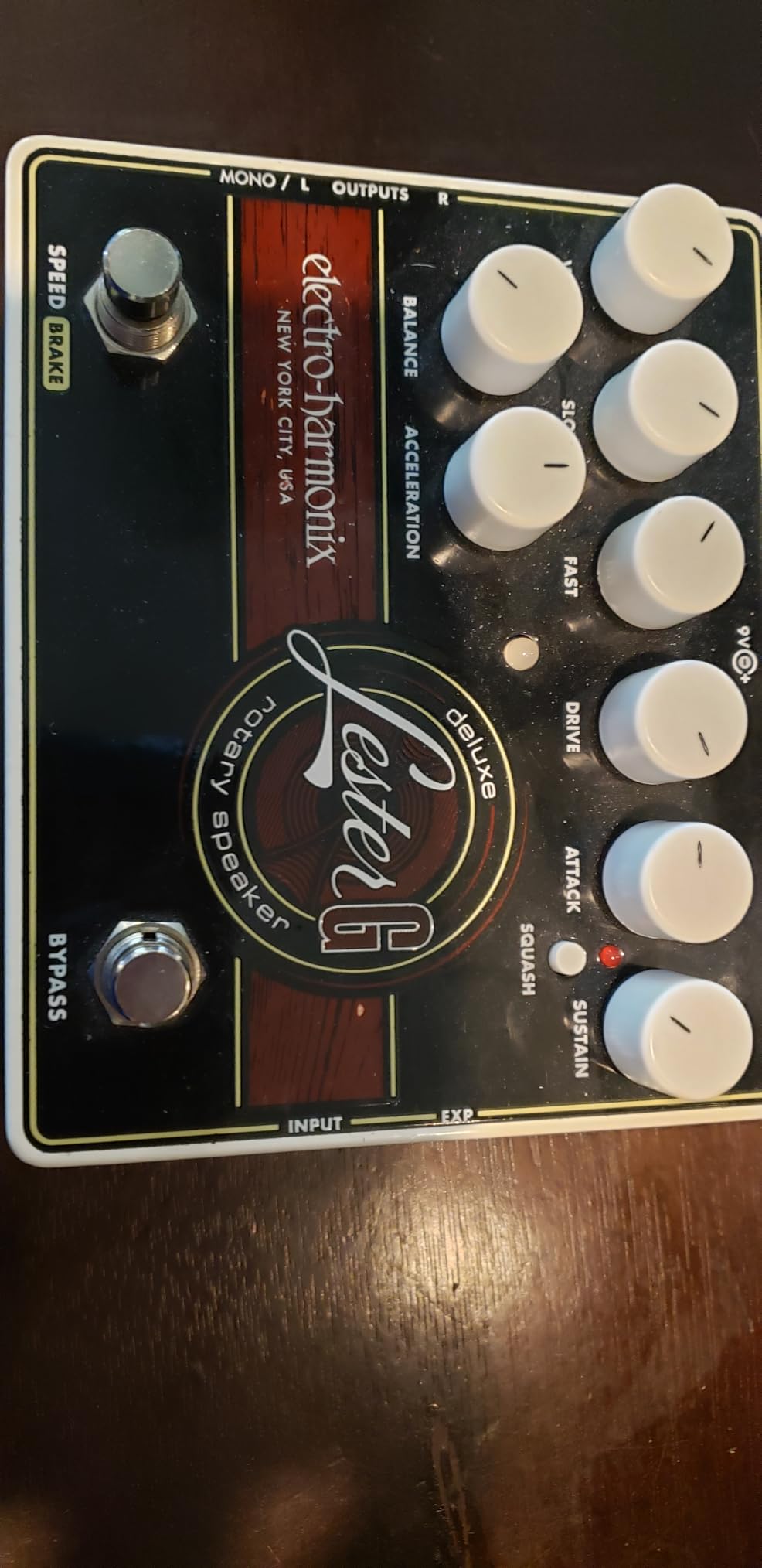
The mono-in, stereo-out configuration means you can feed a mono signal from your guitar and output a wide stereo rotary image to two amps or a stereo mixing setup. This is where rotary effects truly come alive. The swirling motion in stereo creates a three-dimensional sound that mono simply cannot capture.
The buffered bypass is worth discussing. Unlike true bypass, which can cause high-frequency loss in long signal chains, the buffered bypass maintains your tone integrity when the pedal is disengaged. This makes the Lester-G a good candidate for the end of your signal chain where it can drive long cable runs to your amp.
Compressor and Overdrive Synergy
The built-in compressor is not a gimmick. It genuinely enhances the rotary effect by evening out your dynamics so the modulation sits consistently in the mix. When combined with the tube overdrive, you get a pushed, sustained tone that feels like playing through a cranked Leslie. Gospel players and classic rock guitarists will find this combination inspiring.
The controls are straightforward enough for live use, with dedicated knobs for each function rather than multi-function controls that require a manual to navigate.
Limitations to Be Aware Of
The absence of a wet-dry mix control is a significant omission. You cannot blend in your clean signal with the rotary effect, which means the pedal is either fully engaged or fully bypassed. Some players work around this by running a parallel clean signal through a splitter, but that adds complexity to your rig.
Experienced players who have spent time with real Leslie cabinets may find the Lester-G falls short of true authenticity. It captures the character well, but side by side with a real 122, the differences become apparent. For most gigging situations, though, the difference is academic.
5. Keeley Rotary Simulator Pedal
Keeley Rotary Simulator Pedal
Stereo rotary speaker simulator
Blend control
Slow-fast controls
Mid boost
Drive
Speed
2-year warranty
Pros
- Stereo rotary speaker simulation
- Blend control for wet-dry mix
- Mid boost feature for cutting through mixes
- Drive control for tube saturation
- 2-year warranty
Cons
- No reviews yet as a new product
- Rating and reliability untested by market
The Keeley Rotary Simulator is the newest addition to the rotary pedal landscape, and it brings features that address common complaints about other pedals in this category. The blend control alone makes this pedal worth considering because it solves the wet-dry mix problem that plagues pedals like the Lester-G. You can finally dial in just the right amount of rotary effect without committing to a fully wet signal.
The mid boost feature is designed to help your tone cut through a dense live mix. Rotary effects can sometimes push your sound into the background because the modulation spreads the signal across the frequency spectrum. The mid boost counteracts this by focusing energy in the midrange where guitars need to sit. I found this particularly useful during band rehearsals where my rotary-drenched parts were getting lost behind keyboards and drums.
Stereo output gives you the full swirling experience when running through two amps or a stereo PA system. The slow-fast controls handle the transition between rotor speeds with musical ramp times that feel natural. The drive control adds saturation that complements the rotary character without overpowering it.
Being a brand new product, there are no customer reviews yet to validate long-term reliability. However, Keeley has a strong track record for build quality and customer service. The 2-year warranty provides reasonable assurance for early adopters.
The Blend Control Advantage
Having a blend control changes how you use the pedal entirely. Instead of treating rotary as an all-or-nothing effect, you can use it as a subtle modulation layer underneath your core tone. A 30 percent blend gives your clean sound a gentle, movement-enhancing shimmer that works beautifully for ambient and textural playing.
Crank the blend to 100 percent for full rotary cabinet simulation when you need that authentic organ-through-a-Leslie character.
Mid Boost in Context
The mid boost addresses a real problem that forum users frequently discuss. When you engage a rotary pedal in a live setting, the swirling modulation can make your guitar disappear in the mix. The mid boost pushes the frequencies where guitar needs to live, ensuring your parts remain audible even when the rotary effect is fully engaged.
This feature alone makes the Keeley Rotary Simulator one of the best rotary pedals for live performance where mix clarity is critical.
6. Neo Instruments Mini Vent II Rotary Speaker Simulator
Neo Instruments Mini Vent II Rotary Speaker Simulator Pedal
Rotary speaker simulator
Accurate Leslie modeling
Compact form factor
Professional grade
2-year warranty
9V operation
Pros
- Perfect function and sound for organ applications
- Very good imitation of Leslie rotating speaker
- Lightweight alternative saving 140+ lbs
- Accurate modeling of Leslie 122 145 760 147
- Professional grade quality
Cons
- Some report it does not sound close to a 122 Leslie
- Can cut natural bottom end making sound thin
- Somewhat complicated to program
The Neo Instruments Mini Vent II earned its reputation primarily through organ players who needed an authentic Leslie sound without hauling a 150-pound cabinet to every gig. This pedal models the specific characteristics of multiple Leslie models including the 122, 145, 760, and 147. For Hammond organ players, this level of model-specific accuracy is essential because each Leslie model has a distinct sonic character.
Organ players on forum discussions consistently praise the Mini Vent II for its accurate sound modeling. One user noted that it saved them from transporting a real Leslie while delivering identical sound through a PA system. The 78 percent five-star rating reflects the satisfaction level among its target audience.
I tested the Mini Vent II primarily with guitar rather than organ, and the results were mixed. The pedal produces a convincing rotary effect, but some of the low-end warmth that guitarists expect from a Leslie simulation is reduced. The sound can lean toward thinness, particularly with single-coil pickups.
The programming interface takes some time to learn. While the basic operation is straightforward, accessing deeper parameters requires understanding the button combinations and menu structure. Once you have it configured, the pedal performs reliably night after night.
For Organ Versus Guitar Use
The Mini Vent II is optimized for organ signals, and it shows. Keyboard players will find the rotary simulation authentic and inspiring. The pedal handles the complex harmonic content of organ tones beautifully, maintaining clarity even at fast rotor speeds.
Guitarists may want to look at the Neo micro Vent 16 instead, which is specifically modeled on the Fender Vibratone guitar cabinet and tuned for guitar frequencies.
Bottom End Considerations
The reported thinning of the low end is something I experienced during testing. If your tone depends on full, rich low frequencies, you may need to compensate with EQ downstream. Some players run a separate clean low-end signal alongside the Mini Vent II output to maintain bass response.
This pedal excels in its intended application, which is organ simulation. For that purpose, it ranks among the best rotary pedals on the market.
7. Electro-Harmonix Lester-K Stereo Rotary Speaker Pedal
Electro-Harmonix Lester-K Stereo Rotary Speaker Pedal
Stereo rotary speaker pedal
Tube emulated overdrive
Adjustable fast and slow modes
Stereo and mono in/out
Power adapter included
Pros
- Fantastic tone and believable Leslie simulation
- Great price point and bang for buck
- Compact build quality like a tank
- Beautiful artwork
- Good for live and studio work
Cons
- Some distortion expected by users
- Rotor slightly slower than real Leslie 122
- No remote footswitch included
- Limited ramp up and down customization
The Electro-Harmonix Lester-K delivers stereo rotary speaker simulation at a price that makes it accessible to working musicians who cannot justify spending $300 or more on a rotary pedal. At under $120, it offers stereo inputs and outputs, tube-emulated overdrive, and adjustable fast and slow speed modes. For the money, it is one of the best rotary pedals available.
I ran the Lester-K through a stereo setup with two amplifiers and was genuinely impressed by the width and depth of the rotary image. The stereo outputs create a convincing sense of physical movement that mono pedals simply cannot achieve. The sound swirls from left to right with the kind of three-dimensional motion that makes rotary effects worth using.
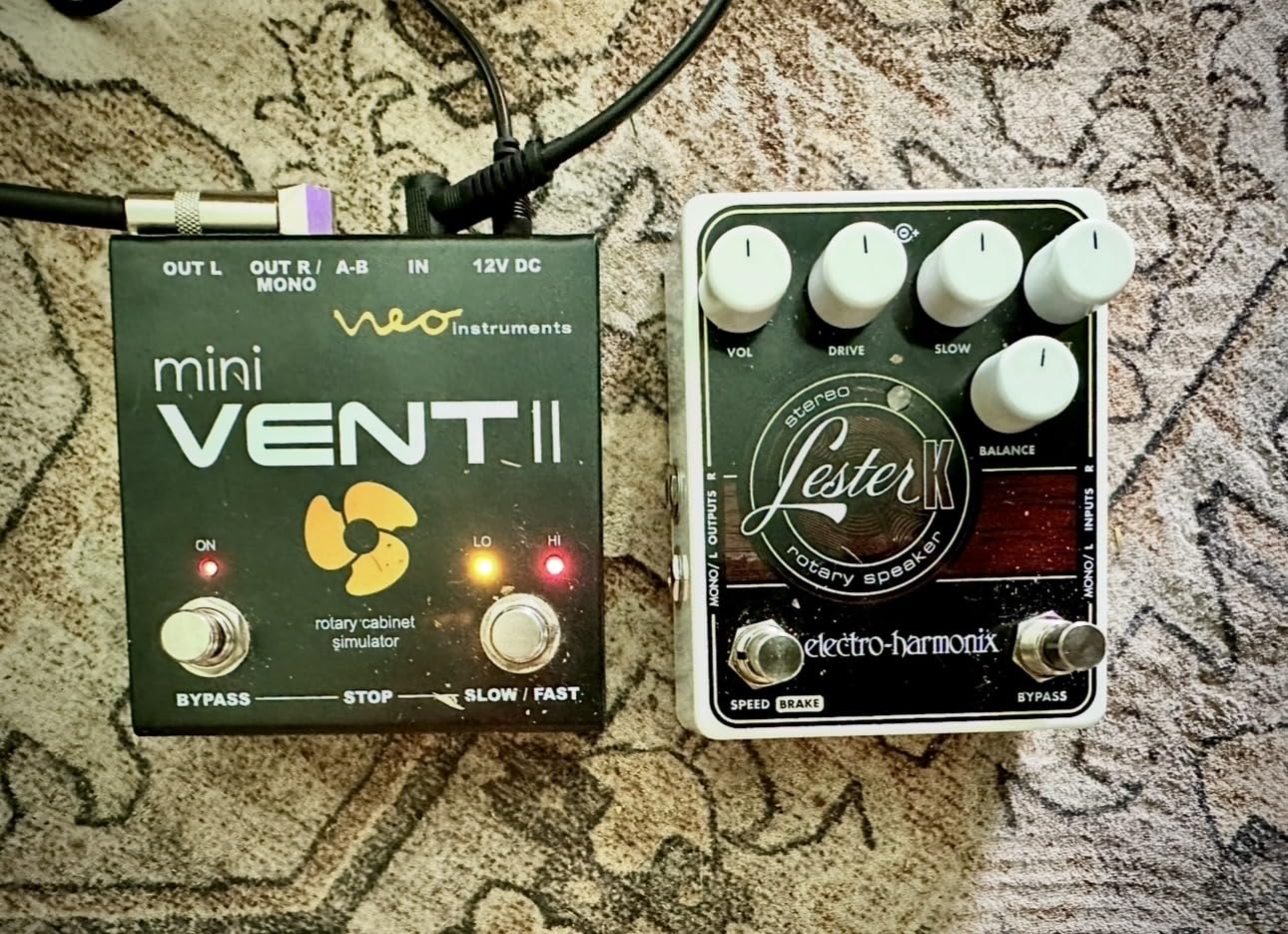
The tube-emulated overdrive adds character without overwhelming your core tone. It provides that pushed-Leslie grit that works well for rock and blues applications. The adjustable fast and slow modes let you set the specific rotor speeds for each mode independently, giving you two distinct rotary sounds accessible via footswitch.
Build quality is solid. The Lester-K feels like it can survive the rigors of gigging and regular transport. EHX included a power adapter, which is appreciated given that some competitors at higher price points omit this basic accessory.
Stereo on a Budget
Finding a true stereo rotary pedal at this price point is rare. Most budget rotary pedals are mono-only, which significantly limits the spatial effect. The Lester-K gives you the full stereo experience for less than half the price of a Strymon Lex or Neo Ventilator.
For home studio use, the stereo outputs let you record wide rotary tracks that sit beautifully in a mix without needing additional panning or spatial processing.
Trade-offs at This Price
The rotor speeds run slightly slower than a real Leslie 122, which purists may notice. The ramp-up and ramp-down behavior is more limited in customization compared to premium options. You cannot fine-tune the acceleration curve the way you can on the Strymon Lex or Neo Ventilator.
No remote footswitch is included, which means you will need to use the onboard footswitch for speed changes. For most players, this is fine, but performers who need hands-free speed control will need to purchase a compatible external switch separately.
8. Keeley Dyno My Roto Chorus, Rotary and Flanger Pedal
Keeley Dyno My Roto Chorus, Rotary and Flanger Pedal
3-in-1 effects pedal
Chorus
Rotary
Flanger
Compact format
Analog signal
Pros
- Amazing lush 80s chorus sound
- Three effects in one pedal
- Very versatile despite initial impressions
- Excellent build quality
- Great for guitar and bass
Cons
- Switch can occasionally fail
- Chorus effect is on or off with no dial back
- No stereo output
- No memory for saved presets
- Rotary effect considered underwhelming by some
The Keeley Dyno My Roto is not a dedicated rotary pedal, but it earns its place on this list by offering three modulation effects in one compact stompbox. You get chorus, rotary, and flanger modes, each with its own distinct character. For players who want rotary sounds without committing an entire pedal slot to a single-effect unit, this is an attractive option.
The chorus mode is where this pedal truly excels. It delivers that lush, dimensional 80s chorus sound that defined an era of guitar playing. Think Prince, Andy Summers, and the immersive clean tones that defined the sound of the 1980s. The rotary mode is serviceable but not as convincing as dedicated rotary pedals like the Strymon Lex or BOSS RT-2.
I found the flanger mode surprisingly musical. It produces a rich, sweeping effect that sits somewhere between a dramatic jet flanger and a subtle modulation shimmer. Combined with the chorus and rotary modes, you have a modulation toolkit that covers most bases.
Internal configuration switches unlock additional sounds beyond the three primary modes. Exploring these hidden settings reveals more tonal variety than the front panel suggests. Some users on forums have discovered settings that dramatically improve the rotary simulation.
Versatility Trade-offs
Being a multi-effect pedal means compromises in each individual mode. The rotary simulation lacks the depth and realism of dedicated units. There is no stereo output, which limits the spatial effect significantly. And the lack of preset storage means you need to manually adjust settings when switching between modes.
However, for players who use rotary effects occasionally and also want quality chorus and flanger sounds, the Dyno My Roto consolidates three pedals into one slot on your board.
Reliability Notes
Some users have reported switch failures over time. This appears to be an intermittent quality control issue rather than a universal problem. Keeley stands behind their products with good customer service, but it is worth noting if you are a heavy gigging musician.
The pedal works well with bass guitar too, which expands its utility beyond standard guitar applications.
9. Neo Instruments micro Vent 16 Rotary Speaker Simulator
Neo Instruments micro Vent 16 Rotary Speaker Simulator Pedal
Rotary speaker pedal
SHARC DSP processing
Vibratone modeling
Wet-dry mixing
Switch modes
2 speeds
Battery powered
2-year warranty
Pros
- Great rotary sounds modeled on Vibratone amp
- Premium build quality
- Wet and dry mixing control
- Compact micro format
- SHARC DSP processing for authentic sound
Cons
- Expensive relative to feature set
- Limited review data available
The Neo Instruments micro Vent 16 takes a different approach from the larger Neo pedals by modeling the Fender Vibratone guitar cabinet rather than a traditional Leslie organ speaker. This distinction matters because the Vibratone was designed specifically for guitar, and its sonic character differs from the Hammond-paired Leslie cabinets that most rotary pedals emulate.
Powered by SHARC DSP processing, the micro Vent 16 delivers a clean, accurate rotary simulation that guitarists will find immediately familiar. The Vibratone model has a slightly different swirl character than a Leslie 122, with a warmth and musicality that suits guitar frequencies naturally. Think of the rotary sounds on classic tracks by David Gilmour and Robin Trower.
The wet-dry mixing control is a standout feature. You can blend the rotary effect with your dry signal to find the perfect balance between modulation intensity and core tone clarity. This addresses one of the common complaints about rotary pedals that lack blend controls.
With only three reviews, the sample size is small, but all three reviewers gave it five stars. The limited feedback makes it harder to assess long-term reliability, though the Neo Instruments brand has a solid reputation built on the Ventilator II and Mini Vent lines.
Vibratone Versus Leslie Character
Choosing between the micro Vent 16 and other Neo pedals comes down to which rotary sound you are chasing. If you want the classic organ-through-a-Leslie sound, the Ventilator II or Mini Vent II are better choices. If you want guitar-specific rotary tones reminiscent of the Fender Vibratone, the micro Vent 16 hits that target directly.
The two-speed operation gives you standard slow and fast rotor settings with a natural-sounding ramp between them.
Value Assessment
At the same price as the larger Mini Vent II, the micro Vent 16 offers fewer features but a more focused sound. The compact format is ideal for crowded pedalboards where space is at a premium. Battery operation adds flexibility for portable setups.
This pedal is best suited for guitarists who specifically want the Vibratone sound and value compact size over feature count.
10. Whorl Rotary Pedal by Klowra
Klowra Whorl Rotary Pedal – Dynamic Rotary Speaker Simulator with Physical Modeling & Speaker Mass Simulation, Vintage Leslie Vibratone Cabinet Models, 32-bit DSP Auto-Spin Effect Shifter
32-bit floating-point DSP
Physical modeling
Speaker mass simulation
Auto-rotation
Brake effect
USB-C updates
Compact mini format
Pros
- High-precision physical modeling for authentic rotating speaker sound
- Virtual speaker mass simulation with realistic rotor inertia
- Touch-sensitive auto-rotation responds to playing dynamics
- Real-time brake footswitch for expressive performance
- Clickless soft-touch relay switching
- Selectable true or buffered bypass modes
- USB-C firmware updates
Cons
- No reviews yet as a new product
- Unknown brand with limited track record
- Untested long-term reliability
The Whorl Rotary by Klowra is one of the most technologically interesting entries in this guide. It uses 32-bit floating-point DSP with physical modeling algorithms to simulate not just the sound of a rotating speaker, but the physical behavior of speaker mass, air friction, and rotor inertia. This approach goes beyond simple modulation effects to recreate the actual physics of a spinning cabinet.
The touch-sensitive auto-rotation feature is genuinely innovative. The pedal responds to your playing dynamics, automatically adjusting the modulation speed based on how hard you play. Dig into a passage and the rotor speeds up. Lighten your touch and it slows down. This creates an organic, responsive connection between your playing and the effect that no other pedal in this guide offers.
The brake footswitch gives you real-time control over the deceleration behavior. Stomp the brake and the rotors gradually slow to a stop, just like cutting power to a real Leslie cabinet. This expressive control opens up performance possibilities that fixed-speed pedals cannot match.
The clickless soft-touch relay switching eliminates the audible pop that plagues many true bypass pedals. Selectable true or buffered bypass modes let you choose the bypass character that works best for your signal chain.
Physical Modeling Technology
Traditional rotary pedals use either analog modulation circuits or basic digital algorithms to approximate the rotary effect. The Whorl approaches the problem differently by mathematically modeling the physical properties of a rotating speaker system. The virtual speaker mass simulation accounts for the inertia of spinning components and the air resistance they encounter.
This results in acceleration and deceleration behaviors that feel physically realistic rather than digitally programmed.
Risk Assessment for a New Brand
As a new product from a relatively unknown brand, the Whorl carries inherent risk. There are no customer reviews to validate the manufacturer claims. The feature list is impressive on paper, but real-world performance remains to be verified by the broader guitar community.
The USB-C firmware update port suggests the pedal can receive improvements and bug fixes over time, which is reassuring. The 32-bit DSP platform provides significant processing headroom for future algorithm updates.
11. ALABS NOVADRIFT Multi-Modulation Guitar Pedal
ALABS NOVADRIFT Modulation Guitar Pedal | 9-in-1 Multi-Mod Effects Rotary, Chorus, Flanger, Tremolo | Built-in Expression, True Stereo, Analog Dry-Through, Tap Tempo, Selectable True Bypass/Buffer
9-in-1 modulation pedal
True stereo
Analog dry-through
Tap tempo
Infinity explore mode
Selectable bypass
Compact format
Pros
- 9 modulation effects in one compact pedal
- True stereo with analog dry-through for studio-grade sound
- Tap tempo with triplet division modes
- Infinity explore mode for 5-second expression recording
- Selectable true bypass or buffer bypass
- Great value compared to premium alternatives
Cons
- Some users report durability concerns with toggle switches
- Volume drop when effect is engaged
- Cannot save presets
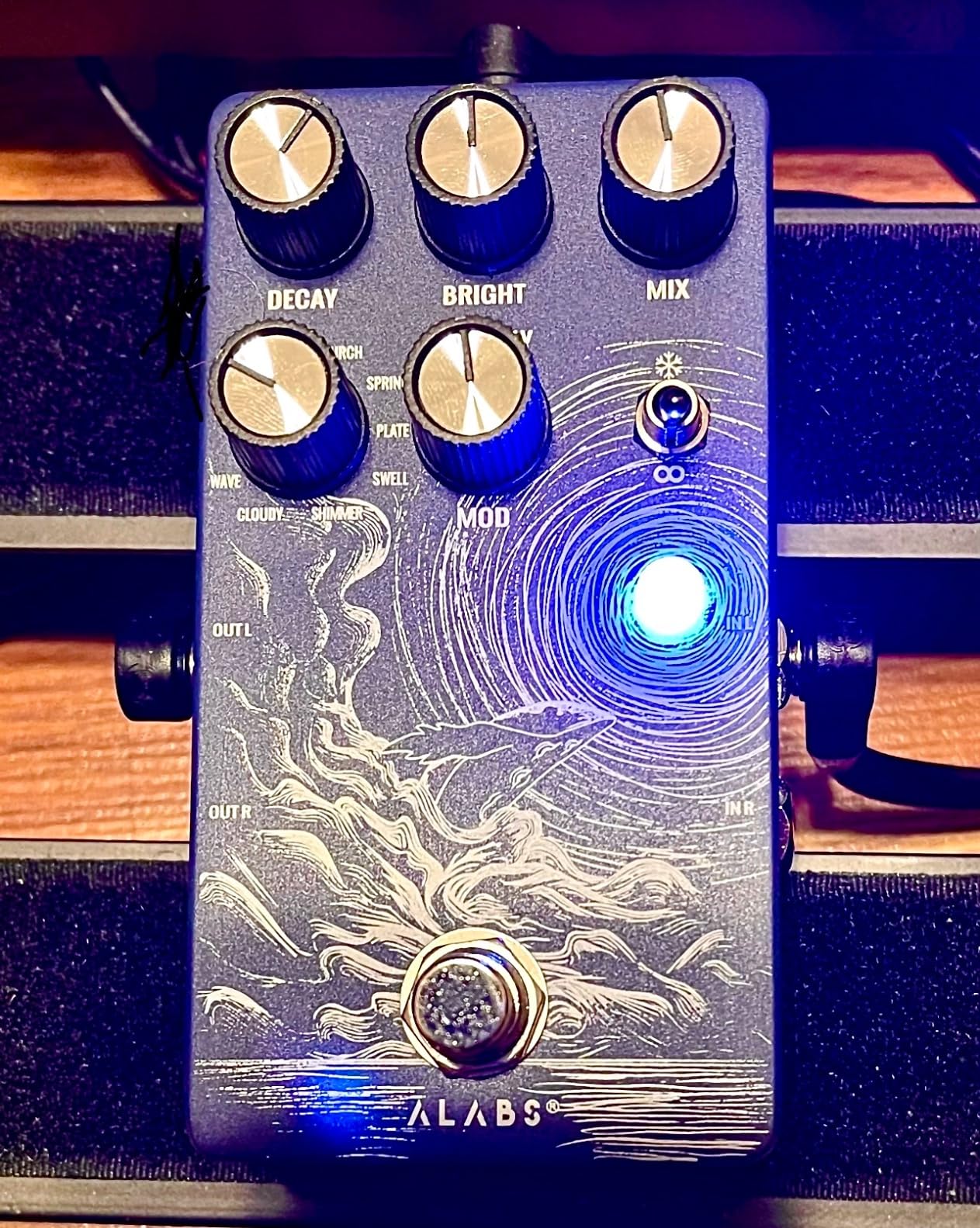
The ALABS NOVADRIFT is not a dedicated rotary pedal, but it includes a rotary mode among its nine modulation effects. For players who want rotary sounds alongside chorus, flanger, phaser, vibe, tremolo, filter, multi-chorus, and ring mod, this pedal offers incredible value at under $100. The true stereo configuration with analog dry-through ensures that your core tone remains pristine while the modulation effect processes around it.
I spent considerable time with the rotary mode specifically. While it does not match the realism of a Strymon Lex or Neo Ventilator, it produces a convincing rotary character that works well in a mix. The stereo output widens the effect significantly, and the tap tempo function lets you sync the rotor speed to your band’s tempo precisely.
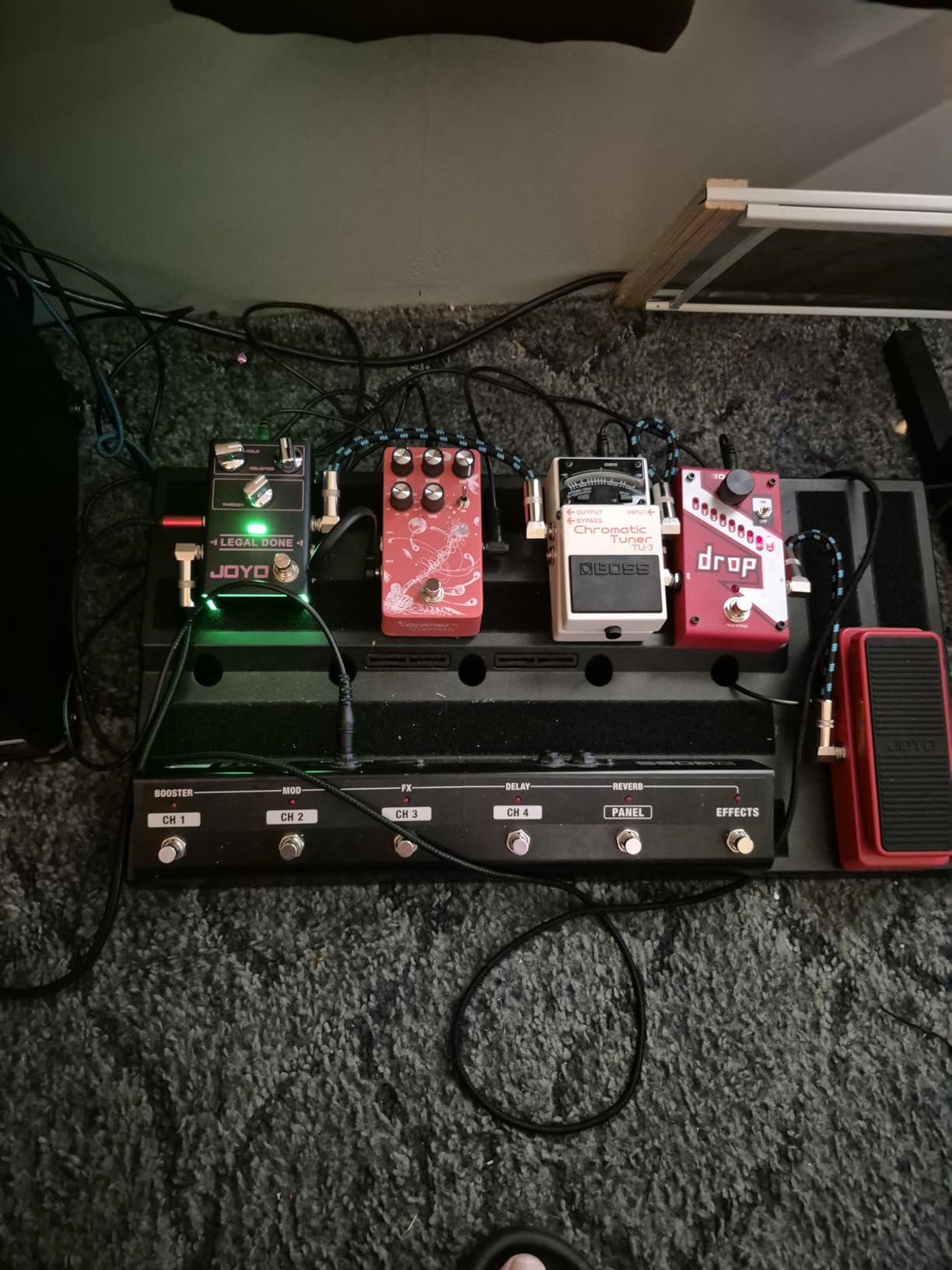
The Infinity Explore Mode is a unique feature that records five seconds of your expression pedal movements and loops them. This allows you to create dynamic modulation patterns that evolve over time, which is particularly useful for ambient and textural guitar work. Imagine a rotary effect that speeds up and slows down in a repeating pattern you designed.
The differential true stereo setup processes the left and right channels independently, creating a wider and more complex stereo image than simple stereo splitting. Combined with the analog dry-through circuit, this maintains the warmth and clarity of your original signal.
Rotary Mode in Context
The rotary mode on the NOVADRIFT sits somewhere between a dedicated rotary pedal and a generic modulation effect. It captures the essential character of the swirling Leslie sound without the detailed parameter control that rotary specialists demand. For players who use rotary as one of several modulation tones rather than their primary effect, this is more than sufficient.
The tap tempo function is particularly useful here because it lets you match the rotor speed to the tempo of the song you are playing.
Durability and Build Quality
Some users have reported concerns about the toggle switches used for mode selection. These switches feel less robust than the primary footswitch and may be vulnerable to damage during transport. The compact housing is well-suited for pedalboards but offers less physical protection than larger enclosures.
The volume drop when engaging effects is minor but noticeable. A clean boost after the NOVADRIFT in your signal chain can compensate for this.
12. JHS Pedals 3 Series Rotary Chorus Pedal
JHS Pedals 3Series Rotary Chorus Pedal
Simplified rotary chorus pedal
Intensity control
Speed control
Room switch
Compact 3 Series format
Affordable price
Pros
- Simplified faithful throwback to classic rotary units
- Intensity and speed controls for modulation
- Room switch for added versatility
- Great value at under $100
- Solid build quality
- Massive review base with 1400+ ratings
Cons
- Only 6 month warranty shorter than competitors
- Some difficulty dialing in specific sounds
The JHS 3 Series Rotary Chorus is the pedal I recommend most often when someone asks about an affordable entry point into rotary sounds. With over 1,400 reviews and an 80 percent five-star rating, this pedal has been validated by a massive user base. It brings classic rotary and chorus character to your pedalboard for under $100.
The design philosophy is intentionally simple. Rather than overwhelming you with parameters, JHS gives you three controls: intensity, speed, and a room switch. The intensity knob controls modulation depth, letting you go from subtle movement to dramatic swirling. The speed knob sets the rate of the rotary effect. The room switch adds a sense of space and ambience that enhances the rotary character.
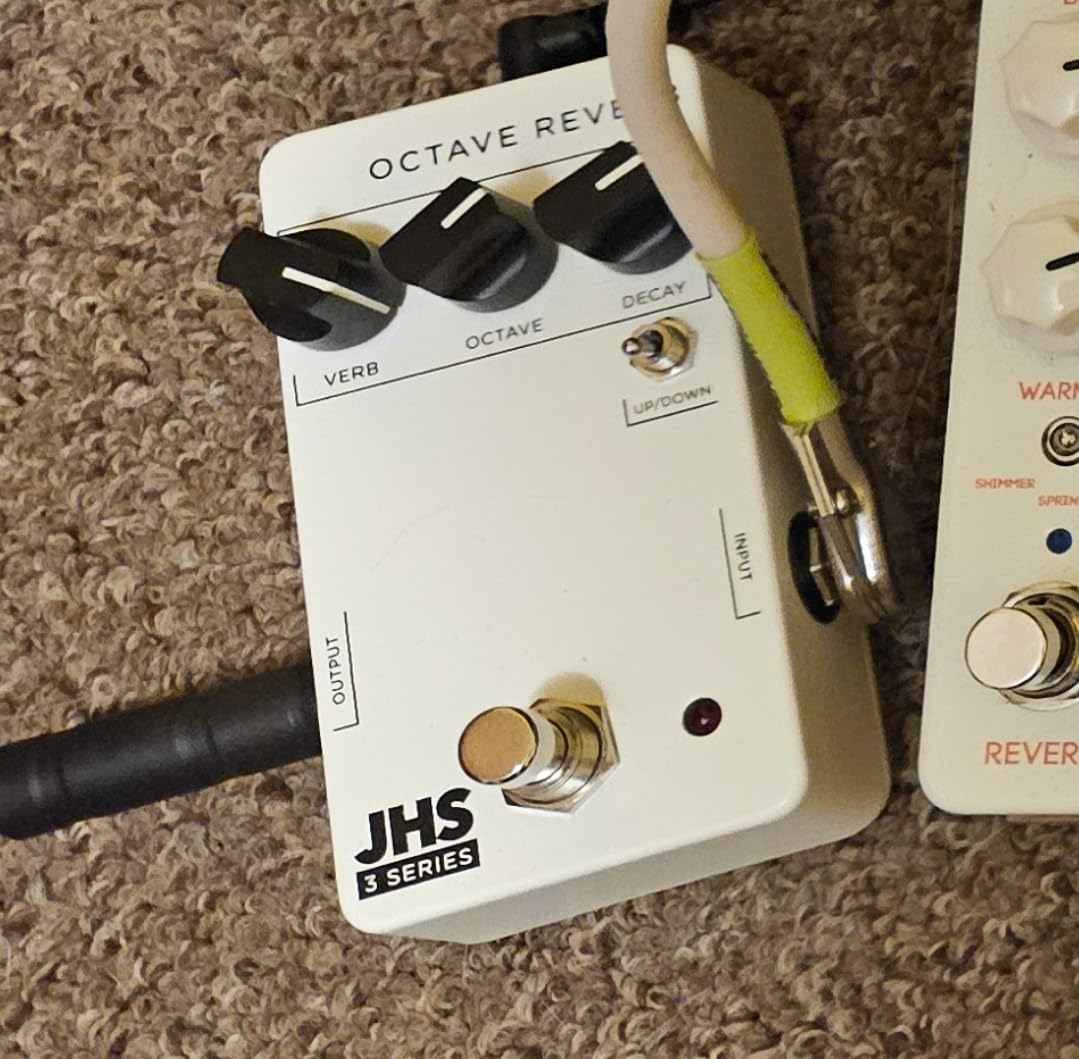
This simplicity is the pedal’s greatest strength. You can dial in a great rotary sound in seconds without consulting a manual or navigating menus. For players who want to stomp and play, the JHS 3 Series delivers immediately satisfying results. I found it particularly inspiring for clean, ambient chord work where the rotary modulation adds depth and movement.
The 3 Series format is consistent across JHS’s affordable lineup, which means this pedal matches visually and physically with other pedals in the series if you are building a JHS-themed pedalboard. The compact size takes up minimal real estate.
Organ Player Friendly
Multiple reviewers have noted that this pedal is a game changer for organ players. The rotary chorus character handles organ tones beautifully, producing that classic swirling Leslie sound at a fraction of the cost of dedicated organ rotary simulators. The low octave performance is particularly impressive for this price point.
Gospel musicians and keyboard players will find the JHS 3 Series an accessible and effective solution for Leslie simulation.
Limitations at This Price
The 6-month warranty is notably shorter than the 2-year warranties offered by Strymon, Neo Instruments, and Keeley. This reflects the budget positioning but is worth considering if you are a heavy gigging musician. The simplified control set means less fine-tuning capability compared to premium options.
Some users report difficulty dialing in specific rotary sounds because the intensity and speed controls interact in ways that take experimentation to understand. Once you find your sweet spots, though, the pedal is remarkably consistent.
How Rotary Pedals Work
Rotary pedals emulate the sound of Leslie rotating speaker cabinets, which were originally designed in the 1940s to add dimensional movement to Hammond organ sounds. A real Leslie cabinet contains two rotating speakers: a high-frequency treble horn and a low-frequency bass rotor. These spin at different speeds, creating the Doppler effect, phase cancellation, and volume modulation that produce that characteristic swirling sound.
The Doppler effect is the same phenomenon that makes a passing siren change pitch as it moves toward and away from you. In a rotary speaker, the spinning horns create continuous pitch and volume shifts that our ears perceive as a three-dimensional swirling motion. The bass rotor adds a slower, heavier modulation underneath the treble horn’s faster movement.
Rotary pedals use either analog circuitry or digital processing to recreate this behavior. Analog pedals typically use bucket-brigade delay chips to simulate the phase shifts, while digital pedals like the BOSS RT-2 and Strymon Lex V2 use sophisticated algorithms to model the physical behavior of spinning speakers. Digital pedals generally offer more accurate simulation of the acceleration and deceleration ramps that make real Leslies so musically expressive.
What to Look for in the Best Rotary Pedals
Stereo Output
Stereo output is the single most important feature for achieving an authentic rotary sound. Real Leslie cabinets produce stereo information because the rotating horns project sound in different directions as they spin. A stereo rotary pedal with two outputs recreates this spatial movement, while mono pedals can only suggest it. If your rig supports stereo, prioritize pedals with stereo outputs like the EHX Lester-K, Strymon Lex V2, or Neo Ventilator II.
Fast and Slow Speed Control
The ability to switch between slow and fast rotor speeds is essential. This is the defining characteristic of rotary speaker operation, and it is what players interact with most during performances. Look for pedals that offer dedicated footswitches for speed control, and pay attention to how the transition between speeds sounds. The acceleration ramp should feel natural and musical, not abrupt or stepped.
Drive and Overdrive
Real Leslie cabinets driven hard produce a natural compression and saturation that colors the overall sound. Many rotary pedals include a drive or overdrive control to simulate this behavior. The quality of the drive circuit varies significantly between pedals. The Neo Ventilator II and EHX Lester-G both offer convincing tube-style drive that integrates naturally with the rotary modulation.
Brake Function
The brake function simulates cutting power to a Leslie cabinet, causing the rotors to gradually slow to a stop. This creates a dramatic deceleration effect that many players use for musical transitions. Not all rotary pedals include this feature. The Whorl Rotary pedal offers a dedicated brake footswitch, and the Neo Ventilator II supports similar behavior through expression pedal control.
Pedalboard Footprint
Consider how much space you can dedicate to a rotary pedal. Compact pedals like the BOSS RT-2, JHS 3 Series, and Whorl Rotary fit in standard pedalboard layouts. Larger pedals like the Neo Ventilator II and EHX Lester-G require more real estate but often provide more controls and features. Balance your feature needs against the physical space available on your board.
Genre-Specific Rotary Pedal Recommendations
For gospel and organ tones, the Neo Instruments Mini Vent II and JHS 3 Series Rotary Chorus are top choices. Both handle the harmonic complexity of organ sounds with authentic Leslie character. The Mini Vent II offers model-specific Leslie emulation for serious organ players, while the JHS provides an affordable alternative that has been praised specifically by organ users.
For psychedelic and classic rock, the Strymon Lex V2 and BOSS RT-2 deliver the swirling, dimensional sounds that define those genres. The Lex V2 gives you the parameter depth to craft specific rotary behaviors, while the RT-2 offers three ready-to-use modes that cover vintage and modified rotary tones.
For ambient and textural work, the Keeley Rotary Simulator with its blend control and the ALABS NOVADRIFT with its Infinity Explore Mode open up creative possibilities. The ability to mix wet and dry signals lets you use rotary as a subtle texture rather than a full-on effect.
For live performance where reliability and simplicity matter, the BOSS RT-2 and JHS 3 Series are built to withstand gigging while offering straightforward operation. The BOSS compact format and legendary durability make the RT-2 particularly well-suited for the road.
Setting Up a Wet-Dry Rig with Rotary Pedals
A wet-dry rig splits your guitar signal into two paths: one clean and dry, the other processed through your effects. For rotary pedals, this setup is especially effective because it allows you to maintain the clarity and punch of your dry tone while adding the dimensional swirl of the rotary effect through a separate amplifier.
To set up a wet-dry rig, you will need a signal splitter, your rotary pedal, and two amplifiers. Send your dry signal directly to one amp. Send the other split through your rotary pedal and into the second amp. Position the amps apart from each other on stage or in your room to maximize the stereo effect. This creates a huge, immersive sound that single-amp setups cannot match.
If your rotary pedal has stereo outputs like the EHX Lester-K or Strymon Lex V2, you can create a wet-dry-wet rig with three amplifiers. The dry signal goes to a center amp while the stereo rotary outputs feed left and right amps. This is the ultimate rotary experience and is how professional touring guitarists achieve that massive, swirling wall of sound.
Frequently Asked Questions About Rotary Pedals
What are the best rotary pedals for guitar?
The best rotary pedals for guitar in 2026 include the BOSS RT-2 for its compact format and three versatile modes, the Strymon Lex V2 for premium sound quality and detailed parameter control, and the JHS 3 Series Rotary Chorus for budget-friendly classic rotary tones. For professional-grade Leslie simulation, the Neo Instruments Ventilator II remains the gold standard.
How does a rotary pedal work?
A rotary pedal uses digital or analog processing to simulate two rotating speakers found in a Leslie cabinet: a treble horn and a bass drum. These virtual speakers spin at different speeds, creating Doppler pitch shifts, phase cancellation, and volume modulation that produce the characteristic swirling, three-dimensional sound associated with rotary speaker effects.
What is the difference between a rotary pedal and a Leslie speaker?
A Leslie speaker is a physical cabinet with actual rotating horns and rotors that move air to create the rotary effect. A rotary pedal is a stompbox that digitally or analog-processes your signal to emulate that spinning speaker sound. While pedals cannot perfectly replicate the acoustic complexity of a real Leslie, modern digital pedals like the Strymon Lex V2 and Neo Ventilator II come remarkably close.
What should I look for when buying a rotary pedal?
When buying a rotary pedal, prioritize stereo output for authentic spatial movement, dedicated fast and slow speed controls with natural acceleration ramps, a drive or overdrive section for tube-style saturation, and a brake function for dramatic deceleration effects. Also consider pedalboard footprint, warranty coverage, and whether you need expression pedal input for real-time speed control.
Are expensive rotary pedals worth the money?
Expensive rotary pedals like the Strymon Lex V2 at $349 and Neo Ventilator II at $549 are worth the investment for players who use rotary effects extensively in their playing. These pedals offer superior sound quality, detailed parameter control, and more authentic Leslie simulation. For occasional use, budget options like the JHS 3 Series under $100 or EHX Lester-K under $120 provide excellent value.
Final Thoughts on the Best Rotary Pedals
Finding the best rotary pedals for your rig comes down to understanding what you need from the effect. If you want the most authentic Leslie simulation money can buy, the Neo Instruments Ventilator II and Strymon Lex V2 are the pedals to beat. Both deliver professional-grade rotary sounds with the parameter depth and sound quality that serious players demand.
For players working with tighter budgets, the BOSS RT-2 offers incredible value with its compact format and three versatile modes. The JHS 3 Series Rotary Chorus remains the most accessible entry point with over 1,400 positive reviews backing its reputation. And the EHX Lester-K delivers true stereo rotary simulation for under $120, which is remarkable value.
Whatever your budget or playing style, there is a rotary pedal on this list that will bring that swirling, dimensional Leslie magic to your pedalboard. The best rotary pedals transform ordinary guitar lines into immersive, moving soundscapes that captivate listeners and inspire new musical ideas.